












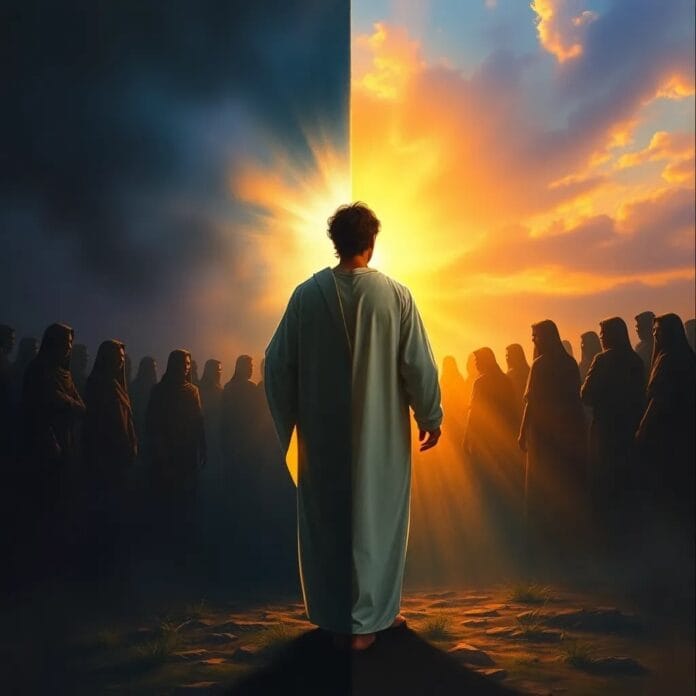
Reading from the letter of Saint Paul the Apostle to the Romans
Brothers,
You know this: the time has come, the hour has already arrived for you to wake up from your sleep. For salvation is nearer to us now than when we first embraced faith.
The night is over, the day is at hand. Let us cast off the works of darkness and put on the armor of light. Let us behave honorably, as in the daytime, not in revelry and drunkenness, not in debauchery and licentiousness, not in quarreling and envy, but put on the Lord Jesus Christ.
Waking up to live: the luminous urgency of the Gospel according to Saint Paul
The call that resonates through the centuries.
There are biblical texts that caress us gently, like a light breeze on a summer evening. And then there are those that shake us, that wrench us from our torpor with an almost disturbing urgency. The passage of the letter to the Romans The passage we are about to explore together definitely belongs to this second category. Paul writes to his brothers and sisters in Rome with the intensity of a man who has seen something extraordinary and can no longer remain silent. «You know this,» he tells them, as if to jolt them awake. And what he announces to them is that salvation is not a distant, abstract reality, reserved for an uncertain future. No, salvation is «closer to us now.» This statement changes everything. It transforms our way of seeing time, ethics, and daily life. It invites us to a radical conversion, not tomorrow, but today, right now, at this very moment as you read these lines.
In the following paragraphs, we will first delve into the historical and literary context of this fascinating text, to understand to whom Paul was addressing himself and why his words carried such weight. We will then analyze the heart of his message, this striking dialectic between night and day, between sleep and waking. Next, we will explore three main areas of reflection: the temporal dimension of Christian hope, the ethical imperative that stems from it, and the mystery of Christ's "clothing." We will draw upon the voices of tradition to enrich our reading, before offering concrete suggestions for meditation and application. For a biblical text that does not transform our lives has not yet revealed its full treasure.
When Paul wrote to the Christians in Rome: a letter of his time
A community at the crossroads of history
To grasp the significance of Paul's message, we must first transport ourselves to Rome in the years 55-57 AD. Imagine this bustling metropolis, the beating heart of the Empire, where merchants from the East, soldiers on leave, Greek philosophers, freed slaves, and jaded patricians mingle. It is in this cosmopolitan melting pot that a small community of believers in Jesus Christ attempts to live out their nascent faith.
Unlike so many other churches, the Christian community of Rome was not founded by Paul himself. It formed gradually, probably from Jewish converts who had returned from Jerusalem after Pentecost, and was later enriched by Gentiles drawn to this message of hope. This dual Jewish and Gentile origin created tensions that Paul was well aware of and that he sought to alleviate throughout his letter.
When the apostle wrote his Epistle to the Romans, he was probably in Corinth, about to embark on his journey to Jerusalem to deliver the collection for the poor Christians of the holy city. He had not yet seen Rome with his own eyes, but he carried it in his heart. He dreamed of going there, of... strengthen faith believers, before pushing further towards Spain, to the edge of the known world.
The literary context: a theological symphony
There letter to the Romans This is undoubtedly Paul's most systematic work. Where other epistles address specific problems, this one develops a true theology of justification by faith, of grace, and of the relationship between the Law and the Gospel. The first eleven chapters constitute a profound meditation on God's plan of salvation for all humanity, Jews and Gentiles united in the same mercy.
Our passage is located in chapter thirteen, in the parenetic section of the letter, that is, the part devoted to moral and practical exhortations. Having established the theological foundations of the Christian life, Paul now draws out their concrete consequences. Chapter twelve spoke to us about spiritual worship and community life. The beginning of chapter thirteen dealt with relations with civil authorities. And here Paul concludes this section with a vibrant call to spiritual awakening.
A text that transcends time
This passage has enjoyed considerable renown in the history of the Church. It is read every year on the first Sunday of Advent in the Catholic liturgy, which gives it a privileged place in Christian spirituality. This is no coincidence: Advent is precisely this time of vigilant waiting, this period when the Church prepares to celebrate the coming of the Lord, both in the mystery of Christmas and in the horizon of his glorious return.
But beyond its liturgical use, this text has decisively marked individual lives. The most famous case is that of Augustine of Hippo, whom we will discuss later. In the midst of a spiritual crisis, the young African rhetorician heard a child's voice tell him, "Take and read!" He opened the Book of Scripture and came upon this precise passage. It was the moment of his conversion. Thus, these few verses changed the course of Western thought.
The text in its nakedness
Let's reread these words together, slowly, letting them resonate:
«Brothers and sisters, you know that the time has come, the hour has already come, to wake up from your sleep. For our salvation is nearer now than when we first believed. The night is almost over; the day is at hand. Let us put aside the works of darkness and put on the armor of light. Let us walk properly, as in the daytime, not in reveling and drunkenness, not in sexual immorality and debauchery, not in selfish ambition and jealousy, but put on the Lord Jesus Christ.»
Every word counts. Every image carries considerable theological weight. We are invited on a journey to the heart of this dense and luminous text.
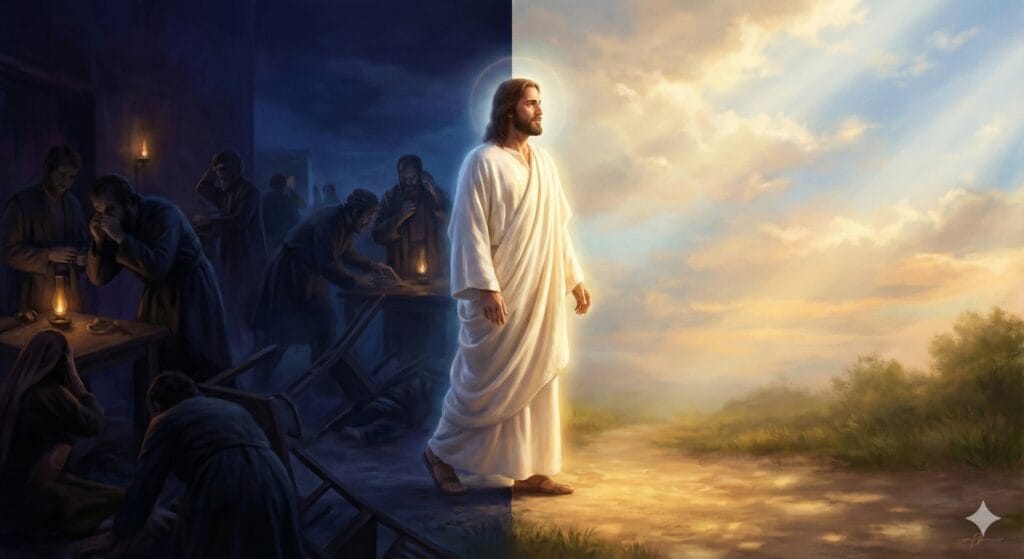
The beating heart of the message: between night and day, between sleep and wakefulness
A direct and fraternal appeal
Paul doesn't mince words. His first word, "Brothers," immediately sets the tone: that of brotherhood, of closeness, of equality before God. The apostle does not speak from on high, from an inaccessible pulpit. He places himself on the same level as his audience, sharing with them the same condition as believers on their journey.
But this fraternity does not preclude demanding standards. On the contrary, it is precisely because Paul loves these Christians in Rome that he speaks to them with such frankness. «You know this,» he tells them, as if to remind them of a truth they already carry within them but may have forgotten under the weight of daily routines. This knowledge is not abstract intellectual understanding; it is an existential awareness, a lucidity about the present time and its implications.
The temporal paradox of hope
Here is the central statement, the one that gives its title to our reflection: "Salvation is closer to us now than at the time when we became believers." This sentence deserves to be considered at length, because it contains a profoundly original vision of time.
In Pauline thought, time is not simply a succession of equivalent moments. It is oriented, directed toward fulfillment. Christ has already come, the victory over sin and death has already been won, but this victory is not yet fully manifested. We live in this strange and fertile "in-between" that theologians call the "already-there" and the "not-yet.".
But Paul affirms that this "in-between" is narrowing. Each passing day brings us closer to the full manifestation of salvation. Time is not static; it moves toward its goal. And this progress has concrete consequences for how we live today.
The luminous symbolism
Paul then deploys striking imagery: night and day, darkness and light. These symbols are deeply rooted in biblical tradition. From the very first chapter of Genesis, God separates the light from the darkness. The prophets foretell a "day of the Lord" when all will be revealed. The prologue to the Gospel of John proclaims that the light shines in the darkness and that the darkness has not overcome it.
For Paul, night represents the old world, the world of sin, ignorance, and separation from God. Day represents the new world inaugurated by the resurrection of Christ, a world of clarity, truth, and communion with God. And we are, he says, at dawn. The night has not yet completely dissipated, but day is already breaking on the horizon. The first glimmers of light color the sky.
This dawning situation is decisive. It calls for a decision, a choice. Will we cling to the works of the night, or will we resolutely turn towards the nascent light?
The weapons of light
The expression is remarkable: «Let us put on the armor of light.» Paul uses military vocabulary, that of a soldier’s equipment. This is no coincidence. The Christian life is not a leisurely stroll; it is a battle. But be warned: the weapons he is referring to are not those of human violence. They are paradoxical weapons, weapons of light.
In his Letter to the Ephesians, Paul will develop this image of spiritual armor: the belt of truth, the breastplate of righteousness, the shield of faith, the helmet of salvation, the sword of the Spirit. Here, in the Epistle to the Romans, he simply mentions these weapons without detailing them, but the idea is the same: the Christian must equip himself to face opposing forces, not with the means of this world, but with the resources that God gives him.
An ethics of light
After the imagery comes the concrete list. Paul enumerates what he calls the "works of darkness": orgies, drunkenness, lust, debauchery, rivalry, jealousy. This catalog is not exhaustive; it is representative of a certain type of behavior that characterizes the old world.
One might be tempted to reduce this list to a simple moral lesson of temperance. That would be to miss the point. What Paul is addressing is not primarily this or that particular behavior, but a fundamental disposition: that of living according to the flesh rather than according to the Spirit, of allowing oneself to be governed by one's impulses rather than by the grace of God.
The first three terms (orgies, drunken revelry, lust) concern excesses related to the body and pleasure. The last three (debauchery, rivalry, jealousy) relate to relationships with others. Paul thus suggests that sin disfigures both our relationship with ourselves and our relationship with others.
Time is running out: living in the urgency of hope
The Pauline «kairos»
When Paul writes "the time is now," he uses the Greek term "kairos," distinct from "chronos." This distinction is crucial. "Chronos" refers to quantitative, measurable time, the time of clocks and calendars. "Kairos," on the other hand, refers to qualitative time, the opportune moment, the decisive instant when something can happen.
The Greeks were well acquainted with this distinction. They depicted Kairos as a winged youth who must be seized in passing, for once he has passed, he cannot be caught. For Paul, the present moment is a "kairos," a moment of grace and decisiveness. It is not just any moment; it is THE moment, the moment when eternity bursts into our temporality.
This awareness of "kairos" should transform our relationship with time. We are not simply passively waiting for a future event. We are actively engaged in a transformative process that demands our participation. Every moment is an opportunity to say yes to grace, to choose light over darkness.
Pauline eschatology: already and not yet
To understand Paul's urgency, one must grasp his vision of salvation history. The apostle lived in the conviction that the resurrection Christ ushered in the end times. The old world is already condemned; the new world is already coming into being. But this coming into being is not yet complete. We live in a period of transition, an overlap between two ages.
This tension between "already" and "not yet" is characteristic of Pauline thought. On the one hand, we are already saved: "It is by grace you have been saved, through faith," he writes to the Ephesians. On the other hand, our salvation still awaits its full manifestation: "We were saved in hope," he tells the Romans a little earlier in the same letter.
This tension is not a contradiction; it is a dynamic. It keeps us in a state of vigilance and active hope. We cannot settle comfortably into the present as if everything were already accomplished. Nor can we despair as if nothing had yet begun. We are called to live in this fruitful in-between, sustained by the certainty of what is already given and reaching toward the fullness of what is to come.
Spiritual sleep: a universal diagnosis
The image of sleep that Paul uses is not insignificant. It suggests a state of unconsciousness, numbness, and detachment from reality. The one who sleeps does not see what is happening around him; he is locked in his own dreams, cut off from the outside world.
This metaphor has a long history in spiritual tradition. Greek philosophers already spoke of the sleep of the soul, of this torpor that prevents human beings from accessing truth. Book of Proverbs He warns against laziness, which leads to ruin. And Jesus himself, in the Garden of Gethsemane, rebukes his disciples for sleeping when he had asked them to stay awake.
Spiritual sleep can take many forms. Sometimes it is religious indifference, this absence of questioning about the meaning of existence. Sometimes it is habit, this routine that leads us to perform meaningless actions. Sometimes it is distraction, in the Pascalian sense of the term, this headlong flight that prevents us from facing our condition. Sometimes it is also comfort, this settling into a well-ordered life where God no longer truly has a place.
Paul invites us to awaken from this slumber, to open our eyes to the spiritual reality of our existence. And this awakening from slumber is not a one-time event; it is a continuous process, a constant vigilance.
Hope as the driving force of ethics
What is remarkable about this text is that the moral exhortation flows directly from the eschatological affirmation. Paul does not say, «Behave well because it is the law.» He says, «Behave well because the day is approaching.» Christian ethics are not founded on an abstract duty; they are founded on a living hope.
This logic changes everything. If we strive to live in the light, it is not to earn our salvation—that is a free gift from God. It is because we already belong to the world of light, because our true identity is that of children of the day, and our behavior must reflect this identity.
It's a bit like someone who, knowing they're going to receive a fabulous inheritance, already begins to live according to the values that inheritance represents. Or like a fiancé who, while awaiting their wedding, already lives according to the logic of marital love. Hope isn't simply a projection into the future; it transforms the present.
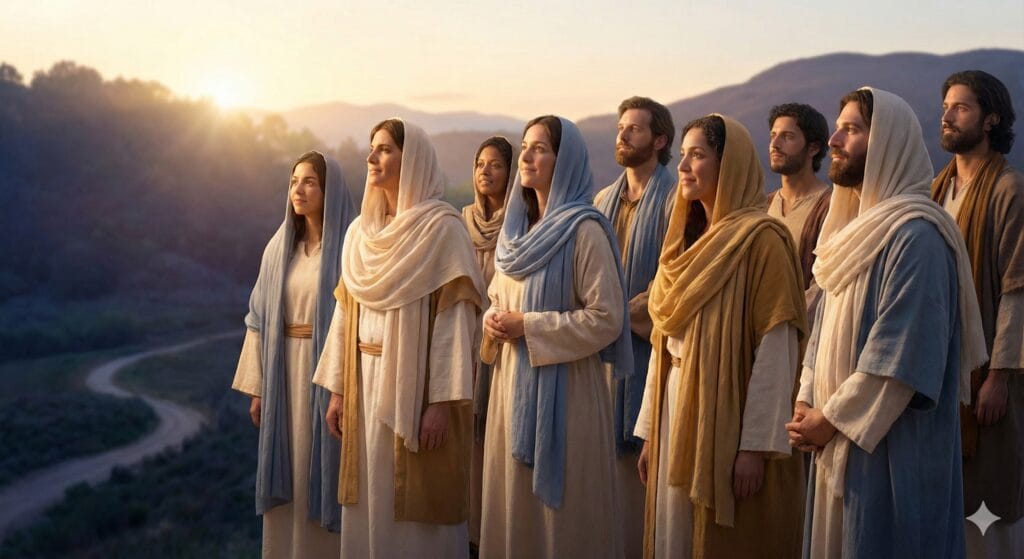
Rejecting the darkness: the courage of lucidity
A list that causes offense
Let's return to the list of behaviors that Paul asks us to reject: "orgies and drunken revelry, lust and debauchery, rivalry and jealousy." These terms may seem to belong to another era. Who among us participates in orgies? Paul's vocabulary seems to target the excesses of Greco-Roman culture, those banquets that sometimes degenerated into licentious scenes.
But let's not be too quick to believe ourselves innocent. While the forms have changed, the realities they represent remain. Intoxication hasn't disappeared; it has simply taken on new forms. Alcohol addiction affects millions of people, but there is also the intoxication of power, the intoxication of consumption, the intoxication of constant entertainment. Our society produces its own forms of numbness.
Similarly, lust and debauchery have not disappeared. Pornography has become a global industry. Sexuality, instead of being a place of communion and giving, often becomes a field of consumption and exploitation. Bodies are commodified, relationships instrumentalized.
As for rivalry and jealousy, they are perhaps more prevalent than ever in a society of widespread competition. Social media exacerbates the constant comparison with others. The race for success, recognition, and visibility breeds competitive behaviors that poison human relationships.
The inner darkness
But Paul isn't just referring to outward behavior. He's referring to a disposition of the heart. The "works of darkness" arise from an inner darkness, a lack of light in our innermost being. That's why conversion can't be limited to a change of behavior; it must reach the depths of our being.
THE Desert Fathers, Those early monks who withdrew to the solitudes of Egypt were well aware of this reality. They developed a subtle psychology of the "passions," those inner impulses which, when uncontrolled, lead to sin. Gluttony, lust, avarice, anger, sadness, sloth, vainglory, pride: these eight fundamental passions are the roots of the behaviors that Paul condemns.
Rejecting the works of darkness, therefore, means undertaking a work of self-knowledge, of discerning the movements of one's own heart. It means learning to recognize the thoughts that pull us down, the emotions that imprison us, the reflexes that distance us from God and from others.
The courage of truth
This work requires courage. It's more comfortable to remain in illusion, to avoid confronting our dark sides. The light, at first glance, can be painful. It reveals what we would prefer to hide, even from ourselves.
But this is precisely where liberation takes place. «The truth will set you free,» says Jesus in the Gospel of John. This freedom comes through an honest confrontation with who we truly are. Not to wallow in guilt, but to open ourselves to God’s transforming grace.
All great spiritual figures have experienced this. Augustine, in his Confessions, does not hesitate to expose his past weaknesses. Teresa of Avila speaks of the necessity of self-knowledge as the foundation of spiritual life. Ignatius of Loyola He begins his Spiritual Exercises with a thorough examination of conscience. This self-awareness is not an end in itself; it is the necessary prerequisite for transformation.
From shame to grace
There is, however, a danger in this introspection: that of sinking into paralyzing shame, into a feeling of unworthiness that closes us off to God's love. Paul certainly does not want to lead us there. If he invites us to recognize the works of darkness, it is so that we may reject them, that is, so that we may place them in the hands of God, who alone can free us from them.
Divine grace is not reserved for the perfect. It is offered precisely to those who recognize their need to be saved. «It is not the healthy who need the doctor, but the sick »" said Jesus. Christ did not come to call the righteous, but the fishermen.
This movement from shame to grace is at the heart of the Christian experience. It is not about denying the evil we have done or the darkness within us. It is about acknowledging them in order to entrust them to the One who can transform them. Confession is not an exercise in self-flagellation; it is an act of trust in mercy of God.
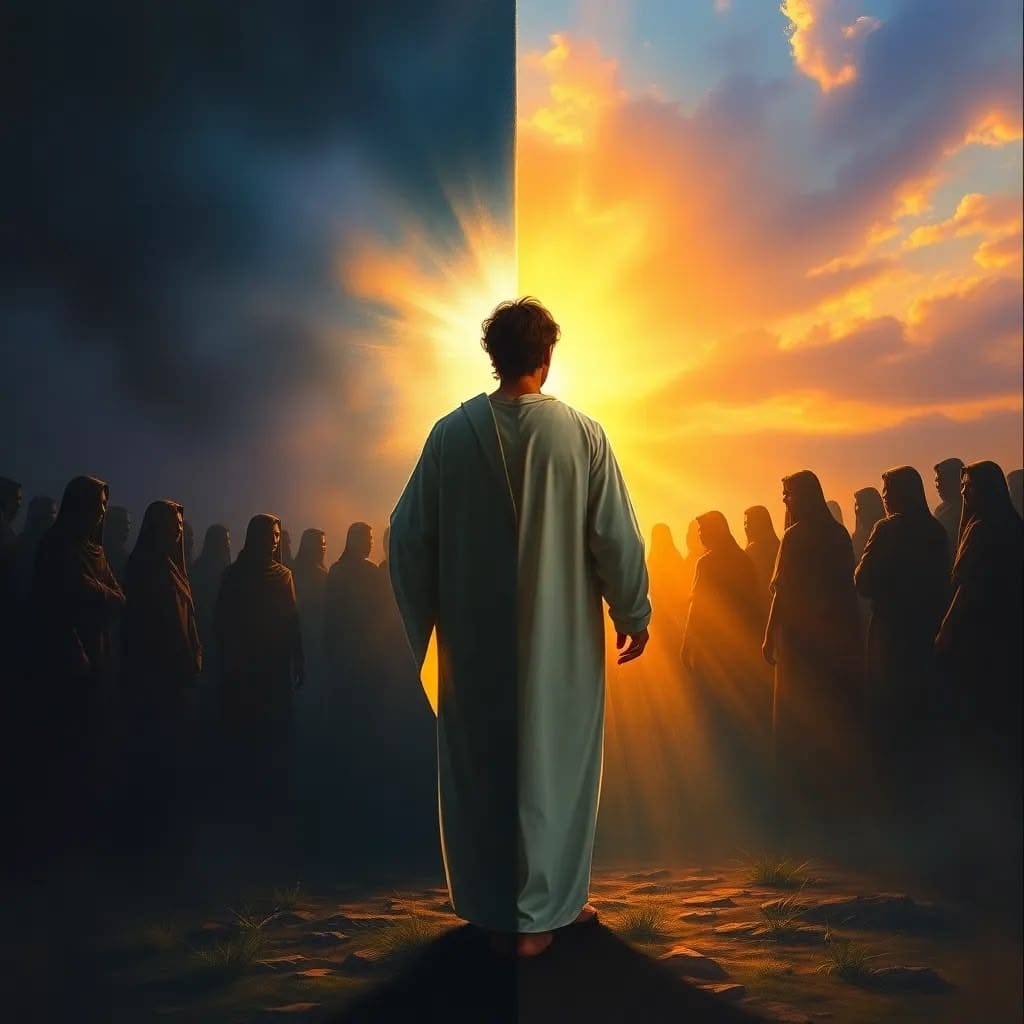
Putting on Christ: the mystery of identification
A clothing metaphor
Paul's final exhortation is perhaps the most surprising and profound: "Clothe yourselves with the Lord Jesus Christ." This clothing metaphor is frequent in Paul's writings. It appears notably in the letter to the Galatians: "For all of you who were baptized into Christ have clothed yourselves with Christ." It also structures the passage of the Letter to the Colossians on Christian virtues: «Clothe yourselves with compassion, kindness, and compassion.’humility, "...of gentleness, of patience..."»
What does it mean to "put on Christ"? The image of clothing suggests several things. First, clothing is what covers us, what hides our nakedness. To put on Christ is, in a way, to be covered by him, protected by him. Our weaknesses and sins are hidden under the mantle of his righteousness.
Furthermore, clothing is what defines us in the eyes of others. In ancient times, clothing indicated social status, function, and affiliation. To put on Christ is to display our Christian identity; it is to present ourselves to the world as disciples of the Lord.
Ultimately, clothing is what transforms us. Anyone who has worn a uniform knows that clothing alters our posture, our behavior, our very being. To put on Christ is to allow ourselves to be transformed by him, to adopt his way of being, to make his attitudes and values our own.
Baptism as clothing
In the early Church, this metaphor had a very concrete resonance. During baptism, catechumens stripped off their clothes, descended naked into the baptismal water, and emerged to put on a white robe. This rite symbolized the shedding of the old self and the birth of the new self in Christ.
This baptismal symbolism is still present in the current liturgy. The white garment of baptism, the white robe of first communion, the alb of priests and altar servers: all these liturgical vestments remind us that we have put on Christ, that we participate in his life, that we are called to holiness.
But baptism is not a magical act that instantly transforms us into saints. It is the beginning of a process, the inauguration of a path. This is why Paul can exhort already baptized Christians to "put on Christ" as if they had not yet done so. Baptism gives us a new identity, but this identity needs to be developed, made real, and embodied day after day.
The Imitation of Christ
To put on Christ is also to imitate him. It is to conform our lives to his, to adopt his choices, to share his priorities. The imitation of Christ is a major theme of Christian spirituality, magnificently developed in the famous work attributed to Thomas à Kempis.
But be warned: this is not a superficial, outward imitation that merely mechanically reproduces the actions of Jesus. It is an inner imitation, a communion of heart and mind with the Lord. What must dwell within us is the love that animated Jesus, his concern for the lowly and the excluded, his trust in his Father, his openness to the divine will.
The saints are those who took this identification with Christ the furthest. Francis of Assisi, who received the stigmata, bore the marks of the Passion in his flesh. Thérèse of Lisieux spoke of her "little way" as a path to living the love of Jesus every day. Charles de Foucauld wanted to imitate the hidden life of Jesus in Nazareth. Each in their own way, they "put on Christ.".
A profound transformation
Putting on Christ is not limited to a change in outward behavior. It is a profound transformation of our being. Paul elsewhere uses the term "new creation": "Therefore, if anyone is in Christ, the new creation has come: The old has gone, the new is here!"«
This transformation touches every dimension of our existence: our intellect, which learns to think according to the Gospel; our will, which gradually conforms to God's will; our emotions, which are ordered according to charity ; our very body, which becomes a temple of the Holy Spirit.
It is a lifelong process. Eastern theologians speak of "theosis" or "divinization": the human being is called to participate in divine life, to become by grace what God is by nature. This breathtaking prospect gives our existence extraordinary dignity and purpose.
The Inner Christ
One final aspect of this Pauline mysticism deserves to be emphasized. To put on Christ is not merely to imitate him outwardly; it is to let him live within us. Paul writes to the Galatians: «It is no longer I who live, but Christ who lives in me.» This astonishing statement reveals the intimacy of the relationship that unites the Christian with his Lord.
Christ is not merely a model to follow; he is a living presence who dwells in the heart of the believer. Through the Holy Spirit, he abides in us and we in him. This divine indwelling is the foundation of the Christian spiritual life. To pray is to enter into contact with this inner Christ. To act according to the Gospel is to allow Christ to act through us.
This perspective radically changes our understanding of moral effort. It is not about improving ourselves through our own strength, but about allowing ourselves to be transformed by grace. It is not about conquering holiness, but about receiving it as a gift. The work spirituality consists of removing the obstacles that prevent Christ from shining within us, clearing the ground so that his light can shine.
The voices of tradition: echoes through the centuries
Augustin: the decisive moment
We have already mentioned the decisive role of this passage in Augustine's conversion. But let us return to it in more detail, for this episode illuminates the transformative power of the Word of God.
We are in Milan, in the year 386. Augustine is a young, brilliant but tormented professor of rhetoric. He has explored Manichaean philosophy, then skepticism, before gravitating towards Neoplatonism. Above all, he is a prisoner of his passions, unable to break free from his relationship with a concubine with whom he has had a son.
That August day, he sat in his garden, gripped by a violent inner turmoil. He wept, begging God to give him the strength to change his life. Then he heard a child's voice from a neighboring house, repeating: "Tolle, lege! Tolle, lege!" – "Take and read! Take and read!"«
Augustine interprets this voice as a divine sign. He takes the book of Paul's epistles that is beside him, opens it at random, and comes across our passage: "No orgies or drunkenness, no lust or debauchery, no rivalry or jealousy, but put on the Lord Jesus Christ."«
He didn't need to read any more. A light of certainty flooded his heart. All his doubts vanished. He now knew what he had to do. A few months later, he would receive baptism from Ambrose, the Bishop of Milan.
This story, recounted in the Confessions, has exerted an immense influence on Western spirituality. It shows how a biblical text, read at the right time, can become a living word, capable of transforming a life.
The Greek Fathers: Divinization
The Fathers of the Eastern Church developed a theology of divinization that sheds light on the mystery of Christ's "clothing." For Irenaeus of Lyons, Athanasius of Alexandria, Gregory of Nyssa, and many others, the purpose of the Incarnation is precisely to allow human beings to participate in divine life.
«God became man so that man might become God,» summarizes a famous phrase attributed to Athanasius. This bold statement obviously does not mean that we become God by nature. It means that, by the grace of Christ, we are admitted to share in the communion of life of the divine Persons.
This perspective gives new depth to Paul's exhortation. To put on Christ is to participate in his divine life. It is to be drawn into the mystery of the Trinity. It is to begin here below the glorious existence that will be ours in eternity.
The liturgical tradition
The passage of Romans 13 found its natural place in the liturgy of Advent. Every year, on the first Sunday of this preparatory time for Christmas, the Church makes this call for vigilance and conversion heard.
This choice is not arbitrary. Advent This is a time of waiting, a time when the Church prepares to celebrate the coming of the Lord. This coming is threefold: a historical coming in the Incarnation, a spiritual coming in the hearts of believers, and a glorious coming at the end of time. Paul's text invites us to live this threefold waiting with an attitude of active vigilance.
The Byzantine liturgy, for its part, uses this passage within the context of Lent, a time of conversion and preparation for Easter. The emphasis is then placed on rejecting the works of darkness and putting on the new self.
Medieval mystics
Medieval mystics meditated on this text from the perspective of union with God. Meister Eckhart, the 14th-century Rhenish Dominican, developed a spirituality of detachment that echoes Paul's concept of "self-emptying." For him, putting on Christ meant stripping oneself of everything that is not God, creating a void within so that God could be born in the soul.
John of the Cross, In the 16th century, he spoke of the "dark night" that the soul must pass through to reach divine union. This night is not unrelated to the night Paul speaks of. It is the necessary passage toward the light, the moment of purification that precedes illumination.
Teresa of Avila, Her contemporary and spiritual friend, Evangelius, describes in "The Mansions" the soul's journey to the center of the inner castle where God resides. This journey involves a progressive transformation, a shift from outward behaviors to inner transformation, culminating in the transformative union where the soul and God become one.
Paths of prayer: embodying the word in everyday life
First step: welcoming the emergency
The first step is to let the urgency of Paul's message resonate within us. "Now is the time," "the hour has come," "the day is near": these expressions are not mere rhetorical formulas. They express a spiritual reality.
Take time, in the silence of your prayer, to ask yourself this question: what is the urgency of my spiritual life? What can no longer wait? What conversions have I been putting off for too long? Let the Word of God call to you, perhaps shake you up, and rouse you from your torpor.
This awareness of the urgency is not meant to frighten us, but to energize us. It reminds us that our lives have meaning, that our choices have consequences, and that each day is an opportunity to grow in love.
Second step: identifying the darkness
The second step is a work of truth about oneself. What are the "works of darkness" in my life? Not necessarily the spectacularly bad behaviors that Paul lists, but the small compromises, the habits that distance me from God, the attitudes that hurt my relationships with others.
This work of discernment can take the form of a regular examination of conscience. Not a guilt-inducing exercise, but a prayerful review of our days in the light of the Gospel. What good have I done today? Where have I lacked love? What thoughts have dragged me down? What temptations have I found difficult to resist?
This self-awareness is the prerequisite for all spiritual growth. It opens us to grace by making us aware of our need for salvation.
Third step: turn towards the light
The third step is the actual movement of conversion. It is not enough to simply acknowledge our darkness; we must actively turn towards the light. This movement has a name in the Christian tradition: metanoia, the turning of the heart and mind.
Turning towards the light means first directing our desire towards God. It means asking him for the grace of conversion. It means recognizing that we cannot save ourselves, but that he can do all things.
It also means taking concrete actions. Conversion is not just an inner disposition; it is embodied in choices, decisions, and changes in behavior. What small step can I take today to live more in the light?
Fourth step: putting on Christ in prayer
The fourth step concerns our prayer life. To put on Christ is to live in his presence, to cultivate our relationship with him, to allow ourselves to be filled with his Spirit.
Daily prayer is the privileged place for this intimacy with the Lord. Whether it takes the form of lectio divina, of silent prayer, of the Liturgy of the Hours or of rosary, It puts us in contact with Christ and allows us to be transformed by him.
The sacraments, and particularly the Eucharist, These are also privileged means of putting on Christ. By receiving his Body and Blood, we become what we receive. We are incorporated into him, assimilated into him, transformed into him.
Fifth step: putting on Christ in action
The fifth step concerns our daily lives. Putting on Christ is not limited to moments of prayer; it involves our entire existence. In our work, our family relationships, our social commitments, we are called to manifest Christ, to make him present through our words and actions.
It can begin with very simple things: a smile offered, a word of encouragement, a service rendered, attentive listening. Each of these gestures, performed in love, is a way of putting on Christ.
This can also be expressed in broader commitments: solidarity with the poor, the fight for justice, the care of creation, The testimony of faith. The Gospel is not just a private matter; it has a social and political dimension that we cannot ignore.
Sixth step: persevere over time
The sixth step is that of perseverance. The spiritual life is not a sprint, but a marathon. Spectacular conversions are rare; most of the time, transformation happens slowly, gradually, through the ups and downs of existence.
There will be moments of fervor and moments of drought. Victories and setbacks. Consolations and trials. The important thing is not to get discouraged, to always get back up, to keep your eyes fixed on the goal.
Loyalty Daily, humble, and persevering efforts are more precious than fleeting impulses. Holiness is forged over time. It is day after day that we learn to put on Christ.
The call that keeps ringing
At the end of this journey, we can appreciate the richness and depth of Paul's message. These few verses from the letter to the Romans they contain a vision of time, an ethic, a mysticism, a whole program of Christian life.
Salvation is closer to us. This statement is not a vague promise for the distant future; it is a reality that transforms our present. Because the day is approaching, we are invited to live now as children of light. Because Christ is near, we can clothe ourselves in him now.
This invitation is not reserved for first-century Christians. It resonates with us today, with the same urgency and the same promise. The world has changed since Paul's time, but the human heart remains the same, with its aspirations and weaknesses, its need for light and its temptation of darkness.
The Church continues to make this appeal heard, particularly in this time of Advent where we prepare to celebrate the coming of the Lord. But every day can be an Advent, every moment can be the moment of awakening.
So, like Augustine in the garden of Milan, let us dare to take hold and read. Let us allow the Word of God to reach us, to shake us up, to transform us. For salvation is not a theological abstraction; it is a person, Jesus Christ, who comes to meet us and invites us to put on his life.
May we respond to this call with our whole being, in joy and the hope of God's children who know that the best is yet to come.
To go further: best practices to remember
- Lectio divina weekly Dedicate twenty minutes each week to slow meditation Romans 13, 11-14, letting each word resonate in your heart.
- Evening exam Before you fall asleep, reread your day in light of this text. Where did you experience light? Where did darkness prevail?
- Daily gesture of light Each morning, choose one concrete action through which you will manifest Christ in your day.
- Regular Confession The sacrament of reconciliation is the privileged place to reject the works of darkness and welcome the grace of forgiveness.
- Spiritual reading Deepen your understanding of this text by reading Augustine's Confessions, particularly Book VIII where he recounts his conversion.
- Prayer of Advent Use this passage as a guide for your prayer during the time of Advent, by meditating each day on one aspect of the text.
- Fraternal sharing : Suggest to a group to share on this text, exchanging on what it awakens in each person and on the conversions to which it calls.
References
Source text Letter of Saint Paul to the Romans, chapter 13, verses 11 to 14, French liturgical translation.
Patristic works Augustine of Hippo, Confessions, Book VIII, Chapter 12 – Account of the Conversion in the Garden of Milan. John Chrysostom, Homilies on the Epistle to the Romans, Homily 24 – detailed commentary on the passage.
Contemporary Biblical Studies Joseph Fitzmyer, Novels: A New Translation with Introduction and Commentary, Anchor Bible – a definitive exegetical commentary on the entire epistle. Romano Penna, Lettera ai Romani, Edizioni Dehoniane Bologna – in-depth analysis of the context and Pauline theology.
Works on spirituality Thomas à Kempis, The Imitation of Jesus Christ – a classic of Christian spirituality on conformity to Christ. John of the Cross, The Dark Night – mystical meditation on the passage from darkness to light.
Liturgical commentaries Roman Missal, first Sunday of Advent, Year A – Liturgical context of the text. Pius Parsch, The Guide to the Liturgical Year – meditations on the readings of the time of Advent.