












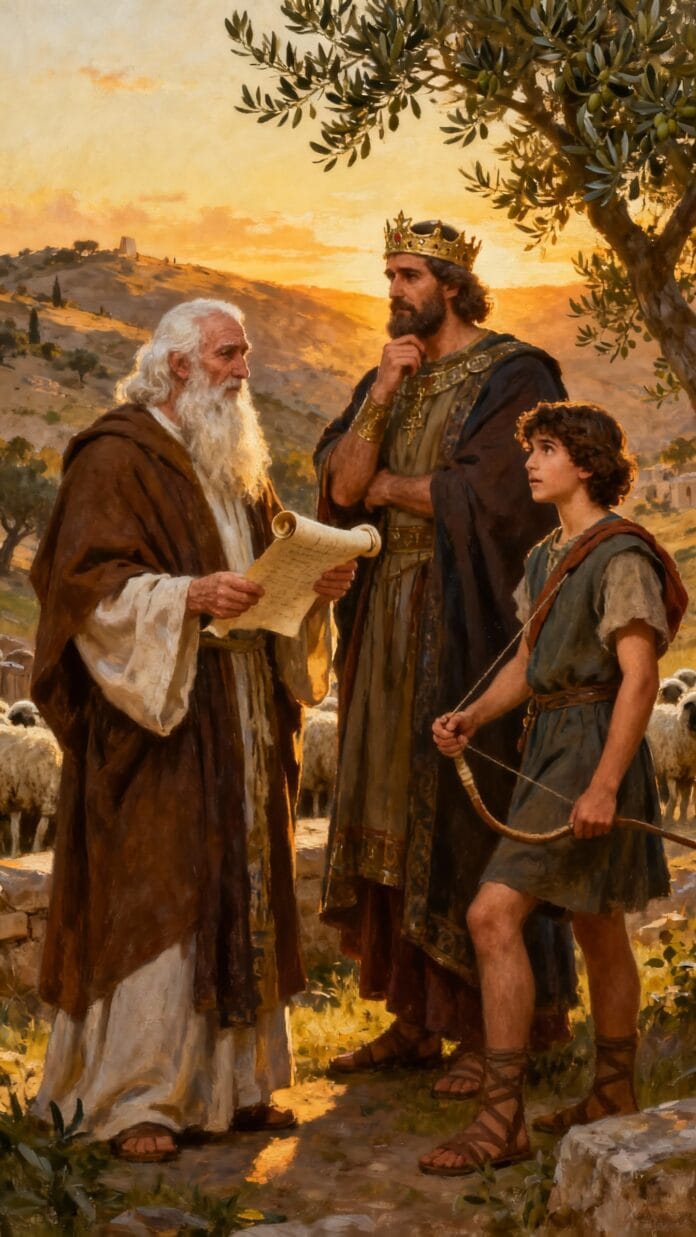
(2th (Book of Kings in the Vulgate)
(For the introduction, see the first book of Samuel)
2 Samuel 1
1 After Saul's death, David had returned from defeating the Amalekites and David had been staying in Ziqlag for two days. 2 On the third day, a man came from the camp, from Saul, with his clothes torn and dirt on his head. When he came to David, he fell to the ground and worshiped. 3 David said to him, "Where do you come from?" And he replied, "I escaped from the camp of Israel."« 4 David said to him, «What happened? Tell me.» He said, «The people fled from the battle, and many of them fell and died; Saul and his son Jonathan also died.» 5 David said to the young man who brought him this news, "How do you know that Saul and his son Jonathan are dead?"« 6 And the young man who brought him the news replied: "I happened to be on Mount Gilboa, and behold, Saul was leaning on his spear, and behold, the chariots and horsemen were about to overtake him. 7 He turned around and, having seen me, called to me and I said, "Here I am."« 8 And he said to me, "Who are you?" I replied, "I am an Amalekite."« 9 And he said to me, «Come near to me and kill me, for I am overcome with dizziness and my life is still entirely within me. 10 I approached him and killed him, for I knew well that he would not survive his defeat. I took the diadem that was on his head and the bracelet that was on his arm and I bring them here to my lord.» 11 David took hold of his clothes and tore them, and all the men who were with him did the same. 12 They celebrated their mourning, weeping and fasting until evening, for Saul, for his son Jonathan, for the people of the Lord, and for the house of Israel, because they had fallen by the sword. 13 David said to the young man who had brought him the news, "Where are you from?" He replied, "I am the son of a foreigner, an Amalekite."« 14 David said to him, «How could you not be afraid to stretch out your hand to kill the Lord’s anointed?» 15 And David called to one of the young men and said, "Go over and kill him." So the man struck the Amalekite, and he died. 16 And David said to him, «Your blood be on your own head, for your own mouth has testified against you when you said, »I have killed the Lord’s anointed.’” 17 David sang this funeral song for Saul and for Jonathan, his son, 18 And he commanded that it be taught to the children of Judah; it is the Song of the Bow. Behold, it is written in the Book of Jashar: 19 Has the splendor of Israel perished on your heights? How have the heroes fallen? 20 Do not announce it in Geth, do not publish it in the streets of Ashkelon, lest the daughters of the Philistines rejoice, lest the daughters of the uncircumcised leap for joy. 21 Mountains of Gilboa, may there be neither dew nor rain upon you, nor fields of firstfruits. For there the shield of the mighty was cast down. Saul's shield was not anointed with oil., 22 But from the blood of the wounded, from the fat of the valiant, Jonathan's bow never retreated and Saul's sword did not return inactive. 23 Saul and Jonathan, beloved and gracious in life and in death, were not separated. They were swifter than eagles, they were stronger than lions. 24 Daughters of Israel, weep for Saul, who clothed you in purple amidst delights, who adorned your garments with gold. 25 How did the heroes fall in battle? Jonathan was pierced on your heights. 26 Anguish overwhelms me because of you, Jonathan, my brother. You were my greatest joy, your love was more precious to me than the love of women. 27 How did the heroes fall? How did the warriors perish?
2 Samuel 2
1 After this, David inquired of the Lord, saying, «Shall I go up to one of the cities of Judah?» The Lord answered him, «Go up.» David said, «Where shall I go up?» And the Lord answered, «To Hebron.» 2 David went up there, with his two wives, Ahinoam of Jezreel and Abigail of Carmel, wife of Nabal. 3 David also brought up the men who were with him, each with his family, and they settled in the cities of Hebron. 4 And the men of Judah came and there they anointed David king over the house of Judah. David was informed that it was the men of Jabesh-gilead who had buried Saul. 5 And David sent messengers to the people of Jabesh-gilead to say to them, «May you be blessed by the Lord, for you have fulfilled this pious duty to Saul, your lord, and buried him. 6 And now, may the Lord show you kindness and faithfulness. I too will repay you for this kindness, because you have done this. 7 And now, let your hands be strong and be valiant men, for your lord Saul is dead, and the house of Judah has anointed me to be their king.» 8 However, Abner, son of Ner, commander of Saul's army, captured Ish-bosheth, son of Saul, and brought him over to Mahanaim, 9 He established him as king over Gilead, over the Assyrites, over Jezreel, over Ephraim, over Benjamin, over all Israel. 10 Ish-bosheth, son of Saul, was forty years old when he reigned over Israel, and he reigned two years. Only the house of Judah remained loyal to David. 11 The time during which David reigned in Hebron over the house of Judah was seven years and six months. 12 Abner, son of Ner, and the servants of Ish-bosheth, son of Saul, went out from Mahanaim to march on Gibeon. 13 Joab, son of Zervia, and David's servants also set out. They met near the pool of Gibeon and settled down, some on one side of the pool, others on the other side of the pool. 14 Abner said to Joab, "Let the young men rise and fight before us." Joab replied, "Let them rise."« 15 They stood up and came forward in equal numbers, twelve for Benjamin and for Ish-bosheth, son of Saul, and twelve of David's servants. 16 Each man seized his opponent by the head and thrust his sword into his companion's side, and they all fell together. And that place was named Shelkath HaZurim; it is in Gibeon. 17 And the battle became very fierce that day, and Abner and the men of Israel were defeated by the servants of David. 18 There were the three sons of Zeruiah: Joab, Abishai, and Asahel. Asahel's feet were as swift as those of the gazelles in the fields, 19 Asaël pursued Abner, without turning away from behind Abner, to go right or left. 20 Abner turned behind him and said, "Is that you, Asael?" And he replied, "It is I."« 21 Abner said to him, "Move aside to the right or to the left, seize one of the young men and take his body." But Asahel would not turn away from him. 22 Abner said to Asahel, «Turn away from me! Why should I strike you and throw you to the ground? How then could I raise my face before Joab, your brother?» 23 But Asahel refused to turn away. So Abner struck him in the stomach with the lower end of his spear, and the spear came out behind him. He fell there and died on the spot. Everyone who came to the place where Asahel had fallen and died stopped there. 24 Joab and Abisai pursued Abner, and at sunset they arrived at the hill of Ammah, which is east of Giah, on the road to the desert of Gibeon. 25 Benjamin's sons rallied to Abner's cause and, united in a single army, they stopped at the top of a hill. 26 Abner summoned Joab and said, «Will the sword always devour? Do you not know that there will be bitterness in the end? How long will you wait to tell the people to stop persecuting their brothers?» 27 Joab replied, "As surely as God lives, if you hadn't spoken, the people would not have stopped pursuing their brothers until tomorrow morning."« 28 And Joab sounded the trumpet and all the people stopped; they did not pursue Israel anymore and they did not continue to fight. 29 Abner and his people, after walking all night in the Plain, crossed the Jordan, crossed all of Bithron and arrived at Mahanaim. 30 Joab also stopped pursuing Abner and gathered all the people; nineteen men were missing from the servants of David and Asahel. 31 And David's servants had struck down three hundred and sixty men of Benjamin and some of the men of Abner. 32 They took Asahel and buried him in his father's tomb, which is at Bethlehem. Joab and his men marched all night and arrived at Hebron at daybreak.
2 Samuel 3
1 The war The rivalry between the house of Saul and the house of David was long. David grew stronger while the house of Saul grew weaker. 2 David had sons in Hebron. His firstborn was Ammon, son of Ahinoam of Jezreel, 3 the second Sheleab, daughter of Abigail of Carmel, wife of Nabal, the third Absalom, son of Maacah, daughter of Tolmai, king of Geshur, 4 the fourth Adonias, son of Haggith, the fifth Saphathia, son of Abital, 5 and the sixth Jethraam, by Eglah, David's wife. These were the sons born to David in Hebron. 6 While there was war between the house of Saul and the house of David, Abner was strengthening himself in the house of Saul. 7 Now Saul had a concubine named Resphah, daughter of Aiah. And Ish-bosheth said to Abner: 8 «Why did you come to my father’s concubine?» Abner, very angry at Ish-bosheth’s words, replied, «Am I a dog’s head belonging to Judah? Today I show favor to the house of Saul, your father, to his brothers and his friends, and I did not hand you over to David, and now you accuse me of wrongdoing with this woman?” 9 May God deal with Abner in all his severity, if I do not act with David according to what the Lord swore to him, 10 saying that he would remove the kingship from the house of Saul and establish the throne of David over Israel and Judah, from Dan to Beersheba. 11 Isboseth could not answer Abner a single word, because he was afraid of him. 12 Abner sent messengers to David, saying, «Whose land is this? Make a covenant with me, and my hand will help you to turn all Israel to your side.» 13 He replied, "Very well, I will make a covenant with you, but I ask one thing of you: that you do not see my face without bringing Michol, Saul's daughter, to me when you come to see my face."« 14 And David sent messengers to Ish-bosheth, Saul's son, saying, "Give me my wife Michal, whom I married for a hundred Philistine foreskins."« 15 Ishbosheth sent for him from her husband Phaltiel, son of Laish, 16 And her husband accompanied her, walking and weeping behind her, as far as Bathurim. There Abner said to him, «Go, return home.» And he returned. 17 Abner had discussions with the elders of Israel and said to them, «For a long time now you have desired to have David as king, 18 "Act now, for the Lord has said to David, 'It is by the hand of David my servant that I will deliver my people Israel from the hand of the Philistines and from the hand of all their enemies.'"» 19 Abner also spoke to Benjamin, and Abner went and reported to David in Hebron what seemed good in the eyes of Israel and in the eyes of all the house of Benjamin. 20 Abner came to David at Hebron, accompanied by twenty men, and David held a feast for Abner and the men who accompanied him. 21 And Abner said to David, «I will arise and go to gather all Israel to my lord the king, and they will make a covenant with you, and you will reign over all that your soul desires.» And David dismissed Abner, who went away in peace. 22 But now David and Joab's servants were returning from a raid, bringing back a large amount of plunder. Abner was no longer with David in Hebron, for David had dismissed him and he had gone away in peace. 23 Joab and all the troops who were with him arrived, and this report was brought to Joab: «Abner, son of Ner, came to the king, who dismissed him, and he went away in peace.» 24 Joab went to the king and said, «What have you done? Abner has come to you: why did you dismiss him and let him go?” 25 You know Abner, son of Ner: he came to deceive you, to spy on your ways and find out everything you do.» 26 Joab, having left David, sent messengers after Abner who brought him back from the cistern of Sira, without David knowing anything about it. 27 When Abner returned to Hebron, Joab drew him aside, inside the gate, as if to speak to him quietly, and there he struck him in the stomach; he died because of the blood of Asahel, Joab's brother. 28 David later learned of it and said, «I and my kingdom are forever innocent before the Lord of the blood of Abner, son of Ner. 29 May this blood fall upon the head of Joab and upon all his father's house. May there always be in Joab's house a man suffering from a discharge or leprosy, or reduced to women's work, or who falls by the sword, or who lacks bread.» 30 This is how Joab and Abishai, his brother, killed Abner, because he had killed their brother Asahel in the battle at Gibeon. 31 David said to Joab and all the people who were with him, «Tear your clothes, put on sackcloth, and mourn before Abner.» And King David walked behind the litter. 32 Abner was buried in Hebron. The king wept aloud over Abner's tomb, and all the people wept. 33 The king sang a funeral dirge for Abner and said: "Should Abner die like a fool?" 34 Your hands were not bound, nor were your feet thrown into chains. You fell as one falls before villains. All the people continued to lament over Abner, 35 And all the people approached David to give him food while it was still day. But David swore an oath: «May the Lord deal with me, be it ever so severely, if I taste any bread or anything else before sunset.» 36 All the people noticed it and thought it was good, just as they thought everything the king did was good. 37 All the people and all Israel understood that day that it was not the king who had put Abner, son of Ner, to death. 38 The king said to his servants, «Do you not know that a leader, a great man, has fallen today in Israel? 39 »For my part, I am gentle, though I have received the royal anointing, and these men, the sons of Sarvia, are harsher than I. May the Lord repay the evildoer according to the evil he has done.”
2 Samuel 4
1 When Saul's son learned that Abner had died in Hebron, his hands were powerless and all Israel was dismayed. 2 Saul's son had two raiding leaders, one named Baanah and the other Rechab, both sons of Remmon of Beroth, one of the sons of Benjamin. For Beroth is also counted as belonging to Benjamin. 3 and the Berothites had fled to Getaim and they have lived there to this day. 4 Jonathan, son of Saul, had a son who was lame in both feet. This child was five years old when the news of the death of Saul and Jonathan came from Jezreel; his nurse had taken him and fled, and in the haste of his flight, he had fallen and become lame; his name was Miphibosheth. 5 Now the sons of Remmon the Berothian, Rechab and Baanah, came and entered the house of Ish-bosheth during the heat of the day, while he was lying down for his midday rest. 6 Having entered the middle of the house to take some grain, they struck him in the stomach. And Rechab and Baanah, his brother, escaped. 7 When they entered the house, Ishbosheth was lying on his bed in his bedroom; they beat him to death and, having cut off his head, they took it and walked all night across the Plain. 8 They brought the head of Ish-bosheth to David at Hebron and said to the king, «Here is the head of Ish-bosheth, son of Saul, your enemy, who sought your life. The Lord has granted today to my lord the king vengeance on Saul and his descendants.» 9 David answered Rechab and Baanah, his brother, the sons of Remmon the Berothian, and said to them, «As surely as the Lord lives, who has delivered me from every peril. 10 The one who came to tell me this news: “Behold, Saul is dead,” this man was a bearer of good news in his own eyes, but I had him seized and put to death at Ziklag, to give him the reward for his good message, 11 How much more, when wicked men have murdered an innocent man in his own home, on his own bed, must I demand his blood again from your hands and exterminate you from the earth?» 12 And David ordered the young men to kill them; they cut off their hands and feet and hung them by the pool at Hebron. Then, having taken the head of Ish-bosheth, they buried it in the tomb of Abner at Hebron.
2 Samuel 5
1 All the tribes of Israel came to David at Hebron and said, «Here we are: we are your bones and your flesh. 2 Even in the past, when Saul was our king, it was you who led Israel back and forth. And the Lord said to you, «You will shepherd my people Israel, and you will be prince over Israel.» 3 So all the elders of Israel came to the king at Hebron, and King David made a covenant with them before the Lord at Hebron, and they anointed David king over Israel. 4 David was thirty years old when he became king and he reigned for forty years. 5 In Hebron, he reigned over Judah seven years and six months, and in Jerusalem he reigned thirty-three years over all Israel and Judah. 6 The king marched with his men to Jerusalem against the Jebusites, the inhabitants of the land. And they told David, «You shall not enter here, but the blind and the lame "They will repel you." Which meant: David will never enter here. 7 But David captured the fortress of Zion: this is the city of David. 8 David said that day, «Whoever strikes the Jebusites and reaches them by the ditch,» as for the lame and the blind, they are the enemies of David’s soul. Hence the saying, «The blind and the lame shall not enter the house.» 9 David settled in the fortress and called it the City of David, and David built around it, from the Mello and within it. 10 David grew greater and greater, and the Lord, the God of hosts, was with him. 11 Hiram, king of Tyre, sent messengers to David, with cedar wood, as well as carpenters and stonemasons, who built a house for David. 12 And David recognized that the Lord was establishing him as king over Israel and exalting his kingdom for the sake of his people Israel. 13 David took more concubines and wives from Jerusalem after he came from Hebron, and more sons and daughters were born to David. 14 These are the names of those born to him in Jerusalem: Samua, Zobab, Nathan, Solomon, 15 Jebahar, Elisua, Nepheg, 16 Japhia, Elisama, Elioda and Eliphaleth. 17 The Philistines heard that David had been anointed king over Israel, so all the Philistines went up to search for David. David heard of it and went down to the stronghold. 18 The Philistines, having arrived, spread out into the valley of Rephaim. 19 David inquired of the Lord, saying, «Shall I go up against the Philistines? Will you deliver them into my hand?» And the Lord said to David, «Go up, for I will certainly deliver the Philistines into your hand.» 20 So David went to Baal-Pharasim and there David defeated them. And he said, «The Lord has shattered my enemies before me, as waters break down dams.» Therefore the name of that place was called Baal-Pharasim. 21 They left their idols there, and David and his people carried them away. 22 The Philistines went up again and spread out into the valley of Rephaim. 23 And David consulted the Lord, who said to him, «Do not go up, go around them from their rear and you will come upon them from the side of the balsam trees. 24 When you hear the sound of footsteps in the tops of the balsam trees, then attack quickly, for then the Lord will go out before you to strike down the army of the Philistines.» 25 David did so, as the Lord commanded him, and he defeated the Philistines from Gibeah to Geser.
2 Samuel 6
1 David again gathered all the elite of Israel, numbering thirty thousand men. 2 Accompanied by all the people gathered around him, David arose and set out from Baale-Judah, to bring up from there the ark of God, which is called by the Name, the name of the Lord of hosts who sits upon the Cherubim. 3 They placed the ark of God on a new cart and brought it from the house of Abinadab, which was on the hill. Oza and Ahijah, Abinadab's sons, drove the new cart. 4 and they brought him from the house of Abinadab, which was on the hill with the ark of God, Achio walking in front of the ark. 5 David and all the house of Israel danced before the Lord, to the sound of all kinds of instruments made of cypress wood, harps, lyres, tambourines, sistrums and cymbals. 6 When they arrived at the threshing floor of Nachon, Oza reached out his hand to the ark of God and took hold of it, because the oxen had stumbled. 7 The Lord’s anger was kindled against Oza, and God struck him down there because of his haste, and Oza died there beside the ark of God. 8 David was angry that the Lord had thus struck Oza, and that place has been called Pheretz-Oza to this day. 9 David was afraid of the Lord that day and said, «How can the ark of the Lord come to me?» 10 And David would not bring the ark of the Lord home to the city of David, and David had it taken to the house of Obededom of Geth. 11 The ark of the Lord remained three months in the house of Obededom of Geth, and the Lord blessed Obededom and all his house. 12 King David was told, "The Lord has blessed the house of Obededom and all that belongs to him, because of the ark of God." So David set out and brought up the ark of God from the house of Obededom to the city of David, with a joyful procession. 13 When the bearers of the ark of the Lord had gone six steps, a fattened ox and calf were offered as a sacrifice. 14 David danced with all his might before the Lord, and David was girded with a linen ephod. 15 David and all the house of Israel brought up the ark of the Lord with shouts of joy and the sound of trumpets. 16 When the ark of the Lord entered the city of David, Michal, daughter of Saul, looked out of the window and, seeing King David leaping and dancing before the Lord, she despised him in her heart. 17 After the ark of the Lord had been brought in and placed in its place in the middle of the tent that David had pitched for it, David offered burnt offerings and peace offerings before the Lord. 18 When David had finished offering the burnt offerings and the peace offerings, he blessed the people in the name of the Lord of hosts. 19 Then he distributed to all the people, to all the multitude of Israel, men and women, to each a loaf of bread, a portion of meat, and a paste of raisins. And all the people went away, each to his own house. 20 As David returned to bless his house, Michal, Saul's daughter, came out to meet David and said, "How glorious it is today for the king of Israel to have unveiled himself today before the female servants of his servants, as a commoner would uncover himself."« 21 David answered Michol: «It was before the Lord, who chose me rather than your father and all his house to establish me as prince over his people, over Israel, it was before the Lord that I danced. 22 I will humble myself even more than that, and I will be brought low in my own eyes, and in the presence of the maids you speak of, I will be honored in their presence.» 23 And Michal, daughter of Saul, had no children until the day of her death.
2 Samuel 7
1 When the king was settled in his house and the Lord had given him rest by delivering him from all his enemies around him, 2 The king said to Nathan the prophet, «Look, I am living in a house of cedar, and the ark of God is dwelling in the midst of the tent.» 3 Nathan answered the king, «Go, do all that is in your heart, for the Lord is with you.» 4 That night, the word of the Lord came to Nathan in these words: 5 «Go and tell my servant David: This is what the Lord says: Are you the one who would build me a house to live in?” 6 For I have not dwelt in a house from the day I brought the children of Israel up out of Egypt until this day; I have traveled in a tent and in a tabernacle. 7 During all the time I traveled with all the children of Israel, did I say a word to any of the leaders of Israel whom I commanded to shepherd my people Israel, saying, “Why do you not build me a house of cedar?” 8 Now you shall say to my servant David: Thus says the Lord of hosts: I took you from the pasture, from tending the sheep, to be prince over my people Israel, 9 I have been with you everywhere you have gone, I have exterminated all your enemies before you and I have made you a great name, like the names of the great ones who are on the earth, 10 I have assigned a place to my people, to Israel, and I have planted them there, and they dwell in their own home. They will no longer be troubled, nor will the sons of iniquity oppress them, as before. 11 And as on the day when I appointed judges over my people Israel, I granted you rest by delivering you from all your enemies. And the Lord declares to you that he will build you a house. 12 When your days are fulfilled and you lie down with your fathers, I will raise up your offspring to succeed you, your own descendants, and I will establish his kingdom. 13 He is the one who will build a house for my name, and I will establish the throne of his kingdom forever. 14 I will be a father to him and he will be a son to me. If he does wrong, I will punish him with a rod of men and with the blows with which the children of men are punished. 15 But my grace will not depart from him, as I departed from Saul, whom I departed from before you. 16 Your house and your kingdom will be established forever before you; your throne will be affirmed forever.» 17 Nathan spoke to David according to all these words and this entire vision. 18 King David came and stood before the Lord and said, «Who am I, Lord God, and what is my house, that you have brought me thus far? 19 And this is still a small thing in your eyes, Lord God, you have also spoken of the house of your servant for distant times: this is to act towards me according to the law of man, Lord God. 20 What more could David tell you? You know your servant, Lord God. 21 It is because of your word and according to your heart that you have done all this great thing, to make it known to your servant. 22 That is why you are great, Lord God, for there is no one like you and there is no God besides you, according to all that we have heard with our ears. 23 What other nation is there on earth like your people, like Israel, whom God came to redeem as his people, to make a name for them, and to perform great and marvelous things for you in favor of your land, driving out from before your people, whom you redeemed from Egypt, the nations and their gods? 24 You have established your people Israel to be your people forever, and you, Lord, have become their God. 25 Therefore, Lord God, keep the word that you have spoken concerning your servant and his household forever, and do according to your word. 26 and may your name be glorified forever, and may it be said: The Lord of hosts is God over Israel. And may the house of your servant David be established before you. 27 For you yourself, Lord of hosts, God of Israel, have revealed yourself to your servant, saying: I will build you a house, therefore your servant has dared to address this prayer to you. 28 Now, Lord God, you are God, and your words are true. You have spoken this pleasing word to your servant, 29 Now, may it please you to bless the house of your servant, so that it may remain forever before you. For it is you, Lord God, who have spoken, and by your blessing the house of your servant will be blessed forever.»
2 Samuel 8
1 After that, David defeated the Philistines and subdued them, and David took the reins of their capital from the hand of the Philistines. 2 He defeated the Moabites and, having made them lie down on the ground, he measured them with a line; he measured two lines to kill them and one full line to spare their lives. And the Moabites became David's slaves, bringing him tribute. 3 David defeated Hadadezer, son of Rehob, king of Zobah, as he was on his way to establish his dominion over the river Euphrates. 4 And David took from him 1,700 horsemen and 20,000 foot soldiers, and David hamstrung all the chariot horses and left only 100 chariot teams. 5 When the Syrians of Damascus came to the aid of Hadadezer, king of Zobah, David defeated twenty-two thousand Syrians. 6 David placed garrisons in the Syria The people of Damascus and the Syrians were slaves to David, bringing tribute. The Lord gave David victory wherever he went. 7 David took the golden shields that were on the servants of Hadadezer and brought them to Jerusalem. 8 King David also took a large quantity of bronze from Bethe and Beroth, cities of Hadadezer. 9 When Thu, king of Hamath, learned that David had defeated all of Hadadezer's forces, 10 Thou sent Joram, his son, to King David to greet him and congratulate him on attacking Hadadezer and defeating him, for Thou was constantly at war with Hadadezer. Joram had in his hand vessels of gold, vessels of silver, and vessels of bronze. 11 King David also dedicated them to the Lord, along with the silver and gold that he dedicated after taking them from all the nations he had trampled underfoot., 12 to the Syria, to Moab, to the Ammonites, to the Philistines, to Amalek, and to the spoils of Hadadezer, son of Rehob, king of Zobah. 13 David made a name for himself when he returned from defeating the Syrians in the Valley of Salt, who numbered eighteen thousand. 14 He placed garrisons in Edom, throughout Edom he placed garrisons, and all Edom became subject to David. And the Lord gave David victory wherever he went. 15 David reigned over all Israel, and David did justice and righteousness for all his people. 16 Joab, son of Zeruiah, was in command of the army; Jehoshaphat, son of Ahilud, was recorder;, 17 Zadok, son of Ahitob, and Ahimelech, son of Abiathar, were priests, and Saraiah was secretary., 18 Benaiah, son of Jehoiada, was chief of the Cherethites and the Phelethites, and the sons of David were his close advisors.
2 Samuel 9
1 David said, "Is there anyone left of the house of Saul whom I can show kindness for Jonathan's sake?"« 2 There was a servant in the house of Saul named Shiba. He was brought before David, and the king said to him, «Are you Shiba?» And he replied, «Your servant.» 3 The king said, "Is there no one left of Saul's house to whom I can show kindness like God?" Shiba answered the king, "There is still one of Jonathan's sons, who is lame in both feet."« 4 And the king said to him, «Where is he?» And Siba answered the king, «Behold, he is in the house of Machir, son of Ammiel, in Lodabar.» 5 King David sent for him from the house of Machir, son of Ammiel of Lodabar. 6 When Miphoboseth, son of Jonathan, son of Saul, came to David, he fell on his face and worshiped. And David said, «Miphoboseth.» He replied, «Here is your servant.» 7 And David said to him, «Do not be afraid, for I want to show you kindness for the sake of Jonathan your father. I will restore to you all the lands of Saul your father, and you will always eat your food at my table.» 8 He prostrated himself and said, "What is your servant that you should turn to a dead dog like me?"« 9 The king summoned Siba, Saul's servant, and said to him, "All that belonged to Saul and all his household, I give to your master's son. 10 You, your sons, and your servants will cultivate the land for him and bring in the harvest, so that your master's son may have enough to eat, but Miphibosheth, your master's son, will always eat from my table.» Now Shiba had fifteen sons and twenty servants. 11 Siba said to the king, "Your servant will do everything that the king, my lord, commands his servant." And Miphibosheth ate at David's table, like one of the king's sons. 12 Miphiboseth had a young son named Micha and all those who remained in the house of Siba were his servants. 13 Miphiboseth lived in Jerusalem, for he always ate at the king's table and he was lame in both feet.
2 Samuel 10
1 After that, the king of the sons of Ammon died and Hanon, his son, reigned in his place. 2 David said, «I will show kindness to Hanon son of Naash, just as his father showed kindness to me.» So David sent his servants to comfort him about his father. When David’s servants arrived in the land of the Ammonites, 3 The princes of the Ammonites said to Hanon, their master, "Do you think that David is sending you comforters to honor your father? Isn't it to reconnoiter and explore the city, in order to destroy it, that David has sent his servants to you?"« 4 Then Hanon seized David's servants, shaved half their beards and cut their clothes halfway up to their buttocks, and sent them away. 5 David was informed and he sent men to meet them, for these men were in great confusion, and the king told them, "Stay in Jericho until your beards have grown back and then you may return."« 6 The Ammonites saw that they had made themselves odious to David, and the Ammonites sent to take into their pay the Syrians of Beth-Rohob and the Syrians of Zobah, twenty thousand foot soldiers, then the king of Maahah, one thousand men, and the people of Tob, twelve thousand men. 7 David learned of this and he sent Joab and all the army, the valiant men, against them. 8 The sons of Ammon went out and lined up in battle formation at the entrance of the gate, the Syrians of Soba and Rohob, as well as the men of Tob and Maacha, were apart in the countryside. 9 When Joab saw that there was a battle front in front of and behind him, he chose a corps from among all the elite of Israel and positioned it opposite the Syrians. 10 and he put the rest of the people under the command of his brother Abishai, who arranged them opposite the sons of Ammon. 11 He said, "If the Syrians are stronger than me, you will come to my aid, and if the Ammonites are stronger than you, I will come to your aid.". 12 Be steadfast and let us fight valiantly for our people and for the cities of our God, and may the Lord do what seems good in his eyes.» 13 So Joab advanced, along with the people who were with him, to attack the Syrians, and they fled before him. 14 The Ammonites, seeing that the Syrians had fled, also fled before Abisai and returned to the city. And Joab went back from the war against the Ammonites and returned to Jerusalem. 15 The Syrians, seeing that they had been defeated by Israel, gathered together. 16 Hadadezer sent messengers to bring the Syrians who were on the other side of the river, and they came to Helam, and Sobah, commander of Hadadezer's army, marched in front of them. 17 David received the news and, having gathered all Israel, he crossed the Jordan and came to Helam. The Syrians drew up their battle lines against David and engaged him in combat. 18 But the Syrians fled before Israel, and David killed the horses of seven hundred chariots and forty thousand horsemen of the Syrians; he also struck down the commander of their army, Sobah, who died there. 19 All the vassal kings of Hadadezer, seeing themselves defeated before Israel, did peace with Israel and were subjugated, and the Syrians were afraid to come to the aid of the Ammonites any longer.
2 Samuel 11
1 At the return of the year, at the time when kings go to war, David sent Joab with his servants and all Israel, and they ravaged the land of the Ammonites and besieged Rabbah. But David remained in Jerusalem. 2 One evening when David got up from his bed and was walking on the roof of the king's house, he saw from the roof a woman bathing, and this woman was very beautiful in appearance. 3 David inquired about the woman and was told, "She is Bathsheba, daughter of Eliam, wife of Uriah the Hittite."« 4 And David sent men to take her, she came to his house and he lay with her. Then she purified herself from her uncleanness and returned to her house. 5 This woman became pregnant and she sent word to David, saying, «I am pregnant.» 6 So David sent this order to Joab: «Send me Uriah the Hittite.» And Joab sent Uriah to David. 7 Uriah having gone to David, the latter asked for news of Joab, the army and the battle. 8 Then David said to Uriah, «Go down to your house and rest.» So Uriah left the king’s house, and a gift from the king’s table was brought after him., 9 But Uriah lay down at the door of the king’s house with all his master’s servants and did not go down into his house. 10 David was informed, and it was said, "Uriah has not gone down to his house." And David said to Uriah, "Have you not just arrived from a journey? Why have you not gone down to your house?"« 11 Uriah answered David, «The ark and Israel and Judah are living in tents, my lord Joab and my lord’s servants are encamped in the open field, and I am going to my house to eat and drink and to lie with my wife. As surely as you live, as surely as you live, I will do no such thing.» 12 David said to Uriah, «Stay here today and tomorrow I will send you away.» So Uriah stayed in Jerusalem that day and the next. 13 David invited him to eat and drink in his presence and made him drunk, and in the evening Uriah went out to lie down on his bed beside his master's servants, but he did not go down to his house. 14 The next morning, David wrote a letter to Joab and sent it by Uriah. 15 In this letter he wrote: "Place Uriah in the thick of the fighting and withdraw from behind him, so that he will be struck and die."« 16 Joab, who was besieging the city, placed Uriah in the place where he knew the bravest men were. 17 The men of the city, having made a sortie to attack Joab, several fell from among the people, from among the servants of David, Uriah the Hittite also died. 18 Joab sent a messenger to inform David of all the facts of the battle, 19 He gave this order to the messenger: "When you have finished telling the king all the facts of the battle, if the king's anger rises and he says to you: 20 Why did you approach the city to give battle? Didn't you know that the besieged would launch arrows from the top of the wall? 21 Who struck Abimelech, son of Jerobaal? Wasn't it a woman who threw a piece of a millstone at him from the top of the wall, so that he died in Thebes? Why then did you go near the wall? Then you will say, 'Your servant Uriah the Hittite is also dead.'» 22 The messenger left and, upon his arrival, he told David everything that Joab had commanded him. 23 The messenger said to David, «These people, stronger than us, made a sortie against us in the countryside, but we drove them back to the gate. 24 Then their archers shot down from the top of the wall at your servants, and many of the king's servants were killed, and your servant Uriah the Hittite also died.» 25 David said to the messenger, «This is what you are to say to Joab: »Do not be too worried about this matter, for the sword devours now one, now the other. Redouble your efforts against the city and overthrow it. And you, encourage him.’” 26 Uriah's wife learned that her husband, Uriah, was dead and she wept over him. 27 When the mourning period was over, David sent for her and brought her into his home. She became his wife and bore him a son. But the thing David had done displeased the Lord.
2 Samuel 12
1 The Lord sent Nathan to David, and Nathan came to him and said, «There were two men in a certain city, one rich and the other poor. 2 The rich man had a very large number of sheep and oxen, 3 And the poor man had nothing except a little ewe he had bought, he raised it and it grew up in his house with his children, eating his bread, drinking from his cup and sleeping on his breast and it was like a daughter to him. 4 A visitor came to the rich man's house, and the rich man refrained from using any of his own sheep or cattle to prepare a meal for the traveler who had come to him. Instead, he took the poor man's sheep and prepared it for the man who had come to him.» 5 David's anger burned fiercely against the man, and he said to Nathan, "As surely as the Lord lives, the man who did this deserves to die!", 6 And he will pay back the sheep four times, for having done such a thing and for having shown no mercy.» 7 And Nathan said to David, «You are the man. This is what the Lord, the God of Israel, says: I have anointed you king over Israel and I have delivered you from the hand of Saul, 8 I gave you your master's house and I placed it on your bosom women of your master and I gave you the house of Israel and Judah and, if that was too little, I would have added this or that. 9 Why have you despised the word of the Lord, by doing what is evil in his sight? You have struck down Uriah the Hittite with the sword, you have taken his wife to be your wife and you have killed him with the sword of the Ammonites. 10 And now the sword will never depart from your house, because you have despised me and have taken the wife of Uriah the Hittite to be your wife. 11 Thus says the Lord: Behold, I am going to raise up disaster upon you from your own house, and I will take your wives before your very eyes and give them to your neighbor, and he shall lie with your wives in the sight of this sun. 12 »For you have acted in secret, but I will do this in the sight of all Israel and in broad daylight.” 13 David said to Nathan, «I have sinned against the Lord.» And Nathan said to David, «The Lord has forgiven your sin; you will not die.”. 14 But because you have caused the Lord to be despised by his enemies through this action, the son born to you will die.» 15 And Nathan went home. The Lord struck the child that Uriah's wife had borne to David, and he became very ill. 16 David prayed to God for the child and fasted, and having entered his room, he spent the night lying on the floor. 17 The elders of his house urged him to get up from the ground, but he refused and did not eat with them. 18 On the seventh day, the child died. David's servants were afraid to tell him that the child was dead, for they said, "While the child was still alive, we spoke to him, and he did not listen to our voice. How can we tell him, 'The child is dead'? He will do even worse."« 19 David noticed that his servants were talking quietly among themselves, and David realized that the child was dead. David said to his servants, "Is the child dead?" They said, "He is dead."« 20 Then David got up from the ground, bathed, anointed himself, and changed his clothes. Then he went into the house of the Lord and worshiped. When he returned home, he asked for something to eat and he ate. 21 His servants said to him, "What are you doing? While the child was alive, you fasted and mourned, but now that the child is dead, you get up and eat bread."« 22 He said, «While the child was still alive, I fasted and wept, for I said, ‘Who knows? Perhaps the Lord will have mercy on me and the child will live?’” 23 Now that he is dead, why should I fast? Can I still bring him back? I will go to him, but he will not return to me.» 24 David comforted Bathsheba, his wife; he went in to her and lay with her, and she gave birth to a son, whom he named Solomon, and the Lord loved him., 25 and he sent word through Nathan the prophet, who named him Jedidiah, because of the Lord. 26 Joab, who was besieging Rabbah of the Ammonites, captured the royal city, 27 and Joab sent messengers to David to tell him: «I have besieged Rabbah and I have already captured the city of waters. 28 Now gather the rest of the people, come and encamp against the city and take it, lest I myself take the city and it be called by my name.» 29 David gathered all the people and, having marched on Rabbah, he attacked it and took possession of it. 30 He removed the crown from their king's head: its weight was a talent of gold, and on it was a precious stone, and it was placed on David's head. And he carried off a very great deal of plunder from the city. 31 As for the people who were there, he brought them out and forced them into hard labor: sawing, stonecutting, woodcutting, and brickmaking. He did the same to all the cities of the Ammonites. Then David returned to Jerusalem with all the people.
2 Samuel 13
1 After this, it came to pass that Absalom, son of David, had a sister who was beautiful and whose name was Tamar, and Amnon, son of David, loved her. 2 Amnon was tormented, to the point of making himself ill, about Tamar, his sister, because she was a virgin and it seemed impossible to do anything to her. 3 Amnon had a friend named Jonadab, son of Sammaah, brother of David, and Jonadab was a very wise man. 4 He said to him, «Why are you so defeated, son of the king, every morning? Won’t you tell me?» Amnon answered him, «I love Tamar, the sister of my brother Absalom.» 5 Jonadab said to him, «Lie down and pretend to be sick. When your father comes to see you, tell him, »Please let my sister Tamar come and give me something to eat, and let her prepare the food in my sight, so that I may see it and eat from her hand.’” 6 Amnon lay down and feigned illness. The king came to see him, and Amnon said to the king, "Please let Tamar, my sister, come and make two cakes in my presence, and let me eat them from her hand."« 7 David sent word to Tamar in the house: «Go to your brother Amnon’s house and prepare a meal for him.» 8 Tamar went to her brother Amnon, who was lying down. Taking some dough, she kneaded it, shaped it into cakes before his eyes, and baked the cakes., 9 She then took the pan and poured them before him. But he refused to eat. Amnon then said, «Bring everyone out of my presence.» When they had all left him, 10 Amnon said to Tamar, "Bring these cakes to my bed and let me eat from your hand." Tamar took the cakes she had made and brought them to her brother Amnon in the alcove. 11 As she presented them to him to eat, he seized her and said, "Come, lie with me, my sister."« 12 She replied to him, "No, my brother, do not dishonor me, for such a thing is not done in Israel; do not commit this infamy. 13 Where would I go to bear my shame? And you would be like one of the infamous people of Israel. Speak to the king, I beg you, and he will not refuse to give me to you.» 14 But he refused to listen to her voice; stronger than her, he raped her and slept with her. 15 Amnon immediately felt a very strong aversion to her, and the hatred with which he hated her was stronger than the love with which he had loved her, and Amnon said to her: "Get up, go away."« 16 She replied, "To the harm you have done me, do not add the even greater harm of driving me away." But, refusing to listen to her, 17 He called the boy who served him and said, "Throw that woman out, away from me, and shut the door behind her."« 18 Now she was wearing a long robe, for that was the garment worn by the king's virgin daughters. Amnon's servant led her out and shut the door behind her. 19 Thamar took some dust and put it on her head, she tore off the long dress she was wearing and, putting her hand on her head, she went away screaming. 20 Absalom, her brother, said to her, «Has your brother Amnon been with you? Now, my sister, be quiet; he is your brother. Do not take this matter to heart.» And Tamar remained, desolate, in the house of her brother Absalom. 21 When King David learned of all these things, he was very angry. [But he did not want to grieve the spirit of Amnon, his son, for he loved him as his firstborn. [Vulgate addition]] 22 Absalom no longer spoke any word, good or bad, to Amnon, for Absalom hated Amnon because of the outrage done to Tamar, his sister. 23 Two years later, Absalom had the shearers at Baal-Hasor, near Ephraim, and Absalom invited all the king's sons. 24 Absalom went to the king and said, "Your servant has the shearers; let the king and his officials come to your servant."« 25 And the king said to Absalom, «No, my son, we will not all go, lest we become a burden to you.» Absalom pleaded with him, but the king would not go and blessed him. 26 Then Absalom said, «If you will not come, at least allow Amnon, my brother, to come with us.» The king replied, «Why should he go with you?» 27 Absalom insisted, so the king let Amnon and all the king's sons go with him. 28 Absalom gave this order to his servants: «Be careful. When Amnon’s heart is full of wine and I tell you, »Strike Amnon,’ you will kill him. Do not be afraid; have I not commanded you? Be steadfast and courageous.” 29 Absalom's servants did to Amnon as Absalom had commanded. And all the king's sons got up, each mounted his mule, and fled. 30 While they were still on their way, this news reached David: "Absalom has killed all the king's sons, and not one of them remains."« 31 The king got up, tore his clothes and lay down on the ground, and all his servants stood there with their clothes torn. 32 Jonadab, son of Shemmaah, David's brother, spoke up and said, "Let not my lord say that all the young men, sons of the king, have been killed; only Amnon is dead. This is something that has been on Absalom's lips ever since the day Amnon defiled Tamar, his sister.". 33 And now, let not my lord the king imagine that all the king's sons are dead, for Amnon alone is dead.» 34 And Absalom fled. Now the young man who was on watch raised his eyes and looked, and behold, a large troop was coming from the western road, from the direction of the mountain. 35 Jonadab said to the king, "Here come the king's sons; things have happened just as your servant said."« 36 As he finished speaking, the king's sons arrived and, raising their voices, they wept; the king also and all his servants shed copious tears. 37 But Absalom fled and went to Tholomai, son of Ammiud, king of Geshur. And David mourned for his son every day. 38 Absalom fled and went to Gessur, where he stayed for three years. 39 And King David gave up pursuing Absalom, because he had been comforted by the death of Amnon.
2 Samuel 14
1 Joab, son of Sarvia, realized that the king's heart was turning towards Absalom. 2 Joab sent for a skilled woman from Tekua and told her, «Pretend to be in mourning and put on mourning clothes, do not anoint yourself with oil and be like a woman who has been mourning for a long time for a dead man. 3 "You will come to the king and you will give him this speech." And Joab put what she was to say into her mouth. 4 Tekua's wife came to speak to the king. Falling face down on the ground and prostrating herself, she said, "O king, save me!"« 5 The king said to her, "What is the matter?" She replied, "I am a widow, my husband is dead.". 6 Now your servant had two sons, and they both quarreled in the fields, and since there was no one to separate them, one struck the other and killed him. 7 And now the whole family has risen up against your servant, saying, »Hand over the murderer of his brother, so that we may put him to death for the life of his brother whom he has killed, and we will even destroy the heir. They will thus extinguish the last embers I have left, leaving my husband neither a name nor a survivor on the face of the earth.” 8 The king said to the woman, "Go home, I will give instructions concerning you."« 9 Tekua's wife said to the king, "Let the blame fall on me, O king my lord, and on my father's house; let the king and his throne not suffer."« 10 The king said, "If anyone is still troubling you, bring him to me, and he will never harm you again."« 11 She said, «Let the king mention the Lord your God, so that the avenger of blood may not increase the damage and my son may not be destroyed.» He replied, «As surely as the Lord lives, not a hair of your son’s head will fall to the ground.» 12 The woman said, "Please allow your servant to speak to my lord the king." He replied, "Speak."« 13 And the woman said, «Why have you thought this way about God’s people? By pronouncing this judgment, the king is guilty, namely, that the king does not recall the one he has banished.”. 14 For we will certainly die, we are like the waters spilled on the earth and which do not gather again, God does not take away life and he forms the plan that the banished will not remain banished from his presence. 15 Now, the reason I have come to tell these things to my lord the king is that the people frightened me, and your servant said, 'I want to speak to the king; perhaps the king will do what your servant says.'. 16 Yes, the king will listen, to deliver his servant from the hand of the man who wants to cut us off, my son and me, from the inheritance of God. 17 Your servant said, »May the word of my lord the king give me rest. For my lord the king is like an angel of God, hearing both good and evil. And may the Lord your God be with you.” 18 The king answered and said to the woman, "Do not hide from me anything I am about to ask you." The woman said, "Let my lord the king speak."« 19 And the king said, «Is Joab’s hand with you in all this?» The woman replied, «As surely as your soul lives, O my lord the king, it is impossible to go to the right or to the left of anything my lord the king says. Yes, it is your servant Joab who gave me orders and put all these words into the mouth of your servant.”. 20 "Your servant Joab did this to deflect attention from the matter, but my lord is as wise as an angel of God, knowing everything that happens on earth."» 21 The king said to Joab, "Here, I will do this; go then, bring back the young man Absalom."« 22 Joab fell facedown to the ground and prostrated himself, and he blessed the king. Then Joab said, «Your servant knows today that I have found favor in your eyes, O king, my lord, since the king has acted according to the word of his servant.» 23 And Joab got up and went to Geshur and brought Absalom back to Jerusalem. 24 But the king said, "Let him go to his house and not see my face." So Absalom went to his house and did not see the king's face. 25 Throughout all Israel there was no man as renowned as Absalom for his beauty; from the sole of his foot to the crown of his head, there was no flaw in him. 26 When he shaved his head, which he did every year, when his hair weighed him down, he shaved it off; the weight of the hair on his head was two hundred shekels, the king's weight. 27 Absalom had three sons and a daughter named Tamar, who was a beautiful woman. 28 Absalom remained in Jerusalem for two years without seeing the king's face. 29 Absalom sent for Joab to be sent to the king, but Joab refused to come. Absalom sent for him a second time, and he still refused. 30 Then Absalom said to his servants, «Look, Joab’s field is next to mine, and there is barley there for him: go and set fire to it.» So Absalom’s servants set fire to the field. 31 Joab got up and went to Absalom in his house and said to him, «Why did your servants set fire to the field that belongs to me?» 32 Absalom answered Joab, «Look, I sent you to say, »Come here, and I will send you to the king so that you may say to him, “Why did I come back from Gezur? It would have been better for me to be there still. Now I want to see the king’s face, and if there is any guilt in me, let him put me to death.”’” 33 Joab went to the king and told him these things. Then he summoned Absalom, who came to the king and bowed down with his face to the ground before him. And the king kissed Absalom.
2 Samuel 15
1 After that, Absalom acquired a chariot and horses and fifty men who ran before him. 2 Absalom would get up early and stand near the gate avenue, and whenever a man with a lawsuit came to the king to obtain a judgment, Absalom would call him and say, "What city are you from?" When he had answered, "Your servant is from such and such a tribe of Israel,"« 3 Absalom told him, "Look, your cause is good and just, but no one from the king will listen to you."« 4 Absalom added: "Who will appoint me judge in the land? Whoever has a lawsuit or a case will come to me, and I will give them justice."« 5 And when someone approached to prostrate themselves before him, he would extend his hand, take him, and kiss him. 6 Absalom acted in this way towards all those of Israel who went to the king to seek justice, and he seduced the hearts of the people of Israel. 7 After four years, Absalom said to the king, "Please allow me to go to Hebron to fulfill the vow I made to the Lord.". 8 For while I was staying in Geshur in Aram, your servant made a vow, saying, «If the Lord brings me back to Jerusalem, I will serve the Lord.» 9 The king said to him, "Go in peace." He got up and left for Hebron. 10 Absalom sent messengers to all the tribes of Israel, saying, «As soon as you hear the sound of the trumpet, you shall say: Absalom reigns in Hebron.» 11 Two hundred men left Jerusalem with Absalom: they were guests who went in all simplicity, without suspecting anything. 12 While Absalom was offering the sacrifices, he sent for Ahithophel the Gilonite, David's advisor, from his city of Gilo. The conspiracy grew powerful, for the people gathered around Absalom in ever-increasing numbers. 13 David was informed, and told, "The hearts of the men of Israel have followed Absalom."« 14 And David said to all his servants who were with him in Jerusalem, «Get up, let us flee, for there is no way for us to escape from Absalom. Hurry and leave, lest he, in his haste, surprise us and bring disaster upon us and strike the city with the edge of the sword.» 15 The king's servants told him, "Whatever course my lord the king takes, these are your servants."« 16 The king left, with his entire family, on foot, and he left ten concubines to guard the house. 17 The king went out with all the people on foot and they stopped at the last house. 18 All his servants walked beside him, all the Cerethians and all the Phelethians and all the Gethians, six hundred men in all, who had come from Geth after him, walked before the king. 19 The king said to Ethai the Gethian, «Why should you also come with us? Go back and stay with the king, for you are a foreigner and indeed an exile without a home. 20 You arrived yesterday, and today I would make you wander with us, while I myself go I know not where. Go back and take your brothers with you, may grace be upon you and loyalty of the Lord.» 21 Ethai answered the king and said, «As surely as the Lord lives and as surely as my lord the king lives, wherever my lord the king may be, whether he dies or lives, there your servant will be.» 22 David said to Ethai, «Go over.» So Ethai the Gethian crossed over with all his men and all the children who were with him. 23 The whole land wept and cried out as all these people passed by. The king having crossed the Kidron Valley, all the people crossed over opposite the road to the desert. 24 And behold, Zadok and with him all the Levites who carried the ark of the covenant of God, put down the ark of God, while Abiathar went up, until all the people had finished leaving the city. 25 Then the king said to Zadok, «Take the ark of God back into the city. If I find favor in the eyes of the Lord, he will bring me back and show me the ark and his dwelling place.”. 26 But if he says, »I have no pleasure in you,” here I am: let him do to me as he pleases.» 27 The king also said to the priest Zadok: «O seer, return in peace to the city, with Ahimas, your son, and Jonathan, son of Abiathar: your two sons with you. 28 Look. I will wait in the desert plains until I receive word from you that gives me information.» 29 So Zadok and Abiathar brought the ark of God back to Jerusalem and they stayed there. 30 David went up the Mount of Olives, weeping as he went up, with his head covered and barefoot, and all the people who were with him also had their heads covered and went up weeping. 31 David was told, «Ahithophel is with Absalom among the conspirators.» And David said, «O Lord, I pray you, thwart the plans of Ahithophel.» 32 When David had reached the summit, where God is worshiped, behold, Chusai the Arahite came to meet him, his tunic torn and dust on his head. 33 David said to him, "If you go with me, you will be a burden to me. 34 But if, returning to the city, you say to Absalom, O king, I want to be your servant; I was your father’s servant once, and now I will be yours, you will thwart Ahithophel’s advice in my favor. 35 You will have with you the priests Zadok and Abiathar, and everything you learn from the king's house, you will report to the priests Zadok and Abiathar. 36 And since they have with them their two sons, Ahimaaz son of Zadok and Jonathan son of Abiathar, you shall inform me through them of everything you have learned.» 37 And Chusai, a friend of David, returned to the city, at the same time as Absalom entered Jerusalem.
2 Samuel 16
1 When David had gone a little past the summit, behold, Siba, servant of Miphibosheth, came to meet him, with a pair of saddled donkeys, carrying two hundred loaves of bread, one hundred clusters of raisins, one hundred ripe fruits and a skin of wine. 2 The king said to Siba, "What do you want to do with these?" Siba replied, "The donkeys are for the king's house, to be ridden; the bread and fruit are for the young men to eat; and the wine is for those who will be weary in the desert to drink."« 3 The king said, "And where is your master's son?" Shiba answered the king, "Behold, he has remained in Jerusalem, for he said, 'Today the house of Israel will restore to me the kingdom of my father.'"« 4 The king said to Siba, "Now everything that belongs to Miphiboseth is yours." And Siba said, "I will kneel before you, that I may find favor in your sight, O my lord the king."« 5 When the king arrived at Bahurim, a man from the same family as the house of Saul came out; his name was Shemei, son of Gera, and he came forward cursing 6 and he threw stones at David and all the servants of King David, while all the people and all the valiant men were on his right and on his left. 7 Semeï spoke thus while cursing him: "Go away, go away, man of blood, man of Belial. 8 The Lord has brought upon you all the blood of the house of Saul, in whose place you made yourself king, and he has given the kingdom into the hand of Absalom your son, and now you are in your own misfortune, for you are a man of blood.» 9 Then Abishai, son of Sarvia, said to the king, "Why does this dead dog curse the king, my lord? Let me pass so I can cut off its head."« 10 The king replied, «What have I to do with you, sons of Zervia? Let him curse! For if the Lord has said to him, »Curse David,’ who can say to him, ‘Why are you doing this?’” 11 And David said to Abishai and all his servants, «Behold, my son, who came from my own body, seeks my life; how much more this son of Benjamin! Let him curse, for the Lord has commanded him to do so.”. 12 Perhaps the Lord will look upon my affliction and show me goodness in return for today's curse.» 13 And David and his men continued on their way, while Shemei walked on the side of the mountain, near David, constantly cursing him, throwing stones at him and making dust fly. 14 The king and all the people who were with him arrived tired and there they rested. 15 Absalom and all the people, the men of Israel, entered Jerusalem, and Ahithophel was with Absalom. 16 When Hushai the Arahite, a friend of David, came to Absalom, Hushai said to Absalom, "Long live the king! Long live the king!"« 17 Absalom said to Chusai, "So this is your devotion to your friend. Why didn't you go with your friend?"« 18 Chusai answered Absalom, «No, but I want to belong to the one whom the Lord and all these people and all the men of Israel have chosen; I want to stay with him. 19 »Besides, whom shall I serve? Is it not his son? As I have been your father’s servant, so shall I be yours.” 20 Absalom said to Ahithophel, "Consult among yourselves about what we should do."« 21 And Ahithophel said to Absalom, «Go to the concubines your father left to keep the house, so that all Israel may know that you have made yourself odious to your father, and the hands of all who are with you may be strengthened.» 22 So they pitched a tent for Absalom on the roof, and Absalom went to his father’s concubines in the sight of all Israel. 23 The advice that Ahithophel gave at that time was like the word of God to the one who asks for it; so it was with all his advice, whether for David or for Absalom.
2 Samuel 17
1 Ahithophel said to Absalom, «Let me choose twelve thousand men, and I will rise up and pursue David this very night and 2 Falling upon him unexpectedly while he is tired and his hands are weak, I will terrify him, and all the people with him will flee; then I will strike the king alone. 3 and I will bring all the people back to you: the man you are angry with is worth the return of all, and all the people will be at peace.» 4 This speech pleased Absalom and all the elders of Israel. 5 However, Absalom said, "Call Chusai the Arachite again, so that we may hear what he too has to say."« 6 Chusai came to Absalom, and Absalom said to him, "This is what Ahithophel said; should we do as he said? If not, speak in your turn."« 7 Chusai replied to Absalom, "This time, the advice Ahithophel gave is not good."« 8 And Chusai added: «You know that your father and his people are brave, they are as exasperated as a bear in the countryside deprived of her cubs. Your father is a man of war and he does not spend the night with the people. 9 Now he is hidden in some ravine or some other place. And if, from the beginning, some of your people fall, it will be heard and it will be said: There has been a rout among the people who follow Absalom. 10 Then even the bravest, even if his heart were like a lion's heart, will be discouraged, for all Israel knows that your father is a hero and that those who accompany him are brave men. 11 Therefore I advise that all Israel should gather around you, from Dan to Beersheba, a multitude like the sand that is on the seashore, and you yourself should go into battle. 12 We will overtake him wherever he may be and fall upon him like dew falls upon the ground, and we will not let him escape, nor any of the men who are with him. 13 If he retreats to a city, all Israel will bring ropes to that city and we will drag it to the stream until not even a stone can be found there.» 14 Absalom and all the people of Israel said, «The advice of Husai the Arahite is better than the advice of Ahithophel.» The Lord had decided to thwart the good advice of Ahithophel, so that the Lord would bring disaster on Absalom. 15 Chusai said to the priests Zadok and Abiathar: «Ahithophel gave such and such advice to Absalom and the elders of Israel, and I gave such and such advice. 16 Send word to David at once and tell him: »Do not spend the night in the plains of the desert, but hurry across, lest there be a great disaster for the king and all the people who are with him.” 17 Jonathan and Ahimas were staying at En-Rogel, the servant was going to inform them and they themselves were going to give notice to King David, because they could not be seen entering the city. 18 A young man saw them and reported it to Absalom. But they both hastened to leave and arrived at Bahurim, at the house of a man who had a cistern in his courtyard, and they went down into it. 19 The woman took a blanket, spread it over the cistern, and scattered crushed grain on it, so that nothing was noticed. 20 Absalom's servants went into the woman's house and said, "Where are Ahimaaz and Jonathan?" The woman replied, "They have crossed the stream." They searched for them, but not finding them, they returned to Jerusalem. 21 After they left, Ahimsaas and Jonathan climbed back up from the cistern and went to inform King David. They said to David, "Get up and hurry across the water, for Ahithophel has given such advice against you."« 22 David and all the people who were with him got up and crossed the Jordan at daybreak; not one of them was left who had not crossed the Jordan. 23 When Achitophel saw that his advice was not followed, he saddled his donkey and got up to go home to his city, then, after giving his household orders, he strangled himself and died and was buried in his father's tomb. 24 David arrived at Mahanaim and Absalom crossed the Jordan, he and all the men of Israel with him. 25 Absalom had put Amasa in charge of the army, instead of Joab. Amasa was the son of a man called Jethrah the Ishmaelite, who had gone to Abigail, daughter of Naas, sister of Zervia, Joab's mother. 26 Thus Israel and Absalom camped in the land of Gilead. 27 When David arrived at Mahanaim, Sobi son of Naas from Rabbah of the Ammonites, Machir son of Ammiel of Lo-dabar, and Berzelai the Gileadite from Rogelim, 28 They came to offer him beds, dishes, earthenware pots, wheat, barley, flour, roasted grain, beans, lentils, roasted grain, 29 Honey, butter, sheep, and cow's cheese: they brought these things as food to David and the people who were with him, for they said, «This people has suffered from hunger, "...of fatigue and thirst in the desert."»
2 Samuel 18
1 David, having reviewed the people who were with him, appointed commanders of thousands and commanders of hundreds over them. 2 David placed the people, one-third in the hands of Joab, one-third in the hands of Abishai, son of Zeruiah, Joab's brother, and one-third in the hands of Ethai the Gethite. And the king said to the people, "I too will go out with you."« 3 But the people said, «You must not go out. For if we are driven away, they will not pay attention to us, and if half of us fall, they will not pay attention. But you are like ten thousand of us; therefore, it is better that you come from the city to help us.» 4 The king answered them, «Whatever seems good to you, I will do.» And the king stood beside the gate, while all the people went out in groups of hundreds and in groups of thousands. 5 The king gave this order to Joab, Abishai, and Ethai: «Spare the young man, Absalom, for me.» And all the people heard that the king was giving an order to all the officials concerning Absalom. 6 The people went out into the countryside to meet Israel, and the battle took place in the forest of Ephraim. 7 There the people of Israel were defeated before the servants of David, and there was a great slaughter there that day; twenty thousand men perished. 8 The battle spread across the entire country, and on that day the forest devoured more people than the sword. 9 Absalom found himself in the presence of David's servants. Absalom had mounted a mule, and the mule became entangled in the thick branches of a large terebinth tree. Absalom's head became caught in the terebinth, and he remained suspended between heaven and earth, while the mule carrying him passed on. 10 A man who saw it came and told Joab, saying, "Look, I saw Absalom hanging from a terebinth tree!"« 11 Joab said to the man who brought him this news, "You saw him. Why didn't you kill him on the spot? I would gladly have given you ten shekels of silver and a belt."« 12 This man answered Joab: «No, even if I were to weigh a thousand shekels of silver on my hand, I would not lay a hand on the king’s son, for in our hearing the king has given this order to you, to Abishai and to Ethai: Be careful not to touch the young man, Absalom. 13 And if I had treacherously attempted to take his life, nothing would have been hidden from the king; you yourself would have risen up against me.» 14 Joab said, "I do not want to linger with you," and having taken three javelins in his hand, he thrust them into the heart of Absalom, who was still alive in the midst of the terebinth tree. 15 And ten young men, who bore Joab’s weapons, surrounded Absalom and, striking him down, killed him. 16 Joab sounded the trumpet and the people returned from pursuing Israel, for Joab held the people back. 17 Having captured Absalom, they threw him into a large pit in the middle of the forest, and a very large heap of stones was piled over him. And all Israel fled, each to his tent. 18 During his lifetime Absalom erected the monument that is in the King's Valley, for he said, "I have no son to preserve the memory of my name." And he gave his own name to the monument, and it has been called the Hand of Absalom to this day. 19 Ahimaas, son of Zadok, said, "Let me run and bring the good news to the king that the Lord has vindicated him by delivering him from the hand of his enemies."« 20 Joab said to him, "You will not be the bearer of the good news today; you will bring it another time, but you will not bring it today because the king's son is dead."« 21 And Joab said to a Cushite, «Go and tell the king what you have seen.» The Cushite bowed down before Joab and ran. 22 Ahimaas, son of Zadok, said again to Joab, "Whatever happens, let me also run after the Cushite." And Joab said, "Why do you want to run, my son? This message will not benefit you."« 23 Achimaas replied, "Whatever happens, I will run." And Joab said to him, "Run." Achimaas ran along the path of the Plain and he outran the Cushite. 24 David was sitting between the two gates. The watchman went up onto the roof of the gate, above the wall, and, looking up, he saw a man running alone. 25 The sentry shouted and warned the king. The king said, "If he is alone, there is good news in his mouth." As this man continued to approach, 26 The sentry saw another man running. The sentry shouted to the gatekeeper and said, "Here is a man running alone." The king said, "He too brings good news."« 27 The watchman said, "I see that the way the first one runs is the way Ahimaaz, son of Zadok, runs." And the king said, "He is a good man; he has come with good news."« 28 Ahimsaas cried out and said to the king, "Victory!" Then he prostrated himself before the king with his face to the ground and said, "Blessed be the Lord your God, who has delivered up the men who raised their hands against my lord the king."« 29 The king said, "Is everything all right with the young man, with Absalom?" Ahimaaz replied, "I saw a large crowd when Joab sent the king's servant and I, your servant, but I don't know what it was."« 30 And the king said, "Step aside and stand here." So he stepped aside and stood there. 31 And behold, the Cushite arrived and said, «Let my lord the king hear good news. Today the Lord has vindicated you against all those who rose up against you.» 32 The king said to the Cushite, "Is everything all right with the young man, with Absalom?" The Cushite replied, "May the enemies of my lord the king and all those who rise up against you to harm you be like this young man."«
2 Samuel 19
1 The king, trembling with emotion, went up to the chamber above the door and wept. As he walked, he said, "My son Absalom. My son, my son Absalom. If only I had died instead of you. Absalom, my son, my son."« 2 Joab was told, "Behold, the king is weeping and mourning for his son."« 3 Victory that day was turned into mourning for all the people, for the people heard it said that day: "The king is grieved because of his son."« 4 That day the people entered the city stealthily, like people who are ashamed of having fled in battle. 5 The king had veiled his face and the king cried out in a loud voice, "My son Absalom! Absalom, my son, my son!"« 6 Joab came to the king at his house and said, «Today you have brought shame upon the faces of all your servants who today saved your life and the lives of your sons and daughters and the lives of your wives and the lives of your concubines. 7 You love those who hate you and you hate those who love you, for you show today that leaders and servants are nothing to you, and I see today that if Absalom were alive and we were all dead on this day, it would be happy in your eyes. 8 »So get up, go out and speak to your servants from the heart, for I swear by the Lord that if you do not go out, no man will spend this night with you, and it will be a worse disaster for you than all the disasters that have befallen you from your youth until now.” 9 Then the king got up and sat at the gate. It was announced to all the people, saying, «Look, the king is sitting at the gate!» And all the people came before the king. The Israelites had fled, each to their own tent. 10 All the people, in all the tribes of Israel, accused one another, saying, "The king delivered us from the hand of our enemies; he saved us from the hand of the Philistines, and now he has had to flee from the land before Absalom. 11 But Absalom, whom we anointed to reign over us, died in battle: why then do you not speak of bringing the king back?» 12 King David sent word to Zadok and Abiathar the priests, saying, «Speak to the elders of Judah and say to them, ‘Why should you be the last to bring the king back to his house?’ And what was being said throughout Israel had reached the king at home. 13 You are my brothers, you are my bones and my flesh: why should you be the last to bring back the king?» 14 You shall also say to Amasa, «Are you not my own flesh and blood? May God deal with me, be it ever so severely, if you do not become commander of the army in Joab’s place before me forever.» 15 And David softened the hearts of all the men of Judah as one, and they sent word to the king: «Return, you and all your servants.». 16 The king returned and arrived as far as the Jordan, and Judah went to Gilgal to meet the king and bring the king across the Jordan. 17 Shemei, son of Gera, a Benjamite from Bahurim, hurried down with the men of Judah to meet King David. 18 He had with him a thousand men from Benjamin and Shiba, a servant of the house of Saul and his fifteen sons and his twenty servants, they rushed to the Jordan before the king. 19 The ship that was to transport the king's household and be at his disposal had already crossed. Shemei, son of Gera, threw himself at the king's feet just as he was about to cross the Jordan. 20 And he said to the king, «May my lord not hold me guilty or remember the offense of your servant on the day my lord the king went out from Jerusalem, to consider it, O king, 21 "For your servant acknowledges that I have sinned, and behold, I have come today, the first of all the house of Joseph, to go down to meet my lord the king."» 22 Abishai son of Zeruiah spoke up and said, «Should not Shemei be put to death for cursing the Lord’s anointed?» 23 But David said, «What have I to do with you, sons of Zeruiah, whom you have made yourselves adversaries today? Should a man be put to death today in Israel? Do I not know that I am made king over Israel today?» 24 And the king said to Shemei, "You shall not die," and the king swore to him. 25 Miphibosheth, Saul's grandson, also went down to meet the king. He had not washed his feet or trimmed his mustache, nor had he washed his clothes from the day the king left until the day he returned in peace. 26 When he came from Jerusalem to meet the king, the king said to him, "Why didn't you come with me, Miphiboseth?"« 27 And he answered, «My lord the king, my servant has deceived me, for your servant said to himself, ‘I will saddle the donkey, ride on it, and go with the king, for your servant is lame. 28 And he has slandered your servant to my lord the king. But my lord the king is like an angel of God; do what seems good to you. 29 For all my father’s household is made up of people worthy of death for my lord the king, yet you have placed your servant among those who eat at your table. What right do I have to cry out to the king any longer?» 30 The king said to him, "Why all this talk? I have already declared: you and Siba will divide the land."« 31 And Miphiboseth said to the king, "Let him take everything, since my lord the king has returned to his house in peace."« 32 Berzelai the Gileadite came down from Rogelim and crossed over to the king at the Jordan to accompany him to the river. 33 Berzelai was very old, eighty years old, he had provided food to the king during his stay in Mahanaim, for he was a very rich man. 34 The king said to Berzelai, "Come with me, I will feed you at my house in Jerusalem."« 35 But Berzelai answered the king, "How many more years must I live, that I should go up with the king to Jerusalem?" 36 I am now eighty years old. Can I distinguish between good and evil? Can your servant still taste what he eats and drinks? Can I still hear the voices of singers, both men and women? And why should your servant still be a burden to my lord the king? 37 Your servant will go a little way beyond the Jordan with the king. And why would the king grant me this reward? 38 »Please let your servant return home so that I may die in my own city, near the tomb of my father and mother. But here is your servant Shamaam; let him go with my lord the king, and do for him whatever seems best to you.” 39 The king said, "Let Shamaam come with me, and I will do for him whatever you please, and I will grant you whatever you desire from me."« 40 And when all the people had crossed the Jordan, the king also crossed it, and the king kissed Berzelai and blessed him, and he returned home. 41 The king went to Gilgal and Shamaam went with him and all the people of Judah, as well as half of the people of Israel escorted the king. 42 But then all the men of Israel came to the king and said to him, «Why have our brothers, the men of Judah, taken you away and brought the king, his household, and all of David’s men across the Jordan?» 43 All the men of Judah answered the men of Israel, «It is because the king has a closer relationship with me; why are you angry about this? Have we lived at the king’s expense? Or have we received anything from him?» 44 The men of Israel answered the men of Judah, saying, «I have ten shares in the king, and David belongs to me more than to you. Why have you insulted me like this? Was not my word the first to restore my king?” And the men of Judah spoke harsher than the men of Israel.
2 Samuel 20
1 There happened to be a man of Belial, named Sheba, son of Bochri, a Benjamite; he blew his trumpet and said, «We have no portion in David, nor do we have an inheritance among the sons of Jesse. Every man to his own tents, O Israel.» 2 And all the men of Israel turned away from David and followed Sheba, son of Bochri. But the men of Judah rallied to their king, from the Jordan to Jerusalem. 3 David returned to his house in Jerusalem, and the king took the ten concubines he had left to look after the house and put them in a guarded house. He provided for their upkeep, but he did not visit them again, and they were confined until the day of their death, living in a state of widowhood. 4 The king said to Amasa, "Summon the men of Judah to me within three days, and you yourself must be present here."« 5 Amasa went to summon Judah, but he delayed beyond the time the king had set. 6 Then David said to Abishai, «Sheba son of Bochri is now going to do us more harm than Absalom. You, therefore, take your master’s servants and pursue him, lest he find fortified cities and escape from our sight.» 7 Behind Abishai went Joab’s men, the Cherethites and the Phelethites and all the valiant men; they went out from Jerusalem to pursue Sheba, son of Bochri. 8 When they approached the great stone at Gibeon, Amasa came before them. Joab was wearing a military tunic, and over the tunic was a sword in its scabbard, fastened at his waist. As he advanced, the sword fell out. 9 And Joab said to Amasa, «Are you well, my brother?» And Joab’s right hand grasped Amasa’s beard to kiss him. 10 Amasa did not notice the sword in Joab's hand, and Joab struck him in the stomach, spilling his entrails on the ground. Amasa died without a second blow. Joab and his brother Abishai then pursued Sheba, son of Bochri. 11 But one of Joab's young men stayed with Amasa and said, "Whoever is favorable to Joab and whoever is for David, let him follow Joab."« 12 Now Amasa had rolled in his blood in the middle of the road. This man, seeing that all the people stopped, pulled Amasa out of the road into a field and threw a cloak over him, because he saw that all those who came near him stopped. 13 When he was removed from the road, everyone passed on after Joab, in pursuit of Sheba, son of Bochri. 14 Joab went through all the tribes of Israel as far as Abel and Beth-Maacha, and all the elite men gathered and followed him. 15 They came to besiege Sheba in Abel-Beth-Maahah and they built a siege ramp against the city, which reached the rampart, and all the people who were with Joab tried to bring down the wall. 16 Then a wise woman began to call out from the city: «Listen, listen, I beg you. Tell Joab: Come here, I want to speak with you.» 17 He approached her and the woman said, "Are you Joab?" He replied, "I am." And she said to him, "Listen to the words of your servant." He replied, "I will listen."« 18 And she said: "In the old days, people used to say: 'Consult Abel,' and everything was settled that way. 19 I am one of the peaceful and faithful cities in Israel, yet you seek to destroy a city that is a mother in Israel. Why would you destroy the Lord's inheritance?» 20 Joab replied: «Far, far from me. I do not want to destroy or ruin?” 21 "That's not how it is. But a man from the hill country of Ephraim, named Sheba, son of Bochri, has raised his hand against King David. Hand him over, him alone, and I will leave the city." The woman said to Joab, "Here, his head will be thrown over the wall to you."» 22 The woman went to all the people and spoke wisely to them, and they cut off the head of Sheba, son of Bochri, and threw it to Joab. Joab sounded the trumpet, and the people scattered from the city, each to their tents, and Joab returned to Jerusalem to the king. 23 Joab commanded the entire army of Israel, Benaiah son of Jehoiada commanded the Cherethites and the Phelethites, 24 Aduram was in charge of forced labor, Jehoshaphat, son of Ahilud, was the recorder, Shiva was the secretary, 25 Zadok and Abiathar were priests, 26 And Ira the Jairite was also a close advisor to David.
2 Samuel 21
1 In the days of David, there was a famine, and it lasted for three consecutive years. David inquired of the Lord, and the Lord said, «It is because of Saul and his household, because there is bloodshed, because he has killed some of the Gibeonites.» 2 The king summoned the Gibeonites and said to them, “The Gibeonites were not of the Israelites, but were of the Amorites, and the Israelites had sworn an oath to them. Nevertheless, Saul had wanted to strike them down out of zeal for the Israelites and Judah.”. 3 David said to the Gibeonites, «What shall I do for you, and with what shall I make atonement, so that you may bless the inheritance of the Lord?» 4 The Gibeonites said to him, «It is not a matter of silver and gold for us with Saul and his household, nor is it our intention to kill anyone in Israel.» And the king said, «What then do you want me to do for you?» 5 They answered the king: «This man has destroyed us and had planned to exterminate us, so that we would not survive in all the territory of Israel: 6 "Give us seven of his sons, so that we may hang them before the Lord at Gibeah, the son of Saul, the Lord's chosen one." And the king said, "I will give them up."» 7 The king spared Miphibosheth, son of Jonathan, son of Saul, because of the oath by the Lord that was between them, between David and Jonathan, son of Saul. 8 The king took the two sons that Resphah, daughter of Aiah, had borne to Saul, Armoni and Miphibosheth, and the five sons that Michol, daughter of Saul, had borne to Hadriel, son of Bersellai, of Molathi, 9 And he delivered them into the hands of the Gibeonites, who hanged them on the mountain before the Lord. All seven perished together; they were put to death in the early days of harvest, at the beginning of the barley harvest. 10 Respha, daughter of Aia, having taken a sack, spread it for herself on the rock, from the beginning of harvest until the rain poured down from heaven on them, and she prevented the birds of the sky from landing on them by day and the beasts of the field by night. 11 David was told what Respah, daughter of Aiah, Saul's concubine, had done. 12 And David went and took the bones of Saul and the bones of Jonathan his son from the inhabitants of Jabesh-gilead, who had taken them from the square of Bethsan, where the Philistines had hung them, on the day that the Philistines had defeated Saul at Gilboa. 13 He brought from there the bones of Saul and the bones of Jonathan, his son, and they also gathered the bones of those who had been hanged. 14 The bones of Saul and his son Jonathan were buried in the land of Benjamin, at Sela, in the tomb of Zish, Saul's father, and everything the king had commanded was done. After this, God was appeased toward the land. 15 There was still war between the Philistines and Israel, and David went down with his servants and they fought against the Philistines: David was tired. 16 And Jesbi-Benob, one of the sons of Rapha, whose spear weighed three hundred shekels of bronze and who was girded with a new sword, spoke of striking David. 17 Abishai, son of Zeruiah, came to David's aid; he struck down the Philistine and killed him. Then David's men swore an oath to him, saying, "You will no longer go out with us to battle, and you will not quench the torch of Israel."« 18 After that, there was another battle at Gob with the Philistines. Then Saboshai the Husathite killed Saph, who was among the sons of Rapha. 19 There was yet another battle at Gob with the Philistines and Elhanan, son of Jaare-oreghim, of Bethlehem, killed Goliath of Geth, the wood of his spear was like the roller of a loom. 20 There was yet another battle at Geth. There was a man of great height there, and the fingers of his hands and the toes of his feet numbered six respectively, twenty-four in all, and he too was descended from Rapha. 21 He insulted Israel, and Jonathan, son of Shema, David's brother, killed him. 22 These four men were sons of Rapha, in Geth; they perished by the hand of David and by the hand of his servants.
2 Samuel 22
1 David addressed the words of this song to the Lord on the day when the Lord delivered him from the hand of all his enemies and from the hand of Saul. 2 He said: The Lord is my rock, my fortress, my deliverer. 3 God is my rock, in whom I find refuge, my shield, the horn of my salvation, my high fortress and my stronghold. My Savior, you have saved me from violence. 4 I called upon the one worthy of praise, the Lord, and I was delivered from my enemies. 5 For the waves of death surrounded me, the torrents of Belial terrified me. 6 The bonds of Sheol entangled me; the nets of death had fallen before me. 7 In my distress I called upon the Lord and cried to my God; from his temple he heard my voice, and my cry reached his ears. 8 The earth shook and quaked, the foundations of heaven shook and were shaken, because he was angry., 9 Smoke rose from his nostrils and a devouring fire came out of his mouth, from which blazing coals sprang. 10 He lowered the heavens and descended; a dark cloud was under his feet. 11 He mounted a cherub and flew; he appeared on the wings of the wind. 12 He surrounded himself with darkness as with a tent, with pools of water and dark clouds. 13 From the brilliance that preceded it sprang embers of fire. 14 The Lord thundered from heaven, the Most High made his voice resound. 15 He launched arrows and scattered them, and lightning and confounded them. 16 Then the bed of the sea appeared, the foundations of the earth were laid bare, at the rebuke of the Lord, at the blast of the wind from his nostrils. 17 He reached down from on high and took hold of me; he drew me out of the deep waters, 18 He delivered me from my powerful enemy, from those who hated me, even though they were stronger than I. 19 They had surprised me in the day of my misfortune, but the Lord was my support. 20 He set me free, he saved me, because he took pleasure in me. 21 The Lord has rewarded me according to my righteousness; he has repaid me according to the cleanness of my hands. 22 For I have kept the ways of the Lord and have not sinned, to stray from my God. 23 All his judgments were before me, and I did not deviate from his laws. 24 I was blameless towards him and I kept myself on guard against my iniquity. 25 The Lord has rewarded me according to my righteousness, according to my purity in his sight. 26 With the good man you show yourself good, with the upright man you show yourself upright, 27 With the pure, you show yourself to be pure, and with the deceitful, you act treacherously. 28 You save the humbled people and with your gaze you humble the proud. 29 For you are my light, O Lord, the Lord illuminates my darkness. 30 With you I rush upon the armed battalions. With my God I leap over the walls. 31 God. His ways are perfect, the word of the Lord is tried and true; he is a shield to all who trust in him. 32 For who is God except the Lord, and who is a rock except our God? 33 God is my strong fortress; he guides the upright man on his path. 34 He makes my feet like those of deer and makes me stand upright on my heights. 35 He trains my hands for combat and my arms draw the bronze bow. 36 You gave me the shield of your salvation and your pain makes me grow. 37 You widen my step beneath me, and my feet do not falter. 38 I pursue my enemies and destroy them; I do not return until I have annihilated them. 39 I annihilate them, I break them, they do not rise again, they fall beneath my feet. 40 You gird me with strength for battle, you make my adversaries bow beneath me. 41 You make my enemies turn their backs on me, as you do those who hate me, so that I may exterminate them. 42 They look and there is no one to save them. They cry out to the Lord and he does not answer them. 43 I grind them like the dust of the earth, like the mud of the streets, I crush them, I trample them. 44 You deliver me from the revolts of my people, you preserve me as leader of the nations, a people I did not know are enslaved to me. 45 The sons of foreigners flatter me; as soon as they hear, they obey me. 46 The sons of foreigners are failing; they are trembling as they emerge from their fortresses. 47 The Lord lives and blessed be my rock. God, my rock of refuge, may he be exalted. 48 God, who grants me vengeance, who brings peoples down under my feet, 49 who delivers me from my enemies, you who raise me above my adversaries, who delivers me from the man of violence. 50 Therefore I will praise you among the nations, O Lord, and I will sing to the glory of your name. 51 He grants glorious deliverances to his king, he shows mercy to his anointed, to David and to his descendants forever.
2 Samuel 23
1 These are the last words of David: The oracle of David, son of Jesse, the oracle of the man on high, the anointed of the God of Jacob, the beloved psalmist of Israel. 2 The Spirit of the Lord spoke through me, and his word was on my tongue. 3 The God of Israel has spoken, the Rock of Israel has spoken: A righteous one who rules over men, ruling in the fear of God. 4 It's like the morning light, when the sun rises on a cloudless morning. Its rays, after the rain, make the grass sprout from the earth. 5 Is it not so with my house with God? For he has made with me an everlasting covenant, ordered and kept in every way; yes, he will cause all my salvation and all his good pleasure to spring forth. 6 But the people of Belial are all like thorns that are rejected; they cannot be picked up with the hand., 7 The man who touches it arms himself with an iron or wooden spear and they are consumed by fire on the spot. 8 These are the names of the heroes who served David: Jesham, son of Hashamoni, the chief of officers. He wielded his spear against eight hundred men, whom he killed at one blow. 9 After him was Eleazar, son of Dodo, son of Ahohi. He was among the three valiant men who were with David when they defied the Philistines who had gathered there for battle., 10 While the men of Israel were returning, he rose up and struck down the Philistines until his hand grew weary and clung to the sword. The Lord brought about a great deliverance that day, and the people returned after Eleazar, but only to gather the spoils. 11 After him, Shemna, son of Agee the Hararite. The Philistines had gathered together as one band, there was a piece of land full of lentils and the people were fleeing before the Philistines. 12 Shemna stood in the middle of the field, defended it, and defeated the Philistines. And the Lord brought about a great victory. 13 Three of the thirty captains went down and came to David at harvest time, to the cave of Odollam, while a troop of Philistines was encamped in the valley of Rephaim. 14 David was then in the fortress, and there was a Philistine outpost at Bethlehem. 15 David had a desire and said, «Who will get me water to drink from the cistern that is at the gate of…” Bethlehem ? » 16 Immediately the three brave men, passing through the Philistine camp, drew water from the cistern which is at the gate of Bethlehem. They took it and brought it to David, but he refused to drink it and instead offered it as a libation to the Lord., 17 saying, "Far be it from me, O Lord, to do that. Is this not the blood of those men who went at the peril of their lives?" And he refused to drink it. That is what those three brave men did. 18 Abisai, brother of Joab, son of Zeruiah, was also chief of the officers. He raised his spear against three hundred men and killed them, and he became renowned among the three. 19 He was the most respected of the three and he was their leader, but he did not equal the first three. 20 Benaiah, son of Jehoiada, son of a valiant man of great exploits, from Cabseel. He struck down the two ariels of Moab. He went down and struck down the lion in the middle of the cistern on a snowy day. 21 He struck down a fearsome-looking Egyptian, who was holding a spear. He went down to him with a staff, snatched the spear from the Egyptian's hand, and struck him with his own spear. 22 This is what Benaiah, son of Jehoiada, did, and he became renowned among the three mighty warriors. 23 He was more highly regarded than the thirty, but he did not equal the three. David made him a member of his council. 24 Asahel, brother of Joab, was among the thirty, Elhanan, son of Dodo, Bethlehem, 25 Semma of Harod, Elica of Harod, 26 Hélès of Phalti, Hira son of Accès of Thécué, 27 Abiéser of Anathoth, Mobonnai the Husatite, 28 Selmon the Ahohite, Maharai of Netophah, 29 Heled son of Baanah of Netophah, Ethai son of Ribai of Gibeah of the sons of Benjamin, 30 Banaiah of Pharaton, Heddai of the valleys of Gaash, 31 Abi-Albon of Araba, Azmaveth of Berom, 32 Eliaba de Salabon, Benê-Yassen, Jonathan, 33 Semma the Hararite, Ahiam son of Sarar the Haradite, 34 Eliphelet son of Aashbai son of a Machatian, Eliam son of Ahithophel the Gilean, 35 Hesrai of Carmel, Pharai of Arbi, 36 Igaal son of Nathan of Soba, Bonni of Gad, 37 Select the Ammonite, Naharai of Beroth, armor-bearer of Joab son of Zeruiah, 38 Ira of Jether, Gareb of Jether, 39 Uriah the Hethean. Thirty-seven in all.
2 Samuel 24
1 The Lord's anger burned again against Israel, and he incited David against them, saying, "Go, take a census of Israel and Judah."« 2 The king said to Joab, the commander of the army, who was with him, «Go through all the tribes of Israel, from Dan to Beersheba, and count the people, so that I may know the number of the people.» 3 Joab said to the king, «May the Lord your God increase the people a hundred times what they are now, and may the eyes of my lord the king see it. But why does my lord the king want to do this?» 4 But the king's word prevailed against Joab and the commanders of the army, and Joab and the commanders of the army went before the king to take a census of the people of Israel. 5 Having crossed the Jordan, they camped at Aroer, to the right of the city, which is in the middle of the valley of Gad, and then at Jazer. 6 They came to Gilead and to the land of Tahtim-Hodsi, then they came to Dan-Jaan and to the vicinity of Sidon. 7 They came to the stronghold of Tyre and to all the cities of the Hivites and the Canaanites, they reached the Negev of Judah, at Beersheba. 8 When they had thus traveled throughout the whole country, they returned to Jerusalem after nine months and twenty days. 9 Joab gave the king the census figures: there were eight hundred thousand fighting men in Israel who could wield the sword, and five hundred thousand men in Judah. 10 David felt his heart pounding after he had counted the people, and David said to the Lord, «I have sinned greatly in what I have done. Now, O Lord, please take away the iniquity of your servant, for I have acted very foolishly.» 11 The next day, when David awoke, the word of the Lord came to Gad the prophet, David's seer, saying: 12 «"Go and tell David: This is what the Lord says: I have set three things before you; choose one of them, and I will do it for you."» 13 Gad came to David and told him the word of the Lord, saying, «Shall a famine of seven years come upon your land, or shall you flee for three months from your enemies who will pursue you, or shall there be a plague of three days in your land? Now therefore, know and consider what answer I shall give to the one who sent me.» 14 David answered Gad, «I am in great distress. Oh, let us fall into the hands of the Lord, for his mercies are great, but let me not fall into the hands of men.» 15 And the Lord sent a plague on Israel from the morning of that day until the appointed time, and seventy thousand men of the people died from Dan to Beersheba. 16 The angel stretched out his hand over Jerusalem to destroy it. But the Lord relented concerning this disaster and said to the angel who was destroying the people, «Enough! Now withdraw your hand.» The angel of the Lord was standing by the threshing floor of Areunah the Jebusite. 17 When David saw the angel striking the people, he said to the Lord, «I am the one who has sinned, I am the one who is guilty, but these sheep, what have they done? Let your hand be on me and on my father’s house.» 18 That day Gad came to David and said, «Go up and build an altar to the Lord on the threshing floor of Areunah the Jebusite.» 19 David went up, according to the word of Gad, as the Lord had commanded. 20 Areuna, having looked, saw the king and his servants heading towards him, 21 Areuna went out and bowed down before the king with her face to the ground, saying, «Why has my lord the king come to his servant?» And David answered, «To buy you this threshing floor so that you may build an altar to the Lord, so that the plague may be removed from the people.» 22 Areuna said to David, «Let my lord the king take the threshing floor and offer whatever sacrifice seems good to him. Here are the oxen for the burnt offering, the sledges and yokes of the oxen for the wood. 23 All this, O king, Areuna gives to the king.» And Areuna also said to the king, «May the Lord your God be gracious to you.» 24 But the king said to Areunah, «No. I will buy it from you for money, and I will not offer burnt offerings to the Lord my God that cost me nothing.» So David bought the threshing floor and the oxen for fifty shekels of silver. 25 And David built an altar to the Lord there and offered burnt offerings and peace offerings. So the Lord was appeased toward the land, and the plague was averted from Israel.
Notes on the Second Book of Samuel
1.10 Men, especially those who held positions of authority, wore bracelets as well as womenWe know that the Romans gave them as well as gold crowns to those who had distinguished themselves by their valor in battles.
1.11 Tearing one's clothes was a common sign of mourning among ancient peoples.
1.14 See Psalms 104:15.
1.18 The bow. It seems to us very simple and natural to consider this word, which has greatly puzzled commentators, as the title of David's lament or elegy, because the author primarily praises the bows of Saul and Jonathan. Secular writers have often used it in this way in their compositions.
1.20 Geth, one of the five principal cities of the Philistines, at the foot of the mountains of Judah. ― Ascalon, in the plain of Sephela, on the Mediterranean, a fortified city of the Philistines.
1.21 As if he hadn't been, etc. Some exegetes attribute these words to Saul's shield; but most apply them to Saul himself, who had been anointed or consecrated with holy oil. Gelboé. See 1 Samuel 28, 4.
1.27 David's elegy on the death of Saul and Jonathan was called the Song of the Bow. It is composed with great artistry. In the original, there are two introductory and two concluding lines; the last words of verse 19 are the same as the first of verse 27. The lines of verse 27 are shorter, as they conclude the poem. — The elegy itself contains five stanzas, each very distinct in meaning. The first and second, the fourth and fifth, are four lines long; the third, forming the middle, has six lines and is thus by all accounts the longest. — Introduction, verses 18 and 19: Theme of the elegy. — 1D Stanza, verse 20: Pain must not erupt, lest it rejoice the enemies. — 2e Stanza, verse 21: A curse against Gelboé, where the heroes have fallen. — 3e Stanza, verses 22 and 23: Joint praise of Jonathan and Saul. The two parts of this middle stanza are symmetrical. — 4e Stanza, verse 24: Special praise of Saul; the daughters of Israel must mourn him. — Repetition of the refrain, verse 25. — 5e stanza, verses 25e and 26: Special praise of Jonathan, his friend. — Conclusion and refrain, verse 27. — From a literary point of view, David's poem can be compared to Ode XX of the First Book.er Horace's book.
2.1 In Hebron. See Genesis 13.18.
2.2 Abigail. See 1 Samuel Chapter 25.
2.3 In the cities of Hebron ; that is to say, in the city of Hebron and in the villages that depended on it.
2.4 See 1 Maccabees 2:57. Jabez in Gilead. See Judges, 21, 8.
2.9 On Jezreel, The city of Issachar, now Zerin, is in a strong position at the end of the valley formed by the Naba-Djaloud between the little Hermon and the mountains of Gelboé. It commands the entire plain of Esdrelon.
2.10 He reigned for two years. ; in peace. This restriction is all the more necessary since Ish-bosheth reigned as long as David resided in Hebron, that is, for seven and a half years (see verse 11). It is, moreover, explained by verse 1er From chapter 3, we read that there was a long war between the house of Saul and that of David. It can be added that the last five years of Ish-bosheth were more the years of Abner than his own; for this general left him only the title of king.
2.12 At Gabaon. See 1 Samuel 3.4.
2.29 Bithron, a city of Ephraim, on the road that led to the land of the Philistines.
3.2 See 1 Chronicles 3:1.
3.7-8 The woman in the second rank, whom Latin authors refer to by the word concubine, She was a perfectly legitimate wife and had the rights of a spouse, although in some respects she was inferior to the mistress of the house. This is why Ish-bosheth reproaches Abner for having married her. It was not permitted, in fact, for a commoner to marry the widow of a king; and by doing so, one was challenging the kingship, declaring oneself a rival to the reigning monarch. This custom existed not only among the Hebrews, but also among other peoples.
3.10 Dan and Beersheba are the two extremities of Palestine. From Dan to Beersheba. See Judges 20.1.
3.14 See 1 Samuel 18:27.
3.16 Bathurim, a locality in Benjamin, on the road from Jerusalem to Jericho, near the Mount of Olives.
3.23 The news from the meeting between David and Abner (see verses 20 and 21).
3.26 The Sira cistern According to Josephus, it was twenty stades north of Hebron.
3.27 See 1 Samuel 2:5.
3.30 At Gabaon. See 1 Samuel 3, 4.
3.31 Surround yourself with bags. This mourning bag, which was also worn in penance and in extreme circumstances. poverty, was a type of cilice or hair shirt, black or brown in color, and made of camel or goat hair.
4.1 His hands were powerless ; He lost heart.
4.2 Beroth, ancient city of the Gibeonites, north of Jerusalem.
4.3 Getahim, unknown.
4.4 From Jezreel. See 2 Samuel 3, 9.
4.10 See 2 Samuel 1:14.
5.1 See 1 Chronicles 11:1.
5.3 Form an alliance with them. David pledged to lead the people according to God's laws (see Deuteronomy 17, verse 14 and following); and the elders, on behalf of all the people, swore obedience to him. Before the Lord ; probably before the ark of the Lord, which was brought forth, or before an altar that was erected, where the customary ceremonies and sacrifices were performed: indeed, we later see an altar erected at Hebron, where Absalom came from Jerusalem to sacrifice (see 2 Samuel 15, 7-12.)
5.6 The Jebusites were still masters of the citadel on Mount Zion. The blind and the lame. It can be assumed with some probability that the Jebusites placed on the walls the blind and the lame from the city to insult the Hebrews, and to show them that they were so little feared, that they only wanted to oppose them with similar soldiers.
5.7 The City of David. Jerusalem thus became the capital of the kingdom.
5.9 Mello was the valley that separated the lower town from the citadel.
5.11 See 1 Chronicles 14:1.
5.13 See 1 Chronicles 3:1-2.cf 2 Samuel 3, 7.
5.18 See 1 Chronicles 14:9.
5.20 See Isaiah 28:21. Baal-Pharasim ; Or owner of dispersion ; Hebraism, for, place of dispersions. There, indeed, the Philistines were so thoroughly scattered and routed that they even abandoned their gods. ― Baal-Pharasim was in the tribe of Judah and in the Valley of Raphaim, southwest of Jerusalem.
5.25 Gabaa. See 1 Samuel 11, 4. ― Gezer, Gazer. See 1 Samuel 9, 16.
6.2 See 1 Chronicles, 13, 5.
6.4 See 1 Samuel 7:1.
6.8 See 1 Chronicles 13:11.
6.12 See 1 Chronicles 15:25.
6.13 See 1 Chronicles 15:26.
6.14 He was wearing a linen ephod. On the ephod, see Exodus 25.7.
6.20 He stripped himself bare of his outer garments; he had kept his tunic, over which the ephod was attached.
7.2 See 1 Chronicles 17:1.
7.8 See 1 Samuel 16:11; Psalms 77:70.
7.11 He will build you a house ; Hebraism, for: he will grant you a large family.
7.12 See 1 Samuel 8:19.
7.13 See 1 Samuel 5:5. I will forever secure the throne of his kingdom. The last words of this promise, taken literally, can only apply to the Messiah, whose reign is an eternal one, while Solomon's line ends with Zedekiah. Compare to Daniel, 2, 44; ; Luke, 1, 32-33.
7.14 See 1 Chronicles 22:10. I will be a father to him, and he will be a son to me., This can only apply to Jesus Christ, the preeminent son of David. Compare to Psalms, 2, 7; Hebrews, 1, 5. ― I will punish him, not in the severity of my justice, but humanely, through punishments that men employ when they only want to correct the guilty.
7.15 See Psalms, 88, vv. 4, 37.
7.16 See Hebrews 1:8.
7.19 It would be a small thing in your eyes to have made me a powerful king, if you did not also promise my posterity an eternal empire.
7.20 You know. The Hebrew term also means to love, to make someone an object of affection.
8.1 See 1 Chronicles 18:1.
8.2 The measurements, etc. After gathering the captives in one place and making them lie on the ground, he divided them into two groups, one to be put to death and the other to be spared. According to the law of the war In those times, David could kill them all, or transport them to foreign countries.
8.3 Soba. Part of the Syria, neighbor of Emath and Damascus. ― The Euphrates. See Genesis, 15, 18.
8.5 THE kingdom of Syria whose capital was Damascus.
8.8 Beast bears the name Thebath in the parallel passage of 1 Chronicles 18, 8. It was a city in Aram-Soba, between Aleppo and Palmyra. ― Beroth, often mistakenly confused with Beirut, was also a city of Aram-Soba, perhaps present-day Bercitàn, in Coele-Syria.
8.9 Hamath, a city and region inhabited by the Amathenes, a Canaanite or Hethean tribe. The city was built on the Orontes River. Under the Seleucids, it was called Epiphany of Syria.
8.13 The valley Salt This is most likely the plain south of the Dead Sea, now called the Ghor. The Edomites had probably taken advantage of the moment when the Israelites were doing the war against the Syria to invade their country.
8.18 The Cerethians and the Phelethians, probably mercenary soldiers from the Cerethian tribe (see 1 Samuel 30, 14) and of the land of the Philistines.
9.4 Lodabar, a city in the land of Gilead.
10.2 See 1 Chronicles 19:2.
10.5 In Jericho. See Joshua 6.1.
10.6 Beth-Rohob. See Judges, 18, 28. ― Soba. See 2 Samuel 8, 3. ― Tob, unknown country, mentioned only here.
10.8 From the door from Medaba, a small neighboring town. See 1 Chronicles 19, 7.
10.14 In the city of Medaba. Compare to verse 8.
10.16 Beyond the river of the Euphrates.
10.17 Helam, unknown city.
11.1 See 1 Chronicles 20:1.
11.4 See Leviticus 15:18.
11.8 Since people simply wore sandals, and sometimes even went barefoot, the sweat and dust made washing their feet necessary. It was also a welcome relief upon returning from a journey.
11.21 See Judges, 9, 53.
12.6 See Exodus 22:1.
12.11 See 2 Samuel 16:22.
12.13 See Ecclesiasticus, 47, 13.
12.20 Se bath, anointed herself, etc. This was the custom at the end of the mourning period. David had not contracted ritual impurity because he had not entered the chamber of the dead man, nor had he attended the funeral; therefore, he could go to the tabernacle of the Lord without a proper purification. In the house of the Lord, the Tabernacle.
12.26 See 1 Chronicles 20:1.
12.30 Among the ancients, the weight of a talent varied depending on the country where it was used. Thus, the diadem placed on David's head during his coronation ceremony may have weighed only 22 pounds; which, certainly, was not beyond the strength of this prince. Another hypothesis is that the diadem did not have the physical weight of a talent, but rather a value of one, being adorned with precious stones.
13.13 to give myself to you : to give myself to you in marriage.
13.19 People tore their clothes as a sign of mourning and grief.
13.23 Baal-Hasor, a city of the tribe of Ephraim.
13.32 A something that was on Absalom's lips ; that is to say, probably, that Absalom had sworn the oath, or had given the order to destroy Amnon.
14.11 THE avenger of blood, were the closest relatives, who, according to the law, were the obligated avengers of the blood shed.
14.14 See Ezekiel 18:32; 33:11.
14.26 Two hundred shekels ; probably Babylonian; which would make thirty or thirty-one ounces.
15.6 Towards all those in Israel ; to all those from Israel who came to ask the king for justice.
15.7 In Hebron. See Genesis 13.18.
15.12 Gilo, in the mountains of Judah, south of Hebron.
15.18 Cerethians and Phelethians. See 2 Samuel 8, 18. ― Geth, one of the five principal cities of the Philistines.
15.22 Pass the Kidron Valley.
15.23 The Cedar Torrent, to the east and south of Jerusalem; it is almost always dry, even in winter, and only flows a little during the rainy season. ― opposite the path desert, the northern part of the Judean desert where the road leading from Jerusalem to Jericho passes.
15.27 Seeing. This word was formerly used to designate the prophets; it also suited the high priest, who consulted the Lord and delivered oracles in his name.
15.28 In the desert plains, near the Jordan River.
15.30 There hill Olive trees, east of Jerusalem.
16.3 See 2 Samuel 19:27.
16.5 See 1 Samuel 2:8. Bahurim, Perhaps the present-day Almit, where there are many cisterns carved into the rock, with very narrow openings. See 2 Samuel 17, 18.
16.7 Belial. See Deuteronomy, 13, 13.
16.8 Your misfortune ; That is to say, the harm you do to others.
16.22 See 2 Samuel 12:11.
17.11 From Dan to Beersheba. See Judges 20.1.
17.16 Hurry and cross ; on the other bank of the Jordan.
17.17 The maid, probably from Zadok or Abiathar, who came to the fountain under the pretext of drawing water or washing clothes. ― Because they could not, etc.; that is to say, they were forbidden to show themselves and enter the city. The En-Rogel fountain, today Job's Well, southwest of Jerusalem.
17.18 Ua cistern, then empty of water, and whose opening was at ground level. ― See 2 Samuel 16, 5.
17.27 Lodabar, a city in the land of Gilead. ― Rogelim, a city in the land of Gilead.
18.11-12 The silver shekel among the Hebrews had the same weight as the gold shekel, about 14 grams.
18.18 In the Valley of the King, probably the Kidron Valley.
18.24 Between the two doors ; that is to say, between the inner door which faced the city, and the outer door which faced the countryside.
18.25 If he is alone, etc.; for if they were defeated, they would return in large numbers.
18.33 See 2 Samuel 19:4.
19.4 Covered his head ; how this was practiced in mourning.
19.17 See 1 Samuel 2:8. Semei, the same one who had cursed David. See 2 Samuel 16, 5-8. ; Benjamite, from the tribe of Benjamin. ― From Bahurim. See 2 Samuel 16, 5.
19.21 Joseph's house It is sometimes used to refer to the whole house of Israel, and sometimes to the house of Israel, as distinct from the house of Judah. It is in this latter sense that it is used here.
19.28 See 2 Samuel 16:3.
19.29 It is likely that David thought he saw something suspicious in Miphiboseth's conduct; that is why he only returned half of his property to him, and left the other half to Siba, who seemed to be very fond of both the king and his government.
19.32 Rogelim, a city in the land of Gilead.
19.33 See 2 Samuel 17:28; 1 Samuel 2:7.
20.1 Belial. See Deuteronomy, 13, 13.
20.7 The Cerethians and the Phelethians. See 2 Samuel 8, 18.
20.8 At Gabaon. See 1 Samuel 3:4.
20.9 See 1 Samuel 2:5. And the right hand grasped the beard. Such was the custom of the Orientals.
20.14 Abel, the city of Naphtali. ― Beth-Maacha, a city close to Abel and even probably joined to it.
20.18 Business was easily completed when one relied on the inhabitants of this city, famous for its wisdom.
20.23 See 2 Samuel 8:16.
21.2 See Joshua, 9, 25. ― oath to preserve their lives.
21.6 Gabaah of Saul ; That is, Gibeah, the residence of Saul. Saul had indeed resided there before and after his ascension to the throne. — See 1 Samuel 11, 4.
21.7 See 1 Samuel 18:3.
21.8 The five sons of Michol, etc. The word Michol appears to be a copyist's error; for we read above (see 1 Samuel 18, 19) that it was Merob, sister of Michal, who married Hadriel the Molathite, and that Michal married Phalti, son of Laish (see 1 Samuel 25, 44), and that she died childless (see 2 Samuel 6, 23). The Jews and most Christian commentators believe, according to the Aramaic version, that it was Merob who fathered these five sons with Hadriel, and that Michol raised them for him.
21.9 On the mountain neighbor of Gabaa. ― Before the Lord, probably in the presence of the altar that was on this mountain. ― the barley harvest, in April.
21.10 A bag, a hair shirt, a garment made of coarse fabric and shaped like a sack. ― Until the rain poured down from the sky on them, in October.
21.12 See 1 Samuel 31:12. Jabez in Gilead. See Judges, 21, 8.
21.16 See 1 Samuel 17:7. A sons of Rapha, giants. ― Three hundred shekels, about 40 kilograms.
21.18 See 1 Chronicles 20:4.
21.20 Geth, one of the five great cities of the Philistines.
22.2 See Psalms, 17, 3.
22.4 See Psalms, 17, 4.
22.5 Belial ; That is to say, the demon, the iron prince. See 2 Corinthians, 6, 15.
22.6 The bonds of the Sheol. See Genesis 37, 35.
22.11 On the wings of the wind. This expression aptly depicts the promptness with which God came to deliver David from the hand of his enemies.
22.35 See Psalms, 143, 1.
22.49 See Psalms 17:49.
22.50 See Romans 15:9.
22.51 Of glorious deliverances ; THE victories won through extraordinary help from God.
23.3 A righteous man dominating men ; This righteous man is the Messiah. See Isaiah, 11, 3.
23.8 See 1 Chronicles 11:10. The parallel passage in Chronicles reads three hundred, and that is probably the true lesson. All at once : in a single battle, and not in a single spear thrust.
23.13 Odollam. See 1 Samuel 22, 1. ― In the Valley of Rephaim, in the valley of Giants. See 2 Samuel 5, 20.
23.14 The fortress ; the cave mentioned in the previous verse.
23.20 Some people here take the word lion in its literal sense; others claim that it refers to warriors.
23.27 From Anathoth, priestly city of Benjamin, northeast of Jerusalem.
24.1 And he excited. As we have already noted, Scripture often says that God only does what He permits. Moreover, since the census of Israel was not in itself evil, God was able to incite David to it without participating in the malice of the devil who led this prince to it, nor in the evil intentions by which he displeased God in carrying it out. In the parallel passage of 1 Chronicles 21, 1, we read: Satan instead of Lord.
24.2 Do it enumeration. This plural form is used here because Joab was not to conduct the census alone. From Dan to Beersheba. See Judges 20.1.
24.5 Aroër The city of Gad is different from Aroer on the Arnon; it was east of Rabbath-Ammon.
24.6 Jazer. See Numbers, 21, 32.
24.7 Tyr, capital of Phoenicia, on the Mediterranean.
24.14 See 1 Chronicles 21:13; Daniel 13:23.
24.16 Near the Areuna area, on Mount Moriah. The hill on which the Temple was built is only named Moriah in 2 Chronicles 3, 1, but this name has passed into common usage, especially because of the tradition that identifies this hill with the name Moriah where Abraham wanted to offer Isaac as a sacrifice, see Genesis, 22, 2.
24.22 For the wood ; to make the pyre.
24.24 Fifty shekels of silver. See 2 Samuel 18.11-12.