









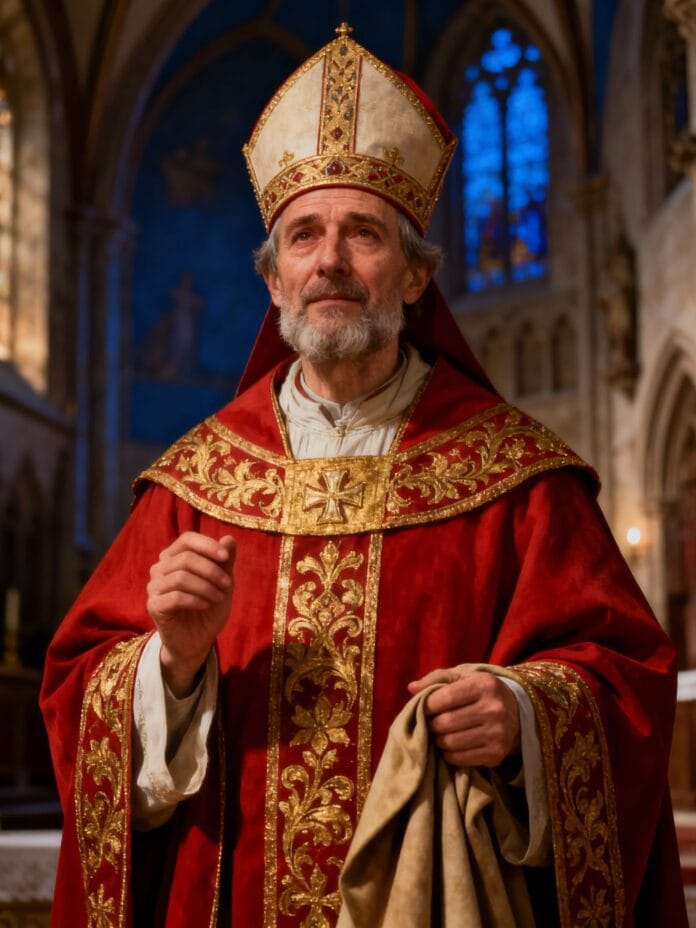
The former soldier turned missionary bishop, a witness to mercy in 4th century Gaul.
In the 4th century, in a Gaul still divided between paganism and ChristianityIn 1800, a young Roman soldier dared an act of charity: he cut his cloak for a poor man. This gesture, which became a symbol, reveals Saint Martin of Tours, one of the first non-martyr saints of the Church. A figure of sharing and evangelization, he continues to invite believers today to unite faith and compassion, action and contemplation.
Serving Christ in the poor
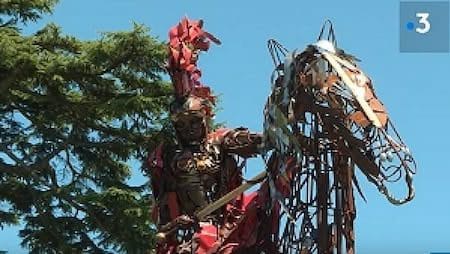
Born around 316 in Pannonia (modern-day Hungary), Martin, the son of a Roman tribune, grew up in a military environment. Early on, he felt the call of Christ despite the prevailing paganism. Recruited at fifteen into the imperial cavalry, he was stationed in Gaul, at Amiens, where his life changed dramatically.
One winter day, he came across a half-naked beggar. Without hesitation, Martin cut his cloak in two to cover him. The following night, Christ appeared to him, wearing this torn cloak. This vision completed his conversion: Martin immediately asked to be baptized.
After leaving the army, he joined Saint Hilary of Poitiers, defender of Christ the true God against Arianism. Together, they founded the first known monastic community in Gaul at Ligugé. There, Martin was formed through prayer and simplicity.
Around 370, the inhabitants of Tours came to ask him to become their bishop. He accepted out of obedience, while maintaining the lifestyle of a monk. Refusing all pomp, he traveled through the villages, preaching conversion and destroying pagan temples. He became known as “the apostle of the countryside”.
Until his death in Candes in 397, he dedicated his life to building monasteries, uniting peoples, and protecting the poorHis last words sum up his faithfulness: he declared himself ready to continue Christ's fight until his last breath. His tomb in Tours immediately became a major pilgrimage site.
The stories surrounding it
The earliest accounts, notably those of Sulpicius Severus, describe the saint's life with restraint. A legendary episode is interwoven: during the transfer of his body to Tours, flowers are said to have begun blooming again despite the season. This phenomenon became known as "Saint Martin's Summer," a symbol of gentleness and spiritual rebirth.
These stories, whether historical or poetic, all emphasize the same message: charity active transforms nature and hearts. Martin does not act out of heroism but out of fidelity to the incarnate Gospel.
Spiritual message
The gesture of the cloak remains a living parable of sharing. Saint Martin does not give away what he has in excess; he shares what he carries. True mercy does not wait to be rich: it acts when others suffer.
His example recalls the Gospel according to Matthew: “I was naked, and you clothed me.” The disciple of Christ never separates faith and tenderness. Like Martin, everyone can manifest the presence of Christ in simple gestures, anonymous encounters, and quiet acts of solidarity.
Prayer
Lord Jesus,
you who revealed your face to the poor man of Amiens,
Give us an attentive heart and open hands.
Teach us to share without counting the cost,
to recognize your presence in the smallest things,
and to spread peace where harshness divides.
May Saint Martin guide us on this path of mercy.
Amen.
To live
- Giving a garment, a meal, or a smile to a person in need.
- To call or visit someone who is forgotten or isolated.
- Read and meditate for ten minutes on Luke 3:10-11: “Whoever has two garments should give one to the one who has none.”
Places
The cult of Saint Martin has shaped the religious history of France. In Tours, the basilica rebuilt in the 19th century over his tomb remains a major place of prayer. Countless villages, streets, and churches bear his name.
It was in Candes-Saint-Martin, on the banks of the Loire, that he breathed his last, surrounded by his disciples. According to tradition, his body was brought back by boat to Tours as nature was blooming again. This “autumn spring” is a reminder that charity It brings life back to the very heart of the cold.
Throughout Europe, from Hungary to Brittany, stained-glass windows, statues, and frescoes celebrate the soldier who became a bishop. Martin, patron saint of soldiers, the poor, and military commissars, remains a figure embodying courage and compassion.
Liturgy
- Readings: Isaiah 61:1-3 / Luke 17,11-19 – Christ heals and sends.
- Song: Ubi caritas et amor, symbol of the unity that Martin sowed.