












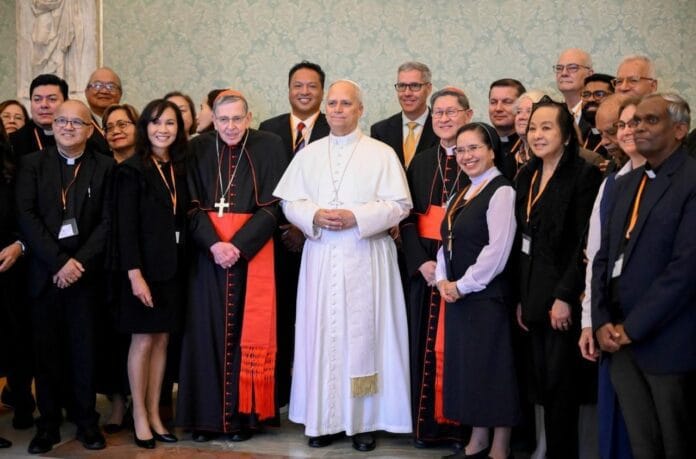
Before the Catholic Biblical Federation, Leo XIV He recalled a fundamental truth: the Church is not self-sufficient. She lives from the Gospel, from this living Word that springs forth from Christ, her Spouse.
This belief refers to the constitution Dei Verbum, a major text of the council Vatican II. This document opened the Scriptures to all the faithful, as a source both spiritual and intellectual, nourishing the faith of entire generations.
For Leo XIV, Returning to this origin is not nostalgia, but an urgent necessity. For through the Word, the Church always rediscovers its youth: it is regenerated by listening to the voice of the Lord who still speaks today.
«Listening to the Word» is not a passive exercise. It is an act of love and’humility. In the speech of pope, we perceive the call for a dual movement: inner reception and transmission.
Before proclaiming, we must receive. Before speaking of God, we must let God speak to our hearts. This balance between contemplation and mission, so typically biblical, is the key to authentic evangelization.
This attentive listening is the foundation of the legitimacy of all Christian discourse. Without it, there is a risk of transforming the proclamation of the Gospel into mere rhetoric, or even ideology. With it, one speaks with the voice of Christ Himself.
Leo XIV He emphasizes a central point: the widest possible access to Scripture. In a world where information circulates freely, it would be paradoxical for the Word of God to remain confined.
Bible translations are presented here as genuine missionary works. Each text rendered in a new language opens a space for encounter between God and a new people.
But beyond translation, it's about fostering a taste for encounters. The pope cite the lectio divina, this prayerful reading and meditative, which transforms the text into an inner dialogue. Where the Bible is read, God speaks; where it is shared, faith is born.
Evangelization in the Age of Screens
The new digital continents
The digital world is the mission field of the 21st century. Social networks, forums, online games, artificial intelligence: each virtual space becomes a place of human experience… or spiritual oblivion.
Leo XIV He doesn't use technical terms, but he understands the theological implications. Where humans express themselves, think, love, and search, God can be found.
Yet, these spaces are often saturated with noise, controversy, and misinformation. The Gospel is stifled or distorted there. Hence the call for pope: not to flee these places, but to inhabit them differently.
Evangelizing without dominating
It is not enough to "post verses" on a page. Evangelizing the digital world means adopting a presence: humble, consistent, embodied.
The risk would be to transform the digital mission into religious marketing. But Christ doesn't campaign; he invites. In the connected world, faith must be transmitted through the quality of witness: kindness, listening, authenticity.
A Christian can become a "living parable" in their daily interactions, through the way they respond, encourage, and serve. This requires inner discipline: praying before posting, discerning before reacting.
Creating oases of meaning
Digital spaces are not doomed to superficiality. They can become places of hope.
Many Christian projects are already innovating: online scriptural libraries, applications of lectio divina, interactive prayer chains, communities for sharing on the daily Gospels.
But the challenge remains: how to ensure that these tools do not replace the live relationship? Leo XIV It calls for "facilitating encounter," not replacing it with content. Digital technology should be a starting point, not an end in itself. A bridge leading to true community, to sacramental life, to the Word lived.
The Word of God in the face of the thousand voices of the world
To become living letters again
The concluding sentence of the speech pope sums it all up: becoming "living letters written not with ink but with the Spirit of the living God".
In a world saturated with messages, the best communication remains that of silent and faithful witness. Every Christian, every community, can be a "living scripture" of the Gospel: a face, a life, an attitude that reveals Christ without necessarily naming him.
This approach restores a sacramental dimension to the mission: the believer becomes a channel, a sign, a transparency of the Word.
Digital discernment
Proclaiming the Gospel online requires ethical vigilance.
The speed of digital technology can lead to religious misinformation or sterile debates. Leo XIV invites us to resist immediacy in order to rediscover the slowness of the Word.
This slowness is a form of spiritual resistance. Read the Bible, Meditating, then sharing from a place of prayerful introspection, becomes a missionary act in its own right. The believer then becomes a filter of peace in the chaotic flow of ideas.
Unity in diversity
The Catholic Biblical Federation, present on several continents, already embodies this vocation. Its translations, ecumenical initiatives, and cultural work build bridges.
In the digital world too, this unity must manifest itself: not a standardization, but a network of voices rooted in the same Source.
The internet can, paradoxically, realize the very spirit of Dei Verbum: to circulate the Word "so that all may hear, each in their own language." However, the missionary intention must prevail over the logic of influence.
A mission that is always new
Leo XIV This reminds us that the mission of the Church has not changed: to make Christ known. What changes is the world in which this Word resonates.
Today, this world is digital, fast-paced, and full of contrasts. But it remains human. That is where faith must take root.
Evangelizing digital spaces is not about conquest, it's about encounter. It's about sowing a living word through glances, messages, and exchanges.
And when that seed falls into a heart ready to listen, then even behind a screen, the Kingdom of God grows.