












Gospel of Jesus Christ according to Saint Luke
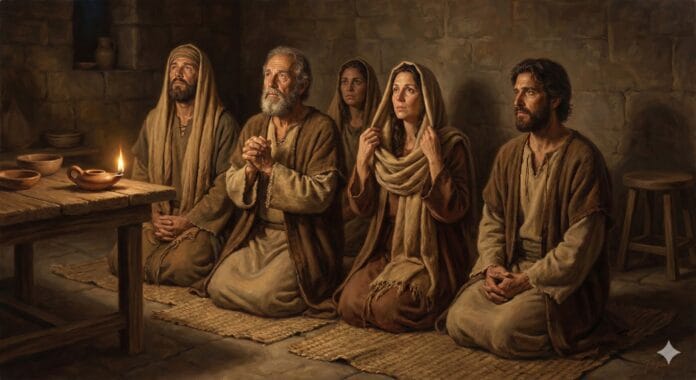
At that time, Jesus was speaking to his disciples:
«Be alert, so that your spirit does not become weighed down with carousing, drunkenness, and daily worries, and that day does not suddenly catch you like a trap; for it will come upon all who live on the earth. Be alert and pray continually, so that you may be able to endure all that is about to happen, and to stand before the Son of Man.»
Staying awake to stand tall: the spiritual art of vigilance according to Luke 21
How Jesus' urgent call to watch and pray transforms our daily lives into spaces for encountering God and prepares us to welcome his coming.
In a world saturated with distractions and anxieties, Jesus' words resonate with striking relevance: "Stay awake and pray at all times." This text speaks to every Christian who feels the weight of daily worries and seeks an inner compass to navigate life's turbulence. The message is clear: spiritual vigilance, nourished by constant prayer, constitutes the fundamental posture of the disciple who wants not only to survive trials, but to stand, free and dignified, before the coming of Christ.
We will begin by exploring the context of Jesus' eschatological discourse and the precise words he uses. Then we will analyze the three spiritual dangers he denounces. Next, we will develop three themes: vigilance of the heart, prayer as strength, and standing before the Son of Man. This will be followed by concrete applications, an anchoring in tradition, a path for meditation, a look at contemporary challenges, and a liturgical prayer to embody this message.
The Discourse on the Last Things: Understanding the Framework and Words of Jesus
To grasp the significance of our passage, we must first place it within its literary and historical context. Luke 21 This belongs to Jesus' great eschatological discourse, delivered a few days before his Passion, while he was teaching in the Temple in Jerusalem. The disciples were admiring the splendor of the building, and Jesus had just announced its imminent destruction. This prophecy opens a broader teaching on the tribulations to come, the signs of the times, and the coming of the Son of Man.
The immediate context is therefore one of dramatic tension. Jesus is speaking to disciples who will soon face the ordeal of the cross, followed by the persecutions of the early communities. But his gaze extends further: it encompasses all of human history up to its final fulfillment. Our passage (verses 34-36) constitutes the practical conclusion of this discourse. After describing the cosmic upheavals and historical trials, Jesus moves to the imperative: how to live now, in the limbo of expectation?
The Greek words deserve attention. “Prosechete heautois” (be on your guard) is a powerful phrase that literally means “be careful.” The danger is not primarily external; it resides within the human heart itself. Jesus then speaks of a “barethosin” (heavy) heart, a medical term evoking torpor and numbness. The image is that of a ship taking on water and slowly sinking.
The three causes of this heaviness form a significant gradation: "kraipale" (the drunkenness following a banquet, the hangover), "methè" (the drunkenness itself), and "merimnais biotikais" (the worries of life, concerns related to subsistence). Thus, we move from festive excess to addiction, and then to ordinary anxieties. Jesus touches here on a broad spectrum of human experience.
The image of the net («pagis») evokes a hunter’s trap that suddenly snaps shut on its prey. The Day of the Lord will not be a gentle transition but a sudden eruption. And this net will encompass «all the inhabitants of the whole earth»: no one will escape this moment of truth. Faced with this prospect, Jesus prescribes two verbs in the present imperative, indicating continuous action: «agrupneite» (stay awake, watch) and «deomenoi» (praying, in a state of supplication). The goal is twofold: to have the strength to escape («ekphugein») what is coming, and to stand («stathènai») before the Son of Man. This standing posture is that of dignity, freedom, and the reconciled human being who has no need to crawl or flee.
The liturgical lectionary places this text on the first Sunday of Advent in cycle C. This choice is theologically relevant: Advent The liturgical year begins with a call to vigilance. Even before preparing for Christmas, the Church reminds us that all Christian life is an active expectation of the Lord who is coming.
A heavy heart: a spiritual diagnosis of a sickness of the soul
The analysis of this passage reveals a remarkably subtle spiritual anthropology. Jesus makes a diagnosis before prescribing a remedy. And this diagnosis concerns the heart, "kardia" in Greek, the center of the person in biblical thought, the seat of intelligence, will, and affections.
The guiding principle is clear: the major spiritual danger is not a frontal attack from the enemy, but the gradual numbness that renders the heart incapable of perceiving spiritual realities. It is an anesthesia of the soul, a loss of inner sensitivity. The heart becomes like an atrophied organ that no longer fulfills its function.
The three causes mentioned by Jesus operate according to a common logic: they capture attention and divert it from what is essential. Drunkenness and revelry represent an escape into pleasure, a search for oblivion, an attempt to flee existential angst through sensory overload. The worries of life, on the other hand, represent the apparent opposite but produce the same effect: the mind is so absorbed by material concerns that no room remains for God.
Saint Augustine He beautifully commented on this paradox in his Confessions. He describes how the soul can be scattered among a thousand demands, "distentio animi," to the point of losing its inner unity and its capacity to be present to God. The burdened heart is a fragmented, scattered heart, no longer able to gather itself together for what is essential.
The metaphor of the net adds a tragic dimension. The trap makes no sound before snapping shut. The spiritually asleep man doesn't see the decisive day coming. He is surprised, caught off guard, in a state where he can neither flee nor confront the danger. The image suggests a certain passivity on the part of the victim: the prey caught in the net did nothing to fall into it; it simply lacked the vigilance that would have allowed it to spot the danger.
This analysis finds striking echoes in the other Gospels. Matthew recounts the parable of the ten virgins, five of whom fall asleep and miss the bridegroom's arrival. Mark emphasizes the unknown hour when the master will return. But Luke adds his own nuance: it is not simply a matter of being ready for a specific moment, but of maintaining a continuous quality of presence. The imperatives of the present emphasize duration: watching and praying "at all times" ("en panti kairô"), not occasionally, but as a permanent disposition.
Jesus' message is therefore not moralizing in the narrow sense. He does not simply condemn intemperance as a vice. He reveals a spiritual mechanism: everything that weighs down the heart compromises the capacity to encounter God. And this encounter is the ultimate goal of human existence.
The vigilance of the heart, an awakening that transforms one's perspective
The vigilance Jesus speaks of is not the anxious nervousness of someone who fears imminent danger. It is a quality of attention, a presence to oneself and to reality that allows one to perceive what escapes the distracted gaze. In Greek, "agrupneô" literally means "not to sleep," but the term has taken on a spiritual meaning: remaining in a state of inner wakefulness, keeping the lamp of conscience burning.
This vigilance begins with self-reflection. «Be on your guard,» Jesus said. The expression «prosecchete heautois» indicates that the first object of attention is our own heart. It involves monitoring inner movements, identifying tendencies toward heaviness, and detecting the warning signs of spiritual numbness. Desert Fathers They called this practice "nepsis", vigilant sobriety, and made it the foundation of all spiritual life.
In practical terms, emotional awareness means stepping back from the incessant flow of thoughts and emotions. Not to suppress them, but to observe them with clarity. When I feel anxiety rising, when I'm tempted to lose myself in entertainment, when my material concerns invade my entire mental space, can I even notice it? This simple awareness is already an act of vigilance.
Spiritual masters have often compared the heart to a citadel whose gates must be guarded. Thoughts, images, and desires all seek to enter. The watchman He does not let them pass without examination. He discerns what comes from God, what comes from wounded nature, and what comes from the enemy. This constant discernment is at the heart of the Ignatian tradition of discerning spirits, but it is rooted in the Gospel itself.
Vigilance also transforms our view of the world. The spiritually awakened person perceives signs that the asleep person does not see. They read events from a broader perspective, they discern God's active presence in history, they recognize the calls and invitations that the Lord addresses to them through circumstances. As Saint Paul says to the Ephesians: “Awake, O sleeper, rise from the dead, and Christ will shine on you” (Ephesians 5:14).
This quality of perception is not reserved for mystics. It can be practiced in ordinary life. The attentive parent perceives their child's unspoken needs. The attentive friend senses the suffering hidden beneath a smile. The attentive Christian recognizes Christ in the poor person who knocks at their door. Vigilance is a form of attentive love that refuses to be numbed by habit or weariness.
Finally, vigilance includes an eschatological dimension. It keeps alive the awareness that history has an end and a meaning, that Christ will return, that every moment could be the last. Not to cultivate morbid anxiety, but to give each moment its own inherent weight. As Saint Cyprian wrote in the third century: “He who awaits Christ does not fear death, for he knows that death is the passage to life.”
Prayer as a source of inner strength
Jesus' second imperative is "pray at all times." This injunction may seem unrealistic at first glance. How can we pray constantly when life demands a thousand activities that require our attention? Spiritual tradition has long pondered this question and offers answers that shed light on the Gospel text.
First, it's important to understand that the prayer Jesus speaks of isn't simply the occasional act of reciting formulas or engaging in meditation. It's a fundamental orientation of the heart toward God, a loving attentiveness maintained amidst our daily activities. Eastern monks developed the practice of the Jesus Prayer, a short invocation repeated until it becomes like the heartbeat. But the principle holds true for every Christian: cultivating an inner presence to God that colors all our activities.
Next, the Greek text uses the participle "deomenoi," which specifically designates supplication, a request. Vigilant prayer is not primarily serene contemplation, but a cry to God, an acknowledgment of our radical need for his grace. Jesus himself prayed in this way in Gethsemane, in the anguish of the impending Passion. The prayer of the watchful one is humble; it knows that without divine help, we are unable to endure.
The purpose of this prayer is explicit: "to have strength" ("katischusète"). The Greek verb suggests a strength that allows one to dominate, to overcome, to prevail. Prayer is therefore not an escape from reality, but a source of energy to face it. It does not eliminate trials but gives the ability to get through them without being overwhelmed. Saint Paul will express the same conviction: "I can do all things through him who strengthens me" (Ph 4, 13).
This strength manifests itself in two ways: it allows one to escape what is destined to happen and to stand before the Son of Man. The first aspect may seem surprising. How can one escape what is inevitable? The escape in question is not a geographical flight, but an inner liberation. The one who prays will not be trapped by fear, despair, or rebellion. They will face the same trials as others, but without losing their soul.
The Carmelite tradition has particularly developed this intuition. Teresa of Avila describes how the soul united with God through prayer can experience profound peace amidst the greatest tribulations. John of the Cross He speaks of the dark night as an ordeal that only persevering prayer allows us to traverse without losing ourselves in it. This is not Christian stoicism, but the certainty that God acts in prayer to transform our relationship to events.
Prayer at all times also implies specific times of explicit prayer. The Church has always structured its days with the Liturgy of the Hours, offering the faithful regular encounters with God. These structuring moments then permeate the entire day. Like a musician who practices scales in order to improvise freely, the Christian who faithfully prays at the prescribed hours develops an inner disposition that enables them to pray "at all times."
Finally, communal prayer holds an essential place. “For where two or three are gathered in my name, I am there among them” (Mt 18:20). Vigilance is not a solitary endeavor. The Church watches together, supports those who falter, and carries in prayer those who are going through trials. community dimension Prayer is a bulwark against individual discouragement.
To stand before the Son of Man
The culmination of vigilance and prayer is a posture: "standing before the Son of Man." This final expression deserves special attention because it reveals the ultimate meaning of the entire passage.
In biblical culture, standing upright is the posture of the free person, the servant in service, the one who gives an account with confidence. Conversely, prostrating oneself on the ground can express servile fear, subjugation, and shame. Jesus does not want disciples terrified by his coming. He calls them to an encounter where they can present themselves with their heads held high, not out of pride, but out of grace.
This upright posture contrasts with the image of a heavy heart. Those who have allowed themselves to be numbed by excess or worry will be bent over, unable to lift their eyes. Those who have watched and prayed will have maintained their spiritual stature. They will be able to look upon Christ face to face, as a friend looks upon a friend, as a child runs to their returning father.
The expression "Son of Man" refers to the vision of Daniel 7where a mysterious being, like a son of man, receives universal and eternal kingship from the Old Man. Jesus applied this title to himself with particular fondness. It signifies his messiahship in its dimension of glory and judgment. To stand before him is to be ready for the final judgment, not with anxiety, but with confidence.
This trust is not presumption. It rests on mercy Divine grace is not based on our merits. Rather, it requires our active collaboration. Vigilance and prayer are our way of responding to the grace that precedes and accompanies us. They prepare within us a space of welcome for the One who comes. As Saint Bernard wrote: “He comes to us so that we may go to him.”
Standing upright also implies a certain freedom from the world. The one who keeps watch is not chained to earthly possessions. He uses them without attachment, he passes through trials without being overwhelmed by them, he looks to the future without fear. This freedom is the fruit of a long process of detachment, not contempt for creatures, but a just relationship with them. Saint Ignatius of Loyola will speak of indifference, this disposition which allows us to always choose what leads more towards the end for which we were created.
Finally, to stand firm is to be ready to bear witness. The vigilant disciple is not withdrawn into his inner life. He is available for mission, ready to give an account of the hope that dwells within him. Vigilance makes him attentive to opportunities to serve, to the promptings of the Spirit, to the needs of his brothers and sisters. It makes him a watchman for others, an awakener who helps his contemporaries to rouse themselves from their slumber.
Experiencing awakening on a daily basis
How can we translate this teaching into concrete practice? Vigilance and prayer must permeate all dimensions of our lives, not as an additional constraint, but as a quality of presence that transforms every activity.
In the personal and intimate sphere, mindfulness begins upon waking. The first minutes of the day are decisive: they often shape everything that follows. Taking the time for a morning prayer, however brief, is an act of mindfulness that colors the hours that follow. Similarly, examining one's conscience in the evening allows one to identify moments when the heart has grown heavy, missed opportunities, and graces received. This Ignatian practice is a powerful tool for spiritual growth.
Personal vigilance also includes attention to the body. The excesses that Jesus denounces have a physical dimension. Sufficient sleep, a balanced diet, and moderate exercise are not concessions to hedonism, but conditions for spiritual vigilance. An exhausted or intoxicated body cannot support an awakened soul. Desert Fathers, Despite their austerities, they knew that it was necessary to take care of the body so that it would remain capable of praying.
In family and relationships, attentiveness translates into being present and caring for loved ones. How many conversations are only half-hearted, with minds elsewhere, eyes glued to phone screens? Being attentive with your children, spouse, and friends means offering them your full attention, free from distractions. It also means discerning their deepest needs beyond their superficial requests and praying faithfully for them.
Family prayer deserves a renewed place. It doesn't need to be long to be fruitful. A sincere grace, a dozen or so rosary Sharing a Gospel reading on Sunday creates a spiritual bond that unites the family and turns it towards God. Children who grow up in an atmosphere of prayer receive a precious inheritance.
In the professional and social spheres, vigilance means maintaining one's ethical compass amidst pressures and compromises. It fosters sensitivity to injustice, attentiveness to vulnerable individuals, and the ability to resist dehumanizing forces. Praying for colleagues, for difficult decisions, and for those encountered professionally allows us to maintain a spiritual perspective. the work.
Social and ecclesial engagement also requires particular vigilance. It is easy to be very active without praying enough, to multiply meetings while neglecting what is essential. The temptation of activism lies in wait for every committed Christian. Vigilance reminds us that apostolic effectiveness comes from God, not from our own busyness. It invites us to balance action and contemplation, service and spiritual renewal.
What the saints and doctors teach us
Our visit has nourished the reflections of the greatest witnesses of the faith. Their meditation enriches our understanding and demonstrates the enduring fruitfulness of this message throughout the centuries.
Saint John Chrysostom, in his homilies on Luke, emphasizes the universal nature of the warning. The net will fall on everyone, says Jesus. No one can consider themselves safe because of their position, their wealth, or even their outward piety. Vigilance is therefore a requirement for everyone, without exception. Chrysostom also stresses that the hardening of the heart is gradual and often imperceptible: this is precisely why constant attention is necessary.
Saint Gregory the Great, in his Moralia on Job, develops the metaphor of the watchman. He compares the Christian to the sentinel on the ramparts, who must remain awake while the city sleeps. This responsibility is all the greater for shepherds, who watch over the flock. But every baptized person participates in this mission of vigilance, at least for themselves and their loved ones.
Monastic tradition has made vigilance a pillar of its spirituality. Saint Benedict, In his Rule, he organizes the monks' lives around the Divine Office, which sanctifies the hours of the day and night. The night vigils, where the monks rise to pray in the dead of night, are the most powerful expression of this vigilance. They serve as a reminder that the Lord can come at any hour and that he deserves to be awaited.
The Rhenish-Flemish mystics, notably Meister Eckhart and Ruusbroec, meditated on the awakening of the soul to its divine depths. For them, vigilance is not merely being aware of dangers, but being open to the presence of God at the core of our being. To remain awake is to allow the divine spark within us to be rekindled, to return to the center where God dwells. This contemplative dimension complements the ascetic dimension of vigilance.
Thérèse of Lisieux, in her "little way," offers an accessible approach to vigilance. It consists of living each moment with love, transforming the smallest actions into prayer, and remaining attentive to the presence of Jesus in the ordinariness of life. This loving vigilance is within everyone's reach and does not require extraordinary austerities.
The Catechism of the Catholic Church summarizes this teaching in paragraphs 2849-2854, in its commentary on the petition "Lead us not into temptation." It speaks of vigilance of heart, final perseverance, and spiritual combat. The catechism emphasizes that this vigilance is a gift to be sought in prayer: we cannot be vigilant by our own strength alone.
Seven steps to entering into speech
To make this text personal nourishment, here is a seven-step meditation itinerary, adaptable according to the time available.
First step: preparation. Find a quiet place, place your body in a stable but relaxed position. Take a few deep breaths to calm your inner turmoil. Ask the Holy Spirit to open your heart to the Word.
Second step: slow reading. Read the passage from Luke 21Read pages 34-36 two or three times, slowly, aloud if possible. Let the words resonate, without yet trying to understand or analyze them. Note down the expressions that strike you.
Third step: the examination. Jesus speaks of a heart weighed down by excesses and worries. Ask yourself honestly: what is weighing down my heart right now? What distractions are preventing me from being vigilant? What worries are invading my inner space?
Fourth step: desire. Jesus promises strength to those who watch and pray. State your desire: what do you ask of the Lord? The strength to resist what temptation? The grace to stand firm in what trial?
Fifth step: the conversation. Speak to Jesus as to a friend. Tell him about your difficulties staying awake, your sleeplessness, your discouragement. Listen to what he wants to answer you. Remain in this dialogue for as long as you feel it is fruitful.
Sixth step: resolution. Choose a concrete point for the coming days. A habit to change, a time for prayer to establish, a particular vigilance to exercise. Let it be simple, specific, achievable.
Seventh step: thanksgiving. Conclude by giving thanks for the word received, for the time of prayer, and for the graces to come. You can conclude with the Lord's Prayer or a Greetings Married.
Staying vigilant in the age of screens: responses to the challenges of our time
Jesus' call to vigilance resonates particularly strongly in our contemporary context. The distractions that weigh down the heart have multiplied in unprecedented ways, and life's worries have taken on new forms. How can we be vigilant today?
The first challenge is that of hyperconnectivity. Screens have become ubiquitous, constantly demanding our attention. Notifications, endless news feeds, and apps designed to be addictive produce precisely the effect Jesus denounced: a heaviness of the heart, an inability to concentrate, and an escape into perpetual entertainment. Spiritual vigilance today requires discipline. digital : disconnected time, screen-free spaces, conscious and limited use of technological tools.
The second challenge is that of widespread anxiety. The worries of life that Jesus spoke of concerned daily sustenance. Today, global anxieties are added to these: climate crisisGeopolitical instability, pandemics, economic uncertainty. The constant stream of alarming information can overwhelm the heart to the point of paralysis. Vigilance does not mean ignoring these realities, but facing them with trust in God rather than in sterile anxiety. Christian prayer is not the opiate of the masses, but a source of courage for action.
The third challenge is secularization. In a culture that has largely forgotten the eschatological dimension, speaking of the coming of the Son of Man can seem archaic. Even among ChristiansThe expectation of Christ's return has often faded. Yet it is precisely this prospect that gives vigilance its urgency. Rediscovering the meaning of history as a journey toward fulfillment, as an expectation of a definitive encounter with Christ, restores to each moment its depth and seriousness.
The fourth challenge is that of spiritual individualism. Vigilance risks being understood as a personal project of self-improvement, a form of self-centered spiritual development. However, the Gospel text situates vigilance within a communal and missionary context. To be vigilant is also to be attentive to others, to share the concerns of the Church and the world, and to practice fraternal correction when a brother or sister falls asleep.
Faced with these challenges, the answer is not a defensive retreat but a creative deepening of tradition. Contemporary tools can also serve vigilance: Christian meditation apps, online prayer communities, easy access to spiritual texts. The essential thing is to remain in control of these tools rather than their slave, to use them to awaken rather than lull.
Prayer to become a watchman
God our Father, you who neither sleep nor slumber, you who watch over Israel and all humanity, we come to you with hearts often weighed down by the excesses and worries of this world. You know our distractions, our escapes, our slumbers. You know how difficult it is for us to remain awake, awaiting your Son.
We beseech you: send your Holy Spirit upon us, the Spirit of vigilance and prayer. May he lighten our burdened hearts, clarify our clouded vision, and rekindle within us the flame of hope. Grant us the grace to watch with perseverance, not out of fear of judgment, but out of longing for your presence.
Lord Jesus, Son of Man who will come in glory, teach us to wait for you as a friend waits for a friend, as a wife waits for her husband, as a child waits for his father returning from a journey. May our waiting not be tense but joyful, not anxious but trusting.
Purify us from the intoxications that dull our senses: the intoxication of comfort, the intoxication of entertainment, the intoxication of success. Deliver us from the worries that overwhelm us: the worry of money, the worry of health, the worry of the future. Not by removing these realities from our lives, but by allowing us to experience them in peace of those who know that you have conquered the world.
Give us the strength you promised to those who watch and pray. The strength to resist temptations, the strength to endure trials, the strength to bear witness to you in a world that forgets you. May this strength not be pride in our own merits but gratitude for your grace.
Make us watchmen for our brothers and sisters. May our vigilance awaken those who sleep, may our prayer sustain those who weaken, may our hope enlighten those who despair. United with Married, the vigilant Virgin who pondered all things in her heart, united with the saints who watched before us, we want to form the great community of those who await your coming.
And when you come, Lord, grant that we may stand before you, not as terrified slaves, but as sons and daughters welcoming their Father. May that day be for us not a net that imprisons, but a door that opens onto eternal life. We ask this through Jesus Christ, our Lord, who lives and reigns with you and the Holy Spirit, now and forever. Amen.
Choosing the posture of the watchman today
At the end of this journey, one certainty emerges: vigilance is not an option for the Christian, but their fundamental stance in the world. Jesus does not offer just another piece of advice; he indicates the very condition of the disciple who wishes to journey through history without losing their soul.
This vigilance is not anxious tension but loving attention. It is not an escape from the world but a lucid presence to reality. It is not heroic performance but humble collaboration with grace. And it is learned, day after day, through the faithful practice of prayer and the courage to constantly return to what is essential.
Jesus' call resonates for you today: "Stay awake and pray at all times." What's stopping you from starting now? Not tomorrow, not when you have more time, not when circumstances are better. Now. Because the present moment is the only time you can respond to grace.
The Son of Man will come. This certainty is not a threat but a promise. It gives your life its horizon and its direction. It frees you from the bondage of the temporary to open you to the eternal. It invites you to live each day as if it were your last, not in turmoil, but in the fullness of one who knows why they live.
Rise up, you who are reading these lines. Shake off your numbness. Be alert. And begin to pray now, to receive the strength that will enable you to stand when the Lord appears.
In practice: seven commitments for concrete vigilance
- Establish a fixed daily prayer time, even a short one, as an anchor for your spiritual vigilance over time.
- Practice self-reflection each evening to identify what has weighed down your heart and give thanks for the moments of presence.
- Choose one day per week to fast digital or to disconnect in order to free your attention from constant demands.
- Join or form a small spiritual sharing group to experience vigilance in community and support each other.
- Memorize the verse of Luke 21, 36 and recite it in moments of temptation or anxiety as a prayer of vigilance.
- Cultivate silence regularly, even if only for a few minutes, to hear the voice of God that is drowned out by noise.
- End each day by placing tomorrow in God's hands, trusting that His grace will go before you.
References
Primary sources: Gospel according to Saint Luke, chapter 21, verses 34-36; Gospel according to Saint Matthew, chapter 25 (parable of the ten virgins); Book of Daniel, chapter 7; Letter of Saint Paul to the Ephesians, Chapter 5.
Secondary sources: Saint John Chrysostom, Homilies on the Gospel of Luke; Saint Gregory the Great, Moralia in Job; Saint AugustineConfessions (Book XI on Time); Catechism of the Catholic Church, numbers 2849-2854; Saint Teresa of AvilaThe Interior Castle; Saint Ignatius of LoyolaSpiritual exercises (rules of discernment).
Contemporary works: Jean-Claude Larchet, Therapeutics of spiritual illnesses; Anselm Grün, Vigilance of the heart; Cardinal Robert Sarah, The power of silence.