












Gospel of Jesus Christ according to Saint Matthew
At that time, Jesus said to his disciples:
«Just as it was in the days of Noah, so it will be at the coming of the Son of Man. In those days before the flood, people were eating and drinking and marrying, up to the day Noah entered the ark; and they knew nothing about what would happen until the flood came and took them all away. So it will be at the coming of the Son of Man.”.
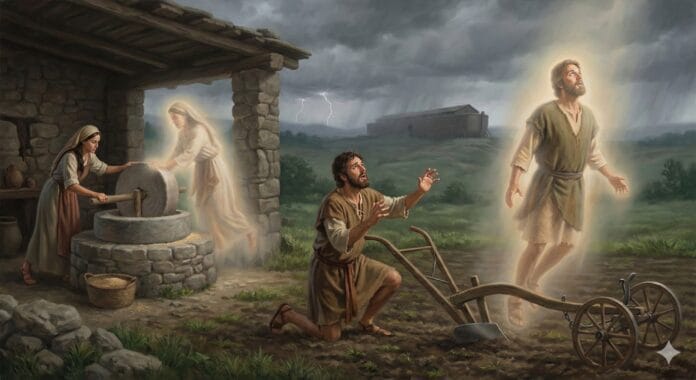
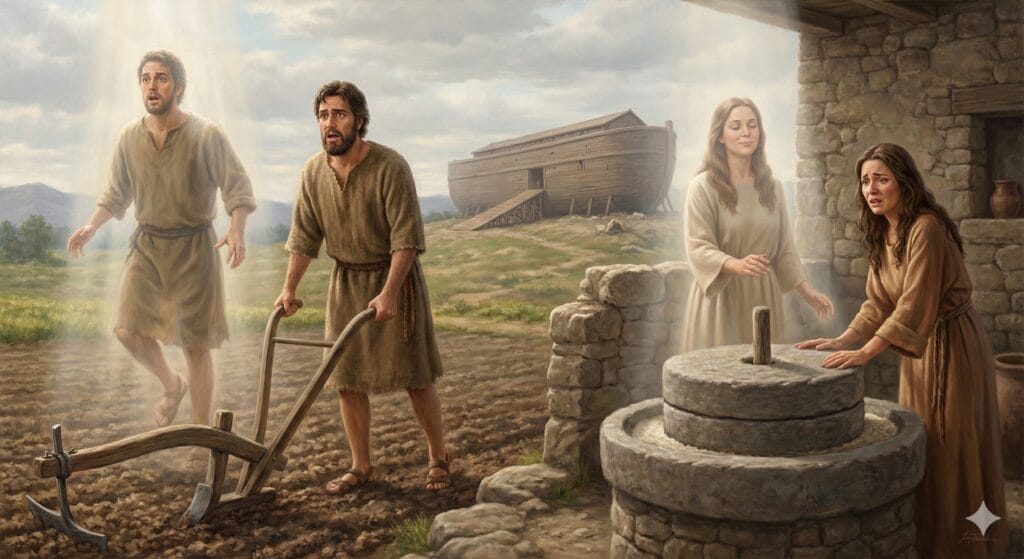
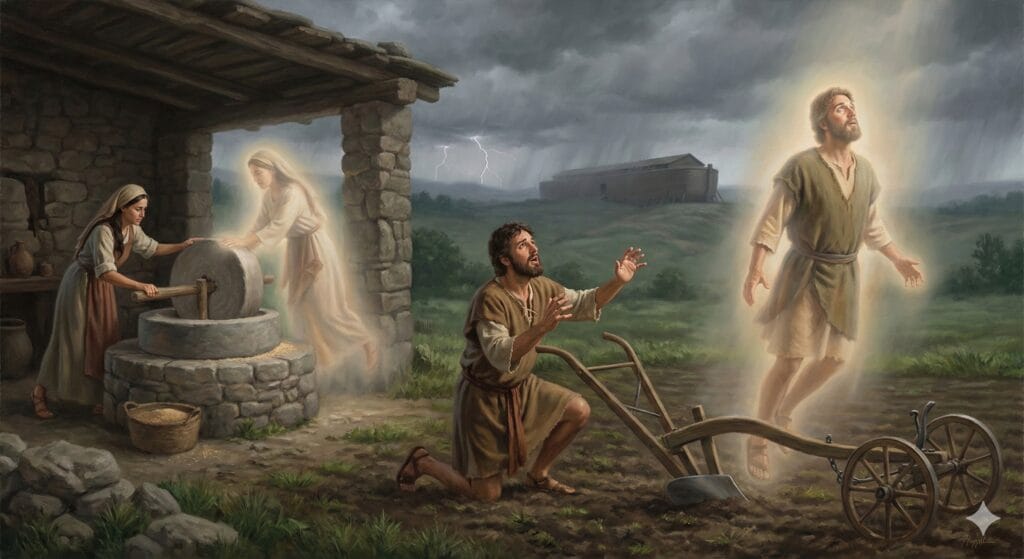
Then two men will be in the fields: one will be taken, the other left. Two women will be at the mill grinding: one will be taken, the other left.
Therefore, stay awake, for you do not know on what day your Lord will come. Understand this well: if the master of the house had known at what hour of the night the thief would come, he would have stayed awake and would not have allowed his house to be broken into.
Therefore you also must be ready, for the Son of Man will come when you do not expect him.»
Be watchful so you are ready: welcome God's unexpected with an awake heart
How Jesus' words on vigilance transform our daily lives into spaces of active waiting and living encounters with the Lord who is coming
We often live as if tomorrow were guaranteed. In this striking passage from Matthew, Jesus shatters this comfortable illusion. By comparing his coming to the days of Noah, he doesn't seek to frighten us, but to awaken us. This article is for any believer who desires to live an embodied, attentive faith, ready to welcome Christ in every moment of daily life. Together, we will explore how this Gospel-based vigilance can become a source of joy rather than anxiety, and how it radically transforms our way of living in the present moment.
This journey will first lead us to the roots of the text, within its Matthean and eschatological context. We will then analyze its structure and the imagery used by Jesus. Three thematic areas will allow us to delve deeper: ordinary blindness, the rupture of time, and the art of vigilance. We will draw concrete implications for our spiritual lives from these themes before drawing upon Christian tradition and offering a practical meditation. Contemporary challenges will be addressed with nuance, followed by a liturgical prayer and a conclusion calling for action.
The eschatological discourse: when Jesus unveils the horizon of history
To fully grasp the significance of this passage, it must be placed within its literary and theological context. Matthew 24:37-44 belongs to Jesus' great eschatological discourse, delivered on the Mount of Olives, facing the Temple in Jerusalem. This discourse, spanning chapters 24 to 25, constitutes one of the five major teachings structuring the Gospel of Matthew.
The immediate context is crucial. Jesus has just announced the destruction of the Temple, causing astonishment among his disciples. They then ask him, «Tell us, when will this happen, and what will be the sign of your coming and of the end of the age?» (Mt 24:3). The question intertwines three temporalities that Jesus, in his response, will deliberately interweave: the fall of Jerusalem, his glorious coming, and the end times. This juxtaposition is not accidental. It teaches us that each generation lives in a state of eschatological urgency, that history is always pregnant with a possible fulfillment.
Our passage comes after a series of warnings about impending tribulations, false prophets, and cosmic signs. But here's the twist: after describing spectacular events, Jesus radically changes tack. The coming of the Son of Man will not be preceded by signs that would allow us to predict it. It will emerge in the most ordinary of everyday life, as in the days of Noah.
The evangelist Matthew wrote for a Judeo-Christian community, probably after the destruction of the Temple in 70 AD. These believers experienced a twofold tension: the expectation of Christ's return and the need to persevere in their faith despite the delay. The text thus addresses a pressing pastoral question: how to maintain vigilance when time stretches on?
The Alleluia verse that accompanies this passage in the liturgy illuminates its interpretation: «Show us your love, O Lord, and grant us your salvation» (Psalm 84:8). This prayer of the psalmist transforms anxious waiting into loving longing. Vigilance is not a clinging to the future, but a trusting openness to the coming love of God.
This text is proclaimed every year on the first Sunday of Advent, this liturgical time when the Church enters a new year and renews its expectation. Advent This is not primarily a preparation for Christmas, but a school of vigilance for the three comings of Christ: in history (Incarnation), in the heart (grace), and in glory (Parousia). Our journey plunges us into the heart of this threefold expectation.
The architecture of a teaching method: structure and dynamics of the text
A structural analysis of Matthew 24:37-44 reveals a remarkably well-crafted construction, where each element contributes to the impact of the message. Jesus unfolds a teaching in three parts, framed by a historical comparison and a domestic parable.
The first movement establishes a parallel with the days of Noah. The expression "as it was" opens a window onto the past to illuminate the future. This typological device, familiar to biblical thought, establishes a correspondence between two moments in the history of salvation. Noah thus becomes a prophetic figure, and his era a mirror of our own.
The description of the "days of Noah" is deliberately neutral, almost banal: "they ate and drank, they married and they married." There is no mention of the violence and corruption that Genesis He attributes this to that generation. Jesus doesn't point to spectacular sins, but to something more subtle and universal: absorption in the everyday, forgetting any vertical dimension. It is precisely this ordinariness that gives the warning its power. The danger lies not in excess but in becoming mired in it.
The second movement presents two parallel scenes: two men in the fields, two women at the mill. The repetition creates a symmetrical effect that underscores the unpredictability of judgment. These people are engaged in the same activity, share the same space, and seemingly live the same lives. Yet, «one will be taken, the other left.» The distinction is not external but internal. It reveals a difference invisible to human eyes but decisive in the eyes of God.
The interpretation of this "taken" and "left" has been the subject of much debate. Does being "taken" mean being saved or being swept away by judgment? The context of the flood suggests that those "taken" by the waters perished, while Noah was preserved. But from an eschatological perspective, being "taken" evokes rather the gathering of the elect (Mt 24:31). This ambiguity may be intentional: it prevents us from settling comfortably on one side or the other.
The third movement draws the practical conclusion: «Therefore, be watchful.» The imperative is reinforced by the parable of the house owner and the thief. This bold image compares the coming of the Son of Man to a burglary. The point of comparison is clearly not moral but temporal: total unpredictability. If we knew the hour of danger, we would prepare. But we don't know. Therefore, we must always be watchful.
The central idea running through the entire passage is clear: the uncertainty of time is not a problem to be solved but a condition to be lived in. Christian vigilance is not a technique of prediction but a quality of being. It transforms our relationship to time by keeping it open to the intervention of God.

Ordinary blindness: when everyday life becomes a gilded cage
The first thematic area we identify concerns what we might call "ordinary blindness." Jesus describes Noah's contemporaries with a precision that reflects our own reality: "They ate and drank, they married and were given in marriage." These activities are not inherently bad. Eating, drinking, and marrying: these are fundamental human realities, blessed by God from the very beginning.
So, where does the problem lie? It lies in the word Jesus uses to describe this generation: «they suspected nothing.» In Greek, the verb suggests willful ignorance, a refusal to see. These people weren't incapable of understanding; they were simply too preoccupied to care. Daily life had consumed their consciousness, leaving no room for God's unexpected intervention.
This description resonates strangely with our times. We live in a culture of saturation. Our schedules are overflowing, our screens are constantly flashing, our attention is perpetually being solicited. In this whirlwind, who takes the time to look up? Who still asks themselves, "What if God came today?" The question seems almost incongruous, out of place, like a religious intrusion into the serious world of everyday business.
The philosopher Blaise Pascal had already identified this mechanism, which he called "diversion." Not amusement in the trivial sense, but anything that distracts us from what is essential by absorbing us into the trivial. "All of humanity's problems stem from a single source: our inability to sit quietly in a room," he wrote. Perpetual restlessness becomes a spiritual anesthetic.
Saint Augustine, In his Confessions, he describes a similar experience. Before his conversion, he lived scattered among creatures, unable to find inner peace and encounter God who nevertheless dwelt within him. «You were within me, and I was outside,» he confesses. This blindness is not primarily intellectual but existential. It is a way of life that exiles us from our own inner depths.
The Christian spiritual tradition has developed a whole vocabulary to name this state: acedia, lukewarmness, spiritual worldliness. pope François readily uses this last expression to describe a faith that accommodates itself to the world to the point of losing its prophetic flavor. One can be outwardly very religious and spiritually asleep. Practices become routines., the sacraments Habits, prayer a monologue. God is no longer awaited, he is managed.
The remedy Jesus offers is not to flee from daily life, but to inhabit it differently. Ordinary activities—eating, working, loving—can become places of mindfulness if we approach them with an awakened awareness. It is about cultivating within immanence an opening to transcendence, about living each moment as potentially carrying the potential for eternity.
The rupture of time: when eternity bursts into history
The second thematic axis explores the very nature of the event announced by Jesus: "the coming of the Son of Man". This expression, laden with biblical resonances, designates the definitive intervention of God in history, that moment when time will be as if recapitulated and judged.
The image of the flood is particularly illuminating. The flood, in the narrative of Genesis, This represents a radical break in the course of the world. Overnight, everything changes. Certainties crumble, points of reference disappear, and human projects are swallowed up. Yet this rupture was not without preparation: Noah had built the ark over many years, visible to all. But no one had wanted to see.
The coming of the Son of Man will have this same disruptive structure. It will not fit into the predictable continuity of history. It will strike like a flash of lightning, suddenly revealing what was hidden. The two men in the fields, the two women at the mill, lived side by side, seemingly identical. The coming of the Lord reveals their secret difference.
This view of time is profoundly biblical. For the Bible, time is not a homogeneous and indifferent flow. It is punctuated by kairos, those decisive moments when eternity touches the temporal. The Incarnation was such a moment. The Resurrection Another was to follow. The Parousia will be its fulfillment. But between these great events, every moment can become a kairos for the one who is vigilant.
The Danish philosopher Søren Kierkegaard beautifully reflected on this dimension of Christian time. For him, faith is precisely this capacity to live in the present moment with all the seriousness of eternity. Not to flee time into an abstract beyond, but to embrace time as the realm of decision. Each moment is pregnant with an alternative: to open oneself or close oneself off, to welcome or reject, to be awake or to sleep.
Orthodox tradition speaks of "transfigured time." In the liturgy, particularly in the Divine Liturgy, chronological time is suspended. The faithful enter into God's time, this "eighth day" which is both a memory of the Resurrection and anticipation of the Parousia. The liturgy is not an escape from time but a transformation of time, an initiation into eschatological vigilance.
For us today, this means that the future is not simply what comes after the present. God's future can emerge at any moment, in any circumstance. An encounter, a reading, a trial, a joy can become the occasion for the Lord's coming. Vigilance consists of keeping this awareness open, this willingness to be surprised by God.
This does not mean living in constant anxiety. The image of the thief, while striking, should not mislead us. Jesus is not a burglar who comes to steal. He is the bridegroom who comes for the wedding feast, the master who comes to reward his faithful servants. The break he brings is that of joy that overflows our calculations, of love that exceeds our merits. To watch is to await this joy with confidence.
The Art of Vigilance: A Spirituality of Loving Attention
The third thematic axis leads us to the heart of Jesus' injunction: "Therefore, be watchful." This verb, in Greek gregoreo, literally means "to be awake," as opposed to sleeping. It designates a state of active consciousness, sustained attention, a presence to what is happening. But what kind of vigilance is it exactly?
Let us first clarify what it is not. Christian vigilance is not an anxious watch for heaven, searching for cosmic signs. Nor is it an obsession with calculating time, seeking to determine the date of Christ's return. History is littered with the ruins of such predictions, all of which have been disproven. Jesus himself claims to know neither the day nor the hour (Mt 24:36). To claim to know what the Son does not know would be a form of spiritual pride.
Vigilance is not a moral rigidity, a constant fear of judgment. Some spiritual traditions have cultivated this fear to the point of neurosis, producing terrified rather than enlightened Christians. But love casts out fear, as Saint John reminds us (1 John 4, 18). Vigilance that is not imbued with trust would betray the Gospel.
So, what level of vigilance is needed? Desert Fathers, These early monks, who explored the depths of the spiritual life, developed a practice they called nepsis, often translated as "sobriety" or "vigilance." It involves paying attention to the inner movement of the soul, discerning thoughts and desires, and guarding the heart. This vigilance is not primarily concerned with the external world but with the inner self. It consists of remaining present to oneself before God.
Saint Basil of Caesarea explains that to be vigilant is "to have a soul that does not sleep, that does not succumb to passions." Vigilance is therefore a quality of the soul, an inner awakening that is then expressed in actions. It presupposes self-work, an asceticism in the positive sense of the term: not a morbid mortification, but a training in inner freedom.
The Carmelite tradition, with Saint Teresa of Avila and holy John of the Cross, This dimension has been explored in greater depth. For them, vigilance is inseparable from prayer, that silent prayer in which the soul remains attentive to God. In prayer, one learns to silence the inner chatter, to calm the agitation of thoughts, in order to become available to the divine presence. This regular practice gradually cultivates a permanent disposition of vigilance.
But Christian vigilance is not only contemplative. It is also active and engaged. To be vigilant is to be attentive to the signs of the times, to the calls of the Gospel in history. It is to discern where Christ comes today: in the poor, the stranger, the sick, the prisoner (Mt 25:31-46). Eschatological vigilance leads to ethical commitment.
Simone Weil, this mystical philosopher of the 20th century, spoke of attention as the purest form of prayer. Being attentive to others, truly present to their experience, is already a form of spiritual vigilance. In a world of widespread distraction, this attention becomes a prophetic witness. Those who are vigilant see what others do not see, hear what others do not hear, because they are not swept away by the tide of insignificance.
Living vigilance: from the spheres of everyday life to the horizons of eternity
How does this evangelical vigilance translate concretely into the different dimensions of our existence? Let's explore some spheres of life where the call of Jesus can take flesh.
In the personal and spiritual sphere, vigilance begins with establishing regular times for reflection. This can take the form of morning prayer, where one entrusts one's day to the Lord with the awareness that this day could be the last or the first of eternity. lectio divina, this prayerful reading Scripture is another privileged place for vigilance: there, we listen to the Word with the expectation that it will reach us today. The evening examination of conscience allows us to review the day to discern God's presence and missed opportunities.
In the realm of relationships and family, being watchful means being truly present for those entrusted to our care. How many families live under the same roof without ever truly connecting? Gospel-inspired vigilance invites us to cultivate the quality of presence: to truly listen, truly see, truly be there. It also urges us not to postpone words of love, forgiveness, and gratitude. If the Lord were to come this evening, what would we want to say to those we love?
In the professional and social spheres, vigilance takes the form of ethical discernment. How can I practice my profession as a service and not simply as a pursuit of profit? How can I be attentive to the injustices around me, to vulnerable people, to situations that call for a word or a gesture? The vigilant Christian is not content with simply doing their job correctly; they are attentive to the broader dimensions of their actions, to their impact on others and on creation.
Within the Church, vigilance protects us from religious routine. Participating in the Eucharist with a keen awareness that Christ is truly coming, now, under the appearances of bread and wine. Receive the sacraments Not as formalities, but as encounters. To engage in the community not out of habit, but out of love. Ecclesial vigilance also implies a critical sense: being attentive to possible abuses, counter-witnesses, and necessary reforms.
In the civic and political sphere, Christian vigilance awakens a sense of responsibility for the common good. Faced with the major challenges of our time—ecological, social, and geopolitical—believers cannot take refuge in a spiritualized indifference. To be vigilant is also to watch over the community, over the most vulnerable, and over creation. It is to exercise discernment in the face of ideologies and manipulations, and to seek truth and justice.
In all these spheres, vigilance is not a tense effort but a confident disposition. It arises from the certainty that the Lord is coming and that his coming is good news. It is nourished by the hope that "does not disappoint" (Rm 5, 5). It is expressed in charity which is "the fullness of the law" (Rm 13, 10).
Vigilance throughout the ages of the Church
The Christian tradition, in its diversity, has consistently reflected on the call to vigilance. Let us explore some significant voices that enrich our understanding.
From the earliest centuries, the Church Fathers made vigilance a central theme of their preaching. Saint John Chrysostom, commenting on our passage, emphasizes the merciful aspect of uncertainty. If we knew the day of our death, he says, we would spend our lives in carelessness, only to convert at the last moment. Not knowing the time invites us to a constant conversion, to a vigilance that is truly a grace.
Saint Gregory the Great developed a pastoral theology of vigilance. For him, the pastor must first and foremost be a watchman, attentive to the dangers that threaten the flock, to the needs of souls, and to the signs of the times. This pastoral vigilance is not anxious but loving. It arises from charity of the shepherd for his sheep.
Monastic tradition has made vigil a structuring element of spiritual life. The Office of Vigils, celebrated during the night, liturgically embodies the expectation of the Lord. The monks who rise to pray in the darkness bear witness that the Church keeps watch while the world sleeps. This monastic vigil is like the beating heart of the Church; now, let the flame of hope burn bright.
The Rhenish mystics of the Middle Ages, particularly Meister Eckhart, explored the inner dimension of vigilance. For Eckhart, vigilance means remaining in the "depths of the soul," that secret place where God is continually born. Vigilance is an attentiveness to this perpetual birth of the Word within us. It requires a detachment from creatures, not out of contempt, but out of love for the One who is beyond all things.
The Protestant Reformation, with Luther and Calvin, emphasized the eschatological dimension of faith. For Luther, the Christian always lives *simul justus et peccator*, both justified and sinner, awaiting the full revelation of what he already is in Christ. This eschatological tension grounds a humble vigilance, based not on one's own merits but on the grace of God.
The Council Vatican In the constitution Gaudium et Spes, Pope Francis renewed reflection on the signs of the times. The Church is called to scrutinize historical events to discern the promptings of the Spirit. This ecclesial vigilance is collective, not merely individual. It engages the entire community of believers in a work of ongoing discernment.
THE pope Pope Francis, in his teachings, frequently returns to this theme. He denounces the "globalization of indifference" that numbs consciences, and calls for a "Church that goes forth," awakened to the existential peripheries. Vigilance, for him, is inseparable from mercy and attention to the poor. It is not a timid retreat but a bold opening.
These diverse voices converge on a common intuition: Christian vigilance is a grace to be received as much as an effort to be made. It springs from the Holy Spirit who "searches everything, even the depths of God" (1 Cor 2:10) and who makes us cry out "Maranatha": "Come, Lord!"«
Path of meditation: seven steps towards renewed awareness
How can we concretely enter into this vigilance that the Gospel proposes to us? Here is a path of meditation in seven steps, to be followed slowly, taking the time to let the Word work within us.
First step: stopping. Before anything else, you must stop. Find a quiet place, turn off screens, silence the noise. This physical pause is already a first act of awareness. It says: "I refuse to be swept away by the current. I choose to be present."«
Second step: conscious breathing. Take a few deep breaths, welcoming the air as a gift. This breathing anchors us in the present, in our bodies, in the concrete reality of the moment. It also reminds us of our dependence: each breath is received, not conquered.
Third step: slow reading. Read the text of Matthew 24:37-44 slowly, in a low voice, savoring each word. Then read it again. Let a phrase, an image, a word stand out in your mind. What touches you most is often where God wants to speak to you.
Fourth step: imagination. Enter the scene Jesus describes. Picture yourself in the fields, at the mill, in the ordinary activities of your life. Imagine this potential presence of Christ, at every moment. How does this change our perspective on what we do?
Fifth step: self-examination. Ask yourself honestly: in what ways am I like Noah's contemporaries? What absorbs me to the point of making me forget what is essential? Where is my spiritual slumber? This introspection is not guilt-inducing but lucid. It opens a space for grace.
Sixth step: desire. Inwardly formulate our desire for vigilance. «Lord, I want to watch. I want to be ready. I want to welcome you when you come.» This desire, however fragile, however tinged with doubt, is already a beginning of vigilance. God looks at the heart.
Seventh step: commitment. Choose a concrete action for the coming days. This could be a daily prayer time, renewed attention to someone, or letting go of a burdensome habit. This commitment grounds meditation in reality and extends it over time.
This meditation can be repeated regularly, especially during the important times of the liturgical year such as Advent. It gradually forms within us this disposition of vigilance which becomes second nature.

Contemporary challenges: staying vigilant in the age of constant distraction
Our era presents specific challenges to evangelical vigilance. Identifying them clearly is necessary to respond to them wisely.
The first challenge is information overload. We are bombarded with data, news, and demands. This overload paradoxically produces a kind of numbness. By knowing everything, we no longer truly perceive anything. Attention becomes superficial, fleeting, unable to focus. How can we be alert when our very capacity for attention is eroded?
The answer lies in hygiene. digital Deliberate. Choosing moments to disconnect, limiting information flow, cultivating silence and slowness. This is not a rejection of modernity but a condition for spiritual survival. Just as the body needs sleep, the soul needs rest, these spaces where it can find itself before God.
The second challenge is that of presentism. Our culture tends to absolutize the present moment, detached from all memory and all hope. We live in the urgency of the now, without historical depth or eschatological horizon. This presentism is paradoxically the enemy of true presence in the present, which presupposes an awareness of time as both a gift and a task.
The Christian response is to reintegrate the present into a history of salvation. The time we are living through is not an absurd fragment but a moment in the grand narrative of God's love for humanity. The liturgy, with its year punctuated by feasts and memorials, is a school for this historical awareness. It teaches us to inhabit time as a pilgrimage toward Encounter.
The third challenge is that of spiritual individualism. Many live their faith alone, without community, tradition, or guidance. This solitude makes vigilance fragile. We easily become complacent when no one is there to awaken us. Sects and extremism often thrive in this breeding ground of isolation.
The answer is to rediscover the community dimension of faith. Christian vigilance is not only personal but also ecclesial. We watch together, we encourage one another, we correct one another fraternally. Small communities, sharing groups, and fraternities are places where this shared vigilance can be exercised.
The fourth challenge is that of disenchantment. Many contemporaries, including Christians, have ceased to truly believe in the coming of the Lord. The Parousia seems to them an archaic myth, irrelevant to their lives. This disenchantment empties vigilance of its meaning: why keep watch if nothing is going to happen?
The answer is not to impose a belief but to bear witness to a hope. The Christian who lives in joy The expectant spirit, which faces trials with confidence and is not attached to worldly possessions, becomes a vital question for its contemporaries. Vigilance is transmitted less through words than through lived experiences.
Prayer: Lord, grant us the grace to watch
This prayer can be used in a personal or communal setting, particularly during the time of Advent.
Lord God, Father of all mercy, You sent Your Son in our flesh to snatch us from the sleep of death and awaken us to the light of Your life. We give You thanks for this first coming that changed the face of the earth and opened for us the gates of eternity.
We confess our slumber before you. Like Noah's contemporaries, we let ourselves be absorbed in our affairs, we ate and drank without thinking of you, we built and planted as if this world were our final home. We forgot that you are coming, that you are always coming, that you will come in glory.
Awaken us, Lord, from our slumber. May your Holy Spirit, that Spirit of vigilance and prayer, descend upon us and dwell within us. May it open our eyes to see the signs of your presence, sharpen our ears to hear your voice in the noise of the world, and set our hearts ablaze with the desire for your coming above all else.
Grant us, Lord, that vigilance which is not anxiety but trust, which is not tension but openness, which is not fear of judgment but longing for your face. Make our waiting a joy, our vigil a celebration, our preparation a dance toward you.
We pray for all those who sleep, the sleep of indifference or despair. May your light pierce their darkness, may your voice call them by name, may your love draw them from the nothingness into which they sink. Grant us to be watchmen and sentinels for them, witnesses to the rising dawn.
We pray for your Church, that it may be entirely a community of watchmen. Preserve it from the worldliness that lulls, from the comfort that numbs, from the routine that dulls. May it journey toward you, lamps lit, ready for the feast of the eternal wedding.
Come, Lord Jesus! Come into our hearts each day, come into your gathered Church, come into this world that awaits you without knowing it. And when you come in glory, find us standing, awake, joyful, faithful servants whom the Master, at his return, will find watching.
We ask this through Jesus Christ, our Lord, who lives and reigns with you and the Holy Spirit, now and forever. Amen.
Possible response: Maranatha! Come, Lord Jesus!
The quiet urgency of the Gospel
At the end of this journey, what have we learned? That Jesus' call to watch is not a threat but a promise, not an anxiety-inducing injunction but an invitation to joy. Evangelical vigilance transforms our relationship to time: it makes each moment a potential kairos, an opportunity for encounter with the One who is coming.
We have seen that this vigilance is not primarily a striving toward a distant future, but rather a quality of presence in the present. It consists of inhabiting our daily lives with an awakened consciousness, attentive to God's presence in events and people. It is rooted in prayer and unfolds in commitment to serving others.
Christian tradition offers us a treasure trove of wisdom for cultivating this vigilance. Desert Fathers From modern mystics to monks and committed laypeople, countless voices accompany and encourage us. We do not keep watch alone, but in the Church, sustained by the communion of saints.
The challenges of our time—information overload, presentism, individualism, disenchantment—should not discourage us but spur us on. It is precisely because the world is asleep that the witness of those who keep watch is so precious. Every Christian who lives in joyful expectation of the Lord is a light in the darkness, a sign of hope for their contemporaries.
The call to action is simple and demanding: start today. Not tomorrow, not at Advent Next, not when we have more time. Today, now, in this very moment. For it is perhaps at this hour that the Son of Man comes. And we want him to find us awake, standing, joyful, ready to welcome him.
«Therefore you also must be ready, for the Son of Man will come at an hour you do not expect.» This is not a sentence of condemnation but a declaration of love. The Lord is coming. He is coming for us. Everything else—our busy schedules, our important projects, our daily worries—all pales in comparison to this radiant certainty.
Maranatha! Come, Lord Jesus!
Practices for daily vigilance
- Establish a time for morning prayer, even a short one, to entrust your day to the Lord and to remember that this day may be the day of his coming.
- Regularly practice evening self-reflection to discern where God has been and where we have missed Him, thus refining our spiritual awareness.
- Choose moments to disconnect digital voluntary to create spaces of silence where inner vigilance can develop.
- Cultivate genuine presence in relationships by truly listening, truly looking, and truly being there for those entrusted to our care.
- Participate regularly in the Eucharist with the awareness that Christ truly comes to meet us under the appearances of bread and wine.
- To join or form a small community of faith to share vigilance and encourage one another in waiting for the Lord.
- Read and meditate regularly on the eschatological texts of Scripture to nourish hope and keep alive the awareness of the coming of the Lord.
References
Primary Sources
- Gospel according to Saint Matthew, chapters 24-25 (eschatological discourse)
- Book of Genesis, chapters 6-9 (narrative of the flood)
- Psalm 84 (a song of waiting and longing for God)
- First Letter to the Thessalonians, Chapter 5 (Exhortation to Vigilance)
Secondary sources
- John Chrysostom, Homilies on the Gospel of Matthew, homily 77 (classical patristic commentary)
- Saint Augustine, Confessions, Book X (meditation on time and the presence of God)
- Romano Guardini, The Lord, Meditation on eschatological discourse (20th-century theological reflection)
- Pope François, Evangelii Gaudium, chapters on spiritual worldliness and the Church going forth (contemporary magisterium)
- Hans Urs von Balthasar, Eschatology, In The Divine Drama (major theological synthesis)