










Reading from the second book of the Martyrs of Israel
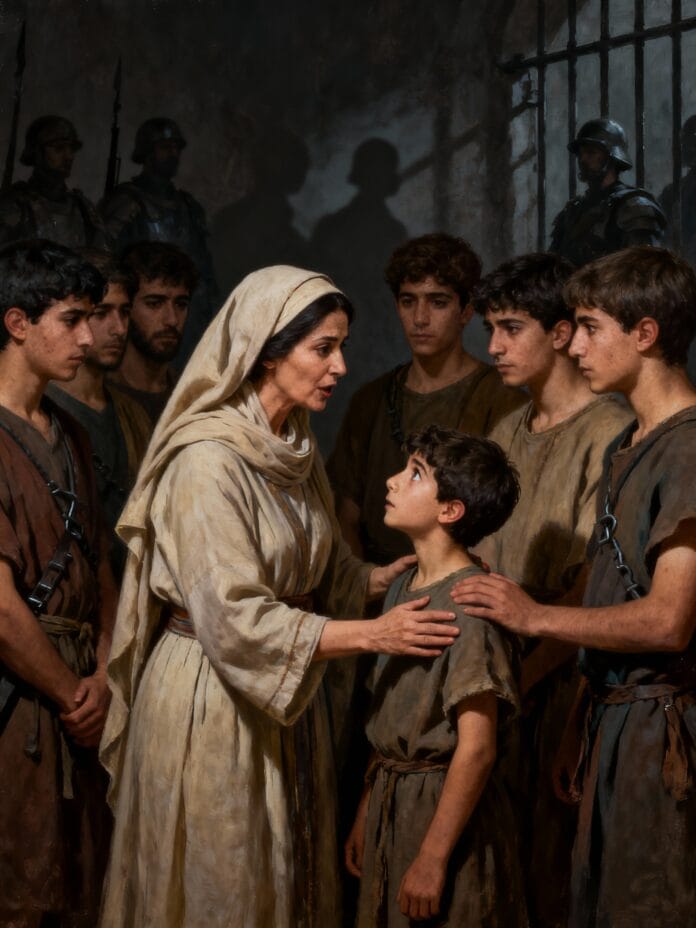
In those days, seven brothers were arrested with their mother. King Antiochus tried to force them to eat pork, a forbidden meat, using whips and bullwhips.
Their mother was particularly admirable and worthy of glorious remembrance: seeing her seven sons perish in the space of a single day, she bore it courageously because she had placed her hope in the Lord. She encouraged each of them in the language of their ancestors; this heroic woman spoke to them with manly strength: «I am unable to explain how you were formed in my womb. It was not I who gave you breath and life, who assembled the elements of which each of you is composed. It is the Creator of the world who fashions the child in the beginning, who presides over the origin of all things. And it is He who, in His compassion, will restore your breath and life, because, out of love for His laws, you now despise your own existence.»
Antiochus imagined he was being scorned and suspected the speech contained insults. He began to exhort the youngest son, the last survivor. Moreover, he swore an oath to make him both rich and fulfilled if he abandoned the customs of his ancestors: he would make him his confidant and entrust him with public offices. When the young man refused to listen, the king summoned the mother and urged her to advise the youth and save him.
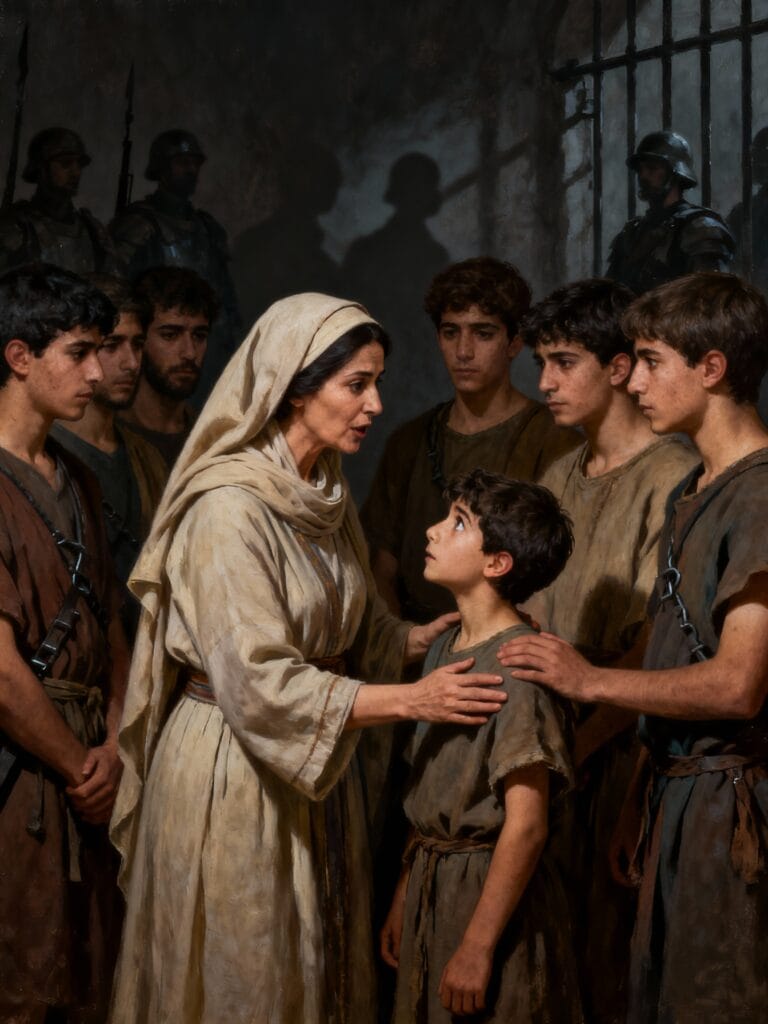
After these long exhortations, she agreed to persuade her son. She leaned towards him and spoke to him in the language of his ancestors, thus deceiving the cruel tyrant: «My son, have pity on me: I carried you for nine months in my womb, I nursed you for three years, I nourished and raised you to the age you have reached, I watched over you. I beg you, my child, contemplate heaven and earth with all that they contain: know that God created all this from nothing, and that the human race was born in the same way. Do not fear this executioner, show yourself worthy of your brothers and accept death, so that I may be with you again on the day of reckoning.” mercy. »
When she had finished speaking, the young man declared, «What are you waiting for? I am not obeying the king’s order, but I am listening to the order of the Law handed down to our ancestors by Moses. And you, who have invented all kinds of torments against the Hebrews, will not escape the hand of God.»
«"The Creator of the world will restore your spirit and life."»
At the heart of Second Book of the Martyrs of Israel an unprecedented cry of hope arises: faith, carried to the summit of love, This is enough to transfigure death into birth. This moving episode, which features a tyrannical king, a heroic mother, and seven martyred sons, is not only addressed to souls tormented by persecution; God asks each of us to hear the promise hidden within suffering: the spirit and life, received from the Creator, surpass all human calculations. Let us delve into this source text to uncover its riches and inspiring power, in the light of Catholic tradition.
- Immersion in the biblical and historical context of the martyr narrative
- Central analysis: the resurrection as faith and hope
- Thematic deployment: family solidarity, obedience and ethical vocation
- Echoes in the Christian tradition and practical meditation
- Applications in inner and social life
Context
The episode from the second book of the Martyrs of Israel, set in the turbulent context of the 2nd century BCE, takes place during the persecution orchestrated by King Antiochus IV Epiphanes against the Jewish people. Under the pressure of pagan laws, seven brothers and their mother are ordered to eat pork, in flagrant violation of Mosaic Law. Refusing this compromise, they embody loyalty to the Lord until the ultimate gift — their lives.
Historically, this phase marks the confrontation between loyalty Jewish and Hellenistic hegemony. In the wake of the desecration of the Temple, the people find themselves torn between the temptation of material survival and obedience to God. Literarily, the text of 2 Maccabees chapter 7 is full of poignant dialogues, particularly those of the mother edifying her sons in the language of her ancestors: «I do not know how you came to be in my womb… It is the Creator of the world who forms the child in the beginning.».
Spiritually, the passage is read in the Church as a prophecy of the resurrection bodily but also a radical testimony to the vocation of hope. The mother refuses the inevitability of nothingness and affirms the power of God the Creator: "He will restore to you your spirit and your life." In liturgy, this reading strengthens the community in times of trial, invites it to contemplate the mystery of salvation, and prepares meditation on Christ's victory over death. This excerpt is regularly read during commemorations of the martyrs and in catechesis on the meaning of the resurrection.
The text's impact is immediate: faced with the violence of human power, it is loyalty Silent and transcendental to God, who becomes the pledge of true life. The example of the mother of martyrs transcends the centuries and inspires spiritual resistance against the idols of each era.
Analysis
The key to the text, from a Catholic perspective, lies in the confession of God as creator and resurrector. The mother, bearer of unwavering faith, transmits to her sons a logic that transcends mere biological preservation: she invites them to look to heaven and earth, to contemplate the work of the Creator, to discern that existence does not depend on the flesh, but on the divine will.
The central paradox of the narrative lies in the alliance between human weakness and divine power. The executioners hold power over bodies, but not over the mind: «Do not fear this executioner, show yourself worthy of your brothers and accept death, so that I may find you again on the day of resurrection.” mercy. » Through the ordeal, the text reveals a central axis of Catholic theology: true life is not measured by earthly duration, but by the orientation of the heart towards God.
The existential implications are immense. Man, risking everything for divine law, discovers that his destiny does not end in torment but opens onto eternal life. The promise of the resurrection It is rooted not in an abstract hope, but in the word of the Creator: "It is he who, in his mercy, will restore to you spirit and life…". The ultimate vocation of Christian witness then emerges: to offer one's life for Truth and the Law, in an obedience that becomes a source of light for the world.
This theology of the resurrection is explicitly reiterated in Catholic doctrine, which states that loyalty to Christ — even unto death — is inscribed in the hope of a new life, bodily and spiritual, received from God.
Family solidarity and the communion of saints
In this story, the family is not merely a social unit but the premise of the communion of saints. The mother unites her sons in the same act of faith; they become "brothers" not only by birth but also through their shared spiritual witness. The episode weaves a portrait of motherhood that transcends genetics: the heroic woman becomes an educator in the faith, a spiritual guide, a figure of Mother Church.
The community, Catholic by vocation, draws inspiration from this figure to accompany its members through trials. Each reader is invited to see their own family relationships in the light of faith: to support, to build up, to transmit hope even in the darkness of doubt. The mother-child bond extends to the entire ecclesial community; motherhood becomes a mediation of spiritual life, a reflection of the Virgin Mary. Married at the foot of the cross.
The expression "the Creator will restore to you your spirit and your life" posits human solidarity at its deepest level: a fraternity rooted not in the flesh but in eternity. The Christian family is called to form a coven of fidelity, a place where divine law takes precedence over the compromises of the age.
Loyalty to the Law and a commitment to obedience
The narrative of the Martyrs of Israel conveys the extreme demand for obedience to Mosaic Law in the face of the excesses of political power. Refusing to eat pork, in this context, is not a dietary whim: it is a symbol of resistance to any idolatrous assimilation. In the Catholic tradition, obedience to the Law finds its fulfillment in Jesus Christ, who does not come to abolish but to fulfill (Mt 5, 17).
The attitude of the young martyrs illustrates a divine pedagogy: God seeks hearts capable of preferring his word to all the allurements of the world. Obedience becomes an act of freedom—liberation from the powers that claim to rule the mind. In contemporary reality, this can mean choosing loyalty to Christian principles in all areas: family, relationship to truth, use of goods, respect for creation.
The call to obedience, far from being passive submission, is affirmed as an existential choice, the foundation of Christian freedom. Every hesitation, every temptation to give in to the easy way out, finds in these martyrs a vital strength to choose Christ above all else.
Axis 3: The practical and ethical vocation of the resurrection
The promise "will restore your spirit and life" commits every believer to living with the prospect of the resurrection. It is not simply a matter of surviving death, but of orienting one's existence towards Good, by making self-sacrifice a concrete habit. This hope touches upon individual ethics: every choice, every word, every commitment becomes a seed of eternal life.
The resurrection is no longer a secret reserved for initiates; it becomes the horizon of charity. The martyrs did not sacrifice themselves in hatred but in the humble expectation that God would find ultimate justice in his mercy. This dynamic invites us today to seek the "day of mercy »", through acts of forgiveness, solidarity, social justice. The Christian ethic is nourished by active hope: working for the poor, to honor the dignity of all, to refuse deadly compromises.
The believer is called to become a living witness that the resurrection illuminates earthly life: every gesture that is rooted in the Law of God prepares the renewal of the spirit and of life, already here below.
Martyrs and Christian spirituality
The story of the Martyrs of Israel continues to inspire the Church Fathers to this day. Origen, Ambrose, and Augustine saw in this text a prelude to the sufferings of Christ, the source of universal salvation. The Catholic liturgy celebrates the feast of the Maccabean Martyrs on August 1st, associating them with the column of faithful witnesses.
In the medieval tradition, this text fuels reflection on the resurrection bodies, the value of freely given sacrifice, the capacity of grace to transfigure death. The prayers of the Church often invoke the mother of martyrs as a figure of the Virgin Married, suffering but believing in God's victory over human history.
Contemporary Christian spirituality reads the experience of martyrs as an invitation to radical trust: even when traversed by suffering, the believer is called to offer his life so that the light may shine forth, so that spirit and life may be restored to all humanity.
Journey towards a new life
Here are some inspiring steps to get into the flow of the text:
- To regularly contemplate creation as a visible sign of the Creator, a bearer of hope.
- Reread the story of the Martyrs of Israel in prayer, asking for the grace of loyalty.
- Meditate on spiritual motherhood, identifying the figures in your life who initiated you into the faith.
- Make a concrete commitment to defend the human dignity, even against the grain.
- Practice forgiveness as an opening towards the resurrection And mercy.
- To offer a present trial to God, believing that he will be able to draw new life and spirit from it.
- To unite spiritually with the martyrs of the past and present in common prayer, bearing hope for the Church and the world.
Conclusion
The episode of the Martyrs of Israel, punctuated by the words, "The Creator of the world will restore to you your spirit and your life," reveals the power of the living God in the face of the brutality of death. It teaches the strength of loyalty In destitution, the grandeur of hope is revealed in the heart of hardship. For every believer, the resurrection is no longer a vague concept; it becomes a lived promise, a light for the road, a call to a radical conversion of perspective and heart. The call to action is embodied in the bold implementation of charity, of truth and courage, so that every moment of life becomes a prelude to the resurrection, a gift received from the Creator and passed on to humanity.
Practical
- Take time each morning to contemplate creation as a sign of the life received.
- Reread chapter 7 of 2 Maccabees as a family or in a prayer group, to build spiritual bonds.
- To engage in concrete solidarity actions towards those who suffer injustice or persecution.
- Write a letter of gratitude to a "spiritual parent" who has fostered your growth in faith.
- Offering personal suffering to God, entrusting it to mercy divine.
- Meditate on the promise of the resurrection and transform every fear into an act of hope.
- To attend the liturgy or a commemoration of the martyrs in order to commune with the whole Church.
References
- 2 Maccabees, ch. 7 (Jerusalem Bible or TOB)
- Origen, On Prayer, XIX
- Augustine, Sermons on the Martyrs
- Ambrose, De Officiis, III
- Catechism of the Catholic Church, §§ 991-996
- Roman Lectionary: Feast of the Maccabean Martyrs, August 1st
- John Paul II, Salvifici Doloris
- Contemporary work: Anthony Delgado, «A Biblical Theology of 2 Maccabees»