












Gospel of Jesus Christ according to Saint Luke
«What happened in the days of Noah will be repeated at the coming of the Son of Man. People were eating, drinking, marrying, up to the day Noah entered the ark. Then the flood came and swept them all away.”.
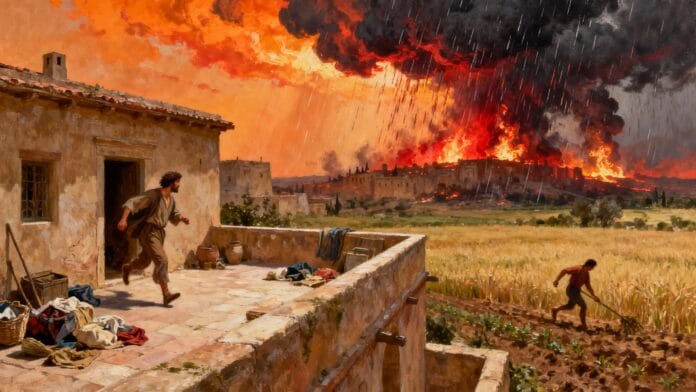
It was the same in the days of Lot: people ate, drank, bought, sold, planted, and built. But the day Lot left Sodom, fire and brimstone rained down from heaven and destroyed them all.
It will be exactly like this on the day the Son of Man is revealed.
On that day, whoever is on their terrace with their belongings in the house, let them not go down to take them away. Likewise, whoever is in the fields, let them not turn back.
Remember Lot's wife.
He who seeks to preserve his life will lose it. But he who accepts to lose it will preserve it.
I assure you: that night, two people will be in the same bed; one will be taken, the other left. Two women will grind grain together; one will be taken, the other left.»
His disciples asked him, "Where, Lord?" He replied, "Where there is a dead body, there the vultures will gather."«
Revelation of the Son of Man: vigilance, faith and commitment in eschatological expectation
Understanding the Gospel Teaching (Luke 17, (p. 26-37) to live with hope and discernment in our daily lives.
The tension between daily life and eschatological hope
In a world marked by complexity, speed, and crises, the Christian faith invites us to keep in perspective the promise of Christ's return, this "revelation" of the Son of Man announced in the Gospel according to Luke. This passage (Luke 17, (pp. 26-37) confronts us with a historical and cosmic event, while emphasizing the urgency of a faithful life in the present. Christian faith is not limited to passive waiting; it calls for constant vigilance, active justice, and ongoing conversion.
In this extended reflection, we will seek to understand not only the Gospel text but also its implications for our lives, our spirituality, and our commitment. The tension between hope and vigilance, between patience Eschatological considerations and present responsibility will be our guiding thread.
The context of Luke 17: between history and anticipation
The Gospel of Luke, written for a community facing persecution and end-times questions, highlights a fundamental fact: the certainty that Christ's return will take place. Luke 17,26-37 is part of a series of discourses on eschatology, where Jesus uses powerful images to awaken his disciples.
This passage, placed just before the passion and the resurrection, It emphasizes the unpredictability of the eschatological event, as in the stories of Noah and Lot. The reference to ancient narratives shows that the final revelation will not be something entirely new and unknown, but a culmination of human history, marked by God's justice.
The liturgical context of this reading reinforces the idea that each faithful person must live in active expectation, in communion with the believing community, with an acute awareness of temporality as a space of opportunity for conversion.
The theological dimension: active expectation
The text reminds us that the revelation of the Son of Man will occur suddenly, but that this surprise should not lead to panic or despair. On the contrary, it demands of us inner preparation, a life of justice and mercy.
The revelation of the Son of Man: an event as much cosmic as moral
The idea that "where the body is, there also the vultures gather" (Luke 17,37) evokes the scene of a final judgment where the separation will be manifest. The revelation of Christ is not only a spectacular manifestation, it is also a call to personal and collective responsibility.
This passage emphasizes that Jesus expects a life of vigilance from his disciples, where each day becomes a space of trial and grace. Revelation is the moment when divine justice is manifested, but it begins today with our choices. Faith is not passive; it calls for concrete commitment in the pursuit of justice, of peace, of mercy.
The theology of waiting: active patience
The "day" of revelation is unpredictable but not unexpected for those who are vigilant. Vigilance is not synonymous with anxiety but with inner stability, with the ability to recognize God's presence in everyday life.

Vigilance in everyday life: an effort of constant attention
The art of being vigilant at the threshold of each day
This first focus emphasizes the need to establish a daily relationship with God, through prayer, reading the Gospels, and practicing charity. Vigilance is not limited to passive waiting; it consists of recognizing the divine presence in small gestures, and preventing the temptation of routine or conformity.
Justice and mercy as signs of authenticity
Waiting while acting: justice and mercy in action
This theme highlights that prophetic vigilance translates into concrete action: solidarity with the most vulnerable, the fight against injustice, and commitment to... peace. The parable of "taking care" is combined with an ethical commitment in all our relationships.
Sobriety and availability: living in dependence on God
Simplicity as a way of life for faithful vigilance
Living "as if" the return were tomorrow implies inner sobriety, a freedom from possessions, honors, and fleeting pleasures. Constant openness requires a heart free of idols, to welcome revelation.
Living with awareness in every sphere of life
Believers are called to transform their daily lives through simple but radical acts: praying each morning asking for wisdom, practicing charity Without delay, take a concrete act of justice, take the time for personal conversion.
- Within the family: establish times of prayer, promote justice and peace.
- At work: act with honesty, transparency, and respect.
- In the community: engaging in social actions, working towards peace.
- Person: to meditate on the fragility of life and the urgency of conversion.
Spiritual legacies and openness to new things
The Church Fathers, like Saint Augustine John Chrysostom, among others, reflected on the need for vigilance in all circumstances. Liturgical tradition encourages vigilance through the Night Office and the feasts of expectation (Advent, Ascension). Ignatian spirituality emphasizes prayer with discernment.
Scripture, through its stories of Noah, Lot, and the Second Coming, offers an immersive reading into the history of salvation. The coming revelation should not blind us but enlighten us, enabling us to live with courage and compassion.
Meditating in the manner of a vigilant Christian
- To sit in silence, to breathe deeply.
- Read the passage slowly again Luke 17,26-37.
- Pray to receive the wisdom and strength to be faithful each day.
- Identify one small, concrete action to take during the week.
- Remember that each day is a preparation for the revelation.
Living hope in a modern context
The challenges: how to reconcile the urgency of the social justice, The threat of indifference, the temptation of individualism? The answer lies in balanced vigilance, a living faith that translates into concrete actions, a refusal of indifference, and a commitment to justice.
The balance lies in not giving in to fear or catastrophism, while remaining committed to active expectation. Vigilance should not become a source of anxiety, but a way of life characterized by discernment and compassion.
Prayer: an act of hope
A living prayer to watch and hope
«Lord, so that I may not be surprised by your return, grant me the wisdom to watch in love, justice and simplicity.
Increase hope within me, so that I may not delay my conversion or my commitment.
Help me to listen to your Word, to choose justice and peace.
Strengthen my heart in the face of trials, and make my life a space of confident waiting.
May I always be ready to recognize your presence in every moment, in every person.
Amen.»
A call for active vigilance and commitment
Living in expectation of Christ's return does not mean giving in to passivity. Christian vigilance must be embodied in every act of justice, in every gesture of love. The revelation of the Son of Man, when it comes, will finally unveil the fullness of salvation, but it must begin here and now, in our concrete lives. Let us therefore be active witnesses, clear-sighted watchmen, faithful to the hope that does not disappoint.
Practical
- Start each day by meditating Luke 17,26-37.
- To engage in an act of community justice.
- Take time for gratitude during daily prayers.
- Participating in a process of spiritual discernment.
- Living in sobriety in order to welcome revelation.
References
- Luke 17,26-37, 21,28
- Saint Augustine, "The City of God"«
- Jérôme André, "The Theology of Vigilance"«
- P. Ricœur, «Justice and Temporality»
- Ignatian spirituality, exercises in discernment
- Encyclopedia of Biblical Theology