












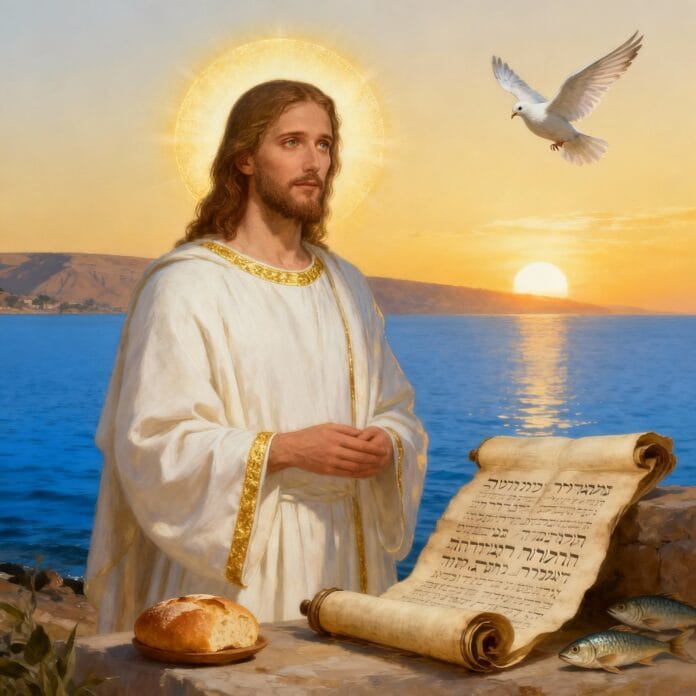
CHAPTER 1
John 1. 1 In the beginning was the Word, and the Word was with God, and the Word was God.. – General commentary on verses 1–18, Prologue of the’Gospel according to Saint John 1. From the outset, the sacred writer sought, so to speak, to guide his readers, emphasizing the main ideas and an explanation: Jesus Christ is God; he is the eternal and creative Word who became flesh to save poor humanity. It is therefore a true Christology that we find here. The entire divine and human life of Jesus is contained within it. 2. Theological richness. – The Word within the Father and the incarnate Word, God, the God-Man, and the redeemed man: how important this prologue has been for theologians of all times! «Christian metaphysics, from St. Augustine to St. Anselm, from St. Thomas to Malebranche, has explored this abyss without ever reaching its bottom» (Baunard, The Apostle St. John, p. 381). «The highest degree of doctrine concerning Jesus Christ, true God and Son of God, is concentrated in a single chapter of Saint John, 1:1-18. In this passage, we are taught that he who became flesh in time is God, eternal God, God the creator of the universe, God the author of grace and supernatural order; that he is the God to whom supreme worship is due, that he is distinct from the Father without being inferior to him, that he was begotten by God the Father, that he is his Word and his only Son.» Franzelin, Of the Incarnate Word, th 8. See also Mgr Ginouillhac, History of Catholic dogma, Part 1, Book 9, Chapter 1. But nothing is more expressive than the words of St. Augustine, In Jean Tract. 36: The other Evangelists seemed to walk on earth with Jesus Christ considered as a man; but John, as if ashamed to drag himself down here below, raised his voice to such a degree that, from the very beginning of his writing, he placed himself not only above the earth, the air, and the stars, but even above the host of angels and all the invisible powers established by God; he thus reached Him who created all things, for he said: «In the beginning was the Word, and the Word was with God, and the Word was God. All things were made through him, and without him was not anything made that was made.» The rest of his Gospel is worthy of such a beautiful beginning. Like a bird, he took flight, and he spoke of the divinity of the Savior. In this, he simply gave us back what he had drawn from the source of truth. Obviously, he did not tell us without reason, in his Gospel, that at the Last Supper he rested on the Lord's breast. Leaning on Jesus' heart, he drew from it a secret drink; but this unknown drink, he revealed to us by distributing it to us. He taught all nations not only the incarnation of the Son of God, his passion and resurrection, but what he was before becoming man: the only Son of the Father, his Word, co-eternal with Him who begot him, equal to Him who sent him, but who, through his incarnation, became inferior to his Father and less great than him.» Similarly, St. John Chrysostom said: «No longer praise the thoughts of Plato and Pythagoras. They search; John saw.” From its very beginning, it seizes our entire being, lifts it above the earth, the sea, and the sky, carries it higher than the angels, beyond all creation. So, what a perspective opens before our eyes. The horizon recedes without end, limits vanish, infinity appears, and John, the friend of God, finds rest only in God.» Hom. in John 1, n. 2. The reader will find other magnificent quotations from the Fathers on the Word in the fine work of Bishop Landriot, The Christ of tradition. 3. Beauty of form. – This splendor aroused the admiration even of pagan philosophers, among others those Platonists who, as St. Augustine recounts, would have liked, De civit. Dei, Book 10, 29, that this prologue be engraved in letters of gold at the entrance to temples, cf. Eusebius, Ecclesiastical History 11, 18. Human language has nothing comparable to this "sublime opening," to this "prologue that comes from heaven" (St. Jerome, Proem. in Matth.). It is the noblest association of simplicity and majesty. As elevated as the ideas are, the style appears devoid of ornament, with its short phrases interspersed and linked to one another by the conjunction "and"; but this very fact is a great beauty and produces a great effect. – Another peculiarity of the form has been noted, a kind of spiral movement in the arrangement of thoughts; thus, an idea appears, withdraws, and reappears further on to be developed and more fully defined. Meanwhile, another idea is presented to us and withdraws, only to reappear in a similar fashion. For example, the Logos is shown to us in verse 1, then disappears, and is shown to us again in verse 14. Creation passes before our eyes in verse 3, only to return in verse 10. Light appears in verse 4; it then disappears and returns in verses 10 and 11. Finally, the testimony of John the Baptist is mentioned in verses 6 and 7, reiterated in verse 15, and taken up again in verses 19 and following. – In the beginning. As if swept away by rapture… he begins his Gospel without preamble. It is already, “the eagle’s gaze into infinity” (Lacordaire). But what beginning did the evangelist mean? Nothing could be clearer. He certainly had in mind the same beginning of Genesis, John 1:1: «In the beginning.» God willed that the story of redemption, or the second creation, should begin with the same formula as the story of creation itself. In both cases, «beginning» thus designates the origin of the world, the beginning of time. But what a difference! Here, the narrator goes back beyond creation to gaze into divine eternity; there, Moses, on the contrary, descends back through the ages. Without directly and in itself marking eternity, the expression «in the beginning» thus brings us back here, in the clearest possible way, to this idea. It is equivalent to «before the world existed,» John 17:5. «Where am I going to lose myself?” Into what depths, into what abyss?... Come, let us walk under the guidance of the beloved among the disciples, of John, child of thunder, who does not speak a human language, who enlightens, who thunders, who stuns, who strikes down every created spirit under the obedience of faith, when, by a swift flight cleaving the air, piercing the clouds, rising above the angels, the virtues, the cherubim and the seraphim, he intones his gospel with these words: In the beginning was the WordWhy speak of the beginning, since it concerns the One who has no beginning? It is to say that in the beginning, from the origin of things, He was; He did not begin, He simply was; He was not created, He was not made, He simply was… In the beginning, without beginning, before all beginning, above all beginning, was He who is and who always subsists, the Word.» Bossuet, Elevations on the Mysteries, 12th week, 7th elevation, cf. also the 8th elevation. Was : As we have just seen in Bossuet's admirable commentary, the imperfect tense is full of importance, since it is this imperfect tense that transforms the notion of the words "in the beginning," making them represent eternity. It denotes permanence, an endless continuity. Therefore, the evangelist will repeat it four times in succession in this verse and the following one, in order to clearly show that there was no period when the Word did not exist, cf. Colossians 1, 15; Hebrews 1:8; 7:3; Revelation 1:8. See below (note to verse 4) the difference that exists between this "being" of the Logos and the "existence" of creatures. It is without sufficient reason that various ancient and modern exegetes have translated the Greek noun as Eternal Father, or Divine Wisdom (Origen, St. Cyril of Alexandria, etc.). The Verb, (with the article, the Logos par excellence). This is, of course, the principal expression of the prologue, which is entirely dominated by it (cf. verses 1 and 14). It is therefore important to understand it well and to form a correct idea of it. In recent centuries, it has sometimes been attributed false meanings: for example, when it has been considered a synonym for "word, promise," that is, Messiah; or for "revealed word," that is, Christ as teacher. No, the term here is eminently theological and metaphysical, and it expresses the deepest concepts. There seems to have been some hesitation in the Latin Church regarding an adequate translation: sometimes "sermo," sometimes "verbum," in the second century. Tertullian cites both words, and he wrongly prefers a third, "ratio." Gradually, "verbum" prevailed. But it says more than that: it is a two-sided expression, marking both the thought, the "verbum mentis," and the word by which this thought is expressed, the "verbum oris" (St. Augustine). The four Evangelists use it frequently (St. John, nearly forty times) in its general meaning of "word," etc., and the Synoptic Gospels also use it in a more specific way to designate the Word of God, the Gospel preaching. However, the remarkable use made of it, without commentary and in an absolute manner, either in this passage four times (verses 1 and 14), or in 1 John 5:7, to designate the personal Word, the Son of God, the second person of the Most Holy Trinity, is unique to St. John. Compare 1 John 1, 1 and Revelation 19:13, where it is found with the same meaning, but accompanied by another noun that characterizes it: «the Word of God.» And, what is most astonishing, is that our evangelist assumes it to be perfectly clear to his readers and adds not the slightest explanation. Let us first seek where he obtained it; it will then be easy to indicate why he alone used it. – 1° According to the rationalists, who have written lengthy dissertations on this subject, St. John supposedly drew the name and doctrine of the Logos from secular sources. We reply, and the demonstration is quite easy today, that St. John borrowed this name and this doctrine neither from the Gnostics nor from the writings of the Jew Philo, but from the Jewish tradition, supplemented for him by a special revelation. 1. We know the Logos of the Gnostics from a few quotations in St. Irenaeus, Against Heresies 1, 24, 3. Nothing is more complicated than the systems they attached to this sublime notion. Thus, according to Basilides (early second century), the Word is the second of the seven intelligences emanating from the supreme God. «The spirit was born first of all from the eternal Father; then from the spirit was born the Logos, from the Logos Prudence, from Prudence Wisdom and Power, from Wisdom and Power the Virtues, the Princes, and the Angels.» Valentinus (mid-second century) admits a first principle, called Proarkē or first beginning, Propator or first Father, Bythos or abyss. This «Propator» is eternal; With him coexists the ennoia, or thought of his mind, which conceives and produces the nous, which in turn engenders the famous pleroma, and first and foremost, the Logos. From the Logos united with Life are born man and the Church. Ogdoad, decad, dodecad, the thirty aeons: truly, is there any connection between these convoluted complications and the so simple prologue of Saint John? Yes, but «far from the author of the fourth Gospel having borrowed from Gnosticism the terms Word, Life, Light, and Only Begotten Son, it is Gnosticism that took these metaphysical expressions from him; they had, in fact, the double advantage of lending themselves to subtle interpretations, while being consecrated by the respect of the Church.» From a source so troubled as these gross errors, one cannot extract the fresh and limpid essence that Saint John gives us. See Mgr Ginouilhac, *Histoire du dogme catholique*, vol. 2, p. 183 ff.; Vacherot, *Histoire critiq. de l'École d'Alexandrie*, p. 201 ff. – 2. Philo is the principal representative of those Alexandrian theosophists, contemporaries of St. John, whose doctrine was a striking mixture of Platonism, Judaism, and Eastern mysticism. He was especially regarded at the end of the 19th century as the inspiration for St. John. It is true that Philo frequently speaks of the Logos, but in such a hesitant, sometimes contradictory way, that it is difficult to know exactly what he thinks of it. One cannot even say whether his Word is a real person or a mere abstraction. What is true, at least, is that Philo's Logos is merely an intermediary between God and the world, between the unapproachable celestial light and matter: it separates as much as it unites. It is God, the Son of God, but an inferior God, God in a misleading sense, as opposed to the true God. It did not become incarnate, it did not redeem us, it is not the Messiah. What a stark contrast between these vague ideas and the rich substance of the prologue to St. John. The Logos of the fourth Gospel is to Philo's Logos what St. Paul's discourse before the Athenian Areopagus was to the inscription to the unknown God – 3. If the resemblance between Philo's and St. John's ideas about the Word is purely superficial, and turns into complete opposition as soon as one delves into the details and the heart of the matter, we must admit, on the contrary, that Jewish tradition offered our evangelist a real point of support for his prologue. This is easily proven with the help of either the Old Testament or the Targums, or ancient Jewish paraphrases of the Bible. The first traces of the Logos appear to us from the very beginning of the world, for it is through his word, mentioned ten times in the history of creation, that God produced the entire universe (Genesis 1, 3, 6, 9, 11, 14, 20, 22, 24, 26, 29). Later, at Book of Psalms, This same word is almost personified, and divine properties are attributed to it (Ps. 32:6: «The Lord made the heavens by his word, the universe by the breath of his mouth»; Ps. 147:15: «He sends forth his word to the earth; swift, his word runs throughout it»; Ps. 106:20: «He sends forth his word, he heals them, he snatches their lives from the pit»). Similarly in Isaiah (cf. 40:8: «The grass withers and the flower fades, but the word of our God endures forever»; 55:11 ff.). In the books of Job (28:12 ff.) and Proverbs (8 and 9), there is a further movement toward personification, although we find a change in the terms: "Wisdom" of God, instead of "Word" of God; but these expressions are synonymous. Note especially this passage from Proverbs 8:22 ff.: "The Lord made me for himself, the beginning of his works, the first of his works, from of old. Before ages I was formed, from the beginning, before the earth existed. When the deeps were not yet, I was brought forth, when the springs were not gushing forth. Before the mountains were settled in place, before the hills, I was brought forth… playing before him always, playing in the earth, in his land, and delighting in the children of men." Finally, progress is increasingly accentuated in the deuterocanonical writings, cf. Ecclesiasticus 1, 1-20; 25, 1 22; ; Wisdom 6, 21-9, 18; Baruch 3, 9-4, 4. There are extremely striking lines here, which make the divine Word a very distinct hypostasis: notably the following, Wisdom 18, 15, «your all-powerful Word poured forth in the very midst of this land of distress,» where the Word appears as the instrument of heavenly vengeance. The Targums present us with analogous facts, not only here and there, but consistently. Indeed, the phrase appears hundreds of times Mèmera da Yeya, The phrase "Word of God" is used to replace or be added to the divine names. It appears more than 150 times in Onkelos' Targum of the Pentateuch alone, nearly 100 times in the Jerusalem Targum, and about 320 times in Jonathan's Targum. In many of these cases, the Memera represents not only God as he reveals himself, but also as a distinct hypostasis within the divinity. The following examples are significant in this regard. In Genesis 3:8-9, instead of the text's words, "They heard the voice of the Lord God…; God called Adam," we read in the Aramaic paraphrases: "They heard the voice of the Word of God;… the Word of God called Adam." In Genesis 9:12, Onkelos translates: "The sign of the covenant will be between my Word and you" (it is God himself who speaks). Genesis 22:16, instead of "I have sworn by myself," God says in the Targum: "I have sworn by my Word." In Genesis 16, Hagar sees "the Word of God," which she then identifies with the Shekinah, or divine presence. Deuteronomy 1:32-33, according to Onkelos: "You have not seen the Word of God, who was your guide on earth." Deuteronomy 26:17-18, according to the Jerusalem Targum: "Today you have established the Word of God as king over you, to be your God"; etc. Furthermore, note that the Targums have another expression, Pithgama, to designate the ordinary language of God, which further enhances the power of Memera. For example, in Deuteronomy 18:19, we find this nuance clearly marked: «If anyone does not listen to my word (Pithgami), which he has spoken in my name, my Word (mèmerati) will call him to account,» cf. Deuteronomy 5:5, etc.; L. Stapfer, Religious ideas in Palestine at the time of Jesus Christ, 2nd ed. p. 39 ff. – 4. And yet this Jewish tradition, though so formal, could not suffice for Saint John, for it is far from being as clear as his prologue, to express all that he himself says. Nowhere does it attribute the messianic character to the Word of God; nowhere does it directly express that he is a distinct person in God. Thus, the beloved apostle needed a special revelation to acquire this sublime knowledge, as he himself recounts, Revelation 19.« 11 Then I saw the sky opened and there appeared a white horse, the one who rode it is called Faithful and True, he judges and makes war with justice. 12 His eyes were like a burning flame, he wore several diadems on his head, and bore a name written that no one knew but himself., 13 He was clothed in a garment dyed with blood, and his name is the Word of God.» – 2. Let us now answer the second question posed above: Why is Saint John alone in using this remarkable name? It was because of the particular needs of his time, and to oppose, on this subject no less delicate than important, true doctrine to the errors that were beginning to circulate in the Church. As for the marvelous aptness of the word Logos to designate the second person of the Holy Trinity, it emerges so clearly from this very expression that it is unnecessary to dwell on it. «This name of Word or divine speech is the most refined, the most spiritualized image of the nature of the Son that exists in language» (Baunard, The Apostle St. John, (p. 381); nothing better marks the intimate and eternal relationship between the Father and Our Lord Jesus Christ, cf. St. Thomas Aquinas, Summa Theologica, Part 1, q. 34; Bishop Ginouilhac, History of Catholic Dogma, vol. 2, pp. 2-6, p. 386 ff., etc. «Whoever speaks of the Word speaks of the interior word, the substantial word of God, his intelligence, his wisdom; a discourse eternally spoken, and in which everything is said, which, in the infinite fecundity of a soul, of a word spoken once and never to cease, contains all truth, is substantially with truth itself.» Fouard, The Life of Our Lord Jesus Christ, vol. 1, p. 461 (this is the beginning of an excellent dissertation on the Word of St. John). And the Word … The solemn, gradually ascending movement in the first verse has long been noted: it comprises three clauses, all three relating to the life of the Word within his Father; but the second says more than the first, and the third more than the second. This rises continuously in an admirable symmetry. Was continues to express five times in succession (verses 1-4) an eternal permanence; when we encounter it for the sixth time (verse 4, "the life was the light of men"), it will again signify perpetuity, but in time. In God. The choice of the Greek preposition is remarkable; following a verb of rest, one would expect something else. The evangelist deliberately employed in this passage and in verse 18 a construction that denotes not only juxtaposition, coexistence in the same place, but also an inner activity, ineffable energies and tendencies—in short, those divine communications which, in theological language, are called processions or relationships. See 3:35, one of these relationships. It clearly follows from this that the Word possesses a personality distinct from that of God the Father. And the Word was God. The third proposition adds a new element to the other two. Undoubtedly, the divinity of the Word had been implicitly affirmed in the preceding lines; nevertheless, Saint John wished to declare it explicitly. «God» is emphasized to better highlight the idea, although «Word» remains the subject of the proposition. This time, the article is omitted before the Greek word to avoid a significant ambiguity: the Greek phrase could have meant that the Word alone possesses the entire divine being, that he is the Divinity (this was Sabellius’s error), while he shares the divine nature with the Father and the Holy Spirit. Thus, in these few words, three great truths are revealed: the Word is eternal, the Word possesses a distinct personality, and the Word shares in the divine essence. It is brief and complete.
John 1.2 He was in the beginning with God.– Having thus plunged into the abyss of the Divinity, and having described the eternal state of the Word of God and its intimate action, the evangelist, before moving on to another kind of action of the Logos, summarizes even more briefly what he has just said. A fourth proposition (verse 2) summarizes, by combining them, all the elements contained in the other three (verse 1). He is a summary of the third proposition: this Word-God; ; was in the beginning reproduces the first one; ; in God The second part is shortened. It's an energetic recap.
John 1.3 Everything was done by him and without him nothing that has been done was done.–We have contemplated the indwelling Word, living within the Father; now behold the Word going forth, manifesting himself in the world through his works (Saint Justin, Apol. 1). The evangelist indicates the Logos's relationship first with creatures in general (verses 3 and 4), then more specifically with humanity (verse 5). All : everything that exists apart from God, the entire universe (cf. verse 10, "the world"), in its entirety and in all its smallest details. The Greek word without an article is more expressive than that of Saint Paul (1 Corinthians 8:6; ; Colossians 1, 15; etc.), because it is not limited in any way. – By him: God the Father is the "efficient cause" of creation, as theologians express it: thus, his relations with the created world are usually designated by the preposition "of." When it comes to the Son, the Word, his relations with creatures are preferably marked by two other formulas, "through" and "in." 1 Corinthians 8:6, cf. Hebrews 1:2. He is indeed at once the "instrumental cause" and the "exemplary cause" of creation; the instrument of the Father or the arm of the Father, and a marvelous type of all things. See Bishop Ginouilhac, loc. cit., p. 320 ff. From what has been done What a difference! The Verb "was"; the creatures "were made"; more literally: "they became," an expression so frequently used in the first chapter of Genesis. – And without him …The idea, so clear, that we have just read in the first hemistich is repeated in the second, but in a negative form that is even more expressive. This is a peculiarity of the style of Saint John, cf. 1:20; 3:16; 10:5, 8; 20:27; 1 John 1, 5, 6; 2, 4, 10, 11, 27, 28; Revelation 2:13; 3:9. It recalls the antithetical parallelism of Jewish poetry… Nothing has been done The Greeks say, with more force, "not a single thing." Everything that exists has therefore passed through the will of the Word before coming into being: atom, blade of grass, tiny insect, shining seraph; there are no exceptions. Everything is alike in this respect. From what has been done The Greek aorist referred to the very fact of creation, and showed us creatures passing into existence on an order of the Word; the Greek perfect now describes creation as an acquired and permanent result.
John 1.4 In him was life, and that life was the light of all mankind., – What kind of life? Life in all its forms and manifestations, according to the various degrees and properties of creatures: physical life, intellectual life, and moral life; natural and supernatural life; life in time and in eternity. We have no restrictions to make. From every point of view, the Word is a source of life, cf. 5:26; 14:6. And this was necessary, since «all things were made through him,» verse 3. The phrase «in him» says more than «through him.» – Continuing to descend the «river of time,» the sacred writer moves from the general relations of the Logos with the universe to its more specific relations with humankind. He thus quickly approaches his particular subject. The Word «touches all beings, but in an unequal way. It has contacts that give only existence without life or feeling; others that give existence, life, feeling, and intelligence.» St. Gregory the Great. The contact of the word with its privileged creature, man, is here given the beautiful name of light: and life was the light of men, the light par excellence, the ideal and essential light (St. Cyrus of Alexandria). A magnificent symbol, which the Catholic Fathers and theologians have so aptly emphasized. Jesus would later make a personal application of it (8, 12, cf. 1 John 1, 5). – Men, The plural is used to show that it refers without exception to all members of the great human family. "Every rational being," says St. Cyril, "is like a beautiful vessel that the great Artist of the universe has formed to fill it with this divine light.".
John 1.5 And the light shines in the darkness, and the darkness has not received it. One more step forward. We are going to learn what the Word is for fallen man. And the light. The Logos, according to the beautiful expression of St. Peter (1 Peter 1:19). Nothing is more magnificent than these rich propositions, simply placed one after the other. In the darknessBut where could this darkness possibly come from? What happened in the world created by the Word? Chapter 3 of Genesis answers these questions. Between verses 4 and 5, we must therefore insert the terrible catastrophe of the fall of the first humans, which brought so much darkness to the earth. Despite this, the light shines. Note this present tense, the only one we find in the first five verses. It is picturesque and full of meaning. Despite the devil, despite sin, despite the human passions that tend to obscure everything morally, the Word shines in the most serene way, in accordance with its nature and its purpose. It is there like a restorer after the fall. And the darkness. Alas, it will not undo all the harm done. For this darkness is intelligent; it resists and refuses to be fully penetrated by the light (cf. 3:19: «The light has come into the world, but people loved darkness instead of light»). This passage presents us with the first example of what we will call the «tragic tone» of St. John. The evangelist first cites a happy event, then, without transition, links it to another, extremely painful and sad event, which is in complete contradiction with the good results one might have expected from the first (cf. verses 10, 11; 3, 11, 19, 32; 5, 39, 40; 6, 36, 43, etc.). On the metaphorical use of the word «darkness,» see 8:12; 14, 35, 46; 1 John 1, 5 ; 2, 8, 9, 11. – They did not receive it. This scene is vivid. It seems as if one is seeing a mass of thick darkness that closes in and becomes ever more compact, preventing the sun from penetrating and dissolving it. Ephesians 3:18 Their understanding is clouded, and they are separated from the life of God by the ignorance and blindness of their hearts.. It is wrong to have sometimes (following, it is true, illustrious exegetes such as Origen and St. John Chrysostom) translated the Greek verb as "to stop, to dominate".
John 1.6 There was a man sent from God, whose name was John.
«Until then, the evangelist had been discussing the divinity of the Word; here he begins to discuss the incarnation of the Word,» St. Thomas Aquinas. The Forerunner leads the way (verses 6-8), as in the Synoptic Gospels and in the actual life of Our Lord Jesus Christ. Verse 6 indicates his nature and dignity; verses 7-8 develop his role. Very few words, but a great wealth of thought. St. John tacitly refers his readers to the first three Gospels for the details. There was ; as in verse 3; The Word "was," the Forerunner "became," it had a beginning. Note the complete lack of transition; the narrator abruptly changes to his new subject. A man. The Logos was God, John the Baptist was only a man. Messenger of God. This man is characterized first in general terms: he was an apostle, a divine messenger, cf. Malachi 3, 1; 4, 5. The Greek formula is not a simple periphrasis for "was sent"; the participle is a true attribute, which must be translated separately: There was a man, sent from God. His name was John. A beautiful name, quite significant (Iochanan, the Lord has been gracious). See commentary on Luke 1:13. The Forerunner is mentioned twenty times in the fourth Gospel; but the epithet Baptist is never added to his name.
John 1.7 He came as a witness, to bear witness to the light, so that through him all might believe: – This one Summarize and recap verse 6: This man, sent by God. It came This refers to the beginning of St. John's public ministry. Matthew 3:1. "And he went throughout the region of the Jordan, preaching a baptism of repentance for the forgiveness of sins," cf. Luke 3:3. As testimony. This, in its general aspect, was the role of John the Baptist: he was to be a witness. The following words, to bear witness to the light determine the specific object of his mission: his testimony concerned the Word-Light. On the Greek particle ἵνα (for), which our evangelist uses so frequently, especially to mark a divine intention, see the Preface, § 6, 2; μαρτυρεῖν (to bear witness) and μαρτυρία (testimony) are also among his favorite expressions: they appear about fifty times in his Gospel, nearly forty times in his letters and the Book of Revelation. So that all may believe. This was the ultimate goal of John the Baptist's testimony: to incite all people to believe in Our Lord Jesus Christ. Undoubtedly, "all" refers more directly to the Jews, since it was first to their ears that the preaching of the Forerunner resounded (cf. verses 19 ff.); but this expression also applies to all humankind, since, in the divine plan, John was an integral part of a religious system through which faith was to penetrate all peoples without exception. See, moreover, Matthew 3:7-10, the vigor with which he challenged the exaggerated interpretation that the Israel of that time gave to its national privileges. The use of the verb "to believe" without a complement is very frequent in the fourth Gospel, cf. vv. 51; 4, 41, 42, 48, 53; 5, 44; 6, 36, 64; 11, 15, 40; 12, 39; 14, 29; 19, 35; 20, 8, 29, 31. Through him : through the Precursor.
John 1.8 not that he was the light, but he had to bear witness to the light. – Not that this one was… . […] He was not the light. Compare 2:21; 5:19, 35, 46, 47; 6:29; 8:42, 44; 9:9, 11, 25, 36, etc. This usage is still characteristic of the writings of St. John. The light, cf. v. 4. However great John the Baptist was, he was not himself a source of light, but simply reflected the light he received; or, to use Jesus' own words (5:35), "the lamp that burns and shines" (see the commentary). St. Augustine says it with his usual energy: "Who was he to bear witness to the light? He was something great, of great merit, of great grace, of great elevation. Admire him, yes, admire him, but admire him as a mountain. Now, a mountain remains in darkness unless the light shines upon it with its rays," Tract. 2, 5. But he had to give testimony…The narrator insists in a surprising way on this idea: John the Baptist is a witness to the Word, nothing more. As has often been repeated, he obviously does so for polemical purposes, to refute the errors that were prevalent, even at the end of the first century, concerning the personality and role of the Forerunner. See the significant episode in the Book of Acts, 19:1-6, cf. Clement, Recognitiones, 1, 54, 60. Yet John had been so faithful to his mission as a witness of Christ.
John 1.9 The light, the true light, the one that illuminates every man, was coming into the world. – That was the true light. We return to the Word-light and its action upon humankind, cf. verses 4 and 5. «Was» (always this majestic imperfect tense) has «Word» as its implied subject; «light» is here an attribute. The adjectives TRUE And Perfect These terms often recur in the fourth Gospel and in the other writings of St. John; they express subtle nuances. The first is the opposite of liar, deceiver; the second characterizes a being who corresponds to his ideal, who is consequently complete and perfect. Such is the light of the Word, cf. 6:32, «the true bread that came down from heaven»; 15:1, «I am the true vine.» Who sheds light on this?. The present tense follows the imperfect tense, as in verses 4 and 5; a very expressive construction. The object of the divine illuminations of the Word is indicated by the words "every person." The absence of an article in the Greek and the use of the singular further emphasize the thought: so that no one may be excluded. And not only is no one excluded, but each person is included in this formula individually. Most ancient versions (especially the Itala, the Vulgate, the Syriac, and the Coptic) connect "person" with the qualifier "coming into this world," which is ambiguous in the Greek text and can also be understood as referring to "light": likewise, the majority of commentators. It is a general expression modeled on the Hebrew word of the Rabbis (to come into the world, that is, "to be born"), and intended to place all people without exception under the illuminating rays of the Word. Some exegetes, however, prefer the other connection, and translate: He was the true light..., which came (then) into this world. Their interpretation does, admittedly, add a felicitous idea to the text, preparing the historical appearance of the Word (verses 10 and 11).
John 1.10 He was in the world and the world was made through him, yet the world did not know him. A sentence similar to that of verse 1: on either side, three short, solemn clauses, simply juxtaposed. He was in the world. It is generally accepted that the evangelist is referring to the times preceding the Incarnation (see verses 4 and 5). Even before manifesting himself to humankind as one of their own, the Word lived in the midst of the world, and it was easy to recognize him in his works. The expression "world," one of the most frequently used by Saint John (eighty times in his Gospel, twenty-two times in his first letter), here designates in a more specific way the pagan world, as opposed to the theocratic people (verse 11). And the world was made by him, See verse 3 and the commentary. And the world did not know him. We find the tragic tone even more pronounced here than in verse 5. The narrator had admirably highlighted the circumstances that seemed destined to prepare the Word for the most favorable reception from the world. The world, where it attested in so many ways to its benevolent presence; the world, where it continued to exert its creative action. And yet, unbelief, though seemingly impossible, was the great crime of this ungrateful world: it refused to acquire knowledge of the Word.
John 1.11 He came home and his family did not receive him. Another failure of the Word, even more painful because it then seemed impossible. Verses 9 to 11 form three concentric circles, gradually approaching their common center. In verse 9, the Logos shines suspended in the moral firmament and divinely illuminates all people; in verse 10, he is in closer communication with the world, but the world does not concern itself with him; in verse 11, we see him rejected even by Israel, his chosen people. Indeed, it is certainly the Jews who are designated by the expressions at his home. Several passages in the Bible show them to us as God's chosen nation, belonging to Him alone (literally in Hebrew: the people of ownership). Palestine is the "land of Emmanuel." Thus, the relationship of the Logos with Israel is marked not by "« was »", but using a more concrete verb, come. He came to the Holy Land as if it were his own home, to have close and friendly relations with his people. – The result of his coming is expressed in a more profoundly elegiac and sorrowful tone than ever before: and his own people did not receive him. The darkness had not overcome the light (verse 5), the world had not known the Word (verse 10); now we have a stronger expression, corresponding to a greater guilt on the part of the Jews [the Jewish elite: the majority of the Sanhedrin]: they stubbornly and willfully refused to receive their Master, their Messiah-King. Note, in the Greek, the compound verb which is here full of solemnity. It properly means "to receive into one's home," and is very apt to describe the welcome the Jews should have given the Word as a nation. And yet, what delicacy in this very energy, for Israel was far from remaining in a state of negative unbelief toward Our Lord Jesus Christ. See Isaiah 53, 1-6, on the rejection of Jesus.
John 1.12 But to all who did receive him, to those who believed in his name, he gave the right to become children of God., – to all those…However, the Logos' failure was not absolute. It found faithful followers among both the Jews and the pagan world. The Greek particle establishes a contrast between these believers and the unbelievers of verses 10 and 11. «To all» highlights the individual, isolated nature of the conversions. The world and Israel, as a whole, rejected Christ; it was private individuals who received him. Nowhere was Jesus Christ officially received, so to speak. He gave To his friends, the Logos offered the most magnificent reward in exchange for their devotion: the power to become children of God. The Greek term designates not merely a possibility but a true right, a real power. And what a right it is! The glorious and ineffable privilege of divine sonship, whose advantages St. Paul will expound at length. Note, however, the difference: the only Son of God possesses this title from all eternity; he does not "become" a son as we do. To those who believe The evangelist adds an explanation, stating the conditions under which people can become children of God, or, in other words, what it means to receive the Word. Both of these things are summed up in faith, that crucial word of the Gospel and of the Christianity. – In his name : A Hebraism of very common use in both Testaments. The name is considered a revelation of the one who bears it, the adequate expression of his nature: to believe in the name of the Word is therefore to believe in his divinity. St. John constructs the Word "to believe," sometimes with the preposition "in" and the accusative case (thirty-five times in his Gospel), sometimes simply with the dative case: the first formula, used in this passage, is much more forceful, as we will reiterate from time to time.
John 1.13 who were born not of blood, nor of the will of the flesh, nor of the will of man, but of God. A beautiful development of the words "children of God" (verse 12). Divine filiation, to which all who believe in Our Lord Jesus Christ are entitled, is not obtained through human generation, as the Jews thought; as its name indicates, it comes directly from God. These two ideas are contrasted in the most expressive way. The first, on which St. John places greater emphasis, is repeated up to three times, using forceful synonyms arranged in ascending order. Those who were not born of blood. «"not as the son of a mortal, but as an offspring of the divine race,", Tite Lives, 38, 58. Blood was regarded by the ancients as the center of physical life, cf. Genesis 9:4; Leviticus 17:1, 14; Deuteronomy 12:23, etc. According to some commentators, the Greek plural refers to the blood of the father and that of the mother, communicated to their children. Others consider it a Hebraism. Today, the expression "of blood" is more commonly seen as an idiomatic plural, designating the multiple particles of which blood, like any other liquid, is composed. Nor from the will of the flesh. By flesh, we must understand, according to numerous passages in the New Testament and especially in St. Paul, the animalistic nature of man and his lower, sensual appetites. Nor from the will of man. The third assertion, which reiterates and summarizes the other two, is marked by St. Thomas Aquinas in these terms: «From the blood, therefore from a material cause; from the will of the flesh, therefore from a cause linked to concupiscence; from the will of man, therefore from a cause of an intellectual order.» The «will of man» is the personality superior to blind instinct. But from God. A striking contrast. A single word opposed to the three preceding it; a purely spiritual birth in contrast to the carnal and material origin; a second humanity that replaces the first. "Our birth is a virginal birth. God alone makes us born again as his children," Bossuet. They were born. «were begotten» in Greek. Strangely enough, St. Irenaeus and Tertullian protest against the plural; they insist on the singular as the true reading and apply this word to the Word of God. This is a clear error, which the context sufficiently refutes, not to mention all the ancient documents. What beauty in this title of «son of God» thus conferred upon believers! We sometimes find it in the writings of the Old Testament to designate the relationship of Israel with God; but it is far from having the same meaning as under the New Covenant. There it expresses only a particular affection, a special tenderness, but never an adoption properly speaking, cf. Exodus 4:22 ff.; Deuteronomy 14:1; 32:11; Isaiah 43:1, 15; 45:11; 63:16; 64:7; Jeremiah 31:9, 20; Malachi 1:6; 2:10, etc.
John 1.14 And the Word became flesh and dwelt among us, and we have seen his glory, glory as of the only begotten of the Father, full of grace and truth. – This is the pinnacle of world history and divine benevolence. And the Word became flesh. The Word made flesh. Saint John does not shy away from the realism of this expression. He could have said, «He became man,» as we do in the Creed; but he deliberately chose the most forceful and humble word, in order to better emphasize the profound self-annihilation of Our Lord Jesus Christ, cf. Philippians 2:6ff. He could also have said, «The Son of God became flesh»; but, for a reason similar to the previous one, he wanted to use the name Logos again, which reminds us of the inexpressible greatness described in verses 1–5. Finally, he could have said, «The Word was united to the flesh»; but here again he used the expression of the’humility. «In all the rest, (the Word) was, and behold, it begins to be made» (Bossuet), to become, like his own creatures, cf. verses 3, 6, 12. It is a sentence unique in the world, and worthy of the mystery it represents. 1 John 4In 2 John 7, we find the analogous phrase "to come in the flesh," also applied to the Son of God; but it is far from having the same force. Moreover, with this expressive language, the apostle dealt a death blow to Docetism, which denied the reality of the Incarnation in Jesus Christ. As for the details of these two sublime mysteries, Saint Luke expounded them at greater length in a completely virginal account, 1:28-38. And he lived among us The Greek verb (literally: he dwelt in the tent) is more picturesque. It recalls, on the one hand, the mobile tabernacle (the sacred tent), under which the Lord had deigned to dwell among the Jews for many years, and on the other hand, the transitory nature of the sojourn that the Logos was to make in the world in human form, cf. 16:28. Saint John is the only one to use it, cf. Apocalypse 7, 15; 12, 12; 13, 6, 21, 3. – And we saw ; In Greek, it means "we have contemplated, seen at our leisure." In his first letter, which generally serves as an introduction to his Gospel, Saint John himself develops this thought admirably: "That which was from the beginning, which we have heard, which we have seen with our eyes, which we have looked upon and our hands have touched, concerning the Word of life—this we proclaim to you. Yes, the life was manifested, we have seen it, and we testify to it: we proclaim to you the eternal life which was with the Father and was manifested to us. That which we have seen and heard we proclaim also to you, so that you also may have fellowship with us" (1 John 1:1-3). There is a true accent of triumph here. The apostle fondly recalls the joy he experienced in personally witnessing, along with the other apostles and disciples, the wonders of the Word made flesh. His glory. Although the Logos, in becoming like one of us, had divested himself of his divine attributes, nevertheless numerous facts during his mortal life attested to his celestial origin and nature. Miracles which he multiplied under his feet, and especially that of the Transfiguration (cf. Luke 9:32; 1 Peter 1:17), were brilliant rays of his glory. Glory, a solemn repetition intended to complete the thought. Like that which an only Son receives from his Father. Saint John uses the expression "unique" only to refer to Our Lord Jesus Christ. Here, it distinguishes the Incarnate Word from the many children of God mentioned earlier, verse 12. He possesses divine sonship in a proper and unique sense. "Like" denotes here and there in the Holy Scriptures, and especially in this passage, an exact and real resemblance, a complete identity. It is not a comparison, but an assertion (cf. Matthew 7:25; Luke 22:44, etc.). The glory manifested in the person, works, and words of the Incarnate Word was of such a nature that it could belong only to the Son of God. The context clearly indicates who this Son and who this Father are. Two ideas have already been presented to us in this rich verse: the fact of the Incarnation and the narrator's testimony in honor of the "God-Man." A third trait briefly reveals the character of the God-Man: full of grace and truth. The somewhat unusual construction makes the thought even more striking. Saint John had paused for a moment to sing a short but sublime hymn in honor of the Word; he now completes his sentence, linking "full" to "Word." Two essential attributes, grace and truth, revealed in Jesus Christ the only Son of the Father. Nothing could be clearer for a Jew; for the Old Testament very often associates these two attributes and identifies them as the exclusive prerogative of the true God (cf. Genesis 24:27, 49; 32:10; Exodus 34:6; Psalm 86:15; 89:1-2, etc.). Full of grace insofar as he is life, the Word is full of truth insofar as he is light par excellence.
John 1.15 John testifies to him and exclaims, «This is he of whom I said, »He who comes after me has surpassed me because he was before me.’” In support of this wholly divine glory, of which he had been one of the first witnesses, the evangelist now cites an explicit testimony from the Forerunner. Give testimony. Chosen to bear witness to Christ (verses 7 and 8), John the Baptist faithfully fulfills his role. The use of the present tense is remarkable; for, at the time the beloved disciple wrote this line, the Forerunner's mouth had been silent for more than half a century; but the testimony still remained with all its power. And shouts. In the Greek, it is in the perfect tense, because the voice, from a physical and material point of view, had ceased to resound. The expression is very forceful: it indicates a vivid, moving, sonorous speech. It was the clear and resounding voice of the herald who publicly proclaimed his message, so that all could hear it, cf. 7, 28, 37; 12, 44. That's the one. A picturesque beginning. In saying these words, John the Baptist pointed to Our Lord Jesus Christ (cf. verses 29, 30, 36). The imperfect tense expresses a subtle nuance regarding time. Since the Forerunner had repeated on various occasions the solemn assertion "He who is to come after me" (cf. v. 27; Matt. 3:11; Mark 1:7; Luke 3:16), it is assumed here that he is referring in thought to the moment when he first uttered it before the appearance of Jesus on the banks of the Jordan. As I was saying. That's the one I had in mind when I told you… The one who comes…A solemn pronouncement, which defines with the utmost clarity the mutual relationship between the Word made flesh and St. John the Baptist. In its outward form, it is one of those apparent paradoxes that Eastern thinkers have always appreciated. It plays, as it were, on the words "after and before, who is to come, has been made, and was." The thought is very rich, very profound. It amounts to the following phrase in Western language: Although Jesus, as a man, appeared only after me on earth, he nevertheless surpasses me by far, for he is eternal. – As we see, here we understand "after me" in terms of time; "has been placed above me" in terms of dignity; "was before me" also in terms of time. John the Baptist explains why he had to immediately give way to Jesus and gradually efface himself completely before him: he was the eternal Word.
John 1.16 And it is from his fullness that we have all received, grace upon grace,– In the last three verses of the prologue (16-18), the evangelist confirms John the Baptist's assertion through the experience of all believers. It is wrong to sometimes view this passage as a continuation of the Precursor's words: the phrase "And we have all received" would not be appropriate for his specific time. Of its fullness… The narrator, returning to the words «full of grace and truth» in verse 14, confirms their truth with a magnificent series of facts. The Incarnate Word, he repeats first, truly possesses a fullness of all good things. «For him, to give is not to share; he himself is the principle and source of all good things; he is life itself, light itself, truth itself; he does not keep his treasures within himself, but he pours them out on everyone else; and after he has poured them out, he remains full; after he has given to others, he has nothing less; but he lavishes his good things, always he pours them out, and in pouring them out abundantly on others, he remains in the same perfection, in the same fullness,» St. John Chrysostom, Hom. 14 in hl, cf. Ephesians 1:23; ; Colossians 1, 19 ; 2, 9. – All. It is not only the apostles and disciples (verse 14) who have drawn from this abundant, inexhaustible source, but all the faithful. And this comforting saying is as true as it was in the time of St. John. The graces of the Word have overflowed across the centuries, and its treasures are as full as on the first day. And thanks for thanks. These words have received quite a few interpretations; let us simply mention the principal ones. 1. The grace of the Gospel substituted for the grace of the Old Testament (St. John Chrysostom, St. Cyril, St. Leontius, Theophylact, Euthymius, etc.). This explanation is somewhat at odds with verse 17, which makes grace a prerogative of the New Covenant. 2. The grace of glory in heaven, following the grace of faith on this earth (St. Augustine). This seems a bit contrived. 3. Grace upon grace; that is to say, a new series of graces as a reward for those that have been faithfully put to good use. 4. Grace upon grace, graces that overflow one after another from the treasures of the Word. This last interpretation is our preference.
John 1.17 Because the law was given through Moses, grace and truth came through Jesus Christ. – In the manner of St. Paul, the evangelist establishes a swift and striking contrast between the Old Testament and the New, to highlight the vast superiority of the latter. The law was given by Moses The law par excellence. All words carry weight; Moses had given a law; a sublime law, no doubt, which had been a precious advantage for Israel; but rigorous and difficult to fulfill. Moreover, he had not given it of his own volition, but as a mere mediator, cf. Galatians 3:19. Grace and truth (cf. verse 14), these two incomparable blessings, this is what we receive directly from Our Lord Jesus Christ. The omission of any particle at the beginning of the second clause makes the contrast more striking. Through Jesus Christ. St. John writes this beautiful name here for the first time. Now that the divine Word, the Son of God, has become incarnate, he is given his historical name, under which he remains better known and forever worshipped. They came. Grace and truth «came,» were born, as it were, with the Incarnation; for before, they existed only imperfectly. Thus, the New Testament in every respect has preeminence over the Old. It prevails in the nature of the benefit bestowed: grace and truth in place of strict legislation. It prevails with regard to the mediators: on the one hand, a man, even if that man was Moses; on the other, the Logos made flesh. It prevails in the manner in which the benefit was conferred: there, Moses receives theocratic institutions from God's hands to communicate them to the Jews. Here, «John says that Christ not only gave, but also made grace… Christ did not receive grace, he made it, for he himself is the fountain of grace.» (Maldonat).
John 1.18 No one has ever seen God, but the only begotten Son, who is himself God and is in closest relationship with the Father, has made him known.– The evangelist explains the purpose of the Incarnation, which was to reveal and manifest the Lord, who had remained largely unknown until then. Earlier, in verse 14, Jesus Christ was presented to us as full of grace and truth. Verse 16 separated these two elements to emphasize grace. Verse 17 reunited them. Now, truth is considered separately. – The noun «God» is highlighted as carrying the main idea. No one ever saw him A great abundance of negations. The Greek verb is in the perfect tense, to better emphasize the point. No, never; no, no one. Not even Moses, to whom the allusion is so obvious. Exodus 33:18 ff.: Moses said, «Please let me behold your glory.» The Lord said, «I will pass before you in all my splendor, and I will proclaim before you my name, which is the Lord. I will be gracious to whom I will, I will show compassion to whom I will.» He also said, «You cannot see my face, for no one may see me and live.» Finally, the Lord said, «There is a place near me where you may stand on the rock. When my glory passes by, I will put you in the cleft of the rock and will hide you with my hand until I have passed by. Then I will withdraw my hand, and you will see my back, but my face no one may see.» The other theophanies of the Old Testament likewise only very incompletely manifested the divine being. How then could men speak of God in an accurate and adequate way? – What a difference for Our Lord Jesus Christ, the only Son of the Father. In verse 14 we have already found this epithet only son significant. Here, in a number of very ancient documents, it accompanies not the noun (as most Greek or Latin manuscripts, versions, and Fathers use), but "Deus, God" (according to […] the revised Syriac, St. Irenaeus, Clement of Alexandria, Origen, Didymus, etc.). This second reading, which is more difficult, and even strange at first glance, could well be the correct one. It was adopted at the end of the 19th century by many critics and commentators. Moreover, the meaning is identical in both versions. Who is in the bosom of the Father. A charming image, denoting the most complete intimacy, and consequently, absolute knowledge of God. The image is borrowed from manifestations of human tenderness (cf. 13:23; Numbers 11:12). Note also the present tense, which so aptly marks eternity, permanence, and, in the Greek text, the new association of movement and rest. Even after the Incarnation, the Word remains within the Father, exchanging with him his ineffable communications. Here's the one is emphatic, as in verse 8: He and no other. St. John favors this use of the pronoun, cf. vv. 33; 5, 11, 37, 39, 43; 6, 57; 9, 37; 12, 48; 14, 12, 21, 26; 15, 26, etc. He made him famous . The verb was admirably chosen, for it represents a complete interpretation, a perfect exegesis. The object of these marvelous narratives of the Word made flesh is not directly expressed, but it emerges clearly from the context: it is God, his nature, his attributes, his will. Reason alone provides us with only fragments of "theology"; the revelation of the Old Testament leaves many pages of the magnificent treatise on God blank. Fortunately, Jesus Christ, who knows all, who has seen all in the bosom of the Father, deigned to become our teacher. – And now, "be silent, human thoughts. Man, come and collect yourself in the intimacy of your intimacy… Let us repeat: In the beginning was the Word; in the beginning, above all beginnings, was the Son." The Son, says St. Basil (Oration on Faith, Homage 25), is a Son who was not born by the command of his Father, but who, by power and fullness, burst forth from his womb: God from God, Light from Light, in whom was life, who gave it to us. Let us therefore live this eternal life, and die to all creation. Amen. Amen.« Bossuet, Elevation on the Mysteries.
John 1.19 And this is the testimony that John gave when the Jews sent priests and Levites from Jerusalem to ask him, «Who are you?» – The words Here is Jean's testimony dominate and characterize these same episodes. When This marks the occasion of the first testimony recounted by our evangelist. The time is not directly indicated; but it follows from verses 29-34 that the scene must have taken place after the baptism of Our Lord Jesus Christ. The Jews. This term, which is very rare in the Synoptic Gospels, appears more than seventy times in the fourth Gospel. According to its etymology and original usage, it applied only to members of the tribe of Judah; but, since the exile, it has been used to designate indiscriminately all the descendants of Jacob, whatever tribe they belong to. Although Saint John sometimes takes it in this general sense (cf. 2:6, 13; 3:1; 5:1; 6:4; 8:31, etc.), he frequently attributes to it, as is the case here, a particular meaning, according to which we must understand the religious leaders of the Jewish nation, and, more specifically, these leaders insofar as they were hostile to the Lord Jesus (cf. 2:18, 20; 5:10, 15, 16, 18). 7, 1, 11, 13; 9, 22, etc., etc. This refers to the Sanhedrin, a renowned body whose structure we explained in our commentary on Matthew 2:4. Since the role of the Sanhedrinists was primarily religious, they did not overstep their bounds by questioning Saint John the Baptist about his ministry. The Mishnah (tr. Sanhedrin 1:5) explicitly reserves the judgment of a tribe, a prophet, and a high priest to the tribunal of the Seventy-one. Nevertheless, it is likely that, in this particular instance, their primary motive was less a genuine spirit of zeal than a feeling of aversion and rivalry toward the Forerunner. See Maldonatus. The Pharisaic party then held sway in the Great Council of the Jews (cf. verse 24). Now, we know from Saint Matthew 3:7 ff. that John the Baptist vigorously attacked the vices of the Pharisees from the very first days of his preaching. From the frequent use of the word "Jews" in the Fourth Gospel, some rationalists have concluded that its author was not Jewish by birth, and consequently, that Saint John could not have written it. This deduction is utterly illogical. The fact in question only proves that the Fourth Gospel was written for the Gentiles, at a time when Christians And the Jews formed two completely separate and distinct groups, so that a converted Jew was no longer a Jew, but a Christian. The Jews sent from Jerusalem. It was a formal delegation, departing from the very heart of the theocracy, the holy city, to meet Saint John on the banks of the Jordan (verse 28). It was composed of priests and Levites: a perfectly natural choice, since the matter at hand was eminently religious and ecclesiastical. The priests were, par excellence, the nation's theologians; the Levites accompanied them here as an honor guard. Moreover, several passages in the Old Testament (2 Chronicles 22:7-9; 35:3; Nehemiah 8:7) demonstrate that the Levites also had the function of teaching Mosaic Law; they could therefore themselves serve as judges, especially if a large number of them were scribes or doctors of the law, as has often been surmised. They are mentioned in only three places in the New Testament (here, Luke 10:32, and Acts 4:36). Who are you ? So much noise had been made about the person of John the Baptist (cf. Matthew 3:5 and parallels) that one could rightly suspect him of being a superior being. – Maldonat very aptly highlights the solemn nature of this staging: «Whether one considers the messengers themselves, or those who had sent them, certainly from the great synagogue of the Jews, or the place from which they had been sent, or the person of John to whom they were sent, or the matter for which they had been sent, everything shows that this delegation was of extreme importance, and demonstrates the significance of John’s testimony about Christ. This is why the evangelist recounts it in such precise detail.».
John 1.20 He declared, and did not deny it; he declared: "I am not the Christ."« – The Forerunner first responds negatively to the envoys of the Sanhedrin (cf. verse 21). The series of his replies is introduced by a remarkable formula (And he confessed and did not deny; and he confessed), the emphasis of which had already struck the ancient exegetes. «The evangelist says the same thing three times,» exclaims St. John Chrysostom. This repetition clearly aims to highlight the frankness, energy, clarity, and promptness with which John the Baptist rejected the undeserved title that they were so determined to attribute to him. Like a loyal servant, he refuses to usurp the honor that belonged to his master. See, in 5:33, the praise with which Our Lord Jesus Christ rewarded the noble confession of St. John. The sacred writer undoubtedly had a polemical intention against the Johnites once again when he wrote these forceful words. Compare verse 8 and the explanation. I am not Christ. Indeed, the delegates had simply asked the Forerunner: Who are you? But John understood the full implications of their question; for he was well aware of the prevailing ideas among the people about him: «Now the people were waiting expectantly, and all were wondering whether John might be the Christ,» Luke 3:15. He is therefore truly responding to the innermost thoughts of his questioners. – Note the frequent use of the pronoun «I» by St. John throughout this passage, and the force with which he emphasizes it, cf. verses 23, 26, 27, 30 (in the Greek), 31, 33, 34.
John 1.21 And they asked him, «What then? Are you Elijah?» He said, «I am not. Are you the prophet?» He answered, «No.”. – The words «what then» can be interpreted as an exclamation of surprise. And that seems to be the best translation. But it is also possible to substitute the verb «are». Who are you then, if you are not Christ? Are you Elijah? This new question and those that follow reflect very well the nature of the religious concerns then associated by the Jews with their expectation of the Messiah. They all assumed, according to Malachi 4:5-6, that the prophet Elijah would return to earth shortly before the appearance of Christ (see Matthew 17:14); now, John the Baptist had more than one resemblance to the great prophet of Thisbe. I am not. And yet Our Lord once affirmed that St. John was another Elijah (Matthew 11:14); nevertheless, the Forerunner and Christ do not contradict each other. After all, John is not Elijah in person, and, as has been very rightly said, he does not need to enter into theological distinctions here between the personal Elijah and the figurative Elijah; therefore, he simply denies it. Are you the prophet? In Greek, with the definite article, it therefore refers to a specific prophet. Which one? That cannot be said with certainty. Quite a few exegetes have suggested Jeremiah, to whom the Jews at that time attributed some role concerning the coming of the Messiah (cf. Matthew 16:14 and the commentary). Others (like St. John Chrysostom) see here an allusion to the unnamed prophet whom Moses promised to the Hebrews in a famous prophecy, Deuteronomy 18:15. It is true that this prophet is not different from the Messiah; but the rest of the narrative (7:40-41) will teach us that this was not the general opinion at the time, and that several Jews distinguished between these two figures. Finally, a few commentators suppose that Christ is directly designated. They base their argument on: 1) John 6, 14, where we see the people using this expression to represent the Messiah; 2° on Matthew 11:9 and Luke 1:76, where John the Baptist receives the title of prophet in a completely divine manner, a title he would not reject here if the word "prophet" were not synonymous with "Christ." But we have seen previously that Our Lord's compatriots did not agree concerning the nature of the prophet foretold by Moses; moreover, John the Baptist does not say that he is not a prophet: what he denies is being the specific prophet of whom he is told. Finally, and most importantly, to refute this opinion, it suffices to refer its proponents to verse 26, where the delegates of the Sanhedrin ask the Forerunner: "Why then do you baptize if you are neither the Christ, nor Elijah, nor the Prophet?" They thus establish a very clear distinction between the Messiah and the prophet, a distinction for which verse 2 had already prepared us. In conclusion: the prophet in question seems to have been linked by the Jews of that time to the coming of Christ; however, we cannot precisely define his character, which seems to have remained rather vague even for the Israelites themselves. He replied: No. «No; always no, and always no: it is nothing but a no everywhere; and John is nothing in his eyes… And although he is so excellent, he is nothing.» Bossuet, Elevations on the Mysteries, 24th week, 2nd elevation. The Forerunner’s negations are remarkable for their force, remarkable also for their ever-increasing brevity. «I am not Christ; I am not; No.».
John 1.22 »Who are you then?” they asked him, “so that we may give an answer to those who sent us. What do you say about yourself?” Having obtained nothing positive from their initial, specific inquiries, the priests and Levites addressed another question of a general nature, which would force their interlocutor to give a categorical answer. So that we can give an answer As official delegates, they will have to present a report to the Sanhedrin; but, for that, they need to know clearly how John the Baptist himself defines his role.
John 1.23 He replied, "I am the voice of one crying out in the wilderness: 'Make straight the way of the Lord,' as the prophet Isaiah said."« – He replied. The desired answer was not long in coming, and it was as clear as could be for anyone with a genuine desire to learn. Indeed, to clearly define his mission, John appropriated a passage from Isaiah (40:3) which had long ago foretold it. It is the mission of a forerunner, and the Lord preceded by his herald is none other than the Messiah. See the Gospel according to Saint Matthew 3:3. I am the voice only a voice, a cry, "a breath lost in the air." Bossuet. There is a great act of«humility in this quote, which attributes only a very minor role to John the Baptist. Make straight the way of the Lord. In the Septuagint: "prepare".
John 1.24 But those who had been sent to him were Pharisees. – Before moving on to the second part of the interrogation, the narrator returns to the character of the delegates. They belonged, he says, to the Pharisaic party. The reason for this retrospective mention is easy to deduce from the context. The Pharisees, those ultraconservatives of Judaism, as they were spiritually called, clung very tightly to traditions and could not tolerate the slightest innovation in the religious sphere (see commentary under Matthew 3:7): yet here was John the Baptist administering a new rite.
John 1.25 And they questioned him, saying, «Why then do you baptize, if you are neither the Christ, nor Elijah, nor the Prophet?»– Why then are you baptizing …? Why? By what right? By suddenly mentioning, without any explanatory detail, the baptism of the Forerunner, for which nothing in the preceding narrative has yet prepared us, the evangelist shows that he is addressing readers familiar with the writings of St. Matthew, St. Mark, and St. Luke, published previously. If you are not Christ… The prophets had once foretold a messianic ablution, which was to have the power to forgive sins. «I will sprinkle clean water on you, and you will be clean; I will cleanse you from all your impurities and from all your idols,» the Lord said to the house of Israel through Ezekiel 36:25. The Pharisees, taking these words literally, would therefore have found it natural for the Messiah or his officially recognized forerunners, Elijah and the prophet, to institute baptism; but no one else, according to them, could claim this right. They thus tried to condemn John the Baptist by his own admissions. Had he not categorically stated that he was neither the Christ, nor Elijah, nor the prophet?
John 1.26 John answered them, «I baptize with water, but among you stands one you do not know, 27 "It is the one who comes after me; I am not worthy to untie the strap of his sandal."» – John answered them The rationalists claim that this answer from the Forerunner is obscure and does not fit with the question of the delegates. They are merely reviving an old objection of Heracleon, refuted by Origen, and which is still easy to refute. St. John was asked to justify his baptism, and that is precisely what he does here by indicating the nature and character of this ceremony and by describing his own role in relation to the Messiah. – 1° I baptize in water. The Forerunner had to emphasize the words "in water," thereby showing that this baptism, which so greatly worried the members of the Sanhedrin, was merely an external rite and nothing more. – 2° After this already very clear beginning, he continues his indirect defense by saying that the Messiah has appeared, and that he himself is the servant, the forerunner of Christ, which obviously gives him the right to baptize. In the proposition someone you don't know, There is an emphasis on the pronoun "you": to the delegates' ignorance, John tacitly contrasts the personal insights he has received. You do not know him, but I do. It was at the baptism of Jesus that the Forerunner was enlightened in a truly marvelous way about the role of the son of Married, his relative, cf. verses 31-34 and Matthew 3:13-17. From this it follows, as stated above, that some time had passed since this mystery when the delegation from the Sanhedrin arrived on the banks of the Jordan. A comparison between verse 29, Matthew 4:2, and Luke 4:2 allows us to estimate this time at approximately forty days. He's the one who comes… John the Baptist strongly emphasizes the superior dignity of the Messiah, first in positive terms (passed in front of me (see verse 15 and the commentary), then in negative terms: I am not worthy… See in the Gospel. According to Matthew 3:11, the explanation of the expressive formula: I am not worthy to untie the strap of her sandal..
John 1.28 This took place in Bethany, beyond the Jordan, where John was baptizing. This note, with which the evangelist concludes his first narrative, was «certainly not dictated by geographical interest; it is inspired by the solemnity of the preceding scene, and by the extraordinary gravity of this official testimony, addressed to the representatives of the Sanhedrin and the entire nation» (Godet, 11). It is not without renown in the history of textual criticism, because of the discussion raised since the time of Origen concerning the word Bethany. Origen recounts that, having searched for a place of that name on the banks of the Jordan, he found none, but that on the other hand he came across another, called Bethabara, which he was told was on the site where the Forerunner had once baptized. It could be that Bethabara is identical to Bethany, as has long been conjectured; For, on the one hand, there is a fairly strong analogy between these two words in the Hebrew language, (beth onyah), meaning "house of the lake", and (beth habarah), "house of the passage"; on the other hand, political upheavals caused many names in Palestine to disappear or change during the first two centuries of our era. Beyond the Jordan. The narrator mentions these details to prevent his readers, unfamiliar with Palestinian geography, from confusing the Bethany on the banks of the Jordan with the village inhabited by Lazarus. The latter was located in Judea, not far from Jerusalem (cf. 11:18); the former was in Perea, the precise location unknown, but most likely to the southwest. Where John was baptizing. This construction is often used by evangelists to mark repeated acts, situations that continue over time.
John 1.29 The next day John saw Jesus coming towards him and he said, «Behold the Lamb of God, behold the one who takes away the sin of the world. – There is a gradation in the testimonies of the Forerunner. Earlier, he had limited himself to saying: The Messiah is among you; now he designates Christ in a direct, personal way, and characterizes him by the most important aspect of his redemptive work – The day after. To translate it as "another day, a little later" would be contrary to the usual meaning of this expression. The dates are very carefully marked in this chapter and the following one, cf. 1, 35, 43; 2, 1, 12, 13, 23. The narrator presents himself in every way as an eyewitness. The word "John," which is omitted by several very old manuscripts, could well have been inserted by the copyists. John saw Jesus coming towards him. Where then did Our Lord come from? What circumstance brought him to Saint John? The evangelist omits these details because they were of secondary importance to his narrative, and besides, he did not intend to recount everything. But it is easy to fill in the gaps in his silence. According to what has been said previously (note to verse 26), Jesus was returning from the desert where he had been tempted by the devil; and his purpose was to provide Saint John with the opportunity to bear further witness to him (St. Thomas Aquinas). And he said This time, the Forerunner speaks of his own accord: verse 35 ("The next day John was there again, with two of his disciples") suggests that he was addressing his disciples, at least more specifically. Here is the Lamb of God, here is the one who takes away.... In this passage, which is one of the most beautiful and important in the Gospel, every word is worthy of our attention, despite the perfect clarity of thought. – The particle here is This must have been accompanied by a gesture that signified the sacred person of Jesus. From God The term "lamb" is variously linked to "lamb" by commentators: the lamb submitted to God (A. Maier), the lamb pleasing to God (Tholuck), the lamb consecrated to God, the divine lamb (several early exegetes), the lamb destined by God for sacrifice (Maldonat, Corluy, etc.). The simplest and most natural interpretation seems to be: the lamb that belongs to God, the lamb of God. "Of God" is therefore what grammarians call a genitive of ownership. As for the gentle name "lamb," which suits Our Lord Jesus Christ so well, it is obviously a typical designation, based on the Old Testament; however, there is controversy among exegetes concerning the specific event that served as its starting point in the thought of Saint John. The lamb that was sacrificed every morning and evening in the temple in the name of all Israel, to offer the Lord a perpetual burnt offering (cf. Exodus 29:38; Numbers 28:3 ff.); the Passover lamb, which the Fourth Gospel (19:31) and Saint Paul (1 Corinthians 5:7) present as a type of the Messiah, and whose blood had once produced admirable results of salvation (Exodus 12:13); the lamb described by Isaiah in his famous chapter 53 (verse 7)—these are the subjects to which various authors differ in their interpretation. But it is most likely to Isaiah's prophecy that the Forerunner was alluding. This was already the opinion of Origen, St. John Chrysostom, and St. Cyril, followed later by Theophylact, Euthymius, and Cornelius Lapidus. The article placed before lamb This shows that John the Baptist meant to speak of a specific lamb, known to all Jews; now, the lamb of Isaiah's prophecy was then universally regarded as a figure of the suffering Christ (cf. Acts 8:32). Thus, Erasmus was right to write in his annotations: "The article not only emphasizes dignity, but also relationship: 'Here is this lamb, of which Isaiah prophesied.'" Compare also Jeremiah 11:19, where we encounter the same type: "I was like a gentle lamb led to the slaughter." – The following words, the one who takes away the sin of the world, confirm this explanation, for they summarize all that Isaiah, divinely enlightened, said of the heavenly lamb who atoned for our sins through his generous sacrifice. «Take away» replaces the Hebrew verb which ordinarily means «to carry» but which, when combined with other words in many places in the Old Testament, has the special meaning of remove sins, by offering God a bloody recompense, cf. Leviticus 10:17; 24:15; Numbers 5:31, 14, 34; Ezekiel 4:5; 23:5; etc. «Seeing Jesus as the Lamb of God, Saint John already saw him swimming in his blood» (Bossuet). It is as if he had contemplated him beforehand, carrying his cross and going towards Calvary. – Note the use of the present tense: «who takes away.» The evangelist thus presupposes the certainty and continuity of our redemption through the Lord Jesus. Sin is put collectively for sins ; But this singular is more expressive than the plural. All the sins of humankind (of the world) are thus considered as a horrible mass that the divine lamb must destroy. It is therefore the universality of salvation that is foretold by the Forerunner, just as it had been by the prophets of old. – It is remarkable that this title of lamb, under which the evangelist first came to know Jesus, is the one by which the savior is preferred in the Book of Revelation. The chord that had resonated, at that decisive moment, in the depths of his being, continued to resonate within him until his last breath. And yet, according to some rationalist writers, this beautiful title, which has been rightly seen as an abridgment of the Gospel, had no other purpose than to represent gentleness and the innocence of Jesus, without any relation to the idea of sacrifice. (Gabler, Paulus, Ewald, etc.).
John 1.30 It was of him that I said: »A man comes after me who has surpassed me because he was before me.” – It was him I said After highlighting the greatness of the work of Jesus Christ, John returns to his person and dignity. What he had previously affirmed of the Messiah in general terms, he repeats, applying it directly to Jesus. A man comes after me: In the present tense. See verse 15 and the commentary. "Man" is a noble expression.
John 1.31 And I myself did not know him, but it was so that he might be revealed to Israel, whom I came to baptize with water.» – In this verse and the three that follow, John the Baptist recounts how he was granted to know the Messiah in an infallible, entirely divine way. And I didn't know him.. Saint John Chrysostom, Theophylact, Euthymius, etc., believe that in reality the Forerunner had never seen Our Lord Jesus Christ before baptizing him on the banks of the Jordan, since the son of Zechariah and Elizabeth seems to have withdrawn to the desert in his earliest years (cf. Luke 1:80). It is more commonly assumed, however, that the verb "knew" should not be taken in an absolute sense; indeed, it is difficult to conceive that the person, nature, and mission of Jesus could have remained unknown to his cousin for so long. It is therefore a matter of relative ignorance. John did not officially know the messianic character of Jesus until he had received from on high the miraculous sign that was to confirm it. This simple and natural distinction eliminates any appearance of contradiction between this passage and Matthew 3:14 (see the commentary). So that it might be manifested…An expression that highlights the primary purpose of baptism administered by the Forerunner. The secondary purpose was to prepare hearts for the coming of the Messiah by encouraging them to repent. What a beautiful role it is to manifest Our Lord Jesus Christ. to Israel. Saint John the Baptist knows that his mission is limited to the Jews and does not concern the Gentiles, cf. Luke 1:16, 17, 76, 77.
John 1.32 And John bore witness, saying, «I saw the Spirit descending from heaven like a dove and resting on him. – And John bore witness…This formula does not introduce a new testimony distinct from the previous one (verses 29-31): it serves at least as a solemn transition to the commentary that the Forerunner himself will give on his last words (verse 31). John first points to a miraculous event, of which he was recently a witness (verse 32); then he shows, according to a heavenly revelation, the connection that exists between this event and the dignity of Jesus (verse 33); finally, he recounts how he obeyed the divine commands (verse 34). – The event is known to us through the detailed narratives of the Synoptic Gospels: Matthew 3:16; Mark 1:10; Luke 3:12, and our commentaries. It is the third person of the Holy Trinity that is represented by the word «Spirit.» Like a dove That is to say, in the form of a dove. And he relied on him. This is an important feature, unique to our Gospel. By hovering so visibly for a considerable time over the sacred head of Jesus, the divine dove attested that in him the prophecy of Isaiah 11:2 was fulfilled: «The Spirit of the Lord will rest on him.» Clearly, Jesus Christ, as the Word of God, had never been separated from the Holy Spirit : this symbol of intimate union was therefore intended to enlighten first the Forerunner, and later the Jews, to whom he shared it.
John 1.33 And I myself did not know him, but the one who sent me to baptize with water told me: The one on whom you see the Spirit descend and rest is the one who baptizes with the Holy Spirit. – And I didn't know him.… John the Baptist rightly insists on this point, cf. verse 31. His testimony carried all the more weight because it was entirely selfless, being based neither on flesh and blood, nor on friendship or inclination, but on a warning straight from heaven. The one who sent me to baptize…told me…St. John's listeners knew very well that it was God himself who had sent him to baptize, cf. Mark 11:32; Luke 20:6. It is the one who baptizes in the Holy Spirit. Another solemn circumlocution, which quite clearly designated the Messiah, because John the Baptist, in his first testimony given in front of all the people (Matthew 3:11 and parallels), had used these same expressions to describe the role of the Redeemer.
John 1.34 And I have seen and I have testified that this is the Son of God.» And I saw. There is, in these three words, a hint of triumph. A sign had been promised to me: this sign, I saw it, I saw it with my own eyes, and I believed, cf. verse 32. – The Forerunner hastens to add that he immediately set about fulfilling his task: and I gave testimony ; And at that very moment he was still faithfully fulfilling it. The Son of God. John the Baptist uses the phrase "son of God" in its strict sense, to represent Jesus as the Word made flesh, and not simply in its broader sense, as it is sometimes synonymous with Messiah. The Forerunner thus echoes the heavenly voice that, at the baptism of Our Lord, had publicly proclaimed his divinity. There is nothing in this entire episode (verses 29-34) that does not fit perfectly with the Synoptic Gospels' narrative; those who claim to find contradictions in it must distort the texts to justify their assertion.
John 1.35 The next day, John was there again, with two of his disciples. – The day after. That is to say, two days after the official delegation of the Sanhedrin came to see Saint John, cf. verse 29. Jean was still there. Ancient exegetes readily praise this attitude of John the Baptist: he stands to demonstrate his zeal in fulfilling his ministry; or rather, he stands to await the Messiah, his master. Compare. Habakkuk 2, 1. – With two of his disciples. On the disciples of the Forerunner, who appear to have been quite numerous, see Matt. 9:14; 11:2; Mark 2:18; Luke 5:33; 7:18; Acts 19:3. Those among them who were living with him at that time must have been filled with very ardent desires, since they had come to know the person of the Messiah.
John 1.36 And looking at Jesus as he passed by, he said, «Behold, the Lamb of God!» – Having looked : indicates a fixed, penetrating gaze, cf. verse 42; Matthew 19:26; Mark 14:67; Luke 20:17, etc. In verse 29, we simply had "saw". Jesus was passing by. Above (verse 29): «came to him.» The nuance, which is easy to grasp, is that yesterday, Jesus came to John, as to the one who was to introduce him to future believers. Today, the testimony has been given; he has nothing more to receive from his Forerunner than the souls his Father has prepared; and, like a magnet held in the sand to attract metallic flakes, he simply approaches the group surrounding the Baptist, to persuade some of its members to come to him. Jesus therefore passed silently by, at some distance from John and his entourage. He said: Behold the Lamb of God. Since his disciples had heard it the day before, the Forerunner did not need to repeat his testimony in its entirety. He only repeated the most salient part.
John 1.37 The two disciples heard him speak and they followed Jesus. The two disciples showed by their immediate actions that they had understood the practical meaning of their master's gaze and words. Indeed, that gaze and those words meant: "It is to him that you must now cling." And so, without hesitation, though with a delicate reserve (cf. the following verse), they followed Jesus. Was it not fitting that Christ's first friends should be disciples of his Forerunner?
John 1.38 Jesus turned around and saw them following him, and said to them, «What are you looking for?» They answered him, «Rabbi» (which means Teacher), “where are you staying?” – Jesus turned around and saw.... The disciples doubtless intended to silently accompany Jesus to his home and only then reveal their intentions to him; but his kindness anticipates their desires, and that is why he asks them familiarly, he who knew all the secrets of hearts (cf. 2:24-25): “What are you looking for?” This is the first word of Our Lord in the fourth Gospel. It appears entirely human and marked by the greatest simplicity; but from the mouth that uttered it will soon flow teachings that are clearly divine (verses 42, 47, 48, 51). By comparing this passage with Matthew 3:15; Mark 1:15; and Luke 2:49, we have the first four words of Jesus in the Gospels. Rabbi. This title was usually given to a revered teacher; but it was far from expressing all the hopes that the two disciples of St. John had conceived concerning Jesus. The narrator provides the translation, proof that those to whom he was addressing himself were of pagan origin, cf. verses 41 and 42. Where do you live? They asked Jesus to show them the place where he had set up his temporary residence. This was a discreet way of expressing their desire to speak with him at length, not just briefly.
John 1.39 He said to them, «Come and see.» So they went and saw where he was staying, and they spent that day with him. Now it was about ten o'clock in the afternoon. – Come and see!. Their prayer was immediately answered. "How sweet these words are, and how sweet it is to know where Jesus dwells." Bossuet, Elevations on the Mysteries. "Come and see," rabbis frequently said to their students when they were about to give them some explanations on a given point; but it is probable that the similarity of the formulas is entirely accidental. They went and saw. The evangelist repeatedly uses Jesus' own words to recount this event. And they stayed with him that day.. That is to say, according to the context, from the tenth hour of the day until nightfall. St. Andrew's words in verse 41 reveal the outcome of this meeting. The two disciples, upon leaving Our Lord, had a complete understanding of his messianic character.’it was about the tenth hour. According to the system then adopted in Palestine for counting the hours, this amounts to 16 hours. Quite a few exegetes believe, it is true, that St. John is conforming here to the Roman system, according to which the days ran from midnight to midnight, and, in this case, the tenth hour would be equivalent to 10 a.m.; but they offer no convincing reason for this departure from Palestinian customs.
John 1.40 Now Andrew, the brother of Simon Peter, was one of the two who had heard the word of John and had followed Jesus. – André, Simon-Pierre's brother. Here is a truly remarkable fact. St. Peter has not yet been mentioned, and yet his brother is referred to in his name. Thus, and the Protestants themselves acknowledge this, "Peter is treated from the outset as the most important figure" (Godet). This also presupposes that the readers to whom St. John was addressing himself were already familiar with the Gospel narrative. Was one of the two…Who was the other disciple? His name is not mentioned, but the ancient exegetes had already very successfully conjectured, and most modern scholars admit without the slightest hesitation, that it was our evangelist himself. Three powerful arguments demonstrate the legitimacy of this belief. 1. The entire narrative, as we have already noted, is that of an eyewitness: these are clearly personal recollections that the writer recorded in this interesting passage. 2. St. John never directly presents himself, but he is accustomed to concealing himself in the most delicate and modest way behind the veil of anonymity, cf. 13:25; 18:15; 19:26, etc. 3. If St. Andrew's companion was not the narrator himself, it is unclear why his name was not mentioned while all the others are, cf. verses 35 and 36. It seems very difficult to accept, following Euthymius and Maldonatus, that he was "an insignificant disciple". Those who had heard the words of John cf. verses 35 and 36. See below, 6, 45, a similar use of the verb "to hear".
John 1.41 He first met his brother Simon and told him, "We have found the Messiah, which means Christ."« – He first met. Whatever reading one adopts in the Greek text, it follows quite clearly from this phrase that the other disciple also had a brother, and that he too had set out to find him in order to lead him to Jesus, but that he only succeeded in finding him a little later. This is the most rational interpretation; it is also the most common. It is less accurate to say, with Klofutar, A. Maier, de Wette, Alford, and L. Abbott, that the simultaneous searches of Saint Andrew and of Saint John referred only to Simon Peter. As for the translation by the American professor Jacobus, "The first thing this man did was to find his brother," it is completely untenable. Here, then, are the first disciples of Jesus already working to win hearts for him; they are thus foreshadowing their role as apostles. We have found the Messiah: Andrew speaks of the Messiah as someone deeply desired, long and impatiently awaited. But now, Israel's hope is finally fulfilled. The fourth Gospel alone uses the name Μεσσἰας, modeled, as is known, on the Hebrew "Mashiach," or, better still, on the Aramaic form "Meshicha." Even then, it uses it only twice (here and in 4:25), taking care to translate it immediately for its readers: which means Christ. Messiah is therefore a Hebrew word; Christ a Greek word, given prominence by the Septuagint translation. The meaning is the same on both sides: the anointed of God, par excellence. See the Gospel according to Saint Matthew, 1:16.
John 1.42 And he brought him to Jesus. Jesus looked at him and said, «You are Simon, son of John; you will be called Cephas, which means Peter.» – And he brought him. In verse 41, the narrator had used the present tense; he now uses the simple past. This change of tense gives the narrative much more life. On three occasions, we see St. Andrew playing the important role of introducer to Our Lord Jesus Christ in the fourth Gospel (cf. 6:8; 12:22). The writings of the New Testament tell us nothing else about him. In all likelihood, the meeting described in verse 42 took place on the same evening as that of verses 37 ff. Jesus looked at him: The same expression as in verse 36. A few hours before his death, Jesus would cast another penetrating glance upon St. Peter, but in sad circumstances (cf. Luke 22:61). Now, by a wholly divine intuition (cf. 2:2), the Son of Man sees the inner character of the future prince of the apostles, and he reveals it by means of a remarkable antithesis. You are Simon, son of John. That is to say: Until now you have been just an ordinary man, like all the other sons of Adam. But in the future, it will no longer be so. You will cease to be simply Simon the Jew, son of John; you will be called Cephas. This change of name foreshadowed for Peter, as it had for Abraham (Genesis 17:5) and Jacob (Genesis 31:28), a transformation of nature and role. Cephas, the Aramaic form of the Hebrew Keph (cf. Job 30:6; Jeremiah 4:29), means stone, rock, as the evangelist adds in an explanatory note: which translates to Pierre, (the masculine form of "Petra"). This is an Eastern-style play on words, meaning that Peter will one day be the unshakeable rock upon which the Church of the Savior will be built. "A magnificent nickname, which makes Simon the principal figure after Jesus." We are pleased to find this valuable admission in a Protestant commentary. The Synoptic Gospels never use the word Cephas, replacing it with its Greek equivalent. St. John himself only mentions it in this passage. But it is found quite frequently in the letters of St. Paul, cf. 1 Corinthians 1:12; 3:22; 9:55; 15:5; Galatians 1:18; 2:9, 11, 14. – Rationalists have claimed that there is a contradiction between this account and Matthew. 16, 17, 18, where Our Lord, about two years later, again says to Simon: «Blessed are you, Simon son of Jonah… And I tell you, you are Peter.» But where is the antilogy? Doesn’t the second scene, on the contrary, presuppose the first, as H.W. Meyer himself acknowledges? Here the name is simply promised, there it is given definitively; that is why we have here the language of prophecy, «you will be called,» and there that of fulfillment, «you are Peter.» Simon only became Peter as a reward for his glorious confession (Matt. 16:16).
John 1.43 The next day, Jesus decided to go to Galilee. And he met Philip. – The following day Note again this very precise indication of the dates. We thus have four consecutive days: verses 19, 29, 35, and 43. Such details are hardly invented; they therefore contribute to proving the authenticity of the story. – The simple past tense resolved As has been aptly stated, it expresses "a will fulfilled": the evangelist therefore transports us to the very moment when Jesus set out to return to his beloved Galilee. Go, to leave the place that had served as his temporary residence in Judea. He met (in Greek, present tense). A truly providential and blessed encounter for St. Philip. The analogy of the context would even seem to indicate that the good shepherd had deigned to seek out this new sheep, cf. verses 41 and 45.
John 1.44 And Jesus said to him, «Follow me.» Philip was from Bethsaida, the city of Andrew and Peter. – Follow me. There is more in these two words than an invitation to make the journey from Judea to Galilee in the company of Our Lord. This is the formula Jesus usually used to draw to himself, as close disciples, those to whom he addressed himself (cf. Matthew 8:22; 9:2; 19:21; Mark 2:14; 10:21; Luke 5:27; 9:59, etc.). St. Andrew, St. John, and St. Peter had themselves gone to find Our Lord; but now Jesus is making the first approach. – Philip is a name of Greek origin, like Andrew and many other Galilean names. This shows the extent to which the northern districts of Palestine had been invaded by Hellenic customs and language. Bethsaida, the city of Andrew. From this detail, which is unique to the fourth Gospel, we can reasonably conclude that St. Philip knew Peter and Andrew, that he was probably also a disciple of John the Baptist, and that his fellow countrymen had told him about their encounter with Jesus. In this way, he was prepared for the Savior's call. On the location of Bethsaida, see commentary on Mark, p. 103.
John 1.45 Philip met Nathanael and told him, «We have found the one Moses wrote about in the Law, and also the Prophets: Jesus, the son of Joseph of Nazareth.» –Philippe met…The brothers led their brothers to Jesus; the friend led his friend. This new scene probably took place at the beginning of the journey; but the text doesn't specify anything about it. Note the frequent use of the verb "to meet" in this passage (verses 41-45). Jesus finds disciples, they find each other, and they find the Messiah. Nathanaël is a purely Jewish name, which is found several times in the Old Testament, cf. Numbers 1:8; 1 Chronicles 2:14; Ezra 1:9; 9:22. It means "gift of God" and corresponds to the Greek Theodore. It has always been commonly believed since Rupert of Deutz (twelfth century) that the Nathanael mentioned in this passage and towards the end of our Gospel (21:2) is no different from the apostle St. Bartholomew. See Salmeron, Cornelius Jansenius, Cornelius a Lap., Calmet, etc. This view is made at least very plausible by the following reasons: 1) all the figures mentioned from verse 37 onwards became apostles; 2) in 21:2, we again see Nathanael in a society composed exclusively of apostles: the analogy requires that he was also one; Now, within the apostolic circle, only St. Bartholomew can be identified with Nathanael; in lists of the apostles, St. Bartholomew is usually associated with St. Philip, just as Nathanael is here; 4° Bartholomew, in Hebrew Bartholomew, is a patronymic name, which generally implies the coexistence of another, personal, private name. We can add 5° that several of the apostles and disciples had two distinct names: Matthew-Levi, Jude-Thaddaeus, John-Mark, etc. The Fathers do not directly address this question; when they speak of Nathanael, they seem not to include him among the Twelve, cf. St. Augustine, Tract. 7 in John, 17; Enarrat. In Ps. 65, 2; St. Gregor M., Moral. 33, 1 – The one about whom Moses wroteA solemn paraphrase of the name of the Messiah. The principal messianic prophecies contained in the Law, that is, in the Pentateuch, relate to the "offspring of the woman" (Genesis 3:15), the Lion of Judah (Genesis 49:10), the Star of Jacob (Numbers 24:17), and (Deuteronomy 17:15-19) the prophet like Moses. Those in the prophetic books are: Isaiah 7, 14; 9, 6; 53; Jeremiah 23, 5; Ezekiel 34, 23-31; Micah 5, 2; Zechariah 13, 7, etc. We found it. By speaking in the plural, Philip shows that others share his belief and that he was not alone in discovering Christ (see verse 41). Jesus, son of Joseph, from Nazareth. These last words show that St. Philip was still mistaken on several very serious points concerning Jesus. He was unaware of his true nature, believing him to be the son of the humble carpenter Joseph, and a native of Nazareth. But the truth would gradually emerge. What, however, are we to think of the rationalists (de Wette, Strauss, etc.) who dare to infer from this passage that the evangelist himself did not know the mystery of the supernatural conception of Our Lord Jesus Christ? Nothing could be more arbitrary and less scientific than such an assertion; for it is quite clear that the writer is speaking here as a mere reporter, simply relating Philip's words without evaluating them. The only legitimate conclusion is that God's secret had been admirably kept.
John 1.46 Nathanael answered him, «Can anything good come out of Nazareth?» Philip said to him, «Come and see.» – Can he get something out?…? Nathanael could not have expressed his disdain for Nazareth more strongly. Why did he have such a low opinion of Jesus' city? Perhaps because it was merely an insignificant village, lost in the mountains of Galilee. Perhaps, it has also been said, though without any positive proof, because of the lax morals of its inhabitants. The Synoptic Gospels, at least, show Our Lord's compatriots in a rather unfavorable light: on two occasions, the Nazarenes, out of pride, refused to believe in Jesus' divine mission; they even wanted to put him to death one day (cf. Matthew 13:58; Mark 6:6; Luke 4:29). It is also out of contempt that modern Jews give the savior the nickname "Hannôtzeri" (the Nazarene). We know this saying of St. Jerome: "Those who are now called Christians were called Nazarenes as a reproach." Can he produce something good?, all the more so the supreme good, the Messiah. Come and see. A fine response, indeed the best one can give to men steeped in religious prejudice. Philip knew from experience that simply seeing Our Lord Jesus Christ would be enough to convince him immediately of his supreme role. "We must believe that there was an ineffable grace in the discourses and words of Christ, which attracted and charmed the souls of his listeners," St. Cyril. – This time Nathanael objected nothing and allowed himself to be led obediently to Jesus.
John 1.47 Jesus saw Nathanael coming towards him and said of him, «Here truly is an Israelite in whom there is no deceit.» It retains the same freshness and delicacy of storytelling. And yet, what simplicity! And said, speaking of him Jesus was speaking directly to his first disciples, St. Peter, St. Andrew, and St. John; but he spoke in such a way that Nathanael, who was already standing close to him, could hear him. This is truly an Israelite. Again (cf. verse 42), Our Lord manifested his supernatural knowledge of the human heart by describing the inner character of Nathanael. Many Jews at that time were sons of Israel only in name and by the flesh (1 Corinthians 10:18): Philip's friend, on the contrary, was so in every reality. In whom there is no artifice. These words explain the preceding ones and contain an allusion to the story of the great ancestor of the Jews. See Genesis 25:27, where Jacob is called "a man without deceit.".
John 1.48 Nathanael said to him, «How do you know me?» Jesus answered and said to him, «Before Philip called you, when you were under the fig tree, I saw you.» Nathanael's candor was already evident in his reply to Philip; it is further revealed in his response to Jesus: "How do you know me?" Nathanael is quite surprised, and indeed, "nothing strikes a man so much as to see that another man reads the depths of his heart." (Tholuck) For further explanation, Jesus addresses Nathanael with a statement even more astonishing than the first, thus showing that there was nothing hidden from him. Before Philippe called you, This most likely refers us to the moments immediately preceding the meeting between Philip and Nathanael, verses 45 and 46. It is unnecessary and contrary to the context to go back to an earlier, unspecified time. – After the date, Jesus fixed the place: when you were under the fig tree ; under which Nathanael had withdrawn, probably to meditate and pray. In the Jerusalem Talmud, tractate Berachot, 2, 8, we indeed see Rabbi Akiva studying the law under a fig tree, and rabbinic collections mention several other similar cases. This tree is, moreover, famous in sacred literature, which, to describe an era of happiness and peace, particularly the Messianic era, depicts each member of the chosen nation sitting in the shade of their fig tree and vine, cf. 1 Kings 4:25; Malachi 4:4; Zechariah 3:10, etc. I saw you. With insistence: At that precise moment, in that precise place, I saw you. There is no doubt that the perception Jesus speaks of was supernatural, miraculous. Most exegetes also admit that Our Lord is not only alluding to an external phenomenon («you were under the fig tree»), but that he is reminding Nathanael, in veiled terms, of a very particular state of mind in which he had found himself at that time.
John 1.49 Nathanael answered him, "Rabbi, you are the Son of God, you are the King of Israel."« – When Nathanael sees that Jesus has discovered his most secret thoughts, he is fully convinced, and he waits no longer to make his profession of faith. He precedes it with the respectful title of Rabbi, he who, previously (verse 48), had given no title to his interlocutor. You are the Son of God. It seems unlikely that Nathanael could have taken the words "Son of God" in their strict theological sense of God made man; indeed, about two years later, when Saint Peter solemnly affirmed the divinity of Jesus, he was told that he had only used such lofty language by virtue of a special revelation (cf. Matthew 16:18 ff., and the parallel passages). Therefore, important authors such as Saint John Chrysostom, Theophylact, Euthymius, and, at the end of the 19th century, A. Maier, Father Corluy, etc., have thought that "Son of God" here, as in many other places in the Gospels, simply means Messiah. However, without going as far as other ancient and modern exegetes (Saint Augustine, Maldonat, Olshausen, Milligan, etc.), who maintain the literal meaning, we believe we can admit that Nathanael had at least sensed the divine nature of Our Lord; for the Old Testament expresses itself very clearly on the superhuman character of the Messiah (cf. Ps, 2, 7, 12; ; Isaiah 9, 6), and Nathanael had received two striking proofs of Jesus' extraordinary wisdom in quick succession. It is true that messianic prophecies were often very poorly understood. You are the king of Israel. As we have said, the "good Israelite" here recognizes his king and pays him faithful homage. After establishing, in his noble confession, Jesus' relationship with God, Nathanael indicates his role in relation to the Jewish people. The king that Israel awaited at that time was none other than Christ. Despite the clarity of this testimony, rationalists claim that Jesus only came much later, and gradually, urged on by his disciples, to claim the title of Messiah.
John 1.50 Jesus answered him, «Because I told you, »I saw you under the fig tree,’ you believe. You will see greater things than these.” – In this first part of his response, Our Lord first acknowledges Nathanael's act of faith; then he makes him a general promise, which will be developed in the second part (verse 51). You think. There is no need to frame the thought in a questioning way (St. John Chrysostom, etc.). Jesus simply states a fact. You'll see bigger things… That is to say, wonders far superior to those which already excite your admiration to such a high degree, even stronger proofs of my divine mission.
John 1.51 And he added: «Truly, truly, I tell you, you will now see heaven opened and the angels of God ascending and descending upon the Son of Man.» – The evangelist introduces, with a new transitional formula (and he told him), the important revelation that will follow. Jesus himself introduces it with a solemn assertion: Truly, truly, I tell you. Apart from two passages in the Old Testament (Numbers 5:22; Nehemiah 8:6), this double "in truth" appears only in the Gospel of John, where we encounter it up to twenty-five times, always on the lips of the Savior. It is noteworthy that Jesus now speaks in the plural ("you will see"); he is therefore no longer addressing himself exclusively to Nathanael (cf. verse 50: "you will see"); although his prediction concerns him more directly ("he said to him"), it also applies to Philip and the other disciples who were with him at that time. See the note to verse 47. You will now see the open sky and the angels of God ascending and descending. In these words, everyone agrees, there is a new allusion (see ours for verse 47) to the story of the patriarch Jacob. «He (Jacob) had a dream: behold, a ladder was set up on the earth, and its top reached to heaven, and that the angels The angels of God ascended and descended upon her. And behold, the Lord, who stood before him, said, “I am the Lord…” Genesis 28:12-13. What ancient Israel had seen, the “true Israelite,” his grandson, was to see also; with this difference: for the former, everything took place in a dream, while for the latter, the mysterious scene had been transformed into reality. But what meaning should we give to the words of Jesus? Should we interpret them literally, or should we be content with taking them morally and figuratively? The first opinion was held in antiquity by St. John Chrysostom, St. Cyril, and Euthymius. According to these great commentators, the “angels who ascend and descend upon the Son of Man” would be the angels which appeared after the temptation of Our Lord, during his agony, after his Resurrection and his Ascension. However, apart from the fact that Jesus' disciples did not witness the first of these apparitions, such a small number of events would seem to poorly fulfill such a prophecy. Therefore, other exegetes have conjectured, albeit quite gratuitously, that Nathanael and Philip were favored with visions of angels passed over in silence in the Gospel narrative. It is thus difficult to accept the literal interpretation. St. Augustine already rejected it (cf. Tract. 7 in John; Contr. Faust. 12, 26); likewise, Bede the Venerable, Tolet, Maldonat, A. Maier, Beelen, Klofutar. Bishop Haneberg and other authors similarly declare themselves in favor of the mystical meaning, albeit in different ways. According to the simplest and most natural idea, the angels depicted here, in accordance with their usual role, is a perpetual exchange of relations between heaven and earth, these two kingdoms formerly divided, but which will henceforth, thanks to Our Lord Jesus Christ, form a single inseparable whole. Around Jesus, there will be an incessant coming and going of divine forces of astonishing wonders: what had happened at the time of his baptism was to be repeated endlessly during his public life. In this way, he would truly be the central point of the world, a perfect intermediary between God and men, cf. Ephesians 1:10; ; Colossians 1, 20. The apostles witnessed these miracles: «And we have seen his glory, the glory as of the only Son from the Father» (verse 14). – It seems surprising, at first glance, that the angels be represented "ascending and descending," especially after the words "you will see the open sky," which would require the reverse construction, "descending and ascending." But 1° such was already the description of Genesis (see the comments), and it is understandable that Jesus would have preserved its arrangement; 2° the Son of Man has long been on earth, and, wherever he is found, the angels They surround him in great numbers: it is therefore right that he should take himself as his starting point. See in Plato, Symposium 23, a beautiful passage concerning the mediating powers that help maintain relations between gods and men. It is not without analogy to the present saying of Jesus. On the Son of Man. We explained this mysterious name in our commentary on St. Matthew, 8:20. Our Lord uses this title for himself approximately eighty times in the Gospels (according to Westcott: Matthew thirty times, Mark thirteen times, Luke twenty-five times, John twelve times). It is worth noting that Christ called himself by this name in certain circumstances, especially when he attributes to himself things that are divine or that exceed human nature. He uses a different name when speaking of things that were humiliating for him, but beneficial for us, which he endured or was about to endure (cf. St. Augustine, *De cons. Evang.*, 1). – How many titles are attributed to Jesus in the course of this chapter! He is the Word (verses 1, 14), the light par excellence (verse 9), the only begotten Son of the Father (verse 14), the Son of God (verses 34, 49), the Lamb of God. God (verse 36), a revered master (verses 38, 49), the Messiah (verse 41, 45), the king of Israel (verse 49), finally the Son of Man.