













Silence occupies an essential place in the Christian monastic tradition. It is not simply an absence of words, but a true spiritual practice at the heart of the quest for God. In monastic communities, silence is above all a path towards interiority, a space where the soul is purified and opens itself to the divine encounter.
The importance of silence in monastic Christian spirituality This is manifested by its fundamental role: it allows us to listen attentively to the word of God, to deepen our meditation, and to foster an authentic inner presence. Silence then becomes a powerful spiritual language, capable of revealing what transcends words.
Historically, this practice dates back to the very origins of Christianity and developed within the monastic rules that have structured the lives of monks for centuries. Even today, silence retains a major place in monastic orders, adapting to contemporary challenges while remaining an essential pillar of spiritual life.
This article explores the multifaceted importance of silence in the Christian monastic tradition, highlighting its biblical roots, its ritual expressions, and its human and theological significance.
The biblical roots of monastic silence
Silence in the Christian monastic tradition has its origins in the Bible, where it appears as an essential posture for encountering God. The meditation on the Psalms, attributed to King David, constitutes a major foundation of this practice. These poetic texts, often sung or recited silently by the monks, invite profound inner listening and contemplation that transcends words.
The spiritual importance of silence in the Bible
Several biblical stories illustrate the spiritual importance of silence:
- The prophet Elijah is a prime example: after experiencing powerful and noisy manifestations of God—fire, violent wind—he hears «a small, still whisper» (1 Kings 19:12). This moment reveals that the divine presence often manifests itself in stillness, not in tumult.
- Jesus himself practiced silence during his moments of prayer, particularly in the desert or in the Garden of Gethsemane. These silent moments testify to an intimate relationship with God, where words give way to attentive listening and inner communion.
The role of silence in wisdom and sanctification
The Epistle of James also emphasizes the virtue of silence as an element of wisdom and sanctification: "Let every man be quick to listen, slow to speak, slow to anger" (James 1,19). This exhortation reinforces the idea that mastering one's speech helps to purify the soul and opens the way to an authentic spiritual life.
Thus, the Psalms, biblical figures like Elijah and Jesus, and the teachings of the Apostolic Scriptures present a framework where silence is not simply the absence of words, but a true path to divine encounter. Monasticism is rooted in this ancient tradition, which considers silence a source of inner peace and a privileged way to hear the voice of God.
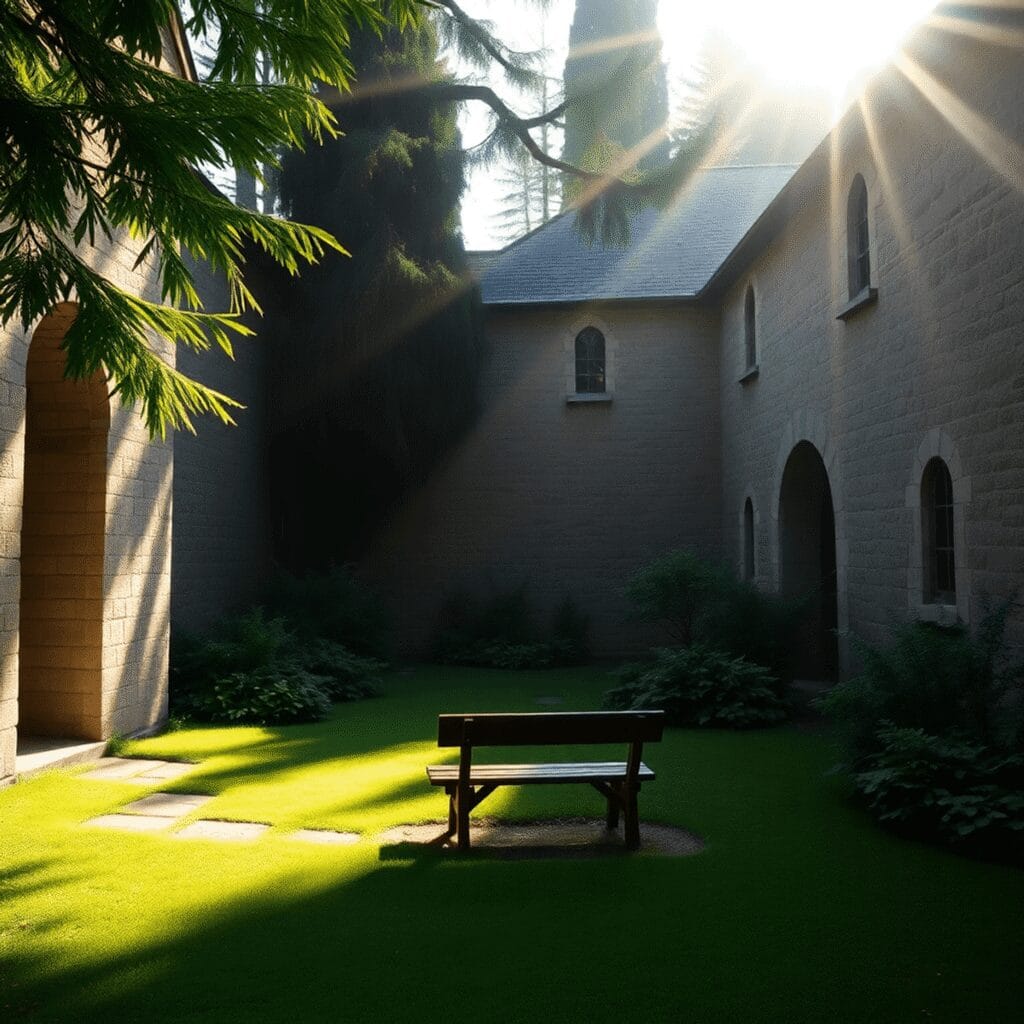
Silence in monastic rules
Silence occupies a place essential in the rules that structure the monastic life. This is not simply an absence of words, but an essential framework for spiritual discipline and the purification of the mind.
Central role in historical rules
THE ancient monastic rules, in particular those of Saint Benedict and of Saint Columbanus, insist on silence as the foundation of a consecrated existence. Saint Benedict, Silence is prescribed to encourage introspection and...’humility, These are essential conditions for progressing on the spiritual path. Saint Columbanus, less well-known but just as influential, emphasizes silence as a necessary support for inner vigilance.
Teachings of Saint Benedict and Saint Columbanus
- Saint Benedict presents silence as a means of inner purification, a discipline allowing the monk to free himself from distractions and passions. In his rule, he recommends limiting speech to necessities to avoid "useless words which are enemies of salvation".
- Saint Columban He emphasizes a stricter silence, seen as a means of asceticism that opens one to a deeper divine presence. Silence thus becomes a space where the soul can recenter itself and ascend.
Listen attentively to the divine word
Silence facilitates attentive listening: Listening to God means first and foremost being silent.. This practice allows the monk to hear not only the scriptural word but also what could be called the "inner voice," a discreet manifestation of the divine presence. The absence of external noise creates a climate where attention is refined, making possible a true receptivity to the word that transforms.
«"Silence is a school where the soul learns to listen to God," could summarize this monastic vision.
Thus, silence is not merely a means of controlling one's own words; it becomes a profound tool for welcoming and responding to the divine call, the very foundation of all monastic life authentic. This concept of silence as a central element in monastic spirituality has been explored in depth in several studies, including in academic publications such as those available on OpenEdition.
Contemporary practices of silence in monastic orders
The Cistercian and Trappist orders rigorously perpetuate the tradition of silence, while adapting it to the demands of the modern world. Maintaining these silent practices remains a fundamental pillar of their spiritual life.
Strict silence and contemplative meditation
In these communities, silence is not simply the absence of words; it is above all a necessary framework for contemplative meditation. Strict silence facilitates a deep immersion in inner prayer, allowing each monk or nun to refocus on their relationship with God. This discipline fosters attentive listening and an inner presence, far removed from the distractions of the outside world.
Avoid unnecessary speech
Superfluous speech is seen as an obstacle to spiritual purity. Cistercian rules encourage speaking only when necessary, in order to avoid the sin associated with idle or hurtful words. This conscious choice strengthens self-awareness and cultivates a form of restraint in verbal expression.
Adapting to current realities
While remaining true to its roots, monastic silence also fits into a contemporary context where constant noise can become overwhelming. Some monasteries introduce specific times dedicated to absolute silence, alternating with periods of manual or communal work where speech is permitted but always measured.
These practices testify to the importance of silence in the Christian monastic tradition as a living means of deepening one's inner life, protecting the soul from negative influences, and opening a sacred space for encountering the Divine. Silence is not simply withdrawal; it is an active presence that sustains the entire spiritual dynamic of the Cistercian and Trappist orders.
Silence as a spiritual language and inner experience
Silence goes far beyond the absence of words. It is a love language, a form of spiritual communication that requires neither words nor sounds. This silent language opens a unique space where the heart can express itself freely, where the soul dialogues with God in profound intimacy.
This silence becomes a inner presence alive. It is not empty, but inhabited by peace and divine light. In this contemplation, the monk is no longer merely a spectator, but an active participant in a mystical encounter. Silence invites one to welcome the Invisible, to perceive the subtlety of the divine presence which often manifests itself in what noise prevents us from hearing.
«"Silence is the language of God; everything else is just a poor translation."»
— Monastic proverb
L'’experience of God Silence transforms the believer's relationship with their faith: it is no longer simply about reciting prayers or sacred texts, but about experiencing a profound and silent communion. This inner experience fosters spiritual awakening, allowing each person to come into direct contact with their own essence and that of God.
By abandoning verbal distractions, silence invites active and compassionate listening. It is a sacred space where thoughts quiet down, giving way to pure contemplation. Through this, silence becomes a universal language of the heart, accessible to all who seek to touch the invisible beyond words.
Silence thus reveals an essential truth: it is possible to communicate without speaking, to love without uttering a single sound. It is that invisible bridge between the creature and its Creator, a place where the very authenticity of spiritual life is played out.
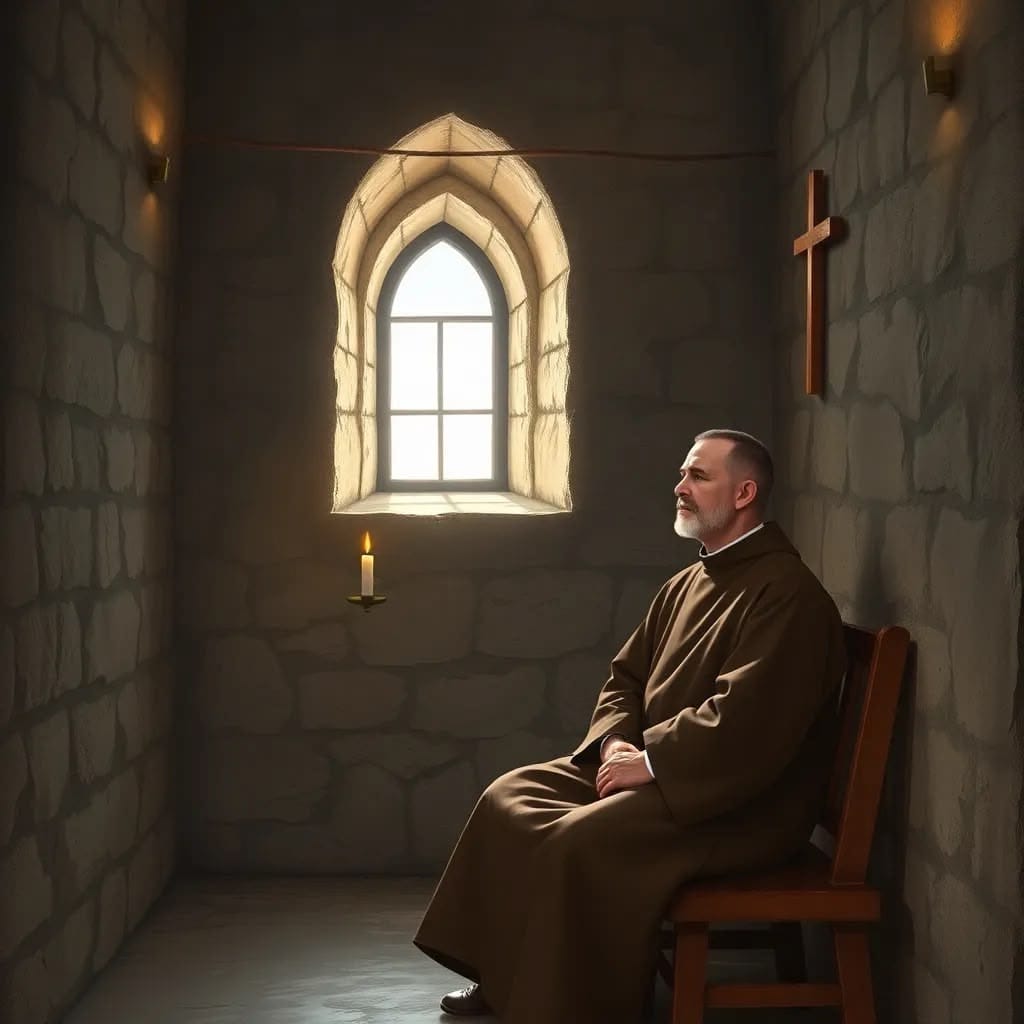
THE inhabited body through silence: a human and spiritual dimension
Monastic silence is not limited to a simple cessation of speech. It pervades the inhabited body, transforming each gesture, each breath into a vehicle for inner peace and attentive listening. The body thus becomes a bearer of silence, embodying a silent presence that transcends words.
A profound internalization
From this perspective, silence acts as a form of profound introspection where the body opens itself to the spiritual dimension. The monks, through their calm posture and measured movements, manifest a being in harmony with this invisible reality. inhabited body This then reflects a state of acceptance and openness to the divine encounter.
The discovery of the authentic self
This phenomenon also reveals an essential human dimension: silence allows for the discovery of the authentic self. When verbal distractions fade away, the individual can confront themselves without artifice. This authenticity is expressed in bodily simplicity, far removed from social masks or pretenses.
THE effects of silence on the body
The effects of silence on the body are numerous:
- Slowing of the pace : breathing becomes deeper, promoting overall calming.
- Reclining posture : physical attitude reflects silent inner feelings.
- Enhanced sensory awareness : the senses unfold differently, capturing subtle realities.
The body as a temple of spiritual silence
This union of silence and corporeality invites us to perceive the body as a temple of spiritual silence. It is no longer merely a functional vehicle but a living space where inner life manifests. In this context, silence becomes a bodily language—that of a humble and genuine presence.
The revelation of the authentic person
The revelation of the authentic person thus comes through this inhabited body which bears witness without words to the spiritual experience lived. Silence then transforms the monk into a fully alive being, rooted in his humanity and open to the divine mystery.
This exploration of inhabited body The use of silence is also linked to broader aspects of our existence. Indeed, according to some research, such as that presented in this... document, There is a significant relationship between our inner state and our physicality. This underscores the importance of a holistic approach in our understanding of the body and silence.
Silence as resistance to contemporary noise
The modern world is saturated by a constant noise which pervades every aspect of daily life. Modern media, social networks, incessant notifications, ubiquitous advertising: this sound saturation leaves little room for inner peace. This constant cacophony weakens our ability to concentrate, to meditate, and to listen to deeper thoughts.
Silence in the Christian monastic tradition
In this context, the importance of silence in the Christian monastic tradition takes on a dimension of resistance. Silence becomes a voluntary act of withdrawal from external agitation and information overload. It is not simply an absence of noise, but a conscious choice to preserve a sacred space where the soul can find itself.
Monastic communities as a model
Monastic communities offer a model. They cultivate silence not only for their own spiritual growth, but also as a critical stance towards the frenetic pace of the contemporary world. This monastic silence invites us to slow down, to silence the external chatter in order to hear our inner voice and the voice of God.
Several aspects illustrate this resistance:
- Creating quiet spaces in monasteries, far from the sounds of the city.
- Regular practice of silence, sometimes strict, to counter the invasion of useless words.
- Contemplative approach, using calm to deepen meditation and prayer.
- Rejection of superfluous speech, which often fuels mental and social turmoil.
This rejection of excessive noise is not a rejection of the world, but a way of responding to it differently. Through silence, we cultivate a form of attentive listening that opens us to a truer and deeper understanding of human and divine realities. From this perspective, it is interesting to explore how the Silence can be used as a tool in public spaces, allowing for a more enriching and contemplative experience.
The importance of silence in the Christian monastic tradition thus emerges as a powerful response to the contemporary challenges posed by the noise saturation imposed by modern media and current lifestyles. the practice of silence offers a restful and spiritually nourishing alternative to the surrounding noise. At the same time, it is essential to recognize that this dialectic of silence is not only applicable to the monastic sphere but can also be integrated into our daily lives as’architect and dialectic of silence.
Theological dimension of silence: the "silence of God"«
There theology of silence It occupies a unique place in the Christian tradition. This concept, often called "divine silence," refers to the paradoxical experience where God seems absent or silent, even as humanity seeks His presence. This silence is not a void, but a space filled with mystery and an invitation to faith.
Biblical origins and key moments
- THE Holy Saturday is the prime example of God's silence: between the crucifixion and the resurrection, Christ is plunged into an apparent silence that causes his disciples to question deeply. This moment reveals a God who is silent but who acts profoundly.
- In Scripture, this silence is also manifested during times of trial, such as when Job cries out to God without an immediate answer. This silence invites trust and spiritual endurance.
Theological meanings
Divine silence can be interpreted as follows:
- A test of faith, where the believer learns to trust in the apparent absence of obvious signs.
- A call to introspection, encouraging listening beyond words, to enter into a deeper spiritual relationship.
- A mysterious presence, because silence is never absolute nothingness but a more subtle form of communication, sometimes perceived as an ineffable inner peace.
Patristic and contemporary reflections
The Church Fathers often meditated on this silence. For example:
«God speaks in silence; he does not always speak with words, but through his invisible spirit that dwells in the heart» (Saint Augustine).
Today, contemporary theology explores this same silence as a meeting place between God and man, emphasizing that it opens up an experience where divine absence and presence are lived simultaneously.
Divine silence reminds us that our relationship with God is not based solely on outward manifestations or spoken words, but on a profound intimacy that transcends the limits of human language. theological dimension of silence This enriches monastic practice by giving spiritual meaning to periods of perceived divine "absence".
Conclusion
Silence occupies an essential place in the Christian monastic tradition, as spiritual practice multiple and rich in meaning. It is not limited to the absence of words, but asserts itself as a true path of’silent adoration where the monk's heart opens to the encounter with God.
- Silence serves to purify the soul, allowing for attentive listening to the divine word.
- It promotes deep and contemplative meditation, far from the distractions of the world.
- This retreat into silence helps to reveal human and spiritual authenticity, rooted in the inner presence of God.
- In a contemporary context saturated by noise and information, it becomes a salutary resistance that renews inner life.
This path of silence is also a call to spiritual elevation. By practicing silence, you enter into a dynamic of interiority where adoration becomes more than a verbal act: it is transformed into a profound communion with the divine.
The richness of silence in the Christian monastic tradition invites you to rediscover this invisible and powerful language. Silence is much more than a simple absence: it is a way of fully inhabiting each moment in the loving presence of God.
Frequently Asked Questions
What is the importance of silence in the Christian monastic tradition?
Silence occupies a fundamental place in the Christian monastic tradition as spiritual practice essential. It allows the purification of the mind, promotes attentive listening to the divine word and constitutes a privileged path of worship and spiritual elevation.
What are the biblical roots of silence in monastic Christianity?
The biblical origins of silence in the Christian tradition are found in particular in the psalms attributed to King David, the silent experiences of the prophet Elijah hearing God in a whisper, the silent prayers of Jesus, as well as in the Epistle of James which emphasizes the virtue of silence.
How is silence integrated into historical monastic rules?
Silence is central to monastic rules, such as those of Saint Benedict and Saint Columbanus. It is taught as a means of inner purification and an indispensable condition for attentive listening to the divine word, thus strengthening the spiritual life of the monks.
What are the contemporary practices of silence in monastic orders such as the Cistercians and Trappists?
Among the Cistercians and Trappists, strict silence is maintained to foster contemplative meditation. This discipline aims to avoid unnecessary or superfluous speech, thus allowing the monks to fully experience their spirituality and their relationship with God.
In what way does silence constitute a spiritual language and an inner experience?
Beyond the absence of words, silence is considered a true language of love and an inner presence where God can be experienced. It allows for profound communication with the divine, revealing an intense spiritual dimension.
How does monastic silence act as a resistance to contemporary noise?
In a modern world saturated by constant noise and information overload from the media, monastic silence emerges as a form of resistance. It offers a space of calm and contemplation essential for preserving inner peace and fostering an authentic encounter with God.