










A reading from the book of the prophet Daniel
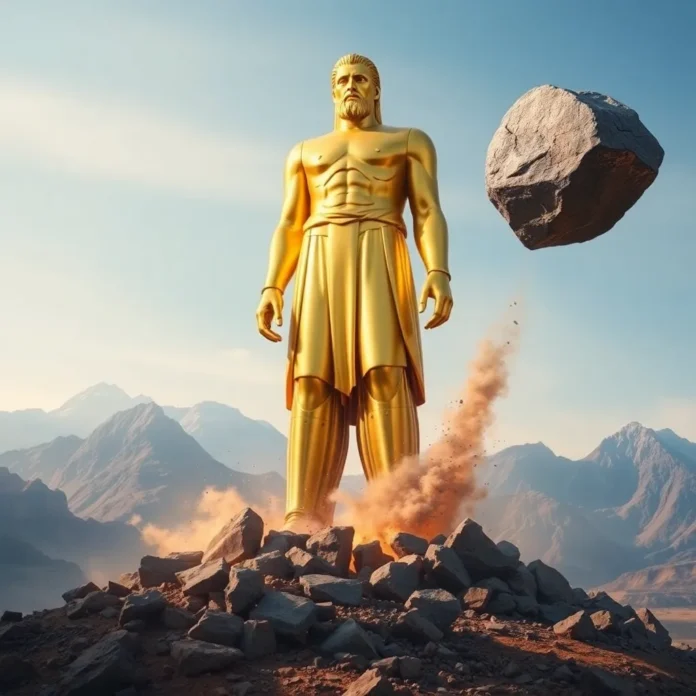
In those days, Daniel said to Nebuchadnezzar: «O king, this is your vision: an immense statue stood before you, a great statue, exceedingly bright and terrifying in appearance. Its head was of pure gold; its chest and arms of silver; its belly and thighs of bronze; its legs were of iron, and its feet partly of iron and partly of clay.
As you watched, a stone was cut out of the mountain, but not by human hands. It struck the statue's feet of iron and clay and crushed them to powder. The iron and clay, the bronze, silver, and gold were all reduced to powder; they became like chaff that blows away in the summer threshing season and were carried off by the wind without leaving a trace. But the stone that struck the statue became a huge mountain that covered the whole earth.
This is the dream; and now, before the king, we will give its interpretation. To you, King of kings, the God of heaven has granted kingship, power, strength, and glory. To you he has given dominion over humankind, over beasts of the field, and over birds of the air, wherever they dwell; he has appointed you ruler over all things: you are the head of gold.
After you will arise another kingdom, inferior to yours, then a third kingdom, a bronze kingdom that will rule the whole earth. There will be yet a fourth kingdom, as hard as iron. Just as iron breaks and crushes everything, so too will it pulverize and shatter all the kingdoms.
You saw the feet, which were partly clay and partly iron: indeed, this kingdom will be divided; it will have the strength of iron, just as you saw iron mixed with clay. These feet, partly iron and partly clay, signify that the kingdom will be partly strong and partly fragile. You saw the iron combined with the clay because the kingdoms will unite through marriage alliances; but they will not hold together, just as iron does not bind to clay.
But in the days of those kings, the God of heaven will set up a kingdom that will never be destroyed, nor will its kingdom pass to another people. This last kingdom will crush and annihilate all the others, but it will itself endure forever. Just as you saw a stone cut out of the mountain, but not by human hands, and it shattered the iron, the bronze, the clay, the silver, and the gold.
The great God revealed to the king what must happen next. The dream is true, the interpretation is reliable.»
Welcoming the Unshakeable Kingdom: The Stone That Topples Empires
Rereading the statue of Nebuchadnezzar helps us discern the Kingdom of God which traverses, judges, and transfigures human history.
Nebuchadnezzar's dream, as interpreted by Daniel, is one of the most striking visions in the entire Bible: a colossal statue made of decaying metals, toppled by a mysterious stone that becomes a mountain filling the earth. This account, often read as a key to universal history, poses a crucial question for believers today: on what kingdom does our hope truly rest? This article is for all those who seek to reconcile political awareness, biblical fidelity, and the desire for a Kingdom that does not pass away.
- Historical and spiritual context of Daniel's dream and the statue.
- Theological analysis of the statue, the kingdoms, and the stone.
- Three themes: the fragility of empires, the birth of the Kingdom, Christian hope.
- Echoes in the Christian tradition and contemporary spiritual life.
- Concrete paths to living today as citizens of an unshakeable Kingdom.
Context
THE Daniel's book It opens with a trauma: the Babylonian exile, the collapse of the Davidic monarchy, and the destruction of Jerusalem. The people of the Covenant find themselves in a foreign land, subjected to the crushing power of Nebuchadnezzar, "king of kings" in the eyes of the nations. In this context, the burning question is this: who truly governs history? The gods of Babylon or the God of Israel? The story of the statue emerges precisely as a powerful and symbolic response to this crisis.
Nebuchadnezzar has a dream that deeply disturbs him: a gigantic, terrifying, resplendent statue. Its head is made of pure gold, its chest and arms of silver, its belly and thighs of bronze, its legs of iron, and its feet a mixture of iron and clay. This descending structure, from the most precious to the most fragile, suggests a gradual decay: the initial glory crumbles, the solidity cracks, and the colossus ultimately rests on an unstable base. The impressive appearance masks an intrinsic fragility.
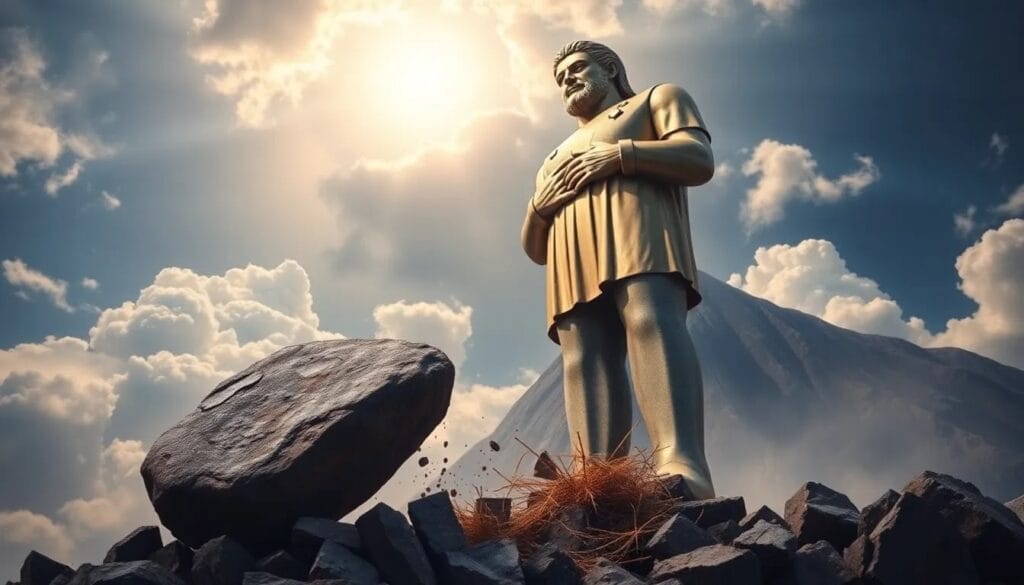
As the king contemplates the statue, a stone breaks away from a mountain, "without anyone having touched it." This detail is crucial: this stone is not the work of men, nor the result of a political or military strategy. It comes from elsewhere, from God, and emerges in history without passing through the ordinary mechanisms of power. It strikes the statue's feet, that point of convergence between the strength of iron and the weakness of clay, and pulverizes the entire structure. Iron, clay, bronze, silver, and gold are swept away like a ball carried by the wind: no trace remains of these supposedly eternal kingdoms.
The stone, however, does not disappear into the dust of empires. It becomes an immense rock that fills the entire earth. The image shifts: from the proud verticality of the statue to the expansive horizontality of the mountain. History is no longer dominated by a single monument to the glory of a sovereign, but by a stable, living reality that gently and firmly pervades the whole world. The mountain evokes the dwelling place of God, the place from which law, presence, and blessing originate.
Daniel then provides the interpretation. The head of gold represents Nebuchadnezzar himself, to whom God has given kingship, power, strength, and glory. Other kingdoms follow, symbolized by silver, bronze, and iron, succeeding one another, dominating each other, and ultimately collapsing. The fourth kingdom is described as particularly harsh, crushing, and oppressive, but it too is subject to division and fragility: an unstable mixture of iron and clay, political alliances, dynastic marriages, and attempts to unify what cannot be held together. Human empires, however powerful, carry within them the seeds of their own dissolution.
The culmination of the interpretation lies in this statement: «In the days of those kings, the God of heaven will raise up a kingdom that will never be destroyed, and whose kingship will not pass to another people. This last kingdom will crush and annihilate all the others, but it itself will endure forever.» The narrative does not merely relativize earthly empires; it announces the irruption of a Kingdom of a different order, one that is not based on violence, but on a gratuitous divine initiative, symbolized by the unhewn stone.
Analysis
The central idea of this passage can be summarized as follows: human history, marked by the succession of powers and systems, is ultimately judged and transfigured by a Kingdom that comes from God and endures forever. The fundamental contrast is between the statue and the stone, between what humans build to glorify themselves and what God brings forth to save and establish his sovereignty.
The statue embodies the fascination and illusion of power. It is immense, gleaming, and terrifying. It impresses the senses, like all political or imperial propaganda. Each metal can be interpreted as an era, a regime, a culture. But the essential point lies elsewhere: even the golden head, symbol of an apparently absolute reign, is placed under the judgment of a God who "bestows" kingship and power. The king's sovereignty is neither natural nor absolute; it is received, conditional, and provisional.
The very structure of the statue manifests a logic of decline. Gold gives way to silver, silver to bronze, bronze to iron, and iron to this bizarre mixture with clay. The deeper one goes, the harder the material becomes, but also the more fragile it is overall. Iron breaks everything, but the mixed feet reveal the internal contradiction of empires: they strive to be indestructible, yet they rest on alliances, compromises, and conflicting interests. The displayed solidity masks a deep fracture. This tension is found in many political, economic, or ideological systems: strong on the outside, cracked on the inside.
Stone, however, introduces a different logic. It does not belong to the system of metals. It comes from the mountain, the place of divine presence and initiative. It is neither sculpted nor polished; it is raw, given, gratuitous. It is not added to existing empires: it does not become a fifth metal in the statue. It strikes, overturns, replaces. It is not just another empire in the game of powers; it is another type of Kingdom, revealing the radical relativity of all others.
The gesture of the stone striking the feet is revealing: God attacks points of weakness, areas of compromise, where empires are artificially maintained. God's judgment is not a whim, but a revelation of truth: that which is not founded on Him cannot stand. The shattering of the statue signifies not only the fall of a particular empire, but the collapse of all human pretension to consider itself ultimate, absolute, and self-founding.
However, the text does not simply depict destruction. The stone becomes a mountain that fills the earth. The image is not one of bombardment or sterile annihilation, but of growth, expansion, and unfolding. This Kingdom comes not only to judge, but also to build, fill, and inhabit. It does not pass from one people to another according to the logic of conquest; it is given, brought about, and established by God himself.
Existentially, this passage challenges the believer to consider what they deem "solid" in their life. On what does hope rest? On a career, a nation, a regime, an economy, a cultural identity? Or on a Kingdom that comes from elsewhere, that does not depend on power struggles, but on loyalty Of God? The statue serves as a reminder that even the most impressive structures can disappear without a trace. The stone invites us to cling to what remains, even when everything else is crumbling.
The spiritual significance of this text is therefore twofold: it educates the eye to historical lucidity, by relativizing all political idolatry, and it opens the heart to a theological hope, rooted in the Kingdom of God, already at work but still growing in the world.
The structural fragility of all empires
The statue of Nebuchadnezzar is an icon of all human systems that claim omnipotence. It speaks of Babylon, undoubtedly, but it also speaks of all the "Babylons" that punctuate history. The golden head evokes those moments when a civilization sees itself as the unsurpassable pinnacle of culture and power. Yet, this glory is already presented as fleeting: "After you, another kingdom will arise." This "after you" serves as a constant reminder: no regime is permanent.
The shifting of metals indicates a kind of spiritual entropy. Humanity, left to its own devices, does not necessarily progress toward improvement, but can oscillate between refinement and brutality, between enlightenment and oppression. Iron, a symbol of military strength and destructive capacity, dominates at a certain point, but this power is not synonymous with stability. The iron and clay feet reveal that every human construct, even one armed to the teeth, rests on social, relational, and cultural bonds that are often fragile.
The image of political marriages illustrates the persistent temptation to cement unity through artificial means. An empire attempts to hold together divergent peoples, cultures, and interests by multiplying superficial alliances. But iron does not adhere to clay. Structures may hold for a time, through force, fear, or propaganda, but they do not become a true communion. What is lacking is internal cohesion, justice, and truth., charity, In short, everything that comes from a Kingdom rooted in God.
For the believer, recognizing this structural fragility is not an exercise in cynicism, but a call to spiritual vigilance. It means not absolutizing what is relative, not confusing the earthly city with the City of God. One can love one's country, engage in politics, work for institutions, but without idolizing them. The statue reminds us that everything not founded on God is destined for dust.
This also requires a certain inner freedom in the face of historical crises. When a system collapses, when political or economic landmarks crumble, the temptation is fear or despair. Daniel's text offers another perspective: these upheavals are also moments of truth where God reveals what truly endures. Christians are called upon to go through these times not as panicked spectators, but as witnesses of a Kingdom that does not falter.
Finally, the fragility of empires reflects the fragility of our own small, personal "kingdoms." Each of us builds inner statues: self-image, success, recognition, certain idealized emotional bonds. These constructions can be brilliant, admired, but they sometimes rest on feet of clay: the fear of not being loved, the need to prove one's worth, the pursuit of absolute control. The passage invites us to let God strike these feet of clay to build life on a new bedrock.
The rejected stone: birth of a Kingdom of a different order
The stone that detaches itself from the mountain, without human intervention, is the symbolic heart of the passage. It has nothing spectacular about it: no precious metal, no refined form. It seems poor, insignificant, compared to the radiant statue. But it is this stone that possesses true historical and spiritual efficacy. The entire paradox of the Kingdom of God can be sensed here: that which appears weak destroys that which believed itself invincible.
The fact that this stone was not hewn by human hands indicates a purely divine origin. It does not fit into the logic of grand human projects; it is not the product of political genius or a planned revolution. It escapes the calculations of the powerful. This stone represents God's sovereign initiative, his freedom to visit his people and guide history according to his own path. The Kingdom that results from it is not a product of culture, but a gift.
By striking at the feet, the stone reveals the nerve center of empires. It doesn't attack the golden head, as if the central issue were simply changing leaders. Nor does it target only the hardest metal, as if everything hinged on a direct confrontation. It touches the zone where strength and weakness intertwine, where human ambition attempts to conceal its flaws. God doesn't merely correct the surface; he lays bare the profound truth of human constructs.
But the stone is not merely an instrument of judgment. It is the seed of a Kingdom. The text emphasizes its growth: it becomes a great mountain that fills the entire earth. The image evokes a gradual, patient presence, gaining in scope without losing its solidity. This Kingdom does not replace empires with an even more powerful one, according to the logic of one-upmanship. It inaugurates another way of inhabiting the earth: no longer under the domination of terrifying colossi, but in the shadow of a stable mountain.
For the Christian reader, this stone spontaneously evokes the figure of Christ, the "cornerstone," the "rejected stone," yet chosen by God. The logic is the same: what the world judges insignificant, marginal, contrary to the ordinary criteria of power, becomes the center of an unshakeable Kingdom. The cross, in this perspective, appears as the moment when the stone definitively strikes the statue: the powers of this world unite against Christ, and it is precisely there that the victory of the Kingdom of God is revealed.
This Kingdom does not unfold primarily through institutional conquests, but through the transformation of hearts, relationships, and communities. It invades the earth not with legions, but through the spread of faith, hope, and love. The image of the mountain also recalls the words and actions of Jesus on the mountain: the teaching of the Beatitudes, the Transfiguration, and prayer. The stone transformed into a mountain represents Christ founding a new people, gathered around his word and his presence.
Christian hope and historical discernment
Daniel's passage does more than simply offer a symbolic interpretation of the past. It fosters a discerning stance for believers of all times. Understanding that "the last kingdom will crush and destroy all the others" invites neither flight from the world nor religious triumphalism, but rather a clear-sighted and committed hope.
First, a clear-eyed hope. The text does not deny the reality of empires. It acknowledges their power, their capacity to dominate lands and peoples. The believer is not invited to live in a bubble, ignoring the political, economic, or cultural stakes. But they are called to see them in the light of God: powerful, but relative; impressive, but mortal. This clear-eyedness allows us to avoid both naiveté (idolatry of a system) and cynicism (believing that everything is equal).
Next, a committed hope. Knowing that the Kingdom of God endures forever does not absolve us from acting in the present. On the contrary, it liberates us for selfless action, which does not seek to save a particular regime, but to bear witness to the values that come from the Kingdom: justice, mercy, truth, and peace. Christians can thus work for the common good, support just causes, and denounce injustices, without confusing any human project with the ultimate fulfillment of God's plan.
This hope also invites a certain humility ecclesial. The history of the Church has sometimes been tempted to see itself as a statue of precious metal, unshakeable as a historical institution. The text of Daniel reminds us that only the stone from God, that is, Christ and his Kingdom, is truly unshakeable. The historical forms of the Church can change, be purified, sometimes collapse here or there, without the Kingdom being affected in its essence. This humility opens the door to reform and conversion.
Finally, the historical discernment inspired by Daniel touches the inner life of every believer. Each person experiences crumbling "empires": aborted projects, lost securities, broken relationships. The shattered statue can symbolize these personal collapses. At the heart of these apparent ruins, the text dares to proclaim that a Kingdom remains, that a stone endures, that a mountain is growing. Christian hope does not consist in denying loss, but in believing that no failure, no fall, can prevent God from building his Kingdom in an open heart.

«"The Kingdom That Does Not Pass Away"»
Christian tradition quickly interpreted Nebuchadnezzar's dream as a foreshadowing of the Kingdom of Christ. The stone, unhewn by human hands, was linked to the virgin birth, the cross, the resurrection, In short, with everything in the life of Jesus that escapes the ordinary categories of power. Many ancient authors saw in the statue the succession of great pagan empires, culminating in the coming of Christ who inaugurates a spiritual and universal Kingdom.
The Church Fathers often emphasized the contrast between the statue, the work of men, and the stone, the work of God. They discerned in this an implicit critique of all political or religious idolatry: men fashion images of power to suit their own purposes, but God overthrows these idols to establish worship in spirit and in truth. The shattering of metals was understood as the end of pagan cults and the victory of the one God, revealed in Jesus Christ.
In medieval theology, this text was sometimes read from a more historical-salvific perspective, as a grand fresco of salvation history: after the ancient empires comes the time of the Church, sign and instrument of the Kingdom already present but not yet fully manifested. The stone that became a mountain then evokes the growth of the Christian people through the centuries, despite persecutions and crises. The liturgy, in particular, has favored this passage to nourish the awareness of a God who guides history toward a culmination where his kingship will be recognized by all.
In contemporary spirituality, this text finds a new resonance in the face of ideological collapses and global crises. It reminds us that neither totalitarian regimes, nor economic imperialisms, nor technological utopias can claim the final word. The Kingdom announced by Daniel is not to be confused with any human project, but it inspires forms of community life where the dignity of each person, justice, and peace are more than a slogan: a requirement rooted in the kingship of Christ.
Thus, from century to century, the Christian tradition has heard in this vision a call to shift hope: to leave behind the fascination with the statues of the moment, to attach oneself to the living stone, to the Kingdom that is coming, discreet and powerful, to judge and save history.
«Walking on rock»
- To stand inwardly before the statue: to imagine this colossal figure made of various metals, to let rise within oneself the images of the "empires" which impress today: political, economic, media powers, but also the small personal statues built around the ego or the gaze of others.
- Contemplating the stone that falls from the mountain: recognizing that it does not come from human effort, but from a gratuitous initiative of God. Asking for the grace to believe that, in one's personal life as in the history of the world, God acts beyond human calculations.
- Re-examining one's own collapses: identifying situations where what seemed solid crumbled. Rather than remaining in regret or resentment, embracing the possibility that these "shatterings" have opened a space for a truer, humbler foundation, more rooted in God.
- Meditate on the Kingdom that does not pass away: remember that this Kingdom is manifested in acts of justice, mercy, and truth. Ask yourself: where, concretely, today, is the Kingdom of God seeking to grow through my choices, my work, my relationships?
- Offering God one's fears about the future: sharing them in prayer, laying them on the stone. Asking for the grace of a hope that does not depend on the apparent stability of human systems, but on loyalty of the God who makes his mountain grow in secret.
- Conclude with a prayer of trust: surrender to God one's own life, that of the Church and of the world, repeating inwardly that his Kingdom will endure forever.
Conclusion
The vision of the statue and the stone confronts each of us with an inner decision: to choose the path of shining, fascinating metals destined for dust, or to rely on the unassuming stone that becomes a mountain and fills the earth. Daniel's text is not simply a prophetic depiction of the past; it is a living word that, even today, exposes our illusions and opens a path to freedom.
To recognize that «the final kingdom will crush and destroy all the others, but it will itself endure forever» is to accept that nothing founded on God can claim permanence. This may seem threatening to our sense of security, but it is in reality an immense liberation: the value of a life does not depend on its place within a particular system, its success, or its recognition. It lies in responding to the call of the Kingdom, in welcoming the stone that God sends, in allowing this Kingdom to shape our concrete choices.
This call is not abstract. It invites us to a conversion of perspective (no longer idolizing the statues of the moment), of heart (placing our ultimate trust in God), and of action (already living according to the values of the Kingdom). The challenge is revolutionary: to become, at the heart of fleeting empires, citizens of an unshakeable Kingdom, capable of weathering the upheavals of history with an unwavering hope.
Practical
- Identify each evening an inner «statue» (fear, ambition, self-image) and explicitly place it in God’s hands.
- Regularly reading biblical passages about the Kingdom of God nourishes a hope rooted elsewhere than in current events.
- Each week, take a concrete action of justice or mercy, however modest, as an active participation in the Kingdom.
- Practicing a time of silence to contemplate inwardly the stone that has become a mountain, asking for a stable heart amidst the changes.
- Rereading world events with other believers, to learn together to discern what belongs to statues and what belongs to the Kingdom.
- When anxiety arises about the future, repeat a short prayer of surrender to the God whose Kingdom will never pass away.
References
- Book of the Prophet Daniel, chapters 1–7 (narrative context and visions of kingdoms).
- Synoptic Gospels : words of Jesus on the Kingdom of God and the cornerstone.
- Patristic writings on the Daniel's book (Christological readings of the stone and the kingdoms).
- Medieval and liturgical texts on the kingship of Christ and the eternal Kingdom.
- Magisterial documents on Christian hope and historical discernment.
- contemporary biblical commentaries of Daniel's book, in particular on chapter 2.
- Works of Christian spirituality dealing with the theme of the Kingdom of God in daily life.