










A reading from the book of the prophet Isaiah
Words of Isaiah,
— what he observed concerning Judah and Jerusalem.
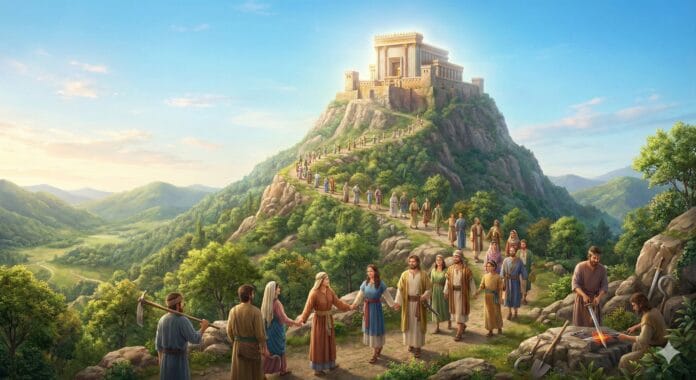
In the days to come, the mountain of the Lord’s house will be raised above the mountains and will be exalted above the hills. All nations will gather there, and many peoples will come together and say, «Come, let us go up to the mountain of the Lord, to the house of the God of Jacob. He will teach us his ways, so that we may walk in his paths.» The law will go out from Zion, the word of the Lord from Jerusalem.
He will be judge between the nations and an arbiter for many peoples. They will beat their swords into plowshares and their spears into pruning hooks. Nation will never take up sword against nation; they will no longer learn the art of war. the war.
Come, house of Jacob! Let us walk in the light of the Lord.
When swords become plows: Isaiah's vision for a reconciled world
Imagine for a moment a world where military budgets are converted into agricultural programs, where arms factories manufacture tractors, where generals become peacemakers. A naive utopia? An unrealistic vision? Yet, this is precisely what the prophet Isaiah invites us to contemplate in one of the most powerful texts in all of biblical literature. This passage from’Isaiah 2, Chapters 1-5 are not addressed only to dreamers or idealists disconnected from reality. They speak to you, to me, to all those who refuse to accept violence as inevitable and who seek a horizon of meaning for our fragmented humanity. Whether you are a devout believer, a spiritual seeker, or simply in search of wisdom, this prophetic text has something essential to tell you about your own vocation as a peacemaker.
In this article, we will first delve into the historical and literary context of this prophecy to grasp its full significance. We will then analyze the text's inner movement, this ascendant dynamic that transforms hearts before it transforms weapons. Next, we will explore three major themes: the mountain as a place of universal encounter, the transformation of instruments of death into tools of life, and the final call to walk in the light. We will examine how the Christian tradition has received and meditated upon this text before offering concrete suggestions for embodying it today.
A word that emerged from the darkness of history
To understand the power of this text, one must first imagine the world in which Isaiah prophesied. We are in the 8th century BCE, in a small kingdom of Judah caught between predatory empires. To the north, Assyria extends its brutal domination over the entire... Middle East ancient. Its armies are notorious for their cruelty: mass deportations, public executions, crushing tributes. To the south, Egypt remains a power to be reckoned with. And between the two, this tiny territory of Judah, with Jerusalem as its capital, struggles to survive through a web of risky alliances and political compromises.
Isaiah ben Amoz—his full name—exercised his prophetic ministry for approximately forty years, during the reigns of four kings of Judah: Uzziah, Jotham, Ahaz, and Hezekiah. He was a man of the court, likely from the aristocracy, with access to the circles of power. But he was also a visionary, someone who experienced a life-changing encounter with the holy God in the Temple of Jerusalem—that famous vision in chapter 6 where he sees the Lord seated on a high throne, surrounded by seraphim who proclaim: «Holy, holy, holy is the Lord God Almighty!»
This formative experience explains the dual tone of his preaching: on the one hand, an uncompromising denunciation of social injustices, idolatry, and the corruption of the elites; on the other, an unwavering hope in God's plan for his people and for all humanity. Isaiah is neither a naive optimist nor a resigned pessimist. He is a realist of faith, someone who clearly sees evil but refuses to let it have the last word.
The passage we are meditating on is located at the very beginning of the book, just after the first chapter, which presents a harsh indictment of Judah. The contrast is striking. After the accusations, after the announcement of judgment, a window onto the future suddenly opens. It is as if the prophet, after describing the night, were pointing to the dawn breaking on the horizon.
The text itself has a remarkable structure. It opens with a solemn introductory formula: «The word of Isaiah, which he saw concerning Judah and Jerusalem.» Note well: Isaiah invents nothing; he transmits what he «saw.» Biblical prophecy is not intellectual speculation; it is a vision, a revelation, something that imposes itself on the prophet with the force of undeniable truth. Then comes the heart of the oracle, with this extraordinary image of the mountain rising up and drawing all nations to it. Finally, the text concludes with a direct exhortation addressed to the «house of Jacob»: «Come! Let us walk in the light of the Lord.»
From a literary perspective, this passage belongs to the genre of eschatological oracles, those texts that speak of the "last days," of the final fulfillment of history. But be careful: in biblical thought, eschatology is not simply a description of the end times. It is a way of saying that the future belongs to God, that history has meaning and direction, and that this ultimate meaning already illuminates the present. The "last days" are not only chronologically distant, they are qualitatively different—and this new quality can already burst into our present.
The paradox of elevation: when the highest becomes the most accessible
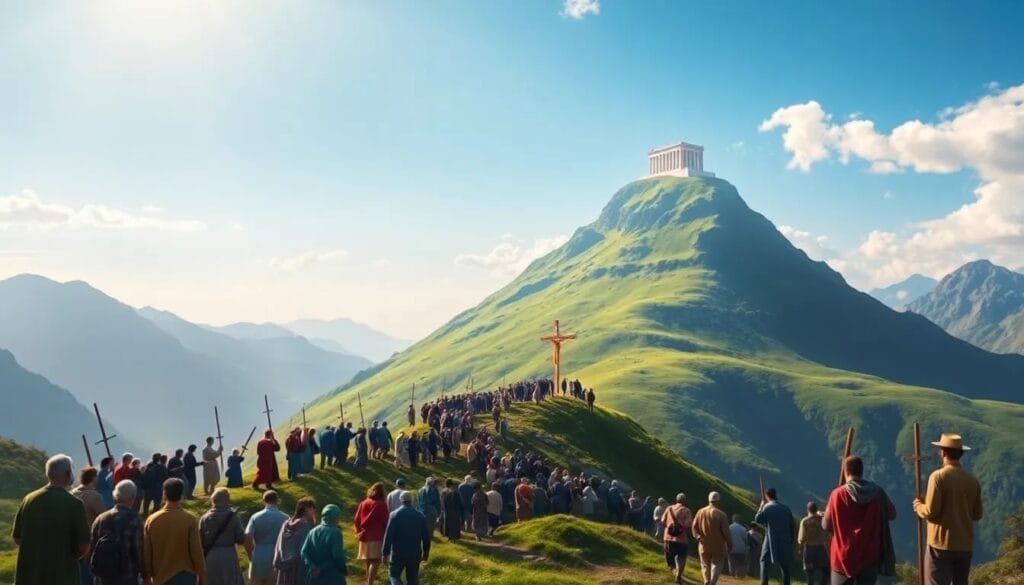
Let us now delve into the inner workings of this text. The first striking image is that of the mountain of the Lord's house, which "will stand above the mountains" and "will be exalted above the hills." At first glance, one might see this as a simple assertion of superiority: the God of Israel would be greater than other gods, his temple more important than other sanctuaries. But that would be to miss the essential point.
In the ancient world, mountains were considered places of contact between heaven and earth, points of connection between the divine and the human. Each people had its sacred mountain: Mount Olympus for the Greeks, Mount Saphon for the Canaanites. By declaring that Mount Zion will rise above all others, Isaiah is not engaging in religious chauvinism. He is announcing that the place of divine revelation will become the focal point for all humanity.
And here lies the magnificent paradox: this rising mountain is not an inaccessible summit reserved for a spiritual elite. On the contrary, it becomes a place of universal affluence. «To it shall flow all nations, and many peoples shall come.» Elevation is not a distancing, but a making visible. The higher the mountain, the more visible it is from afar, the more it attracts. Divine transcendence does not separate, it unites.
This upward movement is also a movement of inner conversion. The nations that "go up" to the mountain of the Lord are not simply making a geographical journey. They are undertaking a spiritual pilgrimage. To ascend, in biblical symbolism, is to rise toward God, to leave the plains of daily life to reach the heights of contemplation. It is also an act of«humility : recognizing that there is something greater than oneself, accepting the need to make an effort, to surpass oneself.
But most remarkable is the message these nations utter on their way to Zion: «Let him teach us his ways, that we may walk in his paths.» These people do not come as curious tourists or consumers of spirituality. They come to learn, to be transformed. They recognize that they do not know everything, that they need to be taught. This openness and’humility is the prerequisite for any true encounter with the divine.
The following formula is rich in meaning: «The law will go out from Zion, and the word of the Lord from Jerusalem.» In biblical thought, the Torah—the law—is not a binding legal code, but a teaching for life, a fundamental guide, a wisdom that points the way to happiness. As for the «word of the Lord,» it is the very expression of the divine will, that creative word which brought the world into being from nothingness and which continues to call humanity to its fulfillment.
What is being announced here, then, is a complete reversal of the usual flows of history. Normally, empires impose their law on small nations, conquerors export their culture and religion by force. Here, it is the opposite: nations come freely, drawn by an inner light, to receive a teaching that liberates them. The power of God is not exercised through coercion but through attraction.
The open mountain: the universality of the divine call
A reversal of borders
The first major theme of this text concerns the universality of salvation. When Isaiah announces that "all nations" and "many peoples" will stream to the mountain of the Lord, he shatters the narrow confines of religious nationalism. Let us recall the context: Israel is a small people defined by its election, by its special covenant with YHWH. This awareness of being chosen could have led—and sometimes has led—to a form of exclusivism: we are God's people, the others are pagans, impure, strangers to the promise.
But Isaiah proclaims the exact opposite. Israel's election is not a selfish privilege, but a universal responsibility. Israel is chosen not to exclude others, but to open a path for them. Mount Zion is not a fortress to be defended against invaders, but a beacon illuminating the nations, a magnet drawing all of humanity.
This universalist vision is all the more remarkable as it emerges in a context of threat and insecurity. When the Assyrians are at your doorstep, the temptation is great to withdraw into oneself, to reinforce borders, to demonize the foreigner. Isaiah does precisely the opposite: he broadens the perspective, he opens the horizon, he includes in the divine plan those very people who threaten his nation.
This openness is not naive. Isaiah does not say that the nations are already good and peaceful. He says that they are destined to become so. Prophecy is not a description of the present; it is a summons toward the future. It creates a space of possibility; it opens a breach in the wall of historical determinism.
Pilgrimage as a model of encounter
The image of nations "going up" to Jerusalem suggests a very particular model of encounter between peoples. It is not a conquest, it is not an invasion, it is not colonization. It is a pilgrimage, that is to say, a voluntary movement, motivated by a spiritual quest.
The pilgrim is someone who accepts leaving their comfort zone, setting out into the unknown, and opening themselves up to encounters. They don't come to impose their worldview but to receive something they haven't yet experienced. This openness is the antithesis of the imperialist attitude that claims to know everything and comes to "civilize" others.
Note also that the nations come together, not against one another. The pilgrimage to Zion is a movement of convergence, not competition. Differences are not abolished—there are still "nations" in the plural—but they are no longer a source of conflict. Unity is achieved around a common center, not through the absorption of differences into a uniform empire.
This vision has concrete implications for our contemporary world, marked by identity tensions and communal withdrawal. It suggests that the unity of humanity will not be built by erasing cultural particularities or by the domination of a single model, but by recognizing a common transcendence that relativizes all our absolutisms.
Words as a place of communion
The text specifies that the nations come to receive instruction: «Let him teach us his ways.» The communion established around Mount Zion is not primarily political or economic; it is spiritual and intellectual. It is a communion in truth, in the pursuit of good, in listening to a word that enlightens.
This is fundamental. Isaiah does not envision a world peace that would simply be a balance of power or a pragmatic compromise between divergent interests. Peace that which he announces is based on a conversion of minds and hearts, on the common adherence to a wisdom that transcends human calculations.
This centrality of speech and teaching reminds us that conflicts between people always have a spiritual dimension. Before being clashes of interests, they are clashes of worldviews, of conceptions of the good life. Lasting peace, therefore, cannot be built solely through treaties and trade agreements. It requires profound work on representations, values, and the ultimate purpose of human existence.

From swords to plows: the conversion of the powers of death
The most famous image from the Bible
We now come to the heart of the text, to this image that has transcended centuries and continues to fascinate: «They will beat their swords into plowshares and their spears into pruning hooks.» This phrase is probably one of the most quoted in all of biblical literature. It has inspired pacifist movements, works of art, and political speeches. It is engraved on the wall of the United Nations building in New York. Why such evocative power?
First, the image is brilliantly simple. It takes two very concrete realities—weapons of war and agricultural tools—and shows their transformation into one another. Not destruction, not annihilation: a metamorphosis. The iron that was used to kill will now be used to nourish. The energy that was invested in death is redirected toward life.
Furthermore, this image touches on something very deep in the human experience. The war Agriculture and farming are two fundamental activities that have structured all civilizations. Since humanity has existed, it has cultivated the land and made the war. These two activities mobilize the same resources: physical strength, collective organization, and the most advanced technologies of each era. Isaiah tells us that this energy can be redirected, that the same metal can be used for opposing purposes.
A profound transformation
But be warned: it's not simply a matter of melting down swords to make plowshares. The text says that the nations themselves will do this work of forging. "They will beat their swords into plowshares." The transformation of weapons is the outward expression of an inner transformation. The peoples who are coming up to Zion are not simply laying down their weapons as one might discard a burden. They are recasting them, transforming them, giving them a new form and a new function.
This forging process is significant. The blacksmith works the metal with fire. He heats it until it becomes malleable, then he strikes it, shapes it, and gives it a new form. It is a powerful image of spiritual conversion. To be transformed, one must accept going through the fire, allowing oneself to be heated, softened, and struck. Peace It is not a comfortable, cozy situation. It demands intense inner work, a radical questioning of our habits of violence.
The prophet Joel takes up this image, reversing it in a different context: «Beat your plowshares into swords, and your pruning hooks into spears» (Joel 4:10). This reversal shows that transformation can go both ways. The same metal can serve life or death, depending on the direction we give it. This is a formidable responsibility. With each generation, humanity must choose in which direction it wants to shape its future.
Learning peace
The following sentence is equally important: «Never will nation take up sword against nation; they will no longer learn the war. The verb "to learn" is crucial here. The war It's not a natural instinct, it's something you learn. You learn how to do it. the war just as one learns any other technique. There are military schools, strategy manuals, martial traditions passed down from generation to generation.
What Isaiah announces is the end of this apprenticeship. The nations will cease to teach the art of the war to their children. The intellectual and educational resources that were invested in military training will be redirected towards other learning. Imagine a world where military academies become schools of mediation, where weapons research budgets are devoted to medical or agricultural research.
This perspective has concrete implications for our thinking about education. If the war is a learning process, peace It is too. We don't automatically inherit the ability to resolve conflicts non-violently. This ability must be cultivated, taught, and practiced. Every family, every school, every community is a place where the art of non-violence is learned—or not. peace.
Peace as abundance
Let's not forget the material dimension of this vision. Ploughshares and sickles are not abstract symbols. They are agricultural tools used to produce food. Peace What Isaiah promises is not a disembodied, purely spiritual peace. It is a peace that translates into abundant harvests, food security, and shared prosperity.
In a world where global military spending exceeds $2 trillion annually, this vision challenges us. What could be done with these resources if they were redirected toward the fight against hunger, Agricultural development, environmental protection? Isaiah's prophecy is not a reverie disconnected from economic realities. It is a call for a radical reallocation of human resources in service of life.
Walking in the light: the call to action
An urgent exhortation
The text concludes with a direct exhortation: «Come, O house of Jacob! Let us walk in the light of the Lord.» After the grand vision of the nations converging on Zion, after the announcement of the transformation of weapons into tools, here is a personal and immediate call. The prophet is not content simply to describe a distant future. He summons his contemporaries—and us with them—to set out now.
The shift in register is striking. We move from the prophetic future ("it will happen," "they will forge," "they will no longer learn") to the present imperative ("come," "let us walk"). It's as if Isaiah were saying: "You have seen the vision, now it's your turn. Don't wait for others to begin. Don't remain spectators of the future. Become its actors."«
The expression "House of Jacob" refers to the people of Israel in its historical continuity, from the patriarch Jacob to the contemporaries of Isaiah. But in the universalist perspective of the text, it extends to all those who recognize themselves as heirs to this promise. The "House of Jacob" is the community of those who have heard the call and who accept to set out on the journey.
Light as a path
«Let us walk in the light of the Lord.» This concluding phrase is inexhaustibly rich. In biblical symbolism, light represents God’s presence, his glory, his truth, his benevolence. To walk in the light is to live under God’s gaze, to orient one’s life according to his will, to allow oneself to be guided by his wisdom.
But light is also what allows us to see the path. In darkness, we stumble, we get lost, we go around in circles. In the light, we can move forward with confidence, avoid obstacles, and reach our destination. Walking in the light of the Lord, therefore, means benefiting from a fundamental guidance that gives meaning and direction to our existence.
This light is not dazzling to the point of blinding. It is gentle, it accompanies, it gradually reveals the path as one moves forward. The spiritual life is not an instant illumination that solves all problems at once. It is a patient walk, a daily journey, a gradual discovery.
Walking together
The verb is plural: "let us walk." This is not an invitation to a solitary adventure. It is a call to walk together, as a community. Peace What Isaiah promises is not an individualistic peace, an inner serenity detached from the fate of others. It is a communal peace, a social harmony, a reconciliation of peoples.
This «let us walk» also creates a sense of solidarity between the prophet and his people. Isaiah does not place himself above his listeners, as a lecturer. He includes himself in the call; he recognizes that he too needs to walk, to grow, to be converted. Prophecy is not the privilege of a select few. It is a path open to all, on which we advance together.
This community dimension The spiritual journey is essential. One cannot building peace all alone. We cannot turn swords into plows individually. Isaiah's vision presupposes a collective mobilization, a shared commitment, a communal conversion.
The urgency of taking the first step
There is an urgency in this final call. «Come!» This is not a polite suggestion, but a pressing summons. The prophet seems to be saying: the time for hesitation, calculation, and procrastination is over. The future I have described to you will not fall from the sky. It begins now, with your decision to set out.
This urgency remains as relevant as ever. Faced with the conflicts tearing our world apart, the proliferation of weapons, and the threats to humanity, the temptation is great to resign ourselves, to give up, to consider that peace is an unattainable dream. Isaiah tells us the opposite: peace It is possible, it starts with a first step, and that first step depends on you.
The first step doesn't need to be spectacular. It can be very simple: a word of reconciliation, a gesture of forgiveness, a decision not to respond to violence with violence. But this small step, repeated, shared, amplified, can trigger an irresistible movement. Great historical transformations have often begun with modest gestures, taken by ordinary people who believed that the impossible was possible.

From Church Fathers to mystics
The patristic interpretation
Christian tradition has meditated on this text from Isaiah with particular intensity, seeing in it an announcement of the coming of Christ and the Church. The Church Fathers developed a Christological reading of the prophecy: Mount Zion is Christ himself, lifted up on the cross and then in the glory of the resurrection, drawing all men to himself. «And I, when I am lifted up from the earth, will draw all men to myself,» says Jesus in the Gospel of John.
Origen, the great Alexandrian theologian of the 3rd century, saw in this text a description of the Church as a gathering place for the nations. For him, the "law that goes out from Zion" is none other than the Gospel, this good news that spread from Jerusalem to the ends of the earth. The "word of the Lord" that goes out from Jerusalem is the Word made flesh, the divine Logos who became incarnate in Jesus of Nazareth.
Saint Augustine, in his City of God, commented at length on the vision of peace universal. For him, this peace is already present in the Church, but imperfectly and under struggle. It will only find its full realization in the heavenly Jerusalem, when God will be "all in all." But this eschatological perspective does not permit quietism: Christians are called upon to be peacemakers from this moment on, witnesses to the possibility of reconciliation.
Liturgical reading
The text of’Isaiah 2, 1-5 is proclaimed in the Catholic liturgy on the first Sunday of Advent, at the beginning of the liturgical year. This placement is not insignificant. Advent This is a time of waiting, preparation, and hope. By opening this time with the reading of Isaiah, the Church invites the faithful to lift their eyes to the horizon, not to be confined to the present, and to cultivate the hope of a reconciled world.
This liturgical reading creates a link between the first coming of Christ in the’humility of the manger and his final coming in glory. The Christ who comes at Christmas is the one who will one day fulfill Isaiah's vision in its fullness. But between these two comings, there is the time of the Church, the time of our history, the time when we are called to prepare the way of the Lord.
The hymns and antiphons of Advent They reiterate the themes of our text: the light that comes in the darkness, the nations that converge towards the Savior, peace which is coming. The liturgy thus makes the ancient prophecy resonate in the hearts of today's believers, reminding them that hope is not an option but a constitutive dimension of the Christian faith.
Mystics and Inner Peace
The great Christian mystics explored the inner dimension of this vision of peace. For them, Mount Zion also represents the summit of the soul, that intimate place where God dwells and where man can encounter Him. Peace The universal peace announced by Isaiah begins with the pacification of the human heart, with the reconciliation of man with himself and with God.
Master Eckhart, the 14th-century Rhenish mystic, spoke of the "depths of the soul" as the place where God is continually born in man. John of the Cross described the ascent of the "mountain of perfection," that spiritual path which leads the soul to union with God. Teresa of Avila compared the soul to an "inner castle" with many mansions, the innermost being the place of the divine presence.
These spiritual readings do not contradict the social and political dimension of Isaiah's text. They underpin it. For it is in the transformed heart that the impulse toward justice is born. peace. The man who experienced peace His inner self becomes capable of spreading it around him. Contemplation is not an escape from the world but the source of a renewed commitment to its transformation.
Seven steps to becoming a peacemaker
Isaiah's text is not meant to remain a beautiful vision without practical implications. It calls us to become peacemakers ourselves, blacksmiths who transform swords into plowshares. Here are some steps to embody this message in our daily lives.
Start with your own heart. Before you try to bring peace to the world, examine the war zones within yourself. What resentments do you harbor? What anger do you cultivate? What judgments do you make? Peace exterior begins with peace inner peace. Take time each day to be silent, to reflect, to let God's presence soothe your inner storms.
Identify your "swords". We all have words, attitudes, and behaviors that hurt others. These are our swords. They can include systematic criticism, sarcasm, indifference, and contempt. Take stock of these weapons you use, consciously or unconsciously, in your relationships. Then ask yourself: how can I transform them into tools for building?
Learn the language of peace. If the war It is learned, peace Also, train yourself in nonviolent communication, conflict management, and active listening. These skills aren't innate; they're cultivated. There are books, training programs, and workshops that can help you develop these abilities. Invest in this learning as you would in any professional skill.
Expand your circle. Isaiah's vision shows diverse nations converging toward a single center. In your life, do you tend to confine yourself to homogeneous circles, associating only with people like yourself? Make the effort to reach out to others, to those who are different, to strangers. Not to convert them to your ideas, but to learn from them, to discover what they can teach you.
Get involved in a concrete way. Peace It's not just a matter of good intentions. It requires concrete commitment and visible actions. This can take many forms: getting involved in a humanitarian organization, participating in intercultural or interreligious dialogue initiatives, supporting development projects, or practicing fair trade. Find the form of engagement that matches your talents and circumstances.
Pray for peace. Prayer is not a surrender to action; it is the source of right action. Pray for conflict zones around the world, for leaders who have decisions about war or peace to make, for victims of violence. Prayer connects you to a source of energy that transcends your own strength. It reminds you that peace is ultimately a gift from God, even if it requires our active cooperation.
Pass on hope. Isaiah says that the nations «will no longer learn” the war »This implies that someone must teach them something else. Be that someone for those around you, especially the youngest. Pass on to them a positive vision of the future, a confidence in humanity's capacity for transformation, a hope that resists the prevailing cynicism. Education at peace is one of the most important investments we can make.
An invitation to transform the world
At the end of this journey through the text of Isaiah, what should we remember? First, that peace Reconciliation is not a naive utopia but a divine promise, inscribed in God's plan for humanity. This promise does not absolve us from action—on the contrary, it grounds and guides our actions. We do not work in vain when we strive for reconciliation. We are collaborating on a project that infinitely transcends us but requires our participation.
Furthermore, the transformation of swords into plows is possible, but it requires a profound conversion. One cannot change the world without changing oneself. Peace external is the result of peace inner. Those who wish to be peacemakers must first accept going through the purifying fire, allowing a new humanity to be forged within them.
Finally, the time has come to move forward. «Come, let us walk in the light of the Lord!» This call resounds today as it did in the time of Isaiah. It wrenches us from our passivity, our resignation, our temptation to believe that things cannot change. It sets us on our feet and propels us toward the future.
Isaiah's vision is revolutionary in the truest sense of the word: it heralds a complete reversal of human history. But this revolution will not come about through violence—that would be contradictory. It will come about through the conversion of hearts, through the spread of hope, through the multiplication of acts of peace. Each of us, in our own way, with our own means, can contribute to it.
So, what are we waiting for? The swords are here, ready to be forged. The fire is lit, capable of transforming metal. The mountain of the Lord rises on the horizon, visible from every point on earth. And the voice of the prophet resounds through the ages: «Come! Let us walk in the light of the Lord!»
To go further in your journey
• Every morning, Before starting your day, slowly reread the five verses of’Isaiah 2 And ask yourself, "How can I walk in the light of the Lord today?"«
• Identify a conflictual relationship in your life and commit to taking a concrete step towards reconciliation this week, however small.
• Read a book on active non-violence (Gandhi, Martin Luther King, Jean-Marie Muller) to deepen your understanding of peace as a path to social transformation.
• Join a Bible study group where you can meditate together on prophetic texts and encourage each other in your commitment.
• Practice daily self-examination by asking yourself each evening: "Where have I been a peacemaker today? Where have I failed in this calling?"«
• Provide financial support an organization that works for peace, disarmament or reconciliation between peoples.
• Memorize the final verse ("Come, house of Jacob, let us walk in the light of the Lord") and repeat it as a prayer throughout the day.
References
- The Book of Isaiah, chapters 1-39, in the Jerusalem Bible or the Ecumenical Translation of the Bible (TOB).
- Alonso Schökel, Luis and Sicre Díaz, José Luis, Profetas, vol. I, Madrid, Ediciones Cristiandad, 1980 – a reference exegetical commentary on the prophets.
- Brueggemann, Walter, Isaiah 1-39, Westminster John Knox Press, 1998 – contemporary theological interpretation of the first Isaiah.
- Origin, Homilies on Isaiah, Sources Chrétiennes n° 232 – fundamental patristic reading.
- Saint Augustine, The City of God, Books XIX-XXII – reflections on peace terrestrial and peace celestial.
- Moltmann, Jürgen, Theology of Hope, Cerf, 1970 – contemporary theology of eschatological hope.
- Muller, Jean-Marie, The principle of non-violence, Desclée de Brouwer, 1995 – philosophy of non-violence from a Christian perspective.
- Council document Vatican II, Gaudium et Spes, no. 77-82 – teaching of the Catholic Church on peace and the community of nations.