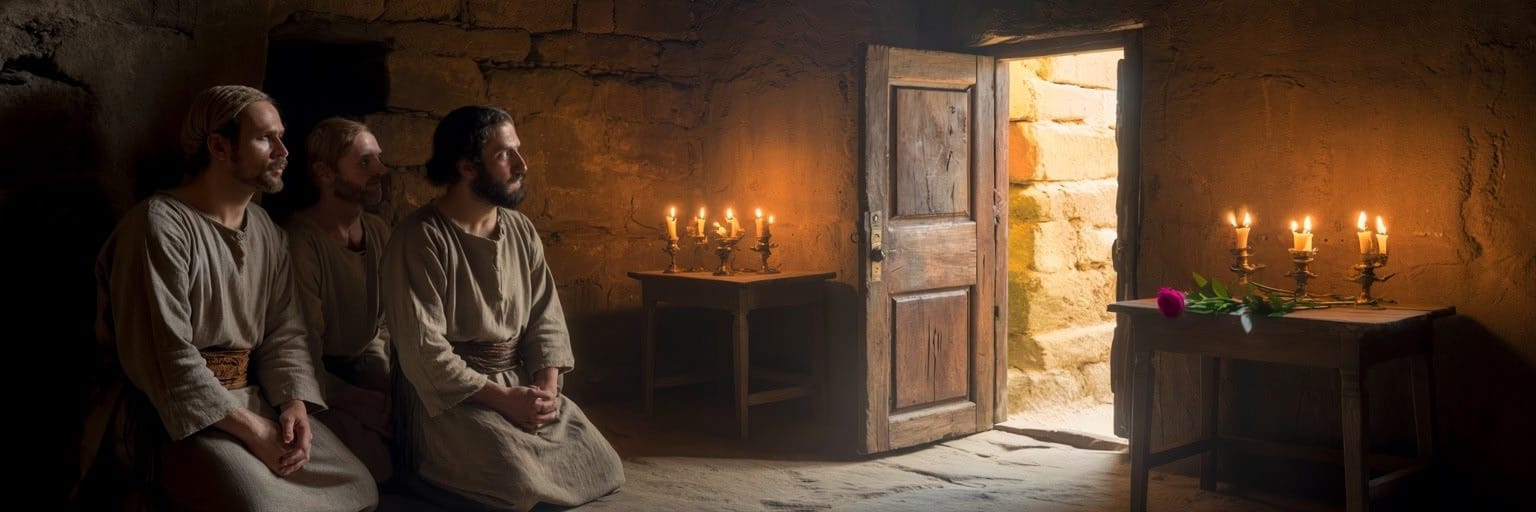


- Job facing total collapse: what the first ordeal of an upright man reveals
- A book born from the oldest question in the world
- What this text does to the reader: the question that never ends
- Evil that strikes without reason: what Job forces us to confront
- The solitude of the one who suffers and the presence that has not yet been announced
- The blessing that cannot be explained: Job's freedom in the face of loss
- What this text concretely changes in a life of faith
- Voices that accompany Job through the centuries
- Lectio divina
- A word to let the heart rest
- What Job says about our age of performance and control
- Keep standing, even without an answer
- Practices
- References
- ✝ Biblical references
Reading from the Book of Job

6It came to pass one day that, when the sons of God came to present themselves before the Lord, Satan also came among them. 7And the Lord said to Satan, «Where do you come from?» Satan answered the Lord and said, «From roaming the world and walking around on it.» 8The Lord said to Satan, «Have you considered my servant Job? There is no one like him on earth, blameless and upright, fearing God and turning away from evil.» 9Satan answered the Lord, «Does Job fear God for nothing?” 10Have you not surrounded him, his house, and all that belongs to him with a fence? You have blessed the work of his hands, and his flocks cover the land. 11""But stretch out your hand, touch everything that belongs to him, and we'll see if he doesn't curse you to your face."" 12The Lord said to Satan, «Behold, all that belongs to him is in your power, only do not lay a hand on him.» And Satan went out from the presence of the Lord. 13One day, while his sons and daughters were eating and drinking wine in their elder brother's house, 14A messenger came to Job and said, «The oxen were plowing and the donkeys were grazing around them, 15Suddenly the Sabeans came and took them away. They put the servants to the sword, and I alone escaped to tell you.» 16He was still speaking when another messenger arrived and said, «The fire of God fell from heaven and consumed the sheep and the servants; and I alone have escaped to tell you.» 17He was still speaking when another arrived and said, «The Chaldeans, divided into three bands, fell upon the camels and carried them off. They put the servants to the sword, and I alone escaped to tell you.”. 18He was still speaking when another man arrived and said, «Your sons and daughters were eating and drinking wine at their eldest brother's house, 19And then a great wind rose from the other side of the desert and seized the four corners of the house; it collapsed on the young men, and they died. I alone escaped to tell you.» 20Then Job got up, tore his robe and shaved his head, then, throwing himself on the ground, he worshiped 21And he said, «Naked I came from my mother's womb, and naked I will return there. The Lord gave, and the Lord has taken away; blessed be the name of the Lord.» 22In all this, Job did not sin or say anything foolish against God.
A man has everything—cattle grazing on the hills, his children's weekly celebrations, a reputation as a righteous man beyond reproach. And in a room he will never see, a conversation takes place about him. Someone asks: would his faith hold if it brought him nothing? That day, everything collapses in a matter of hours. Messengers arrive one after another, each before the last has finished speaking, each with news worse than the last: stolen livestock, slaughtered servants, fire falling from the sky, and then—the final, devastating blow—the house collapsing on the children during a family meal. A man who had everything becomes, in the space of an afternoon, a man with nothing. And what he does then is something no one expected: he doesn't curse, he doesn't justify himself, he falls to the ground and he blesses.
Job facing total collapse: what the first ordeal of an upright man reveals
When the loss of everything does not destroy faith: understanding the meaning of the Book of Job
This text speaks to anyone who has seen what they spent a lifetime building crumble in an instant. It offers no explanation for misfortune—it shows a man who stands tall without one. For those experiencing grief, ruin, or a betrayal of fate, Job's words offer less an answer than a presence: that of a righteous man who blesses without understanding.
We will begin by examining the world and audience for which this story was written, and then what the text truly does for the reader—beyond the simple lesson in patience it is so often attributed. Next, we will explore three concrete dimensions of Job's ordeal: the question of undeserved suffering, the solitude of the one who endures, and the astonishing freedom of his response. We will take time to listen to what the Church Fathers and tradition have seen in this text before pausing, in silence, on a single verse. Finally, we will consider what this millennia-old story still has to say to our age, saturated as it is with discourse on the meaning of suffering.
A book born from the oldest question in the world
The Book of Job belongs to the wisdom of Israel, but it extends far beyond the borders of Israel. Nothing in the text connects it to a king, a prophet, or a specific event in the history of the chosen people. Job lives «in the land of Uz»—a vaguely defined land, somewhere to the east, outside the usual biblical map. This is no accident: the book seeks to speak to every person, not just the son of Abraham. Suffering does not choose its nationality. Scholars place the writing of the text somewhere between the 7th and 5th centuries BCE, probably after the Babylonian exile—a period when the entire people had just lost everything that Job loses here in a single chapter: the land, the temple, the children who died or were deported, their very identity. The collective misfortune of Israel is concentrated in the fate of one man. It is therefore not an abstract philosophical treatise on evil: it is a collective cry transposed into a story. The author borrows the form of an ancient tale—already found in the book of Ezekiel, where Job appears alongside Noah and Daniel as the archetype of the righteous. The prologue we read today functions like a two-act play: a celestial scene, where a wager is played out between God and the Adversary—the Hebrew word satan here designates a function, that of the accuser in a tribunal, not yet the proper name of the devil he would later become—then an earthly scene, where Job suffers four catastrophes in quick succession.


The literary device is devastatingly effective: four messengers, four disasters, and each time the same phrase—"I alone escaped to tell you." The repetition hammers home, denying Job and the reader any pause, any respite. The text wants us to physically experience the accumulation, not to understand it intellectually. This is the author's choice: to show before explaining.
For the Jewish listener of the post-exilic era, this story resonated as a necessary provocation. The dominant theology of the time taught a direct link between virtue and prosperity: be righteous, and you will be blessed; commit evil, and misfortune will befall you. Job, presented from the outset as "blameless and upright," shatters this overly simplistic equation. If even he can lose everything without having done anything wrong, then the theory of merit collapses—and another way must be found to stand before God when life no longer rewards virtue.
You might like...

What this text does to the reader: the question that never ends
The central idea of this passage is not "God is testing his faithful"—that's too simplistic, almost cruel a reading if one dwells on it. The central idea, more unsettling and more accurate, is this: authentic faith is never measured by what it receives, but by what it continues to say when it receives nothing more.
The human drama of the text follows a simple, almost unbearable, rapid pattern: I have everything → everything is taken from me, all at once, without warning → I should collapse → I bless anyway. This last step is the one no one expects, and it is precisely this step that the text wants to convey.
Note what the narrative doesn't do: it offers Job no explanation. Job knows nothing of the celestial wager that we, the readers, have just witnessed unfold before our eyes. This is a crucial, almost dizzying detail: we know more than the main character. This asymmetry completely changes the meaning of the text. It's not a book about "why God allows evil"—Job himself will never have that answer, nor will we, not really. It's a book about what remains possible when the answer doesn't come.
Why does this still matter today? Because the temptation to fabricate an explanation for all suffering hasn't disappeared—it has simply changed its vocabulary. We speak of "life lessons," of "what doesn't kill you makes you stronger," of "everything happens for a reason." The Book of Job rejects these ready-made formulas. It doesn't console by explaining; it consoles by showing that one can endure without explanation. It is a harsher consolation, but infinitely more solid, because it doesn't crumble the day the explanation never comes.
Evil that strikes without reason: what Job forces us to confront
The first thing this text demands is that we abandon the idea that misfortune is always deserved. It's a thought that crosses our minds, even if we don't admit it: when a friend falls ill, when a couple breaks up, when a business goes bankrupt, a little voice almost always looks for a hidden cause, a fault that would explain everything. This thought is reassuring because it suggests that by being careful enough, virtuous enough, we can protect ourselves from it.
The Hebrew text emphasizes Job's integrity from the outset with a word—tam—that means not only "without sin" but "whole," "consistent throughout." Job is not a perfect man in the abstract moral sense; he is a man without pretense, whose inner self corresponds to his outer self. And it is precisely this man, the most upright one could find, whom misfortune chooses. The text deliberately destroys, from the very first line, any attempt to link suffering and sin.
This profoundly changes how we support someone who is suffering. A parent who loses a child, a couple who lose their home in a fire, an employee laid off after twenty years of loyalty—none of these misfortunes needs a moral explanation to be real. To look for fault in the one who is suffering, even silently, even in thought, is to add a second wound to the first. The Book of Job, from its very prologue, disarms us of this reflex.
There is also an even harsher lesson in this text: evil can strike in waves, with no respite between blows. Job's four messengers don't arrive at intervals—they overlap, one still speaking while another is already there. This is how misfortune often presents itself in a life: not an isolated shock that one absorbs and digests, but a series that leaves no time to catch one's breath. The medical diagnosis followed by job loss followed by the breakup. The text never minimizes this brutality; it stages it with almost cinematic precision, so that we know it has been seen, named, taken seriously even before it has been experienced.
The solitude of the one who suffers and the presence that has not yet been announced
There is a disturbing emptiness in this prologue: no one is there for Job as everything collapses. His sons and daughters are dead. His servants, those who might have borne with him, are also slaughtered. Only messengers remain—bearers of bad news, not comforting presences. Job learns of his misfortune alone, in a house suddenly emptied of everything that gave it life.
This solitude in the text is deliberate, and it speaks volumes about the ordeal: precisely when we need to be surrounded by others most, we often find ourselves the most alone. Job's friends only arrive later in the book—three chapters later—and their presence, as we know, will quickly turn into a trial rather than a source of comfort. In this particular prologue, there is only Job, standing alone, facing four successive pronouncements.
Perhaps this is what makes the final gesture so devastating. Job rises—the text specifies, he does not remain prostrate—he tears his garment and shaves his head, ritual gestures of mourning in the ancient world, perfectly normal, perfectly human. Nothing in this gesture is stoic or superhuman: Job weeps in his own way, according to the customs of his time. But then, he prostrates himself. And this is where the text shifts: prostration is not a resigned submission, it is an act, a choice made amidst the ashes.
For anyone facing hardship in isolation today—a bereavement during which loved ones have distanced themselves, an illness no one knows how to address, a loss that words can never truly touch—this text offers recognition rather than a solution. It says: yes, this solitude is real, it has always existed, and it doesn't prevent us from standing strong. God's presence in this prologue is not manifested through a comforting word sent to Job. Paradoxically, it is manifested in the freedom Job retains to bless despite everything—as if this freedom itself were already, in its very essence, a grace.
The blessing that cannot be explained: Job's freedom in the face of loss
The high point of the text is not the catastrophe—it is Job's response. «Naked I came from my mother's womb, and naked I will return there. The Lord gave, and the Lord has taken away; blessed be the name of the Lord!» These words are not passive resignation. There is a crucial difference between suffering and blessing, and the Hebrew text marks it precisely: the verb used, barak, is the same word used to bless God in the Temple liturgy. Job does not simply accept his fate—he performs an act of worship amidst the ruins.
This is where the entire theology of the book unfolds: Job doesn't say, "God has taken what belonged to me," but acknowledges that everything—the children, the flocks, the house—was already a gift before it was a loss. One can only lose what one has first received. This perspective overturns the logic of ownership: nothing we call "ours" belonged to us absolutely from the start. It's a difficult thought to accept on a day of mourning, but it is also, paradoxically, what makes Job's blessing possible without it being a self-deception.
The text closes with a sentence that sums it all up: «Job did not sin. He did not speak an unkind word to God.» Note carefully what this sentence does not say: it does not say that Job did not suffer, nor that he understood, nor that he remained silent. It says only that in his suffering, he did not break the relationship. Therein lies an essential spiritual lesson: one can cry out, weep, tear one's clothes, and remain faithful. Faithfulness does not require numbing one's grief; it requires only not letting grief become a rupture.
This freedom of Job already foreshadows, unknowingly, another night of solitude and apparent abandonment, that of a man who will also cry out to his Father without receiving an immediate answer, and yet who will not sever the relationship completely. The prologue to Job does not explain the cross—but it prepares the reader's heart to understand it: the faith that endures in darkness, without proof, without response, is already at work here, centuries before Gethsemane.

What this text concretely changes in a life of faith
On a spiritual level, this text invites us to distinguish between two forms of prayer: that which negotiates with God («if you bless me, I will serve you») and that which blesses unconditionally. Job does not pray to recover what he has lost—not yet, not in this chapter. He blesses first, without asking for anything in return. This is a practical exercise: the next time a prayer begins with a request, try starting instead with an acknowledgment of what has already been given, even in pain.
On a relational level, this text teaches a supportive approach. When faced with someone going through a modern-day Job—a series of devastating blows that follow one another without respite—the temptation is to want to explain, to reassure too quickly, to find meaning. The prologue to Job teaches instead the value of silent presence: being there, without trying to fill the void with words that, in any case, will never reach the pain.
Finally, on an ethical level, this text questions our own relationship to what we possess. Job had «built a wall»—the Adversary himself says so—around his prosperity. Many of us today live behind similar walls: insurance, savings, job security—all legitimate protections, but which can also become silent idols if they become the secret condition of our faith. The text does not call for us to renounce these protections, but rather to never allow them the place that belongs to God alone.
Voices that accompany Job through the centuries
Gregory the Great
In his Moralia in Job, a monumental work written at the end of the 6th century during his forced exile in Constantinople, Pope Gregory the Great devotes a meticulous commentary to the book's prologue. He sees in the protective enclosure mentioned by the Adversary an image of grace itself: God surrounds his servants with a protection that is never fully visible to them, and whose extent they only realize when it is removed. Gregory particularly emphasizes the rapid succession of the messengers, which he interprets as an image of how the Adversary seeks to leave the soul no respite, lest a moment of calm allow it to regain its inner balance.

John Chrysostom
In a homily on the patience of Job, preached to the people of Antioch, Chrysostom dwells at length on the gesture of mourning followed by prostration. He sees in it two distinct and necessary movements: Job first "renders to nature what is due to her" through his tears and torn garments, before "rendering to God what is his due" through blessing. For Chrysostom, this distinction is crucial: faith does not demand insensitivity; it only demands that grief never become the final word.
Thomas Aquinas
In his own commentary on the Book of Job, the Expositio super Iob ad litteram, Thomas Aquinas approaches the prologue from a more philosophical perspective: he sees in it a demonstration that divine providence is not measured by outward prosperity, contrary to the opinion—widespread in his time as in ours—that material happiness is a sign of God's favor. For Thomas, the case of Job proves that true virtue is manifested precisely when it ceases to be visibly rewarded.
Contemporary liturgical resonance This text is proclaimed on an ordinary Sunday of the liturgical year, often associated with the question of evil and innocent suffering, which is addressed in parallel by the New Testament. It continues to inform the pastoral care of the sick and the bereaved: many spiritual directors still quote the phrase "the Lord gave, and the Lord has taken away" at funerals, not as a formula of resignation, but as an act of faith that the deceased himself, through this ancient text, helps the living to utter.
Lectio divina
«The Lord gave, and the Lord has taken away; blessed be the name of the Lord!» (Job 1:21)
Job has just lost everything—his children, his flocks, his home—and his first word is not a lament, but a blessing. He understands nothing of what has just happened in heaven; he knows nothing of the wager between God and the Adversary. All he has left is this phrase, like a dike erected in the midst of the storm. And you, when life has taken something from you without warning, what have you been able to say, or not say, to God?
Lord, I don't always understand what you give or what you take away. Teach me the freedom of Job, the freedom that weeps without turning away from you. When my house crumbles, when messengers come and go without respite, stay close to me as you stayed close to him, even in your silence. May I know how to give thanks for what I have received, even before understanding what I have lost. Keep my mouth from any word that would break the bond with you.
A man kneeling in the dust, his clothes torn, his face turned towards the sky.
A word to let the heart rest
A few simple actions can help make this text resonate in real life. Reread this prologue slowly, once a day for a week, pausing each time on a different messenger—truly inhabiting the accumulation before running toward the final blessing. Write down, without judgment, the moments in your own life when you felt this same accumulation of blows.
A particularly fruitful exercise is to repeat Job's words aloud in a moment of calm, not as a magic formula, but as a training exercise: "The Lord gave, and the Lord has taken away; blessed be the name of the Lord." Repeating it even before a trial occurs prepares the heart not to collapse on the day it truly comes.
Finally, it can be helpful to make a concrete list of everything you consider "your own"—health, work, loved ones, home—and to ask yourself, for each item, whether it was first a gift before becoming a possession. This exercise, far from being anxiety-inducing, often brings about unexpected gratitude.
What Job says about our age of performance and control
Our era has invented countless ways to protect ourselves against misfortune: insurance, health tracking apps, career plans, predictive algorithms. There's nothing wrong with that in itself—Job himself had his enclosure. But our culture goes further: it often implicitly promises that with enough foresight, misfortune can be avoided entirely. The Book of Job reminds us of a truth we find hard to hear: no enclosure is absolute.
In our time, there is also a particular difficulty in dealing with grief and loss: the social pressure to "move on," to quickly find meaning in what happens to us, to transform pain into an inspiring story on social media. Job, however, takes the time for ritual mourning before offering a blessing. He doesn't skip the stage of tears to more quickly reach that of outwardly displayed faith. This text invites us to resist the contemporary injunction of instant resilience.
Finally, this story speaks directly to those who have lost everything in a world that measures a person's worth by what they produce or own. A layoff, bankruptcy, a house destroyed by a natural disaster—our society tends to reduce these events to statistics or insurance claims. The Book of Job restores the human and spiritual dimension of loss, refusing to let it be merely administrative.
Keep standing, even without an answer
This text does not conclude with an explanation of evil—it will never offer one, neither to Job nor to us. It concludes with a man standing, his clothes torn, yet still blessing. This is perhaps the most demanding and liberating lesson of the Book of Job: faith does not need understanding to endure.
May this text accompany anyone who is currently facing their own accumulation of messengers, their own relentless series of bad news. May it restore, not answers, but the freedom of Job: the freedom to weep sincerely and to bless nonetheless, without one excluding the other.
Practices
Read the prologue slowly — one messenger a day, for four days, to truly inhabit the accumulation before seeking final consolation.
Listing one's "fences" — naming in writing what protects our stability, to distinguish what is a gift from what has become a silent idol.
Say Job's words aloud — even before a trial occurs, to prepare the heart not to break down when the day comes.
Accompanying in silence — when faced with someone who is suffering, resisting the urge to explain and simply choosing to be present.
Distinguishing between grief and breakup — remembering that crying, tearing oneself apart, screaming are never signs of infidelity, but necessary passages towards blessing.
Recognize the gift before the loss — for every thing you believe you possess, ask yourself if it was first received.
Resisting instant resilience — refusing social pressure to «find meaning» too quickly, and allowing grief the time it needs.
References
Antiquity and the Fathers (1st–5th centuries)
- John Chrysostom, homily on the patience of Job — analysis of the double movement of Job's mourning, between the tribute paid to nature by tears and that paid to God by blessing, illuminating the coexistence of sincere sorrow and fidelity.
Late Fathers and the Middle Ages (5th–15th centuries)
- Gregory the Great, Moralia in Job — a monumental commentary on the Book of Job written in the 6th century, which interprets Job's protective enclosure as an image of divine grace and the rapid succession of messengers as a strategy of the Adversary to deprive the soul of all respite.
- Thomas Aquinas, Expositio super Iob ad litteram — philosophical commentary on the book of Job demonstrating that divine providence is not measured by visible prosperity, against the widespread idea linking virtue and material happiness.
✝ Biblical references
1 passage · 1 book
I know that my Redeemer lives. (Job 19:25)
The mystery of the suffering of the righteous and the dialogue with God at the heart of the ordeal.
→ Explore the Codex Job

 IN
 IN
 IN
 IN
 IN
Recommended reading
Considered by Thomists like Gilson and Maritain as one of the finest introductions ever written to Thomas Aquinas, this 1933 biography combines erudition with a flamboyant style. Chesterton portrays an intellectual giant with humor and depth, without ever sacrificing rigor. A lively text that inspires the reader to discover the Summa Theologica itself.
View on Amazon →
Gregory's most widely read work, a collection of miracle stories and lives of Italian saints, includes the famous Book II entirely devoted to Saint Benedict of Nursia—the only ancient account of his life. This English translation from the Fathers of the Church series makes accessible a text that shaped Western hagiography throughout the centuries…
View on Amazon →
This study is the essential reference for understanding the internal coherence of Athanasius's theology, far beyond mere anti-Arian polemics. Anatolios demonstrates how Christology, creation, and deification are articulated in Athanasius around a single intuition: the radical distinction, yet intimate relationship, between God and the world. A demanding but indispensable work for anyone who wants to grasp…
View on Amazon →
Considered the definitive scholarly biography in English, this study traces with rare erudition the entirety of Chrysostom's life, from his asceticism in Antioch to his exile and death in Armenia. Kelly, a leading Oxford patrologist, paints a nuanced portrait of an upright yet tragic man, whose own weaknesses precipitated his downfall. A demanding work, but…
View on Amazon →
The first comprehensive study devoted to Gregory the Great since Dudden's in 1905, written by one of the foremost specialists in early Christianity. Markus paints a vivid portrait of a Roman aristocrat converted to the ascetic ideal, torn between monastic vocation and episcopal office, at the dawn of the Middle Ages. An essential classic for understanding the man behind the pontificate.
View on Amazon →
Hailed as a major reference on Nicene Trinitarian theology, this book places Athanasius alongside Gregory of Nyssa and Augustine in the development of Trinitarian dogma. Anatolios demonstrates that the doctrine of the Trinity is not an isolated speculative exercise, but a comprehensive interpretation of all Christian existence. Available in Kindle edition, this text offers a historical and theological synthesis…
View on Amazon →
A definitive introduction in English, written by two of today's leading Chrysostom scholars, which situates the preacher in his concrete role as deacon, priest, and then bishop in service to his people. The book offers vivid and faithful translations of selected sermons and letters, allowing the reader to hear the saint's voice directly. An essential resource for…
View on Amazon →
The best entry point into Thomistic thought in English: Kreeft selects the essential philosophical passages from the Summa Theologica and accompanies them with notes that clarify every technical difficulty. Originally intended for students, this book remains the standard reference for anyone who wants to read Thomas himself rather than a summary. A must for any serious English-speaking reader.
View on Amazon →
The historic English translation by the English Dominicans, presented here in a complete and navigable digital edition with a table of contents. A free or nearly free resource for anyone seeking the full text of the Summa without the expense of a scholarly edition. Ideal as a complement to Kreeft's anthology for a deeper exploration of the text itself.
View on Amazon →
The definitive Dominican translation, published by Cerf, which has trained generations of seminarians and French-speaking students. This first volume covers the existence of God and how creatures know Him, the foundation of the entire Thomistic edifice. A classic purchase for anyone who wants the authoritative French print version, rather than the complete Kindle edition.
View on Amazon →
A study focused on an essential and often underestimated aspect of Gregorian chant: his work as a hagiographer in the Dialogues, at a time when the era of martyrs was over and new models of sanctity needed to be invented. Boesch Gajano shows how this text, far from being minor, constitutes a key to understanding all of Gregorian thought and…
View on Amazon →
Gregory's own foundational text, written at the very beginning of his pontificate to outline the figure of the ideal pastor. This bilingual Latin-French edition from the Sources Chrétiennes collection, annotated by Bruno Judic, provides direct access to the work that shaped the Western conception of the episcopate throughout the Middle Ages. A fundamental text, as accessible to Latin scholars as to…
View on Amazon →
This dialogue is John Chrysostom's most widely read and admired work on the dignity and formidable demands of the priestly ministry. For fifteen centuries, it has been an essential reference for the formation of clerics, from Saint Jerome to Vatican II. This bilingual Greek-French edition, based on the finest manuscripts and compiled by the renowned patrologist Anne-Marie Malingrey, offers…
View on Amazon →
The masterpiece of Thomas Aquinas, available in its entirety in a single digital volume at a modest price. A comprehensive synthesis of faith and reason, organized into questions and articles, which shaped all subsequent Catholic theology. Ideal for anyone who wants to own the complete text without investing in an expensive scholarly edition.
View on Amazon →
This recent and accessible handbook succeeds the now out-of-print major introductions (Quasten, Sister Gabriel Peters) by combining scholarly rigor with pedagogical clarity for any reader curious about the first eight centuries of the Church. Chrysostom is presented within the broader context of the Greek and Latin Fathers, allowing the reader to appreciate his unique place among his contemporaries. A library of…
View on Amazon →
Edited by the current director of the Institute of Christian Sources, this collection brings together nine studies that profoundly renew our understanding of Chrysostom's exegesis, from its technical terminology to its use of biblical figures such as Cain and Paul in Athens. It draws upon the 38,000 biblical references that Chrysostom left in his work, the most extensive of all…
View on Amazon →
A classic of popular Thomistic thought, designed to make the substance of the Summa Theologica accessible to ordinary believers without scholastic jargon. Organized in a question-and-answer format like a catechism, this book has been the gentlest gateway to Thomas's thought for a century. Perfect for a non-academic audience who nevertheless wish to grasp the heart of…
View on Amazon →
The only readily available comprehensive French biography for discovering the entirety of Chrysostom's life, from his childhood in Antioch to his death in exile. Brändle recounts, without embellishment or caricature, his journey as a hermit, preacher, and then bishop in conflict with imperial power, in language accessible to the non-specialist reader. An excellent starting point before delving into…
View on Amazon →
Written by one of the foremost French-speaking specialists on Athanasius, this work offers a nuanced reading of the four anti-Arian discourses, the true doctrinal heart of Athanasius's work. Kannengiesser demonstrates how, in Athanasius, polemical argumentation and pastoral contemplation of the mystery of Christ converge. Available in Kindle edition, this title is a valuable addition to the existing bibliography, offering a study in French…
View on Amazon →
An unconventional biography, written by the master of paradox, that engages as much with the modern reader as with the 13th century. Chesterton blends history, philosophy, and cultural criticism to offer a vivid and ever-evolving portrait of Aquinas. A true intellectual delight, available in a very affordable Kindle edition.
View on Amazon →
A meticulous Spanish translation of the Dialogues, published by Trotta in a leading series on religions. This text remains the richest ancient source on the life of Saint Benedict of Nursia, surrounded by accounts of miracles and meditations on the fate of the soul after death. A narrative and accessible gateway into the spiritual world of…
View on Amazon →
A Thomist Dominican here condenses the entire structure of the Summa Theologica into a short and clear volume, without ever betraying the rigor of the original text. Designed for the general Italian public who wish to grasp the overall coherence of the work before venturing into the complete text, it is an excellent entry point before scholarly reading.
View on Amazon →
The definitive Italian translation of Markus's seminal work on Gregory the Great, published in the Cultura e Storia series. In it, Markus analyzes Gregory's culture within the context of late Roman education and patristic tradition, while covering every aspect of his pontificate: Bishop of Rome, administrator of ecclesiastical lands, architect of the mission…
View on Amazon →
A bilingual Latin-Italian edition that allows you to verify each Thomistic formula in its original language while following a faithful translation. Despite the doubled text, its compact format is designed for sustained study rather than simple consultation. A good compromise between philological rigor and a reasonable price for the Prima Pars.
View on Amazon →
The biography that Maritain and Pegis considered the best ever written on Thomas, presented here in a beautiful Italian translation. Chesterton paints a witty and insightful portrait of the great saint of the Catholic Church, from his rebellious youth to his teaching in Paris. A text accessible to all non-specialist readers, believers or not.
View on Amazon →
A recent Portuguese translation (2024) of a portion of the Registrum Epistularum, the vast correspondence of over 800 letters that documents Gregory's daily pastoral, diplomatic, and administrative activities. Published in the prestigious Patrística series by Paulus publishers, it offers Portuguese-speaking readers direct access to the Pope's thought through his most concrete exchanges with bishops…
View on Amazon →
Chesterton, grappling with the challenge of summarizing such a giant, nevertheless delivers one of the most accomplished studies ever devoted to the great scholastic doctor. The text blends erudition and humor, retracing in eight chapters the life of a man nicknamed "the Ox" for his imposing stature as much as for his deceptive silence. A lively read, much appreciated by readers…
View on Amazon →
Josef Pieper, one of the greatest German Thomists of the 20th century, recounts here, in just a few pages, the life and work of Aquinas with remarkable clarity. This small book is recognized as an ideal introduction to Thomism in German, neither simplistic nor dry, written by someone who dedicated his life to keeping Thomistic thought alive. A classic reference…
View on Amazon →
Die full text summa theologiae in einer preisgünstigen digitalen Ausgabe. Thomas entfaltet hier ein System, das Glauben und Vernunft seiner Zeit systematisch aufeinander bezieht und bis heute die katholische Theologie prägt. A solid Möglichkeit, sich das Hauptwerk ohne hohe Anschaffungskosten anzueignen.
View on Amazon →
A biography explicitly designed to appeal to a broad audience, including readers without a formal background in history—a gamble that has paid off, according to academic critics themselves. Eich draws on the most recent historiographical work to trace Gregory's life at the crossroads of Antiquity and the Middle Ages, with particular attention to the relationships between the Bishop of…
View on Amazon →