












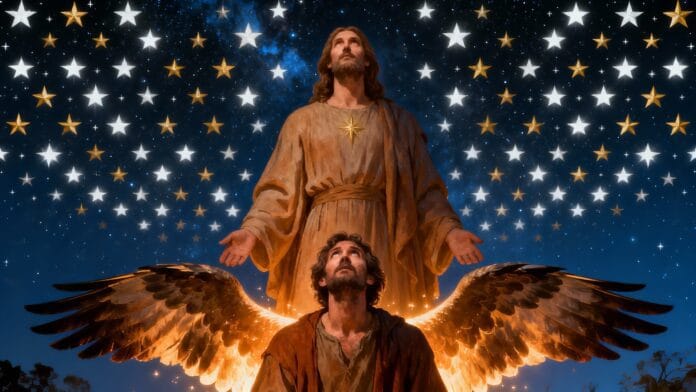
A reading from the book of the prophet Isaiah
To whom can you compare me? Who can equal me? says the Holy One. Lift up your eyes and see: who created all these? He who brings forth all the host of stars, and names them all by name. So great is his power, and so great is his might, that not one of them is lacking. Jacob, why do you say, Israel, why do you maintain, «My way is hidden from the Lord, my right is departed from my God»? Do you not know? Have you not heard? The Lord is the eternal God, the Creator to the ends of the earth; he does not grow tired or weary. His understanding no one can fathom. He gives strength to the weary and increases the power of the weak. Even youths grow tired and weary, and young men stumble and fall; but those who hope in the Lord will renew their strength. They soar as if on eagles' wings, they run without growing weary, they walk without getting tired.
Finding renewed strength when everything collapses: Isaiah's eternal message
How contemplating the Creator transforms our exhaustion into renewed spiritual energy.
Fatigue isn't just a matter of sleep or physical rest. It affects our lives on every level: mental fatigue, spiritual exhaustion, existential weariness. The prophet Isaiah speaks precisely to people who have lost hope, who feel abandoned and invisible. His message transcends centuries to reach each of us in our moments of discouragement. This passage from chapter 40 reveals a liberating truth: the God who created the universe is personally concerned about our weariness and possesses the power to completely renew us.
We will first explore the tumultuous historical context in which these words were spoken. Then, we will analyze how God presents himself as an inexhaustible source of strength. Three essential dimensions will be developed: weariness as a universal reality, hope as a path to renewal, and the metaphor of eagles' wings as a promise of transformation.
The voice of a prophet in the heart of the Babylonian exile
The Book of Isaiah is divided into several sections written at different times. Chapters 40 to 55 constitute what exegetes call Deutero-Isaiah or Second Isaiah. These oracles were proclaimed during the Babylonian exile, probably between 550 and 539 BCE. The Jewish people were then living through an absolute catastrophe. Jerusalem was destroyed, the Temple reduced to ashes, and the elite deported far from their land. This situation had lasted for decades. The first generation of exiles had perished, and their children were growing up without ever having known freedom.
Imagine the state of mind of these exiles. Everything that structured their identity had collapsed. No more Temple to offer sacrifices, no more Davidic king on the throne, no more promised land beneath their feet. Their faith wavered. Many wondered if their God had been defeated by the Babylonian gods. Others thought that the Lord had abandoned them forever, that he no longer saw their distress. This profound spiritual crisis is reflected in our passage: «My way is hidden from the Lord, my rights are not recognized by my God.»
The prophet intervenes in this desperate situation with a life-changing message. Chapter 40 marks a radical turning point in the book. After chapters of judgment, here comes the announcement of consolation. The prophet proclaims that God has not abandoned his people, but that, on the contrary, he is preparing to intervene dramatically to liberate them. But before announcing this concrete liberation, he must restore the people's vision of God himself.
Our passage begins with a powerful rhetorical question. God asks to whom he could be compared. This question expects no answer, for the answer is obvious: no one. No creature, no idol, no pagan god can measure up to the Creator of the universe. The text then invites us to look up at the starry sky. In ancient times, without light pollution, the night sky must have been breathtaking. Thousands of stars shone in the darkness. The prophet affirms that it is this God who created each star, who calls them by name, who deploys them like an army.
This cosmic vision serves a specific purpose: to restore trust. If God governs the entire universe with such mastery that not a single star is missing, how could he lose sight of his people? The shift from the cosmic to the personal is striking. The same God who commands the stars is concerned with the path of Jacob, with the rights of Israel. Moreover, he knows their weariness and their weakness.
The liturgical context of this text enriches its significance. Proclaimed in prayer gatherings or public readings, it reminded the people that their faith does not rest on favorable circumstances but on the unchanging nature of God. This passage constitutes a fundamental catechesis on divine identity: eternal God, universal creator, unfathomable intelligence, source of strength for the weary.
A God who never tires but restores strength
I'll continue with the central 800-word analysis. I need to develop the main idea: God as an inexhaustible source that renews human strength. I will analyze the contrast between universal human fatigue and inexhaustible divine vitality.
The heart of this passage lies in a striking contrast. On one hand, the universal weariness that afflicts all human beings. On the other, a God who never tires and who possesses the power to transmit his inexhaustible vitality. This dynamic reveals something fundamental about the human condition and the nature of the divine.
Observe the progression in the description of human fatigue. The text first mentions young people, those who symbolize strength and vitality. Even they grow tired and weary. Even more surprisingly, they stumble. The image is striking. These vigorous young people, brimming with apparent energy, end up losing their footing, staggering, collapsing. If youth itself is not immune to exhaustion, who then could claim to be autonomous and self-sufficient?
This observation by the prophet reveals a profound anthropological truth. Human beings, regardless of their natural strength, remain limited creatures. Their vigor is temporary; their resources eventually run out. This applies not only to the physical dimension but to our entire existence. We become weary psychologically, emotionally, and spiritually. Life's challenges, disappointments, trials, and responsibilities weigh upon us and ultimately deplete our inner reserves.
Faced with this universal human reality, the text presents God in a radically different light. The Lord is described as the eternal God. Eternity does not simply mean endless duration, but a quality of being that completely transcends time and its limitations. God exists in a fullness of being that knows neither wear nor diminution. He creates to the ends of the earth, an activity that presupposes inexhaustible power. And here is the central assertion: he does not tire, he does not grow weary.
This absence of divine fatigue is not a trivial detail. It is the very foundation of the possibility of human renewal. If God were to tire, he could not be a source of strength for anyone. He would be a creature like any other, subject to the same limitations. But precisely because he is beyond all fatigue, he can become for humanity a wellspring of renewed and inexhaustible vitality.
The text goes further, adding that God's intelligence is unfathomable. This means that He possesses infinite wisdom to understand exactly what each person needs. He does not distribute energy blindly or mechanically. He knows the precise nature of our fatigue, its root causes, and knows exactly how to renew us. His action is not a simple injection of energy but an intelligent and personalized restoration.
The dynamic described next is extraordinary. God restores strength to the weary. He increases the vigor of the weak. These two parallel statements emphasize the same reality: God intervenes precisely where we are at our wits' end. He does not require us to be strong to approach him. On the contrary, it is in our very weakness that he displays his power. Our exhaustion becomes the place where he manifests himself.
This logic completely reverses our natural reflexes. Spontaneously, we think we must recharge ourselves before turning to God. We wait until we have regained a minimum of strength to resume our spiritual life. The prophet affirms exactly the opposite. It is when we are exhausted, when we have nothing left, that we can fully receive what God wants to give us.
The condition for accessing this renewal is clearly stated: placing one's hope in the Lord. The hope in question is not vague optimism or a mere wish. It designates a fundamental orientation of being, an anchoring of one's entire life in God. To hope in the Lord means recognizing that he is our only true source of strength, that without him we can do nothing, but that with him all things become possible.
The result of this hope is described with striking imagery. Those who hope find renewed strength. The Hebrew expression literally suggests an exchange: they exchange their weariness for divine power. They spread their wings like eagles. The eagle symbolizes power, freedom, the ability to rise above obstacles. They run without growing weary, they walk without growing tired. These verbs describe not frenetic activity but a new dynamism, an unprecedented capacity to persevere over time.
Existential fatigue: accepting our condition as creatures
In our contemporary societies, fatigue has become a silent epidemic. Everywhere, accounts abound of people exhausted, suffering from burnout, unable to keep up with the imposed pace. This fatigue is not limited to the professional world. It affects all areas of life: family relationships strained by lack of time, friendships neglected due to lack of energy, spiritual life put on hold because one no longer finds the strength to pray.
This situation reveals something deeper than a simple time management problem. It manifests a fundamental illusion of our time: the idea that human beings can be autonomous and self-sufficient. Our culture values independence, performance, and the ability to manage everything independently. We live as if our resources were infinite, as if we could draw on ourselves indefinitely without ever running out.
The prophet Isaiah refutes this claim. Even young people, symbols of strength and vitality, grow weary and stumble. This observation is not depressing but liberating. It invites us to accept our condition as creatures. We are not gods; we do not possess unlimited energy. Recognizing our limitations is not a sign of weakness but an act of lucidity and...’humility.
Think of all those situations where we exhaust ourselves because we refuse to admit we can't do everything. The parent who strives for perfection in every area and collapses under the weight of guilt. The professional who works tirelessly until they have no personal life left. The volunteer who takes on so many activities that they end up doing nothing worthwhile anywhere. In all these cases, the exhaustion isn't just physical. It's existential.
Existential fatigue stems from the tension between who we want to be and who we actually are. We want to be infallible, always available, able to respond to every demand. Reality brutally reminds us of our limitations. We get sick, we make mistakes, we disappoint, we fail. This confrontation with our limitations can be painful.
Yet, Isaiah's message radically transforms our relationship with fatigue. It is no longer a failure but an invitation. It reminds us that we need a source outside ourselves. Our exhaustion becomes a sign that we must turn to the One who never tires. Paradoxically, it is when we stop pretending to be self-sufficient that we access true strength.
Accepting our creaturely condition does not mean passivity or resignation. On the contrary, it unleashes a new energy. When we stop wasting our strength maintaining the illusion of our omnipotence, when we accept our dependence on God, we discover unsuspected resources. We learn to discern what is essential from what is secondary. We dare to say no to certain demands in order to preserve what truly matters.
The Christian spiritual tradition has always insisted on this need to recognize our poverty. The great mystics speak of poverty in spirit, of trusting surrender, of placing oneself in God's hands. Saint Thérèse of Lisieux spoke of her littleness and weakness not as obstacles but as stepping stones towards the holiness. She understood that God delights in acting through the weak precisely because they do not stand in his way.
In our daily lives, this acceptance can take very concrete forms. Recognizing that we need enough sleep instead of constantly cutting back on it. Admitting that we need to delegate certain tasks instead of trying to control everything. Accepting the need to ask for help when we are overwhelmed instead of stubbornly clinging to a sterile heroism. Daring to take time for prayer and spiritual rest instead of considering these moments as wasted time.
Each of these concrete decisions represents a small victory over the illusion of omnipotence. It brings us closer to the truth of our condition and, paradoxically, makes us stronger. For a life built on truth, however humble, is infinitely more solid than an existence built on the lie of self-sufficiency.
Hope as a path to radical renewal
The text of Isaiah establishes a direct link between hope and the renewal of strength. Those who place their hope in the Lord find new strength. This statement deserves closer examination because it reveals something essential about the nature of Christian hope.
Hope is not a vague feeling or superficial optimism. It is a theological virtue, that is, a fundamental disposition of human beings that can only come from God himself. To hope means to orient one's entire life toward God as one's ultimate goal and sole source of happiness. This orientation engages the whole person: the intellect that recognizes God as the ultimate end, the will that chooses to walk toward him, and the heart that loves and desires him.
In the context of the Babylonian exile, this hope took on a very concrete form. The exiles had to believe that God had not abandoned his plan for them, that he would intervene to liberate them. This trust required an extraordinary act of faith. Nothing in the visible circumstances suggested an imminent liberation. The Babylonian empire seemed indestructible. The Jewish people appeared destined to disappear, absorbed by the surrounding nations.
To hope under these conditions meant looking beyond immediate appearances to anchor oneself in a deeper and truer reality: loyalty of God and his promises. This hope was not an escape from reality but a different way of perceiving reality. The exiles had to learn to see their situation not with the eyes of the flesh but with the eyes of faith.
This spiritual dynamic remains incredibly relevant. How often do we find ourselves in situations where everything seems blocked, where no way out is in sight? Incurable illness, grief impossible to overcome, a relationship irrevocably broken, professional failure jeopardizing the future, a spiritual crisis that cuts us off from all consolation. In these moments, hope becomes a heroic act.
Christian hope is rooted in the contemplation of the One in whom we place our trust. The text of Isaiah begins precisely with this: Lift up your eyes and look. Before speaking of the renewal of strength, the prophet invites us to contemplate the grandeur of the Creator. This contemplation is not an abstract intellectual exercise but a transformative experience.
Looking at the starry sky and realizing that the same God who governs the universe is personally interested in our lives radically changes our perspective. Our problems, however overwhelming, are infinitely small compared to divine power. Not that God despises or ignores them—quite the contrary. But nothing is impossible for the one who commands the stars. Our desperate situation is only desperate from a limited human point of view.
Hope thus broadens our vision. It pulls us away from obsessively focusing on our difficulties and opens us to the immensity of God. This movement is not an escape, but rather a deeper grounding in reality. For ultimate reality is not our problem, but the active presence of God at the very heart of our problem.
The renewal of strength promised to believers flows directly from this hope. It is not a magical mechanism where simply reciting a formula automatically grants energy. Renewal occurs through a living relationship with God. To hope in the Lord means to remain in his presence, to be nourished by his word, and to open oneself to his transforming action.
Think of those times when, after praying long and hard during a difficult period, you emerged transformed. Nothing had changed in your external circumstances, but something within you had been changed. You had regained the courage to persevere, the clarity to discern the path, the strength to face another day. This renewal came from your renewed connection to God.
Christian hope also possesses a community dimension often overlooked. The exiles listened to the prophet's words together. Hope is shared and mutually strengthened. When we are tempted to despair, the faith of our brothers and sisters sustains us. Conversely, our hope becomes a light for those who are suffering. This fraternal dimension of hope reminds us that we are not alone in our trials.
The path of hope also requires patience and perseverance. The text speaks of those who run without growing weary, who walk without growing tired. These verbs suggest duration. Hope does not produce an instantaneous transformation but gives us the capacity to endure over time. It allows us to keep moving forward even when we do not immediately see the fruits of our faith.

Spreading eagle wings: the promise of transformation
The image of eagles' wings is one of the most striking metaphors in our passage. Those who hope in the Lord spread their wings like eagles' wings. This comparison deserves closer examination because it reveals the profound nature of the renewal that God offers.
The eagle holds a special place in biblical imagery. It symbolizes strength, grandeur, and freedom. It can fly at altitudes inaccessible to other birds. It possesses keen eyesight that allows it to spot its prey from afar. It spreads its large, powerful wings, which carry it with apparent ease. In antiquity, the eagle was considered the king of birds, associated with majesty and power.
The metaphor thus suggests a radical elevation. Those who receive divine strength do not merely survive painfully. They rise above their difficult circumstances. This elevation is not a denial of reality or an escape. It represents a new capacity to gain perspective, to see things from a broader viewpoint, to avoid remaining trapped in the oppressive immediacy of the present.
Observe how the eagle uses updrafts to rise effortlessly. It doesn't frantically beat its wings but lets itself be carried by the winds. This image beautifully evokes the action of the Spirit in the life of the believer. We do not produce our own strength through exhausting efforts. We learn to let ourselves be carried by divine grace, which lifts and sustains us.
This transformation touches every aspect of our existence. First, our inner vision. Like the eagle that sees from afar, we develop a keener capacity for discernment. Situations that once seemed utterly confusing begin to make sense. We perceive the movements of the Spirit where we previously saw only chaos. We distinguish the essential from the trivial, whereas everything before seemed equally urgent.
This transformation also touches our inner freedom. The eagle soaring in the sky symbolizes freedom par excellence. Similarly, those who receive divine strength discover a new freedom. Not a freedom to do whatever they want, but a liberation from fears, unhealthy attachments, and the dependencies that held us captive. We can make choices that truly align with our deepest calling instead of succumbing to external pressures.
This metaphor also speaks of endurance. The eagle can travel great distances without tiring. Similarly, divine renewal gives us the strength to persevere over time. It is not a temporary boost that allows us to last a few more hours before collapsing. It is a profound force that transforms our very capacity for endurance.
In everyday life, this transformation manifests itself in many ways. A person who found prayer difficult suddenly discovers that prayer becomes a source of joy and peace. Someone who exhausted themselves trying to control everything learns to let go and discovers a new effectiveness in surrendering. A believer who experienced their faith as a burdensome weight experiences the lightness of the Gospel.
The image of wings also suggests a dimension of beauty and grace. The eagle, spreading its wings and soaring majestically, offers a magnificent spectacle. Similarly, a life renewed by the Spirit acquires a spiritual beauty. Not a superficial or artificial beauty, but the authentic beauty of an existence aligned with its deepest vocation, inhabited by the divine presence, radiating inner peace.
It's important to note that the text doesn't say we become eagles, but rather that we spread our wings like eagles. This distinction is crucial. We remain human, with our limitations and vulnerabilities. But we receive a new, unnatural ability. It's a gift, a grace, something that comes from beyond and lifts us beyond our natural capabilities.
This transformation doesn't happen once and for all. It must be constantly renewed by our return to the source. The wings we spread today must be spread again tomorrow. Hope is not a permanent possession but a constant direction, a daily choice to place our trust in God rather than in our own strength.
The final promise of the text combines several action verbs: to run, to walk, without growing weary or tired. These verbs suggest different rhythms of life. Sometimes we must run, face emergencies, and respond quickly. Other times we walk at a more leisurely pace. In both cases, divine strength allows us to maintain our momentum without destructive exhaustion. This ability to adapt to circumstances while maintaining inner balance characterizes a mature spiritual life.
Echoes in the grand tradition
The Church Fathers meditated extensively on this passage from Isaiah. They saw in it a prophetic description of the Christian life animated by the Holy Spirit. Saint Basil the Great emphasized that the hope spoken of by the prophet foreshadows faith in Christ. Only the incarnate Son of God can truly renew humanity exhausted by sin. The weariness Isaiah speaks of is not only physical but also spiritual, a consequence of the separation from God.
Augustine of Hippo often used the image of eagle's wings to describe the soul's ascent to God. In his homilies, he explained that these wings represent the love of God and the love of neighbor. It is these two loves that allow the soul to rise above earthly constraints and fly to its heavenly homeland. Without these wings, humanity crawls on the ground, weighed down by the burden of its desires.
Monastic tradition has made this text a central reference for understanding the spiritual life. The monks experienced fatigue firsthand: prolonged vigils, repeated fasts, and demanding physical labor. They discovered through experience that a mysterious force sustained them beyond their natural capacities. This force stemmed from their grounding in prayer and meditation on Scripture.
Medieval mystics particularly explored the theme of weakness as the locus of divine manifestation. Catherine of Siena repeatedly stated that God delights in manifesting his strength in human weakness. The more we acknowledge our nothingness, the more space we offer to divine action. This insight perfectly aligns with Isaiah's teaching about God restoring strength to the weary.
Carmelite spirituality, heir to John of the Cross And Teresa of Avila, developed a theology of abandonment which is rooted in this trust in God alone. John of the Cross He explained that the soul must pass through dark nights where all its natural strength seems to abandon it. It is precisely in these moments that God acts in a transformative way, communicating to the soul a new, supernatural strength.
In Christian liturgy, this passage from Isaiah is often proclaimed during Advent. This choice is not accidental. Advent It represents a time of waiting, of hope focused on the coming of the Savior. The prophet's message perfectly reflects this spiritual attitude: to wait for Renewal comes from God alone; do not rely on your own strength but on the divine promise.
Contemporary theology is rediscovering the relevance of this message in a world marked by widespread exhaustion. Thinkers like Henri Nouwen have shown how Christian spirituality offers a radical alternative to the culture of performance and frenetic activism. Nouwen spoke of the discipline of gratuitousness, this capacity to receive rather than always to produce.
The Church's social doctrine also echoes this text when it criticizes a view of human beings reduced to their productive capacity. The teaching on Sunday rest, on the dignity of the person independent of their productivity, and on the right to rest and leisure, extends this prophetic intuition. Human beings are not meant to exhaust themselves in endless work but to find in God their source of life and renewal.
Concrete paths to spiritual renewal
Isaiah's message doesn't remain abstract but calls for concrete action. Here are some suggestions for welcoming this renewal of strength promised by God into our daily lives.
Start by honestly identifying the sources of your fatigue. Take a moment of silence to examine what is truly draining you. Is it an excessive pace of life, toxic relationships, an unrealistic pursuit of perfection, or unconfronted fears? This clarity is the first step. Acknowledging your fatigue is not a failure, but the beginning of healing.
Cultivate daily contemplation of God's grandeur. The prophet invites us to lift our eyes to heaven. Take a few minutes each day to marvel at creation, to meditate on the creative power that permeates the universe. This contemplation broadens your perspective and puts your worries into context without denying them.
Anchor your hope in God's Word rather than in your fluctuating impressions. Choose a few key verses, such as those from Isaiah, and repeat them silently, especially during difficult times. The Word acts like a seed that slowly germinates in the heart and gradually transforms our perspective.
Dare to acknowledge before God your absolute need for Him. In prayer, simply express your weariness, your discouragement, your feeling of powerlessness. Don't look for beautiful phrases. Tell Him: "Lord, I am exhausted, I can't go on, come to my aid." This prayer of the poor opens the door to divine action.
Learn to distinguish between apparent urgency and true importance. Many things that seem urgent aren't really important. Prioritize based on your deepest calling rather than external demands. Saying no to certain requests frees up space for what truly matters.
Seek the company of other believers who share your hope. Hope is strengthened in fellowship. Participate in a prayer community, share your spiritual struggles with trusted friends, and be encouraged by the testimonies of those who have gone through similar trials.
Accept the slow pace of spiritual renewal. God does not work according to our rhythms. He works deeply, gradually transforming our hearts. Do not be discouraged if you do not see dramatic changes immediately. Persevere in faith. Your wings will unfold little by little.
A call for a revolution of hope
This text from Isaiah, proclaimed twenty-six centuries ago, resonates with extraordinary force in our contemporary world. It exposes the illusion of human autonomy and reveals our fundamental dependence on a transcendent source. The prophet invites us to a true inner revolution: to move from trusting in our own strength to hoping in God alone.
This revolution touches the very heart of our relationship to existence. It liberates us from the exhaustion generated by the pretense of self-sufficiency. It opens a path of radical renewal where our limitations become the very site of divine manifestation. The weary individual discovers that they can receive new strength not through desperate efforts but through their grounding in the inexhaustible source.
The image of eagle wings promises a stunning transformation. Not that we become invulnerable superhumans, but we gain access to a new way of inhabiting our humanity. We learn to let ourselves be carried by the breath of the Spirit rather than exhausting ourselves in fruitless efforts. We discover a freedom, a perspective, a capacity for endurance that surpasses our natural abilities.
This divine promise awaits our response. It demands that we renounce the idol of self-sufficiency and accept our condition as creatures. It requires that we orient our entire lives toward God as our sole hope. This fundamental choice is not an escape from reality but, on the contrary, an anchoring in ultimate reality: the active presence of the Creator at the heart of our existence.
The world today desperately needs this revolution of hope. So many people are collapsing under the weight of crushing responsibilities, exhausted by a system that knows neither pause nor limit. The prophet's message resonates as a radical alternative: there is an inexhaustible source of strength, a God who never tires and who can renew those who place their trust in him.
Will you lift your eyes to the One who created the stars? Will you dare to acknowledge your weariness and your absolute need for Him? Will you choose to anchor your hope in God rather than in your failing strength? The promise is there, magnificent and certain. Those who hope in the Lord find renewed strength. They spread their wings like eagles. They run without growing weary. They walk without growing tired. This renewed life awaits you.
To go further in the practice
- Meditate each morning on the phrase "The Lord gives strength to the weary" as you offer your day to God.
- Identify a draining activity that you can delegate or eliminate to create space for prayer.
- Pray the passage from Isaiah in contemplation, asking God to concretely renew your inner strength.
- Share with a friend your experience of fatigue and your desire to anchor yourself more firmly in hope.
- Join a prayer group or community where hope is shared and mutually strengthened.
- Establish a rhythm of life that includes regular periods of genuine rest and spiritual renewal.
- Read the testimonies of saints who experienced the renewal of their strength in times of trial.
References
- Isaiah 40, 25-31: source text for this meditation
- Exodus 19:4: God carries his people on eagles' wings
- Psalm 103:5: Your youth is renewed like that of the eagle
- Romans 8, 26: The Spirit comes to the aid of our weakness
- 2 Corinthians 12:9-10: God's power is displayed in weakness
- Saint Augustine, Confessions: On the restlessness of the heart until rest in God
- John of the Cross, The Dark Night: On Transformation in Ordeal
- Thérèse of Lisieux, Story of a Soul: On the Little Way of Abandonment