












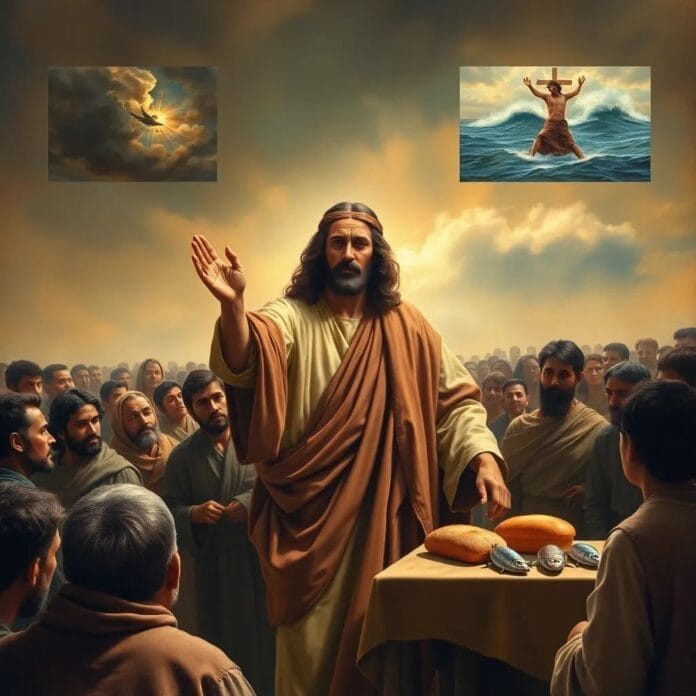
The miracles of Jesus The Gospels occupy a central place in Christian tradition. These numerous and varied accounts present supernatural events attributed to Jesus that transcend the ordinary realm of human experience. They include, in particular, healings, exorcisms, resurrections, and interventions in nature.
In the Gospel texts, these miracles are not simply described as isolated events; they are above all... signs (Greek for "semeion") which manifest the divine presence and reveal the profound nature of Jesus as Messiah and Son of God. Their importance therefore goes beyond the simple narration of extraordinary events: they play a crucial role in the affirmation of the Christian faith and in the understanding of the Gospel message.
This article aims to explore the relevance of Jesus' miracles today. It seeks to understand not only what these miracles meant within their historical and cultural context, but also how they continue to nourish contemporary faith and spiritual reflection. You will discover various dimensions—theological, historical, and symbolic—that allow us to grasp these narratives with depth and relevance.
The different types of miracles in the Gospels
The miracles attributed to Jesus in the Gospels define themselves as supernatural events which transcend natural laws and testify to divine intervention. These extraordinary acts are not simply astonishing facts, but revealing signs of God's presence and power through Jesus.
Four main types of miracles clearly emerge in the Gospel texts:
1. The healings
They constitute the most numerous category. Jesus healed the sick suffering from various ailments—paralysis, blindness, leprosy, fevers… These healings were not only physical; they also restored the social and spiritual integrity of the individuals. For example, the healing of the paralytic (Mark 2:1-12) illustrates Jesus' ability to forgive sins while restoring physical health.
2. The exorcisms
Jesus frees individuals possessed by unclean spirits. These interventions demonstrate his dominion over evil and its dark forces. A striking episode is that of the possessed man in Gerasa (Mark 5:1-20), where Jesus commands the demons to leave the tormented man's body.
3. The Resurrections
Rare but fundamental, these miracles point to the victory over death. resurrection of Lazarus (John 11) is the best-known example, symbolizing not only power over physical death but also an anticipation of the final triumph promised by the Christian faith.
4. Control over nature
These miracles demonstrate that Jesus exercises authority even over the natural elements. He calms the storm (Mark 4:35-41), multiplies the loaves to feed a multitude (Matthew 14:13-21), and walks on water (Matthew 14:22-33). These events show that the created order is subject to his divine will.
Each type of miracle plays a specific role in the Gospel narrative. They are not merely spectacular; they offer a glimpse into the divine nature of Jesus and foreshadow the Kingdom of God in action. Understanding these categories allows us to appreciate their richness and function within the Christian message.
Historical and cultural context of miracles in the ancient world
The miracle stories in the Gospels are part of a rich historical context, marked by the presence of various figures called ancient thaumaturges or charismatic healers. These figures, active in ancient Judaism as well as in the Greco-Roman world, were often perceived as intermediaries capable of performing extraordinary acts thanks to a privileged relationship with the divine.
The ancient Jewish context
In Jewish tradition, miracles were frequently associated with prophets and holy figures. Biblical examples such as Moses, Elijah, and Elisha illustrate this ability to perform miracles (healings, resurrections, control of the elements) to manifest God's power. These acts aimed to confirm the divine authority of the messenger and to announce God's saving intervention in history. It is within this framework that the miracles of Jesus : they are perceived not only as supernatural manifestations, but also as signs heralding the Kingdom of God.
The Greco-Roman world
The Greco-Roman context also saw an abundance of thaumaturgical figures such as’Asclepius, the Greek god of medicine, or Apollonius of Tyana, a philosopher renowned for his miraculous healings and his powers over nature. These thaumaturges exerted considerable influence on populations seeking healing or explanations for unexplained phenomena. Miracles The accomplishments of these figures often served to reinforce their personal prestige and spiritual authority.
Comparison with the miracles of Jesus
Miracles The miracles recounted in the Gospels share several traits with those of ancient miracle workers:
- Physical healings Many charismatic figures were believed to cure illnesses and infirmities.
- Exorcisms : chasing away unclean spirits was a common act among some thaumaturges.
- Control over nature The concepts of calming a storm or multiplying food appear in Jesus as well as in others.
However, the miracles of Jesus They are distinguished by their unique theological scope. They do not simply aim to impress or attract disciples, but to reveal a new divine reality embodied in himself and to inaugurate a Kingdom that is present but also future.
«"« Miracles "These are not just isolated prodigies, but signs that reveal a greater divine design," emphasizes the comparative study between these traditions.
This look at the historical context sheds light on how the first witnesses perceived these extraordinary events: at the crossroads of a Jewish messianic expectation and a cultural universe where the miracle was a common language to assert spiritual authority.
The theological significance of miracles in Catholic Christianity
The miracles of Jesus The events in the Gospels are not simply extraordinary occurrences. They embody a divine revelation and announce the arrival of Kingdom of God established by Jesus. These supernatural signs testify to a profound spiritual reality where God acts concretely in human history.
Theological significance of miracles
- Annunciation of the Kingdom of God : miracles They demonstrate that the reign of God is already present and active. For example, healings show that total restoration, both physical and spiritual, is possible through divine power.
- Manifestation of the divinity of Jesus Through these acts, Jesus reveals his unique nature as the Son of God. His powers over nature, demons, and even death confirm his divine authority.
- A sign of hope and salvation : each miracle carries a message of hope for believers, inviting them to believe in a new life, free from evil and suffering.
Impact on faith and Christian conversion
Miracles They play a crucial role in embracing the Christian faith. They draw attention to the Gospel message and inspire the wonder that often precedes conversion.
- Strengthening Faith For those who witness or hear about miracles, they become tangible proof of divine power at work in the world.
- Invitation to conversion : miraculous stories call for an inner transformation, for turning one's heart towards God and for accepting the salvation offered by Jesus.
- Foundation of Apostolic Testimonies : the first disciples relied on these signs to affirm the messianic identity of Jesus to the nascent communities.
Miracles are essential to understanding how the Christianity Catholics understand the work of Jesus. They go beyond their spectacular aspect to reveal a spiritual dynamic at the heart of the Gospel message. Studying them today invites us to rediscover this transformative force, still alive in contemporary Christian faith.
The miracles of Jesus as seen through other religious traditions: the example of Islam
In Islam, Jesus (ʿĪsā) is recognized as a major prophet endowed with miraculous powers granted by God. The recognition of miracles in Islam presents similarities with the Gospel narratives, but also notable differences that reflect a distinct theological perspective.
Commonly attested miracles
Among the miracles attributed to Jesus In the Quran and Islamic traditions, we find, in particular:
- The healing of the sick, similar to the gospels where Jesus restores the health of the infirm.
- The exorcism, which testifies to his spiritual authority over impure forces.
- The resurrection dead, a powerful sign of his connection with the divine.
These miracles confirm his prophetic mission and his closeness to God, while emphasizing that these acts are always performed by divine permission.
Miracles specific to Islam
Some miracles mentioned in Islam are not found in the Gospels or are only marginally present there:
- There speech from birth Quranic tradition reports that Jesus spoke in his cradle to defend his mother Married against the accusations.
- There creating birds out of clay, which he would have shaped and then animated by the divine breath, illustrating an extraordinary creative power.
These elements reinforce the uniqueness of Jesus in Islam, where he is honored as an exceptional prophet, without however being divine.
«"And he [Jesus] created for them a bird out of clay; then he breathed into it, and it became a bird, by permission of Allah" (Quran 3:49).
Comparative interreligious analysis
Miraculous narratives play a key role in both traditions but serve different purposes:
- In the Christianity, They attest to the divine nature of Christ and the coming of the Kingdom of God.
- In Islam, they confirm the prophetic mission of Jesus while emphasizing his humanity and his submission to God.
Studying these differences allows us to better understand how each religion constructs the miraculous figure of Jesus according to its own doctrinal frameworks. This encourages a respectful and nuanced reading of sacred texts and enriches the interreligious dialogue around a common figure, but interpreted differently. In this context, it is essential to consider the *Quranic foundations of the interreligious dialogue centered on the person of Jesus.
Critical and historical approaches to miraculous narratives
The miraculous accounts of Jesus in the Gospels have been the subject of in-depth analysis by historical criticism, a discipline that seeks to understand these texts within their original context while questioning their nature and function. This approach often highlights the dimension Christian apologetics miracles, that is to say their role in the construction of a messianic image intended to convince and strengthen the faith of the first Christians.
Historical criticism in the face of miracles
- Some researchers believe that miracles Reported events are not always factual but of the narrative constructions developed to meet the messianic expectations specific to 1st century Judaism.
- These stories fit into a strategy aimed at demonstrating the spiritual and divine superiority of Jesus, in an environment where miracles were considered proof of divine legitimacy.
- The apologetic intention is manifested by the selection and staging of miracles that correspond to strong theological symbolisms, reinforcing the idea that Jesus is the messenger of God.
Modern exegetical methods
Modern exegesis uses several criteria to distinguish between what falls under the legendary and what could be a historical event perceived as miraculous by contemporaries:
- Dissimilarity criterion : a story is more likely to be historically reliable if it does not correspond to ancient Jewish traditions or classical messianic expectations.
- Consistency criterion : miracles must integrate harmoniously with the rest of the Gospel message without major contradiction.
- Multiple attestation criteria : a miracle mentioned in several independent sources gains credibility.
- Contextual analysis : evaluation of the socio-cultural context to understand how witnesses might have interpreted certain extraordinary events.
These methods do not aim to deny the reality of miracles but rather to discern their historical, legendary, or symbolic dimension. They invite us to read these accounts as complex testimonies, reflecting both the faith of the early believers and the spiritual realities they sought to express.
«"Historical criticism thus opens a window onto how ancient communities lived and transmitted the experience of the sacred embodied in Jesus, between lived history and spiritual memory."»
Understanding miracles today: symbolic and spiritual dimension
The miracles of Jesus The teachings in the Gospels often go beyond simply demonstrating supernatural power. religious symbolism It invites a reading that transcends the material fact to grasp a profound spiritual message. These stories are not merely descriptions of extraordinary events, but meaningful signs intended to awaken faith and reveal a greater reality.
Interpreting miracles beyond the material fact
- Healings, for example, symbolize the complete restoration of the person — body, mind and community.
- Resurrections evoke hope for a new life, beyond physical death.
- Exorcisms represent victory over the forces of evil and inner oppression.
- Control over nature underlines divine authority and the harmony between the Creator and his creation.
This approach allows us to move beyond a literal reading and encourages us to understand these events as manifestations of a spiritual reality in action around the world.
The Place of Miracles in Contemporary Christian Faith
In the Christian faith today, miracles These powerful signs remain, nourishing the believer. They remind us that God is always at work in human history, not only through visible interventions but also through an intimate presence. These signs invite us to:
- to reconnect with a deep trust in divine power,
- to perceive the Kingdom of God already present among us,
- to encourage a personal experience of inner transformation.
Miracles They thus become "windows" open onto the invisible, allowing the believer to access a transcendent dimension where it manifests love divine.
«"A miracle is not simply what astonishes; it is what reveals a greater mystery," emphasizes a contemporary theologian.
Miraculous narratives are therefore an essential spiritual language for interpreting Christ's message today. They continue to illuminate contemporary Christian faith by giving form to hope and affirming that God always acts with power and compassion.
Final reflections on the miracles of Jesus and their current relevance for nourishing faith and contemporary spiritual reflection
The miracles of Jesus The Gospels constitute a major spiritual heritage that spans the centuries. Their relevance lies not only in the extraordinary nature of the events recounted, but also in the capacity of these narratives to provoke profound reflection on the meaning of life, the presence of the divine, and hope.
You can draw several key lessons:
- Miracles as signs of a transcendent reality : they invite us to perceive beyond the visible a spiritual dimension that challenges personal faith.
- A call for conversion and commitment These miraculous acts encourage us to renew our perspective on ourselves and others, by valuing compassion, inner healing and forgiveness.
- A source of inspiration for facing contemporary challenges : in the face of current crises, they remind us that profound transformations are possible, symbolizing God's action in the world.
Understanding miracles transcends their mere historicity to encompass a lived experience, a dialogue between tradition and modernity. They thus nourish a living faith, capable of adapting without losing its depth.
To deepen your spiritual journey, keep in mind thatThe miracles of Jesus "in the Gospels: understanding their significance today" opens a door to an inexhaustible treasure of hope and light.
Frequently Asked Questions
What are the different types of miracles attributed to Jesus in the Gospels?
The Gospels describe several types of miracles performed by Jesus, including healings, exorcisms, resurrections, and interventions in nature. These supernatural events illustrate his divine power and messianic role.
What is the theological significance of Jesus' miracles in the Catholic Christian tradition?
In the Christianity Catholic, the miracles of Jesus They are perceived as signs heralding the Kingdom of God established by him. They reveal the divine presence, promote Christian conversion, and strengthen the faith of believers by bearing witness to divine revelation.
How does the ancient historical and cultural context influence the understanding of Jesus' miracles?
Miraculous narratives are situated within a Jewish and Greco-Roman context where thaumaturges and charismatic healers already existed. Understanding this context allows us to situate the miracles of Jesus among other contemporary supernatural manifestations, thus enriching their interpretation.
How are the miracles of Jesus perceived in other religious traditions, particularly Islam?
Islam also recognizes certain miracles attributed to Jesus, such as his speech from birth and the creation of clay birds. However, there are differences with the Gospel accounts. This interfaith recognition underscores the universal significance of the miraculous figure of Jesus.
What critical and historical approaches exist regarding miraculous narratives in the Gospels?
Critical approaches sometimes view these narratives as apologetic constructions intended to reinforce Jesus' messianic status. Modern exegesis seeks to distinguish between legendary elements and plausible historical events perceived as miraculous by contemporaries, offering a nuanced interpretation.
What is the symbolic and spiritual significance of Jesus' miracles for contemporary Christian faith?
Beyond the material fact, miracles They carry a profound spiritual message. They symbolize a transcendent reality and nourish contemporary Christian faith by recalling divine action in the world. Their spiritual interpretation remains essential to understanding their significance today.