










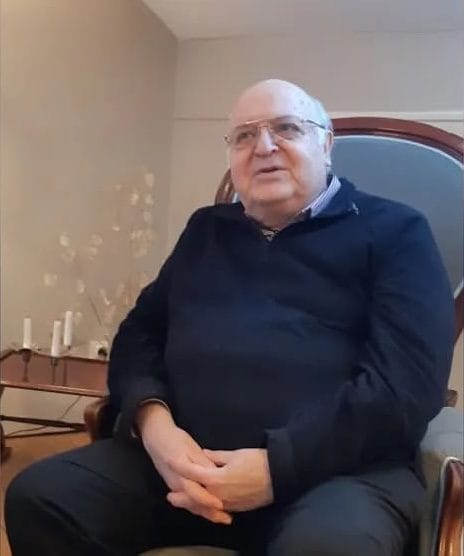
On December 3, 2025, the French Catholic Church lost one of its most discreet yet influential figures in biblical ministry. Father Marc Sevin, a priest of the Diocese of Orléans, passed away at the age of 84 after six decades of ministry entirely dedicated to making the Scriptures accessible to all. His death, which occurred in Nazareth near Orléans, marks the end of an era for all those who were nourished by his rigorous exegetical work and his bold pastoral vision.
Though little known to the general public, Marc Sevin has nonetheless had a lasting impact on how French-speaking Catholics read and understand the Bible today. Co-director of The Writers' Bible, With this groundbreaking translation published by Bayard in 2001, he orchestrated one of the most ambitious publishing ventures in contemporary biblical history. But beyond this flagship project, he embodied an entire philosophy of biblical education for decades.
Father Gérard Billon, who succeeded him as head of the Catholic Biblical Service Évangile et Vie (Gospel and Life), perfectly summarizes the essence of his ministry: «Marc Sevin’s entire ministry was focused on biblical pastoral care, that is, enabling everyone to read the Bible, collectively and not just individually, through Bible study groups, catechesis, and ongoing formation.» This quote captures the spirit of a man who dedicated his life to democratizing access to sacred texts, convinced that the Word of God should reach beyond the circles of initiates to connect with every believer on their spiritual journey.
A life dedicated to the Word
Orléans roots and an early vocation
Ordained a priest around 1965, Marc Sevin navigated the upheavals of the post-conciliar Church with a clear objective: to train the faithful in an enlightened and vibrant reading of Scripture. At a time when the Vatican II Council had just promulgated the constitution Dei Verbum On divine revelation, encouraging Catholics to rediscover the Bible, the young priest from Orléans understood that a silent revolution was underway.
His commitment to biblical education never wavered. A professor at the Centre for Christian Study and Reflection in Orléans since 1988, he trained generations of biblical facilitators, catechists, and pastoral leaders. His teaching method rested on a delicate balance: the scientific rigor of modern exegesis without ever losing sight of the spiritual and accessible dimension of the teaching.
What characterized Marc Sevin was his ability to navigate between two worlds. On the one hand, he was a rigorous exegete, fluent in Hebrew, Greek, and Aramaic, attentive to the latest archaeological discoveries and theological debates. On the other, he was a pastor concerned that Mrs. Dupont, in her local parish, could understand the Book of Isaiah without having attended the École Polytechnique. This dual expertise made him an indispensable figure in French biblical pastoral care.
The leadership of Évangile et Vie: a long-term mission
In 1988, Marc Sevin took over as director of the Catholic Biblical Service Évangile et Vie (Gospel and Life), a responsibility he held for many years. This service, affiliated with Éditions du Cerf, plays a crucial role in the biblical education of French-speaking Catholics. Its mission: to offer accessible and rigorous resources to support personal and group reading of the Bible.
Under his leadership, The Gospel Notebooks, The flagship quarterly journal of the service is experiencing remarkable growth. These issues offer in-depth yet accessible analyses of biblical texts, allowing readers to deepen their understanding of a biblical book, a historical period, or a theological theme. Each issue becomes a concise reference manual for Bible study groups, preachers, and trainers.
Marc Sevin's approach was distinguished by its refusal to oversimplify. It wasn't about "popularizing" the Bible in the pejorative sense of the term, but about making it accessible without betraying its complexity. He believed that the faithful deserved better than watered-down or moralizing interpretations. They needed to be given the tools to understand the historical context, the literary genres, and the theological issues, all while preserving the flavor and the strangeness of the ancient texts.
This conviction was rooted in a lofty vision of God's people. For Marc Sevin, the baptized were not passive vessels to be spoon-fed spiritually. They were capable of reflection, questioning, and personal appropriation of the Word. The biblical scholar's role was not to spoon-feed them. the work, but to open up pathways, to offer tools, to support discovery.
A prolific and generous collaborator
Alongside his institutional responsibilities, Marc Sevin has never stopped writing and contributing to various publications. He is a regular contributor to Let us pray in church, In the most widely circulated liturgical monthly in France, he offers commentaries on the Sunday readings and in-depth articles on biblical and theological questions. His style, always clear without being simplistic, appeals to a wide audience of regular churchgoers seeking spiritual understanding.
In 2008, he published The Bible in 50 Keys, This book will quickly become a go-to resource for anyone wishing to explore the Scriptures without getting lost in their vastness. It offers a highly accessible path to discovering the Bible: its origins, history, internal structure, and major interpretations. This is the essence of its teaching method: providing answers to the essential questions needed to begin reading the Bible.
Over the years, Marc Sevin has directed numerous publications to aid in the study of the Bible: reading guides, thematic commentaries, and tools for Bible study group leaders. His name has become synonymous with rigor and accessibility. Religious booksellers know that the works bearing his name combine scholarly rigor with pastoral concern.
The adventure of The Writers' Bible
A revolutionary project born at the turn of the millennium
But it is probably with The Writers' Bible, Published by Bayard in September 2001, Marc Sevin would go on to make his mark on the history of biblical translation into French. The project, incredibly ambitious, would consume his energy for over six years. The initial idea was simple yet revolutionary: what if contemporary writers worked hand in hand with exegetes to produce a new, complete translation of the Bible?
The project originated with Frédéric Boyer, a writer and translator convinced that traditional biblical translations had lost their literary power through repetition and rigid formulas. He proposed to Bayard that they bring together renowned writers and leading biblical scholars to attempt a new approach. Marc Sevin, with his experience and pastoral perspective, naturally became one of the project's co-directors and coordinators.
The stakes are enormous. This isn't about producing yet another literal translation or a modernized paraphrase. The objective is twofold: to restore the literary power of the original texts while producing a scientifically rigorous translation. Scholars will provide the philological and exegetical foundation, while writers will contribute their literary sensibility and creative freedom. A daring undertaking that could have easily ended in disaster.
An unprecedented collaboration between exegetes and writers
To carry out this monumental project, 27 exegetes and 20 writers are involved. Among the writers are prestigious names: Jean Echenoz (winner of the 1983 Prix Médicis and the 1999 Prix Goncourt), Emmanuel Carrère (winner of the 1995 Prix Fémina), Married NDiaye (winner of the 2001 Femina Prize and the 2009 Goncourt Prize), François Okay, Jacques Roubaud, Olivier Cadiot, Married Depussé, Valère Novarina. A very high-level literary team, some being believers, others agnostics, all recognized for the quality of their writing.
Facing them is a team of some of the most renowned biblical scholars in the French-speaking world. Marc Sevin is naturally among them, alongside Jean-Pierre Prévost, Philippe Abadie, Michel Berder, Hugues Cousin, Daniel Marguerat, and many others. A review committee, chaired by biblical scholars Pierre Gibert and Thomas Römer, ensures the overall coherence and scholarly rigor.
The work process is meticulous. Each biblical book is entrusted to a team of two: an exegete and a writer. The exegete first establishes a very literal base translation from the original languages (Hebrew, Aramaic, Greek), explaining the possible choices, the difficulties of the text, and the theological issues at stake. Then the writer takes this material and produces a version that seeks to capture in contemporary French the power, rhythm, and imagery of the original text.
Marc Sevin plays a crucial coordinating role. Harmonization is necessary. the work, Managing the inevitable tensions between scientific rigor and literary freedom, and staying the course throughout the six long years of the project, his experience as a trainer, his listening skills, and his quiet authority work wonders. He knows when to let the writers explore bold avenues and when to remind them of the boundaries that must not be crossed in order to remain faithful to the text.
The result exceeded expectations. The first edition, published in September 2001, caused a sensation. The treatment of Genesis The opening lines are striking: «First God created heaven and earth / empty earth, solitude / blackness above the depths / breath of God / movements above the waters.» The text breathes differently. The verses are placed in the margins, freeing the layout. The French is vibrant, sometimes disorienting, always powerful.
A translation that sparks debate and leaves a lasting mark
The reception was mixed but generally enthusiastic. The bishops of France, in an official statement from the Episcopal Conference, welcomed the initiative.« the work "Accomplished and original." They did not adopt it for the liturgy (that was not the objective) but recognized the quality and pastoral value of this new translation. Academic circles took an interest in the experiment, some with enthusiasm, others with reservations about certain literary liberties.
The general public, meanwhile, is discovering a Bible unlike any other. Where liturgical translations opt for a noble and slightly antiquated language, The Writers' Bible dares to use modern French. Scribes become "literate," tax collectors "scum," divine wrath is expressed through phrases like "red with anger" or "purple with anger." Certain passages of Book of Judges reveal a surprising poetry, like this verse from the Song of Deborah: "Why, lying in ambush between two camps, did you merely listen, spying on the pipes of the shepherds?"«
On the NALOT scale, which ranks Bible translations from the most literal to the most dynamic, the Bayard Bible occupies 6th place, attesting to an excellent translation close to the original. It is important to remember that these are rigorous translations, based on thorough exegetical and philological work on the biblical source languages. This is not a paraphrase or a free adaptation, but rather a scientifically grounded translation.
The Writers' Bible It has seen several re-editions: a paperback edition in 2005, a new edition in 2009, then in 2015 and 2018, before an anniversary edition in 2023 with a new preface by Frédéric Boyer. This longevity testifies to its lasting impact. In 2023, the edition was enhanced with a QR code providing access to excerpts from the Bible, fully interpreted by Noam Morgensztern, an actor with the Comédie-Française, in an immersive binaural recording.
For Marc Sevin, this project represents the culmination of a deep conviction: the Bible must be made accessible without being watered down, demanding without being elitist. It demonstrates that scientific rigor and literary creativity, tradition and innovation, can be combined. This experience will inspire other translation projects, in France and elsewhere, seeking to renew biblical language to make it resonate with contemporary audiences.
A living legacy for biblical pastoral care
The Bible for All: A Democratic Vision of Faith
Marc Sevin's legacy extends far beyond his publications. He helped shape an entire generation of Bible study leaders, catechists, priests, and laypeople Committed and convinced that the Bible is not reserved for specialists, their vision of biblical pastoral care rests on a few simple but powerful principles.
First, the conviction that collective reading is irreplaceable. Certainly, individual reading has its place, but it is in group sharing that the Word unfolds its full richness. Each person brings their own sensibilities, experiences, and questions. The text opens up under the shared perspectives of the group. The facilitator is not the "master" who holds the key to meaning, but rather the guide who helps the group along its journey.
Next, the importance of ongoing training. One doesn't become a Bible study leader in a few hours. A basic understanding of the historical context, literary genres, and theological frameworks is essential. But this training should never become an obstacle. Marc Sevin knew how to make complex concepts accessible without simplifying them. His pedagogical skill allowed beginners to progress without feeling overwhelmed.
Finally, the refusal to separate intellect and prayer, study and spirituality. The Bible is not an archaeological artifact to be coldly dissected, nor a magical text to be chanted without understanding. It is a living Word that calls for an existential response. Exegesis must nourish faith, And faith must be illuminated by intelligence. Marc Sevin naturally embodied this alliance.
The lasting impact on Catholic communities
Today, in French dioceses, thousands of Bible study groups meet every week. Parishes offer training courses on specific books of the Bible. Catechists rely on The Gospel Notebooks to prepare for their meetings. Liturgical readers are trained using tools developed by Évangile et Vie. All of this bears the mark of Marc Sevin.
His influence extended far beyond his home diocese. The training programs he led, the tools he designed, and the translations he coordinated permeated the entire French-speaking Catholic world. In Quebec, Switzerland, Belgium, and elsewhere... Africa As a French speaker, his name is known to biblical educators and pastoral leaders.
The evolution of biblical pastoral care in recent decades owes much to figures like hers. Before Vatican In the Second Vatican Council, the Bible remained largely inaccessible to ordinary believers. The Latin liturgy, the lack of educational support, and the prevailing clericalism created an intimidating distance. The Council opened the floodgates, but workers were needed to build the canals. Marc Sevin was one of these patient and discreet builders.
Today, a French Catholic wishing to deepen their knowledge of the Bible has a wealth of resources at their disposal: online courses, degree programs, reading groups, mobile apps, podcasts, and educational videos. Marc Sevin was one of the key figures in this democratization of access to Scripture, even if his name often remains in the shadows.
A prophetic vision that remains relevant today
In 2025, as the Catholic Church faces numerous challenges, Marc Sevin's vision remains remarkably relevant. At a time when religious practice is declining, when younger generations are turning away en masse from church institutions, and when biblical culture is fading from the common intellectual landscape, his intuition retains its full significance.
Marc Sevin believed that a Church unfamiliar with its Scriptures is a weakened Church. He believed that Christians cut off from their biblical roots become easy prey for superficial spiritualities or rigid fundamentalisms. He believed that the Bible, far from being a dusty book, carries a life-giving message for today, provided we know how to listen to it with contemporary ears.
His work on The Writers' Bible He anticipated a question that has become crucial: how to transmit a thousand-year-old heritage in a language and culture that are constantly evolving? How to remain faithful to the original text while making it accessible to contemporaries who no longer share the cultural codes of past centuries? These are questions that every missionary church must ask itself. Marc Sevin provided a concrete and creative answer.
His passing on December 3, 2025, marks the end of an era. The generation of pioneers of post-conciliar biblical pastoral care is gradually passing away. But the torch is now carried by those they trained. Gérard Billon, who succeeded him at Évangile et Vie, and so many others continue the work. The tools evolve, the methods diversify, but the fundamental intuition remains: the Bible belongs to all believers, not just to the clergy and scholars.
The funeral Mass for Father Marc Sevin was celebrated on December 10, 2025, at Saint-Paterne Church in Orléans, followed by his burial in the Neuville-aux-Bois cemetery. Among those gathered to pay their final respects were renowned biblical scholars, leaders of parish groups, former students, and grateful readers. All carried within them a piece of the legacy he had patiently built: the conviction that the Word of God is meant to be shared, studied, meditated upon, and lived by everyone.
In a Church undergoing transformation, searching for new ways to proclaim the Gospel, the example of Marc Sevin remains a powerful inspiration. His intellectual rigor without elitism, his creative boldness without demagoguery, his spiritual grounding without piety, trace a precious path. A path where the Bible becomes once again what it should never have ceased to be: an open, accessible, living book, capable of transforming lives and enlightening communities.