












Gospel of Jesus Christ according to Saint Luke
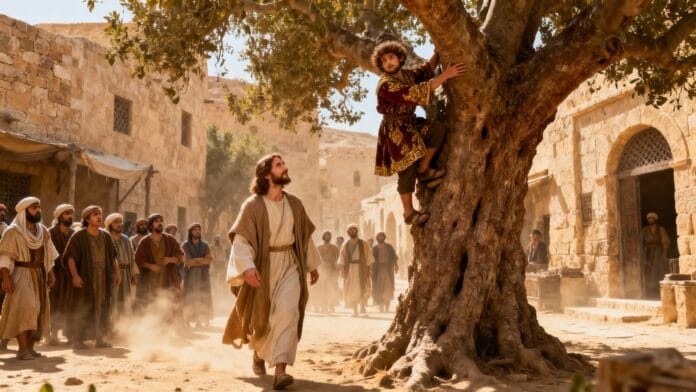
At that time, Jesus entered the city of Jericho and was passing through it. Now there was a man there called Zacchaeus; he was a chief tax collector, and he was a wealthy man.
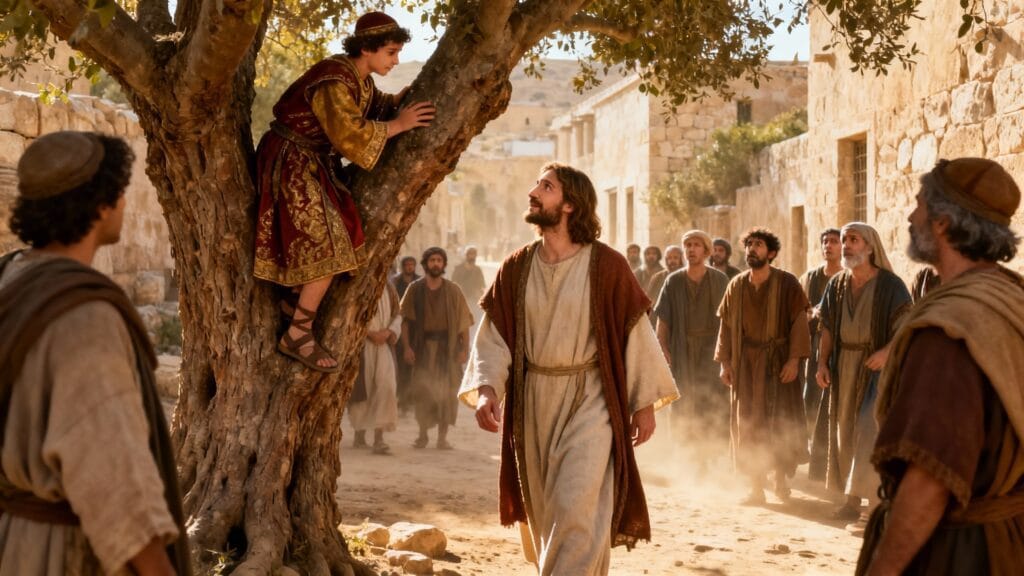
He was trying to catch a glimpse of who Jesus was, but he could not because of the crowd, for he was short in stature. So he ran ahead and climbed a sycamore tree to see Jesus, who was about to pass that way.
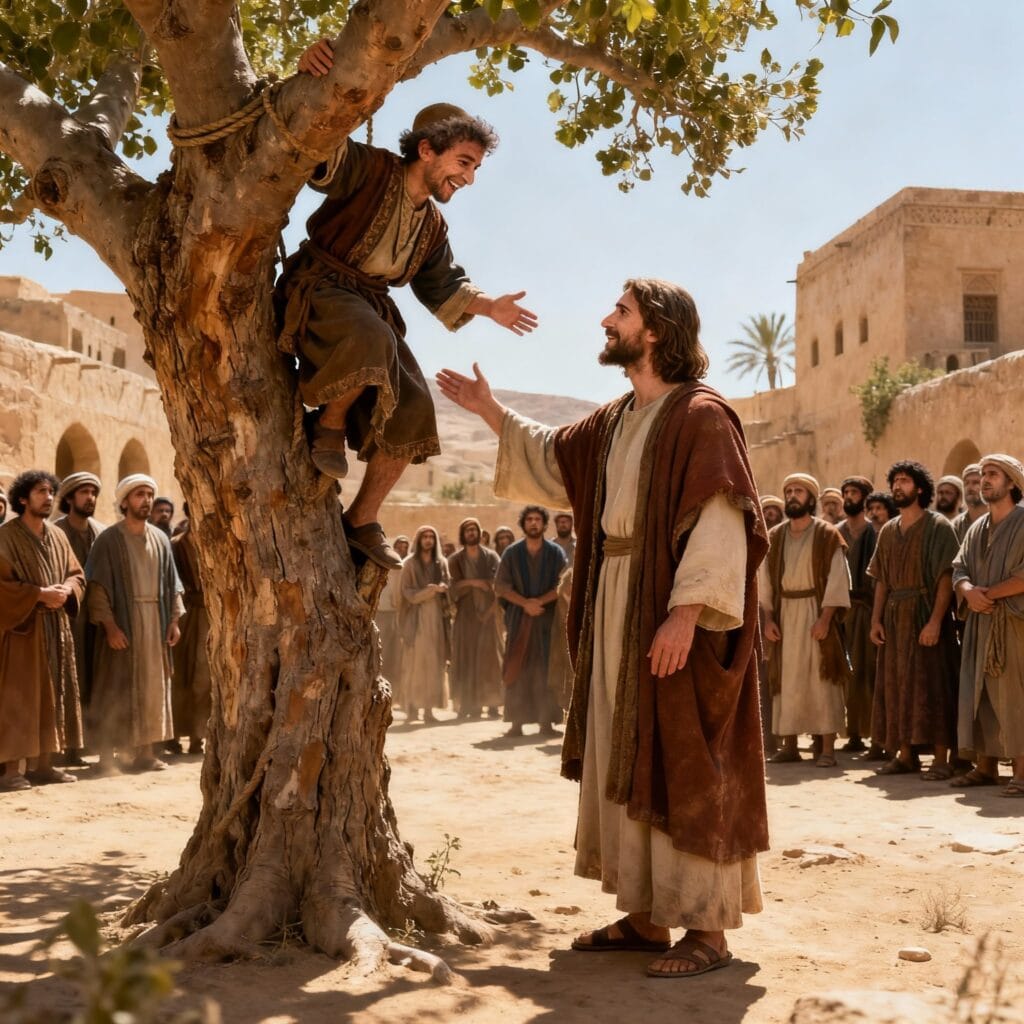
When Jesus arrived at the place, he looked up and said to him, «Zacchaeus, come down quickly, for I must stay at your house today.»
Immediately he went downstairs and welcomed Jesus with joy. Seeing this, they all murmured, "He has gone to stay with a sinner."«
Zacchaeus stood and said to the Lord, «Look, Lord! Here and now I give half of my possessions to the poor, and if I have cheated anybody out of anything, I will pay back four times the amount.»
Then Jesus said to him, «Today salvation has come to this house, because this man, too, is a descendant of Abraham. For the Son of Man came to seek and to save the lost.»
Welcoming unexpected salvation: how Zacchaeus teaches us to come down from our trees
A theological and practical exploration of Luke 19, 1-10 to rediscover joy to be found by Christ who actively seeks the lost.
Dear reader, the story of Zacchaeus, often relegated to children's stories, is actually one of the theological high points of the Gospel of Luke. It is a drama in miniature about prevenient grace. This article is for you, whether you feel "too small," "too rich," or "too sinful" to encounter God. We will explore how Jesus' mission—"to seek and save what was lost"—is not an abstract formula, but a divine initiative that shakes up our homes, our finances, and our certainties.
- Context : The sycamore tree of hope (Jericho, a place of tension).
- Analysis : The grammar of encounter (Desire and initiative).
- Axes:
- The gaze that precedes (The theology of "seeing").
- The shared dwelling (Salvation as "communion").
- The metamorphosis of wealth (Justice, the fruit of salvation).
- Implications: When salvation comes home.
- Scope : The Echo of the Son of Abraham (Prevenient Grace).
- Practical : Climb the tree of presence.
- Challenges: The scandal of a salvation that was "too easy".
- Prayer, Conclusion and Action Plans.
The sycamore of hope
We are at a turning point. Jesus is walking towards his Passion in Jerusalem. The Gospel of Luke, from chapter 9 onwards, is a long "ascent" to the cross. Every encounter, every parable along this path, is laden with the weight of this ultimate goal. Jericho, our setting, is not just any city. It is the last stop before the final ascent to the Holy City. It is a border town, a lush oasis known for its palm trees and flourishing trade. But it is also a place of tension. It is the first city conquered by Joshua Entering the Promised Land (Joshua 6), it was a symbol of military victory. But in Jesus' time, it was above all a major customs center, a strategic commercial crossroads between Judea, Perea, and Nabataea.
Customs meant taxes. Taxes meant Romans. And Romans meant tax collectors. These men, Jews, were doubly hated. First, they collaborated with the despised occupiers. Second, they enriched themselves by collecting, in addition to the official tax owed to Rome, an often exorbitant commission. They were considered legal thieves, traitors to the nation, and public sinners, ritually impure because of their constant contact with pagans and their "dirty" money.
It is in this climate Luke introduces our protagonist: «Now there was a man named Zacchaeus.» The Greek text uses a classical construction to introduce a character (the particle «kai idou,» «And behold»), but Luke adds a detail that creates the entire tension of the narrative: «He was the chief (architelōnēs) of the tax collectors, and he was a wealthy (plousios) man.» It is an accumulation. Not only a publican, but chief publicans. Not only at ease, but rich. For a listener of Luke, who had heard Jesus say a few lines earlier that it is "hard for a rich person to enter the Kingdom" (Luke 18, 24), the story of Zacchaeus begins as a theological impossibility.
The Alleluia verse that precedes this reading in the liturgy (1 John 4, 10b) is the hermeneutical key to the entire passage: «God loved us, he sent his Son as forgiveness for our sins.» The initiative is divine. Love precedes merit. Forgiveness It is a mission, not a reward. The story of Zacchaeus does not really begin with Zacchaeus searching for Jesus; it begins much earlier, with God who, out of love, sends his Son to find Zacchaeus.
The grammar of the encounter
The entire story (Luke 19, (1-10) is built on a play of glances and a contrast of verbs "to seek". The narrative structure is remarkably effective, moving from the outside (the street, the crowd) to the inside (the house, consciousness).
The primary driving force behind the action is Zacchaeus. «He was seeking (ezētei) to see who Jesus was.» The Greek verb is in the imperfect tense, suggesting a continuous action, a persistent desire, a quest. Zacchaeus is not merely curious; he is driven by intention. But he encounters two obstacles: «the crowd» and his «short stature.» These obstacles are more than physical; they are symbolic. The «crowd» represents public opinion, the anonymous mass that forms a barrier between the sinner and Christ, the very mass that will later «cried out against him.» His «short stature» (hēlikia, which can also mean «age» or «social condition») symbolizes his moral insignificance in the eyes of others, his unworthiness. He is «small» because he is despised.
Faced with this obstacle, Zacchaeus did not give up. He innovated. «So he ran ahead and climbed a sycamore tree.» This is a crucial detail. A architelōnēs, A rich and powerful man, a prominent figure, runs in public and climbs a tree like a child. It is an act of utter social absurdity. He sacrifices his dignity to satisfy his desire. The sycamore (a fig-mulberry tree) is a common, sturdy tree, but one whose fruit was often considered low-quality food. Zacchaeus humbles himself, he climbs a "common" tree to see the Lord pass by. He exposes himself, he perches there, waiting, hoping for even a glimpse.
This is where the dynamic reverses. The man who "sought to see" will be seen. "When Jesus arrived at that place, he looked up (anablepsas) and said to him." The verb anablepsas is powerful. It's the same verb used just before, in chapter 18, for the blind man Bartimaeus who "receives his sight." Jesus, who has just give the view to a blind man, now go look up towards a "lost" man. Jesus' gaze is not passive; it is active, it is creative. He does not see a "rich chief tax collector," he sees "Zacchaeus.".
The initiative is entirely Jesus's. "Zacchaeus, come down quickly: today I must (dei) stay (meinai) at your house." It is an avalanche of grace.
- He calls her by her name: «Zacchaeus» (which means «the pure one,» «the righteous one» in Hebrew, a magnificent irony). Jesus restores his original identity, beyond his function.
- He gives an order: «"Come down quickly." The urgency of grace.
- It is essential: «Today it is necessary (dei).» This «dei» is the «it is necessary» of the divine will, the same one Jesus uses for his Passion («the Son of Man must suffer»). The visit to Zacchaeus is not a whim; it is the fulfillment of God’s plan.
- He invites himself to "stay" (meinai): This is not a courtesy visit. It is the expression of profound communion (cf. John 15, "remain in me"). Jesus wants to share intimacy, the«oikos (the house) of Zacchaeus.
Zacchaeus's response was immediate: "Quickly, he went down and received Jesus with joy (chara).". Joy is the infallible sign of the presence of salvation in the Gospel of Luke. The crowd, however, responds with criticism: «When they saw this, they all grumbled (diegongyzon).» This is the verb of murmuratio, the murmuring of Israel in the desert against God, the murmuring of the Pharisees when Jesus eats with the fishermen (Luke 15, 2). They see a scandal where Zacchaeus sees a liberation.
The denouement takes place within. «Zacchaeus, standing (statheis), addressed the Lord.» The «standing» is a posture of regained dignity. He is no longer perched, he is no longer small. He stands upright. His declaration is the consequence of the encounter, not its condition. He does not say, «If you come, I will give,» but «Behold, Lord…» The presence of Jesus has already brought about the transformation. Salvation has entered, and the fruits of justice burst forth: «half to the poor» (an immense act of charity) and «to repay four times as much» (a restitution that goes beyond Jewish or Roman legal requirements, cf. Ex 21:37).
Jesus concludes with a threefold statement:
- «Today, salvation has come to this house.» Salvation is an event (Today!) and it is communal (for this House).
- «"For he too is a son of Abraham." This is reintegration. The traitor, the outcast, is reintegrated into the lineage of the promise.
- The key phrase, the thesis of the entire Gospel of Luke: "For the Son of Man came to seek (zētēsai) and to save (sōsai) what was lost (to apolōlos).".
Zacchaeus's verb "to seek" (ezētei) finally finds its fulfillment, not in what he found, but in the fact that he was find by the one who "came seeking" (zētēsai). The human quest, however sincere, is enveloped and fulfilled by the divine quest.
The preceding perspective: the theology of "seeing"«
The tragedy of Zacchaeus is above all a tragedy of sight. There is a striking contrast between Zacchaeus's "seeking to see" (zētei idein) and Jesus's "lifting up his eyes" (anablepsas).
Zacchaeus wants to "see who Jesus was." His primary motivation seems to be curiosity. He has heard about this man. But his quest is thwarted. The crowd forms a barrier. One cannot see Jesus when one remains in the crowd, in anonymity, within the confines of common opinion. To see, Zacchaeus must detach himself, gain some perspective, at the risk of appearing ridiculous. He climbs. He positions himself as an observer. He wants to see without being seen, a profoundly human desire. He wants to control the information, to grasp the phenomenon of Jesus from his elevated vantage point.
But the encounter shifts the perspective. Jesus "arrives at that place." The sycamore tree becomes a theophanic place, a "holy place." And there, Jesus "looks up." It's a reversal. The one who was observed becomes the observer. The one who wanted to see becomes the one who is seen.
The Greek verb anablepō (to raise one's eyes, to look up) is immensely rich. As we have noted, it is the verb of healing the blind man Bartimaeus (Luke 18, (verses 41-42), who begged Jesus, «Lord, let me see!» Jesus said to him, «See! Your faith has healed you.» And immediately, «he saw.» The physically blind man regained his sight.
Luke, a shrewd literary strategist, places the episode of Zacchaeus, the spiritually blind man, immediately afterward. Zacchaeus, however, asks for nothing. He is "too small," he doesn't dare. He is the rich man who, unlike the rich young man (Luke 18He doesn't even engage in conversation. He is a sinner and he knows it. But the same gaze that healed the blind man now rests upon him. Jesus "lifts his eyes" and, with that simple look, he "gives sight" to Zacchaeus. He allows him to see himself no longer as a "chief tax collector" or a "rich man," but as "Zacchaeus," a unique individual, worthy of being seen, worthy of being named.
Jesus' gaze is a gaze that precedes. He doesn't wait for Zacchaeus' repentance. He doesn't wait for his conversion. He sees him. In His sin, perched on the tree of his unacknowledged desire. It is a gaze that does not judge, but that calls out. It does not condemn "petty-mindedness," it embraces it. By raising his eyes, Jesus bridges the distance.
For Zacchaeus, being seen by Jesus is both a crisis and a liberation. The public gaze (the crowd) condemned him. The divine gaze (Jesus) saves him. He is recognized. The Alleluia (1 John 4The phrase "God loved us" takes on its full meaning here: first and foremost. God's love is not the reward for our efforts to climb trees; it is the power that finds us there and invites us to come down and enter into communion.
The shared dwelling: salvation as "communion"«
Jesus' command is astonishing: "Zacchaeus, come down quickly, for I must stay at your house today." Luke's theology is a theology of radical incarnation. Salvation is not an idea, it is a presence.
Let us analyze this "it is necessary" (Greek: deiThis is a major theological term in Luke. It is not a matter of social convention or logistical obligation. It is the "must" of divine necessity, of God's plan of salvation. It is the same "must" that Jesus uses to describe his own mission: "Did you not know that he must that I should be about my Father’s business?» (Luke 2:49); «He must that I proclaim the Good News… for that is why I was sent» (Lk 4:43); and above all, «He must that the Son of Man suffers many things… is rejected… is killed and rises again» (Lk 9:22).
By saying, "I must stay at your house," Jesus places this visit to a sinner on the same level of divine necessity as his Passion and Resurrection. Going to Zacchaeus's house is part of the mission for which he came. This is not a detour, it is the very path to salvation.
The place of this salvation is the "house" (oikos). In antiquity, the house was not merely the building; it was the hearth, the family, the servants, the business, the intimacy. It was the place of concrete life. And the house of a chief tax collector was a place of ritual impurity par excellence. It was there that the money from collaboration was counted, there that pagans were probably received. To enter this house, for a Jewish master, was to compromise himself. It was to become impure himself in the eyes of the law.
This is the heart of the scandal for the crowd: «He went to stay (katalysai) with a sinner.» They see the impurity. Jesus, however, sees the opportunity. It is a complete reversal of the logic of the sacred. The sacred is no longer that which must be protected from the defilement of the world; the sacred (Jesus) is that which enters into defilement to sanctify it from within. Jesus does not ask Zacchaeus to purify himself. Before to receive it. He receives it, and it is this reception that purifies Zacchaeus and his house.
The verb "to abide" (meinai) is even stronger. It evokes stability, permanence. This is the verb John will use for Trinitarian communion and life in Christ ("Abide in me"). Jesus doesn't just want to pass through; he wants to settle, to make the sinner's house one's own dwelling place. Salvation is God coming to dwell within us, in the disorder of our lives, amidst our dubious accounts and broken relationships.
Zacchaeus's answer is "« joy »"(chara). This is the fruit of the Spirit, the sign that the Kingdom of God is here. The crowd murmurs, but Zacchaeus is celebrating. Salvation is a celebration, an overflowing joy because the Master of life has chosen my a house, however unworthy it may be, to make one's home in.
The metamorphosis of wealth: justice, the fruit of salvation
The scene shifts indoors. The atmosphere is tense. Outside, murmurs; inside, the presence of Jesus. And it is there that the moral miracle occurs. "Zacchaeus stood (statheis) and addressed the Lord.".
The word "standing" (statheis) is solemn. It is neither the restlessness of a climber nor the haste of a descender. It is the posture of a man who has regained his uprightness, his dignity. He stands before the "Lord" (Kyrios), a title Luke uses more and more frequently as Jesus approaches Jerusalem. Zacchaeus acknowledges the sovereignty of his host.
His declaration is explosive: «Behold, Lord: I give half of my possessions (half of my fortune) to the poor, huparchontōn), and if I have wronged someone (if I have extorted, esykophantēsa), I'll give him four times as much back."»
It is crucial to note the verb tenses. Some manuscripts use the present tense («I give,» «I return»), others the future. Most exegetes agree that this is a commitment made on the spot. It is not Zacchaeus describing his past habits (as if to say, «I’m already a good guy»), but the new man who emerges from the encounter. Jesus’ presence in his home shattered his old value system.
Let's consider the magnitude of the gesture. "Half of my possessions to the poor." This isn't charity; it's a radical sharing. It's far more than a tithe. It's a direct, and inverted, response to the rich young man (Luke 18) who, for his part, had not been able to "sell all that he had". Zacchaeus, without being asked, offers the half.
«If I have wronged him… I will pay him back four times as much.» The verb «to wrong» (sykophantein) is technical: it refers to extortion by false accusation, blackmail. This was the core of his business. He admits his sin. And he offers reparation. Jewish Law (Exodus 22) required returning the principal plus one-fifth for financial harm, and four or five times the value for cattle theft. Roman law was similar. By offering «four times as much» for all In the case of extortion, Zacchaeus voluntarily and extravagantly adopts the maximum penalty.
This is the central point of Luke's theology of wealth. For Luke, wealth is a deadly danger because it isolates (cf. the rich man and Lazarus, Luke 16Zacchaeus' salvation is not manifested through tears or ecstatic prayer, but through a economic restructuring. Conversion (metanoia) is not a feeling, it is an act of justice.
Jesus did not say to Zacchaeus, "Your faith has saved you." He said, "Today salvation has come to this house." Why? Because (Greek: kardi) the money changes hands. Because The fruit is there. The encounter with Jesus freed Zacchaeus from the idolatry of money. He can finally give, because he has received The essentials: a look, a name, a home. He no longer needs to accumulate in order to exist. Salvation has made him righteous.
When salvation comes home
The story of Zacchaeus is not a historical anecdote; it is a paradigm for our lives. It touches on three vital spheres: our relationship to ourselves, to our community, and to our possessions.
1. Personal sphere: Identifying our sycamores We all have our "smallnesses," our indignities, our shames—those aspects of ourselves that we judge too small or too sinful to be presented to God. We all have our "crowds": distractions, fears, the fear of what others will say, the inner voice that tells us we aren't good enough. Zacchaeus's invitation is first and foremost an invitation to courage. What "sycamore tree" must I climb? What effort, however small, am I willing to make to "seek to see" Jesus? It might be opening a Bible for the first time, daring to push open the door of a church, or simply pausing in silence and naming one's desire for God. It's also learning to "come down quickly." When we feel the invitation of grace (a word that touches us, an inner call), we mustn't negotiate it. We must come down from our tree of observation and joyfully open the door of our "home," without feeling ready, because we never will be.
2. Community and Church Sphere: Stop the Murmuring In this story, there are two groups: Zacchaeus and Jesus on one side, and "everyone" (the crowd) on the other. The crowd represents the religion of separation, of purity through exclusion. They know who is a "sinner" and who is not. They are scandalized by mercy. The question for our churches and communities is stark: are we the murmuring mob or the welcoming home? When someone "impure" (according to our standards: the divorced and remarried person, the LGBTQ+ individual, the undocumented migrant, the ex-convict, the wealthy individual from a polluting industry…) approaches, what is our first reaction? Scandal or joy Jesus shows us that the Church's mission is not to protect its own purity, but to follow Christ into impure homes to bring salvation. We must become experts in "looking up," watchers among the sycamore trees, actively seeking out those whom the crowd despises.
3. Socio-economic sphere: Restorative justice Zacchaeus's conversion is the most concrete example imaginable. It comes at a cost: half his fortune and four times the amount of damages. The application is direct: does our encounter with Christ impact our bank account, our spending habits, and our sense of justice? Salvation is not "low cost." It compels us to examine our "wealth" (money, time, power, privileges) and ask ourselves: how can this be shared? How can I fix The harm that my lifestyle, directly or indirectly (consumption, investments), causes to others or to the planet? Zacchaeus teaches us that charity Giving to the poor is essential, but justice (repairing wrongs) is inseparable from it. A faith that does not lead to economic and social justice is an incomplete faith, according to Saint Luke.
The Echo of Abraham's Son
Jesus himself reveals the theological significance of his action in two powerful statements.
The first is: «for he too is a son of Abraham.» This is a public rehabilitation. The crowd saw Zacchaeus as a traitor, a «pagan» within, a man who had sold his soul (and his people) to Rome. He was «lost» to the community of Israel. By declaring him a «son of Abraham,» Jesus reintegrates him into the history of salvation, into the lineage of the promise. He affirms that God’s covenant is stronger than human sin. The blood of the covenant is thicker than the water of ritual impurity. This statement is a liberation of identity. Zacchaeus is no longer defined by his profession («chief tax collector») or his wealth, but by his fundamental belonging to the people of God.
This reintegration echoes many Old Testament prophecies, notably Ezekiel 34, where God himself promises to care for his flock against bad shepherds: «I will search for the lost, and I will bring back the strays…» (Ezekiel 34:16). Jesus, the Good Shepherd, fulfills this prophecy.
The second statement, which concludes the narrative, is the keystone of the entire Gospel: «For the Son of Man came to seek (zētēsai) and to save (sōsai) what was lost (to apolōlos).» This sentence is a perfect summary of Luke’s soteriology (the theology of salvation). The subject is the «Son of Man,» a title that Jesus attributes to himself, linking his humanity (son of man) to his eschatological authority (cf. Daniel 7The mission has two verbs: "to seek" and "to save." The order is important. God does not wait for the lost to appear; He go get it. It is a theology of the thoughtful grace (a term dear to Jean Wesley, but profoundly biblical). Divine initiative precedes and elicits the human response. Zacchaeus's desire to "see" was already, in itself, a fruit of Jesus's quest, which led him there. The object of the mission is "that which was lost" (to apolōlos, a neuter singular). It is not only "those" (people) but "that which" (everything) is lost. This includes people (as in the parables of the sheep and the drachma, Luke 15), but also lost humanity, spoiled creation, and violated justice. Zacchaeus is the embodiment of "what was lost": a rich man (lost according to Luke 18), a public sinner (lost to the community), a short man (lost in the crowd).
The encounter with Zacchaeus is therefore the enactment of the great parables of mercy of Luke 15 (the sheep, the drachma, the prodigal sonZacchaeus is the lost sheep that the Shepherd finds. He is the lost coin in the darkness of his house. He is the prodigal son who did not even have to leave his father's house, because it was the Father (in Jesus) who came to find him in his inner exile.
Climb the tree of presence
To internalize this text, I propose a short five-step meditation, based on the actions in the story.
- Identify the crowd: Take a moment to name what, within you and around you, constitutes a "crowd." What are the voices (fear, shame, distraction, the opinions of others) that prevent you from "seeing" Jesus, from seeking a deeper meaning?
- Identifying the sycamore tree: What is the "step aside" you can take today? What is that effort, however small or "ridiculous" (like praying for 5 minutes, reading this text, calling someone), that you can make to rise above the "crowd" and express your desire to see?
- To receive the gaze: Imagine yourself in that tree. Jesus passes by. He stops. He looks up at you. He doesn't see your position, your failures, or your wealth. He sees YOU. He says your name. Remain in that gaze that does not judge, but calls and loves.
- Hear the invitation: Listen to him say to you, "Come down quickly. I must stay with you today." Accept the urgency and necessity of this invitation. It's not for tomorrow, it's for "today.".
- Open the house: «"Come down quickly" from your vantage point. Open the door to your inner "home" (your heart, your secrets, your finances, your time) and receive him "with joy," without preconditions. Let his presence begin to transform everything.
Zacchaeus, the scandal of a salvation that was "too easy"«
This text, however gentle it may be, poses formidable challenges to our modern sensibilities, just as it challenged the contemporaries of Jesus.
The challenge of "instant" conversion: Our age is psychological. We are accustomed to lengthy processes, therapies, and "self-improvement." Zacchaeus's conversion is instantaneous, triggered by a simple glance and an invitation to dinner. This seems "too easy," even suspicious. Isn't it a rash act? Won't he regret tomorrow having promised half his possessions? This challenge forces us to re-evaluate what saves. It is not Zacchaeus's psychological process that saves him; it is the irruption of God's grace. Salvation is a event before being a process. The encounter with Christ is a shock that reorients one's existence. The process (the distribution of goods, the reparation of wrongs) will follow. After, but it is the result of the event, not its cause.
The challenge of "cheap grace": Dietrich Bonhoeffer warned against "cheap grace," the kind that forgives sin without demanding a change of life. The story of Zacchaeus is the absolute opposite. The grace Zacchaeus receives is "free" (he didn't earn it), but it is incredibly "costly." It costs him half his fortune and a complete overhaul of his affairs. The text warns us against a purely sentimental view of salvation. If our encounter with Christ costs us nothing, if it doesn't affect our finances, our privileges, or our way of life, is that truly the grace of Luke's Gospel?
The challenge of judging the "super-rich": Zacchaeus is an "architelōnēs" and "plousios." He is the equivalent of our 1%, perhaps even of those who enrich themselves through legal but morally dubious means (collaboration, speculation, aggressive tax optimization). The text forces us to ask the question: do we truly believe that Jesus came "to seek and save"?« Also The CEO of the polluting multinational, the speculative banker, or the oligarch? The "politically correct" crowd (of which we are often a part) still murmurs. We would prefer that salvation be for the "little people" and the "poor" (whom we idealize). Jesus, however, goes to the wealthy collaborator. He reminds us that there is no hopeless case for grace, and that the heart of the rich is also a mission field.
Prayer from the sycamore tree
Lord Jesus, Son of Man and Savior, You who pass on our roads, even when we no longer expect You, You who enter our "Jerichos", these places of commerce and compromise, see us.
See us, Lord, perched in our sycamore trees. We are "small": small in fear, small in shame, small in our lack of courage, paralyzed by the crowd. We are "rich": rich in our certainties, rich in our judgments, rich in what we accumulate so as not to feel our emptiness. We seek to "see," out of curiosity or vague desire, without daring to believe that we might be seen.
But then You stop. You look up. Your gaze is not that of the accusing crowd, it is the gaze that calls, the gaze that names. You say my name: "Zacchaeus," "the pure one." You see in me lost innocence, the buried image of God.
You say, "Come down quickly!" And you don't give me time to justify myself. You invite yourself in: "Today, I must stay at your house." Not at the more respectable neighbor's house, not at the synagogue, but at my house, in the heart of my sin.
So, Lord, give us joy of Zacchaeus. Joy to descend from our heights, from our evasions, to welcome You with eagerness. May Your presence in our home shatter our safes. May the love we freely receive be transformed into justice for the poor and in reparation for those we have wronged.
Silence the murmurs of the crowd within us. Grant us to see in every "Zacchaeus" of this world, in every "lost soul," a "son of Abraham," a sister, a brother whom You came to seek and save. For You are the God who seeks before being sought, You are the Love that loved us first, You who live and reign with the Father and the Holy Spirit, now and forever. Amen.
To become God's guest
The story of Zacchaeus is Jesus' mission in a single act. It reminds us that the Gospel is not a moral lesson, but an encounter. An encounter initiated by a God who actively "seeks," who is not afraid to get his hands dirty or compromise his reputation by entering our unclean homes.
Salvation, as Luke presents it, is not a reward for a righteous life; it is the event that makes a righteous life possible. It is "today." It does not wait for us to be perfect. It simply asks that we be there, perched on the tree of our desire, and that we have the courage to "come down quickly" when He calls us by name.
The question Zacchaeus poses to us is not: "Am I good enough for Jesus?" but "Am I joyful enough to welcome Him?" And: "Am I transformed enough for my encounter to be reflected in my bank statement?"«
The final call is a sending forth on a mission. Jesus, the Son of Man, came to seek and save what was lost. He did it for Zacchaeus. He does it for us. Now, as restored and joyful «children of Abraham,» we are called to do the same: to lift our eyes, to spot the sycamore trees, and to become, in our turn, seekers of what is lost, bearing joy salvation in the homes of this world.
Seven days to climb down the tree
- Day 1: Identify "the crowd" within me (that voice that tells me "you are too small"). Name it.
- Day 2: Dare to "climb" (do something unusual to seek God: read a psalm, walk in silence).
- Day 3: Practicing the "gaze" of Jesus (looking at a person I usually judge, looking for the "son of Abraham" in them).
- Day 4: Meditate on "Today" (do not put off until tomorrow an act of forgiveness or sharing).
- Day 5: Welcome "with joy" (find a concrete reason for gratitude and celebrate it, even in a small way).
- Day 6: Calculate "half" (look at my budget/time and decide on a donation, a concrete sharing).
- Day 7: Think about "reparation" (have I wronged someone? How can I "make it up to them", not just in words?).
References
- Source text: The Bible, liturgical translation. Gospel of Jesus Christ according to Saint Luke, chapter 19, verses 1-10. First Epistle of Saint John, chapter 4, verse 10.
- Old Testament: Book of Ezekiel, chapter 34 (The Shepherd of Israel). Book of Exodus, chapter 21-22 (Laws on Reparation).
- Gospel of Luke: Parables of mercy (Luke 15), The rich young man (Luke 18), The Blind Man of Jericho (Luke 18).
- Comment : François Bovon, L'Gospel according to Saint Luke (15,1-19,27), Commentary on the New Testament (CNT), Geneva, Labor et Fides, 2007.
- Comment : Joseph A. Fitzmyer, The Gospel According to Luke (X-XXIV), The Anchor Yale Bible, Doubleday, 1985.
- Church Fathers: Saint Ambrose of Milan, Treatise on the Gospel of St. Luke, VII, 83-96. (Ambrose sees in the sycamore, "the mad fig tree", a symbol of the cross which raises up the sinner).
- Theology: Dietrich Bonhoeffer, The Price of Grace (original title: Nachfolge), for the distinction between "cheap" and "expensive" grace.