












Gospel of Jesus Christ according to Saint Luke
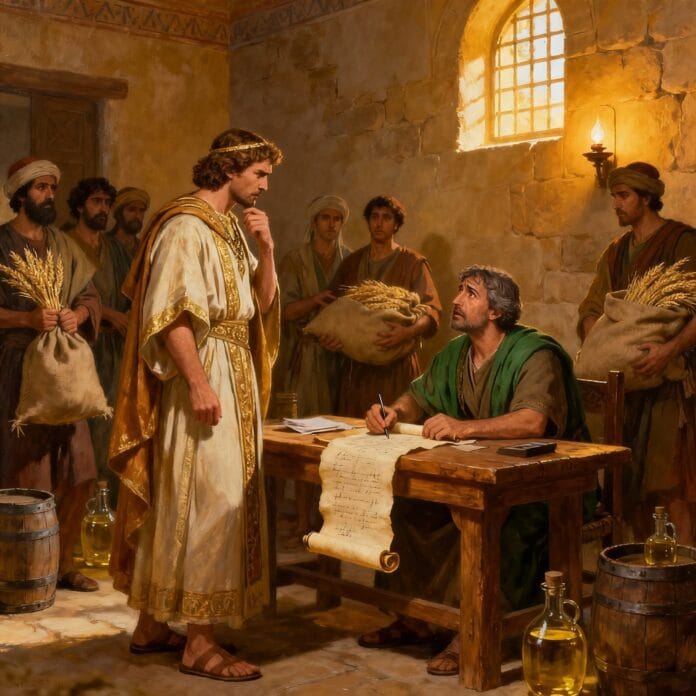
At that time, Jesus said to the disciples:
«A wealthy man had a steward who was accused of squandering his wealth. He summoned him and said, «What is this I hear about you? Show me the balance sheet of your management, for you can no longer remain my steward.»”
The steward said to himself, "What am I to do, since my master is taking away my position? Cultivate the land? I don't have the ability. Beg for alms? I would be too ashamed. I know what I will do so that, once I am removed from my post, people will open their doors to me."«
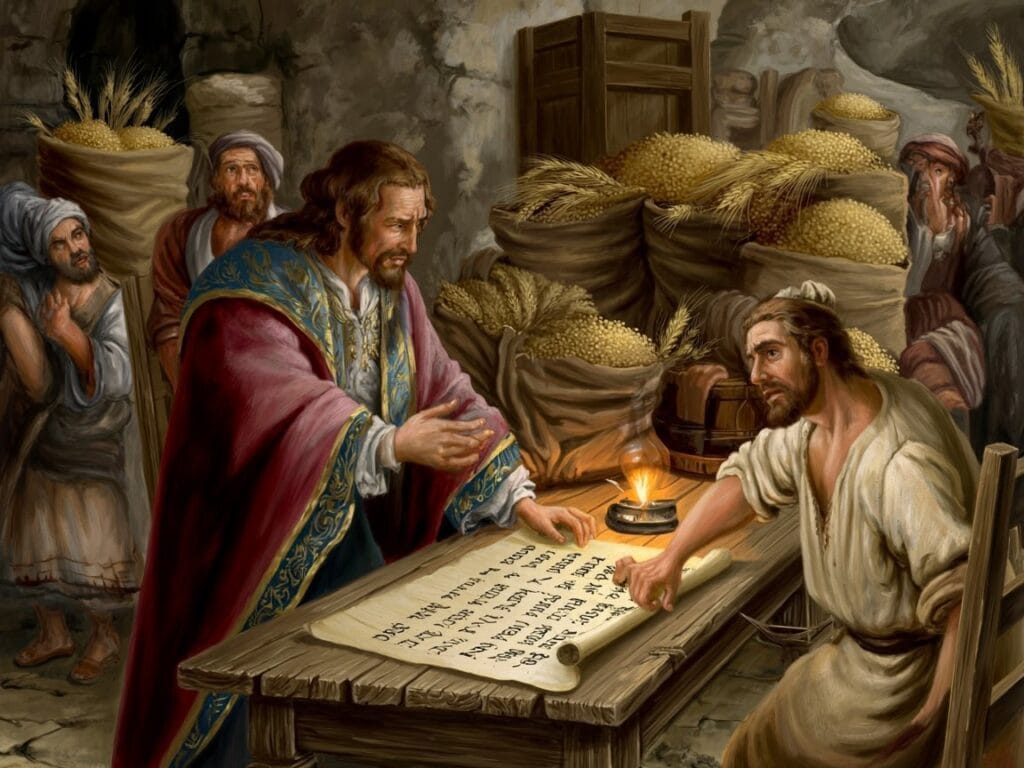
He then summoned, one by one, those who owed his master money. He asked the first, "What do you owe my master?" The man replied, "One hundred jars of oil." The steward said to him, "Here is your IOU; quickly, sit down and write down fifty."«
Then he asked another, "And you, what do you owe?" He replied, "One hundred measures of wheat." The steward told him, "Here is your IOU, write down eighty."«
The master congratulated the dishonest steward for his cunning; for the children of this world are more cunning with one another than the children of light.»
Cultivating light in a skillful world
How can we learn from the cunning of the sons of the world without losing the purity of the sons of light?.
The dishonest steward's passage through the’Gospel according to Saint Luke This puzzles us. Jesus seems to praise the cunning of a shrewd man, caught red-handed, yet intelligent in the face of crisis. Why this paradoxical parable? To whom is it really addressed? To believers who strive to be righteous but are often naive? This article is for those who wish to combine clear-sightedness and charity, worldly understanding and fidelity to God, to cultivate an enlightened and embodied faith.
- Context: the unexpected wisdom of a disgraced manager
- Analysis: Cunning as a school of discernment
- Areas of focus: foresight, responsibility, shift in perspective
- Applications: active faith in everyday life
- Spiritual and theological resonances
- Concrete meditation strategies
- Contemporary challenges and moral discernment
- Final prayer and daily practice

The parable of the dishonest manager: the scandal of a praised skill
The Gospel of Luke places this parable after that of the prodigal son: two stories of loss and recovery, but this time the scene is economic, almost commonplace. A rich man discovers that his steward has squandered his wealth; he removes him from his position. The steward improvises: he reduces the debts of his debtors to gain allies.
Jesus concludes with a provocative statement: «The children of this world are more shrewd in dealing with their own kind than the children of light.» This is neither an apology for lying nor an encouragement of corruption: Jesus admires the reactivity, there creativity, and the analytical finesse which this man demonstrates in the face of the crisis.
This passage engages in dialogue with others: the parable of the talents (Mt 25:14-30), where the master praises the fruitfulness of risk; or Christ's recommendation: "Be as shrewd as serpents and as innocent as doves." The steward is an anti-hero: his fault reveals our lack of spiritual agility.
Spiritual intelligence: between prudence and audacity
At first glance, the parable seems to blur moral boundaries. Yet, Jesus does not praise dishonesty but the shrewd use of means. The Gospel teaches us to unite two virtues rarely compatible: realistic prudence and purity of heart. son of light They should not be naive: faith is not a refuge, but a way of lucidly inhabiting reality.
The manager's skill highlights a blind spot for Christians: the lack of spiritual strategy. Many live their faith sincerely, but without practical intelligence: they let the world dictate the pace, instead of approaching life with wisdom and boldness.
The real lesson is the conversion of lucidityLearning to use one's gifts, networks, and talents, not to manipulate but to serve the Kingdom. Jesus doesn't say, "Be dishonest," but, "Be intelligent." The light needs clear minds and burning hearts.
Foresight: seeing before acting
The manager, caught off guard, assesses his situation. He doesn't complain, he thinks: What am I going to do? This immediate realism gives him a head start.
In the spiritual life, clairvoyance is this honesty in the face of truth: recognizing our limitations, our mistakes, our conditioning. A clairvoyant believer does not flee from reality: he reads it with clarity. light of God. This inner skill is born from prayer and daily lucidity: noting, understanding, anticipating.
Clairvoyance is not distrust: it is the art of discerning the intention behind things. It transforms faith into active wisdom.
Responsibility: redirecting one's resources towards the good
The manager uses what little power he has left: time, a bit of authority, connections. He turns the situation to his advantage, but in the parable, this initiative seduced the master.
It teaches a Christian responsibility: never give up on doing good with the means at hand. Managing the world requires entrepreneurial spirit, moral discernment, and civic responsibility. Bringing the light, It is also about choosing to act rather than to be acted upon.
A responsible believer learns to manage his possessions, his influence, his knowledge justly: this forms the basis of the human economy of salvation.
III. The Conversion of Perspective: Intelligence in the Service of Love
The great temptation of our time is efficiency without purpose. Jesus shows us that intelligence can become spiritual if it serves. love. The manager's cunning becomes a parable of conversion: moving from self-interest to communion.
The children of light, too often naive, can learn from the children of the world: discipline, preparation, cooperation. The challenge is not to imitate their morality, but their capacity for action; not their cynicism, but their realism.
Thus, the light must become strategic: innovate for good, build bridges, work in networks. Love Intelligent is fertile.

Active faith and daily life: inhabiting the world without getting lost in it
In professional life: dare to reconcile competence and integrity. Faith does not excuse performance; it teaches another way to succeed: to serve before dominating.
In domestic life: the manager's cunning is a reminder of the creativity needed to maintain peace And patience family.
In social life: light must be expressed through coherence., the word That's right, evangelical diplomacy. The believer becomes a strategist of peace.
Spiritual resonances and tradition
Saint Augustine He read in this passage an invitation to transform material goods into eternal good: "Make friends with deceitful money." Thomas Aquinas, for his part, emphasizes the importance of prudence: "Skill is praiseworthy only if it is directed toward a good end."«
In the monastic tradition, the discretio — right discernment — constitutes the root of all wisdom. Ignatius of Loyola will take up the idea: act as if everything depended on us, pray as if everything depended on God.
Jesus never separates intelligence and love: light is recognized by its fruitfulness.
Meditation prompt: training the intelligence of the heart
- Read the parable slowly.
- Identify a situation in which you acted with fear or naivety.
- Ask God for light to understand what you could have done differently.
- To seek a just and strategic action to take today.
- Offer your reflection to God as a prayer for unity: may prudence and charity embrace.

Contemporary challenges of light
Our era values efficiency, speed, and success. Faith seems out of step, slow, and "unproductive." Yet, Christ calls us to be effective In other words: not to dominate, but to humanize.
The challenge lies in the tension between purity and competence: how to avoid corruption while remaining active? The Gospel provides the answer: by cultivating spiritual clarity.
In space digital, Whether economic or ecological, it is about learning virtuous strategies: clarity in intentions, courage in decisions, solidarity in means.
The children of light must no longer flee the arenas of the world, but become intelligent witnesses of the Kingdom.
Prayer – For an inhabited intelligence
Lord, light of the world,
teach us the art of fearless prudence.
Give our hands the flexibility of service.,
to our minds the subtlety of discernment,
to our hearts the audacity to love.
May our initiatives be as clear as your Gospel,
Our calculations, pierced by your grace.
Make us faithful stewards of your light,
not to dominate, but to enlighten.
Amen.
Final appeal: the light must dare to think
The children of light are not called to flee the complexity of the world, but to transfigure it. Skill, purified by charity, It becomes an instrument of good. Cultivating an intelligence of the heart means rejecting spiritual laziness.
The holiness of the 21st century will be lucid, creative and active: a faith that thinks, that anticipates, that dares.
Practical track
- Identify each week a decision to be made with evangelical discernment.
- Reviewing one's mistakes is not about judging oneself, but about learning.
- Developing one's lucidity through reading the lives of saintly strategists.
- Cultivate gratitude rather than defensive cunning.
- Distinguishing between prudence and fear: one enlightens, the other stifles.
- Dare to speak clearly in your workplace.
- To offer each success as a shared light.
References
- Gospel according to Saint Luke 16, 1-8.
- Saint Augustine, Sermons on the Gospel of Luke.
- Saint Thomas Aquinas, Summa Theologica, II-II, q.47-48.
- Ignatius of Loyola, Spiritual exercises.
- Benedict XVI, Light of the world, interviews.
- Pope Francis, Gaudete et Exsultate, no. 130-134.
- Catechism of the Catholic Church, §1806-1808.