












Gospel of Jesus Christ according to Saint Luke
At that time, tax collectors and the fishermen They all came to Jesus to listen to him. The Pharisees and the scribes murmured against him, saying, «This man welcomes the fishermen and shares his meals with them!»
Then Jesus told them this parable:
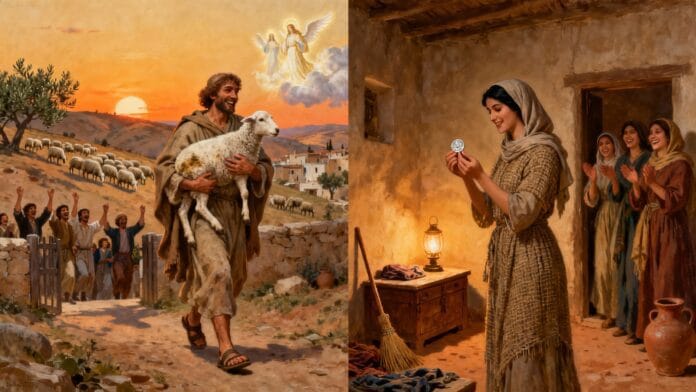
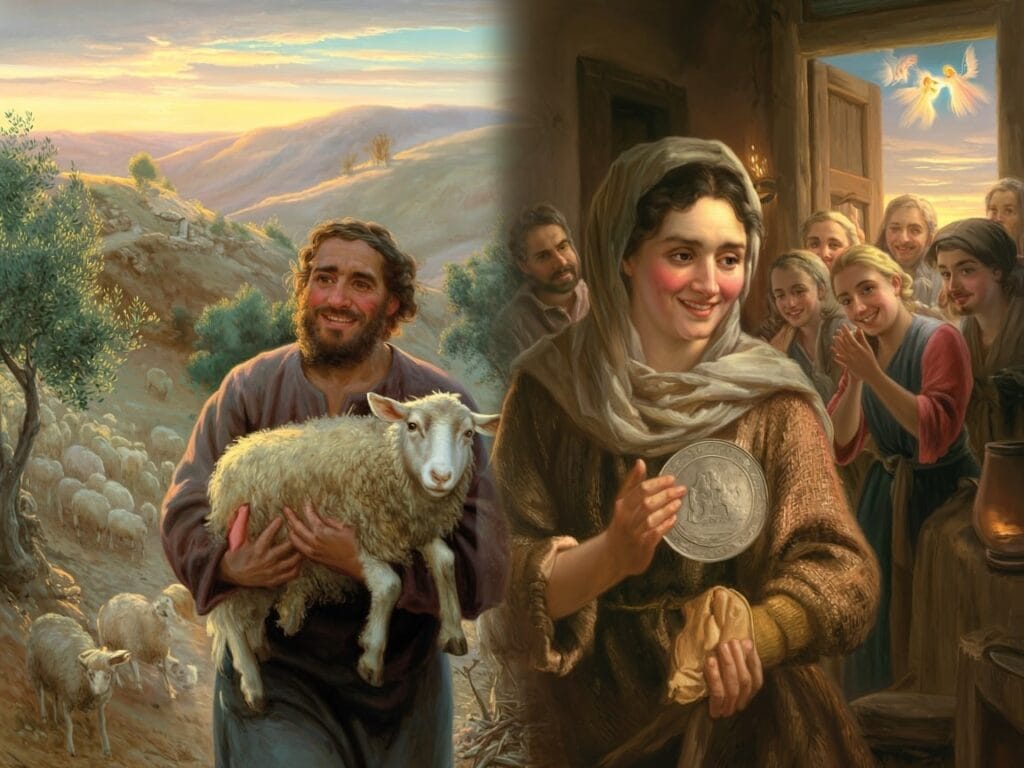
«Which of you, if you own a hundred sheep and lose one, does not leave the ninety-nine others in the field and go in search of the lost one until you find it? And when you find it, you lift it onto your shoulders, filled with joy, and when you get home, you gather your friends and neighbors and say to them, «Share my joy, for I have found my lost sheep!»”
I assure you: in the same way, there will be more joy in heaven over one sinner who repents than over ninety-nine righteous people who do not need to repent.
Or, if a woman has ten coins and loses one, does she not light a lamp, sweep her house, and search carefully until she finds it? And when she finds it, she calls together her friends and neighbors and says, «Share my joy, for I have found the coin that I had lost!»
Similarly, I assure you: there are joy among the angels "God's favor for one sinner who repents."»
To find the lost soul, to awaken the joy of heaven
How the parable of the lost sheep reveals the merciful face of God and redirects our lives towards the light.
Every human being has experienced getting lost, taking a detour, entering a gray area where meaning falters. And if joy Was true perfection born not from perfection, but from return?’Gospel according to Saint Luke – through the parable of the lost sheep and the lost coin – reveals a shocking truth: God rejoices infinitely more in the repentance of a single sinner than in loyalty The tranquility of the righteous. This article is for those who seek to understand the logic of this joy, to experience it, and to let it radiate in their lives.
- The Gospel context: sinners welcomed, scribes scandalized.
- The core of the message: joy divine, an echo of forgiveness.
- Three axes: loss, search, reunion.
- Spiritual applications: conversion of perspective, of relationship, of speech.
- A call: to transform our own joy into active mercy.

Context
The Gospel of Luke (15:1-10) opens with a familiar scene: two crowds facing each other. On one side, the tax collectors and the fishermen, attracted by the words of JesusOn the other hand, there were the Pharisees and scribes, shocked to see him eating with them. The social and spiritual contrast is striking: the outcast and the moralist, the one hungry for love and the guardian of purity. It is precisely there, at the point of friction between exclusion and mercy, that Jesus recounts his two parables.
The shepherd searching for his sheep, the woman sweeping her house: two simple images of everyday life, two faces of the same tenderness. Both end with an explosion of joy: friends, neighbors, even angels rejoice at the discovery of the lost good. This dual narrative reveals the dynamic of salvation: God takes the initiative to seek the lost soul, without ever reducing it to its sin.
Luke, the evangelist of the poor and marginalized, writes for communities sensitive to the grace that is offered to all, not just the perfect. He emphasizes "joining" them and "taking them on his shoulders." Conversion is not a verdict, but an embrace: the sheep on the shoulders, the coin found in the light, symbolize restored dignity.
This passage is part of a larger whole: Luke chapter 15, often called "the«Gospel of MercyThis culminates in the parable of the prodigal son. Each time, divine logic contradicts human logic. Where man judges, God seeks; where man grows weary, God persists. Joy God's love is that of a love that refuses loss.
Analysis
The essential message of this Gospel passage lies in a shift in focus: from guilt to relationship, from the norm to mercy. Jesus teaches that conversion is not imposed, it is welcomed. It is an inner movement made possible by the certainty of being awaited.
The reason for joy Heavenly here transcends mere emotion: it expresses the communion of the divine and the human. When a sinner returns, all of creation regains its harmony. This deliberate disproportion in the narrative—one sheep out of a hundred, one coin out of ten—reveals that for God, attention is always focused on the specific wound, not on moral statistics.
The event of conversion has a threefold effect. First, it restores the person to their truth: they cease to be "lost." Second, it restores the community: friends and neighbors share joy. Finally, he glorifies God: mercy becomes the very color of the sky. Through these parables, Jesus overturns the religious hierarchy: perfection is no longer at the top, but humble return becomes the heart of the Kingdom.

Loss – Recognizing the Misstep
The parable always begins with loss, the condition of any quest. Recognizing that something is lost already presupposes an awakened consciousness: the shepherd counts his sheep, the woman notices the missing coin. People often prefer to ignore their shortcomings, to conceal them, or to justify them. Jesus, on the contrary, shows that lucidity is the first step toward grace.
In the Bible, straying is rarely a crime; it's a way of drifting away. The sheep may simply have followed a mirage, the coin slipped through a crack in the house; nothing dramatic. This corresponds to our own failings: routine, indifference, inner distraction. To be "lost" is to no longer hear the call.
To acknowledge our loss is already to listen to the One who seeks us. Conversion is born from this humble listening: God never tires of speaking our name in silence.
The search – God in motion
The God Jesus presents doesn't wait: he goes out, he searches. The shepherd abandons ninety-nine sheep in the desert; the woman lights a lamp and carefully sweeps her house. Two determined gestures, full of tender urgency. The divine search is an embodied action: God walks, illuminates, cleanses. These are concrete verbs, imbued with energy and closeness.
The quest for the Lord is not a random journey: it follows the path of compassion. He does not seek to punish, but to bring back. The image of the shepherd referred, for Jesus' listeners, to that of God the shepherd of Israel (Ezekiel 34). Christ assumes this role and reinvents it: he becomes the shepherd who knows solitude, who himself carries the cross of the desert.
In our spiritual experience, this means that grace acts before our response. God goes before us: he activates the signs, the encounters, the events that prepare our return. This is why conversion is never a mere moral effort; it is a response to a call already present. Everyone can attest to this: a word heard, a face met, a book opened at random—so many shards of light in the swept house of our soul.
The reunion – shared joy
The summit of the two parables is the same: joy overflowing. The shepherd returns home, the woman summons her neighbors. Joy It becomes contagious: it spreads from heaven to earth, from angels to friends. Salvation is not a private matter: it inaugurates a celebration.
In this context, the phrase "rejoice with me" foreshadows the Gospel itself—euangelion means "good news." Divine happiness is not solitary: it calls for witnesses. Every conversion is celebrated, not analyzed. God does not ask for assessments, but for invitations.
This joy, however, comes at a price: that of compassion. The shepherd grew weary, the woman exerted herself. She is therefore a joy imbued with effort and tenderness. She does not deny the wounds; she illuminates them.

Implications
- In personal life: to welcome our fragility as an opportunity, not a failure. To remember that God is not ashamed of our smallness.
- In relationships: learning to seek out the other before judging. Mercy It is not about excusing, but about understanding.
- In the community: prefer the celebration of return to the rigidity of purity. Celebrate new beginnings.
- In prayer: rediscovering the taste of simple gratitude, a source of lasting joy.
- In social action: to see each person in difficulty as a precious sheep, not as a problem.
These applications show that mercy becomes a path to unity. Joy Heaven's grace is not reserved for the afterlife; it springs forth in every heart that chooses forgiveness.
Tradition
The Church Fathers commented extensively on these parables. Saint Augustine saw in the sheep all of humanity carried by Christ on his shoulders: the weight of the world supported by love. Origen read in the drachma the image of the soul bearing the effigy of God, obscured by the dust of sin, which the woman — figure of divine wisdom — cleans so that it may regain its brilliance.
Liturgical tradition associates these verses with rites of reconciliation: they convey the promise of a God "who does not want the death of the sinner». In Christian art, from the Roman catacomb to the Byzantine icon, the good shepherd remains a symbol of hope. Mercy It always triumphs over solitude.
Meditations
- To locate oneself: recognizing an area of one's life where one feels "lost".
- To call: to pronounce one's own first name inwardly as God would.
- Listen: imagine the voice of the shepherd walking towards you.
- Receive: to let oneself be carried along without resistance, at least in thought.
- Share: to express to a trusted person joy a little return.
This prayer-meditation leads to the experience of a God who is on the move. It transforms the feeling of guilt into gratitude for being found.
Challenges
Can we still speak of sin in a culture that celebrates autonomy? The word seems weighty, guilt-inducing. Yet, it is not fault, but loss that lies at the heart of the Gospel message. To call oneself a sinner is to acknowledge one's vital dependence on love of God.
Another challenge: in a divided society, how to live joy Shared? Where everything encourages criticism, following Christ means choosing celebration instead of suspicion.
Finally, mercy This is not weakness: it requires the courage to listen and forgive. Searching for the lost sheep demands time and risk. The Christian, like his Lord, must therefore be "going forth"—ready to cross the moral desert of the world.
Prayer
Lord Jesus,
You who carry the wounded sheep on Your shoulders,
come find me in my detours.
Light within me the lamp of Your Spirit,
sweeps away the dust of my fears.
Let me hear joy from heaven when I return to You,
because You do not rejoice in my perfection,
but with my timid steps towards Your heart.
Grant me the grace to welcome my brothers as You have welcomed me,
to search for the lost face in every glance exchanged.
May my life become an act of thanksgiving,
and let my whole being sing mercy.
Amen.
Conclusion
Find joy The search from heaven begins with an act of trust. No straying is so profound that God ceases to seek. By discovering this logic, we in turn become seekers of others: in our families, our cities, our churches. It is less about putting people back on the "right path" than about reminding them that a home awaits them.
This parable is therefore not just a story; it is a way of life: losing, searching, finding again, rejoicing. Each step can be lived every day, like a breath of the soul.
Practical
- Reread Luke 15:1-10 each morning in silence, remembering only one word.
- Keeping a journal of the "found": a grace, a face, a peace restored.
- Symbolically sweep a room in the house while praying.
- Meditate on an image of the good shepherd when in a moment of doubt.
- Thank God, even for his unfinished research.
- Celebrate every tiny step forward as a heavenly celebration.
- Offering a concrete gesture of reconciliation each week.
References
1. Jerusalem Bible, Gospel according to Saint Luke, chapter 15.
2.Saint Augustine, Sermons on the Gospel according to Luke.
3. Origen, Homilies on Luke.
4.Pope François, Misericordiae Vultus, 2016.
5. Benedict XVI, Jesus of Nazareth, Volume 2.
6. John Chrysostom, Homilies on Conversion.
7. Catechism of the Catholic Church, articles 1425-1439.
8. Liturgical prayer for the 24th Sunday in Ordinary Time.