













Gospel of Jesus Christ according to Saint Luke
At that time, tax collectors and the fishermen They all came to Jesus to listen to him. The Pharisees and the scribes murmured against him, saying, «This man welcomes the fishermen and shares his meals with them!»
Then Jesus told them this parable:
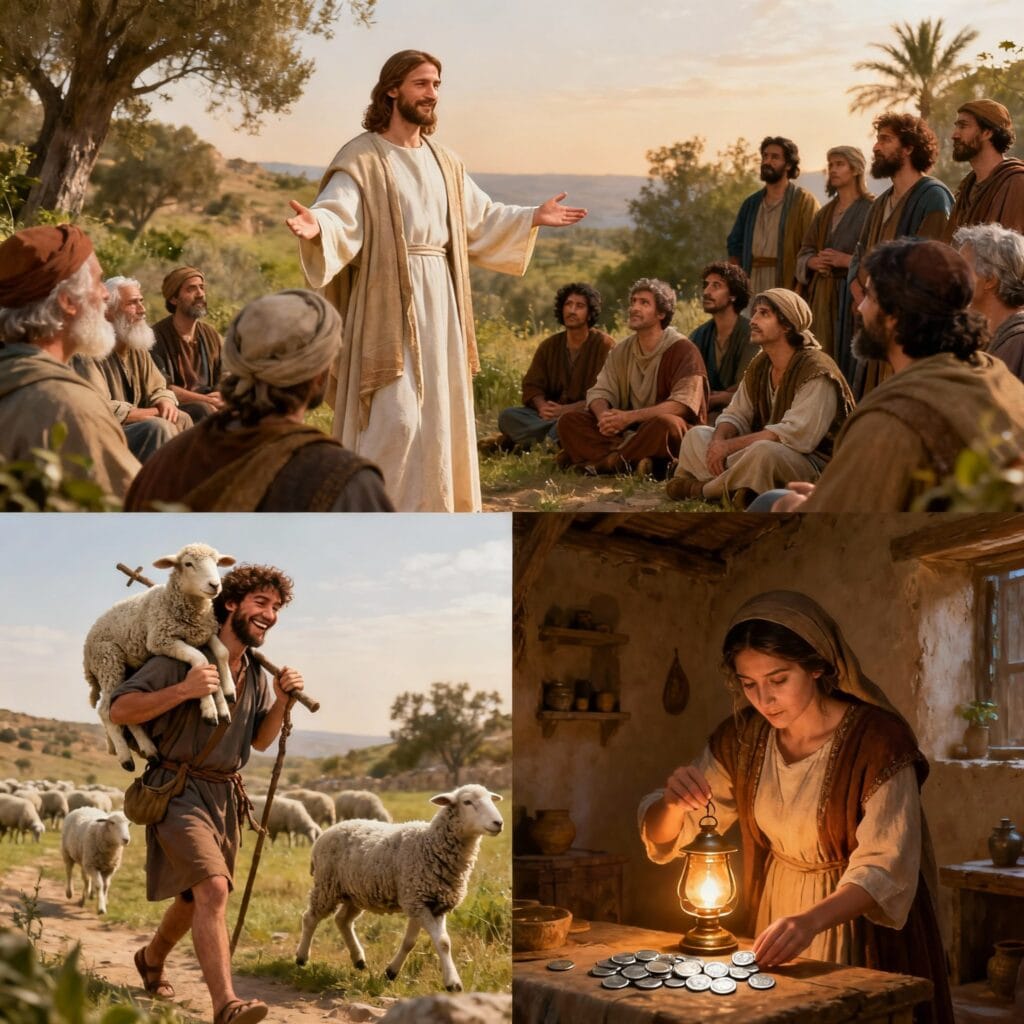
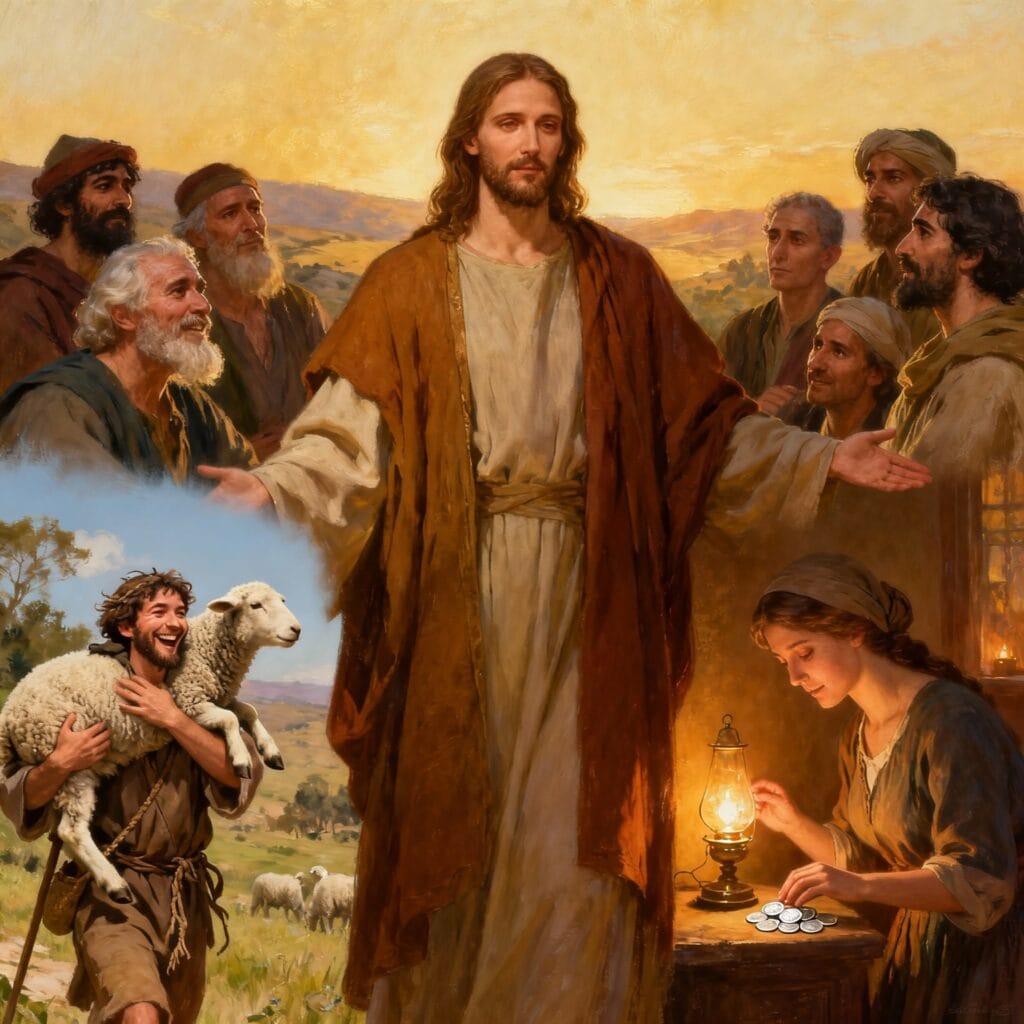
«Which of you, if you own a hundred sheep and lose one, does not leave the ninety-nine others in the field and go in search of the lost one until you find it? And when you find it, you lift it onto your shoulders, filled with joy, and when you get home, you gather your friends and neighbors and say to them, «Share my joy, for I have found my lost sheep!»”
I assure you: in the same way, there will be more joy in heaven over one sinner who repents than over ninety-nine righteous people who do not need to repent.
Or, if a woman has ten coins and loses one, does she not light a lamp, sweep her house, and search carefully until she finds it? And when she finds it, she calls together her friends and neighbors and says, «Share my joy, for I have found the coin that I had lost!»
Similarly, I assure you: there are joy among the angels "God's favor for one sinner who repents."»
Rediscovering lost joy: when God rejoices in a single return
How the parable of the lost sheep and the lost coin reveals the tender and joyful face of mercy.
Through two parables Simple yet profound, Jesus reveals to us joy God's favor to the one who has come from afar. Luke 15 This is not simply a text about conversion: it is a window onto God's tenderness and a mirror for our own relationship with Him. This article is for those who seek to understand joy Heavenly promise to every heart that rises again, believer or on the path.
- Evangelical context: a teaching born from scandal.
- Analysis : the heart of God put into a parable.
- Thematic areas: research, joy and the community reunited.
- Applications: spirituality, daily life, Church.
- Traditional and theological resonances.
- Meditation prompts and challenges of today.
- A prayer to enter into joy from the sky.
Context: a scandal of mercy
We are faced with one of the most audacious moments in the Gospel. Luke situates this passage as Jesus draws people to him the publicans and the fishermen. Those whom religious society marginalized flocked to Him. And immediately, the Pharisees murmured: «"This man welcomes sinners and eats with them!"»
This comment is not insignificant: to welcome a fisherman And sharing a meal, according to Pharisaic law, risks moral contamination. Jesus, however, reverses this logic: it is holiness that now contaminates, not impurity. In response, He tells two parables binoculars– that of the lost sheep and that of the found coin – to reveal that God never tires of searching, and that all of heaven rejoices when a single heart returns.
In this context, Luke 15 It becomes a spiritual manifesto. Loss does not mean failure: it calls for seeking. Conversion is not humiliation: it unleashes divine celebration. These pastoral and domestic images speak to everyone: they convey the closeness of a God who descends to the level of everyday life to reveal his mercy through simple gestures.
It is also a pivotal passage in the third Gospel, because Luke develops his theme of joy: each reunion becomes a liturgy, each conversion a shared celebration – an anticipation of the Kingdom.
Analysis: The Logic of God's Heart
The text is not structured around moral reasoning, but around a emotional dynamics: loss, search, reunion, celebration. Each of the parables follows this ternary rhythm. It's an emotional crescendo, where joy The finale retroactively illuminates all the pain of the loss.
The key lies in the repeated formula: «"« Rejoice with me ». God does not keep his joy to himself; he shares it. sharing. He calls upon the heavenly community to celebrate every conversion. The image of the shepherd carrying the sheep on his shoulders symbolizes the tenderness of the Savior: not a reproach, but a comfort.
From a theological point of view, conversion is not a moral reparation, but a renewed relationship. The central movement comes from GodIt is He who seeks, initiates, and bears the burden of return. This is a theology of active and joyful grace, faithful to the entire Lucan tradition. «"The Son of Man came to seek and to save what was lost."»
Research – a God who never gives up
The image of the shepherd who leaves his 99 sheep for just one overturns human common sense. All calculations of profitability disappear. God does not operate according to the logic of numbers, but according to that of relationships.
This persistent search expresses a personal love: every human being has infinite weight in the heart of God. In biblical culture, the desert evokes a place of risk, but also a place of encounter. Thus, the divine search becomes a pilgrimage of love: God exposes himself to find the one he loves.
Spiritually, this relates to our own desertions: God does not abandon our absence. He anticipates our wanderings, even before we feel the urge to return. Conversion always begins with a call received.
Joy – the celebration of heaven and heart
The word "joy" appears three times in these ten verses. It permeates the entire passage. It is neither optional nor incidental: it is revealing of divine nature. God's happiness is not static: it vibrates with the movement of salvation.
In our lives, this joy becomes a sign of inner conversion. To gladden God's heart is to learn to rejoice ourselves in the goodness of others, without jealousy or calculation. In the parable, joy Personal becomes communal: «"Gather your friends and neighbors"» said Luc. Joy It is shared in order to be complete.
The first Christians saw in it the model for the liturgy: the meal of mercyThis is already the Eucharist of return. Where God rejoices, the community is transformed.
The community rediscovered – the sky expanding
Each parable concludes with an invitation: «"« Rejoice with me. » This inclusion of the other is essential. It underscores that salvation is never solitary. Welcoming the found sinner expands the circle of communion.
In the first parable, it is the shepherd's friends; in the second, the woman's neighbors. In both cases, joy A private event becomes a public one. This is the role of the Church, called to make this heavenly joy visible on earth.
Even today, welcoming "the lost sheep" means making our community alive: a Church that seeks, liberates and consoles more than it controls.
When joy is experienced on earth
- In spiritual life: not to judge oneself as irreparable. Mercy precedes merit.
- In relationships with others: to adopt the gaze of Christ: to see the possible beauty before the past sin.
- In society: to oppose the culture of exclusion by celebrating every human recovery.
- In the Church: to make room for the celebration of forgiveness, for communities of reconciliation rather than suspicion.
In practical terms, this changes the way we pray, educate, and govern. It's less about controlling conformity than about creating opportunities for return – within families, communities, and the inner self.
Resonances: tradition, theology, and spirituality
The Church Fathers commented on this passage with profound tenderness. Saint Gregory the Great saw in the shepherd Jesus himself, in the sheep wounded humanity, and in the shoulders the cross that bears it. Benedict XVI writes that joy "From heaven, it is not euphoria but fulfilled love: the cycle of infinite giving."
In the liturgical tradition, these parables They are understood during periods of penance, but their tone remains luminous: they celebrate the victory of mercy on shame. Saint Isaac the Syrian added: "There is no fault that love "He cannot be cured, but man must accept being loved."»
Spiritually, Luke 15 founds the entire theology of joy – that of Francis of Assisi, of Thérèse of Lisieux, up to the pope Francis himself, for whom « mercy is the name of God and the face of his Church.”
Meditation prompt: walking towards joy
- Read the parable slowly and identify the moment of the reversal.
- Name your own inner "lost sheep".
- Allow yourself to be sought: imagine Christ coming to meet you.
- To taste joy to be worn.
- Giving thanks: "Rejoice with me" becomes a prayer.
- To offer this joy to someone else in turn.
Welcoming unlikely returns
Our societies struggle to celebrate reintegration. forgivenessChange. Even within the Church, we sometimes struggle to accept that a former adversary, a public sinner, a wounded brother or sister can be welcomed unconditionally. Yet, Jesus dismantles this harshness: the justice of the Kingdom does not calculate, it repairs by bringing joy.
Pastoral challenge: how to express this joy concretely? Through more inclusive liturgies, through spaces for open and honest dialogue. Inner challenge: how to avoid siding with the self-assured "99"? By rediscovering the need to be supported.
Christ does not glorify straying, but he sanctifies returning. This is the revolution of mercyShe brings celebration where we place suspicion.
Prayer: Entering into the joy of heaven
Lord Jesus, Shepherd of our souls,
you who know our lost paths,
come find us in our nights.
Pose on our shoulders gentleness of your mercy,
and restore to our steps the lightness of joy.
Make your church an open house
where the festival of forgiveness begins anew each day.
Teach us to rejoice like you,
to sing for each brother found,
and to bear together the weight of grace.
SO, joy from heaven will descend to earth,
and our hearts will become your kingdom.
Conclusion: Rebirth to the joy of return
This entire passage from Luke is a call to live mercy like a celebration. The Christian is not the one who never makes mistakes, but the one who allows himself to be found. Joy From heaven, it is God who dances because only one of us returns.
With every conversion, however small, the world expands with a new light. And what if, ultimately, our spiritual mission was simply to make God happy?
In practice
- Read again Luke 15 every week for a month.
- Write a prayer of gratitude for your own "reunion".
- Anonymously sharing an act of reconciliation.
- Celebrate a meal as a sign of forgiveness offered.
- Take a day of silence to "allow yourself to find yourself again".
- Pray for someone who is far away rather than judging them.
- Sing a hymn of joy after each confession.
References
- Gospel according to Luke, chapter 15, 1-10.
- Benedict XVI, Jesus of Nazareth, vol. 2, Paris, Parole et Silence.
- Saint Gregory the Great, Homilies on the Gospels.
- Isaac the Syrian, Ascetic discourse, 3rd century.
- Pope François, Joy of the Gospel.
- Catechism of the Catholic Church, §1439-1468.
- Saint Augustine, Confessions, Book VIII.
- Therese of Lisieux, Manuscript C, chap. 3.