












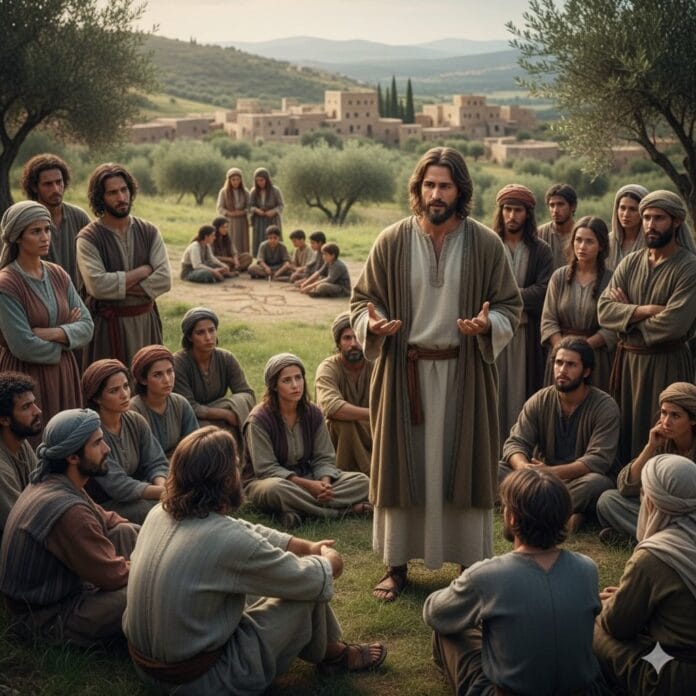
Gospel of Jesus Christ according to Saint Matthew
At that time, Jesus said to the crowds, «To what can I compare this generation? They are like children sitting in the marketplaces and calling out to one another: «We played the flute for you, and you did not dance; we sang a dirge, and you did not mourn.» For John came neither eating nor drinking, and people say, «He has a demon.» The Son of Man came eating and drinking, and people say, «Look at him! A glutton and a drunkard, a friend of tax collectors and sinners!» But wisdom is vindicated by her deeds.»
When God speaks and no one listens: the parable of the capricious children
How can we recognize the voice of God when our prejudices make us deaf to every form of his presence?.
This is a scene we all know. Children who refuse to play, no matter what game is offered. Jesus uses this everyday image to denounce the spiritual inconsistency of his contemporaries. Neither the austerity of John the Baptist nor the conviviality of the Son of Man finds favor in their eyes. This passage from Matthew 11 It challenges us on our own capacity to welcome God's calls, even when they disrupt our expectations.
In this article, we will explore first, the historical and literary context of this controversial passage (Matthew 11, (pp. 16-19), then we will analyze the dynamics of the double rejection that Jesus denounces. We will then develop three major theological themes: spiritual resistance through prejudice, the diversity of God's ways, and justification by its fruits. Finally, we will explore the concrete implications for our spiritual lives, offer a practical meditation, and address the current challenges of discernment in a pluralistic world.
The context of a confrontation: Jesus facing the criticisms of his time
This passage occurs at a pivotal moment in Jesus' ministry. John the Baptist, imprisoned by Herod Antipas, has just sent his disciples to ask Jesus, "Are you the one who is to come?" Jesus' response consists of listing the messianic signs performed (the blind seeing, the lame walking, the lepers cleansed), then paying a vibrant tribute to the Baptist: "Among those born of women there has not risen anyone greater than John the Baptist. »
But the atmosphere changes abruptly. After praising John, Jesus turns to the crowd and delivers our passage: «To what shall I compare this generation?» The tone becomes accusatory. Matthew places this speech within a sequence where Jesus expresses his growing frustration with unbelief. Immediately after our passage, he will unleash his «woes» upon the unrepentant cities (Chorazin, Bethsaida, Capernaum) that refused to convert despite his miracles.
The evangelist is writing for a Judeo-Christian community experiencing rejection. Around 80-85 AD, Jesus' disciples encountered the incomprehension of their fellow Jews who did not recognize the Messiah. Matthew preserves this saying of Jesus because it sheds light on the enigma of this rejection: how is it that God speaks and so many people do not hear?
The literary structure of the passage is remarkable. First, an introductory parable (the children in the marketplace); then, two concrete examples (John and Jesus); finally, a wisdom saying ("the wisdom of God has been found to be right"). This triptych structure mimics Jesus' pedagogical approach: image, application, theological principle.
The vocabulary chosen reveals a polemical intent. The term "generation" (genea) in the Gospel of Matthew often refers to a perverse and adulterous generation (Mt 12:39, 45; 16:4; 17:17). The "kids" (paidiois) evoke immaturity, not innocence. "To challenge" (prosphonousi) suggests loud mockery. The entire lexicon constructs an atmosphere of sterile dispute.
Matthew specifies that Jesus "declared to the crowds" (tais ochlois). For this evangelist, the crowds represent a hesitant group, neither openly hostile nor truly committed. They follow Jesus out of curiosity but balk at the demands of the Kingdom. Our passage, therefore, is addressed to these undecided people who always find a reason not to commit.
The Anatomy of a Refusal: When Objections Mask a Closed Heart
The parable of the unruly children acts as a mirror held up to the crowd. Jesus compares his listeners to children sitting in the marketplace, an emblematic place of public life in the Middle East ancient. These children play at imitating the great occasions of community life: joyous weddings and sad funerals. But their friends refuse to participate, neither in the dancing nor in the lamentations.
The image is striking in its absurdity. Children refusing to play? This defies the very nature of childhood. The refusal isn't about a particular game, but about play itself. No matter what's suggested, the answer is always no. It's this fundamental inconsistency that Jesus denounces.
The historical context follows immediately. John the Baptist embodies the ascetic prophet. He lives in the desert, wears a camel-hair garment, and feeds on locusts and wild honey. His message is somber: «You brood of vipers, who warned you to flee from the coming wrath?» He neither eats nor drinks wine. The reaction of the religious authorities? «He’s possessed!» A daimonion echei—literally, «he has a demon.».
Then came Jesus, the Son of Man. He did not shun social life. He accepted dinner invitations, frequented tax collectors, and allowed himself to be approached by the fishermen notorious. He drinks wine (his first miracle at Cana!), shares festive meals. And the reaction? "Here is a glutton and a drunkard, a friend of tax collectors and sinners." The accusation is twofold: moral (gluttony) and religious (impure associations).
Jesus thus highlights a formidable psychological mechanism: bad faith. Criticisms are not based on objective errors but on pretexts. If John fasts, he is too extreme; if Jesus feasts, he is too lax. Austerity is suspect, conviviality scandalous. Faced with two opposing paths, the objections remain identical in their function: to justify the refusal to accept God's message.
This dynamic reveals that the problem lies not with the messenger but with the receiver. The Pharisees and scribes are not truly seeking to discern the divine will; they are seeking to maintain their religious system intact, their privileges preserved, their certainties reinforced. Any novelty, whatever its form, is unsettling.
The final sentence sheds essential light on this: «But wisdom was vindicated by what she did.» The Greek uses the verb dikaioō (to justify) and the noun erga (works). Divine wisdom—embodied here by John and Jesus—is justified by its concrete fruits, not by conformity to human expectations. The blind see, the lame walk, the fishermen convert: that's the real validation.
This reversal is crucial. Jesus shifts the criterion for evaluation from style to effectiveness, from appearance to substance, from propriety to results. It matters little whether the prophet fasts or feasts, as long as the word of God bears fruit. This is a hermeneutical revolution that liberates God from our preconceived frameworks.
Prejudice as a barrier to grace
Our prejudices act like filters that distort our perception of reality. They are the opaque lenses through which we view the world, unable to see what doesn't fit our preconceived mental frameworks. In the spiritual realm, this blindness becomes tragic because it prevents us from recognizing God when He reveals Himself to us.
The Pharisees of Jesus' time had constructed a precise theology of the awaited Messiah. He was to be a Davidic king, a political liberator, a victorious warrior driving out the Romans. Their framework was so rigid that it blinded them to the radical newness of Jesus. A crucified Messiah? Impossible; it was a theological contradiction. Paul would later write: "A stumbling block to Jews and foolishness to Gentiles" (1 Corinthians 1:23).
But theological prejudices are not the sole domain of the Pharisees. Every Christian era has its blind spots. In the Middle Ages, theologians struggled to conceive that God could speak outside of Aristotelian scholasticism. In the modern era, some Catholics could not imagine that the Spirit was at work in the Protestant Reformation movements. Today, we have our own filters: sociological, ideological, and cultural.
Let's take a contemporary example. Imagine a parish community deeply attached to the traditional liturgy, to contemplative silence, to the aesthetics of the sacred. A new priest arrives who introduces rhythmic hymns, emphasizes socializing after Mass, and focuses on a warm welcome. The reactions are swift: "It's no longer sacred!", "It's like a concert!", "The liturgy is being cheapened!" But if young people return, if distant families re-engage, if charity The concrete flower blooms, isn't that a sign that the Spirit is at work?
Conversely, a highly charismatic parish may reject a contemplative priest who insists on silent adoration and the lectio divina. "Nothing is happening!", "Where is the fervor?", "We are bored!" Yet, if the faithful discover the depth of prayer, if the Word of God takes lasting root, if the interior life deepens, is not the Spirit at work?
The tragedy is that we often confuse our spiritual preferences with the will of God. We absolutize our religious sensibilities as if they were the only legitimate ones. Contemplators despise the active, the socially engaged judge ethereal mystics, traditionalists denounce progressives, and vice versa. Everyone believes they possess the "true" path and dismisses the others.
This attitude betrays a lack of faith in divine creativity. God is great enough to take many paths. He speaks in the silence of a monastery and in the hubbub of a soup kitchen. He manifests himself in the beauty of Gregorian chant and in the spontaneity of gospel music. He touches hearts through theological study and through the simple testimony of a convert. To reduce God to our own experience is to create an idol in our own image.
Prejudices also protect us from conversion. Accepting that God speaks differently than we expected means acknowledging that we may have been mistaken, that we must broaden our horizons, step outside our comfort zone. This is demanding. It is easier to discredit the messenger than to question one's own certainties. The children in the parable refuse to dance or lament because it would force them to step outside themselves, to enter into a movement that transcends them.
Saint Augustine, In his Confessions, he recounts how his philosophical prejudices prevented him from welcoming faith Christian. He found the Scriptures unworthy of a cultivated mind, the style coarse, the stories naive. It was only upon hearing Ambrose of Milan He explained the spiritual meaning of the texts, discovering their depth. His aesthetic prejudices masked his existential resistance: accepting Christ meant giving up his ambition, his relationship, his comfortable life.
Liberation begins with’humility intellectual and spiritual. Recognizing that we don't possess the whole truth, that we can be wrong, that God is greater than our categories. This humility This is not relativism – not all positions are equal. But it does imply a critical openness: honestly examining whether our objections concern substance or form, whether our rejection stems from the spiritual discernment or simply prejudice.
The plurality of paths as divine pedagogy
If God sent both John the Baptist and Jesus, it is because he recognizes the diversity of human temperaments and spiritual needs. Some people need prophetic rigor, fasting, the desert, and radical penance to convert. Others flourish more in mercy free, joy shared, fraternal closeness. God does not favor a single model but adapts his pedagogy to each soul.
This diversity is not a concession to human weakness but a richness willed by God. Paul will express this magnificently in his metaphor of the body: «There are different kinds of spiritual gifts, but the same Spirit distributes them. There are different kinds of service, but the same Lord. There are different kinds of working, but in all of them and in everyone it is the same God who works.»1 Corinthians 12,4-6). Each member has its function, and all are necessary.
The history of Christian spirituality illustrates this plurality. The first hermits of the Egyptian desert (3rd-4th centuries) embodied the ascetic path: solitude, silence, spiritual struggle, and extreme privations. Anthony the Great spent twenty years alone in an abandoned tomb. Pachomius founded cenobitic communities where everything was regulated, from sunrise to sunset. These monks attracted thousands of disciples seeking radicalism.
But simultaneously, the Church was developing other models. Basil of Caesarea favored a monastic life integrated into the city, at service to the poor. He created hospices, orphanages, and other structures for charity. For him, the real holiness He does not flee the world but transfigures it through concrete love. His monastery resembles a social enterprise more than a solitary desert.
In the Middle Ages, this diversity intensified. The Benedictines offered a balanced spirituality: ora et labora, liturgical prayer and manual labor, stability and hospitality. The Cistercians radicalized austerity with their return to contemplative practices. The Franciscans chose poverty joyful and itinerant evangelical life. The Dominicans dedicate themselves to preaching and theological study. Each spiritual family responds to a need of the Church and attracts different temperaments.
In modern times, foundations multiplied: Jesuit missionaries and educators, contemplative Carmelites, Salesian teachers, Vincentians in service to the poor, Little Sisters of the Poor, caring for the elderly. Each charism expresses a facet of the mystery of Christ. Jesus is at once the contemplative who spends his nights in prayer, the teacher who preaches on the mountain, the miracle worker who heals. the sick, the friend who shares the meal of sinners.
This plurality raises a theological question: why doesn't God reveal a single, clear, and indisputable path? Wouldn't that be simpler? The answer lies in the very nature of divine love. God doesn't want spiritual clones but free individuals who respond to his call according to their irreducible uniqueness. He infinitely respects the diversity of his creatures.
Furthermore, the diversity of paths prevents the absolutization of a single model. If the austerity of John the Baptist was the only legitimate path, the Christianity would become an overwhelming rigidity. If Jesus's friendliness were the only valid approach, it would risk veering into laxity. The tension between the two poles maintains the balance: demandingness and mercy, justice and tenderness, conversion and consolation.
In practical terms, this means that there is no "one size fits all" when it comes to spirituality. A young adult brimming with energy might find their path in missionary work with underprivileged youth. A mother exhausted by daily life might discover grace in five minutes of silent prayer before the tabernacle. An intellectual might find nourishment in the lectio divina and patristic theology. An artist will praise God through created beauty.
The Church has always resisted attempts at uniform reduction. When certain medieval movements (Cathars, Waldensian rigorists) sought to impose a poverty absolute to all Christians, Rome defended the legitimacy of Christian life in the world. When quietists promoted passive detachment as the only true holiness, The Church has reaffirmed the value of action and commitment. The Magisterium protects diversity against spiritual totalitarianism.
This understanding transforms our relationship with other believers. Instead of judging those who do not pray as we do, we can recognize another legitimate expression of faith. The contemplative person is not better than the socially engaged person, nor vice versa. Each responds to their own vocation. Ecclesial communion is not born of uniformity but of unity in diversity, like an orchestra where each instrument plays its part to form a symphony.
Justification by the fruits, the ultimate criterion for discernment
«The wisdom of God has been proven right by what she has done.» This statement by Jesus establishes a fundamental principle of spiritual discernment It is by its fruits that the tree is recognized. Not by appearances, declarations of intent or outward forms, but by concrete results, effective transformations, works of life.
Jesus himself had already formulated this criterion in the Sermon on the Mount: «Beware of false prophets, who come to you in sheep’s clothing but inwardly are ravenous wolves. By their fruits you will recognize them. Are grapes gathered from thornbushes, or figs from thistles? Every good tree bears good fruit, but a rotten tree bears bad fruit.»Mt 7,15-17).
But what are these fruits that authenticate the presence of God? Paul lists them in the letter to the Galatians: «The fruit of the Spirit is love, joy, peace, patience, kindness, kindness, loyalty, gentleness And self-control »"(Gal 5:22-23). These fruits are relational and internal. They transform the heart and radiate into behaviors.".
Let's apply this to John the Baptist and Jesus. Despite criticism, their ministries bore undeniable fruit. John baptized crowds in the Jordan, sparked a national movement of repentance, and prepared the way for the Messiah. Even Jesus recognized his immense prophetic stature. His extreme asceticism was irrelevant: hearts were converted, consciences were awakened, and the people prepared to welcome the Kingdom.
Jesus, for his part, multiplies the signs of God's saving presence. The blind regain their sight, the deaf hear, lepers are cleansed, and the paralyzed walk. But even more: the fishermen They convert. Zacchaeus, the cooperating tax collector, promises to return four times what he stole. The adulterous woman leaves without condemnation but with the exhortation: "Go, and from now on sin no more." The fruits of conversion abound.
The criterion of fruits frees discernment from two symmetrical traps. On the one hand, formalism judges everything based on the apparent orthodoxy of outward forms. A priest can celebrate Mass with perfect rubric precision while despising his parishioners and living in pride. Conversely, someone can improvise a liturgy that is not entirely conventional but radiate authenticity. charity. Where is true worship pleasing to God?
On the other hand, there's sentimentality, which is content with fleeting emotions. One can weep with emotion during a celebration, feel "touched by God," without it changing anything in one's daily life. The true fruits are not mystical thrills but lasting transformations: more patience with one's spouse, more generosity toward others. the poor, more truth in his words, more forgiveness towards offenders.
Church history offers edifying examples of this discernment by fruits. In the 13th century, François Assisi deeply disturbs the clergy by its poverty radical and itinerant preaching. Many suspect him of heresy. But the pope Innocent III, a prudent man, observed the results: thousands of young people converted, peace spreads through war-torn cities, joy The evangelical movement shines brightly. He approves of the Franciscan Rule. The results have spoken louder than the suspicions.
In the 16th century, Ignatius of Loyola He underwent multiple interrogations by the Spanish Inquisition. His method of Spiritual Exercises, his emphasis on personal discernment, and his rejection of traditional monastic garb worried the authorities. But his disciples converted thousands of people, founded colleges that became intellectual beacons, and evangelized the Japan and Latin America. Finally, the Church approved and encouraged the Society of Jesus. The fruits had overcome the prejudices.
Conversely, some initially promising movements prove toxic when their results are examined. Charismatic communities flourish with enthusiasm, attracting fervent young people and multiplying healings and conversions. Then, gradually, cult-like practices are discovered: psychological control by the founders, spiritual abuse, manipulation of consciences, and exclusion of those who doubt. The fruits prove bitter: divisions, trauma, and apostasy. The tree was rotten despite the beautiful appearance.
The fruit criterion requires time and patience. We don't judge a tree by its spring buds but by its autumn harvest. A spiritual movement may spark initial enthusiasm that quickly fades. Other initiatives may seem timid at first but bear lasting fruit over the long term. Only a long-term perspective allows for true discernment.
This evangelical criterion also resonates with universal wisdom. Buddhism teaches that the value of a practice is measured by the peace it brings and by compassion which it develops. Talmudic Judaism insists: "It is not the study that counts but the practice." All the great spiritual traditions converge on this wisdom: the tree is judged by its fruits, not by its pronouncements.
Living spiritual openness in everyday life
How can we translate this Gospel lesson into our ordinary lives? The call to spiritual openness manifests itself in several spheres of our existence, each offering concrete opportunities for growth.
In the life of personal prayer, Let us accept that our relationship with God evolves and changes form. Perhaps we have long prayed with learned formulas, and now these words ring hollow. Instead of forcing ourselves or feeling guilty, let us dare to explore other paths: silent prayer, contemplation of nature, meditation on icons, listening to spiritual songs. God awaits us in these new forms as in the old. He is not offended that we change our approach; he rejoices that we seek him sincerely.
In family life, recognize that each member can live their faith differently. One spouse may need daily Mass while the other is more nourished by the lectio divina Weekly. A teenager feels called to serve in a charity rather than participate in the family prayer group. Instead of imposing a single model, let's celebrate the diversity of vocations under the same roof. Family unity does not require spiritual uniformity but mutual respect and support.
In parish life, Resist the temptation of "things were better before" or "everything must be modernized." Welcome both those nourished by Gregorian chant and those moved by contemporary hymns. Offer Alpha courses for seekers of God alongside lectio divina groups for contemplatives. Create spaces for social engagement and for the adoration of the Blessed Sacrament. A vibrant parish is like a banquet where everyone finds their spiritual bread, not a restaurant where everyone eats the same dish.
In our relations with non-believers, Let's abandon hasty judgments. Someone claims not to believe in God but dedicates their life to serving the homeless. Another attends church every Sunday but exploits its employees. Who is closer to the Kingdom? Jesus shocked the religious leaders by saying, "The tax collectors and prostitutes are entering the kingdom of God ahead of you" (Matthew 21:31). The fruits matter more than the labels.
Compared to other Christian denominations, to overcome exclusionary reflexes. Does a Protestant who reads the Bible daily and lives an exemplary missionary life bear less fruit than a Catholic who only practices sociologically? An Orthodox Christian who prays the rosary And is not rigorous fasting in spiritual communion with us despite institutional divisions? Recognizing the action of the Spirit wherever the fruits of the Gospel are manifested, while ardently desiring visible unity.
In our professional and social life choices, dare to take unusual paths if the fruits of the Spirit are found there. Why couldn't a Christian serve God as a night nurse, actor, chef, or gardener? If these professions bear fruits of love, service, beauty, or life, are they not legitimate vocations? Let's stop valuing only "Church professions" and recognize the holiness possible in any activity carried out with awareness and love.
In practical terms, let's regularly ask ourselves these questions: Do I allow my spiritual preferences to become prejudices against other forms of faith? Do I tend to criticize those who don't pray like me, who don't engage in the same works, who express their faith differently? When I encounter something new in the Church, is my first reaction to look for the fruits or to condemn the form?
The exercise of discernment then becomes a daily practice. Faced with every ecclesial reality that disturbs me, I pause and ask: «What fruits does this bear?» If the fruits are good—more love, joy, peace, sincere conversions—then perhaps my discomfort reveals my own limitations rather than an objective error. If the fruits are bad—division, pride, lies, suffering—then my criticism is justified and must be expressed with charity but firmness.
The Patristic Roots and Theological Scope of Discernment
The Church Fathers deeply pondered this question of the double rejection and of spiritual discernment. John Chrysostom, in his homilies on Matthew, emphasizes the absurdity of the behavior denounced by Jesus: "They accuse John of having a demon because he fasts, and they accuse Christ of gluttony because he does not fast. Do you see their malice? They are not seeking the truth but a pretext to reject."«
Chrysostom insists that this attitude reveals a spiritual sickness: a hardening of the heart. «When someone absolutely refuses to believe, they always find objections. But those who sincerely seek the truth recognize the light regardless of the lamp that carries it.» For the Patriarch of Constantinople, the problem is not intellectual but moral. The Pharisees have willfully closed their hearts.
Augustine of Hippo, in his sermons, develops the notion of "wisdom justified by its children." He understands the "children" of wisdom to include the saints, the prophets, all those who have borne fruit. "John and Jesus are children of divine wisdom. Through their different but converging works, they manifest the same truth: God saves." Augustine sees in this diversity a divine pedagogy that adapts the message to the variety of souls.
Saint Thomas Aquinas, commenting on this passage in his Catena Aurea (Golden Chain of Patristic Commentaries), highlights a principle of theological discernment: «Divine truth is not bound to a single expression. It manifests itself in multiple ways according to times, places, and people. What matters is not the uniformity of the means but the unity of the end: to lead souls to God.»
This theology of the diversity of paths is rooted in the doctrine of Providence. God, in his infinite wisdom, orders all things toward the good, but he does so while respecting secondary causes and human freedom. He does not manipulate events like a puppeteer but guides them with a subtlety that leaves created contingency intact. Similarly, he does not impose a single spiritual path but fosters a multiplicity of vocations that converge toward the one thing necessary.
The mystical tradition deepens this intuition. John of the Cross distinguishes between "nights of the senses" and "nights of the spirit", showing that God purifies each soul according to a unique path. Teresa of Avila, In The Interior Castle, he describes seven successive dwellings but specifies that "God does not lead all souls by the same path.". Ignatius of Loyola develops a whole art of discerning spirits based on the observation of inner movements and their fruits.
Theologically, this passage of Matthew 11 This raises the question of recognizing revelation. How do we know that God speaks? Karl Rahner, in his theological anthropology, speaks of a "transcendental openness" of the human being to the Absolute. Each person carries within them an infinite longing that only God can fulfill. But this longing manifests itself in infinitely varied ways. Some experience it as a mystical thirst, others as a hunger for justice, and still others as a need for meaning. God responds to this multifaceted longing with a revelation that is itself plural.
In his theology of beauty, Hans Urs von Balthasar adds that the glory of God is manifested in the "form" (Gestalt) that revelation takes. But this form can never be reduced to a single expression. Christ himself presents multiple faces in the Gospels: miracle worker in Mark, teacher in Matthew, friend of sinners in Luke, and the Incarnate Word in John. Each evangelist offers a different "form" of the same Christian revelation. To claim to reduce Christ to just one of these forms would be to impoverish the mystery.
In contemporary ecclesiology, this diversity is reflected in the notion of "legitimate diversity" defended by Vatican II. The decree Unitatis Redintegratio recognizes the "legitimate variety" of liturgical and theological traditions within the Church. Lumen Gentium celebrates the diversity of charisms and ministries. The Council rejects uniformity and values the richness of catholicity—in the etymological sense of universality—which encompasses all cultures, all sensibilities, and all temperaments.
This theological significance transforms our understanding of the Church itself. The Church is not a club of spiritual uniforms but the mystical body of Christ where each member has their own specific function. It is not an army where everyone marches in step but a family where each person makes their unique contribution. It is not a mold that shapes everyone but a matrix that gives birth to infinitely diverse saints.
A practical meditation in three movements
To internalize this Word and allow it to transform our perspective, let us suggest a structured three-part meditative exercise. It can be practiced for about fifteen minutes, in a quiet place, at the beginning or end of the day.
First step: recognizing my closures. Sitting comfortably, I breathe calmly for a few moments. Then I slowly reread the Gospel passage, letting Jesus' question resonate within me: "To whom shall I compare this generation?" I honestly ask myself: In my spiritual life, what are the "flutes" I refuse to dance to? What invitations from God have I rejected because they didn't fit my preconceived notions? I note these resistances mentally or in writing, without judgment but with clarity.
Perhaps I rejected an invitation to a prayer group because "it's not my style." Perhaps I ignored a call to get involved in charity work because "I prefer contemplation." Perhaps I criticized a new liturgical form without even experiencing it. I allow these memories, these resistances, to surface, asking the Spirit to enlighten me about my own hardening of heart.
Second movement: embracing divine diversity. I now meditate on the phrase: «John came, he neither ate nor drank… The Son of Man came, he ate and drank.» I contemplate this diversity willed by God. I imagine John in the desert, austere, prophetic, his powerful voice calling for conversion. Then I imagine Jesus at table with Zacchaeus, sharing bread and wine, perhaps laughing, creating a joyful communion.
I realize that these two opposing attitudes come from the same Father, express the same love, and pursue the same goal. I ask myself: In my own life, which "John the Baptists" should I recognize? Which "Jesus" should I welcome? Perhaps I need austerity in some areas (discipline of prayer, fasting, silence) and conviviality in others (sharing with the poor, (community joy, celebrations). I let God show me the balance necessary for my growth.
Third movement: opening oneself to the fruits. I conclude by turning to the "fruits of the Spirit": love, joy, peace, patience, kindness, goodness, faithfulness, gentleness, and self-control. I ask the Lord, "In my daily life, what fruit do you want to see grow more fully?" Perhaps I need more patience in my family relationships. Perhaps there is a lack of joy in my Christian commitment, which has become burdensome and sorrowful. Perhaps I need to cultivate more gentleness in my judgments of others.
I then formulate a simple and concrete intention for the coming week. For example: «This week, when I see an expression of faith different from my own, instead of criticizing, I will look for the fruit of the Spirit it bears.» Or: «This week, I will experience a new form of prayer for myself, with an open heart.» I entrust this intention to God in a spontaneous prayer.
This meditation can become a regular appointment, an exercise in discernment and openness that gradually softens our spiritual rigidities and expands our capacity to receive God's multifaceted grace.
Facing current challenges: pluralism and discernment
Our era presents believers with unprecedented challenges in terms of spiritual discernment. Religious and spiritual pluralism has reached an unprecedented intensity. In our Western cities, Catholicism, Protestantism, and Orthodoxy coexist., Islam, Buddhism, Hinduism, New Age movements, militant atheism, quiet agnosticism. How to discern without falling into either soft relativism ("everything is equal") or closed fundamentalism ("everything is false except us")?
Contemporary spiritual relativism asserts: «Everyone has their own truth, all paths are equal, the important thing is to be sincere.» This position, seductive in its apparent tolerance, ultimately denies the very possibility of truth. If all contradictory statements are equally true, then none are true. Jesus cannot be both God incarnate (Christianity) and just another prophet (Islam), an avatar of Vishnu (Hinduism) and a mythological invention (atheism).
Faced with this challenge, our Gospel passage offers a valuable key: the criterion of fruits. Without abandoning the affirmations of truth (Jesus is indeed the Son of God, who died and rose again for the salvation of the world), we can honestly recognize that the Spirit blows where it wills and that authentic fruits of goodness, compassion, and sacrifice can be found outside the visible boundaries of the Church. Vatican He affirms this in Lumen Gentium: "Those who, through no fault of their own, are ignorant of the Gospel of Christ and his Church, but nevertheless seek God with a sincere heart and strive, under the influence of his grace, to act in such a way as to fulfill his will as their conscience reveals and dictates it to them, they too can attain eternal salvation."«
Another contemporary challenge is the proliferation of "alternative spiritualities": mindfulness meditation detached from its Buddhist roots, Westernized yoga, personal development tinged with positive psychology, and the quest for "well-being" and "personal fulfillment." How can we assess these phenomena? Here again, let's look at the results. A secular meditation practice that helps someone overcome anxiety and live more serenely bears real fruit in terms of peace. But if this same practice traps the person in an even more self-centered ego, without openness to others or to the transcendent, the result becomes ambiguous.
Christian discernment does not demonize these practices but evaluates them with nuance. It recognizes that certain techniques (breathing exercises, concentration, mindfulness) are neutral in themselves and can be integrated into an authentic Christian practice. However, it maintains a critical vigilance: any spirituality that eliminates the dimension of sin, salvation, grace, and conversion risks becoming a tool for psychological comfort without real transformation.
A third challenge is hypercommunication digital. Social media amplifies extremist voices, creates echo chambers where individuals only encounter opinions that confirm their own, and facilitates hasty judgments and public condemnations. In this context, how can we practice patient, nuanced discernment, attentive to long-term benefits?
The evangelical wisdom of "by their fruits you will know them" requires time, depth, and duration. However, the digital world It operates on immediacy, clicks, and instant judgment. Someone says something clumsy, and within hours they are "cancelled," judged, condemned, without appeal or nuance. This logic is the exact opposite of evangelical discernment, which patiently observes the fruits over time.
Christians are called upon to resist this culture of snap judgment. Before sharing a viral critique of a priest, a bishop, or a church movement, let us ask ourselves: «Have I checked the facts? Have I looked at the whole of this person’s life and ministry? Have I sought the real fruits of their actions?» Often, we will discover that reality is more complex than the accusatory tweet suggested.
Finally, there is an internal challenge within the Church: the temptation to make our spiritual sensitivities absolute criteria for judgment. The "traditionalists" and the "progressives" regard each other with suspicion, each convinced that the other is betraying the Gospel. This sterile polarization overlooks the lesson of our passage: God can speak through John and through Jesus, through austerity and through conviviality, through tradition and through renewal.
The answer is not ecclesiastical relativism where all practices are equally valid. Objectively, some liturgies are more beautiful than others, some theologies more just, some pastoral practices more fruitful. But this evaluation must be based on the criterion of results, not on our aesthetic or ideological preferences. A "well-said" Mass that converts no one bears less fruit than an imperfect celebration that ignites hearts and inspires vocations.
Prayer for opening the heart
Inspired by the psalms of calling and opening collects, this prayer can be used at the beginning of a celebration or during a personal time of prayer.
God, creator of all things.,
you who made day and night,
the scorching summer and the icy winter,
the storm and the calm,
teach us to recognize your presence
in all seasons of our lives.
You sent John into the desert,
dressed in camel hair, fed on grasshoppers,
a prophet of fire who cried out: "Repent!"«
And you sent your only Son,
who shared the bread with the fishermen,
who drank the wine at the wedding,
which welcomed children and outcasts.
Two such different paths,
two such contrasting voices,
And yet, only one message of love.,
a single will for salvation.
Lord, forgive us our hasty judgments,
our easy criticisms,
our heart's closures.
How many times have we said:
«"That's not how you should pray.",
«"That's not how you should serve.",
«"That's not how God speaks?"
How many times have we refused to dance?
when you played the flute,
refused to lament
When you sang the ballads?
Open our hearts, Lord.,
as the sky embraces the horizon.
Open our eyes to see your works
even where we least expected them.
Deliver us from our prejudices,
of our narrow certainties,
of our judgments that imprison rather than liberate.
Grant us true discernment,
He who recognizes the tree by its fruit,
no to the appearance of its bark.
That we may know how to see in the contemplative
and in social activism,
in the traditionalist
and in the innovative,
in the silent mystic
and in the noisy prophet,
the many faces of your one and only love.
Grant us the grace of’humility
to recognize that we do not possess the whole truth,
May your Spirit blow where it wills,
that your wisdom far surpasses ours.
Make us sincere seekers of your will,
no, merciless judges of our brothers.
May our disagreements be fruitful rather than destructive.,
our debates should be constructive rather than divisive.,
Our differences are enriching rather than exclusionary.
Through Jesus Christ, your Son,
who reconciled within himself the demanding and mercy,
justice and tenderness,
the truth and compassion,
and which calls us to be one body
in the diversity of its members.
With Married, who knew how to welcome the unexpected,
who carried within her the Wholly Other,
who accepted not understanding everything
but to keep everything in one's heart,
we pray to you:
Make us docile to your Word,
attentive to your signs,
open to your surprises,
available at your mercy.
Thy Kingdom come,
No, according to our narrow plans.
but according to your immense will.
Thy will be done.,
no, according to our limited preferences
but according to your infinite wisdom.
Give us today
the bread of the opening of the heart,
the bread of the’humility true,
the bread of right discernment.
And deliver us from evil
of the closure,
spiritual pride,
of destructive judgment.
Because it is to you that they belong
The Kingdom, the power, and the glory,
in all the paths you trace,
in every voice you raise,
in every heart you touch,
for ever and ever.
Amen.
Becoming instruments of openness
Jesus' teaching on capricious children leaves us with a crucial question: will we be among those who always find an excuse not to accept grace, or among those who recognize God's wisdom through its many forms? Our answer to this question determines our true capacity to live the Gospel in all its radicality and breadth.
We explored how our prejudices act as barriers, preventing us from recognizing God when he comes to us in unexpected ways. We meditated on God's willed plurality, this diversity of spiritual paths that reflects God's infinite creativity and respects the uniqueness of each person. We established the fundamental Gospel criterion: a tree is known by its fruit, not by its outward appearance.
This journey is not merely intellectual. It engages our entire existence. To live according to this teaching is to accept daily being destabilized, surprised, disturbed by God. It is to renounce the idea of comfortably placing Him within our reassuring categories. It is to consent to the adventure of faith like a march towards a horizon that is constantly receding, rather than like settling into a fixed certainty.
The call to action is clear. In the coming days, we are invited to practice concrete spiritual openness. Identify our resistances, name them honestly, and offer them to God so that He may transform them. Experience a form of prayer, commitment, or celebration that takes us out of our comfort zone. Observe with kindness the fruits that follow. faith of others, even when their path differs radically from ours.
This openness is not naive. It does not dispense with critical discernment, rigorous evaluation, or informed judgment. But it radically changes our stance: we move from the judge who condemns to the researcher who questions, from the censor who excludes to the brother who accompanies, from the possessor of truth to the pilgrim who advances in the’humility.
The Church needs this collective shift in perspective. In a fragmented, polarized world, where everyone is entrenched in their positions and demonizes their opponent, Christians can bear witness to another logic: that of unity in diversity, of communion in plurality, of truth which is enriched by dialogue rather than becoming fixed in monologue.
Concrete actions for the week
- Identify a form of Christian expression that I tend to criticize and honestly learn about its benefits before judging it.
- Reading the testimony or biography of a saint whose spirituality differs radically from my own allows me to discover the richness of another path.
- I practice an exercise of discerning the fruits in my own life: noting the times when I am actually bearing the fruits of the Spirit and those when I am far from it.
- Engaging in a respectful conversation with someone whose religious practice puzzles me, seeking to understand rather than convince
- Participating in a parish celebration or activity different from my usual routine to experience concrete openness
- To examine my judgments about other Christians (traditionalists, progressives, charismatics, etc.) and ask forgiveness for my hardness of heart
- Choosing a reading from the Church Fathers or a mystic can deepen one's understanding of the diversity of spiritual paths.
References
Augustine of Hippo, Sermons on the Gospel of Matthew, particularly the comment from Matthew 11,16-19 on wisdom justified by his children.
John Chrysostom, Homilies on the Gospel of Matthew, homily 37, detailed analysis of the parable of the capricious children and the double rejection.
Thomas Aquinas, Catena Aurea, patristic compilation commenting Matthew 11,16-19 with the main traditional interpretations.
Second Vatican Council, Lumen Gentium (Dogmatic Constitution on the Church), No. 16, on the action of the Spirit outside the visible boundaries of the Church.
Ignatius of Loyola, Spiritual exercises, «Rules for the Discernment of Spirits», foundation of Christian discernment by the inner fruits.
Hans Urs von Balthasar, Glory and the Cross, volume I, on the diversity of the "forms" of divine revelation in history.
Karl Rahner, Fundamental Treatise of faith, chapter on the "transcendental openness" of man to God and its multiple expressions.
Paul Beauchamp, Both Testaments, volume II, on the relationship between the diversity of biblical figures and the one Word of God.