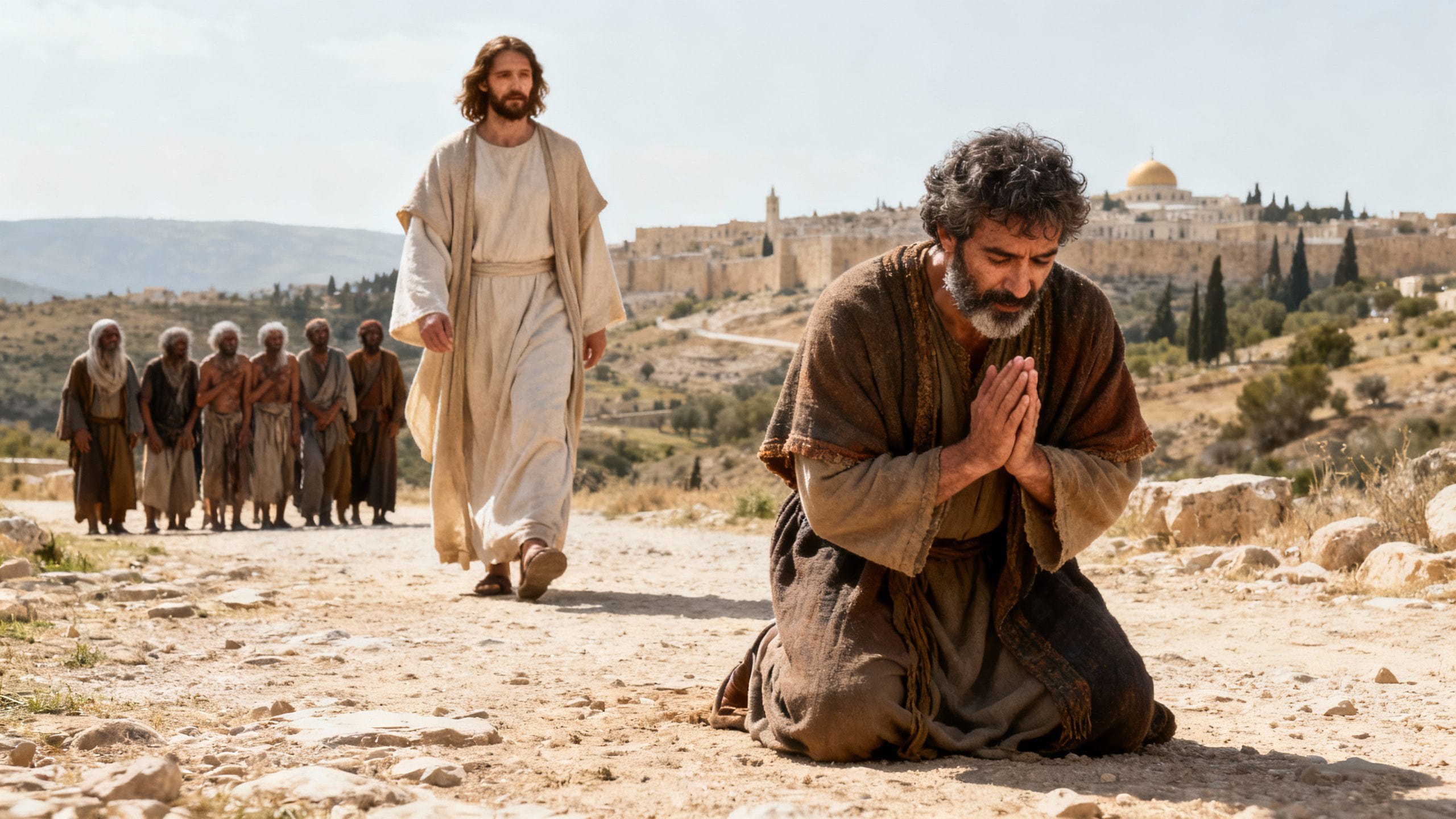


- The context of a celebration and a rift: situating John 10:31-42
- The logic of blasphemy: why the stones?
- Works of art as proof: seeing is believing
- «The Father is in me and I in the Father»: perichoresis as a horizon
- Flight and return: the pedagogy of the moment
- Practical applications
- In personal life: do not flee from confrontation, but face it with truth.
- In community and church life: deeds before words
- In intellectual and spiritual life: do not confuse the defense of God with the fear of change
- What the Fathers and theologians heard
- Cyril of Alexandria and the unity of nature
- Augustine of Hippo: The Stones of Blindness
- Thomas Aquinas and the scriptural reasoning of Jesus
- The ecclesial scope: the Church as the Body sent
- Sit down with the text in five steps
- Current challenges
- The challenge of religious violence
- The challenge of contemporary relativism
- The challenge of indifferent secularism
- The question of Jewish and Christian identity
- Adoration before the Word sent
- Stones fall, but faith remains.
- Practices
- References
- Lectio divina
- ✝ Biblical references
Gospel of Jesus Christ according to Saint John

31The Jews again picked up stones to stone him. 32Jesus said to them, «I have done many good works in your sight, which came from my Father; for which of these works are you going to stone me?» 33The Jews answered him, «We are not stoning you for any good work, but for blasphemy, and because, being a man, you claim to be God, 34Jesus answered them, «Is it not written in your Law, 'I said, you are gods?'‘ 35If the Law calls those to whom the word of God came "gods," and if Scripture cannot be broken, 36How can you say to the one whom the Father sanctified and sent into the world, "You are blaspheming because I said, 'I am the Son of God'?"" 37If I do not do the works of my Father, do not believe me. 38But if I do them, even if you do not believe me, believe the works themselves, so that you may know and understand that the Father is in me and I am in the Father.» 39Thereupon they again tried to sixteen him, but he escaped from their grasp. 40He returned across the Jordan to the place where John had begun to baptize, and he stayed there. 41Many came to him, saying, "John performed no miracles, but everything he said about this man was true."" 42And there were many there who believed in him.
At that time, the Jewish authorities again picked up stones to stone Jesus. He said to them, «I have shown you many good works from the Father. For which of these works are you going to stone me?» They answered him, «We are not going to stone you for any good work, but for blasphemy, because you are a man, and you claim to be God.» Jesus answered them, «Is it not written in your Law, «I said, »You are gods«»? If the Law calls those to whom the word of God came «gods»—and Scripture cannot be broken—how can you say that I, whom the Father consecrated and sent into the world, am blaspheming by saying, »I am the Son of God«? If I am not doing the works of my Father, do not believe me. But if I do them, even if you do not believe me, believe at least the works themselves.» "This is how you will know that the Father is in me and I am in the Father." Again they tried to arrest him, but he escaped. He went back across the Jordan to the place where John had first baptized, and he stayed there. Many people came to him, saying, "John performed no miracles, but everything he said about this man was true." And there many believed in him.


Escaping violence, remaining in the truth: the mystery of Jesus in the face of his adversaries
When stoning reveals a profound misunderstanding of the identity of the Son of God, and how this confrontation invites us today to choose between works and prejudices
John 10:31-42 is one of the most intense, dense, and revealing passages in the entire Gospel of John. In just a few verses, an attempted stoning, a decisive scriptural argument, a mysterious escape, and a return to the origins of baptism unfold with the relentless logic of a drama drawing to its conclusion. This article is for anyone who wants to understand not only what Jesus says about himself, but also why this affirmation of identity still disturbs us today, and how it liberates those who choose to believe it.
This message unfolds in three complementary movements. First, confrontation: Jesus faces adversaries determined to stone him, and he responds not with immediate flight, but with his Word and his works. Second, argumentation: he turns Scripture against his accusers, not to win a debate, but to open a door. Finally, the journey: he leaves Jerusalem, returns to Bethany beyond the Jordan, and there, where John had baptized, many believe. Violence does not have the last word. Faith endures.

The context of a celebration and a rift: situating John 10:31-42
The Feast of the Dedication and Solomon's Portico
To understand this passage, it is essential to place the scene within its liturgical and geographical context. John specifies, in verse 22 of the same chapter, that we are in Jerusalem, in winter, during the Feast of Dedication—Hanukkah in Hebrew—which commemorates the rededication of the Temple by the Maccabees in 164 BC, after its desecration by Antiochus IV Epiphanes. This is not a trivial detail. This festival celebrates Israel's resistance against a foreign power that had dared to defile the holy place, install an idol in the sanctuary, and force the faithful to apostatize. In this context, Jesus is walking under Solomon's Portico, a majestic colonnade that ran along the eastern facade of the Temple. It is there that the religious leaders question him: «How long will you keep us in suspense? If you are the Messiah, tell us plainly.» (John 10:24)

Jesus' response is thunderous in its intensity: he declares that his sheep listen to him, that he gives them eternal life, that no one can snatch them from the Father's hand—and he adds this explosive phrase: "I and the Father are one." (John 10:30) The Jews—a Johannine term here referring to hostile religious leaders, not the Jewish people as a whole—pick up stones. Our passage begins with this gesture.
The dramatic intensity of the scene must be grasped. The stoning was not a spontaneous riot. It was a legal procedure prescribed by the Torah for the crime of blasphemy (Leviticus 24:16). In wanting to stone Jesus, his adversaries believed they were acting in strict accordance with the Law. This fundamental misunderstanding—believing they were defending God by opposing his Son—lies at the heart of this passage and the entire Johannine tragedy. John read this paradox with painful clarity, he who understood after the Resurrection what most had failed to see at the time.
You might like...

The literary structure of the passage
The text of John 10:31-42 is structured around four distinct micro-scenes. The first (vv. 31-33): an attempted stoning and a dialogue about blasphemy. The second (vv. 34-38): Jesus' scriptural argument, based on Psalm 82. The third (v. 39): another attempt at arrest and the flight. The fourth (vv. 40-42): the return to the Jordan, the memory of John the Baptist, and the faith of many. This progression is not accidental. It mirrors the broader movement of the Gospel of John: the journey to the Cross involves successive retreats and circumvented confrontations, until the moment when Jesus himself chooses to no longer flee.
The logic of blasphemy: why the stones?
When the Law becomes a prison for the Truth
The dialogue that begins in verse 32 is characterized by Johannine irony. Jesus poses the question with disarming calm: «I have shown you many good works from the Father. For which of these works do you want to stone me?» His adversaries« response is perfectly logical within their system of thought: »It is not for a good work that we want to stone you, but for blasphemy: you are only a man, and you claim to be God.”
This is the accusation, formulated with precision. It rests on a premise that every theologian must take seriously: the absolute monotheism of Israel. There is only one God, and this one God shares his glory with no one (Isaiah 42:8). For a man—be he a miracle worker, be he a prophet—to claim divine identity is, from this perspective, the ultimate transgression. Their stones are not stones of gratuitous hatred. They are stones of conviction, and that is what makes them so difficult to remove.
This point deserves careful consideration. One of the common errors in the Christian reading of this passage is to reduce Jesus' adversaries to malicious bigots. John himself does not do this. He presents men who believe they are defending God's honor. And it is precisely because they believe they are doing the right thing that they are so far from the mark. Sincerity is not enough when the interpretive framework is inadequate. This is a lesson in epistemic humility that the Gospel offers to every believer throughout history.
The argument of Psalm 82: a bold scriptural response
Jesus' response is one of the most subtle and controversial in the entire New Testament. He quotes Psalm 82, verse 6: "I said, 'You are gods.'" This psalm is a strange and fascinating text, in which God presides over a divine assembly and addresses beings—judges, angels, representatives of the people—calling them "elohim," a Hebrew term that normally refers to God himself. The psalm then says that they will die like men, implying that they have been given extraordinary dignity but have misused it.
Jesus' argument works in two parts. First, if Scripture itself calls "gods" those humans to whom the Word of God was addressed—and Scripture cannot be abolished—then, second, how can you call me a blasphemer, I whom the Father consecrated and sent into the world, because I said, "I am the Son of God"? The argument works a fortiori: if the lesser is possible (humans called gods), the greater is even more so (the eternal Son who becomes incarnate).
Scholars have long debated the precise meaning of this argument. Some, like Raymond Brown in his classic commentary on John, emphasize that Jesus is not reducing his own identity to that of the judges in Psalm 82. He is not saying, "I am like them." He is saying: if they received this title without it being blasphemous, how could my case—infinitely more substantive—be considered so? This is a classic rabbinic argument, the famous kal va-homer (from the lesser to the greater), and Jesus wields it with a mastery that testifies to his perfect understanding of the interpretive methods of his time.
What is decisive in this response is the central formula: «the one whom the Father consecrated and sent into the world.» The verb «consecrated»—hagiazein in Greek—is the same one used in the Dedication liturgy to designate the reconsecration of the Temple. In the context of the Hanukkah festival, the allusion is clear: Jesus is the true consecrated Temple, the place of the divine presence that his adversaries seek to destroy, just as Antiochus had sought to desecrate the ancient one.
Works of art as proof: seeing is believing
John 10:31-42 contains a Christological invitation that deserves careful consideration: the invitation to believe not on word alone—initially—but based on works. «If I am not doing the works of my Father, then do not believe me. But if I do them, even though you do not believe me, believe the works.»
This proposition is remarkably pedagogically generous. Jesus doesn't say, "You must believe in my divinity because I claim it." He says, "Look at what I do, and let the facts speak for themselves." In a world saturated with rhetoric and claims, this invitation to spiritual empiricism is refreshing. The works he speaks of—the healings, the multiplication of the loaves, the raising of Lazarus, which will occur a few chapters later—are not mechanical proofs of his divinity. They are signs that, for those willing to look at them with an open heart, reveal the active presence of the Father in the Son. The contemporary theologian Hans Urs von Balthasar forcefully emphasized this point: Christian faith is not an abdication of reason, but a recognition of the self-evident truth for those capable of seeing. The works of Jesus form what he calls a "beautiful form"—a Gestalt—whose internal coherence testifies to a divine origin. The problem with his opponents is not that they lack evidence. It is that they refuse to see, because seeing would require change.

This is a dynamic we all honestly recognize. How often do we refuse to look at the obvious because it would cost us something? How often do we prefer the comfort of our certainties to the uncomfortable freedom of faith? In this sense, Jesus' adversaries are our brothers in resistance.

«The Father is in me and I in the Father»: perichoresis as a horizon
The formula in verse 38 is one of the most beautiful and profound in the Gospel of John: "You will know and understand more and more that the Father is in me and I am in the Father." This mutual inherence—the Father in the Son, the Son in the Father—is what Greek theology would later call perichoresis, a term that evokes a circular dance, a reciprocal interpenetration of the divine persons without confusion or separation.
This is not a metaphorical formula. It is an ontological affirmation: the very being of Jesus is constituted by this relationship. He does not exist first as an individual who then has a relationship with the Father. He is Son, in the eternal act of being begotten and responding. And Jesus makes this intra-Trinitarian relationship visible in history—in his healings, in his words, in his obedience unto the Cross.
What is so profound about this theological horizon is that Jesus immediately opens it to his disciples. In chapter 17 of the same Gospel—the priestly prayer—he asks the Father that his disciples may be one «as we are one,» that the love between the Father and the Son may also be in them. Perichoresis is not a reality reserved for the Trinity. It is an invitation extended to all humanity to enter into this divine dance. The Incarnation is not merely God descending to humanity; it is God opening the door so that humanity may ascend to him and be included in the Trinitarian life.
Augustine understood this with unparalleled depth: "Our heart is restless until it finds its rest in you." This rest is not passivity. It is the peace of a being finally attuned to its source, like a musician who ceases to struggle against the rhythm and lets himself be carried by it.
Flight and return: the pedagogy of the moment
Verse 39 is brief but powerful: «Again they sought to arrest him, but he escaped their grasp.» This flight is not cowardice. It is a theological statement. In the Gospel of John, Jesus’ hour—the hour of the Passion, of glorification—has not yet come. There is, in the Johannine chronology, an absolute sovereignty of Jesus over his own destiny: no one takes his life from him; he lays it down (John 10:18). The attempts at arrest and stoning fail not because Jesus was lucky or agile, but because the hour has not yet come. When it does come, in chapter 18, Jesus himself will tell his disciples to let him be arrested.
This motif of "the hour" is one of the most important keys to understanding the Gospel of John. It appears as early as the wedding at Cana ("My hour has not yet come," John 2:4), recurs throughout the narrative, and culminates in chapter 17 ("Father, the hour has come"). This pedagogy of the hour tells us something fundamental: God acts in time, but in his own time. His Providence is not the passive powerlessness of one who is subjected to events. It is the sovereign mastery of one who knows when to speak, when to be silent, when to advance, and when to retreat.
For us, disciples of the 21st century, pressed by the urgency of the moment, this pedagogy is a precious antidote. How often do we try to force Providence's hand, obtain immediate results, and resolve our spiritual or relational crises according to our own timetable? The Johannine Jesus teaches us that patience is not inertia. It is active trust in the wisdom of a chronology that transcends us.
Practical applications
In personal life: do not flee from confrontation, but face it with truth.
The scene in Solomon's Portico offers us a model for the confrontations of everyday life. Jesus does not flee from dialogue with his adversaries. Nor does he shout, nor does he crumble under pressure. He speaks, he argues, he refers to the reality of the facts—his works—and to the coherence of Scripture. Then, when dialogue is no longer possible, when stones replace words, he withdraws.
This teaches us something precious for our relationships: there is a time to stand firm in the truth, and a time to withdraw without victory or humiliation. Wisdom lies in discerning which is which. Staying when physical or psychological violence takes hold is not loyalty; it is stubbornness. Leaving when dialogue is still possible is not wisdom; it is cowardice. Discerning between the two is one of the fruits of prayer and humility.
In community and church life: deeds before words
Jesus said to his opponents, «Believe the works.» This invitation resonates immediately with the Church today. In a world where the credibility of religious institutions is undermined by scandals, resistance, rigidity, or silence, Johannine text is strikingly relevant. The Church will not regain its authority through more rhetoric. It will do so through actions: concern for the poor, transparency in governance, welcoming the wounded, and intellectual honesty in the face of difficult questions. Actions speak. And they often speak louder than words.
In intellectual and spiritual life: do not confuse the defense of God with the fear of change
The case of Jesus' adversaries is a mirror we must honestly confront. They thought they were defending God. In reality, they were defending their own image of God, which is quite different. Every living religious tradition carries this risk: that fidelity to the past will become a stronghold against the newness of the Spirit. John 10 invites us to regularly examine whether our fervor serves God or our theological comfort. The question is not easy. But it is necessary.

What the Fathers and theologians heard
Cyril of Alexandria and the unity of nature
Cyril of Alexandria, in his commentary on John, reads "The Father and I are one" as an affirmation of unity of nature (homoousia), not merely of unity of will or action. For him, the passage in John 10:31-42 is one of the key texts against the Arians, who claimed that the Son was merely a superior creature. The argument of Psalm 82 would then be used by Jesus in a way that is inverted from how the Arians would have it: the judges of the psalm are called "gods" in a participatory and temporary way—they will die like men—while the Son is God in a constitutive and eternal way. The abyss between the two is infinite. Cyril insists: it is not a question of degree, but of nature.
Augustine of Hippo: The Stones of Blindness
In his Tractatus in Evangelium Johannis, Augustine develops a striking meditation on the stones the Jews gather. For him, these stones symbolize the hardness of a heart unenlightened by grace. They hold stones in their hands, says Augustine, because the Law is for them a dead letter, not a living word. Jesus, on the other hand, is the Law fulfilled, living, made flesh. By trying to stone him with the stones of the Law, they unknowingly act against the Law itself. This is the tragedy of blindness: one believes one is doing good, and one does precisely the opposite.
This Augustinian reading has a psychological and spiritual depth that far transcends its patristic context. How many of us use rules—moral, liturgical, ecclesiastical—as stones for stoning rather than as paths to life?
Thomas Aquinas and the scriptural reasoning of Jesus
In his commentary on the Gospel of John, Thomas Aquinas meticulously analyzes the argument of Psalm 82 and demonstrates its logical rigor. He emphasizes that Jesus does not use Scripture arbitrarily or sophistically. He scrupulously respects its literal meaning while also highlighting its implications. For Aquinas, this episode illustrates the perfect coherence between reason and faith: revelation is not irrational, but supra-rational, meaning that it transcends reason without contradicting it. The a fortiori argument used by Jesus is a model of what scholastic theology would call sacra doctrina: an understanding of faith that proceeds according to the rules of intellectual rigor, never reducing the mystery to what reason alone can grasp.
The ecclesial scope: the Church as the Body sent
The verb "to send"—apostellein—used in verse 36 ("the one whom the Father consecrated and sent into the world") is the root of the word "apostle." The Church, following the sent Son, is itself a community of those sent. The Christology of this passage directly grounds ecclesiology and missiology. If the Son is in the world to reveal the Father through his works, the Church is in the world to continue these works and prolong this revelation. Mission is not an ecclesiological option. It is inscribed in the very definition of the Body of Christ.

Sit down with the text in five steps
A lectio divina structured around John 10:31-42
Step 1 — Lectio (read slowly). Take the text and read it aloud once, slowly, letting yourself be stopped by the words that resonate with you. Don't try to understand yet. Just listen.
Step 2 — Meditatio (chewing the text). Choose a phrase—just one—that has touched you. For example: «I give them eternal life, and they will never perish.» Or: «The Father is in me and I am in the Father.» Repeat it several times silently, as if letting something melt on your tongue. Let the images and memories come.
Step 3 — Oratio (praying from the text). Speak directly to the Johannine Christ. Tell him what this passage evokes in you: resistance, hope, a question, gratitude. Be honest. The Jesus of John is not afraid of honesty.
Step 4 — Contemplatio (remaining in silence). After speaking, be silent. Let God respond not with words, but with His presence. This is the most difficult and most precious moment: accepting that you cannot control.
Step 5 — Actio (wear something during the day). Identify a concrete act you can perform today in following Christ's example. A word of truth spoken gently. An act of care toward someone who resists you. A prayer for an adversary. The Gospel doesn't stay on the page. It walks in our daily lives.
Current challenges
The challenge of religious violence
The attempted stoning in John 10 is not a historical curiosity. Violence in the name of God—whether it takes the form of terrorist attacks, institutional persecution, or online hate speech—is one of the open wounds of our time. This passage forces us to confront a painful fact: religion can fuel violence when it closes itself off to the newness of God and barricades itself behind its own certainties.
Johannine's response to this reality is not relativism—"all religions are equal, therefore none can claim to possess the truth." It is something more demanding: truth is not imposed by force, it is offered through works and words. John's Christ does not retaliate with stones. He argues, he invites, he withdraws if necessary—and he returns. This non-violence is not a weakness. It is the mark of an authority that does not need coercion to be exercised.
The challenge of contemporary relativism
At the other end of the spectrum, our postmodern era is tempted to neutralize Johannine's claim of divine identity by reducing it to a poetic metaphor or an affirmation of Jesus' subjective religious experience. "He felt himself united with God, and this is what he expressed." This is not what John says. The fourth Gospel is remarkably theologically and philosophically precise. It does not describe a spiritually awakened man. It bears witness to the eternal Word made flesh (John 1:14). The difference is absolute.
The challenge for the contemporary believer is to uphold this statement without arrogance, but also without timidity. It is not about imposing it, but about offering it with the same generosity as Jesus: «Look at the works. If you don’t believe the words, believe the deeds.»
The challenge of indifferent secularism
There is also, in our de-Christianized Western societies, a third challenge: not religious violence, not active relativism, but quiet indifference. The Christ of John 10 does not leave anyone indifferent. One either arrests him or believes in him. The movement of this chapter leaves no room for comfortable lukewarmness. And perhaps this is the surest sign of its authenticity: the figures that divide us are often those that carry within them something real.
The question of Jewish and Christian identity
One final sensitive point must be addressed with care: the use of the expression "the Jews" in the Gospel of John has a complex exegetical and ecclesiastical history and has been exploited for antisemitic purposes that are a disgrace to Christianity. The Second Vatican Council, in Nostra Aetate (1965), explicitly stated that the death of Christ cannot be attributed either to all Jews living at that time or to Jews today. Jesus' adversaries in John 10 are religious leaders of a particular group at a particular time—and several of them, such as Nicodemus and Joseph of Arimathea, would later demonstrate their adherence to Christ. Reading John intelligently requires rejecting any conflation of this Johannine "opposition group" with the Jewish people as a whole. Jesus' tradition is the Jewish tradition. He does not depart from it; he fulfills its deepest promises.

Adoration before the Word sent
Lord Jesus, Son sent into the world, you whom the Father has consecrated and whom our hands have sought to grasp, here we are before you, a little like those men in the Portico.
We too sometimes pick up stones. Not basalt or limestone stones — but stones of judgment, stones of arrogant certainty, stones of fear disguised as zeal, stones of petrified tradition that has lost its source.
And you, you don't shy away from our confrontation. You ask us the same question you asked them: "For which of my works do you want to stone me?"«
Stop our actions, Lord. Make the stones fall from our hands that we no longer even see. Teach us to look at your works—the healings, the forgiveness, the resurrections—before we speak, before we condemn, before we judge.
«"The Father is in me and I in the Father." This phrase is beyond our comprehension, Lord. It should bring us to our knees, not in fear, but in wonder.
You did not come so that we might understand everything. You came so that we might abide in you, as the Father abides in you.
So teach us to remain. Not to flee the silence where you speak. Not to fill with noise the void where you work. To return, like you, to the place of the beginning — to the Jordan of our baptism, to the water and the Spirit where everything began again — to rediscover there the face of who we truly are.
Lord Jesus, you whom John baptized and whom the Father declared his beloved Son, you whose words are spirit and life, have mercy on us, enlighten our blind, and lead us where many will believe in you.
Amen.
Glory to you, Lord, Son of the living God! Your words, Lord, are spirit and they are life; ; You have the words of eternal life. Glory to you, Lord, Son of the living God!
Stones fall, but faith remains.
John 10:31-42 is, ultimately, a text about the resistance of truth to violence. The stones do not harm Jesus. The attempts at arrest fail. And when he withdraws, it is not a defeat—it is a strategic shift to the place where faith is still possible.
This movement—withdrawing without surrendering, retreating without abandoning, seeking the ground where the Word can take root—is a prophetic figure throughout the history of the Church. There are times when the Gospel can no longer be proclaimed in the great hall of the Temple. It is necessary to cross the Jordan and go where people still listen. This is not a capitulation. It is fidelity to the original calling: that many may believe.
And there, beyond the Jordan, in that humble place far from the center of power, «many believed in him.» John says no more. He doesn’t need to. The faith of many is the natural, organic, luminous conclusion to a story that began with threats and stones. Violence does not have the last word. Faith does.
May this conviction — fragile, tenacious, ever new — be ours too.
Practices
- Reread John 10:31-42 once a week for a month, noting each time a word or phrase that resonates differently.
- Identify in your life a "stone" that you carry — a judgment, a fear, a resistance — and name it in prayer before consciously laying it down.
- Practice lectio divina in five steps on this text, alone or in a group, allowing at least twenty minutes for the contemplatio stage.
- Choose a concrete "work" to accomplish this week in the footsteps of Christ: visit a sick person, forgive an old wound, offer a kind word of truth.
- Meditate on the phrase "the Father is in me and I am in the Father" by associating it with your own baptismal identity: you have been immersed in this Trinitarian relationship.
- Reread Nostra Aetate (Vatican II, 1965) to anchor your reading of John in respect for the Jewish people and the Covenant they uphold.
- Share with a loved one or a prayer group something that this text has taught you about how you respond to contradiction and opposition.
References
Primary Sources
- Gospel according to Saint John, chap. 10, v. 31-42 — Greek text and liturgical translation (AELF, 2013).
- Psalm 82 — Elohim presides over the divine assembly, in the Jerusalem Bible (Cerf, 2000).
- Augustine of Hippo — Tractatus in Evangelium Johannis, treatises 48 and 49 (Sources chrétiennes, vol. 74, Cerf, 1959).
- Cyril of Alexandria — Comment on Jean, book VII (PG 74), partial translation in the Augustinian Library.
- Thomas Aquinas — Lectura super Evangelium S. Joannis, chap. X, lectio 6 (ed. Marietti, Turin, 1952).
Secondary sources
- Raymond E. Brown — The Gospel According to John, vol. I, Anchor Bible 29 (Doubleday, 1966): classic and indispensable commentary on John 10.
- Xavier Léon-Dufour — Reading from the Gospel according to John, volume II (Seuil, 1990): spiritual and exegetical reading in French.
- Hans Urs von Balthasar — Glory and the Cross, volume III (Aubier, 1975): the theology of beautiful form applied to the works of Christ.
Lectio divina
«"Then they tried again to arrest him, but he escaped from their grasp." (John 10:39)
Jesus responds to violence not by fleeing but with words—and with a freedom that nothing can bind. He does not yield, he does not defend himself with human weapons, he passes right through them. And you, when opposing forces surround you, how do you pass through? Do you trust the word to guide you? Do you let God be your way out, or do you try to save yourself?
Lord, you passed through hands that sought to imprison you. You alone know how to navigate where everything seems closed. Teach me not to panic when obstacles arise. May your freedom be my trust. Lead me to the other shore, as you did that day, beyond the Jordan.
Hands closing — and between the fingers, nothing but wind and light.
✝ Biblical references
1 passage · 1 book
God so loved the world that he gave his one and only Son. (John 3:16)
The Gospel of the Word: a profound theology of the Incarnation and the signs of Jesus.
→ Explore the Codex John- They were watching Jesus to see if he would heal on the Sabbath day (Luke 6:6-11)
- I will rescue my sheep from their mouths, and they will no longer be their prey (Ezekiel 34:1-11)
- I will give you shepherds after my own heart. All nations will converge on Jerusalem (Jeremiah 3:14-17)
- The Father and I are ONE (Jn 10:22-30)
- The good shepherd lays down his life for his sheep (John 10:11-18)
- The lie of "yes" and the truth of the path taken again
- Trinitarian love: when the Spirit liberates love from its own prison
- To be different in order to be free: the Christian, a happy stranger in a world that rejects him
- The joy that remains: when Jesus fulfills man's deepest desire
- Christ, the Way and the Gate: Entering the Ocean of Peace according to Saint Catherine of Siena


🗺 Map
 IN
 IN
 IN
 IN
 IN
Recommended reading
A definitive introduction to the "Early Church Fathers" series, designed to provide direct and reliable access to Cyril's thought. Russell offers a solid synthesis of his life and theology, then translates five major texts in full, including the Commentary on John and Against Julian. An excellent academic entry point for anyone wishing to…
View on Amazon →
The definitive study on the Nestorian crisis, considered by many specialists to be the most comprehensive work on the subject in English. McGuckin places the conflict between Cyril and Nestorius within its 5th-century political and theological context before offering translations of key texts. A demanding but essential read for understanding the true significance of the Council of Ephesus.
View on Amazon →
Considered by Thomists like Gilson and Maritain as one of the finest introductions ever written to Thomas Aquinas, this 1933 biography combines erudition with a flamboyant style. Chesterton portrays an intellectual giant with humor and depth, without ever sacrificing rigor. A lively text that inspires the reader to discover the Summa Theologica itself.
View on Amazon →
Cyril's own text, written after the Council of Ephesus to expound his Christological doctrine to a wide audience, is presented in a fluid English translation with an accessible introduction. Here, in his own words, Cyril explains how the unity of Christ grounds the entire transfigured Christian life. An excellent way to directly engage with the thought of this Doctor of the Church without going through…
View on Amazon →
The best entry point into Gregory's own thought: this volume brings together, in modern English translation, the five famous "Theological Discourses" delivered in Constantinople, the foundation of the Church's Trinitarian and Christological doctrine, as well as his two letters to Cledonius on the person of Christ. Rather than reading about Gregory, this book allows you to read Gregory himself…
View on Amazon →
The best entry point into Thomistic thought in English: Kreeft selects the essential philosophical passages from the Summa Theologica and accompanies them with notes that clarify every technical difficulty. Originally intended for students, this book remains the standard reference for anyone who wants to read Thomas himself rather than a summary. A must for any serious English-speaking reader.
View on Amazon →
The first critical study in English devoted to the man, his writings, and his inner life, this seminal work by McGuckin definitively illuminates the mind of one of the greatest architects of Nicene theology. Through his extraordinary personality, the book opens a window onto the world of Late Antiquity and the place he held within it…
View on Amazon →
An essential reference in the "Early Church Fathers" series, this book offers the best English-language overview of the life and thought of the great Cappadocian. Brian Daley combines an in-depth study of Gregory's Trinitarian and Christological theology with new translations of eight major speeches, making him directly accessible to the modern reader. An invaluable resource…
View on Amazon →
The definitive English translation of the Confessions, hailed by critics as the most readable and faithful available in modern English. Henry Chadwick, Oxford's eminent patrologist, adds notes of great historical and theological richness. The quintessential Oxford World's Classics edition for discovering this masterpiece in English.
View on Amazon →
A bilingual Greek-English edition of Cyril's most important letters, including his Christological correspondence with Nestorius and John of Antioch. Wickham accompanies each letter with an introduction and notes that illuminate its precise context. The epistolary format provides a more direct and vivid access to Cyril's thought than theological treatises.
View on Amazon →
The historic English translation by the English Dominicans, presented here in a complete and navigable digital edition with a table of contents. A free or nearly free resource for anyone seeking the full text of the Summa without the expense of a scholarly edition. Ideal as a complement to Kreeft's anthology for a deeper exploration of the text itself.
View on Amazon →
A biography that breaks with the traditional narrative by examining the Confessions themselves as a literary construct rather than a simple testimony. O'Donnell, a renowned scholar who produced the definitive critical edition of the Confessions, offers a more political and ambiguous portrait of the Bishop of Hippo. A stimulating and erudite counterpoint to classic biographies.
View on Amazon →
A masterful biography by one of France's foremost specialists in Roman Africa, a renowned archaeologist and Latinist. Lancel presents Augustine in all his complexity, from the man torn apart by his youthful passions to the bishop who became the intellectual touchstone of Latin Christianity. A dense and rigorous work, admired for the subtlety of its human portrait as much as for its historical mastery.
View on Amazon →
A bilingual Greek-French edition, in the prestigious Sources Chrétiennes series, of one of Cyril's exegetical masterpieces. The Johannine commentary unfolds its theology of the Incarnate Word directly within the biblical text, articulating subtle exegesis and Christology. An essential reference for anyone wishing to read Cyril the exegete as well as Cyril the conciliar theologian.
View on Amazon →
The masterpiece of Thomas Aquinas, available in its entirety in a single digital volume at a modest price. A comprehensive synthesis of faith and reason, organized into questions and articles, which shaped all subsequent Catholic theology. Ideal for anyone who wants to own the complete text without investing in an expensive scholarly edition.
View on Amazon →
The definitive Dominican translation, published by Cerf, which has trained generations of seminarians and French-speaking students. This first volume covers the existence of God and how creatures know Him, the foundation of the entire Thomistic edifice. A classic purchase for anyone who wants the authoritative French print version, rather than the complete Kindle edition.
View on Amazon →
A classic of popular Thomistic thought, designed to make the substance of the Summa Theologica accessible to ordinary believers without scholastic jargon. Organized in a question-and-answer format like a catechism, this book has been the gentlest gateway to Thomas's thought for a century. Perfect for a non-academic audience who nevertheless wish to grasp the heart of…
View on Amazon →
The definitive international biography of Augustine, hailed for over fifty years as an essential classic. Peter Brown traces with rare erudition the life of a man shaped by the encounter of two worlds: the end of Antiquity and the dawn of Christianity. A lengthy epilogue takes into account the discovery of previously unpublished letters and sermons that have shed new light on his life…
View on Amazon →
An unconventional biography, written by the master of paradox, that engages as much with the modern reader as with the 13th century. Chesterton blends history, philosophy, and cultural criticism to offer a vivid and ever-evolving portrait of Aquinas. A true intellectual delight, available in a very affordable Kindle edition.
View on Amazon →
The biography that Maritain and Pegis considered the best ever written on Thomas, presented here in a beautiful Italian translation. Chesterton paints a witty and insightful portrait of the great saint of the Catholic Church, from his rebellious youth to his teaching in Paris. A text accessible to all non-specialist readers, believers or not.
View on Amazon →
A Thomist Dominican here condenses the entire structure of the Summa Theologica into a short and clear volume, without ever betraying the rigor of the original text. Designed for the general Italian public who wish to grasp the overall coherence of the work before venturing into the complete text, it is an excellent entry point before scholarly reading.
View on Amazon →
A bilingual Latin-Italian edition that allows you to verify each Thomistic formula in its original language while following a faithful translation. Despite the doubled text, its compact format is designed for sustained study rather than simple consultation. A good compromise between philological rigor and a reasonable price for the Prima Pars.
View on Amazon →
Chesterton, grappling with the challenge of summarizing such a giant, nevertheless delivers one of the most accomplished studies ever devoted to the great scholastic doctor. The text blends erudition and humor, retracing in eight chapters the life of a man nicknamed "the Ox" for his imposing stature as much as for his deceptive silence. A lively read, much appreciated by readers…
View on Amazon →
Die full text summa theologiae in einer preisgünstigen digitalen Ausgabe. Thomas entfaltet hier ein System, das Glauben und Vernunft seiner Zeit systematisch aufeinander bezieht und bis heute die katholische Theologie prägt. A solid Möglichkeit, sich das Hauptwerk ohne hohe Anschaffungskosten anzueignen.
View on Amazon →
Josef Pieper, one of the greatest German Thomists of the 20th century, recounts here, in just a few pages, the life and work of Aquinas with remarkable clarity. This small book is recognized as an ideal introduction to Thomism in German, neither simplistic nor dry, written by someone who dedicated his life to keeping Thomistic thought alive. A classic reference…
View on Amazon →