







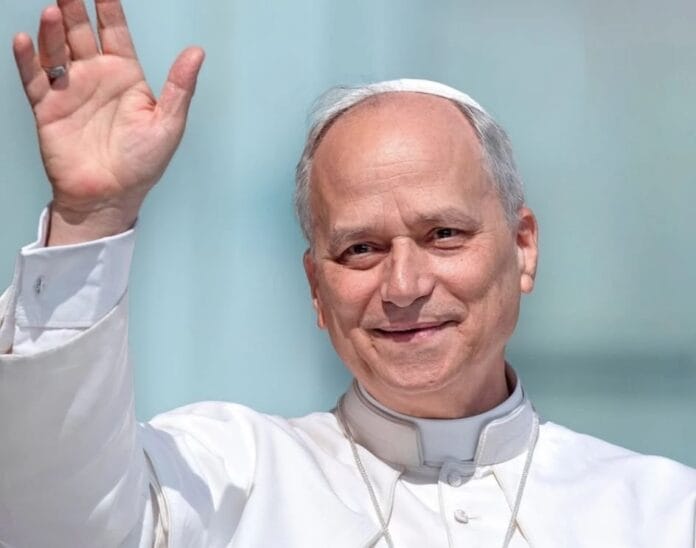
This Wednesday, November 19, 2025, marks the French release of a book that promises to be a landmark: Leo XIV, pope missionary of Globalized Church, written by journalist Elise Ann Allen and published by Artège. Based on two exclusive interviews with the Pope, this book reveals a pope Without a mask, a man of faith, both lucid and passionate, torn between tradition and the new breath of a globalized Catholicism.
Behind the provocative title – "They'll never elect an American as pope" – lies a story of«humility, of discernment and courage. By retracing his path, Leo XIV offers much more than a personal testimony: a spiritual manifesto for a 21st century Church.
The unlikely journey of a son of the American continent
Childhood at the heart of the continent of faith
Born Robert Prévost in Chicago to a modest and devout family, the future Leo XIV grew up in a contrasting America: one of multicultural megacities and parishes overflowing with fervor. Early on, he discovered religious vocation as a call to service rather than a privilege.
His upbringing was influenced by the Augustinians, with their spirituality characterized by rigor, contemplation, and concrete commitment to the poorest members of society. At 17, he already knew that his life would no longer be his own. The young man chose the path of religious life rather than a theological or academic career.
From Peru to Rome: immersion in universality
After his ordination, Father Prévost was sent to Peru, to the Chiclayo region. It was there that his destiny changed dramatically. Through his contact with the Andean communities, he discovered a Living Church, joyful, rooted in poverty, but rich in a visceral faith.
«There, I learned the language of the heart before that of doctrine,» he confides in the book. This missionary experience forms the basis of his entire journey: a way of being a priest among the people, of speaking simply but truthfully, of building bridges before rules.
His return to Rome in 2014 to take on responsibilities within the Augustinian order marked a transition to the institutional sphere. He gradually became a man of balance, capable of understanding the complex workings of the Curia while remaining close to the realities on the ground.
The surprise election of a pope from America
An unexpected conclave
In March 2025, the Catholic world will witness one of the most unpredictable conclaves in a century. Following Francis's resignation due to his advanced age, the cardinals are searching for a figure who is both spiritual and experienced, capable of continuing the pastoral shift initiated in 2013 while restoring the moral credibility of the Church. Vatican.
No one is betting on an American. The idea seems almost taboo. Too pragmatic, too influential, too marked by the political power of his country. And yet, it is Cardinal Prévost, prefect of the dicastery for bishops, who emerges.
«I thought they were joking when I saw my name circulating,» he says. «I prayed, I cried, and I finally said yes, because refusing would have been a lack of faith.»
The decisive moment: choosing a name
By taking the name Leo XIV, Robert Prévost sends a powerful message. He places himself in the lineage of a pope reformer (Leo XIII) but also a builder of dialogue between faith and reason. For him, the name is not symbolic: it is programmatic. His pontificate is resolutely focused on mission, education, and the reconciliation of cultures.
The new pope He knows it: his election is not unanimous. Latin America claims him as one of its own, while in Europe some doubt his legitimacy in the face of more "Roman" figures. His first homily as pope, However, in the Basilica of St. John Lateran, he dispelled any doubts: "The Church does not belong to any continent. It is the breath of Christ poured out into all languages."«
A missionary pope's message for a changing Church
Reform without dividing
Leo XIV rejected simplistic dichotomies. For him, modernity and fidelity, justice and mercy, doctrine and listening were not opposed. His charisma rested on what he called the "discernment of the center": firmly upholding unity without stifling diversity.
His priorities are divided into ten spiritual projects, already mentioned in his first interviews: the economic transparency of the Vatican, the fight against abuses, there women's place in the mission, the simplification of the Curia, attention to the peripheries, synodality experienced as a culture of dialogue.
But behind these administrative axes lies a broader vision. It is not simply a matter of governing the Church, but of converting it once again to its primary mission: to evangelize with consistency and joy.
The style of Leo XIV: intimacy, humor, and introspection
What is striking about his words is his tone. No grandiloquence, no beating around the bush. He speaks like a pastor, using everyday language. In the most personal passages of the book, he recounts his doubts, his anger, but also his moments of wonder: "Every day, I discover how much God loves to surprise his servants. He unsettles us to better bring us back to center."«
His audiences often give rise to spontaneous exchanges. He appreciates silences as much as smiles. In Rome, he is often seen walking alone in the gardens of the Vatican, with his breviary in hand, greeting the gardeners as if they were his brothers.
His American temperament shines through in his disarming simplicity and direct efficiency: shorter meetings, clear decisions, and a rejection of internal intrigue. A style that disconcerts some cardinals, but which gradually wins the hearts of the faithful.
A pope looking towards the future
In the final part of the book, Leo XIV reflects on the future of the Church. For him, the crisis is not a defeat: it is a stage of purification. He compares the Christian community to "a tree pruned by winter, ready to bear new fruit.".
He calls on young people not to be afraid of vocation, families to become schools of living faith again, and priests to be witnesses "with dirty hands and pure hearts".
More than an institutional message, it is a spiritual confession: Leo XIV sees himself as neither strategist nor prophet, but universal brother. He who, having come from America, reminds Rome that the Church is first and foremost missionary or it is nothing.
Elise Ann Allen's dense yet fluid book accurately captures this alchemy between faith and discernment. It shows a pope aware of the fractures of his time, but convinced that the answer lies in ordinary holiness, lived in the fervor of simple gestures.
Leo XIV, in the end, embodies a fruitful paradox: the American they would never have elected – and whom the world, today, so desperately needs.