












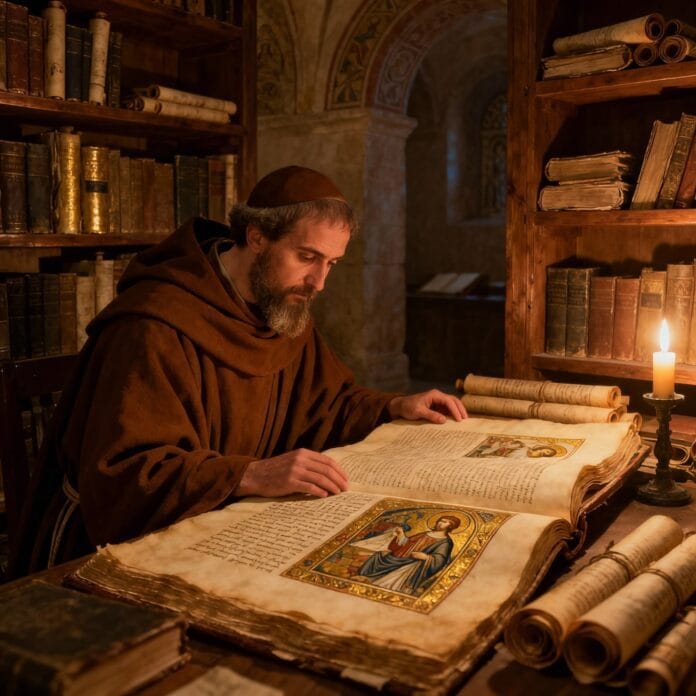
In the silent depths of a monastic library, a fourth-century monk discovers layers of meaning in a single biblical verse that will transform his spiritual understanding for eternity. Meanwhile, in our contemporary universities, that same verse is dissected with scalpel-like precision, revealing its historical context but often leaving the reader's soul unchanged.
This divergence between the ancient and modern approaches to’biblical interpretation reveals a profound fracture in our contemporary spiritual quest. While our era favors historical-critical analysis, the Fathers of the Church navigated the Scriptures with a different compass: that of allegorical methods which revealed not only what the text said, but what it accomplished in the soul of the believer.
The lost legacy of figurative reading
The early Christians approached the Scriptures as a living territory, where each word carried multiple dimensions of meaning. This approach to the figurative reading It was not an intellectual fantasy, but a rigorous method developed over centuries of contemplation and spiritual experience.
Imagine discovering that a familiar text contained hidden treasures, accessible only through an interpretive key you had never learned. This is precisely the revelation that awaits those who explore the allegorical methods of the Ancients. This approach recognized that Scripture operated simultaneously on several levels: literal, moral, allegorical, and anagogical.
The patristic tradition intuitively understood that limiting the’spiritual exegesis On a purely historical level, viewing a diamond from only one angle was like contemplating it. Each facet reveals a unique beauty, but it is their interaction that creates the transformative brilliance of the jewel as a whole.
The limitations of our modern approach
L'Christian hermeneutics Contemporary scholarship, dominated by the historical-critical method, has certainly provided valuable insights into the context and formation of biblical texts. This approach excels in reconstructing historical circumstances, linguistic analysis, and understanding the original intentions of human authors.
However, this method also reveals its inherent limitations. By focusing exclusively on the "what" and the "how" of the text, it often neglects the "deep why" that nourishes the searching soul. Historical-critical analysis can masterfully explain why a psalm was composed, but it struggles to reveal how that same psalm can transform the prayer of the one who meditates on it today.
This modern approach, despite its academic rigor, tends to fragment spiritual experience. It separates study from contemplation, understanding from transformation, creating an artificial dichotomy between knowledge and wisdom. The consequences of this separation manifest themselves in a spirituality that is often intellectualized, rich in information but sometimes poor in personal transformation.
The impoverishment of the contemplative experience
When we reduce the Scriptures to their purely historical dimension, we risk transforming the Bible and tradition as a museum rather than a living source of wisdom. This approach can create an artificial distance between the contemporary reader and the sacred text, as if spiritual truths were prisoners of their original era.
Allegorical methods, on the other hand, established a living bridge between the ancient text and the reader's present experience. They recognized that Scripture possessed an intrinsic capacity to speak directly to the human heart, transcending temporal and cultural barriers.
The spiritual richness of allegorical methods
THE Fathers of the Church They developed their allegorical approaches not out of intellectual whim, but out of spiritual necessity. They discovered that certain dimensions of divine revelation could only be grasped through a contemplative reading that went beyond literal analysis.
This method was based on a fundamental conviction: that the Scriptures contained divine mysteries that were gradually revealed as the reader's soul was purified and deepened spiritually.’spiritual exegesis It thus became a path of personal transformation as much as an intellectual exercise.
Consider this approach an art of spiritual discovery. Each biblical passage becomes a territory to explore, where the literal meaning serves as the starting point for a broader contemplative adventure. Allegory reveals the mysteries of Christ, anagogy elevates the soul toward eternal realities, and moral meaning guides the believer's ethical transformation.
The transformative dimension of figurative reading
Allegorical methods possessed a unique quality: they simultaneously engaged the reader's intellect, imagination, and heart. This holistic approach created the optimal conditions for genuine spiritual transformation, where intellectual understanding was united with contemplative experience.
Imagine a figurative reading which would transform your relationship with Scripture by revealing unsuspected connections between the different books of the Bible, between the Old and New Testaments, between your own spiritual experience and the great mysteries of faith. This approach created a unified vision of divine revelation, where each part illuminated and enriched the whole.
Patristic tradition understood that Scripture functioned like a living organism, where each element contributed to the harmony of the whole. This organic vision allowed readers to discover profound resonances between seemingly distinct passages, revealing the mysterious coherence of the divine plan.
How to integrate these methods into our contemporary practice
The integration of allegorical methods Our modern approach does not require abandoning historical-critical analysis, but rather enriching it with often-neglected contemplative dimensions. This synthesis can create a Christian hermeneutics more complete, which honors both academic rigor and spiritual depth.
Begin by recognizing that your reading of Scripture can operate on several levels simultaneously. After grasping the literal meaning of a passage, ask yourself deeper questions: How does this text reveal truths about the divine nature? What personal transformations does it invite? How does it resonate with other biblical passages to reveal broader mysteries?
This multi-layered approach transforms biblical reading into a contemplative exercise, where each encounter with the text can reveal new facets of meaning. It cultivates an attitude of openness and wonder that gradually enriches your spiritual understanding.
Rediscovering the art of scriptural meditation
The ancients practiced what they called spiritual "rumination": a slow and repeated chewing over of sacred texts that allowed them to gradually extract all their spiritual nourishment. This practice can be reintroduced into our fast-paced world, creating oases of contemplation in our often fragmented lives.
Choose a biblical passage and remain with it for several days, allowing its various dimensions to gradually reveal themselves. Observe how the literal meaning is enriched by symbolic resonances, how moral applications emerge naturally, and how mystical dimensions begin to shine through. This contemplative patience unveils treasures inaccessible to quick or purely analytical reading.
L'spiritual exegesis It thus becomes an art of presence, where your sustained attention to the sacred text creates the conditions for a progressive revelation of its mysteries. This approach cultivates not only intellectual understanding, but also the wisdom of the heart that truly transforms existence.
Awakening to a deeper spirituality
Exploring allegorical methods offers much more than an academic alternative to historical-critical analysis. It opens the doors to a more integrated spirituality, where the study of Scripture becomes a path of personal transformation and divine communion.
This rediscovery of patristic treasures can revolutionize your relationship with sacred texts, transforming each reading into a potential spiritual adventure. Instead of viewing Scripture as historical documents to be analyzed, you begin to experience it as living territories to be explored, rich in mysteries that reveal themselves as your own spiritual maturity deepens.
The synthesis between ancient wisdom and modern research creates the conditions for a Bible and tradition truly alive, capable of nourishing both critical intelligence and a contemplative heart. This approach recognizes that divine revelation possesses an inexhaustible richness that transcends the limits of any single interpretive method.
Towards a renewed hermeneutics
The future of’biblical interpretation The solution may well lie in this creative reconciliation between the patristic heritage and the findings of modern research. This promising synthesis honors both the historical dimension of the texts and their ongoing capacity to transform human lives.
Imagine a community of readers who approach Scripture with this dual expertise: the analytical rigor of contemporary research and the contemplative depth of allegorical methods. This integrated approach could renew the spiritual vitality of many Christian communities, creating spaces where study and contemplation mutually nourish each other.
This vision of a Christian hermeneutics renewed is not a distant utopia, but a concrete possibility that begins with your own transformation of your personal approach to Scripture. Every reader who rediscovers the richness of allegorical methods contributes to this broader spiritual renaissance.
The call to rediscover our contemplative roots
The time has come to recognize that our era, despite its remarkable advances in biblical research, may have lost some essential spiritual treasures by abandoning the contemplative methods of the ancients. This loss is not inevitable, but rather an invitation to rediscover and reintegrate these approaches into our contemporary practice.
Your own journey toward this rediscovery can begin today, with a simple shift in attitude toward Scripture. Instead of approaching it solely as texts to be understood intellectually, dare to experience it as spiritual territories to be explored contemplatively. This transformation of perspective can reveal unexpected dimensions of richness and beauty in passages you thought you already knew perfectly.
The legacy of Fathers of the Church It teaches us that Scripture possesses inexhaustible depth, capable of nourishing our spiritual growth throughout our lives. Each return to the text with an open heart and a contemplative mind can reveal new facets of this divine richness that transcends centuries and cultures.
Are you ready to embark on this adventure of spiritual rediscovery? The allegorical methods of the Ancients await you, not as dusty relics of the past, but as living keys capable of unlocking unexplored dimensions of your relationship with the sacred Scriptures. This exploration could well transform not only your biblical understanding, but your entire spiritual experience.