












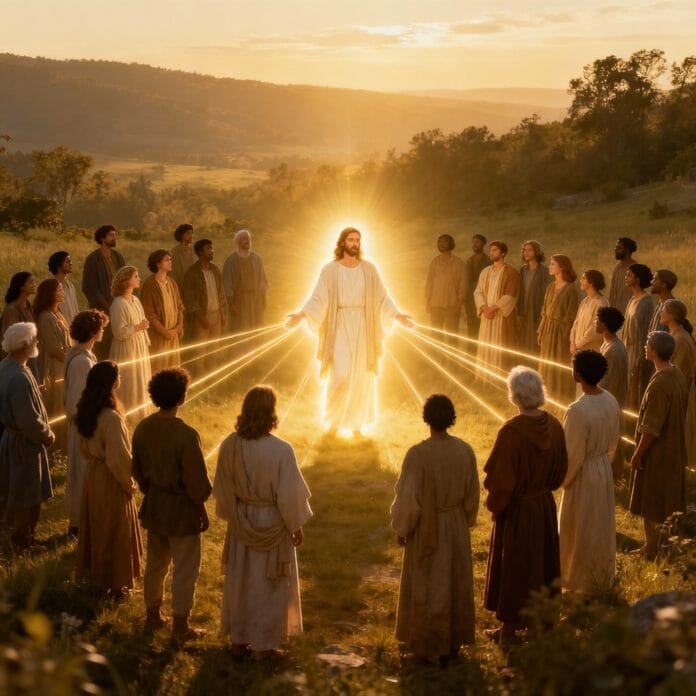
Reading from the Letter of Saint Paul the Apostle to the Romans
Brothers,
We know that for those who love God, he works all things together for their good, because they have been called according to his purpose of love.
Those whom he foreknew he also predestined to be conformed to the image of his Son, in order that he might be the firstborn among many brothers.
Those whom he had predestined, he also called; those whom he called, he also justified; and those whom he justified, he also glorified.
Promoting trust in the divine plan: living predestination according to Saint Paul
Understanding God's plan through the calling, justification, and glory promised to believers.
Reading Romans 8Chapters 28-30 are addressed to anyone searching for meaning, facing life's challenges, and desiring to understand God's providence. This essential passage of the Letter of Saint Paul to the Romans This text invites us to discover that God, through his eternal love, knows, calls, and transforms his chosen ones to make them like Christ, thus opening a path of hope and complete trust. It speaks to us Christians, but also to every soul on a spiritual quest.
We will begin by situating this passage within its historical and theological context; we will then explore the central idea of predestination to Christ, before delving into its human, spiritual, and practical dimensions. Finally, we will examine the resonance of this text within the Christian tradition and offer concrete suggestions for embodying it in daily life.
Context
The Letter to the RomansWritten by the apostle Paul around the year 57-58, it is one of the first major theological syntheses of the Christianity nascent. It addresses the Christian community of Rome, a mix of Jews and Greeks, facing cultural and spiritual tensions. In this context, Paul seeks to affirm God's sovereignty in salvation, which depends neither on human works nor ethnic origins, but on grace working through faith.
The passage of Romans 8, Verses 28-30 are part of a section where Paul reveals how, despite the suffering inherent in the Christian life, God works for the ultimate good of his chosen ones. He declares, «We know that in all things God works for the good of those who love him, who have been called according to his purpose.» This verse lays the foundation for trust: God governs all things to guide believers toward good.
Paul goes on to explain that those whom God foreknew (his divine foreknowledge), he also predestined to be conformed to the image of the Son, so that Jesus might be the firstborn among many brothers and sisters. Predestination here does not refer to fate, but to a divine plan of unification and sanctification through Jesus Christ.
Next, Paul successively discusses calling, justification, and glorification: those whom he has predestined, he calls, justifies, and glorifies—all stages in the realization of salvation. These concepts express a spiritual progression where the believer is welcomed into divine life, purified, and finally glorified in the fullness of eternal life.
This text is therefore at once a promise, an explanation of divine providence, and an exhortation to persevere in faith despite trials, for everything is ordered for the realization of this plan of love.
Analysis
The central idea of the passage is the certainty of the salvation plan of God, which encompasses past, present, and future. The main dynamic is that of predestination based on the prevenient knowledge of God, directing human destiny towards likeness to Christ.
The paradox between human freedom and divine predestination is conveyed here through the subtle interplay of divine knowledge, even before creation (those whom He foreknew), and the freely chosen path of believers who are called and justified. Predestination does not crush freedom, but rather prepares it and guides it to its fulfillment.
Theologically, this predestination refers less to a cold technique than to God's mysterious plan of love, which creates a people conformed to his Son. Configuration to Christ is both a gift and a task: to become "in actuality" what God already "knew" in potential.
Spiritually, this message establishes a climate of hope. No matter the pain or doubt, the believer, assured of being loved with infinite love, can persevere. The final glorification does not eliminate the painful intermediate stages, but illuminates their significance: they contribute to the mystical growth toward the full light.
Thus, Paul reveals that salvation is complete: it includes a call to faith, justification by grace, and promised glorification. Each step is sustained by the invisible work of God, who works all things for good—a good that surpasses our immediate understanding.
The dimension of the divine call: invitation and choice
The call, as Paul presents it here, is an initiating gesture from God. It is not simply an external call, but an internal one, which transforms the heart. God chooses those whom he has "foreknown," according to a foreknowledge that includes their free response.
On a human level, this call brings about a spiritual rebirth. The believer passes from the state of sinner to that of the justified. He is invited to live in trust, knowing that this divine election is not arbitrary but founded on love.
This call creates a concrete vocation: to be conformed to Christ, which implies bearing with him the mission of bearing witness in the world. It is a call to holiness and fraternal communion.
The justification: a received state, an inner transformation
Justification means being declared righteous by God, not on the basis of personal merit, but through the gift of grace. It is a spiritual rehabilitation that frees the believer from the condemnation associated with sin.
This justification opens the way to a gradual transformation, where actions and attitudes harmonize with the divine will. The new life takes root in the Holy Spirit, a source of sanctification.
Justification is therefore experienced as an active process, which encourages human and spiritual growth, with its progress, its struggles and its fragilities.
Glorification: Fulfillment and Ultimate Hope
Glorification is the final stage, that of full communion with God, achieved through rescursion and eternal life. It is presented here as a certainty, already included in the divine plan.
Spiritually, glorification is also experienced as a hope that sustains the believer in the midst of trials. It signifies that the earthly journey has a happy ending, assured by the power of God.
This promised glory is therefore a powerful driving force to persevere in faith, and a call to work towards building a world in accordance with love divine.
Christian Heritage and Traditional Echoes
In patristics, Saint Augustine He extensively developed the doctrine of predestination, emphasizing God's sovereignty and the gratuitous nature of grace. He rejected any notion of mechanical fatalism, stressing that human freedom is compatible with the divine plan.
This vision profoundly influenced medieval Christian theology, where God's justice and love are seen as inseparable. Spiritual tradition also emphasizes that conformity to Christ is a path of ongoing conversion.
In the liturgy, these verses are often meditated upon during feasts related to salvation and the Epiphany, reminding God's people of their call to common holiness. They also serve as support in times of trial, strengthening hope.
More recently, contemporary spiritualities have reaffirmed this confidence in a God who governs history for the ultimate good, encouraging an active and resilient faith.
A path of meditation to embody this truth
- Remember every day that God personally calls each one of us to become like Christ.
- To meditate on difficult moments experienced, and to discern how they contributed to inner growth.
- Read and reread Romans 8, 28-30, praying to welcome trust in the divine plan.
- To commit to bearing witness to this hope around oneself, in the family and the community.
- To live each day as a step towards the promised glorification, by working towards justice and forgiveness.
- Ask the Holy Spirit to strengthen faith to persevere in times of uncertainty.
- Celebrate small spiritual victories as signs of God's active presence.
Conclusion
The passage of Romans 8, Chapters 28-30 reveal a sovereign God whose plan of love embraces all of human existence, even its suffering. This predestination is not a fatalistic lock, but a call to sanctified freedom, to trust, and to growth toward Christlikeness.
This teaching invites us to a radical conversion: to embrace in faith the divine plan that shapes us, justifies us, and prepares us for glory. Thus, the Christian life becomes a dynamic path of hope and inner transformation, which is also manifested in social engagement.
At every stage, faith is nourished by a sure promise: in union with Jesus, every experience, even the most difficult, contributes to final sanctification. This is a revolutionary message that invites us to face life with renewed courage.
Practical advice
- Meditate daily Romans 8, 28-30 in relation to his own life.
- Keep a spiritual journal to record the times when God acts for good.
- Participate in a prayer team or Bible study group to share this hope.
- Practice patience And kindness towards oneself during trials.
- Seek to imitate Christ in daily acts of compassion.
- Confide your fears to God in prayer and ask for the strength to persevere.
- Read works by Saint Augustine on predestination to deepen understanding.