











Gospel of Jesus Christ according to Saint Matthew
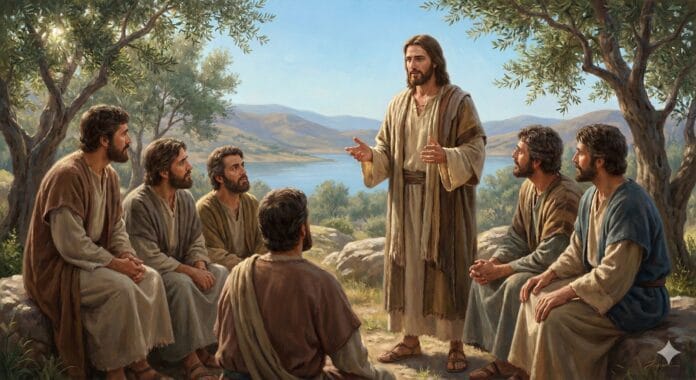
At that time, Jesus said to his disciples: «Not everyone who says to me, «Lord, Lord,» will enter the kingdom of heaven, but only the one who does the will of my Father who is in heaven. Therefore everyone who hears these words of mine and puts them into practice is like a wise man who built his house on the rock. The rain came down, the streams rose, and the winds blew and beat against that house; yet it did not fall, because its foundation was on the rock. But everyone who hears these words of mine and does not put them into practice is like a foolish man who built his house on sand. The rain came down, the streams rose, and the winds blew and beat against that house, and it fell with a great crash.»
Building on the rock: when faith meets concrete obedience
Understanding why Jesus places action at the heart of an authentic relationship with God and discovering how to anchor one's spiritual life in unshakeable foundations.
Jesus confronts us with a disturbing truth: professing one's faith is not enough. Between pious words and entry into the kingdom, there is an essential step: active obedience to the Father's will. This requirement, far from being a legalistic burden, paves the way for a spirituality rooted in reality. Matthew 7 invites us to examine our foundations: are we building on the rock of obedience or on the sands of good intentions?
We will begin by exploring the context of this crucial passage from the Sermon on the Mount, then analyze the twofold parable of the builders. We will then develop three main themes: the distinction between words and deeds, the nature of the divine will, and the dynamics of authentic obedience. Concrete applications, a guided meditation, and a reflection on contemporary challenges will complete our exploration before a liturgical prayer and practical suggestions that can be immediately implemented.
The ground: when Jesus concludes his foundational manifesto
This passage from Matthew 7:21, 24-27 constitutes the powerful conclusion of the Sermon on the Mount, the programmatic discourse that spans chapters 5 to 7 of the Gospel of Matthew. After having explained the Beatitudes, Having redefined the Law with a new radicalism, and taught on prayer, almsgiving, and fasting, Jesus concludes with a solemn warning. The context is crucial: we are not faced with just another piece of advice, but with the conclusion of a fundamental teaching that reorganizes the entire life of the disciple.
The Gospel of Matthew, probably written between 80 and 90 AD, addresses a Judeo-Christian community grappling with questions of identity. How could they live in continuity with Jewish tradition while following the Messiah? Matthew answers by presenting Jesus as the new Moses, the one who fulfills and transcends the Torah. The Sermon on the Mount echoes the Sinai: Jesus ascends the mountain to teach, just as Moses ascended to receive the Law.
Our specific passage comes after a series of warnings about false prophets and entering through the narrow gate. Jesus has already set the stage: the path to the kingdom is demanding, it requires discernment, and not all who claim to follow him will automatically enter it. It is in this atmosphere of caution that the central statement emerges: «Not everyone who says to me, ‘Lord, Lord,’ will enter the kingdom of heaven.»
The repetition of "Lord, Lord" is not insignificant. In Semitic culture, doubling expresses intensity, urgency, even supplication. It is found in key moments: "Martha, Martha" (Luke 10,41), «Jerusalem, Jerusalem» (Matthew 23:37). Here, the repetition underlines the appearance of piety, the religious emphasis that can mask a real lack of commitment.
The term "Lord" (Kyrios in Greek) carries significant theological weight. In the Septuagint, the Greek translation of the Old Testament, Kyrios translates the sacred tetragrammaton YHWH, the name of God. To recognize Jesus as Lord therefore means to attribute divinity to him. But Jesus is not satisfied with this verbal recognition, however orthodox it may be. He demands something deeper: conformity to the Father's will.
The mention of "the Father who art in heaven" creates a link with the Lord's Prayer taught a few verses earlier: "Thy will be done on earth as it is in heaven" (Matthew 6:10). Jesus asks for nothing more than what he taught us to pray. Entry into the kingdom is not an automatic admission based on a confession of faith, but the culmination of a life aligned with the divine will.
The key to understanding: deciphering the apparent paradox
Jesus' teaching seems to create a tension: isn't it by faith that we are saved, as Paul would later affirm? How can we understand this emphasis on works without falling into the legalism that Jesus himself denounces elsewhere? The key lies in understanding what it means to "do the Father's will.".
For Jesus, there is no opposition between faith and obedience. Authentic faith naturally translates into corresponding actions. James, in his epistle, expresses this same conviction: «Faith without works is dead» (James 2:26). It is not a question of meritorious works that would buy us access to the kingdom, but of the organic expression of a living relationship with God.
The Greek formulation is instructive. The present participle "doing" (poiôn) indicates a continuous, habitual action. It is not a matter of fulfilling the divine will punctually, but of making it the rhythm of one's existence. It is a permanent disposition, a way of life, not an occasional performance.
The following double parable illuminates this requirement. Jesus contrasts two builders who, on the surface, are doing the same thing: building a house. The difference lies not in the visible activity, but in the choice of foundation. The rock symbolizes obedience to Jesus' words, while the sand represents sterile listening, the kind that does not lead to concrete change.
The image of building is deeply rooted in biblical tradition. Psalm 127 proclaims: «Unless the Lord builds the house, the builders labor in vain.» Jesus takes up this theme but personalizes it: it is on his own words that the edifice of our lives must be founded. He thus attributes to himself divine authority, the authority that establishes and guarantees stability.
The weather elements—rain, torrents, winds—evoke the inevitable trials of existence. No one escapes them. The question is not whether we will face storms, but whether our foundations will hold. The house on the rock «did not collapse,» a typically Semitic euphemism for: it withstood perfectly. The house on the sand, however, suffers «a complete collapse»—the Greek text emphasizes the totality of the disaster.
This dramatic conclusion is not an arbitrary threat, but a logical consequence. To build without a solid foundation is to program one's own collapse. Jesus does not condemn; he observes. His warning stems from pedagogical clarity, not theological sadism. He confronts us with a responsibility: our current choices determine our ability to weather future crises.

Beyond words, the truth of commitment
When confession becomes comfortable
We live in a culture of words. Declarations of intent abound: "I'm going to start exercising," "I'm going to pray more," "I'm going to be more patient." Spiritual vocabulary also flourishes. We say "Amen" with conviction, we sing fervent praises, we proclaim our faith on social media. But Jesus challenges us: what about concrete action?
The danger of verbal religiosity lies in its ability to reassure us cheaply. Repeating "Lord, Lord" can become a mechanism of self-absolution. We convince ourselves of our piety through the intensity of our verbal expressions, without our daily lives being affected. This is what psychologists call a substitution bias: the act of saying replaces the act of doing, and we are content with that.
In the early Christian communities, this phenomenon was already present. Paul had to remind the Corinthians that speaking in tongues without love is "a loud twanging sound" (1 Corinthians 13:1). James denounced those who told a brother in need, "Go in peace and be warmed," without giving him anything to wear (James 2:16). The history of the Church is punctuated by these reminders: faith is either embodied or dissolved.
To put it simply, imagine Marc declaring his love for God every Sunday, joining in the hymns, and raising his hands during worship. But from Monday to Saturday, he mistreats his colleagues, commits tax fraud, and systematically ignores charitable donations. His Sunday confession is just a veneer. He says, "Lord, Lord," but his life screams, "Me first."«
Or take Elise, involved in all the parish committees, an expert in theological vocabulary, able to quote Scripture with ease. But at home, she imposes a climate Constantly judging, she refuses to forgive her husband for a past mistake and cultivates bitterness as an art form. Her words are orthodox, her life is a counter-witness.
Jesus' demand is not to renounce words, but to align them with actions. The confession of faith remains essential – «If you confess with your mouth that Jesus is Lord, you will be saved» (Romans 10:9). But this confession is only authentic if it is accompanied by a visible transformation. Saying and doing are not opposed; saying without doing, that is the problem.
This consistency requires regular examination. We can ask ourselves these questions: Do my financial priorities reflect my statements about the kingdom? Does my time management demonstrate what I proclaim to be essential? Do my relationships embody the love I say I receive from God? If a neutral observer were to compare my Sunday words with my Monday life, would they see continuity or contradiction?
Contemporary Christian culture sometimes exacerbates this problem. We value eloquence, moving testimonies, and public declarations of faith. Social media amplifies this temptation: displaying one's spirituality becomes more important than living it. We collect shared verses, the hashtag ##blessed, and photos of our prayer times. But behind the screen, who are we really?
Jesus doesn't ask for silence. He asks for truth. If our words are authentic, let them become flesh. If they are not, it's better to remain silent and begin by adjusting our lives before parading our piety.’humility The actions of someone who acts without proclaiming are infinitely better than the arrogance of someone who proclaims without acting.
Obedience as a language of love
Doing the Father's will is ultimately responding to love with love. John will say this explicitly: "If you love me, you will keep my commandments" (John 14,15). Obedience is not an external constraint imposed by a heavenly despot, but the natural response of a heart touched by grace.
Let's think about a healthy romantic relationship. How do we know we truly love someone? Not just through passionate declarations, but through everyday actions: remembering what matters to the other person, anticipating their needs, sacrificing comfort for their well-being. Authentic love is recognized by its tangible results.
The same is true with God. Saying "I love you, Lord" fifty times a day only makes sense if that love is translated into attentive listening to what is dear to His heart. Now, God has revealed what is dear to His heart: justice., mercy, loyalty, L'’humility (Micah 6,8). When we embody these values, we speak to God in the language he understands best: that of likeness.
This perspective radically transforms our relationship to Christian morality. It is no longer a list of rules to be followed under penalty of punishment, but a score to be played to harmonize our lives with God's. The commandments become invitations, not obligations. They show us the path to a fulfilling life, aligned with our deepest vocation.
Sophie, a palliative care nurse, exemplifies this dynamic. She could easily be content with the bare minimum of professional duties. But every day, she takes the time to listen to her patients' stories, to hold the hands of those who are afraid, to pray silently for them. She doesn't do it to gain heaven, but because she has understood that serving the most vulnerable means encountering Christ (Matthew 25:40). Her faith isn't proclaimed; it is lived at the bedside of the dying.
Or Thomas, the entrepreneur who could have maximized his profits by turning a blind eye to some of his competitors' questionable practices. Instead, he chose transparency, even at the cost of losing business. He pays his suppliers fairly, even the smallest ones. He has established a living wage for all his employees. His faith isn't proclaimed in business seminars; it's evident in his accounting decisions.
Obedience understood in this way is not servile. It is creative, joyful, liberating. It frees us from the burden of inventing our own value system in a vacuum, of navigating blindly through the surrounding moral chaos. It offers us a course, a compass, a direction. And paradoxically, this submission sets us free: free from the anxiety of relativism, free from the weight of our contradictions, free to be fully ourselves in Christ.

Decoding divine will in everyday life
Guiding principles as a roadmap
God's will is not an impenetrable mystery. Certainly, some aspects remain veiled, and we perceive only part of it (1 Corinthians 13:12). But the essential has been clearly revealed. Scripture, the teachings of Jesus, and the tradition of the Church offer us a legible map for navigating life.
Jesus summarized the entire Law in two commandments: to love God with all your heart, and to love your neighbor as yourself (Matthew 22,(p. 37-39). This is the Father's will summarized. Every decision, every action can be evaluated according to this twofold criterion: does it increase my love for God? Does it express love for my neighbor?
The Sermon on the Mount itself develops this divine will into concrete themes. Jesus addresses anger (Matthew 5,(21-26), sexual desire (5:27-30), divorce (5:31-32), oaths (5:33-37), revenge (5:38-42), love of enemies (5:43-48), ostentatious religious practice (6:1-18), attachment to riches (6:19-24), anxiety (6:25-34), and judgment of others (7:1-5). Each section sheds light on what it means, in practical terms, to live according to God's will.
Let's take the example of anger. Jesus doesn't simply condemn murder, as the Torah does. He goes back to the root cause: unresolved anger, insult, contempt. The Father's will is not only that we avoid crime, but that we cultivate peace inner peace and active reconciliation. If I harbor resentment against a colleague, I am not doing the Father's will, even if I never resort to violence.
Or anxiety. Jesus identifies it as a symptom of distrust in divine providence. «Do not worry about tomorrow» (Matthew 6:34) is not advice for irresponsible frivolity, but an invitation to trust. When I am consumed by anxiety about the future instead of calmly doing my daily work, I demonstrate that I do not truly believe in the Father's care. My verbal faith is belied by my chronic stress.
These teachings are not optional suggestions. They define the lifestyle of the kingdom. They outline the house we are building. Ignoring anger is like piling bricks on sand. Cultivate peace, It's like digging down to the rock.
Personal discernment as a spiritual laboratory
Beyond grand principles, each of us faces specific choices that are not explicitly addressed in Scripture. Should I change careers? How should I educate my children about screen time? What position should I take on a complex political or ethical issue? This is where the spiritual discernment, this ability to recognize the voice of God in the particular circumstances of our existence.
Discernment is not a gift reserved for mystics. It is a spiritual skill that every believer is called to develop. Paul exhorts the Romans: «Be transformed by the renewing of your mind, so that you may discern what is the will of God—his good, pleasing and perfect will.»Romans 12,2). Discernment therefore presupposes a transformation, a progressive training of our mind to think according to God.
Several criteria can guide us. First, scriptural consistency: does my decision align with the overall message of the Bible? If I feel a call to do something that directly contradicts the teachings of Jesus, I can be sure that it is not God's will. The Spirit does not contradict itself.
Afterwards peace interior. Paul speaks of "« peace of God who guards our hearts» (Philippians 4,7). When we are in accordance with God's will, even if the path is difficult, a profound peace remains. Conversely, persistent agitation or unexplained unease may signal that we are on the wrong path. This criterion is not infallible—we can confuse peace with comfort—but it remains invaluable.
Community confirmation also plays a role. Hebrews 3:13 urges us to encourage one another daily. Discernment is not something to be done alone. Sharing our insights with mature Christians, listening to their perspectives, helps us avoid the illusions of spiritual individualism. If my "discernment" consistently isolates me from the community of believers, I need to examine myself.
Claire, 35, wonders if she should leave her well-paid executive job to start a homeless shelter. Financially, it's a leap of faith. She prays, reads Scripture, and consults her pastor and Christian friends. Gradually, a sense of shared purpose emerges. The burden of caring for the marginalized never leaves her. Peace She feels it when she imagines herself in this new role. Her loved ones confirm that they see her thriving in service. She takes the plunge. Three years later, her association helps about fifty people. She has found her place in God's plan.
Conversely, Bertrand "discerns" that he must leave his wife and children to pursue an extramarital affair that seems to him to be "the love of his life." He speaks of "God's will" to justify his choice. But Scripture clearly condemns adultery. No lasting peace can be born of betrayal. The Christian community warns him. His "discernment" is not discernment at all; it is a rationalization of his desire.
Authentic discernment requires’humility. We can be mistaken. Our emotions, our fears, our ambitions bias our perception. Hence the importance of persistent prayer, sometimes fasting, and patient listening. God is not in a hurry. He shapes us through waiting. To rush a decision "in the name of God" when the signs are contradictory is often to project our will onto Him.

The foundations that withstand the storm
Anatomy of a Life Built on Rock
Building on solid rock means adopting a robust spiritual architecture. This requires several structural elements. First, a personal relationship with God, nurtured daily. Prayer is not optional; it is the cement that binds our lives to the Source. Without this regular connection, our good intentions crumble.
Jesus himself exemplifies this priority. The Gospel shows him regularly withdrawing to pray, sometimes all night long (Luke 6,12). If the Son of God needs this time of intimacy with the Father, how much more do we? Prayer is not a performance, it is an expression. We stand before God, we listen to him, we speak to him, we allow ourselves to be transformed by his presence.
Next, meditation on Scripture. Psalm 1 declares blessed the one who meditates on the Torah day and night. Joshua receives the command: «This Book of the Law shall not depart from your mouth, but you shall meditate on it day and night, so that you may be careful to do all that is written in it.»Joshua 1,8). The Word of God is our spiritual food. A Christian who never reads the Bible suffers from spiritual malnutrition. He cannot build solidly if he does not know the architect's plans.
Community life forms a third pillar. «Let us not give up meeting together,» warns Hebrews 10:25. We need one another. Individual faith is fragile. It is strengthened through sharing, listening to testimonies, and praying together. Isolation is a trap. The solitary Christian is easy prey for discouragement, doubt, or doctrinal deviation.
Gradual obedience is the fourth element. We don't become saints instantly. But we can choose, each day, an area in which to embody God's will more fully. Today, I'm working on my patience. Tomorrow, on my generosity. The day after tomorrow, on my tongue. These small acts of obedience accumulate, like a mason laying brick after brick, until the building stands.
Michel, a Christian for ten years, has structured his life around these pillars. Every morning, he gets up thirty minutes earlier to read a psalm and pray. Twice a week, he participates in a Bible study group at his parish. He has identified his Achilles' heel: gossip. So, daily, he practices speaking well of those who are absent and refusing toxic conversations. Gradually, his character is changing. When he goes through a major professional crisis—his company closes—he doesn't collapse. His deep-rooted faith sustains him. He quickly finds a new job and testifies that this ordeal has strengthened his trust in God.
When the storm reveals the truth
Trials are inevitable. Jesus doesn't promise a life without rain, torrents, and winds. He guarantees that solid foundations will withstand them. The storm doesn't create weakness; it reveals it. If our house collapses, it's not the storm's fault. It's because we neglected the foundations.
Storms take many forms. Serious illness, job loss, the death of a loved one, marital betrayal, crushing failure, profound spiritual doubt. No one escapes them. Job, an emblematic figure of suffering, lost everything in a single day. Yet his final confession remains: «I know that my Redeemer lives» (Job 19:25). His foundations held firm.
David, in the Psalms, traverses emotional depths. He cries out to God, complains, and questions. But he never lets go of the Lord's hand. "Even though I walk through the valley of the shadow of death, I will fear no evil, for you are with me" (Psalm 23:4). His faith, tested, emerges purified.
Conversely, Judas, faced with the guilt of his betrayal, completely collapses. He had no foundation. His relationship with Jesus was superficial and self-serving. When the storm of his conscience erupts, he finds no rock to lean on. Despair consumes him.
Today, Léa, a young mother, receives the diagnosis: her three-year-old son has an incurable genetic disease. Her world collapses. For weeks, she oscillates between anger and despair. But she continues to pray, even though her prayers are cries. She clings to biblical promises, even though she no longer "feels" them. She accepts the support of her community, even though she longs to be alone. Slowly, an incomprehensible peace washes over her. She doesn't understand why God allows this, but she chooses to trust Him. Two years later, her son dies. At his funeral, Léa testifies: "I don't know why, but I know who. And what sustains me is that he went through suffering and death before me." Her home was not built on the strength of her own faith, but on the solidity of the rock upon which it was founded: Christ crucified and risen.
Storms are also opportunities to bear witness. When colleagues see that you don't succumb to cynicism despite injustice, that you maintain hope despite illness, they begin to wonder. Peter writes, "Always be prepared to give an answer to everyone who asks you to give the reason for the hope that you have" (1 Peter 3:15). The way we navigate crises speaks louder than any words we can say.
Embodying the divine will on a daily basis
In the personal sphere: integrity as a compass
Doing the Father's will begins in the secret of our hearts and our private habits. No one is watching us, but God sees. How do we manage our sexuality? What do we watch on the internet? How do we talk about ourselves in our inner dialogue? Are we honest in our tax returns? Do we keep the small promises we make to ourselves?
Integrity is indivisible. You can't be honest on Sunday and dishonest on Monday. The Spirit of God dwells in our entire existence, not just our religious performance. Building on rock means submitting every corner of our lives to divine light, including areas no one else will ever see.
In practical terms: make a list of your daily habits. For each one, ask yourself: "If Jesus were physically present with me, would I do things differently?" If the answer is yes, you've identified an area for improvement. Not to beat yourself up, but to move forward. Choose one habit and work on it this month. Next month, tackle another.
In the relational sphere: love as a criterion
Our relationships—family, friends, colleagues, neighbors—are the primary ground for obedience. Jesus is clear: «By this everyone will know that you are my disciples, if you love one another» (John 13:35). Not by our doctrinal orthodoxy, not by our religious attendance, but by our capacity to love in concrete ways.
This means forgiving when it's difficult, serving when it's uncomfortable, speaking the truth with kindness, truly listening instead of waiting for our turn to speak, and giving without expecting anything in return. In marriage, this takes the form of daily self-giving. In friendship, genuine availability. At work, authentic respect.
In practical terms: identify the most difficult relationship in your life right now. Ask God, "What do you want me to do to show your love in this relationship?" Then obey what he shows you, even if it's costly. You will be laying a stone on the rock.
In the professional sphere: excellence as an offering
Our work, whatever it may be, can become an act of obedience. Paul exhorts: «Whatever you do, work at it with all your heart, as working for the Lord and not for men.»Colossians 3,23). We do not primarily serve our employer, our clients, or our ambition. We serve God through our work.
This changes our perspective. The work It is no longer a chore or just a way to earn a living. It becomes a vocation, a space where we express creativity, order, and kindness of God. Whether we are teachers, plumbers, doctors or cashiers, we can do our jobs "as if for the Lord".
In practical terms: this week, before starting your workday, pray: «Lord, I dedicate to you what I am about to do today. Help me to accomplish it with excellence and in a spirit of service.» Then work with this awareness. Note the differences in your attitude and your satisfaction.
In the social sphere: justice as a passion
God's will extends far beyond our small circle. Amos, Micah, and Isaiah thunder against social injustice. Jesus identifies with the poor, the prisoners, and the hungry (Matthew 25:31-46). Doing the Father's will also means committing ourselves to greater justice in our society.
This can take many forms, depending on our individual gifts. Some will dedicate themselves to charitable organizations. Others will use their public voice to defend the oppressed. Still others will transform their businesses into models of fairness. The important thing is not to settle for a disembodied spirituality that ignores the cries of the vulnerable.
In practical terms: choose a cause that resonates with you – the homeless, the migrants, victims of trafficking, ecology, etc. – and get involved in a concrete way, even a small way. Give your time or your money. But give effectively. Building on solid ground is also about building a fairer society.

Echoes in tradition: when the saints precede us
The Patristic Heritage: Faith and Works Reconciled
The Church Fathers commented extensively on this passage. Augustine of Hippo, in his sermons on the Sermon on the Mount, emphasizes the necessity of a living faith. For him, the true believer is the one whose faith bears the fruits of charity. He writes: «To believe in God is, by loving him, to go towards him and to become one with his members.» Faith is not an intellectual adherence, but a movement of the whole being towards God and towards goodness.
John Chrysostom, in his homilies on Matthew, castigates those who are content with mere formal piety. He compares Christians superficial, like actors who play a role without being transformed. For him, hearing Jesus' words without putting them into practice is mocking God. "It is not only sinning that damns," he says, "but also neglecting to do good."«
Mystics and loving obedience
Teresa of Avila, Alacoque, the great Carmelite reformer, centers her entire spirituality on the union of the human will with the divine will. In The Interior Castle, she describes the soul's journey through seven mansions, leading to total conformity with God. But this mystical union does not exempt one from concrete obedience. On the contrary, it makes it more demanding. "God preserves us from devout and idle people," she writes humorously. True prayer produces acts of charity.
Ignatius of Loyola He developed the concept of "finding God in all things." For the founder of the Jesuits, doing God's will is not limited to explicitly religious actions. It is in the work In our daily lives, ordinary relationships, and professional decisions, we encounter God and obey Him. His book, Spiritual Exercises, offers a method of discernment to identify this will in concrete circumstances.
Protestantism and sola gratia in action
Martin Luther, champion of justification by faith alone, by no means denies the importance of good works. He simply clarifies that they do not save us, but that they attest to our salvation. In his treatise On Christian Liberty, he writes: «Good works do not make a man good, but a good man does good works.» It is the tree that produces the fruit, not the fruit that creates the tree. But a tree without fruit is dead.
Dietrich Bonhoeffer, a Lutheran theologian who died a martyr under Nazism, denounced what he called "cheap grace"—a grace that excuses everything without transforming anything. In *The Cost of Living*, he states: "When Christ calls a man, he commands him to come and to die." Radical obedience is not optional; it defines discipleship. Bonhoeffer paid for this consistency with his life: his commitment against Hitler stemmed directly from his faith.
The theological scope: grace and responsibility
This passage from Matthew 7 presents us with a theological mystery: how to reconcile the divine grace that saves us with our responsibility to obey? The Catholic answer emphasizes cooperation: God's grace empowers us, and then we respond freely. The Reformed answer stresses that grace necessarily produces obedience; if we do not change, it is because grace has not truly touched us.
Beyond denominational differences, a consensus emerges: authentic faith is manifested through actions. James 2:17 sums it up: «Faith without work is dead.» We are not saved by our works, but we are not saved without them either. They are the sign, not the source, of our salvation.
This tension between grace and works protects us from two pitfalls. On the one hand, legalism, which makes our salvation dependent on our performance and generates anxiety and pride. On the other, laxity, which relies on a grace that is supposed to excuse everything and neglects moral transformation. True faith holds both together: we are saved freely, and this grace transforms us radically.
Practicing obedience
Daily examination of conscience
Ignatius of Loyola He recommends a daily examination of conscience, a simple five-step exercise to practice each evening. Take fifteen minutes before going to sleep. First, thank God for the day's gifts. Then, ask for the light to see your day through His eyes. Next, review your actions, thoughts, and words since this morning: Where did you obey God's will? Where did you resist? Then, offer your regrets to God and receive His forgiveness. Finally, ask for His grace to do better tomorrow.
This exercise develops a refined spiritual awareness. Gradually, you identify your areas of strength and weakness. You perceive recurring patterns—perhaps impatience at the end of the day, or harshness in certain relationships. This awareness is the first step toward change.
Meditation on the passage
Settle comfortably in a quiet place. Read Matthew 7:21, 24-27 aloud slowly. Then, close your eyes and imagine the scene. Visualize the two builders at work. One digs deep to reach the rock, the other is content with the sandy surface. See the storm approaching: the clouds darken, the rain falls, the winds blow.
Now, apply this to your life. What are you building on? Identify a specific area. Imagine a particular storm—a likely challenge in your current circumstances. How will your house withstand it? What might collapse? What will hold?
Then, ask Jesus to show you a specific stone to lay this week to strengthen your foundations. Wait for a clear thought to emerge. Write it down. Commit to putting it into practice.
Weekly Obedience Pact
Each Sunday, after worship or mass, take a moment to make a specific commitment for the week. Not a vague resolution ("I will be more patient"), but a concrete action ("Each evening this week, before responding to my annoying teenager, I will mentally count to five and breathe deeply").
Write down this commitment. Place it somewhere visible—on your mirror, in your car, as your phone's wallpaper. Read it every day. On Saturday evening, take stock: did you keep it? If so, thank God and choose a new challenge for the following week. If not, don't get discouraged; understand what went wrong and try again.
This method gradually transforms our lives. Each week, a small victory is achieved. After a year, fifty-two areas will have been addressed. The house is built, stone by stone.
Quarterly review retreat
Every three months, dedicate half a day to personal retreat. Go to a place conducive to quiet reflection—an empty church, a park, a monastery if possible. Bring your spiritual journal and the Bible. Reread your notes from the past three months. Where have you grown? Where have you stagnated? What progress should you celebrate? What failures should you acknowledge?
Pray Psalm 139: «Search me, O God, and know my heart.» Ask the Holy Spirit to reveal your blind spots, those areas of compromise you no longer see. Be honest with yourself and with God. Then, create a roadmap for the next three months: What are your spiritual priorities? What areas of obedience do you want to cultivate more deeply?
This discipline of regular review prevents spiritual drift. We are all prone to complacency, to a gradual lukewarmness. These quarterly pauses put us back on track.
Obeying in a relative world
The prevailing moral relativism
Our era values individual autonomy to the point of idolizing it. "My truth," "my choice," "my freedom" become untouchable mantras. In this context, asserting the existence of an objective divine will to which we must submit seems retrograde, even oppressive. How can we stand firm without appearing rigid?
The key is to distinguish between conviction and coercion. We can be absolutely convinced of biblical truth while still respecting the freedom of others. Jesus never forced anyone. He offered suggestions, exhorted, challenged, but always left the choice open. We are called to bear witness, not to impose.
At the same time, we cannot dilute the message to make it more palatable. The statement, "It is not by saying to me, 'Lord, Lord,' that one will enter the kingdom," remains true, whether or not our contemporaries like it. Our role is not to adapt the Gospel to current trends, but to live it with enough consistency for it to become credible.
The temptation of performative Christianity
Social media encourages a superficial spirituality. People post their prayer times, favorite verses, and church activities. Nothing wrong with that in itself. But the risk is confusing image with reality. We can become spiritual influencers without real depth, virtual builders whose home exists only on Instagram.
Jesus brings us back to reality. Obedience is tested off-camera. How do you treat the delivery person no one sees? What is your first reaction when no one is watching? It is there, in the unspectacular, that it is revealed whether we are building on rock or sand.
The solution is not to flee social media, but to cultivate a secret garden with God, a space of authenticity where we have nothing to prove or project. It is from this hidden source that an authentic public testimony will spring forth.
The balance between grace and high standards
Some Christians, in reaction to legalism, fall into a laxity that excuses everything. "God understands," "We are under grace," "No one is perfect" become escape routes. Certainly, God is merciful. But his mercy does not exempt us from effort.
Others, on the contrary, torment themselves for never measuring up. They live in a state of constant spiritual anxiety, fearing they haven't obeyed enough, haven't done well enough. They build frantically, but out of fear, not faith.
The Gospel offers us a third way. We are fully accepted by grace, and this acceptance sets us free to grow. We can fail without being destroyed, because our foundation is Christ, not our performance. But precisely because we are loved unconditionally, we desire to be like the One who loves us. Obedience is born of gratitude, not fear.
Prayer: For a rooted life
Lord Jesus, Word made flesh, You call us to build our lives on the rock of Your teaching. Forgive us when our words ring hollow, when we proclaim "Lord, Lord" but turn our hearts away from Your will.
Heavenly Father, reveal to us what is dear to your heart. May your Spirit engrave your commandments within us, not as burdensome obligations, but as the path to true life, the score of our regained freedom.
Holy Spirit, strengthen our obedience. When we hear your voice and hesitate to follow it, gently lead us out of our comfort zones. When we choose the easy path, bring us back to the rock, even if the digging is painful.
Give us the courage to build for the long term, To lay a stone of fidelity each day, To not be discouraged by the magnitude of the task, To believe that our house will stand, Not by our strength, but because it rests on you.
Grant us the spiritual discernment, This ability to recognize your will in the thousand decisions of daily life. May our professional, relational, and financial choices gradually reflect your kingdom.
Preserve us from superficial religiosity, from this Christianity A facade that impresses men but does not transform the heart. Make us authentic, vulnerable, real, rather than flawless in appearance and hollow in substance.
When life's storms arise—and we know they will—may our house not crumble. May our tested faith emerge purer. May our witness, in suffering, shine brighter.
Make us artisans of justice, bearers of hope, credible witnesses of this kingdom that is coming and that already dwells in those who trust and obey you.
For all those who are rebuilding today on the ruins, for those who have seen their homes crumble and doubt their ability to rebuild, show yourself as the unshakeable rock. Reassure them: it is never too late to start again.
We ask this of you, Christ Jesus, you, the Master builder of our lives, you, the cornerstone of the Church, you, the foundation that no one can replace. To you be the glory, with the Father and the Spirit, now and forever.
Amen.
From words to action, a path of transformation
We have now reached the end of this journey. Matthew 7:21-27 is not a comfortable text. It confronts us with our contradictions, our tendency to substitute words for actions, our temptation to build hastily on sand rather than digging down to rock. But it is precisely this confrontation that can save us.
Jesus does not condemn us; he awakens us. He shows us the path to an authentic relationship with God: a faith that takes on flesh, an obedience born of love, a patient construction that will withstand the storms. Saying "Lord, Lord" is a necessary beginning. Doing the Father's will is the culmination.
This divine will is not an impenetrable mystery. It has been revealed to us in Scripture, embodied in Jesus, clarified by centuries of Christian tradition, and illuminated by the Holy Spirit in our particular circumstances. We can know it. The question is: will we do it?
Each of us, at this very moment, is building our own house. Every decision, every word, every action lays a brick. The question is not whether we are building, but on what. The sand of good intentions, broken promises, and aesthetic but sterile spirituality? Or the rock of concrete obedience, of coherence between faith and life, of real transformation?
We do not build alone. The Holy Spirit is our foreman, guiding us, encouraging us, and lifting us up when we stumble. The Christian community is our team, supporting and correcting us. And Christ is our unshakeable foundation, upon which our entire life can rest securely.
So, let's begin. Today. Now. Choose one area, one habit, one relationship where you will put the Father's will into action this week. Not all at once—building takes time. But stone by stone, with perseverance.
A day will come when we will stand before God. He will not ask us how many times we have said "Lord." He will look at our house. Has it stood? Was it filled with His presence? Did it reflect His glory? May we then hear: "Well done, good and faithful servant. Enter into joy of your Master.» Not because we were perfect, but because we chose to build upon him.
Practical
- Daily Spiritual Audit : each evening, note down a concrete act of obedience accomplished and a resistance to work the next day.
- Pact of Authenticity : share with a trusted Christian friend an area where your life contradicts your faith and ask for their support.
- Weekly technological fast : one evening a week, turn off all screens to meditate on Scripture and pray, thus rediscovering the silence where God speaks.
- Anonymous service act : each week, do something good for someone without them knowing it was you, leading to selfless obedience.
- Monthly budget review : check if your spending reflects the values of the kingdom, gradually adjusting your financial priorities towards more generosity.
- Quarterly spiritual tutoring : every three months, meet with a more mature Christian for a frank review of your growth and to receive advice.
- Scriptural memory : memorize one verse per week on God's will, equipping yourself for daily discernment of situations.
References
Primary biblical sources Matthew 5-7 (Complete Sermon on the Mount), James 1-2 (Faith and Works), 1 John 2,3-6 (knowing God through obedience), Romans 12,1-2 (renewal and discernment), Psalm 1 and Joshua 1,8 (meditation on the Law).
Fathers of the Church Augustine of Hippo, Sermons on the Sermon on the Mount ; John Chrysostom, Homilies on the Gospel of Matthew ; Gregory the Great, Morals about Job.
Classical Spirituality : Ignatius of Loyola, Spiritual exercises (discernment); ; Teresa of Avila, The Interior Castle (union of wills); Brother Lawrence, The Practice of God's Presence.
Contemporary Theology Dietrich Bonhoeffer, The Price of Grace (radical discipleship); Dallas Willard, The Great Omission (spiritual transformation); NT Wright, After you, Holy Spirit (Christian virtue).
Exegetical Commentaries RT France, The Gospel of Matthew (NICNT); Donald Hagner, Matthew 1-13 (Word Biblical Commentary); Ulrich Luz, Matthew 1-7 (Hermeneia).