







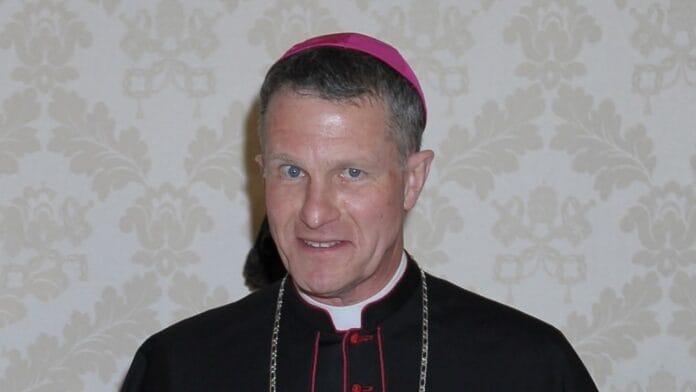
From November 10 to 13, 2025, the Plenary Assembly of the United States Conference of Catholic Bishops (USCCB) will be held in Baltimore amidst internal tensions. This important meeting comes as the current USCCB president, Archbishop Timothy Broglio, completes his three-year term. The election of the new president, as well as the appointment of vice presidents and committee chairs, are central to this assembly.
Internal divisions surrounding Donald Trump
The shadow of Donald Trump looms over this assembly. Some Church figures in the United States are linked to commissions supporting the Trump administration, while other bishops strongly criticize his policies, particularly his restrictive and often harsh approach to the migrants and refugees. This duality illustrates the division within the American episcopate, which is struggling to find a unified voice on this sensitive issue. This situation is exacerbated by public interventions denouncing measures deemed contrary to the human dignity and to the social teaching of the Church, while the Trump administration often dismisses these criticisms.
Migration and sacraments: a key debate
Access to the sacraments for the migrants And the situation of those detained in American detention centers remains a hot topic. Several bishops are concerned that restrictive policies are preventing clergy from fulfilling their pastoral mission, raising crucial spiritual and ethical debates for the Church. This issue will undoubtedly be a key focus of discussions in Baltimore, along with the necessary election of the next USCCB leadership.
Francis's legacy: between hope and challenges for the American Church
François's influence in the USCCB
The legacy of pope Francis strongly influences the context of this assembly. His call to mercy, at the reception of migrants and a Church close to the poor inspires a significant portion of American bishopsFrancis has often criticized American immigration policies, encouraging a focus on humanity and charity, a message that divides some within the episcopate, which is facing internal political pressures.
Leo XIV, the first American pope, and its implications
The election of Leo XIV, first pope American, in May 2025, offers a unique setting for this assembly. Although his contemporaries suggest that his American nationality did not determine his election, the pontificate of Leo XIV could strengthen American influence at Vatican and inject new momentum into the management of the challenges facing the US episcopate. The assembly may also draw inspiration from his speech on unity in diversity and peaceThese are important themes for a country facing internal divisions.
A Church in search of unity and mission
Faced with ideological, economic, and social divisions, the American Church is called upon to rediscover its unity in order to better fulfill its mission. The message of pope François, relayed and purified by Leo XIV, invites us to move beyond divisions to offer credible and effective testimony in a polarized society. A desire to deepen reflection on the reception of migrants and solidarity appears as a possible way out.
Elections and prospects: what future for the USCCB?
The election of the next president: a key moment
At the end of Timothy Broglio's term, the bishops will vote to elect their new president and vice-president, who will take office following this assembly. About ten candidates have been put forward, including bishops known for their diverse positions on social and political issues. This choice will influence the future stance of the episcopal conference.
The challenges facing the committees: from migration to artificial intelligence
In addition to the presidency, key positions will be allocated in six standing committees covering a wide range of topics from migration to ethical issues related to technology, as artificial intelligenceThese committees guide the Church's public stances in the United States, at a historical moment marked by intense social debates.
Towards a New Balance in a Divided America
The USCCB is undergoing a profound transformation, torn between different currents and major external challenges. The November 2025 assembly in Baltimore could be a pivotal moment for defining a new balance, capable of embodying Catholic tradition while responding to contemporary calls for justice, peace, and humanity. The focus on Donald Trump, the management of migration, and theFrançois' legacy will undoubtedly influence future decisions.
Between challenges and hopes, a turning point for the American Church
The Plenary Assembly of American bishops which takes place in Baltimore in November 2025 unfolds in a climate strong tensions, reflecting the deep fractures in American society. Between divisions linked to the figure of Donald Trump, intense debates on immigration policy and the inspiring but demanding legacy of pope Francis, the bishops face a major challenge: that of reconciling their differences to offer a witness of unity, justice and charity in the heart of a polarized country.
The election of the new president of the USCCB marks a crucial step, as it will shape the future of the episcopal conference at a time when the American Church must navigate between fidelity to its teachings and responding to humanitarian and social emergencies. The importance of the message conveyed by Leo XIV, first pope American, also opens the way to a new dynamic, where the call for unity and solidarity could transcend divisions.
Beyond the tensions, this assembly represents a unique opportunity for the bishops to redefine their collective mission, to strengthen their commitment to the most vulnerable, in particular the migrantsand to respond courageously to the ethical and social challenges facing the United States today. The American Church, at the heart of these crucial debates, is thus called to move resolutely toward a future where hope and brotherhood prevail over discord.