












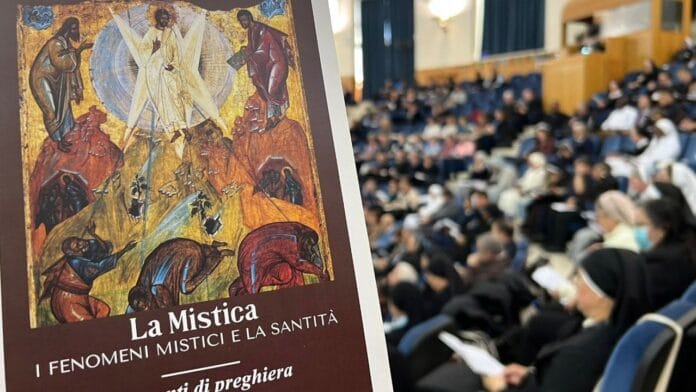
We live in a fascinating era, where spirituality and the search for meaning have never been so intense. At the same time, our culture is enamored with the spectacular. We are captivated by the extraordinary, the inexplicable, the "supernatural." Whether it be accounts of visions, apparitions, levitations, or stigmata, these phenomena attract our attention, inspire devotion, or, conversely, utter skepticism. They make headlines, inspire films, and fuel passionate debates.
At the heart of the Christian tradition, these experiences, often grouped under the term "mystical phenomena," have always existed. They have marked the lives of revered figures, from Francis of Assisi to Padre Pio, including Teresa of Avila. But what place do they truly occupy on the path of faith? Are they the infallible sign of holiness?
It is precisely on this delicate ground that the Pope Leo XIV recently provided some much-needed and wise insights. Addressing experts, theologians, and members of the Dicastery for the Causes of Saints – the «ministry» of the Vatican Tasked with investigating the future saints, the Pope offered a profound reflection. Far from rejecting these experiences outright, he invites us to mature discernment, a crucial reassessment to avoid what he called "superstitious illusion.".
His message is a friendly but firm plea not to confuse the setting with the main plot, the special effects with the film's message. The spiritual life, the true life, the one that leads to holiness, is perhaps far less spectacular than we imagine, and infinitely deeper.
Understanding true mysticism beyond the visible
Before we can separate the wheat from the chaff, it is essential to understand what we are talking about. What is "mysticism"? For many, the word evokes images of monks in trances or seers in ecstasy. The Pope Leo XIV, Drawing on centuries of ecclesiastical tradition, it offers us a much broader and richer definition.
An experience that surpasses us
Mysticism, the Pope, "is characterized as an experience that transcends mere rational knowledge." This is a fundamental starting point. It is not a matter of think to God, to study theology, or to intellectually understand concepts. It is about to experiment of the presence of God, in a way that transcends our senses and our intellect.
This is not something one can "decide" to experience, nor is it the result of a meditation technique or personal effort. It is, by definition, a "spiritual gift." It is God who takes the initiative in the encounter, who reveals himself to the soul in an intimate and direct way. Mysticism is therefore not the privilege of an intellectual or spiritual elite; it is a potential dimension of the faith life of every baptized person, an invitation to a relationship that goes beyond words and ideas.
Light and darkness: the contrasting faces of union
When we think of this «gift,» we often imagine pleasant things: feelings of intense peace, consolation, «luminous visions,» or «ecstasies.» And indeed, this can be part of it. Many saints have described moments of indescribable joy and light.
But the Pope Leo XIV, With great realism, he reminds us that this gift "can manifest itself in different ways," and even cites "opposite phenomena." He speaks of "a dense darkness" and "afflictions." Here, he echoes one of the greatest spiritual masters, Saint John of the Cross, who extensively described the "Dark Night of the Soul.".
This "night" is also a profound mystical experience. It is a state in which the believer no longer "feels" God's presence. Prayer becomes dry, the heart seems empty, and doubt can take hold. The illusion would be to believe that God has left. The mystical reality is that God is acting on a deeper level, purifying the soul of its attachment to... feelings religious to found it on the faith Pure. It is an affliction, yes, but an affliction that hollows out the soul to make it capable of receiving a greater love. Mysticism is therefore not a spiritual "amusement park"; it is a demanding path of transformation.
The purpose of the journey is communion, not side effects
This is where the heart of the clarification lies. Pope. Faced with all these events, whether luminous (ecstasies) or dark (nights), he asks the essential question: why? What is the purpose?
His answer is unequivocal: "the true goal is and always will be communion with God.".
Extraordinary phenomena—visions, inner speech, ecstasies—"remain secondary and non-essential." They may be "signs," "singular charisms," that is, specific gifts bestowed for a time. But they are not the goal.
Imagine you're in a deep, loving relationship with someone. The purpose of this relationship is communion, sharing, mutual love. Gifts, passionate letters, moments of intense emotion are wonderful, but they are... expressions of this love, not love itself. If you start focusing solely on receiving gifts or letters, to the point of forgetting the person, the relationship will be in danger.
The same principle applies to the spiritual life. Mystical phenomena are, at best, "side effects" of the encounter. The danger lies in beginning to seek them for their own sake, collecting them like trophies, and missing the essential point: inner transformation and union of love with God.
The great warning when the extraordinary becomes a trap
It is on this vital distinction that the Pope Leo XIV builds its great warning. Because we are human, and because we are drawn to the marvelous, the risk of going down the wrong path is real. This is the risk of "superstitious illusion".
«Not indispensable»: the Pope’s reframing of holiness
The central message, hammered home by the Pope, is of absolute clarity: "The extraordinary phenomena which may characterize the mystical experience are not indispensable conditions for recognizing the sanctity of a believer.".
This phrase is liberating. It means that holiness is not reserved for those who have visions or stigmata. Holiness is something else entirely. In the examination of candidates for holiness, explains the Pope, What really matters is "their full and constant conformity to the will of God.".
In simpler terms: a saint is someone who has tried, with all their heart, to love God and to love their neighbor, in the concrete circumstances of their life. Holiness is measured by the yardstick of virtues:humility, patience in trials, charity unconditional, forgiveness, perseverance, joy, hope.
Saint Thérèse of Lisieux, proclaimed a Doctor of the Church, is the perfect example of this "holiness without phenomena." She had no grand visions or public ecstasies. She lived her "little way" in the secrecy of her monastery, focusing on small acts of love in everyday life: smiling at an unpleasant sister, performing a thankless task with love, enduring illness without complaint. Her mysticism was that of hidden love, and it is she whom the Church recognizes as a giant of spirituality.
THE Pope This reminds us that holiness can be – and most often is – discreet. It is found in the mother who raises her children with heroic devotion, in the nurse who cares the sick with inexhaustible compassion, in the employee who refuses a dishonest compromise out of loyalty to his conscience. That is the true "stuff of saints".
The "superstitious illusion": what are we talking about?
The danger that the Pope The finger-pointing is "the superstitious illusion." What is it? It's the tendency to reverse priorities.
- It is believing that a person is a saint *because* they have visions.
- It is chasing after the marvelous, thinking that God is there, while neglecting simple prayer, reading Scriptures and serving one's neighbor.
- This gives more weight to a "private revelation" (a vision, an apparition) than to the constant teaching of the Church and the Gospel.
- There is also a risk, for the person experiencing these phenomena, of falling into pride, of believing themselves to be "special" or "chosen," forgetting that while these gifts are real, they are given "not as individual privileges, but... ordered to the edification of the whole Church." A charism is never for oneself; it is for the service of others.
THE Pope invites us to a form of "spiritual common sense." If a supposed phenomenon leads to division, pride, disobedience, or an imbalance in life, there is every reason to be wary. If, on the contrary, it bears fruits of peace, ofhumilityWith increased charity and greater fidelity, he can be regarded with benevolence, but always with caution.
Spiritual masters to the rescue: Teresa of Avila and John of the Cross
To illustrate his point, the Pope Leo XIV He doesn't pull these ideas out of thin air. He draws on the greatest masters of Christian mysticism, who themselves experienced extraordinary phenomena and were the first to warn against their absolutization.
He quotes Saint Teresa of Avila. This great 16th-century Spanish reformer, the first woman Doctor of the Church, experienced ecstasies, visions, and levitations. She spoke of them with disconcerting candor. But after years of experience and discernment (often difficult with her confessors), she arrived at a clear conclusion that the Pope was keen to point out:
«"Supreme perfection does not reside in inner delights, in great ecstasies, visions, and the spirit of prophecy, but in the perfect conformity of our will to that of God, accepting with equal joy the sweet and the bitter, as He wills."»
For Thérèse, the ultimate test is not "What do you have felt "?" but "What's wrong with you?" love Accepting "the sweet and the bitter"—consolation and desolation, health and sickness, success and failure—with equal trust in God's will, is the summit of the mystical life. It is infinitely more difficult and holier than levitating to avoid it.
THE Pope He then mentions Thérèse's great friend and collaborator, Saint John of the Cross. The latter is even more radical. He is the theologian of "purification" and "detachment." For him, clinging to any A gift, even a spiritual one (such as a vision), is an obstacle to total union with God, who is beyond all form, sound, and image.
His teaching, recalled by the Pope, The point is that it is "the practice of virtues" that is the "seed of a passionate availability to God." It is by becoming patient, humble, and loving that our will gradually conforms to God's, "until the lover is transformed into the Beloved." The goal is not to see God, but of become love, as He is Love.
These two giants of mysticism, who have experienced everything, tell us the same thing: don't let yourselves be distracted by the fireworks. The real work takes place in the heart, in the will, in the daily choice of love.
Holiness, a path for all to discern and move forward
The message from Pope Leo XIV This is not merely a warning, but also a tremendous encouragement. By detaching holiness from the spectacular, it makes it accessible to each of us, within the very fabric of our ordinary lives. But this requires a new art of seeing and evaluating: the art of discernment.
The art of discernment, humility, and ecclesial common sense
Faced with a spiritual world filled with ambiguous experiences, how can we avoid falling into "superstitious illusion"? Pope gives two infallible compasses: "a humble discernment in accordance with the teaching of the Church".
THE humble discernmentFirst, it means refusing to consider oneself the supreme judge of one's own experience. If someone believes they are experiencing something extraordinary, the first healthy reaction is not to create a prayer group or start a YouTube channel, but to humbly speak to a wise and experienced spiritual guide and obey their advice.humility and obedience are the surest safeguards against illusion.
In accordance with Church teachingThis means that every experience, every "revelation," must be measured against what the Church has always believed and taught, based on Scripture and Tradition. If a supposed "mystical" message contradicts the Gospel (for example, by preaching hatred, by dispensing...) charity (or by proposing strange doctrines), it is to be rejected without hesitation. God does not contradict himself.
The ultimate criterion is virtue, not vertigo.
For the Church, and in particular for the dicastery that studies the "Causes of Saints", the Pope He reiterated that the central criterion for discernment is not a catalogue of miracles. The heart of the investigation is "listening to his reputation for holiness and examining his perfect virtue.".
The "reputation for holiness" (the fame sanctitatis) is the growing conviction among ordinary people that a person has lived a holy life and is close to God. It is the "flair" of God's people, who recognize authenticity.
«The "examination of his perfect virtue" (or "heroic virtue") is the meticulous investigation to see if the candidate has lived the Christian virtues (faith, hope, charity, prudence, justice, fortitude, temperance) to a heroic degree. Has he forgiven the unforgivable? Has he hoped against all hope? Has he loved radically and constantly? It is this, and not the number of ecstasies, that makes a saint.
The judge's balance: neither fascination nor rejection
THE Pope Leo XIV He asks the "judges" of holiness to demonstrate great balance. He gives them a twofold instruction, full of wisdom.
- Do not promote the causes of canonization uniquely in the presence of exceptional phenomena. That would be falling into the trap of sensationalism. We don't canonize someone *because* they had stigmata.
- Do not penalize these causes if These same phenomena characterize the lives of God's servants. That would be the opposite extreme. If a candidate has, moreover, lived a life of heroic virtue (like Padre Pio or Francis of Assisi), and it so happens that he has Also Having experienced extraordinary phenomena, one should not reject them out of fear of the marvelous. One must "evaluate them with caution," integrate them as an element of one's life, but always keep them in their proper place: secondary to one's charity and obedience.
The most beautiful mysticism: loving every day
Ultimately, the discourse of Pope Leo XIV is a powerful reminder of our universal vocation. In closing, he invited all those working on these issues "to imitate the saints and thus cultivate the vocation that unites us all as baptized Christians.".
This vocation is holiness. And this holiness is found in what the Church calls "intimate union of love with God." This union is the heart of the mystical life, and it is accessible to all.
It is cultivated in the silence of daily prayer, even when it is dry and without "sweetness." It is lived in loyalty to her commitments, day after day. It manifests itself in the patient service of our family, our colleagues, the poor we encounter. It is strengthened in the humble acceptance of our own limitations and the "bitter" aspects of life, uniting them with God.
The message from Pope is ultimately incredibly liberating. It tells us: "Stop looking for signs in the sky. Look at the earth beneath your feet. That is where I am waiting for you. Love where you are. Forgive where you are. Serve where you are."«
Far from extinguishing the mystical fire, the Pope Leo XIV He protects it. He asks us to stop chasing sparks and focus on the warmth of the hearth. The greatest ecstasy is doing God's will. The greatest miracle is loving your neighbor as yourself. And that miracle, with God's grace, is within everyone's reach.