













Gospel of Jesus Christ according to Saint Luke
At that time, Jesus said:
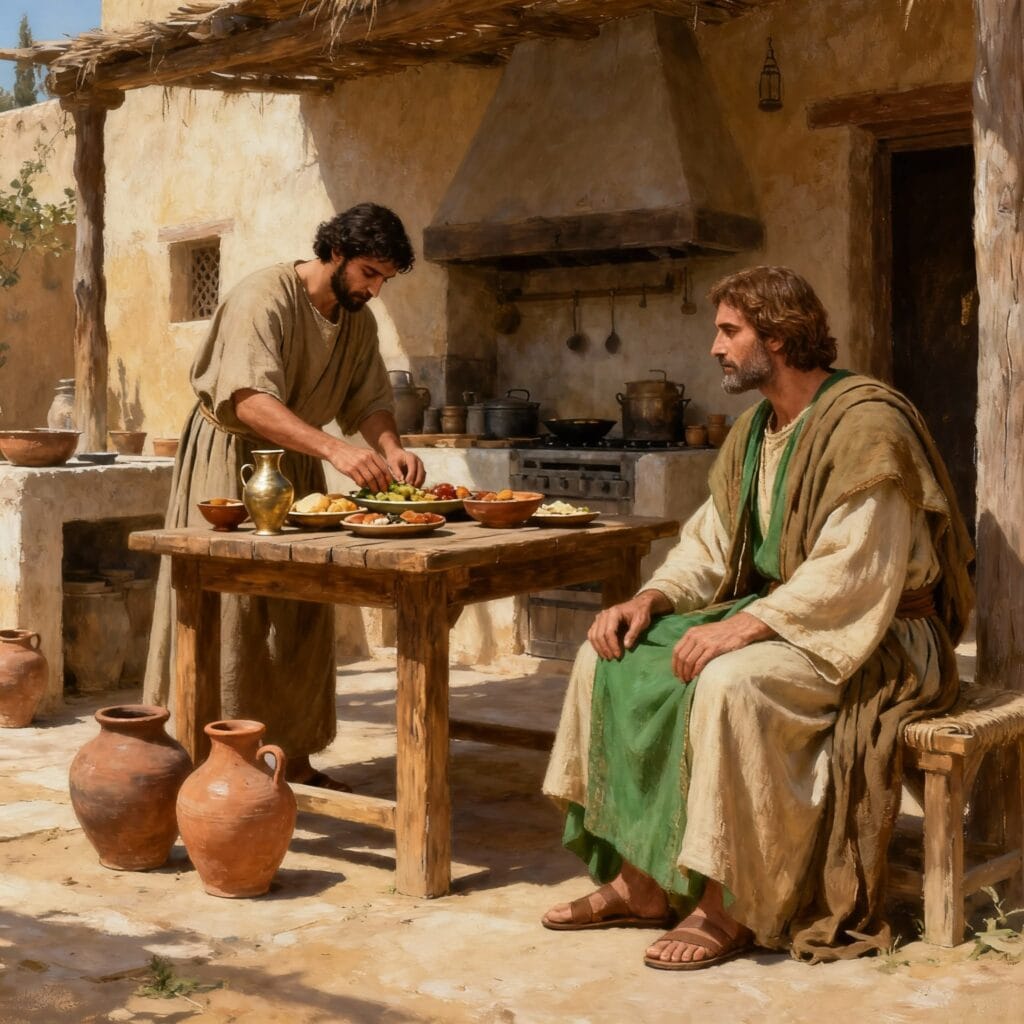
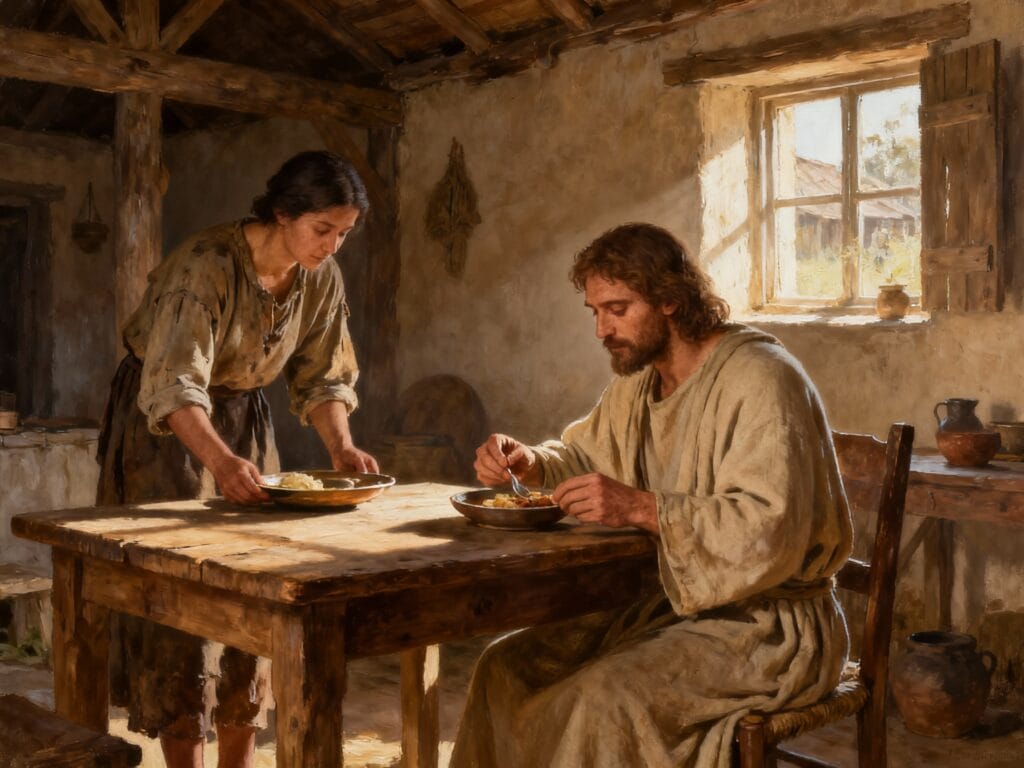
«Which of you, having a servant plowing or tending sheep, will say to him when he comes in from the field, «Come at once and sit down to eat»? Will he not rather say to him, «Prepare my meal, and dress yourself and serve me while I eat and drink; and afterward you may eat and drink»?”
Will he feel gratitude towards this servant because he accomplished what was asked of him?
The same applies to you: when you have done everything you were commanded, say, «We are unworthy servants; we have only done what we were supposed to do.»
Finding fulfillment in service: active humility according to the Gospel
Subtitle: How to understand the vocation of the Christian as a free servant, based on evangelical duty and the filial bond to God.
If the size of the Christianity resides in the mystery of self-sacrifice, so this passage of’Gospel according to Saint Luke, In this passage, where Jesus invites each of us to recognize our humble and selfless service, we are confronted with the true nature of our existence before God: to be servants, and, even more fundamentally, to have "only done our duty." This teaching, far from condemning us to self-effacement, opens us to a life of freedom, profound love, and a call to communion. This text is addressed to those who seek a life where theology illuminates action, faith nourishes daily life, and meaning is found in loyalty to the Word.
- Genesis of the text and biblical context: why and how Luke poses the question of service.
- Theological scope: service, merit, and Christian life.
- Thematic areas (humility, duty, recognition).
- Practical applications in all spheres of life.
- Anchors: traditional readings, spiritual scope.
- Meditative practice and contemporary challenges.
- Liturgical prayer and committed conclusion.
Teaching at the crossroads of duty and relationship
The passage of Luke 17,7-10 fits into a series of teachings on faith, forgiveness And loyalty in the disciple's daily life. Jesus explores the relationship to service: the master and the servant discuss the nature of obedience. But here, the goal is neither reward nor the pursuit of social recognition: loyalty The servant is presented as intrinsically just and necessary—as expressed by the Greek term "achreios" (useless, simple). However, this humility This is not a devaluation but an acceptance of one's place with God, who remains master. The scriptural context links this parable to other passages on active faith: the Apostles ask, "Increase our faith," and Jesus responds with this image, inviting radical service, without expectation of privilege.
This text has been interpreted since the early centuries as a response to the temptation of merit: "All the good we do cannot compensate what we owe to God," wrote Aristotle, a sentiment echoed by Thomas Aquinas in the Summa Theologica. The servant cannot merit God, for every gift received remains infinitely greater than what one can offer. In the Christian tradition, this passage has served to counterbalance overly moralistic interpretations of the disciple: holiness does not arise from calculation, but from giving and freely given service.
The Gospel of John 14,23, with its «If anyone loves me, he will keep my word; my Father will love him, and we will come to him,» introduces the dimension of relationship and reciprocity: God comes to dwell with the one who keeps his word, not as a deserved reward, but as a free and unconditional gift, the fruit of love and loyalty.
Theological scope: Merit, service, and grace
The paradox of divine merit
Through this parable, Jesus explores the question of merit before God. In the Hebrew and Christian traditions, merit is problematic because no one can claim a right before God based on their works. The image of the obedient servant who asks for nothing for having fulfilled his duty is an invitation to enter into the economy of grace: what God gives, he gives freely; no act can buy it. Saint Thomas Aquinas highlights the disproportion between kindness God and our actions render all calculations obsolete: kindness Divine absorbs all possible debt.
The servant is not placed in a state of servile submission: the theology of divine filiation, which is based on John 14,23 invites us to see in all fidelity a response of love, and not a humiliated servitude. The Christian is called to live obedience as an act of freedom and trust, knowing that God always remains the giver of all reality.
The text's interplay between duty and love transcends mere service: God is not a harsh master, but a Father, and it is through loving and keeping his word that the believer gains access to the divine house. Luke's passage does not negate the value of service; rather, it emphasizes the gratuitous nature of the gift, the reality of service as a humble and clear-sighted commitment.
Radical humility and lineage
To be a servant, to be a son
L'’humility The servant is a central theme: it is not self-annihilation, but a lucid understanding of humanity's place before God. Throughout biblical history, the person called by God is a servant (Abraham, Moses, Married). L'’humility Christian Christianity does not imply self-contempt, but the joyful recognition that all life is a gift. humility paradoxically, this allows access to filiation: the servant who accepts his status becomes a son, an heir, when the Word becomes a dwelling place within him (John 14,23).
By declaring themselves "simple servants," the disciples do not reject greatness; they accept being free from all claims: their joy lies in loyalty, not in the conquest of merit. This logic – breaking with that of the ancient world where dignity was acquired through honor and good works – makes the’humility a path towards authenticity and true greatness.
Duty, loyalty, and active loyalty
Duty as creative loyalty
The expression "we have only done our duty" is sometimes interpreted as a condemnation of visible commitment, but the Gospel, on the contrary, invites us to an active, creative fidelity, where duty becomes a space of freedom. The disciple is called to an awareness of the commandment, not mechanically, but as a response to a word given, received, and kept. The Christian's service is daily: working the land, tending the flocks, preparing meals—all ordinary acts, sanctified by loyalty.
This evangelical duty is never passive contentment: it requires inventiveness, vigilance, and the ability to reinterpret daily life in the light of the Word. Thus, Christian commitment is not measured by the quantity of works, but by the quality of their accomplishment.
Recognition and non-expectation
Recognition without expectation of return
One of the major paradoxes of the text is the question of recognition: the master is not obliged to express gratitude for a service rendered, because service is the norm of the relationship. This position may seem unfair, even cold—but it places the heart of Christian commitment not in reward, but in gratuitousness. The believer does not clear the Lord's table in anticipation of retribution, but out of love for Him. loyalty.
This does not mean that God neglects or despises service: in other passages, he promises "then he will gird himself, and have them sit down at the table" (Luke 12,37), a sign that the gift is always received and surpassed in the gift of God. But here, Jesus insists on selflessness: the servant is called to go beyond the expectation of recognition, to enter into the Gospel logic of the "gift without return".
Practical applications in life
To serve without expectation, to love in action
How does this parable unfold in life today? Several spheres are affected:
- Professional life: living responsibility, perseverance, and care in work not for recognition but out of loyalty to an inner calling.
- Family life: educating, supporting, loving without expecting constant return – the Word invites us to an enthusiastic selflessness.
- Social and ecclesial commitment: serving others, in the Church or within society, is the place of charity not calculated.
- Spiritual life: praying, celebrating, studying – every act must be driven by the desire for fidelity, not by the pursuit of an explicit reward.
- Daily life and relationships: in friendship or human relationships, learn to love without setting conditions, to give without measuring what you receive.
The text's encouragement is simple: "Do what needs to be done, and discover in it the freedom of humble service.".
Traditional resonances, sources and spiritual scope
From patristic reading to mystical life
The Church Fathers often reread this text as a remedy against willpower and perfectionism: Basil of Caesarea, John Chrysostom, and Augustine remind us that we are servants, but also friends of God, when the Word abides in us. Thomas Aquinas, as mentioned above, would place this text in tension with the idea of merit: everything is a gift, everything is grace. The medieval mystical current—Meister Eckhart, Teresa of Avila – insists on the simplicity of service: the greatest gift is to love God's will, unconditionally.
Christian spirituality draws from this passage a school of freedom: that of expecting nothing, in order to receive everything. When man ceases to look at himself, he opens himself to the grandeur of the divine gift. The theology of service here converges with the mysticism of dwelling. John 14,23 promises that the Father and the Son come to dwell with the one who loves, whether servant or master. This indwelling introduces into life the miracle of a divine friendship, offered freely.
Practice and meditation exercises
To serve, to meditate, to receive
Here is a step-by-step method, inspired by the text and spiritual traditions:
- Read slowly Luke 17,7-10 each morning, asking for the light of simplicity and of’humility.
- Write down or name each act of service performed during the day, without waiting for thanks or recognition.
- Connect each action to the Word of God, asking: "Is it out of love for God? Is it out of faithfulness to an inner calling?"«
- Meditate on the phrase: "We are mere servants", as a source of freedom, not of erasure.
- Express an inner thanks to God for the gifts received, then to those for whom and with whom one acts, even without explicit return.
- At the end of the week, contemplate the silent reciprocity: God coming to meet the heart that humbly serves him.
Current challenges and nuanced responses
Humble service in the face of a performance-driven society
The text faces several contemporary objections: living without recognition seems impossible in a culture of merit, visibility, and reward. How can motivation be maintained in a world that values only results? The Christian answer is nuanced: while a lack of recognition can lead to weariness, the text invites a shift in perspective: «Do not seek your identity in comparison or reward, but in loyalty to the call received.» It is then a matter of reconsidering the very meaning of success: no longer that which is measured, but that which is received, in peace interior that arises from service.
The challenge also lies in not succumbing to discouragement: the Gospel proposes linking every act, even the smallest, to the source of the original gift. Faced with perfectionism, burnout, and competition, the disciple is called to find another source of energy, that of active faith and the promise contained in the Word made manifest.
Prayer
Prayer of the Joyful Servant
Lord,
Grant me joy to serve without expecting anything other than your presence,
Open my heart to loyalty daily, humble and creative,
Grant me to live each act as an acceptance of your Word.,
May my life become a dwelling place where you come, according to your promise.,
Whether the service, small or large, ordinary or exceptional,
always be a path towards you, without measure or expectation of return.
Amen.
Conclusion: Dare to serve in order to enter into freedom
Luc's visit attracts customers to the self-service area, to the’humility active: the Christian vocation is accomplished in loyalty to the Word, without calculation, in joy The gift, borne by the promise of the divine dwelling place. Righteous action expects no reward; it is its own fruit, a space open to grace, friendship, miracles, and wonder. Dare, then, to serve humbly, and discover that every faithful act builds the dwelling place where God comes to dwell.
Practical
- Read each morning the passage from Luke 17,7-10, by linking it to your own schedule.
- Choose a free service to perform without mentioning it to others.
- Note down each day a Word kept and lived, according to John 14,23.
- Pray for those who serve "in the shadows," at home, at work, in the Church.
- Reread the Fathers' meditations on humble service once a week.
- Offering to God, in the evening, each action accomplished, without expecting reward.
- Take a moment of silence to welcome the promised presence: "We will come to him.".
References
- Gospel according to Saint Luke 17.7-10: source text, translations, commentaries.
- John 14,23: Word from the dwelling, exegetical commentary.
- Thomas Aquinas, "Summa Theologica", Ia-IIae, q. 114, a.1: merit and grace.
- John Chrysostom, Homilies on Luke: Patristic Readings.
- Meister Eckhart, Sermons: Mysticism of Service.
- Basilica of Caesarea, Catecheses.
- Augustine, "Confessions": humility and a full donation.
- Modern commentaries: Michel Quesnel, Passionists of Polynesia, Gardener of God.