











Reading from the first book of the Martyrs of Israel
In those days, the men sent by King Antiochus to force the people to renounce their faith arrived in the city of Modin to organize sacrifices. Many in Israel went to them; Mattathias and his sons joined the assembly.
The king's messengers addressed Mattathias, saying, "You are a respected and influential leader in this city, surrounded by sons and brothers. Go forward first and carry out the king's command, as all the nations have done, the men of Judah and those who remained in Jerusalem. Then you and your sons will be among the king's intimates. You and your sons will be showered with silver, gold, and numerous gifts."«
Mattathias replied in a loud voice: «All the nations that are part of the king’s states may well obey him by abandoning the religion of their ancestors and submitting to his commandments; but I, my sons, and my brothers will remain faithful to the Covenant of our ancestors. Heaven forbid that we should abandon the Law and its precepts! We will not obey the king’s orders, we will not deviate from our religion, neither to the right nor to the left.»
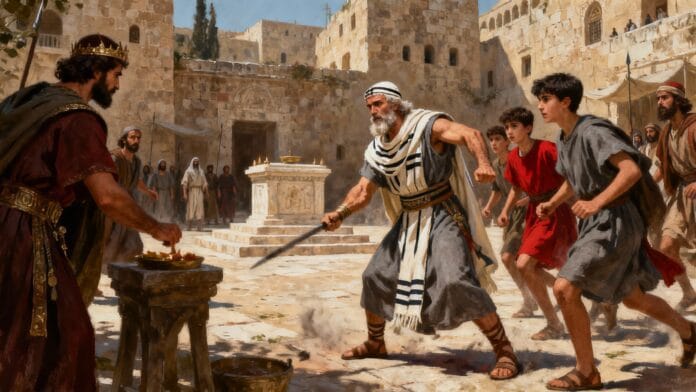
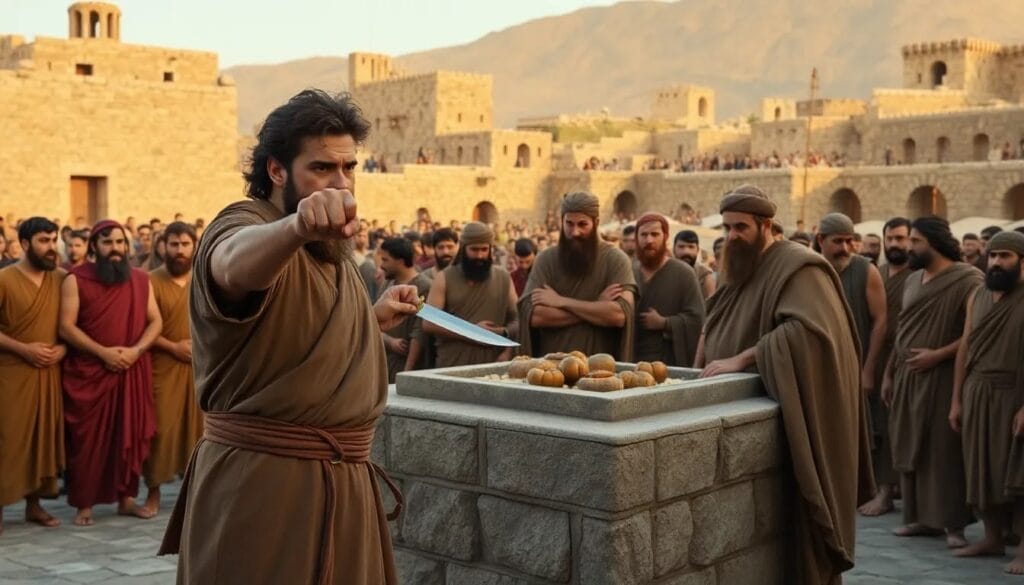
As soon as he had finished speaking these words, a Jew stepped forward to offer the sacrifice, according to the king's command, on this altar at Modin. At this sight, Mattathias was filled with indignation and trembled to his very core; he let righteous anger rise within him, rushed upon the man, and slaughtered him on the altar. As for the king's envoy, who tried to force him to offer the sacrifice, Mattathias killed him on the spot, and then he overturned the altar. He burned with zeal for the Law as Phinehas had burned against Zimri.
Then Mattathias began to shout aloud throughout the city, «All you who are zealous for the Law and uphold the Covenant, let you follow me out of the city!» He fled with his sons to the mountains, abandoning everything they owned in the city. Many of those who longed for righteousness and the Law went to live in the wilderness.
Following the Covenant of Our Fathers: Fidelity and courage in the face of adversity
The power of loyalty to the Alliance despite the persecution.
This famous text from 1 Maccabees plunges us into a crucial moment in the history of Israel where loyalty The divine covenant is severely tested by the apostasy imposed by King Antiochus. Intended for any believer facing adversity, it invites them to understand how the strength of faith and loyalty Following divine commandments allows us to navigate crises. Reading this passage is a source of encouragement and inspiration for strengthening our spiritual journey.
The violent historical context of the ordeal under Antiochus, Mattathias's affirmation of radical loyalty, the analysis of the paradox between civil obedience and religious fidelity, the ethical dimensions of resistance, the patristic tradition on loyalty courageous, and practical tips for living out this loyalty today.
Context
The passage in 1 Maccabees 2:15-29 falls within the tragic period of the Seleucid occupation in the 2nd century BC. King Antiochus IV Epiphanes sought to impose apostasy on the Jews by forcing sacrifices to the Greco-Syrian gods, a symbol of submission to foreign domination and a radical break with the covenant between God and Israel. The scene takes place in Modin, a city where royal envoys attempt to persuade Mattathias, a respected leader, to perform the idolatrous sacrifice. peace and honors. But Mattathias firmly rejects this outstretched hand, loudly proclaiming: "We will follow the Covenant of our fathers," refusing to deviate from the Law, even at the risk of death.
The text emphasizes the importance of unwavering loyalty. Mattathias publicly kills a man who has come to offer sacrifices and the royal envoy, an act that ignites a religious rebellion. He then organizes a mass exodus of the faithful, who swear allegiance to the Law and leave to live in exile in the desert. This narrative is crucial to Jewish history, marking the beginning of the Maccabean resistance, a profound spiritual and political turning point.
The excerpt is situated within both a historical perspective—the struggle for religious identity under oppression—and a spiritual one, illustrating the fight for a living and active faith, inseparable from a community and a collective memory. It is read in liturgical and spiritual contexts as a testimony of total commitment, a call to loyalty Courageous in times of crisis. This scene opens a reflection on the primacy of the divine covenant over the pressures of human power.
Analysis
The central idea of the text is radical fidelity to the Covenant as the supreme act of faith. Mattathias embodies the religious conscience that refuses all compromise, even under the threat of death. His cry, "We will follow the Covenant of our fathers," expresses an unconditional adherence to the Law given by God, manifesting a resistance rooted in historical and spiritual loyalty. This gesture is initially personal, but unfolds into a powerful communal dynamic.
The profound paradox lies in the challenge between obedience to political authorities and loyalty to divine commandments. The text highlights the tension between the legitimacy of an earthly power that imposes injustice and idolatry and the sovereignty of divine Law, which calls for a higher obedience. This dynamic opens a theological space where challenging the political order becomes a legitimate spiritual act.
Existentially, this passage questions the believer about their own place in loyalty He confronts God with social and political pressures, the temptation of denial or compromise. He invites us to recognize that faith is fully exercised in trials, transforming persecution into opportunities for fervent witness. Spiritually, he emphasizes the strength of ancestral memory as the foundation of identity, as well as the importance of a living, evolving covenant.
Faithfulness to the Covenant: a living bond with God
Loyalty proclaimed by Mattathias is rooted in trust in the Covenant, a spiritual and moral bond with God, renewed from generation to generation. This bond transcends historical circumstances to become a foundation of human and religious identity. This theme emphasizes that loyalty is not limited to ritual observance, but is experienced as a living relationship, demanding courage and fidelity in action.
Ethical resistance to injustice
Mattathias's act, violent yet legitimate, illuminates an ethical dimension in the face of oppression. Civil disobedience becomes a moral duty when human laws contradict divine commandments. It is an act of justice, a defense of truth and spiritual life. This principle still inspires us today to discern just causes that call for nonviolent or active resistance.
Community vocation and spiritual mission
The departure of Mattathias and his followers into the desert to preserve the Law illustrates the communal vocation of God's people. This voluntary exodus becomes an act of sanctification and witness. Faith is always a collective journey, and solidarity and resistance are necessary to strengthen the vocation of holiness and the mission to the world. The desert symbolizes a space of purification and spiritual renewal.
Tradition and legacy of courageous loyalty
The Church Fathers often used this story to illustrate the need to remain steadfast in faith, even in the face of oppression or persecution. Saint Augustine Others emphasize the importance of the Covenant as a divine pact that transcends all human authority. In the liturgy, this passage is sometimes invoked to celebrate spiritual heroism, recalling that the Church is always born from courageous acts of witness.
Mattathias is seen as a type of the martyred believer, an inspiring hero of zeal. loyalty generations. Contemporary spiritual tradition sees in this text an invitation to cultivate zeal for the Divine Law, recalling that loyalty is never a simple duty but a path of life valued by the Spirit.
Concrete paths towards loyalty
- Rereading the history of Israel daily helps to anchor oneself in the memory of the Covenant.
- Identify the moments when faith is tested, without seeking to flee from adversity.
- Taking a stand for justice and truth in one's personal and social commitments.
- Seeking a spiritual community to mutually strengthen loyalty.
- Meditating on biblical figures of resistance to nourish courage.
- To practice self-examination regarding one's fidelity to Divine Law.
- To offer moments of prayer dedicated to the fervor for the Covenant.
Conclusion
This passage from 1 Maccabees confronts us with the essence of faith: a radical fidelity to God's Covenant in the face of worldly pressures. It urges us never to compromise divine principles, even when the price to pay is high. This ancient testimony resonates powerfully today, inviting us to inner conversion and renewed commitment. May the strength and wisdom of Mattathias inspire each of us to follow the Covenant of our ancestors with determination and hope.
Recommended practices
- Meditate daily on a passage from the Bible related to the Covenant.
- Follow a biblical journey on resistance and spiritual commitment.
- Practicing prayer to ask for strength in times of hardship.
- To participate in a faith community committed to justice.
- Writing a spiritual journal to express one's personal faithfulness.
- Observe a period of fasting or penance to deepen the experience.
- Recite an act of faith or zeal to the Covenant each morning.