












Gospel of Jesus Christ according to Saint Luke
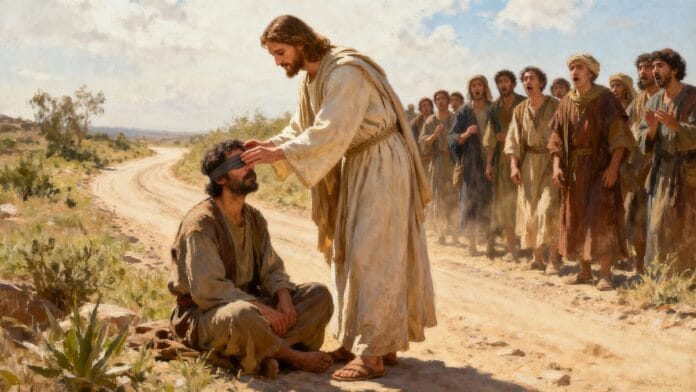
As Jesus approached Jericho, a blind man was sitting by the roadside begging for alms. Hearing a crowd passing by, he asked what was happening. He was told that it was Jesus of Nazareth passing by.
He began to shout, «Jesus, Son of David, have mercy on me!» Those who were walking in front of him rebuked him to be quiet. But he shouted all the more, «Son of David, have mercy on me!»
Jesus stopped and asked to be led to him. When he drew near, Jesus asked him, «What do you want me to do for you?» He replied, «Teacher, I want to see again.»
And Jesus said to him, «Receive your sight! Your faith has healed you.»
At that very moment he regained his sight and went with Jesus, praising God. And all the people who witnessed this praised God.
Dare to cry out to Christ to see the world (and your life) transformed
A biblical and spiritual immersion in the Gospel of the blind man of Jericho to find the light in the heart of our own darkness and finally dare to ask for healing.
This Gospel, it might be yours. It's the story of a man on the margins, marginalized by his disability and his poverty, who refuses to be silent when his only chance passes. It's a story about faith that dares, that persists, and that disturbs. This article is for you if you sometimes feel lost, if you feel that the "crowd" of your worries or the opinions of others prevents you from reaching God. Together, we will explore how this brief but intense exchange between Jesus and this man can become the paradigm for our own prayer and transformation.
- Context: Understanding the tension and setting of Jericho.
- Analysis: Deconstructing the dialogue, from the cry to the healing.
- Deployment: The audacity to shout, the role of the crowd, and the power of Jesus' question.
- Applications: Translating this rediscovered vision into our lives.
- Echoes: The faith that saves and the light of the world (John 8).
- Practice, challenges and prayer: How to make this text a living experience.
«"By the wayside": the setting for the encounter
To grasp the power of this episode, we must first set the scene. Where are we? The evangelist Luke tells us that Jesus «was approaching Jericho.» This is not a trivial detail. Since chapter 9, Jesus has been engaged in a long «journey to Jerusalem» (cf. Lk 9:51). This is not a simple tourist trip; it is a deliberate march toward his Passion, death, and resurrection. The atmosphere is therefore charged with eschatological tension. Every miracle, every teaching along this journey takes on a more serious meaning: the Kingdom of God is imminent.
Jericho itself is a city steeped in biblical history. It was the first city conquered by Joshua upon entering the Promised Land, the one whose walls crumbled to the sound of trumpets (Joshua 6). It is a place of divine victory, but also a place of curse (Joshua 6, 26). It was near there that Elijah was taken up to heaven (2 Kings 2:4-11). Jericho is therefore a "border city", a necessary passage between Galilee and Judea, but also a symbol of God's intervention which overcomes obstacles.
In this context, we find our protagonist: «a blind man was begging, sitting by the roadside.» His situation is one of accumulated hardships. He is blind, which, at the time, was not only a physical handicap but often perceived (wrongly) as a consequence of sin (cf. John 9:2). He is a beggar, therefore dependent on charity public, without social status. And he is "sitting by the roadside": he is on the margins, a passive spectator of life passing by, excluded from the movement.
The Alleluia acclamation that precedes this Gospel in the liturgy, taken from John 8:12 («I am the light of the world…»), illuminates this somber scene. The tragedy of the blind man of Jericho is not merely physical; it is an icon of humanity. seat in darkness, awaiting the "light of life." The scene's significance, therefore, lies not merely in the restoration of two eyes, but in the demonstration that Jesus, on his way to the Cross, is indeed the one who fulfills the prophecies and brings salvation. The encounter is about to begin: humanity, in its utter misery, is on the verge of encountering the Light of the world itself.
«"What do you want?": Anatomy of a life-saving dialogue
The interaction between Jesus, the blind man, and the crowd is a masterpiece of spiritual pedagogy. It unfolds in several key moments, each revealing a facet of faith.
First, there is perception. The blind person cannot see, but they "hear" the crowd. They are attuned to the world. Their disability has sharpened their hearing. They sense that something unusual is happening. They "inquire." They are not passive in their darkness; they seek to understand. This is the first spark of faith: a curiosity, a concern, a desire to know.
Then comes the proclamation. He learns that «it was Jesus of Nazareth who was passing by.» This information is the trigger. The blind man is not content with the information; he transforms it into an invocation. He «cried out.» And what he cries out is not «Jesus of Nazareth,» but «Jesus, Son of David, have mercy on me!» This is a major confession of Christological faith. «Son of David» is a messianic, royal title, awaited by Israel. This blind man, sitting on the margins, «sees» theologically more clearly than many others. He recognizes in Jesus the heir to the promised throne, the one who has the power to restore.
Then came the opposition: «Those who were at the front rebuked him to silence him.» The crowd, the vanguard, the «respectable people» surrounding Jesus, became an obstacle. They wanted decorum, silence. The clamor of this wretched man disrupted the order of the procession. It was a test of faith. How often are our prayers «rebuffed» by our own doubts, by the prevailing cynicism, or even by a religious community that finds our despair too noisy?
Faced with opposition, persistence. "But he shouted even louder." His faith is not a timid suggestion; it is a desperate and tenacious conviction. The obstacle does not stop him; it intensifies his desire. He knows that it is NOW or never.
Divine intervention. «Jesus stopped.» This is the heart of the story. The center of the world, the Word of God on his way to his destiny in Jerusalem, stops for an outcast. A cry interrupts the procession. God stops for the human misery that calls out to him. Jesus «ordered that he be brought to him.» The crowd, which was an obstacle, becomes (probably reluctantly for some) an instrument.
The central dialogue. When the man is there, Jesus asks a surprising question: «What do you want me to do for you?» The question seems absurd. What could a blind man possibly want, if not to see? But Jesus never presumes. He wants the man to articulate his desire, to transform his cry of «pity» (a general appeal) into a specific request. He restores his dignity by making him an active participant in his own healing.
The answer and the healing. «Lord (Kyrie), let me see again.» The man goes from «Son of David» (a messianic title) to «Lord» (a title of divinity, of master). His faith has deepened. He asks for what is essential. Jesus« response is immediate: »See again! Your faith has saved you.« Jesus explicitly links physical healing (»see again«) to spiritual salvation (»your faith has saved you”). The miracle is not magic; it is the fruit of an encounter of faith.
The epilogue. «At that very moment, he received his sight and followed Jesus, praising God.» Healing is not an end in itself. It has two inseparable consequences: discipleship («he followed Jesus») and praise («praising God»). The healed blind man does not return to his former life. He changes course, he leaves the «side of the road» to set out «on the way» following Jesus. And his testimony draws the entire crowd into praise. The outcast has become an evangelist.
The audacity of the cry when faith refuses to be silenced
The first theological focus of this text is undoubtedly the power of the cry. In our modern world, often civilized, imbued with stoicism or modesty, the idea of "crying out" to God seems primitive, even embarrassing. We prefer whispered prayers, silent meditations, polite requests. The blind man of Jericho teaches us a completely different path: that of audacity, of parrhesia (frank and confident speech).
This is not a cry of hysteria, it is a cry of faith. As we have seen, the content of his cry is theology in action: «Jesus, Son of David, have mercy on me!» It is the recognition of the identity of Jesus (the Messiah) and the recognition of his own condition (a sinner in need of mercy). This cry is the ancestor of what the Eastern spiritual tradition will call the «Jesus Prayer» or the « Prayer of the Heart »Lord Jesus Christ, Son of God, have mercy on me, a sinner.«
This cry is a weapon against God's silence, or more precisely, against our perception of his silence. The Psalms are filled with these cries: "Out of my oppressed heart I cry to you, Lord" (Psalm 130), "O God, my God, I call to you all day long, but you do not answer" (Psalm 22The cry is the language of urgency. The blind man has no time for a formal request. He knows that Jesus is "passing by." The opportunity is fleeting.
The theology of the cry is the theology of the decisive moment (kairosThere are times in our lives when polite prayer is no longer enough. There are moments of such dense darkness—a bereavement, a addiction, A depression, a crisis of faith—where the only possible prayer is a raw cry, rising from the depths of the soul. The blind man gives us permission to cry out. He shows us that God is not offended by the intensity of our despair, but that He is, on the contrary, stopped by it.
Moreover, this cry is an act of resistance. The crowd is telling him to be quiet. The crowd represents the voice of "reasonable" resignation. It's the voice that says, "Don't think about it anymore," "That's just the way it is," "Don't bother people with your problems," "God has other fish to fry." To shout "even louder" is to refuse to let this voice of resignation have the last word. It's to affirm that our distress is worth hearing and that whoever passes by has the power to respond. This man's faith is not a gentle tranquility; it is a struggle.
The crowd, obstacle and catalyst: navigating the visible Church
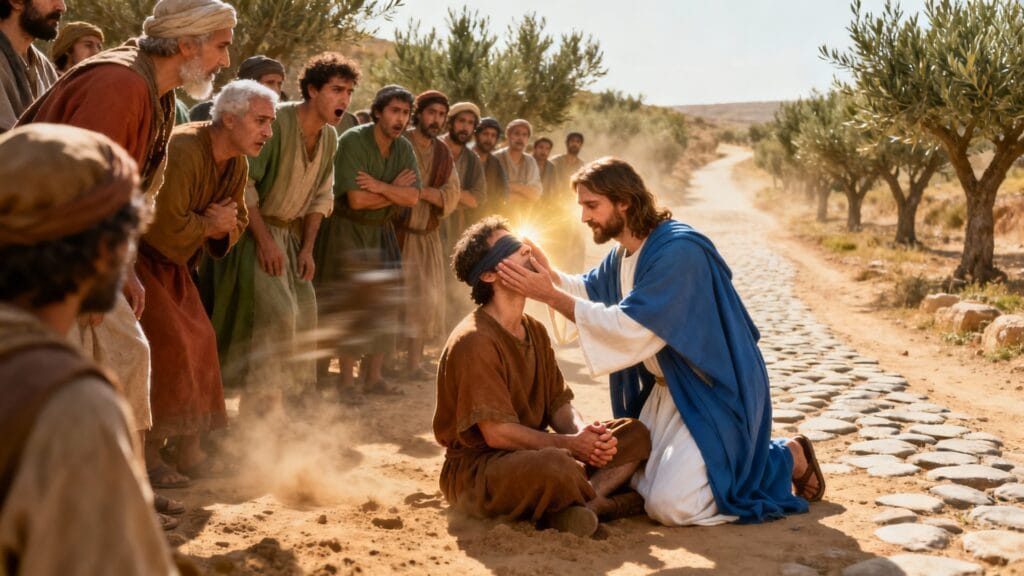
The second thematic axis is the profoundly ambivalent role of the "crowd" (ochlosThis blind man is surrounded by a crowd, and this crowd is, for him, both a source of information and a major obstacle. It is a powerful metaphor for our own experience of community, and more specifically of the Church.
First, the crowd is a catalyst. It is "hearing the crowd passing by" that the blind man is roused from his stupor. It is by asking them for information that he learns the crucial news: "Jesus of Nazareth is passing by." Without the crowd, without this moving community, the blind man would have remained seated, unaware of the opportunity of his life. The community, the Church, is the place where the rumor of Jesus circulates, where the memory of his visits is kept alive, where the Word is proclaimed. It is through the community that we hear about Jesus.
Thus, this same crowd becomes an almost immediate obstacle. "Those who walked at the front rebuked him." The vanguard, the closest disciples (in the parallel text of Mark 10, 48, it is "many" who rebuke him), those who are supposed to be the most "initiated" are the ones who try to silence the cry from the margins. They protect access to Jesus. They have their idea of how one should approach the Master: with order, with respect, certainly not by shouting like a beggar.
This is a scathing theological critique of all our communal "good intentions" that become barriers. When our liturgies are so perfect that they leave no room for the sob of the suffering. When our parish committees are so busy managing the ordinary that they no longer hear the cry of extraordinary need at their doorstep. When our "in-group" of believers becomes impervious to the clamor of those who are "on the margins" of society.
The blind man teaches us not to mistake the crowd for Jesus. He shouts over the crowd to reach Jesus. Our faith must sometimes be robust enough to endure the "rebukes" of the community itself, so as not to let the imperfections of the Church (which is ours) stifle our personal desire for Christ.
However, the story has a happy ending. When Jesus stops and calls the man, it is the crowd that brings him to Jesus. The community, initially an obstacle, is restored to its proper place: that of servant, of mediator facilitating the encounter. And in the end, it is "all the people" who, seeing the result, join the healed man to praise God. The community, initially exclusive, is ultimately transformed and unified by the miracle it had tried to prevent.
What is the title "Son of David"? For a first-century Jewish listener, this title was explosive. It didn't simply mean "descendant of David." It designated the promised Messiah, the Lord's Anointed, who would come to restore the kingdom of Israel, fulfill the prophecies of Nathan (2 Samuel 7), and, according to prophecies like Isaiah 35:5, "open the eyes of the blind." By using this title, the blind man of Jericho made an immense act of theological faith: he identified the itinerant preacher from Nazareth as the fulfillment of Israel's promises. This is why the crowd, who perhaps followed him for his miracles but were not ready for this political and divine proclamation, tried to silence him.
Jesus' question: desire at the heart of faith
The third area of reflection is perhaps the most profoundly moving on a personal level: Jesus' question, "What do you want me to do for you?" This question lies at the heart of the Gospel.
Why does Jesus ask this question? Doesn't the all-knowing Son of God know what a blind man crying for help wants? Of course he does. But Jesus isn't looking for information; he's looking for a confession. He doesn't want a passive patient; he wants a free listener.
First, this question restores his dignity. For years, this man had been an object of pity, defined by his lack. He was given alms without being asked his opinion. Jesus is the first, perhaps in a long time, to address him as a subject, as a person with his own desires and the dignity to express them. By asking him, "What do you want?", Jesus removes him from his status as an object and makes him an active participant.
Next, this question forces us to clarify our desires. Often, our prayers are vague "have mercy." We are unhappy, anxious, lost, and we ask God to fix things. Jesus' question prompts us to introspect: "But deep down, what do you want?" Really "?". The blind man could have asked for money to better cope with his blindness. He could have asked for security. He asks for the impossible: "that I regain my sight." He names his deepest, most radical desire.
This question is posed to us today. In the turmoil of our lives, Jesus stops and looks at us: «What do you want me to do for You Are we capable of answering with such clarity? Do we know what we desire most? Do we simply want an anesthetic for our pain, or do we truly want to "see"?
For in the Gospel, "seeing" means far more than optical perception. It means understanding the meaning of one's life, seeing God's presence in everyday life, seeing others as God sees them, seeing the path to follow. The blind man asks for sight, and when he receives it, the first thing he sees is Jesus. And he follows him. His request was prophetic: he didn't just want to see the world, he wanted to see the way.
The theology of desire is central to Luke. Jesus never imposes himself. He waits for us to formulate our request. For God, who created us free, wants our participation in our own salvation. Faith is not simply believing. that God exists; it is by actively desiring his intervention and daring to name it.
See and follow: The Gospel in our spheres of life
The encounter at Jericho is not simply an ancient historical event; it is a blueprint for our action and transformation. If we take this Gospel seriously, it must have concrete implications in every sphere of our lives.
In our personal lives: This man is "sitting by the roadside." This is an image of our blockages, our inertia, our resignation. Where am I "sitting" in my life, convinced that nothing can change? The Gospel invites us to examine our own blind spots. What are my blind spots? What prejudices, what fears, what addictions prevent me from seeing reality, others, or God, as they truly are? The first step is to dare to "inquire" (What's wrong?) and to "cry out" (Dare to ask God for help).
In our relationships and family life: Are we the "crowd that rebukes" or the one that "leads to Jesus"? When a loved one expresses suffering, doubt, or a cry for help, what is our first reaction? Are we among those who say, "Be quiet, don't exaggerate, it will pass," or are we among those who stop, listen, and try to bring this person face to face with what can save them (whether it be listening, love, or, for a believer, prayer)? Are we an obstacle or a bridge?
In our professional and social lives: The blind person is economically excluded. They are marginalized, dependent. Our world is full of "marginalized" people: the homeless, the long-term unemployed, the isolated, the migrants. «To see,» after encountering Jesus, is to refuse to stop seeing them. It is to develop a «sight» that pierces indifference. Rediscovered faith compels us not only to «follow Jesus» spiritually, but to stop, like him, for those whom the procession of our efficient economy leaves behind.
In our ecclesial life (in the Church): This Gospel is a constant warning for our communities. Are we a place where disruptive "cries" are welcome? Or are we a well-ordered "vanguard" protecting its spiritual comfort? The practical application is to ensure that our structures, our liturgies, and our welcoming practices are designed not for We who are already here, but for the one who is out, in the dark, and screaming.
«I am the light of the world»: theological and spiritual significance
The acclamation (John 8:12) that accompanies this passage from Luke gives it immense theological depth. Jesus says, «I am the light of the world. Whoever follows me will have the light of life.» The episode at Jericho is the enactment of this Johannine declaration.
The theological significance of this healing is therefore threefold: it is Christological, soteriological and ecclesiological.
Christological (Who is Jesus?): Jesus is the Light (Phos). The healing of the blind man is not only a miracle of compassion, it is a "sign" that reveals the identity of Jesus. In the prologue of John, the Light comes into the world, but "the darkness did not overcome it" (John 1, 5). Here, Jesus, the Light, encounters the physical and existential darkness of this man and dispels it. He is the one who inaugurates the new creation, restoring what was broken from the beginning.
Soteriological (How are we saved?): Jesus says it clearly: "Your faith has saved you" (hè pistis sou sesôken seThe Greek verb sōzō It means both "to heal" (physically) and "to save" (spiritually). Luke loves this verb. For him, physical healing is the visible sign of the total, inner salvation that Jesus brings. And the condition for this salvation is faith (pistisBut be careful: faith is not a "good work" which deserved Healing. It's not a payment. Faith, here, is the act of opening your hand, of crying out, of surrendering to mercy of the One who passes by. It is the trust radical that only Jesus can answer the deepest desire. As he says Saint Augustine, Faith is "believing what we do not see, and the reward for that faith is seeing what we believe."«
Ecclesiological (What is the Church?): The miracle is not private. It begins with a public outcry, is challenged by the crowd, and ends with collective praise. «And all the people, seeing this, praised God.» The healed blind man becomes a missionary. His personal transformation has an immediate community impact. He is not saved. of the community; he is saved For The community becomes a catalyst for praise. This is the purpose of every miracle: not only the well-being of the individual, but the glory of God and the edification of the people. The Church is born from these transformative encounters that turn a healed individual into a disciple who praises God and leads others to follow.
Five steps to articulate our desire
This story is an invitation to renew our own prayer. Here is a simple way to meditate on this text, in five steps inspired by the progression of the story, in the manner of a Lectio Divina active.
- Sitting by the side of the road. Take a moment of silence. Don't try to "pray well." Simply accept where you are. Acknowledge your "roadside": your weariness, your confusion, your feeling of powerlessness. Name your blindness.
- Listen to the "crowd". What are the noises surrounding you? The voices of anxiety, the media, the demands of others, your own inner critic? Try to discern, in all this noise, the "rumor" that announces that "Jesus is passing by." Perhaps a word read, a gesture of friendship, a moment of beauty.
- Dare to scream. Let the prayer of the blind man rise from your heart. Do not be afraid of your despair or the intensity of your desire. Formulate it, perhaps even aloud if you are alone: «Jesus, Son of David, have mercy on me!» Repeat it, even if the «crowd» within you (your doubts) tells you to be silent.
- Answer the question. Imagine Jesus stopping. He looks at you and asks you personally, "What do you want me to do for you?" Take the time to let this question sink in. Don't just offer a general "have mercy." What does it mean? in concrete terms For you today? «Lord, may…» (may I forgive this person; may I get out of this addiction ; that I see clearly in this decision; that I have the courage to…).
- Get up and follow. After naming your desire, receive Jesus' words: "Your faith has saved you." Visualize yourself "receiving your sight." What is the first thing you would do if your prayer were answered? The blind man, however, "followed Jesus." Commit to a small, concrete step of "discipleship" and conclude by "giving glory to God," with a time of gratitude for what has been seen and received.
Our modern blind spots
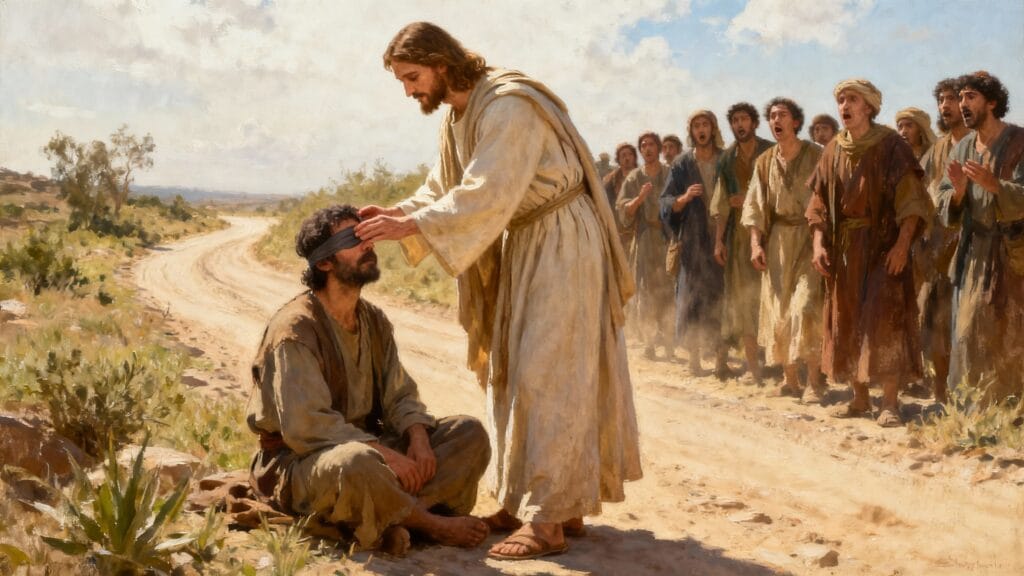
Translating this Gospel today requires naming our contemporary blindness. It may be less physical, but it is just as paralyzing.
The first challenge is that of noise blindness. The blind man hears the crowd and gathers information. We hear the "crowd".« digital We are bombarded with constant information (social media, continuous news updates), but it rarely informs us about "Jesus passing by." It overwhelms us with fleeting emergencies that drown out what truly matters. The challenge is to rediscover selective listening, to silence the noise in order to hear the whisper of the divine.
The second challenge is blindness through self-sufficiency. The man from Jericho is a beggar; he knows he needs help. Our culture values independence, achievement, the self-made man. Admitting one's blindness, crying out for mercy, is perceived as a weakness. The challenge is to rediscover that vulnerability is not a flaw, but the very condition for encountering God. We can only be saved from what we accept we cannot control.
The third challenge is blindness by the ideological "crowd". More than ever, we are being rebuffed by "avant-gardes" who tell us what to think, believe, or say. The polarization of society creates mobs that demand silence from those who don't think like them. The challenge for the blind is to maintain a personal voice of faith, a cry from the heart, that refuses to be intimidated by the prevailing "correctness," whether political, social, or even religious.
Finally, there is the blindness of "reasonable" despair«. Faced with the magnitude of the crises (ecological, wars, injustices), the temptation is to tell ourselves that crying out is pointless, that Jesus "no longer passes by" or that he doesn't stop for such trivial matters. The faith of the blind man, who cries out "even louder" against all evidence, is an act of resistance against cynicism. It is the affirmation that, yes, history is still open and that, yes, God still stops at the roadside.
Prayer for the one who seeks the light
Inspired by Luke 18, 35-43
Lord Jesus, Light of the world, You who pass on our roads, often without us seeing you, You who stop when a heart calls to you, We come to you like the blind man of Jericho.
For those times when we sit by the roadside, resigned to our darkness, unable to move forward, begging for a little love or a little meaning, O Jesus, Son of David, have mercy on us!
For the times when we hear the noise of the world, the passing of crowds, without understanding what is happening, for our lack of spiritual curiosity, O Jesus, Son of David, have mercy on us!
For the grace of those who proclaim to us: "It is Jesus who is passing by," For the witnesses, the Church, the Word that awaken us, Grant us to recognize the moment of your visitation, O Jesus, Son of David, have mercy on us!
When we cry out to you, and the crowd rebukes us, When our own doubts tell us to be silent, When the world mocks our hope, Lord, grant us to cry out even louder!
When weariness overwhelms us and prayer seems futile, When we think you are too far away, too busy, When we no longer dare to disturb heaven, Lord, grant us to cry out even louder!
You who stop for the very last of the last, You whose heart is moved by the cry of the poor, Stop, Lord, at the edge of our lives, And order that we be brought to you.
When we are finally before you, do not leave us in the vagueness of our complaint. Ask us the question that restores our dignity: «"What do you want me to do for you?"»
Lord, may we regain our sight. Sight to our prejudices that blind us, Sight to our children, to see them as you see them, Sight to our brothers and sisters, to see your presence in them. Lord, grant us our sight!
Lord, may we regain our sight. Sight to discern your will in our choices, sight to see the beauty that surrounds us, sight to read the signs of your tenderness. Lord, grant us our sight!
Give us the faith that saves and heals, the faith that is not knowledge, but bold trust. Tell us again today: "Regain your sight!"« And that at that very moment, our eyes are opened.
And when we have seen your face, do not allow us to return to our former place. Grant us the grace to rise, And to follow you, giving glory to God.
May our transformed life, our rediscovered joy, our liberated voice, inspire our brothers, our sisters, and all the people To join us in offering praise to God.
Amen.
From the margins to the center, the call to stand up
The story of the blind man of Jericho is the perfect summary of the Christian path. It begins on the margins, in blindness, poverty and stillness. It is sparked by a rumor, fueled by a desire, and expressed by a cry of faith. It encounters obstacles—not from God, but from men. It triumphs through perseverance.
At the heart of it all, there is a God who stops. Our God is not a distant philosophical principle, nor an indifferent cosmic force. He is a God who, in Jesus, has a face, ears that hear, and feet that stop on the road for a beggar.
The encounter culminates in a dialogue that restores dignity: "What do you want?" God takes us seriously. He takes our desires seriously. He wants us to be partners in our own healing.
And finally, healing is not an end. It is a beginning. The blind man is not simply "fixed" and sent back to life. He is "saved" and called. The end result is not just "I see," but "I follow you." From the margins, he moves to the center of the procession. From passive beggar, he becomes an active disciple. From blind spectator, he becomes a luminous witness.
Today's Gospel pauses and poses the same question to us as it did to that man. In the midst of the noise of our lives, God's procession passes by. Do we hear the clamor? Will we dare to cry out? And if Jesus stops and asks us, "What do you want me to do for you?", will we have the courage to name our deepest desire: not just comfort, but light; not just help, but salvation; not just sight, but THE To see, and to follow Him?
Practical
- Identify this week a "crowd" (a habit, a received opinion, a fear) that is trying to silence my prayer or my desire for change.
- Take 10 minutes to answer in writing the question: "Specifically, what do I want Jesus to do for me today?".
- To perform an act of «discipleship»: to take a step that I put off until later, following my prayer (to forgive, to call, to help).
- To identify a person "on the sidelines" in my circle and, instead of dismissing or ignoring them, to actively listen to them.
- Use the "Jesus Prayer" ("Jesus, Son of David, have mercy on me") as a mantra in a moment of stress or anxiety.
- Giving glory to God: Ending my day by noting a "light" received, a moment when I "saw better", and thanking God for it.
References
- Bible : Gospel according to Saint Luke (not. Luke 18) ; Gospel according to Saint John (notably John 8 and 9); ; Book of Joshua (ch. 6); Psalms.
- Bible commentary François Bovon, L'Gospel according to Saint Luke (15.1–19.27), Commentary on the New Testament (CNT).
- Bible commentary Joel B. Green, The Gospel of Luke, The New International Commentary on the New Testament.
- Patristic : Saint Augustine, Sermons on the New Testament (particularly the sermons dealing with the healing of the blind, where he develops the notion of the inner eye).
- Spirituality : Tales of a Russian Pilgrim (Anonymous), for an exploration of the "Jesus Prayer" (Prayer of the Heart) which stems directly from the cry of the blind man.
- Theology : Karl Barth, Dogmatic, Vol. IV (The Doctrine of Reconciliation), where he explores how Jesus stops for the individual.