

- How Benedict XVI interpreted Jesus' prayer in Matthew 11 as the key to all Christian theology
- What this prayer changes in our way of existing before God
- «To truly know God presupposes communion with God»: the end of a spectator theology
- «Every process of knowledge includes a kind of internal unification»: what this means for our spiritual friendships
- «"The unity of knowledge is possible only because it is the unity of being": why prayer is not an exercise but an existence
- What this meditation leaves us
- Lectio divina
- ✝ Biblical references
25At that time Jesus also said: «I praise you, Father, Lord of heaven and earth, because you have hidden these things from the wise and prudent, and revealed them to little children. 26Yes, Father, I bless you for it has pleased you so. 27All things have been handed over to me by my Father; no one knows the Son except the Father, and no one knows the Father except the Son and anyone to whom the Son has chosen to reveal him.
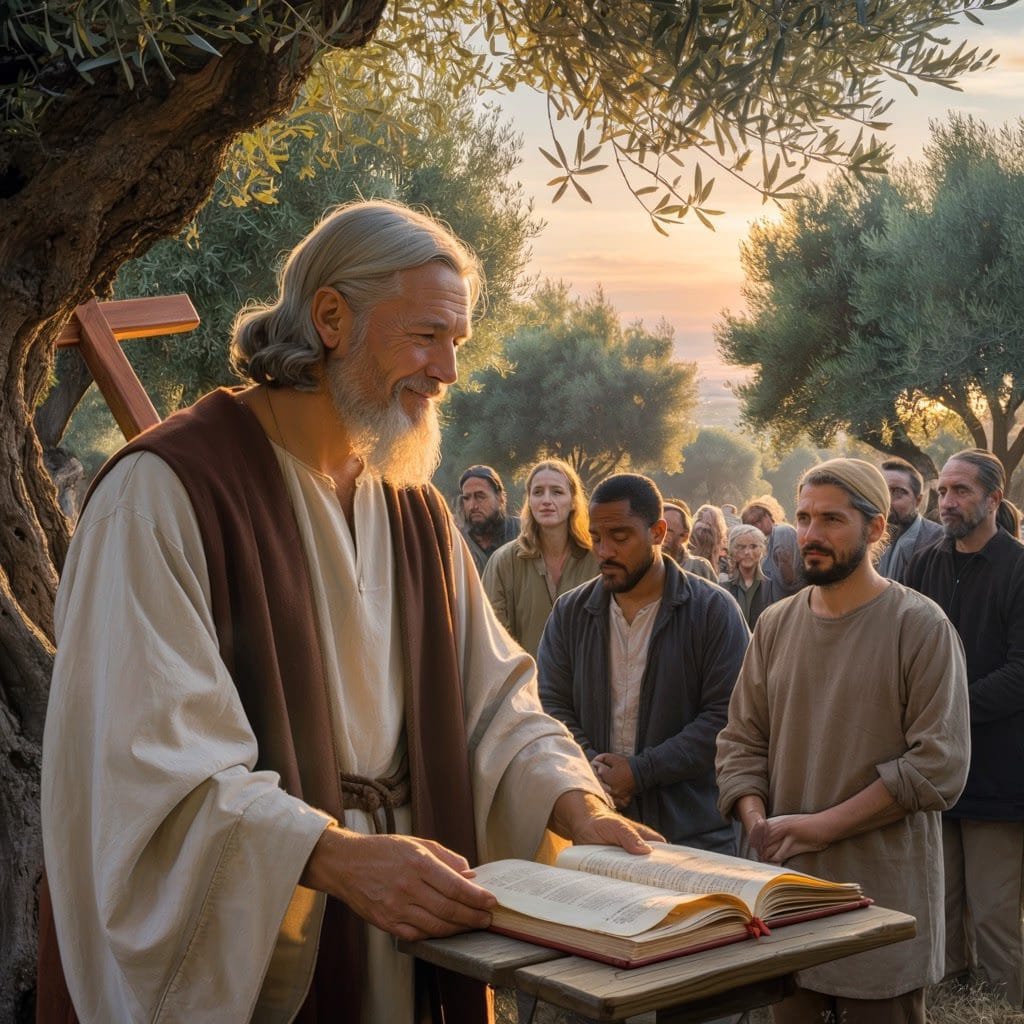
One day, on the road, Jesus lets out a prayer aloud—almost a public thanksgiving. He thanks his Father for having hidden certain things from the learned, the experts, those who already know everything, and for having revealed them to little children, to those who have nothing to prove. Then he adds a breathtaking statement: no one truly knows the Son except the Father; and no one truly knows the Father except the Son—and the one to whom the Son chooses to reveal him. It is a closed, almost secret circle between a Father and a Son, which nevertheless opens, through pure love, to anyone willing to enter it like a child.


How Benedict XVI interpreted Jesus' prayer in Matthew 11 as the key to all Christian theology
There is a phrase of Jesus so profound that it has occupied generations of theologians, and yet it can be contained in a single breath of prayer: no one knows the Son except the Father, no one knows the Father except the Son. Benedict XVI, in the first volume of his *Jesus of Nazareth*, chooses not to comment on this saying as just another doctrinal curiosity, but as the center from which the rest of Jesus' life becomes legible. What the theologian pope sees in this verse, which few see with the same clarity, is that the knowledge Jesus speaks of is not intellectual: it is a way of being, a communion so total that it alone allows us to truly know who the other is. And this changes everything, including for us who have never claimed to know God except through words, catechisms, and sometimes rather lukewarm prayer habits.

We therefore begin with a little-discussed prayer, taken from the Gospel according to Matthew, chapter eleven, verses twenty-five to twenty-seven. Jesus, after speaking to the crowds and encountering the incomprehension of some towns, suddenly turns toward heaven and gives thanks: «I praise you, Father, Lord of heaven and earth, because you have hidden these things from the wise and learned, and revealed them to little children» (Mt 11:25). Then comes the passage that concerns us: «All things have been handed over to me by my Father, and no one knows the Son except the Father, and no one knows the Father except the Son and those to whom the Son chooses to reveal him» (Mt 11:27). It is this twenty-seventh verse that Benedict XVI places, quite literally, at the beginning of his chapter on the prayer of Jesus.
An unexpected figure for a text that one would think was reserved for specialists.
Why choose a pope of the twenty-first century, and not a Church Father, to illuminate a two-thousand-year-old text? Precisely because Joseph Ratzinger, who became Benedict XVI, approaches this text less as a dogmatician than as a praying man seeking to understand how Jesus himself prayed. Jesus of Nazareth is not a treatise on scholarly Christology intended for seminaries; it is, in the author's own words, a book born of a personal search for the face of the Lord, written in the rare free hours of an immense pontificate, and published in 2007 by Flammarion for this first volume, which covers the period from the baptism in the Jordan to the Transfiguration. The book is addressed to anyone who wants to "know Jesus," and its author brings to it his personal faith as much as his exegetical erudition. It is this dual quality — the rigor of the theologian and the interiority of the believer — that makes his reading of Matthew 11 so precious: he does not simply explain a verse, he draws us into a prayer.
What Benedict XVI sees first and foremost is that the word "know" is never insignificant in the mouth of Jesus. We tend to reduce knowing to a mental exercise: knowing a date, a face, a fact. But the Pope reminds us that throughout the biblical tradition, knowing someone implies a closeness of being, not just of information. He states it unequivocally: "To truly know God presupposes communion with God" (Jesus of Nazareth, I, chapter on the prayer of Jesus). This seemingly simple sentence overturns a very modern intuition that one could know God as one knows a subject of study, from the outside, at a safe distance. Benedict XVI says the opposite: there is no knowledge of God without entering, in one way or another, into his life.
He further clarifies, with an almost philosophical formulation that deserves careful consideration: «Every process of knowledge always includes, in one form or another, a process of assimilation, a kind of internal unification between the seeker and the object of their search» (Jesus of Nazareth, I, chapter on the prayer of Jesus). In other words, to know is never simply to observe from afar; it is always, to varying degrees, to become somewhat like what one knows. A musician who truly knows a symphony has not merely listened to it: they have internalized it to such an extent that it now inhabits their way of hearing the world. A mother who knows her child has not merely observed them: she has, in a certain way, absorbed their rhythm, their silences, their manner of being sad or joyful, to the point of recognizing them even before they are expressed. If this is true for knowing a human being or a work of art, how much more so is it true for knowing God himself — an object of knowledge that is not situated at any lower ontological level, but is being itself, the source of all that is.
This is where Jesus' words take on their full significance. If knowing presupposes a form of unity with what one knows, then only someone who is of the same nature as God can truly know him. This is why, according to Benedict XVI, "the unity of knowledge is possible only because it is the unity of being" (Jesus of Nazareth, I, chapter on the prayer of Jesus). The Son does not know the Father as a brilliant student would know a demanding teacher, through study and accumulated merit. He knows him because he is of the same substance as him, because between them there is no distance to bridge through intellectual effort. It is a knowledge that precedes all inquiry, because it is already, from all eternity, perfect communion.
And yet—and this is where the text becomes truly moving for us—this knowledge, once closed off and reserved for the intimacy of the Father and the Son, is opened up. Jesus does not say that this knowledge will remain forever inaccessible to humankind. He says that the Son reveals it «to whomever he chooses to reveal it» (Mt 11:27). Benedict XVI emphasizes this point with a Johannine quotation that illuminates and confirms his interpretation: «No one has ever seen God; the only begotten Son, who is himself God and is in closest relationship with the Father, he has made him known» (Jn 1:18). The Son is therefore not only the one who knows; he is the one who makes known, the one who opens a passage where, without him, there would only be a wall.
What this prayer changes in our way of existing before God
«To truly know God presupposes communion with God»: the end of a spectator theology
This statement by Benedict XVI deserves close attention, for it dismantles a widespread reflex, even among sincere believers: the idea that one could "know more" about God as one might learn more about a subject of history or philosophy. How many of us have accumulated spiritual readings, quotations from saints, explanations of the Trinity, without this changing anything in our actual prayer life? One can recite the articles of the Creed by heart and remain, fundamentally, a stranger to what they signify. This is not a problem of intellect; it is a problem of communion.
Imagine someone who had read every book imaginable on marriage, who knew by heart the statistics on marital happiness, the advice of psychologists, the treatises on fidelity—but who had never lived with someone for twenty years, never shared a bed, a table, or nights of anguish over a sick child. This person would "know" a great deal about marriage. They would not "know" marriage. Benedict XVI tells us that this is precisely the difference between knowing things about God and knowing God: the latter requires inhabiting a relationship, not merely accumulating accurate information.


«Every process of knowledge includes […] a kind of internal unification»: what this means for our spiritual friendships
This second quote invites us to rethink all our relationships, not just our relationship with God. If knowing always implies a beginning of assimilation, then our true friendships—those that truly transform us—are never neutral. We imperceptibly become a little bit of what we spend time with. We adopt the speech patterns of a close friend, their way of seeing a problem, sometimes even their tastes in food or music, without even realizing it. It's an almost physiological phenomenon: spending time with others transforms us.
If this is true of human friendships, it should alert us to our spiritual choices. Spending hours in front of screens that instill anger, comparison, and vanity slowly produces within us an internal unification with this agitation—we become more anxious, more jealous, more superficial, without having consciously decided anything. Conversely, engaging with Scripture, lingering before the tabernacle, slowly rereading a parable, also slowly produces an internal unification—but with peace, with gentleness, with that particular way Jesus has of looking at people. Benedict XVI reminds us, without explicitly stating it, that we become what we assiduously contemplate. Augustine had already sensed this in a more personal and ardent tone: «You have made us for yourself, and our hearts are restless until they rest in you» (Augustine, Confessions, I, 1). This sentence, which opens one of the most widely read books in all of Christian history, says in its own way what Benedict XVI develops as a theologian: we are structurally made for a unification with God, and as long as this unification does not occur, something in us remains restless, unfinished, searching.
«"The unity of knowledge is possible only because it is the unity of being": why prayer is not an exercise but an existence
Here is the most complex quote, the one that demands the most effort, but also the one that is most liberating once understood. If the unity of knowledge presupposes a unity of being, then we understand why only the Son can know the Father with perfect knowledge: there is no ontological distance between them, no gap of a nature to bridge. The Son does not learn to know the Father as a student learns a subject; he knows him because he has always been of the same substance as him.
But then, we might ask with a certain legitimate anxiety, what remains for us, creatures of a radically different nature, made of dust and borrowed breath? It is precisely here that Jesus opens an unexpected breach: the Son wants us to share, by grace, in this knowledge that belongs to him by nature. It is not we who ascend to God by our own intellectual or spiritual powers; it is the Son who descends to us and associates us, as if by adoption, with his own filial relationship. This is exactly what Jesus' prayer suggests when he says that this knowledge is revealed "to anyone to whom the Son chooses to reveal it" (Mt 11:27): it is not a conquest on our part, but a free gift that allows us to enter, in our own way, into an intimacy that was not naturally ours.
This radically transforms our understanding of Christian prayer. Prayer is not primarily about speaking to a distant God to obtain favors; it is about allowing ourselves to be drawn, by the Son himself, into the movement of love that eternally unites him to his Father. When we say "Our Father," we are not uttering a polite formula: we are entering, literally, into the very words of the Son, we are borrowing his filial relationship, we are becoming, for a moment, participants in what he has lived for all eternity. It is a breathtaking audacity, almost scandalous if one truly considers it—and yet it is the central message of the entire Gospel.

What this meditation leaves us
What remains, once we close this dense text on knowledge and communion? First, a certain humility before our own theological pretensions. We can multiply our readings, refine our formulations, debate the nuances of the Trinitarianism, without this bringing us an inch closer to a true knowledge of God, if this knowledge is not accompanied by dedicated time, by an inhabited silence, by a life truly shared with him. Benedict XVI invites us never to confuse the accumulation of knowledge with lived communion—and this is a salutary warning for anyone who loves to read, reflect, and discourse on faith without always taking the time to simply stand before God, silent, like a child before its father.
Then, a profound peace in the face of our limitations. We will never know God as the Son knows the Father—that knowledge belongs to an order of being that infinitely surpasses us. But this is not bad news: it is precisely for this reason that the Son became man, to associate us, by grace and not by nature, with his own filial knowledge. We do not ascend to God by our own strength; we are carried, adopted, introduced. This thought has permeated the entire Christian tradition, from the Greek Fathers to the medieval mystics, who all spoke, each in their own words, of this divinization of humanity made possible by the humanity of the Son. Benedict XVI follows in this long lineage when he insists on the unity of being behind the unity of knowledge: this is not a personal discovery, but the faithful echo of an intuition that runs through twenty centuries of Christian faith.
Finally, a very simple gesture to remember: the next time we pray the Lord's Prayer, perhaps we can recall that these words are not primarily our own. They are those of the Son, which he lends to us, which he makes us say with him and in him. To pray in this way is not to recite a learned formula; it is to allow ourselves, for a moment, to be absorbed in the very movement of the Trinity—to enter, like little children who have nothing to prove, into a secret that was not meant for us and yet is offered to us.
Benedict XVI concludes his meditation on this verse with a sentence that summarizes, without necessary commentary, everything we have just covered: "The unity of knowledge is possible only because it is the unity of being."«
Lectio divina
«No one knows the Son except the Father, and no one knows the Father except the Son» (Mt 11:27).
What are you really looking for when you pray: answers, or a presence? Have you ever noticed that you become a little like those you spend a lot of time with? What would you do differently today if you truly believed that God wants to draw you into his inner circle, and not just answer your requests?
Father, you are hidden from the wise and revealed to little children. Make me small before you, without having to prove anything. Son, lend me your words to address your Father. Make me, for a moment, a partaker of your own knowledge. May I cease seeking you as an object, and may I learn to remain like a child.
A child asleep against his father's shoulder, without a word, without a question, simply there.
✝ Biblical references
2 passages · 2 books
God so loved the world that he gave his one and only Son. (John 3:16)
The Gospel of the Word: a profound theology of the Incarnation and the signs of Jesus.
→ Explore the Codex John- We don't become believers by proving God, but by discovering that he already precedes us.
- You will see the angels of God ascending and descending on the Son of Man (John 1:47-51)
- Why do you do what is not lawful on the Sabbath day? (Luke 6:1-5)
- He sent me to bring Good News to the poor. No prophet finds favor in his own country (Luke 4:16-30)
- This is truly an Israelite: there is no deceit in him. (John 1:45-51)
- When God's love encounters our rejection and yet rebounds
- Before we were found, we were seen: what Nathanael teaches us about grace
- What it means to have been seen before having believed
- You will see the angels of God ascending and descending on the Son of Man (John 1:47-51)
- Why does Jean-Baptiste still disturb the kings of our little lives?
- Bali, Rome, and the light that never goes out: what the Church says to man in the face of the machine
- Jordan 2030: when a land announces baptism before the Church itself
- Jakarta, a bridge city: the Church in Asia faces the temptation of withdrawal
- Becoming bridges in Asia: Synodality as missionary conversion


Behold, I am with you always, to the end of the age. (Matthew 28:20)
The Gospel of the King: Jesus, the new Moses, fulfills the Scriptures for Israel and the nations.
→ Explore the Matthew Codex- Women accompanied them and served them, contributing from their own resources (Lk 8:1-3)
- We played the flute, and you did not dance. We sang a dirge, and you did not weep. (Luke 7:31-35)
- They say, but do not do (Mt 23:1-12)
- Herod sent and beheaded John in prison. John's disciples went and told Jesus (Mt 14:1-12)
- To you it has been given to know the mysteries of the kingdom of heaven, but not to them (Mt 13:10-17)
- The pallium and the face of the Church under Leo XIV: 59 archbishops, 27 countries, a refounding gesture
- The pallium and the cross: what Leo XIV said to the world on June 29
- Humanity as a sacred frontier: Magnifica Humanitas and the digital challenge in Latin America
- The Wounded Heart of a Nation: The Consecration of the United States to the Sacred Heart, a Prophetic Act for a Country at a Crossroads