












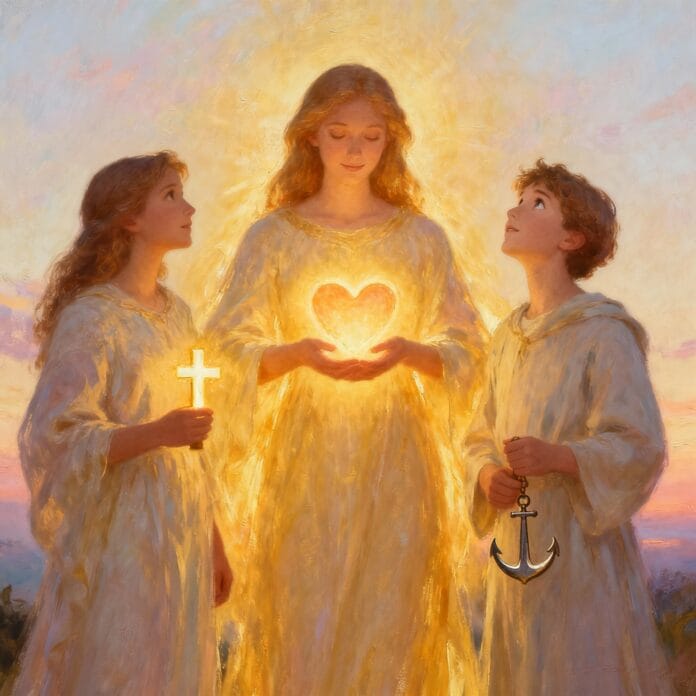
Reading from the first letter of Saint Paul the Apostle to the Corinthians
Brothers,
Aspire fervently to the highest gifts. And now, I will show you the way par excellence.
Even if I speak in the tongues of men and of angels, without love I am only a resounding gong or a clanging cymbal. Even if I have the gift of prophecy and can fathom all mysteries and all knowledge, and if I have a faith that can move mountains, without love I am nothing. Even if I give all my possessions to the poor and give over my body to hardship that I may boast, without love I gain nothing.
Love is patient; love is kind; love does not envy; it does not boast, it is not proud; it does not dishonor others; it is not self-seeking; it is not easily angered; it keeps no record of wrongs; it does not delight in evil but rejoices with the truth; it always protects, always trusts, always hopes, always perseveres.
Love will never fail. Prophecies will cease, tongues will be stilled, and knowledge will pass away. For we know in part and we prophesy in part. But when perfection comes, what is in part disappears.
When I was a child, I spoke like a child, I thought like a child, I reasoned like a child. As an adult, I abandoned what belonged to the child.
Now we see dimly, as in a mirror; then we shall see face to face. Now I know in part; then I shall know fully, even as I am fully known.
And now these three remain: faith, hope, and love; but the greatest of these is love.
The quiet triumph of charity: faith, hope and love at the heart of the present
In a world saturated with rhetoric yet yearning for real presence, Paul's words to the Corinthians remind us of a disarming truth: without love, everything collapses. This article is for those who seek to live their faith in the coherence of daily life—committed believers or those searching for meaning—by giving voice once again to the Pauline triad: faith, hope, and charity. Together, we will rediscover how this hymn transforms the way we believe, hope, and above all, love.
- Context: Paul and the divided community of Corinth
- Central analysis: love, the unifying principle of the body of Christ
- Three pillars: faith that sees, hope that waits, charity who acts
- Living tradition: from the Church Fathers to the liturgy
- Practical suggestions: embodying charity Today
Context
In Corinth, around the year 55 AD, Paul wrote to a young, diverse, and turbulent community. The city, a crossroads of commerce and intellect, was home to a mosaic of believers torn between spiritual pride, social rivalries, and doctrinal arrogance. Some boasted of their extraordinary gifts: speaking in tongues, prophesying, and teaching. In this context, the Letter to the Corinthians becomes a true ecclesial pedagogy: it teaches the hierarchy of the heart.
Paul, a shrewd spiritual strategist, begins by discussing charisms: these varied gifts that the Spirit distributes to the common goodBut he is preparing an inner shift: the "path par excellence" he is about to unveil is not that of miraculous efficacy, but that of inner fruitfulness. The hymn that follows—sometimes called "the song of charity "— is not only poetic; it is performative. It describes a radical transformation of the believing person into a subject of love.
This liturgical text, often read at weddings, nevertheless transcends the domestic sphere. It establishes the universal Christian ethic: to love, not as a feeling, but as a voluntary movement of giving, patience, and joy in truth. Love It is not an emotion, but an architecture of being. Its longevity in the face of faith and hope testifies to an ontological priority: at the end of history, faith will be transformed into vision, hope into possession, but love will remain, for it is already participation in God himself.
Thus, Paul invites us to move beyond the fascination with the extraordinary and to follow the ordinary path of holiness: that of service and self-giving. His thought places love as the ultimate criterion of spiritual discernment — every gift, every knowledge, every asceticism, without charity, becomes sonic emptiness: "a resonating brass". This metallic metaphor is striking: without love, the noise of religion drowns out the music of God.
The unifying power of love
The main idea of the passage is simple: charity is the supreme form of all virtue. It orders faith and hope, transfigures spiritual gifts, and gives the community its organic unity. Where faith believes, and hope waits, charity act now.
Paul develops a paradox here: love is both weak and invincible. Weak, because its logic imposes nothing; invincible, because nothing can alter it. Love Bear all things, hope all things, endure all things. This endurance is not resignation but gentle strength: it coincides with the very creative energy of God.
In Pauline discourse, charity presents itself as Christian maturity. To be an adult in faith means to love unconditionally, like Christ. The child mentioned in the letter symbolizes the search for self through spectacular gifts; the adult man embodies the fullness of lovewho no longer seeks to appear but to give. The conversion Paul calls for is that of spiritual maturity: moving from a self-centered faith to a faith that loses itself in love.
The image of the mirror reinforces this tension between the partial and the perfect. In Greek culture, bronze mirrors reflected an indistinct image. Thus, our current knowledge remains fragmentary, while love It already projects a foreshadowing of the encounter with God. The movement of the text is eschatological: it draws us towards the end, towards the moment when our knowledge will become communion.
Paul therefore does not theorize love He reveals it as a divine reality in action. To love is to participate in the life of God. That is why charity It will never pass away: it is not a mere moral attribute, but an eternal presence at the heart of the world. In a time when everything passes, loving becomes an act of spiritual resistance.
Faith, a perspective rooted in love
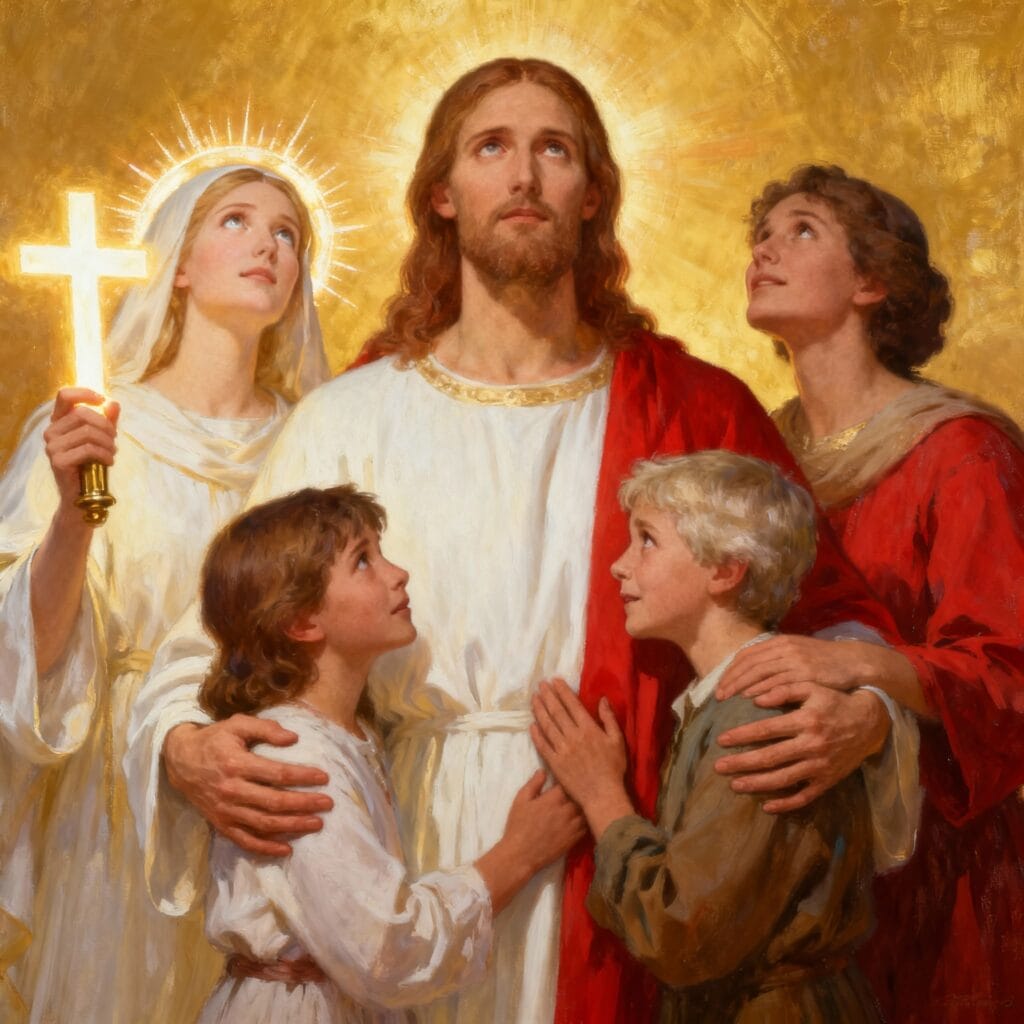
Faith broadens the horizon of the relationship. To believe is to trust before understanding. Paul never separates faith from charity To believe without loving is to transform God into a concept. Authentic faith is a movement of the heart that surrenders to God as he is, not as we imagine him.
This radical trust gives rise to a new way of perceiving the world: with the eyes of Christ. Faith illuminates the stories of others, transforms every encounter into a call, every poverty in a place of revelation. It bases our relationship to reality not on fear but on promise. From this perspective, faith is the breath of the loving soul—not credulity, but the courage to believe in kindness when everything collapses.
Hope, a creative tension towards the future
Hope is born between the already and the not-yet. Paul conceives of it as faithfulness to God's process in time. To hope is not to wait passively; it is to choose to inhabit history as a work of resurrection. Here again, without love, hope is distorted: it becomes escapism, or an empty dream. But with charityIt becomes a beam of perseverance, energy to last through the night.
In Pauline theology, hope is always accompanied by patience. It teaches us to accept God's rhythm, through delays and losses. This virtue dwells in the present without idealizing it, and rejects the despair of the modern world by restoring the promise. It affirms that every "night" conceals a dawn in its nascent stages.
Charity, the concrete face of God among men
Then comes the biggest one, charity : love active. This is not an emotion but a choice. It makes the fruits of faith and hope visible, transforming every prayer into action and every action into an offering. Paul lists attitudes: patience, kindness, humilityJoy in truth. These are not isolated qualities, but a way of being.
The criterion of charityIt is about giving freely. Loving without calculation, helping without boasting, forgiving without reservation—this is the very style of God. In this logic, the Christian is called to become a living sacrament of love Trinitarian. Charity, more than a virtue, becomes a space of incarnation: it is the face that God takes when we draw close to one another.
Tradition and spiritual heritage
The Church Fathers meditated at length on this hymn. Saint Augustine He saw in it the key to all Scripture: "Love and do what you will," he said, not to preach moral anarchy, but to signify that a heart shaped by charity can only desire good. For Thomas Aquinas, charity is the "form of virtues": it unifies them as the soul unifies the body.
The liturgy, by incorporating this passage into wedding celebrations, has placed it at the heart of sacramental life. But beyond marriage, the mystical tradition—of Teresa of Avila Charles de Foucauld recognized in this text the portrait of Christ, poor and gentle of heart. Even today, it remains a criterion for measuring the vitality of a Christian community: not its structures, but its capacity to love.
Points for meditation – Living charity in the present
- Read this passage slowly each morning for a week, letting one sentence resonate with you.
- Identify a difficult relationship: offer a gesture of silent kindness.
- Practicing "active patience": choosing not to respond to anger, but to listen.
- Replace every inner judgment with a prayer.
- Providing an invisible service every day, without talking about it.
- Meditate on the final sentence: «What remains today is faith, hope and charity. »
- Give thanks for every opportunity to love, even if it hurts: it reveals the presence of God.
The gift of love
Paul's final word opens up a dizzying horizon: alone love It transcends time. Faith and hope guide our steps, but love has already arrived, the beginning of the Kingdom. In the performance-driven society, this statement resonates as a reversal: what matters is not spiritual success, but concrete love.
CharityLived in the ordinary, it becomes prophetic: it weaves bonds instead of arguments, it heals instead of explaining. He who loves already gives a face to God. Thus, living according to this text is not an unattainable ideal: it is choosing each day to make love the measure of everything.
In practice
- Take five minutes each evening to review the day from the perspective of charity.
- Read a Gospel while looking for concrete acts of love by Jesus.
- Cultivate gratitude before making any request in prayer.
- Transforming a habit of complaining into a service rendered.
- Keep a journal of the “traces of love” received during the week.
- Meditate once a month on the Hymn to charity as an examination of conscience.
- To perform a gratuitous act without expecting recognition.
References
- First letter of Paul to the Corinthians, chapters 12–13.
- Saint Augustine, From Trinitate And In Epistolam Ioannis ad Parthos.
- Thomas Aquinas, Summa Theologica, IIa-IIae, question 23.
- Holy Teresa of Avila, Path to perfection.
- Charles de Foucauld, Spiritual notebooks.
- Catechism of the Catholic Church, articles 1812–1829.
- Marriage liturgy, Roman lectionary.
- Benedict XVI, Deus Caritas Est.