



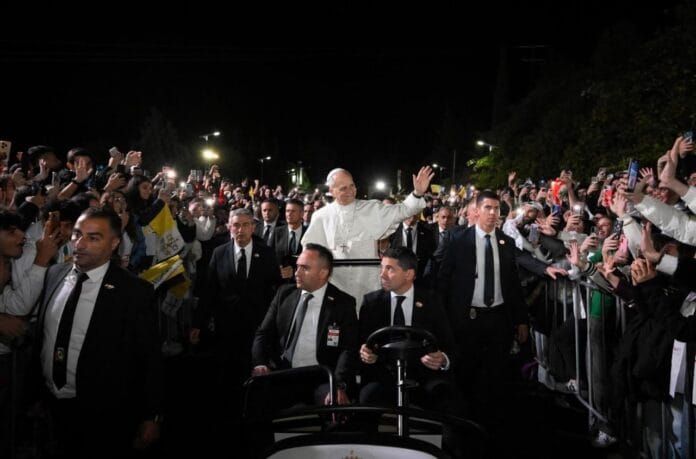
Imagine yourself on the heights of Bkerké, this Monday, December 1, 2025. Night is beginning to fall on the hills overlooking the Mediterranean. You are among 15,000 young people, flags of Vatican and the Lebanon in hand, awaiting the arrival of a man in white. The atmosphere is electric. Chants resonate, smartphones light up in the darkness. And then, he arrives. The Pope Leo XIV, In his Popemobile, he cut through the human tide with a smile that said: "I see you, I understand you, and above all, I believe in you."«
This is not just a pastoral visit. It is a pivotal moment for an entire Lebanese generation that refuses to give up despite the war, The economic crisis and the looming threat of exile. In just a few hours, this first pope American history has succeeded in rekindling a flame that was thought to be extinguished.
A historic encounter in a wounded Lebanon
The context of a visit that could no longer wait
Let's start by setting the scene. The Lebanon what discovers Leo XIV This is not the country of postcards. It is a country on its last legs. Since the devastating explosion at the port of Beirut On August 4, 2020, the country never truly recovered its equilibrium. This catastrophe, which claimed 235 lives and destroyed entire neighborhoods, remains a gaping wound in the hearts of the Lebanese people.
But that's not all. The country is experiencing an unprecedented economic crisis. The Lebanese pound has collapsed, citizens' savings have melted away, and basic services—electricity, water, healthcare—are barely functioning. Add to that the almost daily Israeli bombings, despite a ceasefire signed with Hezbollah in November 2024, and you understand why so many young Lebanese dream of leaving.
It is in this tense context that the pope American – because yes, Leo XIV is the first pope originally from the United States – decided to do Lebanon the second stage of his first apostolic journey, after the Türkiye where he participated in the celebrations of the 1700th anniversary of the Council of Nicaea.
Bkerké, a highly symbolic place
The choice of Bkerké for this meeting with young people is not insignificant. Perched at an altitude of 200 meters, overlooking Jounieh Bay, this site has housed the seat of the Maronite Patriarchate since 1830. It is the spiritual heart of the largest Christian community in the Lebanon.
The road leading there winds through the pine trees, offering breathtaking views along the way. But on that day, a completely different kind of ascent took place: the ascent of hope in the hearts of thousands of young people who came from all corners of the world. Lebanon, but also of Syria, from Iraq, Egypt, Cyprus and even Australia.
By late afternoon, they were there, gathered against the white barriers, waving their flags, their phones raised to capture the moment. The atmosphere was electric, almost festive, contrasting sharply with the gravity of the situation the country was experiencing.
A delirious welcome for a message of hope
When the Popemobile finally appeared in the falling night, there was an explosion of joy. pope, Standing in his open-top vehicle, he waved to the crowd chanting his name. A sea of yellow and white flags of the Vatican mingled with the reds and whites of the Lebanon. The flashes from smartphones created a constellation of lights.
Patriarch Bechara Rai accompanied the pontiff, a symbol of this alliance between the’Universal Church and the local Maronite Church. The two men advanced slowly through the jubilant crowd of young people, taking the time to look at faces, to capture those glances that said: "We need you, we need to be seen."«
Rita, 25, perfectly sums up the general feeling: «I came to witness a historic event. He chose to speak to us, and we must listen to him. We are the new generation; the future of the Lebanon rest.»
A day full of meaning and symbols
But let's rewind a bit. This meeting in Bkerké was just the culmination of a day rich in symbolism. That very morning, Leo XIV had gone to Annaya to pray at the tomb of Saint Charbel Makhlouf, the hermit monk who died in 1898 and whose holiness attracts believers and non-believers of all faiths.
Next, we headed to Harissa and its majestic Our Lady of the Sanctuary. Lebanon, where he met with bishops, priests and pastoral agents. There again, the crowd was impressive, with hundreds of religious figures waving their smartphones in an atmosphere that could almost be described as rock star.
In the afternoon, it was Martyrs' Square in Beirut which was hosting him for an ecumenical and interreligious meeting. The choice of this place, steeped in history and a symbol of the struggles for freedom in Lebanon, was not innocent. Facing the leaders of the country's various religious communities, the pope called for combating intolerance and promoting peaceful coexistence.
And to top it all off, he planted an olive tree – a symbol of peace common to the three monotheistic religions – before flying to Bkerké for this long-awaited meeting with the youth.
Young people determined to believe in the future
Anthony and Maria: Resilience after the explosion
Before the pope Instead of speaking out, four young people were chosen to testify. Their stories alone summarize the ordeal of an entire generation.
Anthony and Maria kicked things off by talking about the explosion at the port of Beirut. You probably remember those terrifying images from August 4, 2020 that went around the world. An explosion of unprecedented power, entire neighborhoods obliterated, thousands injured, lives shattered.
«The suffering was immense,» they confided. But that’s the thing about the Lebanese: they have this incredible ability to transform despair into action. «Beneath the rubble, something unexpected emerged: solidarity, unity, and a renewed sense of civic duty.»
And they weren't just talking. These young people rolled up their sleeves. They cleared the streets, repaired damaged houses, helped the injured, and supported the traumatized. And the most beautiful thing about it all? Suddenly, their community of origin—Maronite, Shiite, Sunni, Druze, Orthodox—no longer mattered. They were all Lebanese. They were all united.
That's the real lesson: in the worst moments, humanity sometimes emerges more beautiful than before. These young people have proven that beyond the religious divisions that plague their country, they are first and foremost citizens united in solidarity.
Elie: to stay despite everything
Then it was Elie's turn. His testimony, more personal, resonates with the reality of so many young Lebanese. He spoke of that little inner voice that constantly whispers to him: "Leave. Save yourself. Go find a better future elsewhere."«
«" THE Lebanon "It never offered me any guarantees, not even the comfort of knowing what tomorrow would bring. The economic collapse stripped me bare," he confided with disarming candor.
Can you imagine living in a country where your savings vanished overnight? Where electricity only works for a few hours a day? Where even buying bread becomes a challenge? This is the daily reality for millions of Lebanese.
But Elie made a choice: to stay. Not out of masochism or lack of opportunities elsewhere. No, he stays because he believes that "difficulties are not an invitation to flee, but a call to reflect more clearly, to love more courageously, and to act for change, even at the cost of less comfort."«
This testimony is powerful because it touches on the heart of a generation's dilemma. On one hand, the legitimate allure of a better life abroad. On the other, the visceral attachment to this land, this culture, this rich and complex Lebanese identity.
The challenge of the brain drain
And Elie is not an isolated case. Tens of thousands of young Lebanese have left the country in recent years. Doctors, engineers, teachers, entrepreneurs – an entire generation of talent is leaving, driven out by the economic crisis and political instability.
This is what is called the "brain drain," and it's a phenomenon that is literally bleeding the Lebanon. Every young graduate who leaves represents a lost hope for rebuilding the country. It's a lost skill. It's a future that slips away.
THE Pope Leo XIV He understood this well. His visit was precisely a message to these young people tempted by exile: "You matter. Your country needs you. And above all, you have the strength within you to change things."«
Stephanie: a message of appreciation
Stephanie Nasr, 25, a tour guide, perfectly summed up what this visit represented for Lebanese youth. "Of course, it's a message of peace, but it's also a recognition of all the resilience we've shown and the solidarity that the Lebanon And young people have shown this in recent years.»
The key word here is "recognition." These young people are not asking for charity. They don't want pity. What they want is recognition for their efforts, their courage, their tenacity in the face of adversity.
They want us to tell them: "We see you. We know what you're going through. And we believe in your ability to turn this ordeal into an opportunity."«
And that's exactly what the pope came to do it.
The Pope's message of hope: changing the course of history
«"Assalamu lakum": starting with peace
When Leo XIV He took the floor, beginning with something simple but deeply symbolic. In Arabic, he exclaimed: "Assalamu lakum!" – "« Peace "Be with you!"»
This gesture is not insignificant. By addressing young people in a local language, even briefly, the pope It showed that he wasn't just passing through. He recognized their culture, their identity. He put himself on their level.
Peace, Indeed, that is the central theme of his entire visit to Lebanon. In a multi-faith country where Christians and Muslims must coexist, where political tensions are compounded by religious divisions, and where bombings serve as a daily reminder of the fragility of the situation, peace This is not wishful thinking. It is a vital necessity.
«"You have time": the advantage of youth
The speech of pope, spoken in English, was by turns encouraging and demanding. He first acknowledged what these young people possess that is most precious: time.
«"There is within you a hope, a gift that now seems to elude us adults. You have time! You have more time to dream, to organize, and to accomplish good."»
It's a truth we too often forget when we're young and feel like everything is urgent. But the pope, With his perspective as a global spiritual leader, he reminds us that youth is a force in itself. Not just because we are full of energy, but because we have decades ahead of us to build, to transform, to improve.
Enthusiasm for changing history
And then came the phrase that captured everyone's attention, the one that made headlines: "You have the enthusiasm to change the course of history!"«
Let's pause for a moment on this statement. The pope He doesn't say "maybe you can improve things." No, he asserts that these young people have the capacity to change the course of history. Nothing less.
This is a huge gamble on this generation. It's an absolute vote of confidence. And that's exactly what these young people needed: for a global moral authority figure to tell them: "Yes, you can. Yes, you will succeed."«
Enthusiasm is that positive energy that drives us to act despite obstacles. It's what makes us get up in the morning with the desire to make a difference. And the pope He told them: keep this enthusiasm safe, for it is your most powerful weapon.
From the root of the cedar to the sap of hope
THE pope He then used a metaphor deeply rooted in the Lebanese imagination: the cedar. This majestic tree is the symbol of the Lebanon, It even appears on their flag.
«"Draw from the roots of the cedar the commitment of those who serve the country, and who do not use it for their personal interest," he said, taking a thinly veiled jab at the corrupt political elites who have ruined the country.
And he continued: "Be the lifeblood of hope that the country awaits!"«
This image is beautiful and powerful. Sap is what nourishes the tree, what makes it live, what allows it to grow. In other words, these young people are not just the future of the Lebanon – they are its current driving force.
Anchoring ourselves in Christ to build peace
Obviously, as a spiritual leader, Leo XIV He did not omit the religious dimension of his message. But he did so in an inclusive and constructive way.
«He, the Living One, is the foundation of our trust; He is the witness of mercy who redeems the world from all evil. It is always in Him and through Him that we have peace. »
Even for the less observant young people or those of different faiths present that evening, the message remains relevant: anchor yourselves in something greater than yourselves, whether it be a faith, values, or an ideal.
And the pope He emphasized a formula: moving from "me" to "you" to arrive at "we." In other words, moving beyond individualism to build together. That's exactly what the Lebanon What is needed: less community selfishness, more national solidarity.
«Together, we will envision a future of peace and development.”
The message from pope It wasn't just spiritual or philosophical. It was also very concrete. He called on young people to "project together a future of peace and development".
The word "project" is important. It implies deliberate action, planning, and a vision. It's not about passively hoping things will get better. It's about rolling up your sleeves and actively building that future.
And the emphasis on "together" is crucial in a country as fragmented as the Lebanon. Development will not come from a single community succeeding at the expense of others. It will come from a collective, cross-community effort, where everyone contributes.
The support of the universal Church
Before concluding, the pope wanted these young people to know one essential thing: they are not alone.
«"Be assured of the support of the entire Church in the decisive challenges of your life."»
It is a promise of presence and support. The Catholic Church, with its 1.3 billion faithful worldwide, stands with these few million Lebanese who are struggling for their survival and dignity.
It is no small thing, when you feel abandoned by your own political leaders, to know that a thousand-year-old institution supports you and believes in you.
Beyond words: symbolic gestures
But the pope He didn't just come with speeches. Earlier in the day, during the interfaith meeting in Martyrs' Square, he had planted an olive tree.
This simple yet powerful gesture resonated with all the traditions present. The olive tree is revered in the Christianity, Judaism and Islam. It symbolizes reconciliation., peace, prosperity.
By planting this tree, Leo XIV This was a concrete act of hope. This olive tree will grow, take root, and produce fruit – just like, it is hoped, the seeds of peace sown during this visit.
In his first apostolic journey, heavy with meaning
It should be emphasized that this visit to Lebanon was part of the very first apostolic journey of Leo XIV. His predecessor, the pope François had already planned this trip to celebrate the 1700th anniversary of the Council of Nicaea in Türkiye, but it's Leo XIV who brought this project to fruition.
The fact that he chose to include the Lebanon —and to dedicate three whole days to it—sends a clear message: this country matters. These Eastern Christians, whose presence dates back to the very origins of Christianity, They matter. This wounded but determined youth matters.
For his first major international trip, a pope could choose easier, safer, more prestigious destinations. Leo XIV He preferred to go where he was most needed. That's entirely to his credit.
The reaction of the authorities and public holidays
Moreover, the Lebanese authorities clearly understood the importance of this visit. They declared two public holidays for the occasion. Imagine: in a country in deep economic crisis, they decide to put the economy on hold to welcome the pope.
This shows just how crucial this moment was considered. It wasn't just a protocol visit. It was a national event, a moment of unity that the country desperately needed.
President Joseph Aoun, the first Christian head of state to lead a predominantly Muslim country, received the pope upon his arrival at Beirut. All political and religious leaders mobilized. Even those who usually disagree on everything found common ground: to honor this papal visit.
The impact on interreligious dialogue
Nayla Tabbara, president of Adyan – an NGO that has been working since 2006 to bring communities closer together – stressed that this meeting «highlights the fact that the Lebanon has extensive experience in the interreligious dialogue »".
And it's true. Despite all its difficulties, the Lebanon remains a unique model in the Middle East: a country where Muslims and Christians coexist, mix, sometimes marry, share neighborhoods, schools, and workplaces.
This model is fragile, admittedly. It has been put to the test by the war civil war of 1975-1990, then by the successive crises of recent decades. But he is holding firm. And the visit of pope came to remind us why this model is worth preserving: because diversity is an asset, not a threat.
The challenges that remain to be addressed
Of course, a papal speech, however inspiring, is not going to solve the problems of the Lebanon. The young people who were in Bkerké that night will wake up the next day facing the same challenges: lack of electricity, shortages, rampant inflation, unemployment, regional tensions.
But what this encounter brought them was something perhaps more precious in the long term: the conviction that they are not alone, that they have value, that they can make a difference.
Father Farid Saab, head of communications for the Maronite diocese of Beirut, [Name], who was present at the meeting, spoke of the profound emotional impact on the participants. There were tears, smiles, faces transformed by emotion and renewed hope.
Why this message resonates particularly today
In a world where young people often feel powerless in the face of global crises – climate, economy, conflicts – the message of Pope Leo XIV offers a powerful antidote: collective action guided by values.
He didn't tell them "everything will magically turn out all right." He told them "you have what it takes for things to get better, provided you work together and don't lose your enthusiasm along the way.".
It's a message of empowerment, as the English say. A message that gives back the power to act to those who felt powerless.
The next steps of the visit
This meeting in Bkerké was, in fact, only the penultimate day of the papal visit. On Tuesday, December 2nd, Leo XIV was still to visit the Croix hospital in Jal el Dib, then to pay his respects in silence at the site of the port explosion Beirut.
This moment of silent prayer was particularly anticipated. Three years and four months after the disaster, the truth about the causes of the explosion has still not been established. The victims' families are demanding justice. pope, By his presence, he would show them that their pain was not forgotten.
Finally, a large mass on the seafront of Beirut was to conclude this historic visit. Tens of thousands of faithful were expected for this final celebration, facing the Mediterranean which represents both the opening of the Lebanon towards the world and its thousand-year history as a crossroads of civilizations.
What we can all learn from this meeting
You don't need to be Lebanese, Christian, or even a believer to learn lessons from this meeting in Bkerké.
The first lesson is that in the darkest moments, human solidarity can work miracles. Remember Anthony and Maria, who spoke of this outpouring of solidarity after the port explosion. When everything collapses, it is our shared humanity that becomes our greatest strength.
The second lesson is that staying and fighting to improve one's community, even when leaving would be easier, is a courageous choice that deserves to be celebrated. Elie reminded us of this: sometimes, true heroism lies not in grand, spectacular actions, but in the daily decision not to give up.
The third lesson is that young people have immense power that is too often underestimated. They are not "the future" in the sense that we have to wait for them to grow up. They are already agents of change in the present, capable of changing things now, with their energy, their creativity, their fresh perspective.
What if we applied this elsewhere?
Think about your own situation. Perhaps you don't live in a country at war or in the midst of a major economic crisis. But you may be facing other challenges: a struggling business, a divided community, a project that seems impossible.
The message from Pope Leo XIV This applies equally: you have within you the enthusiasm necessary to change the course of history. Not world history perhaps, but the history of your family, your neighborhood, your organization.
Start by shifting from "me" to "we." Instead of asking yourself, "What can I gain?", ask yourself, "What can we build together?" This simple shift in perspective can change everything.
Surround yourself with people who, like these young people in Bkerké, reject cynicism and defeatism. Seek out those who, despite the difficulties, retain their ability to dream, to plan, to act.
And above all, remember that you don't need to be perfect to begin. These young Lebanese are not superhuman. They are like you and me, with their doubts, their fears, their moments of discouragement. But they have chosen not to let these difficulties define them.
The legacy of that evening in Bkerké
Years later, those who were present in Bkerké on December 1, 2025, will remember that evening as a turning point. The moment when a pope The newly elected American came to tell them what their own political leaders had failed to convey: you matter, you are capable, and your country needs you.
Some of these young people may become the future leaders of Lebanon – in politics, in business, in civil society, in the Church. Others will remain ordinary but engaged citizens. All will have been marked by this message of hope and responsibility.
And who knows? Maybe in ten or twenty years, when the Lebanon will have overcome its current crises – for it will overcome them, it has already done so in the past – this papal visit will be remembered as a catalyst, a moment when a generation decided to take its destiny into its own hands.
Lebanon, a symbol of a universal struggle
Ultimately, what makes this story so powerful is that it transcends the boundaries of Lebanon. This small Mediterranean country of 5.8 million inhabitants is becoming the symbol of a universal struggle: that of global youth against a world in crisis.
All over the world, younger generations are inheriting problems they didn't create: climate change, colossal public debt, growing inequality, endless conflicts. And everywhere, they are tempted either by resignation or by escape.
Bkerké's message is that there is a third way: collective commitment guided by hope and concrete action. Not a naive optimism that would deny the difficulties, but a clear-eyed determination to build despite everything.
Your homeland – whatever it may be – will flourish again
THE pope He even told the young people: "Your homeland will flourish again." This is not an empty promise. It is a historical reminder. Lebanon has gone through terrible ordeals in the past – wars, occupations, crises – and it has always come out the other side.
This resilience is not automatic. It doesn't come from geography or chance. It comes from people who, generation after generation, have refused to give up. It comes from young people like those in Bkerké who, despite everything, choose to believe and to act.
And this lesson applies to any country, any community. Your "homeland"—whether geographical, professional, or communal—can flourish again if you and others like you decide to make it flourish again.
One last word on enthusiasm
Let's end on this note that the pope has been emphasized so much: enthusiasm. Etymologically, «enthusiasm» comes from the Greek «enthousiasmos», which means «divine transport» or «divine inspiration».
In other words, enthusiasm isn't just about being happy or excited. It's about being driven by something greater than oneself. It's this energy that pushes us to surpass ourselves, to attempt the impossible, to reject the status quo.
The young people of Bkerké received permission, even encouragement, to cherish this enthusiasm. In an often cynical adult world, where you are constantly told that "it's not possible," "it's always been like this," "you'll understand when you're older," it is an invaluable gift.
And the good news? You can cultivate, protect, and nurture this enthusiasm. How? By surrounding yourself with inspiring people. By celebrating small victories. By keeping your capacity for wonder alive. By refusing to let failures stifle your desire to try again.
That evening in Bkerké will go down in history as a moment when a global spiritual leader chose to believe in young people rather than lecture them. When he chose encouragement over moralizing. When he chose to tell them "you can" rather than "you must.".
THE Pope Leo XIV did not solve the problems of Lebanon in one evening. But he did something perhaps even more important: he rekindled a flame of hope in the hearts of thousands of young people. And who knows what these young people, armed with this enthusiasm and conviction, will accomplish in the years to come?
As Rita, 25, said: "We are the new generation, the future of the Lebanon "rest." And thanks to this moment in Bkerké, these young people now know that they do not carry this burden alone. The world is watching them. The Church supports them. And above all, they support each other.
History will judge whether this generation truly succeeded in "changing the course of history" for their country. But one thing is certain: after that December night in 2025 on the hills above Bkerké, they at least have the conviction that they are capable. And sometimes, it is that conviction that makes all the difference.