







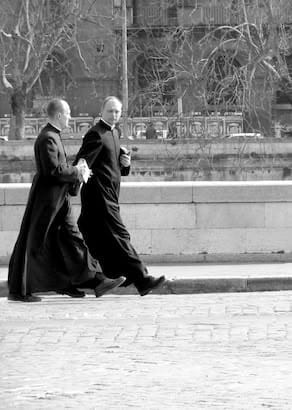
Imagine for a moment: you've been a bishop for years, respected in your community, steeped in centuries-old tradition. And then one day, you make a decision that will change everything. You resign, you cross a five-century-old theological boundary, and you start all over again… as a simple priest. That's exactly what hundreds of Anglican pastors and bishops have done in the last thirty years. Their destination? The Roman Catholic Church.
This phenomenon, long overlooked, has just been quantified by a surprising study. The figures speak for themselves: nearly 500 priests ordained in England between 1992 and 2024 were previously Anglican pastors. And this is just the tip of the iceberg. It represents a veritable exodus, discreet yet massive, that is redrawing the religious map of the United Kingdom.
But why? Why do men and women of the Church agree to start all over again, often giving up positions of power and prestige? And above all, what does this movement tell us about the state of the Christianity British today? Let's delve into this fascinating story that blends personal convictions, institutional upheavals, and societal transformation.
A wave of conversions that is shaking up the British religious landscape
These figures are staggering.
Let's start with the basic facts. The Saint Barnabas Society, an organization that supports former members of the clergy Other Christian denominations published a bombshell study at the end of November. Based on the meticulous archives of Bishop John Broadhurst, himself a former Anglican bishop who became a Catholic priest, this research reveals a startling reality.
More than 700 names. That's the number of priests from the Anglican Churches of England, Wales, and Scotland who have joined the Catholic Church in just over three decades. Among them, 486 have been ordained Catholic priests and 5 have become permanent deacons. But the most striking thing? Sixteen former Anglican bishops appear on this list. Sixteen people who held the highest offices in their Church and who have left it all behind.
Stephen Bullivant, professor of sociology at St. Mary's University in London, makes no secret of his astonishment: "The figures are far greater than most people imagine." And what surprises him most is not so much the absolute number as the proportion. Indeed, about a third of the Catholic priests recently ordained in England come from the Anglican Church. A third! It's as if the British Catholic Church is partly rebuilding its ranks thanks to… its historical rival.
Heartbreaking personal journeys
Behind these statistics lie profound human stories. Take the case of Jonathan Goodall. On March 12, 2022, this man, who had been an Anglican bishop just a few months earlier, knelt in Westminster Cathedral to be ordained a Catholic priest. A simple priest, even though he had previously led the Diocese of Ebbsfleet. It's a bit like the CEO of a major corporation deciding to resign to become a team leader at a competing company.
Goodall doesn't explain his choice by any bitterness. On the contrary, he speaks of "entering into full Catholic communion," as if he had found what he had long been searching for. And he is not alone in this. Andrew Burnham, one of his predecessors at the head of the same diocese, made exactly the same decision in 2011.
What is striking about these journeys is the’humility that they demand. These men do not change their faith out of ambition or to obtain a better position. On the contrary, they accept a form of voluntary demotion. An Anglican bishop who becomes a Catholic priest loses his title, his authority, his status. It is an act of pure faith, guided by an inner conviction.
David Waller perfectly embodies this dynamic. Converted in 2011, he is now Bishop of the Ordinariate of Our Lady of Walsingham, a special structure created by Rome to support Anglicans entering communion with the Catholic Church. His story illustrates how the Catholic Church has been able to build bridges to facilitate these transitions.
The pivotal years that changed everything
Two periods stand out clearly in this saga of conversions. They correspond to moments of rupture for the Anglican Church, moments when the lines shifted irreversibly.
1994: The earthquake of women's ordination
That year, thirty-two women were ordained priests by the Bishop of Bristol. A historic first for the Anglican Church. For many, it was progress, a necessary opening. But for others, it was a break with tradition. More than 150 members of the clergy Anglicans then chose to break with their Church and embrace Catholicism.
Understand this clearly: this is not necessarily about opposition to women in the clergy As such. For many of these pastors, it's a matter of fidelity to what they consider the unbroken apostolic tradition. They believe the Church does not have the power to alter certain fundamental aspects of the faith. It's a complex theological debate, but one with very real consequences for the lives of these men and women.
2010: Benedict XVI's visit, a spiritual tsunami
Sixteen years later, another event would trigger a new wave. In September 2010, the pope Benedict XVI is making a historic four-day visit to the United Kingdom. This is only the second time that a pope travels to Great Britain (the first being John Paul II in 1982). The stated objective? To bring Catholics and Anglicans closer together.
The impact is considerable. In the year following this visit, more than 80 members of the clergy Anglicans are joining the Catholic Church. Some are even talking about a "tsunami." But this visit didn't come out of nowhere. It was preceded, a few months earlier, by a major legal act: the apostolic constitution "Anglicanorum Coetibus.".
This document, promulgated in 2009, authorizes the creation of "personal ordinariates" for Anglican faithful who wish to join the Catholic Church collectively. In practical terms, this means they can retain certain elements of their liturgy and tradition while entering into full communion with Rome. It's like building a bridge with access ramps on both sides.
The Ordinariate of Our Lady of Walsingham, established in 2011, is one such structure. It allows former Anglicans to live their Catholic faith while maintaining ties with their spiritual heritage. It is a solution that is both pragmatic and theologically sophisticated, recognizing the richness of the Anglican tradition while affirming the unity of the Catholic Church.
The underlying reasons for an unprecedented exodus
A theological identity crisis
To truly understand this movement, one must grasp the tensions that have run through Anglicanism for decades. The Anglican Church, born from a break with Rome in the 16th century, has always been a kind of "via media," a middle way between Catholicism and Protestantism. This middle ground has long been its strength, allowing it to accommodate a wide diversity of perspectives.
But this very diversity is now becoming problematic. How can unity be maintained when some consider themselves quasi-Catholic (the "High Church") while others lean towards evangelical Protestantism? Debates on the ordination of women, same-sex marriage, and sexual morality are creating deep divisions.
For those who join Rome, there is often a sense of regaining doctrinal coherence. Catholicism offers a magisterium, a clear teaching authority. Some find this reassuring after navigating the murky waters of Anglican debates. As Stephen Bullivant notes, "Many realized that God had a plan for them, and part of that plan was for them to do this."«
Spiritual, not political, motivations
It would be tempting to reduce these conversions to disagreements on social or moral issues. But the testimonies of those involved tell a different story. Most insist that they do not reject their Anglican past. Rather, they speak of an inner calling, a search for spiritual fulfillment.
Jonathan Goodall, for example, explained that he was acting "in response to the Lord's call" and not "out of rejection" of what he had "known and experienced within the Anglican Church." This is an important distinction. These men and women are not slamming the door in anger. They are crossing a threshold respectfully, often with the pain of leaving a community they love.
Many speak of a quest for unity. Catholicism represents for them the’Universal Church, that which transcends national and cultural boundaries. In a fragmented world, this promise of unity exerts a powerful attraction. It's like moving from a regional network to a global one, with all the connections and sense of belonging that this implies.
Others mention the appeal of sacramental continuity. The Catholic Church claims an unbroken apostolic succession dating back to the first apostles. For some Anglicans, this continuity offers reassurance, an anchor in a two-thousand-year-old tradition. It's a bit like joining a family whose genealogy traces back to its origins.
The catalytic role of scandals and crises
Nor can we ignore the crisis facing the Anglican Church. The sexual abuse scandals, which have also affected the Catholic Church, have shaken the faith of the faithful. But in the Anglican case, these are compounded by other controversies: internal divisions on social issues, declining church attendance, and church closures.
Benedict XVI's visit in 2010 took place against a backdrop of the Catholic Church itself being "mired in sexual abuse scandals," as the study notes. Yet, this did not prevent conversions. Why? Perhaps because converts are not seeking a perfect Church (they know it doesn't exist), but rather a Church that seems to offer them a more stable theological and spiritual framework.
Some observers also speak of a weariness with the incessant debates. Anglicanism, with its synodal and democratic system, can sometimes give the impression of being more preoccupied with discussing than with praying. For those who aspire to a spiritual life centered on the liturgy and the sacraments, Catholicism, with its emphasis on Tradition and the Magisterium, may seem more restful.
The generational factor
A fascinating aspect of this phenomenon concerns generations. One might expect that conversions would primarily affect older priests, attached to tradition. But the data suggests a more complex reality.
The study shows that these conversions span three decades and affect different generations. Some are experienced priests who lived through the changes of 1994 and never truly recovered. Others are younger, having entered the Anglican ministry after these upheavals, but who ultimately felt out of step with the evolution of their Church.
What unites these generations is often an attachment to what is called the Anglican "High Church," a tradition that has always maintained a liturgical and theological closeness to Catholicism. For them, taking the step towards Rome is not a leap into the unknown, but rather the culmination of a spiritual logic already present in their practice.
Catholicism is experiencing a renaissance in the United Kingdom
The game-changing numbers
The arrival of these hundreds of Anglican priests is not happening in a vacuum. It is part of a broader trend: the astonishing growth of British Catholicism. And here again, the figures are staggering.
A study published in April 2025 by the Bible Society, entitled "The Silent Awakening," reveals a dramatic transformation. In 2018, 3.7 million English and Welsh adults (81% of the population) attended church at least once a month. By 2025, this number has risen to 5.8 million, or 121% of the population. That's an increase of 56% in just seven years!
Read these figures again calmly. In the 21st century, in a secularized Europe where churches are emptying, British Catholicism is experiencing double-digit growth. It's as if, while everyone was predicting the end of religion, something completely unexpected was happening.
The silent revolution of the younger generations
But the most striking statistic lies in the figures for young people. Brace yourselves: 411% of young Britons now identify as Catholic, compared to only 201% who identify as Anglican. Let this information sink in. The country's historical religion, that of the king or queen, the one enshrined in the institutions since Henry VIII, is being overtaken by Catholicism among young people.
How can this phenomenon be explained? Several factors combine. First, immigration. The United Kingdom has welcomed many immigrants from recent decades. Poland, from Italy, Spain, Latin America, the Philippines, Africa… Many are Catholic and pass on their faith to their children.
But immigration doesn't explain everything. Conversions are also observed among native-born Britons. Catholicism holds a particular appeal for some young people seeking structure, tradition, and liturgical beauty. In a fluid and ever-changing world, the Latin Mass, incense, processions, and saints offer tangible points of reference.
Social media also plays a surprising role. Charismatic Catholic priests amass tens of thousands of followers. Catholic podcasts are wildly popular. A "traditional Catholicism" aesthetic is developing, with its own visual and cultural codes. For some young people, being Catholic is becoming almost… cool. It's counterintuitive, but it's an observable reality.
Anglicanism in decline: a reversed mirror
While Catholicism is growing, Anglicanism is declining. The figures are undeniable. Attendance at Anglican services has been steadily decreasing for decades. Churches are closing, being converted into apartments, pubs, or concert halls. Dioceses are merging due to a lack of resources.
This decline has multiple causes. The general secularization of British society obviously plays a role. But there are also factors specific to Anglicanism. Its status as an established church, linked to the monarchy and institutions, can make it appear dusty and disconnected from people's real lives.
Its internal divisions also undermine its credibility. When two bishops of the same Church disagree on fundamental issues (marriage, sexual morality, the nature of Revelation), how can the faithful know what they are supposed to believe? This doctrinal confusion pushes some toward Catholicism (which offers clear answers) and others toward evangelical churches (which offer a strong sense of community).
The conversions of Anglican priests to Catholicism are therefore part of a broader movement. They are not an accident, but a symptom of profound transformations in the British religious landscape.
Towards a historic turning point?
In light of these trends, some observers are making a bold prediction: Catholicism could soon overtake Anglicanism and become the largest religious denomination in the United Kingdom. If current trends continue, this shift could occur within the next decade.
Imagine the implications. The country that separated from Rome in the 16th century, that persecuted Catholics for centuries, that built its national identity partly in opposition to Catholicism, would see it regain its majority status. This would be a historical reversal of considerable magnitude.
Of course, we must remain cautious with projections. Trends can reverse. The Anglican Church could reform and regain its appeal. British Catholicism could face its own challenges (scandals, internal tensions, difficulty integrating its growing diversity).
But one thing is certain: we are witnessing a major recomposition of the Christianity British. The conversions of Anglican priests are only one facet of this transformation, but they are also a powerful symbol. They show that even in our secularized societies, the religious question remains alive, dynamic, and capable of surprising us.
What this tells us about our time
Beyond the British case, this phenomenon sheds light on contemporary spiritual aspirations. In a world marked by fragmentation, uncertainty, and a proliferation of choices, some seek an anchor. They want to belong to something that transcends them, that has endured through the ages, that does not change with the whims of fashion.
Catholicism, with its centralized magisterium, its two-thousand-year-old tradition, and its global presence, offers this stability. For some, it is stifling. For others, it is reassuring. Anglican priests who make the switch are often among those who prefer clarity to ambiguity, tradition to innovation, and unity to diversity.
This does not mean that Catholicism is static. The Catholic Church also has its debates, its tensions, its evolutions. But it offers a more structured framework, a clearer hierarchy, a more defined doctrine. In an era where everything seems negotiable, where truth becomes subjective, where everyone is invited to construct their own personalized spirituality, this firmness can be appealing.
The challenges ahead
This growth of British Catholicism and the influx of Anglican priests inevitably raises questions. How will the Catholic Church manage this increasing diversity? Personal ordinariates are a creative solution, but can they function in the long term without creating a two-tiered Catholicism?
How can we train and support these priests who often arrive with their families (Anglicanism permits priests to marry)? Catholic priestly celibacy remains the norm, but these converted priests can be ordained while remaining married. This creates a unique situation that requires pastoral and canonical adjustments.
And then there is the question of integration. These former Anglicans bring with them a different church culture, specific liturgical practices, and a particular theological sensibility. How does all this fit together with traditional British Catholicism, itself marked by centuries of minority status and sometimes persecution?
The British Catholic Church must also avoid premature triumphs. Growth is undeniable. But it must not obscure the immense challenges: integrating immigrants, training priests, maintaining religious practice over time, responding to abuse scandals, and engaging with a largely secularized society.
A testimony for the whole Church
What is happening in the United Kingdom has repercussions far beyond its borders. It is a laboratory that can inform us about the future of the Christianity Western. The conversions of Anglican priests show that the desire for truth, tradition, and communion remains strong. They also testify to the possibility of religious renewal even in the most secularized societies.
For Anglicanism, this is obviously a major challenge. How to retain its members? How to reconcile tradition and modernity? How to maintain unity in diversity? These are questions also being asked by other Protestant denominations, which are facing similar tensions.
For Catholicism, this is both an opportunity and a responsibility. The opportunity to welcome men and women of deep faith, theologically trained and pastorally experienced. But also the responsibility to accompany them wisely, to create appropriate structures, and to maintain unity while respecting legitimate diversity.
And for all of us, believers or not, it's a reminder that religion is not a relic of the past destined to disappear. It remains a fundamental dimension of the human experience, capable of reinventing itself, surprising, and mobilizing. The 500 Anglican priests who converted to Catholicism bear witness to this: faith can still move mountains, or at least, cross borders.
The story is not over. Every week, new Anglican priests take the plunge. Every Sunday, thousands of new British Catholics attend Mass. The "silent awakening" continues, far from the spotlight, in the quiet of parishes and the depths of conscience. What we are witnessing today may be the beginning of a new chapter in British religious history. A chapter that reminds us that even in our hyper-connected and ultra-modern world, the oldest questions—Who am I? What do I believe? Which community do I belong to?—remain as relevant as ever.