










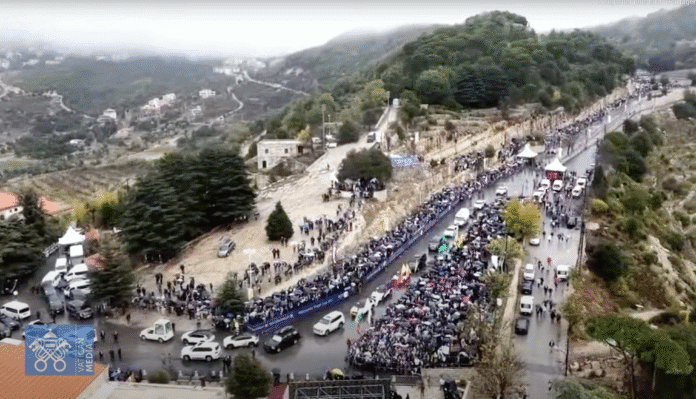
Imagine a country on the brink of collapse, where power outages punctuate daily life, where the currency has lost 98% of its value, where hospitals lack medicine. A magnificent country, scarred by crises, awaiting a sign of hope. It is in this context that Leo XIV settled in Beirut November 30, 2025, for a 48-hour visit that could mark a turning point.
As soon as he stepped off the plane, the pope sent an unequivocal message to the Lebanese political authorities: it's time to serve the people, not your personal interests. A direct, almost brutally frank speech that contrasts sharply with the usual diplomacy of the Vatican.
A country in search of its bearings
The explosive situation in Lebanon
To understand the importance of this visit, one must first understand where the Lebanon Today. The country is going through its worst crisis since the war civil period of 1975-1990. The economic collapse plunged 801,300 of the population below the threshold of poverty. Banks are drastically limiting withdrawals. Queues outside gas stations stretch for miles.
But it's not just about money. It's a complete crisis of confidence in the political class. The Lebanese no longer believe in their leaders, whom they accuse of widespread corruption and incompetence. The confessional system, meant to guarantee a balance between the different religious communities, has transformed into a machine for distributing positions based on religious affiliation rather than competence.
Why Lebanon is crucial for the Church
THE Lebanon is not a country like any other for the Vatican. It is the only Arab country where a Christian can become head of state. Christian communities have been present there since the early centuries of the Christianity. The Maronites, in particular, maintain very strong historical ties with Rome.
But these Christian communities are in danger. Since the 1970s, their proportion in the population has steadily declined, from around 501 to less than 301 today. The mass emigration of young Christians, who leave to seek a better life in Europe, to Canada or in Australia, gradually emptying the country of its religious diversity.
For the Catholic Church, the Lebanon It represents a symbol: that of peaceful coexistence between Christians and Muslims in the Arab world. If this model collapses, it is an entire vision of the interreligious dialogue which wavers.
The pontiff's high-profile arrival
The arrival of Leo XIV did not go unnoticed. First, there was the minor technical incident: the ITA Airways plane had to be repaired the day before departure. During the short press conference on board, the pope dropped a media bombshell by announcing his intention to visit Jerusalem in 2033. This date is not insignificant – it will mark the 2000th anniversary of the crucifixion and the resurrection of Christ.
But it was his speech at the presidential palace that caused the biggest sensation. Contrary to what is generally expected of a diplomatic visitor, Leo XIV He didn't beat around the bush.
A speech that stirs consciences
The central message: serve, not help yourself
«"You must dedicate yourselves to serving the people and the common good," he insisted. pope before the assembled Lebanese authorities. This seemingly simple formula is in reality a full-fledged indictment against the local political class.
When Leo XIV He speaks of "service," not in a metaphor. He directly targets the clientelistic practices that are rampant in the Lebanese political system. In this country, obtaining a job in the civil service, a priority electricity connection, or even a simple building permit often requires "wasta"—political influence.
This culture of favoritism, the pope He denounces it outright. For him, a leader is not there to distribute favors to his relatives or his religious community. He is there to serve all citizens, without distinction.
A call for collective responsibility
The speech of Leo XIV He doesn't just point fingers. He calls for a collective awakening. The Lebanese leaders, he essentially says, bear a historical responsibility. They hold in their hands the future of a country once considered the Switzerland of the Middle East.
This reference to the glorious past is not nostalgic. It aims to remind us that the Lebanon It has the human, cultural and economic resources to bounce back. What's lacking is the political will to put the general interest before particular interests.
THE pope He particularly emphasized the importance of youth. Hundreds of thousands of young Lebanese have left the country in recent years, taking with them their energy, their skills, their dreams. "How can you accept that your children must go into exile to have a dignified life?" the pontiff asked.
Beyond words: a diplomatic strategy
But be careful, Leo XIV He is not naive. His speech is part of a broader diplomatic strategy. By addressing the political authorities directly, he is sending several simultaneous messages.
To the Lebanese Christians, he said: «You are not alone. The Vatican "Do not abandon you." This is important because many Christians in the East feel abandoned by the West, which they believe is not doing enough to protect their presence in the region.
To other religious communities, he sends a signal of dialogue. pope does not come solely to defend Christian interests, but to plead for a Lebanon a pluralistic approach where everyone finds their place.
On the international stage, his speech aims to draw attention to a crisis that the world seems to have forgotten. Lebanon no longer makes headlines like it did in the past the war civil or the explosion at the port of Beirut in 2020. However, the situation remains critical.
The challenges of a visit to a minefield
Navigating between communities
Organize a papal visit to Lebanon It's a delicate balancing act. The country has 18 officially recognized religious communities. Each has its own sensitivities, demands, and fears. Vatican had to prepare for this visit for months, weighing every word, every encounter, every gesture.
The Maronites, who make up the country's main Catholic community, had been eagerly awaiting this visit. For them, the arrival of the pope It is a recognition of their historical role and a show of support during a difficult time. But Leo XIV He also had to meet with other Christian communities – Greek Orthodox, Greek Catholic, Armenian – so as not to offend anyone.
And then there are the Muslims. The Lebanon It includes both Sunnis and Shiites, whose relations are sometimes strained. pope had to send signals of openness without appearing to proselytize, which would have been poorly received.
The explosive regional context
The visit to Leo XIV This comes at a particularly tense regional time. The Middle East remains a powder keg where simmering conflicts can ignite at any moment. The Palestinian question remains unresolved. Tensions between Israel and its neighbors persist. Iran and Saudi Arabia are engaged in a war of influence.
THE Lebanon is directly affected by these regional dynamics. Hezbollah, a Shiite movement supported by Iran, has become a major political player in the country. Its presence and military arsenal worry a segment of the population, who fear that the Lebanon be drawn into conflicts that are not his own.
THE pope He therefore had to choose his words carefully. Too much leniency towards one side or the other could have compromised his position as a moral mediator. Hence his choice to focus on the humanitarian message: serving the people, protecting the weak., building peace.
The Jerusalem announcement: a masterstroke
His announcement of his intention to visit Jerusalem in 2033 is not insignificant. By choosing this symbolic date – the 2000th anniversary of Christ's Passion – the pope It sets the bar very high. It is a distant horizon, certainly, but one that sets a goal: to make 2033 a year of reconciliation in the Middle East.
Jerusalem is at the heart of all conflicts. A holy city for the three monotheistic religions, it is a focal point for tensions. By announcing his intention to go there, Leo XIV sends a message of hope: peace It is possible, dialogue must continue, holy places can be shared in mutual respect.
It is also a way of saying to the Christians of the East: "I will return to this region. You are not forgotten." This promise of a return, even in eight years, is important for communities that sometimes feel abandoned.
The concrete expectations of the Lebanese
Beyond symbols and speeches, the Lebanese expect concrete action. They hope that this papal visit will draw international attention to their situation and unlock aid. Vatican can play a facilitating role, using its diplomatic influence to encourage foreign powers to support the Lebanon.
Christian communities also hope for financial support for their institutions – schools, hospitals, charities – which play a crucial social role but lack resources. These institutions serve not only Christians ; They welcome patients and students of all faiths. Their survival is essential to maintaining the social fabric of Lebanon.
Many are also waiting for the pope It uses its moral weight to encourage political reforms. Lebanon has been stalled for years by political squabbles that prevent any progress. The election of a president, the formation of a government, the adoption of budgets: everything is subject to endless bargaining.
The ecumenical and interreligious dimension
A papal visit to Lebanon cannot ignore the ecumenical dimension. Relations between Catholics and Orthodox have seen significant progress in recent decades, but theological differences persist. pope was to meet with the leaders of the various Eastern Churches, in a spirit of brotherhood.
THE interreligious dialogue is equally crucial. The Lebanon prides itself on being a model of coexistence between Christians and Muslims. This reality, however, is fragile. Communal tensions can quickly escalate, as recent history has shown. pope This serves as a reminder that mutual respect and dialogue are the only viable paths.
Leo XIV He also planned meetings with Sunni and Shiite Muslim leaders. These carefully orchestrated meetings aim to demonstrate that religions can be forces for peace rather than division. pope regularly insists that violence in the name of God is a betrayal of God.
The challenges for the future of Lebanon
Rebuilding political trust
The message from pope on the service of the people directly addresses the fundamental problem of Lebanon : the loss of confidence in the political class. This confidence cannot be decreed; it is patiently rebuilt through actions.
To achieve this, Lebanese leaders should begin by being held accountable. The investigation into the port explosion of Beirut The investigation into the August 2020 massacre, which left more than 200 dead and destroyed entire neighborhoods, has stalled. Those responsible have not been identified or punished. This impunity is fueling public anger.
THE pope He cannot do this work for the Lebanese people, but he can create moral pressure. By directly addressing the leaders, he shines an international spotlight on their responsibilities. It is difficult to ignore such an appeal coming from the spiritual leader of over a billion Catholics.
Preserving the Lebanese model
Beyond the Lebanon In itself, an entire model of society is at stake. The country represents an exception in the Arab world: a parliamentary democracy, admittedly imperfect, where different religious communities coexist and share power.
This confessional system has its limitations, that much is clear. It freezes communities into rigid identities and fosters patronage. But it has prevented one community from dominating the others. It's a fragile balance, constantly threatened, but one that deserves to be preserved and improved.
THE pope This serves as a reminder that this model, despite its imperfections, remains valuable. In a region torn apart by sectarian conflicts, the Lebanon This shows that another path is possible. But for this model to survive, it must be thoroughly reformed, dusted off, and adapted to the realities of the 21st century.
Stemming the demographic hemorrhage
The mass emigration of young Lebanese is perhaps the most serious long-term challenge. Every day, dozens of families leave the country, taking with them their skills, their energy, their dreams. This exodus is gradually draining the country of its vital forces.
For Christian communities, this is particularly worrying. They are proportionally more affected by emigration because they often have diaspora networks in Europe, America, or Australia that facilitate settling abroad. At this rate, some believe that Christians could become a minority at Lebanon within a few decades.
THE pope It cannot provide jobs or stabilize the Lebanese currency. But it can encourage young people to stay, or at least not sever ties with their country. It can also mobilize the Lebanese diaspora to invest in their country of origin and contribute to its reconstruction.
The role of the international community
Leo XIV He is taking advantage of his visit to indirectly address the international community. Lebanon It cannot manage on its own. It needs help – financial, technical, diplomatic. But this help must be conditional on real reforms.
It's a delicate balance. On the one hand, we cannot allow the Lebanese people to sink into poverty. On the other, continuing to fund a corrupt system without demanding change would be counterproductive. The international community must therefore be firm on the conditions while remaining in solidarity with the population.
THE Vatican can play a facilitating role in this process. Thanks to its global diplomacy and its permanent observer status at the UN, the Holy See can encourage wealthy countries to maintain their support for Lebanon while urging the Lebanese authorities to undertake the necessary reforms.
Hope despite everything
Despite the bleak picture, there are reasons for hope. Lebanese civil society remains dynamic. Associations, NGOs, and citizen collectives mobilize daily to compensate for the state's shortcomings. They organize food distributions, provide medical services, collect garbage, and teach on a voluntary basis.
This solidarity on the ground, the pope He salutes and encourages her. She is the one who keeps the country standing despite everything. She is the one who proves that the Lebanese, beyond their communal differences, are capable of uniting in the face of adversity.
The message from Leo XIV aims to amplify this momentum. By calling on leaders to serve the people, it echoes the deep aspirations of society. The Lebanese want leaders who care about them, who work for them. the common good, who think about the future rather than their personal enrichment.
Towards a new era?
Could this 48-hour papal visit mark a turning point? It's hard to say. Lebanon has experienced so many false hopes, so many broken promises. The Lebanese have become skeptical, and understandably so.
But history shows that great changes often begin with courageous speeches. The speech of Leo XIV He will be remembered. He said aloud what many think quietly. He held leaders accountable, before their people and before the world.
The question now is whether this message will be heard. Will the Lebanese political authorities have the courage to question themselves? Will they agree to place the national interest above their partisan or sectarian interests?
THE pope He planted a seed. It is up to Lebanese society to water it, to make it grow, to transform these words into concrete actions. The road will be long, fraught with obstacles, but it exists. And that is already a great deal in a country that seemed to have lost all hope.
The visit to Leo XIV At Lebanon This is not just a religious or diplomatic event. It is a moment of truth for a country at a crossroads. An urgent call to choose between the continuation of the deadly status quo and the courage of change. Between the selfishness of leaders and serving the common good. Between the despair of exile and the hope of reconstruction.
In a few hours, the pope will leave Beirut. But his words will remain, etched in our collective consciousness. It is now up to each Lebanese person to decide whether they want to be an agent of change or a spectator to their country's slow demise. History will remember this moment – and what each individual chooses to make of it.