







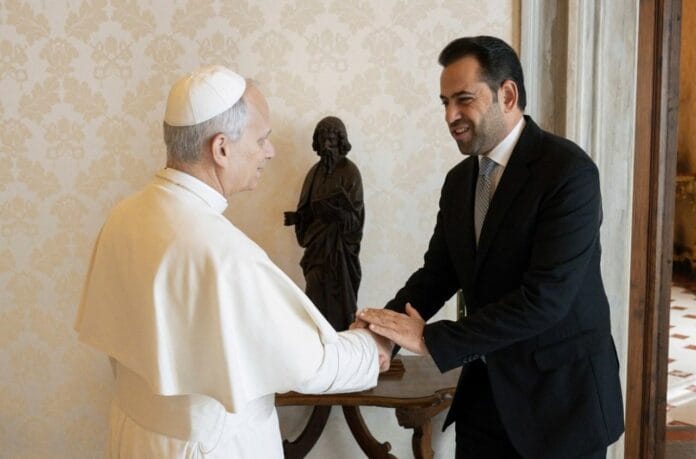
On Thursday, December 11, 2025, during a hearing that might have gone unnoticed in the whirlwind of Vatican news, the Pope Leo XIV delivered a disarmingly clear message. Addressing the organizers of the Zayed Prize for brotherhood In a profoundly human experience, the Pope used words that resonate as an uncompromising diagnosis of our times: «Words are not enough.» In a world saturated with declarations of intent, well-intentioned statements, and discourses on values, this assertion stands out. It invites everyone—believer or not, committed or hesitant—to take the decisive step that separates conviction from action.
A fraternal emergency in a fractured world
The observation of an era marked by division
Let's start by facing reality. When the Pope He evokes "an era marked by a resurgence of conflicts and divisions," but he is not speaking of a geopolitical abstraction reserved for analysts. He is speaking of what we observe daily: the growing tensions between communities, the retreat into identity politics, the walls – physical or mental – that are being erected between peoples.
Let's take a concrete example. In our neighborhoods, our businesses, even our families, the fault lines are multiplying. We no longer discuss, we confront. We no longer try to understand, we dig in our heels. Social networks, meant to bring us closer together, are becoming arenas where everyone defends their ideological territory. This fragmentation is not just a social phenomenon: it strikes at the very heart of our ability to live together.
The Document on Human Fraternity: A Pivotal Moment
THE Pope Leo XIV recalls the origin of the Zayed Prize: the historic signing of the Document on brotherhood human by the Pope François and the Grand Imam Ahmed Al-Tayeb, with the support of Sheikh Mohammed bin Zayed Al Nahyan. This moment, described as a "pivotal" in the interreligious dialogue, deserves closer attention.
Imagine the scene: the two highest authorities of Catholic Christianity and Sunni Islam jointly signing a document affirming that all human beings are brothers and sisters. In a world where religious tensions fuel so much conflict, this gesture represented far more than a diplomatic symbol. It was a declaration of principle: yes, beyond our differences in belief, we share a common humanity that binds us together.
But that's precisely where the Pope Leo XIV The focus is on this: this magnificent document, these inspiring declarations, these laudable intentions are only valuable if they translate into reality. In other words, signing a document is not enough. It must now be lived out.
Every human being and every religion is called upon to promote brotherhood
The Pope emphasizes that the Zayed Prize "not only embodies the legacy of Sheikh Zayed and these other leaders, but it also underlines that every human being and every religion is called to promote brotherhood »Let's focus on this "each".
Every human being. Not just religious leaders. Not just public figures. Not exclusively those with media platforms or considerable financial resources. Each of us, within our sphere of influence—however modest—is concerned by this call to brotherhood.
In concrete terms, what does this mean? For a teacher, it might be how they foster mutual respect among students from different backgrounds. For an entrepreneur, it might be the decision to hire by valuing diversity rather than perpetuating insularity. For a parent, it's the education they give their children about openness to others. For the average citizen, it's the choice to reach out to an isolated neighbor rather than remaining trapped in their routine.
This universality of the call is liberating: it tells us that we do not need to wait for the "great ones of this world" to solve the problems in order to act at our level.
From conviction to action: the heart of the papal message
Words are not enough: an undeniable fact.
«Words are not enough,» he insists. Pope. This statement may seem paradoxical coming from a man whose role specifically includes giving speeches and conveying a message. But that is precisely the strength of this declaration: it comes from someone who understands the potential gap between saying and doing.
Think about the resolutions we make at the beginning of the year. "This year, I'm going to be more generous. I'm going to volunteer my time to charities. I'm going to be more attentive to people in need." Then the weeks go by, life goes on, and these good intentions slowly fade away. Why? Because we remained in the realm of ideas without taking action.
THE Pope This highlights a well-known psychological phenomenon: moral self-satisfaction. We feel good when we affirm our values, proclaim our convictions, and "like" inspiring posts on social media. But this satisfaction often absolves us of the real effort required for concrete action.
Love and convictions must be cultivated through concrete actions.
Leo XIV He explains that "our love and deepest convictions must be continually nurtured, and we do this through our concrete actions." The term "nurtured" is particularly well chosen. You don't cultivate a garden simply by thinking very hard about the vegetables you'd like to see growing there. You have to prepare the soil, sow seeds, water, weed, and protect the plants from pests. It's regular work, sometimes thankless, but essential.
Similarly, our moral convictions are not fixed assets. They are more like muscles that need regular exercise to stay toned. Without practical use, even the most sincere convictions atrophy.
Let's take the example of compassion. You may sincerely believe in the importance of being compassionate towards vulnerable people. But if you never actually confront the suffering of others, if you never take the time to truly listen to someone in distress, if you never engage in a real act of help, your compassion remains theoretical. It doesn't shape your personality, it doesn't transform your view of the world.
The risk of weakening hopes and aspirations
THE Pope formulates a serious warning: "Remaining in the realm of ideas and theories, without translating them into actions of charity Frequent and concrete actions will eventually weaken and even destroy our most cherished hopes and aspirations.»
This passage deserves closer attention because it describes an insidious process. At first, we have high ideals, generous aspirations. We dream of a better world, a more just society, more authentic human relationships. Then, because we do nothing to embody these ideals, a gradual cynicism takes hold.
«What’s the point of believing in the universal brotherhood "What if no one practices it?" we end up asking ourselves. "Why continue to hope for a more united world if all I see is selfishness around me?" This cynicism is doubly destructive: not only does it paralyze us, but it also becomes contagious around us.
On the other hand, those who take concrete actions, even modest ones, nurture their aspirations. Every act of genuine kindness fuels hope and strengthens the conviction that change is possible. It's a virtuous circle: concrete action validates conviction, which in turn inspires further action.
Frequent and concrete acts of charity: a requirement for regularity
Note the adjective "frequent" used by the Pope. It's not about making a grand, generous gesture once a year and then resting on our laurels. Brotherhood True [something] is built over time, through the repetition of attention, gestures, and commitments.
Imagine someone claiming to have a deep friendship while only seeing their friend once every five years. Absurd, isn't it? Relationships thrive on regular presence, repeated exchanges, and sustained attention. The same is true for our fraternal commitment to humanity.
In practical terms, this can take a thousand different forms depending on our situation:
- A healthcare professional who consistently takes the time to truly listen to their patients, even when their schedule is overloaded.
- A neighbor who regularly checks on the elderly person in his building to make sure they are okay
- A colleague who makes a habit of including in coffee break conversations the one who is usually left out
- A citizen who makes a long-term commitment to an association rather than making numerous one-off donations without follow-up
Frequency transforms the exception into a habit, the isolated gesture into a way of life. It is this regularity that truly forges our character and lends credibility to our words.
The authentic testimony of human kindness
THE Pope insists on the need for "authentic testimonies of human kindness and of charity to remind us that we are all brothers and sisters.» The term «authentic» is crucial. We live in an age saturated with communication, carefully constructed images, and «personal branding.» In this context, authenticity stands out.
A genuine act of kindness is one that doesn't seek public recognition. It's the discreet gesture, the help given without calculation, the generosity exercised without to wait for back again. It is also – and this may seem paradoxical – a testimony that is not afraid to show its imperfections, its hesitations, its limitations.
Someone who acts out of deep conviction, without seeking the limelight, exudes a particular strength. Their actions speak for themselves. They inspire not because they are spectacular, but because they are genuine. And it is precisely this kind of witness that has the power to "remind us that we are all brothers and sisters"—not grand pronouncements, not PR stunts, but true actions.
The Zayed Prize: Honoring those who take action
Recognition of concrete measures
THE Pope Leo XIV welcomes the unique nature of the Zayed Prize: it honors "both institutions and individuals who have taken concrete steps to demonstrate compassion and solidarity, thus providing tangible examples of how we can promote brotherhood human today.".
This approach to the prize is revealing. It's not about rewarding fine speeches or laudable intentions, but actual achievements. The laureates are not selected for what they say they believe, but for what they have concretely accomplished.
This distinction is important because it establishes an objective criterion for evaluation. We can discuss the motivations, intentions, and philosophies behind the action endlessly. But ultimately, what matters is: what have you done? How many people have been helped? What structures have you put in place? What tangible changes have you initiated?
Tangible examples to inspire
By honoring those who take concrete action, the Zayed Prize fulfills an essential function: it provides accessible role models. When we see ordinary people—or human-scale institutions—achieve extraordinary things through their determination and concrete action, it changes our perspective.
Too often, we imagine that only saints, heroes, or exceptional figures can truly make a difference. This belief absolves us of responsibility. "I'm not Mother Teresa, so what's the point of trying?" we think. But precisely, the Zayed Prize laureates demonstrate that you don't need to be a moral giant to have a significant impact. You simply need to start, persevere, and remain true to your convictions in action.
These tangible examples serve as proof of feasibility. They tell us: "There you go, it's possible. Others have done it. Now it's your turn, in your own way, with your own resources, in your own context."«
The invitation to persevere in the noble task
THE Pope He concluded his speech by encouraging the prize organizers to "persevere in this noble task," convinced that their efforts will continue to "bear fruit for the good of the human family.".
The word "persevere" perhaps sums up the whole message. Because that's what it's really about: not a one-off impulse, a fleeting commitment or a passing fad, but a long-term determination.
Promote brotherhood Human progress through concrete actions is not a sprint, it's a marathon. There will be moments of discouragement, periods when the results seem insignificant compared to the magnitude of the challenges. There will be misunderstandings, criticism, and unforeseen obstacles. It is precisely in these situations that perseverance makes all the difference.
Those who give up at the first sign of failure or difficulty leave no lasting mark. On the other hand, those who persevere, who adjust their approach without abandoning their goal, who maintain their commitment even when the initial enthusiasm has faded – these are the ones who truly transform the world.
A vision that is both institutional and personal
An interesting aspect of this audience is the dual dimension highlighted by the Pope The prize honors "both institutions and individuals." This connection is important because it recognizes that both levels of action are necessary and complementary.
Institutions – associations, NGOs, foundations, public services – have the capacity to structure aid, giving it a scope and sustainability that individual action cannot always achieve. They make it possible to systematize best practices, pool resources, and create leverage effects.
But institutions are only as good as the people who make them up and run them. Without genuine personal commitment, institutional structures become empty shells, bureaucratic machines disconnected from their original mission.
Conversely, individual action, however sincere, can lack effectiveness without a structured framework. The isolated volunteer quickly becomes exhausted. A generous but disorganized personal initiative struggles to have a lasting impact.
Excellence is when deeply committed individuals organize themselves into effective institutions. It is when structures serve and amplify personal convictions instead of stifling them. This is precisely what the Zayed Prize seeks to recognize and encourage.
The legacy of Sheikh Zayed and continuity in commitment
THE Pope explicitly mentions "the legacy of Sheikh Zayed." This reference to a Muslim political leader in a papal speech is not insignificant. It perfectly illustrates... brotherhood interreligious action: the Sovereign Pontiff recognizes and honors the contribution of a man from another religious tradition to the common work of humanity.
Sheikh Zayed bin Sultan Al Nahyan, founder and first president of the United Arab Emirates, was known for his conciliatory diplomacy, his commitment to human development, and his dedication to building bridges between cultures. The prize that bears his name extends this legacy by recognizing and celebrating those who continue along this path.
This continuity is essential. A visionary leader can spark a movement, but if no one takes up the torch, their work dies with them. Conversely, when institutions perpetuate the initial inspiration and keep it alive through concrete actions, then the impact multiplies across generations.
That's exactly what the Pope recognizes here: a living heritage, not frozen in a nostalgic commemoration, but dynamic and productive, generating year after year new testimonies of fraternity in action.
The universal and inclusive dimension
One final aspect deserves emphasis: the universality of the approach. Pope He speaks of the "human family," not just the Christian community or even the community of believers. This openness is consistent with the entire message: brotherhood Humanity transcends religious, cultural, or national affiliations.
In a world where so many forces seek to divide, classify, and rank human beings according to multiple criteria – origin, religion, social status, skin color, sexual orientation, etc. – the affirmation of a universal brotherhood based on our common humanity is an act of resistance.
And this is not an abstract, disembodied universalism that would deny differences. It is a practical universalism that says: "Precisely because we are different, we must actively build what unites us. And we build it not in theory, but in deeds."«
Every concrete act of solidarity between people of different cultures or beliefs is a stone added to the edifice of brotherhood human. Conversely, every time we allow our differences to justify indifference or hostility, we contribute to the destruction of this edifice.
How can we translate these words into actions in our daily lives?
Now that we have explored the message of the Pope Leo XIV, The question then becomes: concretely, what can be done? How can each of us translate these calls into tangible actions?
In the personal sphere
Start by taking a clear-eyed look at your daily life. Identify three regular moments each week when you could perform a concrete act of kindness. A simple example: if you take the subway every morning, decide to pay attention to people who seem to be struggling instead of automatically retreating into your smartphone. This could mean offering your seat to someone in need, helping someone with a stroller on the stairs, or simply exchanging a smile with the newsagent.
Another option: establish a "routine of giving." This could be a weekly call to someone isolated in your community, a monthly visit to a retirement home, or bi-monthly volunteering with a local charity. The important thing is not the size of the gesture, but its regularity.
In professional life
The workplace offers countless opportunities for genuine camaraderie. You could, for example, take the initiative to truly integrate newcomers into the team – many feel lost during the first few weeks. Organize a welcome lunch, offer yourself as a mentor, and take the time to patiently answer their questions.
If you have managerial responsibilities, establish a simple principle: dedicate time each week to truly listening to each of your team members, not just to discuss current projects, but to genuinely show an interest in them as individuals. This attention radically transforms the atmosphere of a team.
In civic engagement
Rather than spreading yourself too thin by half-heartedly supporting ten different causes, choose one that resonates deeply with your convictions and make a long-term commitment. Whether it's helping the homeless, providing academic support for struggling children, or welcoming... migrants, or environmental protection, commit to a period of at least one year with a regular commitment (e.g., three hours every Saturday morning).
This focused effort will allow you to truly understand the issues, build lasting relationships with those involved, and have a measurable impact rather than remaining on the surface.
In neighborhood life
Our living spaces are often the most neglected areas when it comes to fostering community. How many people don't even know their next-door neighbors? Take the initiative to organize a friendly get-together in your building or on your street. It can start very simply: drinks in the courtyard, a picnic in the neighborhood park, or a system for exchanging services between neighbors.
These initiatives create social connections where none existed before. They transform anonymous living spaces into genuine communities where people look out for one another.
With the most vulnerable
Identify the people around you who are most isolated or struggling: elderly people, people with disabilities, single-parent families in precarious situations, etc. Then ask yourself this simple question: "What can I do concretely to ease their daily lives?"«
This could mean offering to do the shopping for an elderly person once a week, providing a few hours of free babysitting for an overwhelmed mother, or accompanying a person with reduced mobility on outings they cannot do alone.
These commitments don't necessarily require significant financial resources. They require time, availability, and attention. In other words, precisely what we have most precious to give.
The consistency challenge
The message from Pope Leo XIV The message to the organizers of the Zayed Prize can be summed up in a simple but demanding appeal: do what you say. Live what you believe. Translate your convictions into action.
This coherence between words and actions is perhaps the major spiritual and ethical challenge of our time. We live in a world saturated with communication, where everyone has an opinion on everything, where social media offers us permanent platforms to express our outrage and our ideals. But this verbal inflation is often accompanied by a poverty of genuine commitment.
THE Pope This reminds us of a disturbing truth: our fine moral convictions, if they are not translated into concrete and frequent actions, are worthless. Worse, they eventually wither and disappear, giving way to cynicism. It is only through repeated action that our values take shape, solidify, truly transform the world, and transform ourselves.
The Zayed Prize, by honoring those who take action, shows us the way. It tells us that it is possible, that others are doing it, that we too can contribute in our own way. It invites us to join this large family of those who are building. brotherhood human not in speeches, but in the concrete reality of existence.
Now it's up to each of us to ask ourselves: what concrete steps will I take, starting today, to translate my convictions into action? What will be my first contribution to the building of brotherhood Because it is in the answer to these questions – and especially in the actions that will follow from them – that the sincerity of our commitment to a more humane world will be measured.