












One Tuesday in December 2025, the Pope Leo XIV celebrates a mass on the ruins of the port of Beirut. Five years after one of the greatest non-nuclear disasters in history, the Catholic Church continues to give voice to the victims and their families in their quest for truth.
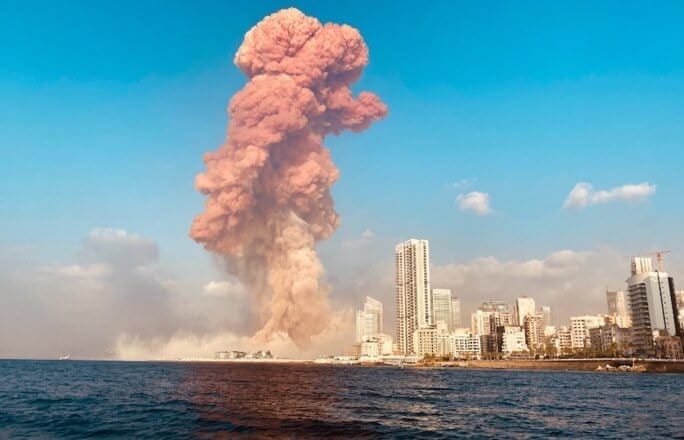
Imagine for a moment. You are in Beirut, on December 2, 2025, and you are driving along the road that runs parallel to the port. Five years after the double explosion that changed the face of the Lebanese capital, the scars remain visible everywhere. Collapsed grain silos, piles of twisted metal, and gutted buildings still bear witness to the scale of the tragedy of August 4, 2020. On that day, 235 people lost their lives and 6,500 others were injured when hundreds of tons of ammonium nitrate exploded in warehouse 12 in the port area.
But on the morning of December 2nd, something different happened. More than 120,000 people gathered at the site of the tragedy for a historic mass presided over by the Pope Leo XIV. This celebration is not just a moment of reflection – it is a cry for justice, carried by a Church that refuses to abandon the victims and their loved ones in their fight for the truth.
The Lebanese Church: From emergency aid to the fight for justice
The Church takes the lead after the tragedy
Let's go back to August 4, 2020, at precisely 6:07 PM. On that day, the shockwave from the explosion devastated half of Beirut. Dozens of churches were damaged, some severely. In one of them, a priest was celebrating Mass live when the force of the blast caused the ceiling to collapse on him. This video, which went viral, perfectly symbolizes the trauma experienced by the Christian communities that day.
St. George's Cathedral, built in 1755 with its gold-leaf ceiling a miniature replica of St. Peter's Basilica in Rome, suffered significant damage. The Jesuit church of St. Joseph, 1.6 km from the center of the explosion, had 951 stained-glass windows shattered. St. Maron's Church in Saifi, dating from 1874, where the official Mass for the patron saint of the largest Christian community is celebrated every February 9th, was also damaged. Lebanon, was devastated. In total, at least ten churches were destroyed, mainly in the Christian quarter of Achrafieh.
But here's what's remarkable: the day after the disaster, even before considering rebuilding their own places of worship, members of the Lebanese Catholic Church began serving the victims. Tents were erected in parking lots next to churches to shelter the homeless. Nuns and priests mobilized to distribute food, medicine, and emergency aid. Thanks in particular to Caritas and other Catholic organizations, more than 2,000 homes were prioritized for restoration, even before religious buildings.
A commitment that goes beyond humanitarian aid
What distinguishes the Church's action in Lebanon After the explosion, it was clear that the response wasn't limited to immediate humanitarian aid. Very quickly, Catholic religious leaders understood that their role also had to be to give voice to the victims in their quest for justice.
Cardinal Bechara Boutros Rai, Maronite Patriarch and President of the Conference of Catholic Patriarchs and Bishops of Lebanon, He was among the first to raise his voice. In an "Appeal to the Countries of the World" launched on August 5, 2020, he described Beirut as a "devastated city," a "war zone." But beyond the request for material aid, he was already demanding the truth about the causes of this catastrophe.
A year after the explosion, during the demonstrations marking the first anniversary, Cardinal Rai again publicly criticized political interference and the state's lack of responsibility, demanding "truth and justice about what happened in the port of Beirut." This clear stance from one of the country's most influential religious leaders lent moral legitimacy to the struggle of the victims' families.
When priests become the voice of the forgotten
In a country where corruption and impunity have become the norm, where state institutions are failing, and where the political class is largely discredited, the Church has often remained the only institution people can trust. Lebanese priests and religious figures fully embraced this role of mediator and spokesperson after the explosion.
Take the example of Archbishop Paul Abdessater, the Maronite Archbishop of Beirut. His archbishopric, whose oldest building dates back to 1874, was completely destroyed by the explosion. But before rebuilding, he made providing aid to parishioners and the residents of Beirut an absolute priority. "Before the Archbishopric of Beirut, the city's churches, the school, and the University of Wisdom, the archbishop gave priority to the parishioners and the city's residents," testifies the architect in charge of the construction site.
This approach is not unique. Throughout Beirut, parishes have become food aid distribution centers. At St. Michael's Church in Beirut, located right next to the port, 200 food parcels are prepared and distributed daily to the community, even five years after the disaster. This daily, often invisible work maintains social cohesion and offers a comforting presence in a country in deep crisis.
Father Tony Elias, a Maronite priest from the village of Rmeich, near the Israeli border, aptly summarizes the spirit of this mobilization: «We lived through nearly two and a half years of war, but never without hope. The pope It carries within it a true message of peace. Lebanon He is weary, he can no longer endure 50 years of war, and he longs to peace. »
The fight for truth and justice
An investigation paralyzed by political gridlock
To understand the importance of the Church's role in the quest for justice, one must first grasp the magnitude of the obstacles faced by the victims' families. The investigation into the Beirut port explosion has become the very symbol of impunity in the Lebanon.
The facts are damning. Reports from international organizations like Human Rights Watch have clearly established that high-ranking Lebanese officials were aware of the dangers posed by the ammonium nitrate stored at the port. Prime Minister Hassan Diab had been informed since June 3, 2020, but took no apparent action. Officials at the Ministry of Public Works and Transport knew that 2,750 tons of ammonium nitrate were being stored with other flammable or explosive materials in a poorly secured warehouse, in violation of international storage guidelines.
Despite this evidence, the national investigation was paralyzed by «procedural and systemic flaws,» according to Human Rights Watch. The first judge assigned to the investigation in 2020 resigned after indicting the former prime minister and three former ministers. The investigation was suspended for nearly two years, between 2021 and 2023, due to political and judicial obstruction.
Today, five years after the disaster, no trials have taken place. No one responsible has been brought to justice. The victims' families are still waiting for answers. This situation fuels a deep sense of injustice among the Lebanese population, who see their elites escaping all accountability.
The Church as a moral amplifier
It is in this context that the Church's commitment takes on its full meaning. By regularly giving voice to the victims, organizing commemorations, and publicly demanding truth and justice, religious leaders amplify the struggle of the bereaved families.
This mobilization is not taking place from Rome or from distant offices – it is happening on the ground, alongside the victims. Priests accompany families in their grief, provide them with psychological support, pray with them, but also encourage them not to give up in their quest for justice.
Bishop Jules Boutros, of the Syriac Catholic Church, who was only 38 years old at the time of the explosion (making him one of the youngest bishops in the world), describes that day as "the most difficult thing" he has ever experienced. "It was shocking; people couldn't believe what had happened in a single moment," he testifies. But despite the multiple crises, he sees a new glimmer of hope: "I believe that our role is to be the light of our world, the light of our nations."«
This metaphor of light often recurs in the testimonies of Lebanese religious figures. In a country plunged into darkness – literally, with daily power cuts, and metaphorically, with corruption and impunity – the Church positions itself as a beacon that continues to illuminate the path towards justice.
Concrete initiatives to ensure we don't forget
Beyond declarations, the Lebanese Catholic Church has multiplied concrete initiatives to keep the memory of the victims alive and maintain pressure for justice to be served.
One of the most moving projects is the memorial garden, spearheaded by lawyer Pierre Gemayel, who lost his brother in the explosion. "We are creating a garden for people to come and reflect," he explains. "We will plant an olive tree for each victim and place small memorial stones on them." These 235 olive trees will be planted between the statue of the Emigrant, which miraculously remained intact, and the port silos, still standing despite the force of the blast.
The choice of the olive tree is not insignificant. "Olive trees are the symbol of life," emphasizes Pierre Gemayel. "They won't bring it back to my brother and the victims, but we are trying to find solutions so that this tragedy can be a rebirth for the Lebanon. » During a prayer vigil on August 3, 2025, 253 olive trees were blessed in the name of the deceased, in a ceremony organized with the support of the Church.
Another significant initiative: some parishes, such as Saint-Charles Cathedral in Saint-Étienne, France, have been celebrating a prayer or Mass on the 4th of every month since August 4, 2020, for the people of Beirut and Lebanon. This international solidarity, orchestrated by church networks, maintains constant moral pressure and serves as a reminder that the world has not forgotten.
The Church also played a crucial role in preserving the physical memory of the tragedy. After heated debates over the demolition of the partially collapsed grain silos, the victims' families, supported by religious leaders, succeeded in having these structures included on a list of historical buildings and transformed into a memorial. These silos, which absorbed part of the blast and thus saved lives in the western districts of Beirut, have become a powerful symbol.
The historic visit of Pope Leo XIV
A pilgrimage laden with symbols
The apostolic journey of Leo XIV in Türkiye and at Lebanon, The trip, from November 27 to December 2, 2025, represents much more than a simple pastoral visit. It is the first international trip of the new pope since his election on May 8, 2025, and he chose to place it under the dual sign of the’Christian unity (with the commemoration of the 1700th anniversary of the Council of Nicaea) and of peace in the Middle East.
For the Lebanese leg of the journey, the chosen motto is explicit: "Blessed are the peacemakers." This choice is not insignificant in a country scarred by decades of civil war, occupation, foreign interference, and now by an unprecedented economic crisis and recent tensions with Israel.
The reception given to pope It was extraordinary. From the moment he arrived on November 30th, thousands of people lined the roads to cheer him. Bkerké, At the seat of the Maronite Patriarchate, 15,000 young people gathered in a highly charged atmosphere to meet him. Nuns waved the flags of the Lebanon and the Vatican, creating a yellow and white tide punctuated by smartphones and flashes.
The Lebanese authorities declared two public holidays to mark this visit, the third in a series pope At Lebanon After John Paul II in 1997 and Benedict XVI in 2012. This exceptional mobilization testifies to the importance of the papal figure for a country where Christians still represent a third of the population of 5.8 million inhabitants.
A clear message to Lebanese leaders
Throughout his stay, Leo XIV He did not hesitate to deliver strong messages to the Lebanese elites. During the ecumenical and interreligious meeting in Martyrs' Square in Beirut, he declared to the leaders of the various religious communities: "You are called to be artisans of peace: to confront intolerance, to overcome violence and to banish exclusion."«
At the end of this ceremony, the pope planted an olive tree – yet another symbol – which he described as «venerated in the sacred texts of the Christianity, of Judaism and Islam, where it is considered a timeless symbol of reconciliation and peace.» This highly symbolic gesture resonated particularly strongly in a country where communal tensions remain high.
At the Harissa shrine, facing the Lebanese bishops, priests, religious figures, and pastoral agents, Leo XIV encouraged the local church to continue its work: "If we want building peace, "Let us anchor ourselves to heaven," he urged, inviting people to "love without fear of losing what is fleeting and to give without counting.".
This emphasis on the spiritual dimension of the struggle for peace and justice does not prevent the pope to be concrete in his requests. His visit to the Saint-Maroun monastery in Annaya, where he prayed at the tomb of Saint Charbel Makhlouf, patron saint of Lebanon, was also a message: the Church must remain rooted in prayer while remaining deeply engaged in the world.
December 2nd: a mass for remembrance and justice
The final day of the papal trip was entirely dedicated to the victims of the explosion. The program was deeply meaningful: a visit to the Cross Hospital in Jal el Dib, silent prayer at the site of the explosion, and then Mass at the port of Beirut.
This silent prayer is particularly significant. In a world saturated with words and speeches, this silence of pope Standing before the ruins speaks louder than any statement. It is a communion with the pain of the victims, a way of saying: "I am here, with you, in your suffering."«
The Mass that followed drew over 120,000 people – an impressive number for a country in crisis. This Eucharistic celebration at the very site of the tragedy transformed the disaster into a place of hope. Families of the victims were present, some carrying photographs of their missing loved ones.
The homily of Leo XIV resonates like a call: to the Lebanese authorities to finally deliver justice, to the Lebanese not to lose hope, to the international community not to forget this small country in the Middle East.
This mass is not just a religious event – it is a political act in the noblest sense of the word. By choosing to celebrate the Eucharist in this place, the pope He inscribed the tragedy of the port of Beirut in the universal memory of the Church. He told the victims and their families: "You are not alone, the whole Church remembers and continues to demand justice with you."«
The impact of the papal presence
The visit to Leo XIV has an impact that far exceeds the three days of his physical presence at Lebanon. First, it gives renewed international visibility to the Lebanese situation. Media outlets around the world cover the event, recalling in passing the tragedy at the port and the prevailing impunity.
Then, it galvanizes the Lebanese themselves. As the president of Adyan, an NGO working to bring communities closer together, explains: «This meeting highlights the fact that the Lebanon has extensive experience in the interreligious dialogue. "The papal visit reminds the Lebanese of what makes their country unique and rich: this ability, unique in the Middle East, to make different religious communities coexist.
For Christians For the Lebanese in particular, this visit is a balm. In a context where many are considering emigration in the face of the economic crisis and political instability, the presence of pope reminds them that they have a crucial role to play in their country. "The Lebanon "It's a message, and that message is a peace project," he said. Saint John Paul II. Leo XIV adopts this message as his own and encourages Christians of Lebanon to remain, to resist, to continue to be this presence of reconciliation and dialogue.
Finally, the papal visit gives moral strength to the struggle of the victims' families. When the head of the Catholic Church worldwide travels personally to pray at the site of the tragedy and meet with the bereaved families, it lends international legitimacy and scope to their quest for justice.
Between persistent challenges and reasons for hope
A catastrophic economic situation
To fully understand the context in which the Lebanese Church continues its fight for the victims of the explosion, one must grasp the magnitude of the crisis the country is experiencing. Lebanon is experiencing one of the worst economic crises in modern history, described by the World Bank as one of the three most serious economic crises since the mid-19th century.
The Lebanese pound has lost over 951,300 of its value. Lebanese savings, frozen in banks, have become inaccessible or have melted away. Power outages last 12 to 20 hours a day. The price of medicine and medical care has become prohibitive for the majority of the population.
In this context, the Church's charitable work takes on an even more crucial dimension. Catholic schools They continue to welcome students – about half of whom are Muslim – despite financial difficulties. Hospitals run by religious orders remain open and are trying to maintain affordable rates. Parishes distribute food and medicine daily.
Marielle, a young Lebanese woman involved with the Church, warns against illusions: «The investigations into the explosion are still progressing very slowly. The families have a right to justice. The economic crisis continues to paralyze daily life. Government subsidies for medicines or hospitalizations are limited. People are still struggling to meet their basic needs.»
The hemorrhage of emigration
Another major challenge facing the Lebanese Church is the mass emigration of young people. Faced with a lack of opportunities, tens of thousands of Lebanese, particularly young graduates, leave the country each year. This exodus is especially affecting Christian communities.
The story of Mounir, nephew of Bishop Mounir Khairallah, illustrates this dilemma. After working hard in Nigeria for eight years to earn money, he returned to Lebanon He found himself penniless, his money frozen in the bank. Faced with the choice of leaving or staying, he decided to stay and "rebuild his life, even starting from scratch." But how many people make this courageous choice?
Maroun, a 21-year-old who lived through the explosion, is leaving to study in France but promises: "Sometimes you have to leave to come back even stronger. I think I have a future in..." Lebanon, "I never thought about leaving permanently." But as Marielle sadly notes: "Most of those who emigrate don't come back."»
This emigration poses an existential challenge to Lebanon as we know it. If Christians As they continue to leave en masse, the entire community balance of the country risks being called into question. The Church is aware of this challenge and is multiplying its initiatives to give young people reasons to stay: educational programs, support for entrepreneurs, spaces for dialogue and engagement.
Persistent regional tensions
As if the economic crisis and impunity weren't enough, the Lebanon remains caught in regional geopolitical tensions. Despite a ceasefire signed on November 27, 2024, between Israel and Hezbollah, Israeli strikes have intensified in recent weeks. The country lives in constant fear of a return of the war on a large scale.
In this context, the message of peace conveyed by the Pope Leo XIV resonates with particular urgency. During his address to Lebanese authorities at the presidential palace in Baabda, he called for "building a future of peace" and recalled that "the Lebanon is, and must remain, a peace project.
The Lebanese Catholic Church thus finds itself on several fronts simultaneously: humanitarian aid, the fight for justice regarding the explosion, and the promotion of interreligious dialogue, support for young people to stay in the country, and advocacy for peace regional. It is a Herculean task for religious institutions themselves weakened by the crisis.
Signs of political renewal
Despite all these difficulties, there is reason for hope. The election of President Joseph Aoun in January 2025, after two years of presidential vacancy, brought a glimmer of political stability. A former commander-in-chief of the Lebanese army, Joseph Aoun enjoys a certain degree of credibility and has publicly pledged to advance the investigation into the explosion.
«"From now on, justice will take its course, those responsible will be judged and the innocent exonerated," he said during a meeting with relatives of the victims in July 2025. He also affirmed that "the law applies to everyone, without exception" and promised "transparency and integrity" in the investigation.
Admittedly, the victims' families remain cautious. They've heard too many broken promises to get their hopes up. But for the first time in five years, they sense a political will to move things forward. Judge Tarek Bitar's investigation, stalled for nearly two years, resumed in 2025. He has succeeded in summoning officials and questioning individuals connected to the case.
«For the first time in five years, we have the feeling that the investigation is no longer at a standstill, that it has been relaunched,» analyzes Sami Aoun, professor and specialist in Lebanon. "There are no guarantees, but it's already better than what we experienced before."«
Extraordinary resilience
What is most striking when listening to the testimonies of Lebanese people five years after the explosion is their extraordinary resilience. Take Affifeh Bachir, 78 years old today. She was traveling when the explosion destroyed her house. When she returned, she found only one window standing, nothing else. But she didn't give up. With the help of the Church and various organizations, she was able to rebuild and continue living.
This resilience is deeply rooted in faith. Bishop Jules Boutros sums it up well: "Despite the many crises, I see a new glimmer of hope for my country. I believe that our role is to be the light of our world, the light of our nations."«
Initiatives of remembrance and solidarity are multiplying. The Garden of Remembrance, with its 235 olive trees, is one example. These trees, which will take years to grow, symbolize a long-term commitment. They say: "We will still be here in ten years, in twenty years, to remember and continue to demand justice."«
The unique role of the Church in social reconstruction
Beyond its charitable work and advocacy for justice, the Church plays a crucial role in maintaining the social fabric of Lebanon. In a country where state institutions are failing and trust in the political class is at an all-time low, the parishes, the Catholic schools, Hospitals run by religious congregations often represent the last remaining spaces of stability and trust.
THE Catholic schools, These schools, where approximately half of the students are Muslim, continue to be places of intercommunal encounter and dialogue. It is there that this precious and fragile Lebanese "living together" is forged, on a daily basis and far from the cameras.
The Church's charitable works – Caritas Lebanon, Aid to the Church in Need, L'Œuvre d'Orient, and SOS Chrétiens d'Orient have mobilized millions of euros to help with the reconstruction. But beyond the money, they provide a presence, support, and solidarity that are invaluable.
Benoît Deblampré, director at Aid to the Church in Need, remembers a nun he met in a hospital near the port a few days after the disaster. She told him, "We are like pinballs in an international game that is beyond our control." But she also added, "Once again, we have decided not to break, to get back up, to rebuild, to reinvent the future."«
It is this determination not to give up that characterizes the commitment of the Lebanese Church. Even in the darkest moments, even when all seems lost, it continues to be present, to carry hope, to demand justice.
What the commitment of the Lebanese Church teaches us
The commitment of the Lebanese Catholic Church to the victims of the Beirut port explosion teaches us several important lessons that extend far beyond national borders. Lebanon.
First, it reminds us that justice is not just a technical or legal matter – it is also a moral issue. When judicial institutions are paralyzed by corruption and political pressure, the role of civil society and moral institutions like churches becomes crucial in keeping the demand for justice alive.
Next, she shows that humanitarian engagement and political advocacy are not contradictory but complementary. Distributing food to the starving and holding those responsible for a disaster accountable are two sides of the same coin: respect for the human dignity.
Finally, it illustrates the power of the long term. Five years may seem like a long time, but for the Church, accustomed to thinking in centuries rather than electoral cycles, it is only the beginning. The 235 olive trees that grow slowly in the garden of remembrance speak volumes: the fight for justice and memory is a marathon, not a sprint.
When the Pope Leo XIV celebrated this historic mass at the port of Beirut on December 2, 2025, surrounded by 120,000 faithful. He not only paid tribute to the victims, but also renewed the commitment of the’Universal Church at their side. He told the bereaved families: "We will not forget. We will continue to seek justice with you. You are not alone."«
In a world where information cycles are getting shorter and shorter, where tragedies follow one another and push previous ones off our screens, this long-term commitment has something profoundly counter-cultural and profoundly necessary about it.
The olive trees planted in memory of the victims will grow slowly but surely. Their roots will sink deep into the Lebanese soil. In ten years, in twenty years, they will still be there, silent witnesses to a tragedy that the Lebanon refuses to forget and of a Church that refuses to abandon its fight for justice.
For that is precisely what is at stake: not to forget, not to give up, to continue to cry out our thirst for justice. Until, finally, the truth comes to light and those responsible are held accountable for their actions. The Lebanese Church, through its priests, bishops, religious, and faithful, is committed to raising this voice for as long as necessary.
And in this fight for dignity and justice, she reminds us all of an essential truth: as long as there is someone left to remember, to demand accountability, to refuse impunity, hope is never truly dead. Even amidst the rubble, even five years later, even in the face of all obstacles, light can always pierce the darkness.