




On December 10th, in Saint-Pierre Square, a message of particular gravity resonated. pope Leo XIV, Visibly moved, he broke with the usual protocol of the general audience to deliver a passionate appeal. At the heart of his concerns: a new escalation of violence between Thailand and Cambodia, two Southeast Asian countries embroiled in a border conflict that has just reignited with dramatic intensity.
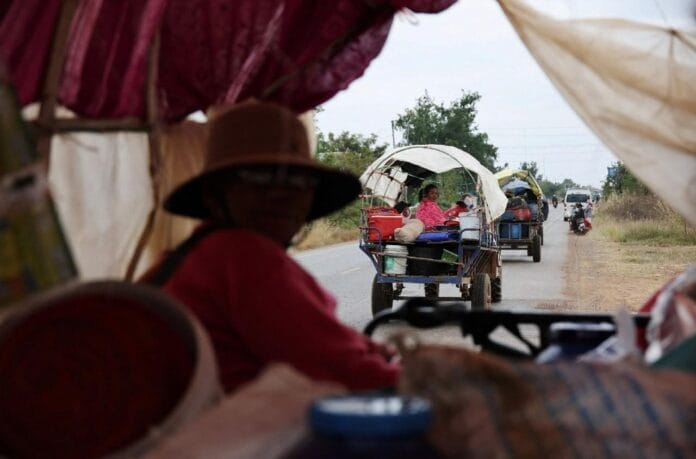
More than a mere diplomatic statement, these few words spoken in Italian carry the weight of a humanitarian emergency. More than half a million people have been forced to flee their homes. At least ten lives have been lost. Entire families are uprooted, seeking refuge wherever they can. Faced with this tragedy, the Pope does not remain silent. His call for dialogue and a ceasefire is part of a tradition of commitment to peace, but also in a contemporary reality where regional conflicts can quickly escalate.
The papal intervention: when Rome speaks to the world
An unusual message from St. Peter's Square
The Wednesday general audience is a regular event for the faithful. Usually, these times are devoted to spiritual teaching and greetings to the various groups of pilgrims. But this December 10th, Leo XIV chose to use this platform for something different: a direct appeal to consciences about an international crisis situation.
«Deeply saddened» – the words chosen by the pope leave no doubt as to the emotion that dwells within him. In the diplomatic language of Vatican, This expression reveals more than just a concern. It conveys an urgency, a feeling of injustice in the face of the suffering of populations trapped in a conflict that is beyond their control.
The timing of this intervention is not insignificant. While the whole world prepares to celebrate Christmas, a time of peace and reconciliation for Christians, The contrast with the violence shaking the Thai-Cambodian border is striking. It's as if Leo XIV wanted to remind everyone that peace cannot remain a pious wish, but must be translated into concrete actions.
Closeness in prayer: much more than a symbolic gesture
When the pope When he declares, "I express my closeness in prayer to these dear people," this is not an empty phrase. In the Catholic tradition, prayer for victims of conflict is always accompanied by a dimension of hope and action. It is a way of saying to the displaced Thais and Cambodians: "You are not alone. The world sees you."«
This spiritual closeness also has political implications. When the head of the Catholic Church, representing more than a billion faithful, takes a public stance on a conflict, it sends a strong signal to the governments involved. It is a reminder that the international community is watching, that consciences are awakened, and that indifference is not an option.
For the affected populations, predominantly Buddhist, this message of solidarity transcends religious boundaries. It testifies to a shared humanity, a compassion that surpasses dogma. In a world often fragmented by differences, such gestures resonate deeply.
The call for a ceasefire: a plea for an immediate end to hostilities
THE pope He did not simply express his sadness. He made a clear and precise demand: "that hostilities cease." This seemingly simple phrase embodies an entire philosophy of conflict resolution. It does not take sides. It does not seek to assign blame. It focuses on the essential point: stopping the violence now.
This approach is characteristic of Vatican diplomacy. Rather than getting bogged down in debates about who is right or wrong, the focus is on the humanitarian emergency. The dead, the displaced, the suffering—that is what matters first. Issues of borders, disputed territories, and historical grievances can be discussed, but not while bombs are falling and families are fleeing.
The call for dialogue that accompanies this ceasefire request is equally crucial. Leo XIV It doesn't simply call for a cessation of hostilities; it invites the parties to talk. This is a realistic recognition that without discussion, without negotiation, any ceasefire would only be a temporary truce before a new escalation.
An ongoing humanitarian catastrophe: understanding the scale of the crisis
Half a million lives turned upside down in just a few days
The figures are staggering. More than 500,000 people displaced in three days. To put that into perspective, it's as if the entire population of a city like Lyon were suddenly forced to flee their homes. Imagine the panic, the uncertainty, the fear. Imagine having to gather what little you can carry in a matter of minutes, leaving the rest of your life behind.
This crisis did not develop in a vacuum. It is part of a pattern of recurring tensions between the two countries, with a significant escalation already occurring last summer. But this new wave of violence took even the most attentive observers by surprise. The speed with which the situation deteriorated left the civilian population little time to prepare.
What makes this crisis particularly alarming is that it primarily affects civilians. These men, women, and children have nothing to do with the territorial dispute between their governments. Yet they find themselves on the front lines, collateral victims of a conflict that is beyond their control. Some have lost loved ones. Others have seen their homes destroyed. All have seen their lives turned upside down.
Chaos on the Thai side: 400,000 people seeking refuge
On the Thai side, the authorities face a colossal logistical challenge. Moving 400,000 people to "safe havens" is no small feat. It requires coordination between the armed forces, emergency services, local authorities, and humanitarian organizations.
Defense Ministry spokesman Surasant Kongsiri spoke of an "imminent threat to the security" of civilians. This assessment led to mass evacuations in seven provinces. But evacuating is one thing, accommodating is another. Where will these hundreds of thousands of people be housed? How will they be provided with food, access to water, and medical care?
The makeshift shelters quickly become overcrowded. Families find themselves crammed into gymnasiums, schools, and public buildings converted into temporary accommodation centers. Children can no longer attend school. Adults lose their jobs. Normal life comes to an abrupt halt, replaced by uncertainty and waiting.
And we mustn't forget the psychological impact. The trauma of having to flee under bombardment doesn't disappear once they're safe. These populations will need long-term psychological support to overcome this ordeal. Children, in particular, bear invisible scars that can affect their development.
The Cambodian reality: more than 100,000 displaced people are seeking shelter
In Cambodia, the figures are slightly lower but just as worrying: 101,229 people evacuated in five provinces. Defense Ministry spokeswoman Maly Socheata confirmed that many have found refuge with relatives or in safe locations identified by the authorities.
This familial aspect of hospitality is remarkable. It demonstrates the solidarity that exists within Cambodian communities. Families already living in modest circumstances open their doors to relatives or even strangers fleeing violence. It is a moving testament to resilience and human generosity in the face of adversity.
But this solidarity has its limits. How long can families host displaced people without straining their own resources? Cambodia, despite its recent economic progress, remains a developing country. Emergency response infrastructure is less developed than in Thailand. International aid is therefore crucial.
Cross-border bombings and air raids have created a climate terror reigns among the local population. Every day, families wonder if they are safe, if they too should leave. This constant uncertainty is exhausting, both physically and mentally.
The roots of the conflict: beyond current tensions
To understand why we've reached this point, we need to go back to the origins of the border conflict between Thailand and Cambodia. Without going into complex historical details, the dispute mainly revolves around contested territories along their shared border.
This region is strategic for several reasons: natural resources, control of trade routes, and in some cases, the cultural or religious importance of specific sites. These issues, combined with nationalist sentiments on both sides, create an explosive mix that could ignite at any moment.
Last summer's escalation should have served as a warning. De-escalation mechanisms should have been put in place. But tensions remained simmering, ready to explode again. And that is precisely what happened, with the dramatic consequences we know.
It is important to note that in such conflicts, the reality on the ground is often more complex than official statements suggest. Incidents can be triggered by errors in judgment, misunderstandings, or actions by local groups operating outside the control of central governments. The spiral of violence then quickly begins.
International mobilization: beyond borders
António Guterres takes the stage: the voice of the UN
The United Nations Secretary-General, António Guterres, did not remain idle in the face of this crisis. His public intervention reinforces the call of pope Leo XIV, creating joint diplomatic pressure on the conflicting parties. Guterres is an experienced diplomat who is well-versed in conflict resolution mechanisms.
His message is clear: "avoid further escalation and renew the commitment to the ceasefire." This wording reveals a major concern. If the situation continues to deteriorate, the conflict could spread geographically or draw in other regional actors. What is currently a bilateral dispute could become a much more difficult-to-manage regional crisis.
The call to "use all mechanisms for dialogue" is particularly significant. It suggests that communication channels exist and structures are in place to facilitate negotiations. The UN can play a neutral mediating role, offering its good offices to bring the parties closer together. But this presupposes that Thailand and Cambodia accept this mediation.
The reference to "a lasting solution through peaceful means" underscores that the goal is not simply to stop the fighting today only for it to resume tomorrow. It is about finding an arrangement that satisfies both sides and can endure over time. This requires compromise, goodwill, and a long-term vision.
The crucial role of the international community
Beyond the Vatican In addition to the UN, other international actors are called upon to play a role. The Association of Southeast Asian Nations (ASEAN), of which Thailand and Cambodia are members, has a particular responsibility in managing this crisis. The credibility of the regional organization is at stake.
Regional powers such as the China, THE Japan, India, and even the United States, also have a say. These countries maintain significant economic and strategic ties with Thailand and Cambodia. Their diplomatic influence could prove decisive in pushing both sides to the negotiating table.
International humanitarian organizations, for their part, are mobilizing to meet the urgent needs of displaced populations. The United Nations High Commissioner for Refugees (UNHCR), the International Red Cross, and various NGOs are preparing or already implementing relief operations. Their expertise in managing humanitarian crises is essential.
International financial support will also be crucial. The Thai and Cambodian governments will need additional resources to manage this crisis. Appeals for humanitarian aid will increase in the coming days and weeks. The generosity of the international community will be put to the test.
Dialogue mechanisms: from theory to practice
Talking about dialogue is all well and good. But in concrete terms, how does that translate? Several options are available to the parties:
Direct bilateral negotiations remain the most direct route. Secret or public talks between representatives of the two governments can quickly defuse the crisis. But this requires both sides to be willing to make gestures of goodwill.
Third-party mediation, whether by the UN, ASEAN, or a neutral country respected by both parties, can facilitate discussions. A mediator can propose creative solutions, help overcome obstacles, and ensure that commitments made are honored.
International legal mechanisms, such as the International Court of Justice, could be used to resolve territorial disputes. Although this approach is more time-consuming, it offers a resolution based on international law rather than military force.
Trust-building measures, such as demilitarized zones, joint patrols, or direct communication mechanisms between armed forces, can reduce the risk of misunderstandings and accidental escalations. These small steps can create a climate more favorable to major negotiations.
Towards lasting peace: the challenges to overcome
Even if a ceasefire is reached quickly, the path to lasting peace will be long and fraught with obstacles. The territorial issues at the root of the conflict will need to be resolved. This could take months, or even years, of complex negotiations.
Reconstruction will be another major challenge. Destroyed infrastructure will need to be rebuilt. Displaced communities must be able to return home safely. Psychological trauma must be addressed. All of this requires considerable resources and effective coordination.
Reconciliation between peoples will perhaps be the most difficult challenge. Conflicts leave scars on collective memory. Mutual mistrust can persist long after the end of hostilities. Cultural exchange programs, education, and peace, Cross-border economic cooperation and cooperation will be needed to rebuild ties.
The role of political leaders will be crucial. They will need to have the courage to sell peace to their public opinions, sometimes going against nationalist sentiments. They will have to demonstrate vision and determination to transcend short-term political interests in favor of long-term stability.
Faced with this Thai-Cambodian crisis, the message of pope Leo XIV resonates as an urgent reminder of our shared responsibilities. More than a religious appeal, it is an appeal to humanity, to reason, to compassion. In a world where conflicts sometimes seem inevitable, her voice reminds us that there is always an alternative to violence.
The 500,000 displaced people are not statistics. They are human lives, broken families, and shattered dreams. Every day of prolonged conflict adds to their suffering. Every hour without dialogue pushes the prospect of a peaceful resolution further away.
History will judge how the international community, the Thai and Cambodian governments, and all stakeholders respond to this crisis. Will they be able to set aside their differences and prioritize the lives and dignity of the people? Will they have the courage to sit down together and find a lasting solution?
The call of pope Leo XIV And António Guterres's appeal is not only addressed to political leaders. It is addressed to each and every one of us. It invites us not to remain indifferent, to make our voices heard. peace, to support humanitarian efforts, and to keep in our thoughts those populations who suffer so far from our sight.
Because ultimately, peace This is not just a matter for diplomats and governments. It begins with the shared conviction that human life has inestimable value, that dialogue is always preferable to violence, and that we all have a role to play in building a more just and peaceful world.