







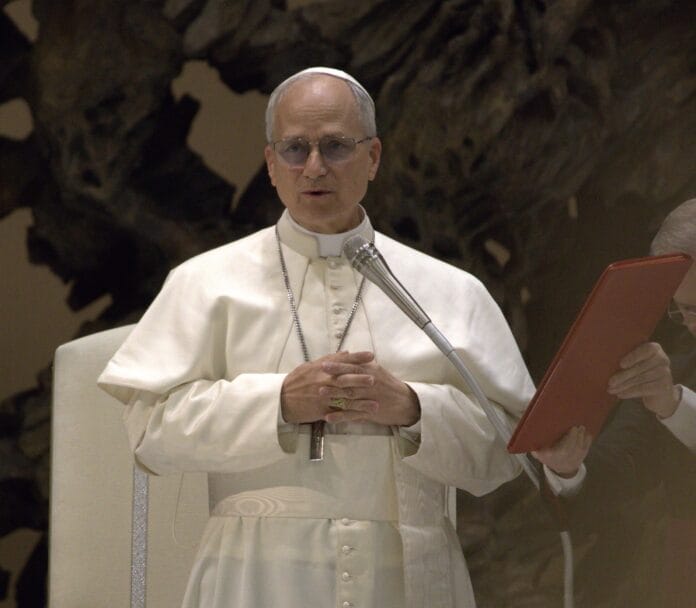
This week at Vatican, An old expression resonated like an echo: "Christian roots of Europe."« Leo XIV She uttered it twice in two days. First in front of conservative MEPs, then in front of archaeologists. Same formula, same words… but a profoundly inappropriate meaning.
What could have been a simple historical reminder has transformed into a subtle political message. The first pope American The man of history, elected last May, has just shown that he does not intend to let this expression become a weapon of identity. On the contrary, he is taking it up again in order to better redefine it.
One phrase repeated, two days, two audiences
December 10: Facing European Conservatives
On Wednesday, December 10th, in the Clémentine room of the Vatican, Leo XIV receives a delegation from the European Conservatives and Reformists (ECR) group. Among them are figures such as Marion Maréchal and Belgian MEP Assita Kanko. This political group brings together approximately 80 right-wing and far-right MEPs: Giorgia Meloni's Fratelli d'Italia party, the Polish Law and Justice movement, and Identité-Libertés in France.
These parliamentarians are in Rome for several days of study on "the conservative and Christian foundations of Europe." The day before, during roundtables, some members of parliament did not mince their words. One of them denounced the "ideologies LGBT and climate change,» which, according to him, fills the spiritual void in Europe. Another asserts that «many Europeans are rediscovering their Christian roots» in the face of «wokism and multiculturalism.».
The context is therefore fraught. These MEPs expect... pope a validation of their identity struggle. They want to hear that Europe must defend itself against Islam, protect its traditions, and erect barriers.
Leo XIV begins his speech in English. He does indeed recall, like his predecessors John Paul II And Benedict XVI, that "European identity can only be understood and promoted in reference to its Judeo-Christian roots." He mentions cathedrals, art, the music sublime, scientific progress, the spread of universities. He recognizes this "intrinsic link between the Christianity and European history.".
So far, conservatives might applaud.
But then the pope He immediately adds a crucial clarification: "The objective of protecting the religious heritage of this continent is not simply to safeguard the rights of its Christian communities, nor primarily to preserve particular customs or social traditions, which in any case vary from place to place and throughout history. It is above all a recognition of the facts."«
An acknowledgment of the facts. Not a political program. Not an identity to defend against an enemy. Just a historical observation.
THE pope He goes on to emphasize that these Christian roots must serve to respond "to the challenges posed by poverty, social exclusion, economic insecurity, as well as by the climate crisis current violence and the war »".
Where MEPs want to build walls, Leo XIV recalls the social doctrine of the Church. Where some speak of immigration as a threat, the pope He insists: "I especially encourage you never to lose sight of the forgotten, those on the margins, those whom Jesus Christ called 'the least among us.'"«
The message is clear: yes, Europe has Christian roots. But these roots dictate how it is received, the social justice, Attention to the poor. Not isolation or withdrawal.
December 11: in front of the archaeologists
The following day, Thursday, December 11, the pope receives members of the Pontifical Institute of Christian Archaeology. The institution is celebrating its centenary. Created in 1925 by Pius XI during a "jubilee of peace »", it trains specialists in the monuments of Christianity antique.
In this academic and scientific context, Leo XIV He delivers a speech and publishes an apostolic letter on the importance of archaeology. In it, he returns to the famous "Christian roots".
This time, he quotes John Paul II «Europe needs Christ and the Gospel, for that is where the roots of all its peoples lie.» Then he adds: «Among the roots of European society and nations, there is certainly the Christianity with its literary and monumental sources; and the work "Archaeologists is a response to the appeal I just mentioned."»
But be careful: for Leo XIV, Christian archaeology is not simply a historical discipline. It is a "valid instrument for ecumenism," a way of "showing peoples the fruitfulness of Christian roots and the fruits for the common good which may result from it.".
Twice in two days, then. Two different audiences. But in both cases, the pope takes up this expression which has been debated in Europe for twenty years… in order to better shift its meaning.
Christian roots… but not as you might think
A rejection of identity manipulation
Leo XIV He knows perfectly well what he's doing. He knows the recent history of this expression, "Christian roots of Europe.".
In the early 2000s, John Paul II had ardently wished that the new European Constitution explicitly mention these roots. Vatican had even expressed his "regrets" when the text adopted in 2004 did not contain these terms. Benedict XVI, a week after his election in 2005, had cited the "indispensable Christian roots" of Europe during his first general audience.
Since then, this expression has become a political marker. It is divisive. For some, it is a historical fact that must be acknowledged. For others, it is an attempt to deny secularism or exclude other cultural contributions. For still others—and this is where Leo XIV intervenes — it has become an identity slogan emptied of its evangelical content.
THE pope He rejects this latter deviation. He does not deny the expression. He does not reject it. But he takes it up again to give it an authentic Christian meaning.
«"Ensuring that the voice of the Church, particularly through its social doctrine, continues to be heard does not mean restoring a bygone era, but guaranteeing that the resources essential for future cooperation and integration are not lost," he explained to the MEPs.
In other words: no, this isn't about nostalgia. No, it's not about returning to a fantasized medieval Christendom. Yes, it's about drawing on this heritage for resources to build the future.
Cathedrals… and the poor
When Leo XIV He speaks of Christian roots, he cites cathedrals, art, universities. It's undeniable: the Christianity It shaped European culture. No one can seriously dispute that.
But here's what he immediately adds: these roots also carry "the wealth of ethical principles and ways of thinking that constitute the intellectual heritage of Christian Europe." And these principles are "fundamental to meeting the challenges posed by poverty, social exclusion, economic insecurity.
Do you see the shift? Christian roots are not just an architectural or cultural heritage to be preserved. They are first and foremost a call to social justice.
THE pope He even cites Saint Thomas More as "a timeless source of inspiration for those who seek to promote the well-being of society." Thomas More, the Chancellor of England who refused to recognize Henry VIII as head of the Church and was executed for it. A man who chose his conscience over power.
The implicit message to Conservative MEPs is clear: you want to talk about Christian roots? Very well. But that implies serving the common good, Not your political agendas. This means defending the marginalized, not just traditions.
«"Never lose sight of the smallest ones"»
The insistence of pope His point on this is striking. On several occasions, he returns to the "forgotten", the "marginalized", those who are "on the margins".
This is not a coincidence. Leo XIV He was a missionary in Peru for over twenty years. He ran a seminary in the poor neighborhoods of Trujillo. He was a bishop in the challenging diocese of Chiclayo. He knows poverty. He was close to it, he didn't just theorize about it.
During his time in Peru, he met Gustavo Gutiérrez, one of the fathers of liberation theology—a movement that combines the Gospel with the emancipation of the poor. Without fully subscribing to this doctrine, Prevost (the civil name of Leo XIV) has retained a keen sensitivity to social issues.
His first apostolic exhortation, published on October 9th, is entitled "« Dilexi Te »"('I have loved you'). Out of 121 points, it deals entirely with the Church's attention to the poor. He writes that commitment to marginalized people is not a "consequence" of faith Christian, but "« faith herself.".
When he speaks about the Christian roots of Europe before conservative members of parliament, Leo XIV It is therefore not simply repeating an empty formula. It recalls the essential point: these roots dictate a preference for the poor.
It's hard not to see the tension. On one side, MEPs talking about fighting "illegal immigration" and defending "traditional values." On the other, a pope who emphasizes the welcome, the social justice, the dignity of migrants.
In his letter« Dilexi Te », Leo XIV He even wrote: "Where the world sees threats, the Church sees sons; where walls are built, she builds bridges."«
It's impossible not to understand the message.
A message consistent with the nascent pontificate
An accepted legacy
Leo XIV does not hide his connection to his predecessor. François died on April 21st, after having prepared the exhortation "« Dilexi Te »In the preamble to this text, the new pope He wrote: "Having inherited this project, I am happy to make it my own."«
It's a way of affirming continuity. François had relentlessly denounced the excesses of a capitalism driven by speculation at the expense of the marginalized and the environment. Leo XIV He takes up the torch. He even quotes his predecessor: "The greatness of a society is measured by the way it treats its poorest members."«
Some observers had wondered if the new pope, a member of the Augustinian order and more discreet than François, was going to change course. The answer is clear: no. On social issues, on the reception of migrants, on the critique of the economic system, Leo XIV is in the same vein.
A French religious figure, Frédéric-Marie Le Méhauté, commented: "This text tells us that we cannot say that the pope François "It will have been a parenthesis in the Church. It is the same teaching that has been upheld for 2000 years."»
Archaeology as a bridge
It is fascinating that Leo XIV He chose to speak about Christian roots to archaeologists the day after his speech to MEPs. This was no coincidence.
Christian archaeology, he explains in his apostolic letter, is not merely a scientific discipline. It is a «form of charity »Why? Because it "restores dignity to those who have been forgotten," because it "highlights the holiness anonymous, one of so many faithful who have built the Church.
THE pope He insists: the Christian archaeologist does not only touch matter. "He studies not only the remains, but also the hands that forged them, the minds that conceived them, the hearts that loved them. Behind each object, there is a person, a soul, a community."«
Do you see the connection? Whether in front of politicians or scientists, Leo XIV It always comes back to humanity. To real people. To the forgotten ones whom history or modern society tend to erase.
Archaeology, he said, thus becomes "a valuable tool for«evangelization »"At a time when "we often lose our roots", it allows us to rediscover what truly constitutes us.
A central ecumenism
Another important element: Leo XIV makes Christian archaeology a "valid instrument for ecumenism". Why? Because it studies "the historical period of the united Church", before the major divisions between Catholics, Orthodox and Protestants.
This ties in with his first apostolic journey, at the end of November in Türkiye and at Lebanon. He had visited the site of the first Council of Nicaea (325) for a great ecumenical prayer. His motto for this journey: "One Lord, one faith, one baptism."«
Here again, the message is clear. When Leo XIV He speaks of the Christian roots of Europe; he is not thinking of a closed Catholic identity. He is thinking of the united Church of the early centuries, of what unites rather than what divides.
In his apostolic letter« In unitate fidei » published before his trip to Türkiye, He wrote: «We need a spiritual ecumenism of prayer, praise, and worship.» He called Christians to "rediscover the heart of their faith: Jesus Christ.".
Not an identity against Islam. Not a culture against modernity. But Christ at the center.
The roots… and the fruits
In his letter on archaeology, Leo XIV quotes Pius XI, the pope who had founded the Institute in 1925. He said that archaeology "shows people the fruitfulness of Christian roots and the fruits for the common good which may result from it.".
Fruits for the common good. That's the gist of it.
We don't talk about Christian roots to retreat into an idealized past. We don't talk about them to erect barriers. We talk about them to understand where certain values come from—the dignity of each person, the primacy of the common good, the preference for the poor — and to make them bear fruit today.
THE pope He stated clearly before the MEPs: "This is not about restoring a bygone era, but about ensuring that the resources essential for future cooperation and integration are not lost."«
Cooperation. Integration. Not closure. Not exclusion.
A pope who causes trouble
This dual intervention of Leo XIV This will obviously be unpopular. Conservatives who hoped for Roman endorsement of their identity struggle will be disappointed. Secularists who see any mention of Christian roots as an attempt at clericalism will have a hard time attacking a pope which links this heritage to the social justice and to the reception of migrants.
Perhaps this is the masterstroke: to take the expression, validate it historically… and empty it of all identity-related charge in order to fill it with evangelical content.
Leo XIV, Seven months after his election, he began to outline the contours of his pontificate. He clearly positioned himself within the continuity of François on social issues. But he also brings his own sensibility: that of a American who became Peruvian, the son of a missionary who lived for twenty years among the poor, an Augustinian for whom charity is not an option but the very heart of faith.
His episcopal motto is "In Illo uno unum": "In the one Christ, we are one." That is precisely what he has just reminded Europe of. You want to talk about Christian roots? Very well. But then let's talk about Christ. About his love for the poor. From his call to serve "the least among us." From his desire that we be one.
Not walls. Bridges.
Not fear of the other. The welcoming of the brother.
These are the true Christian roots of Europe, according to Leo XIV. And it's a message that, clearly, is as disturbing as it is unifying.