











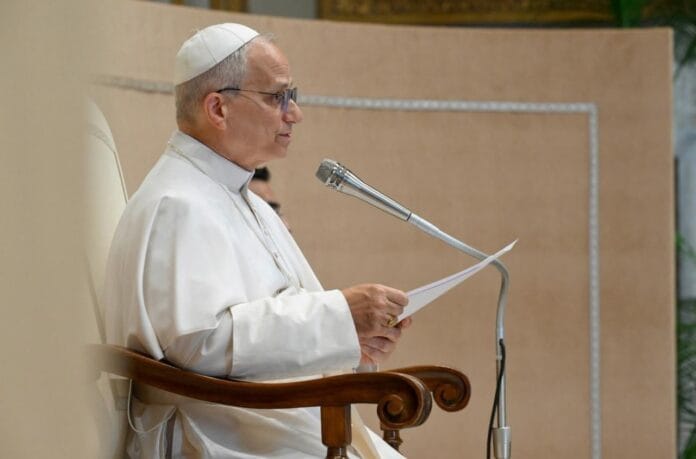
Imagine the scene: a thousand Italian secret agents gathered in the majestic Hall of Blessings of the Vatican, facing the Pope. This is not the plot of a thriller, but a very real event that took place recently, marking a historic moment where spirituality and national security met to discuss a crucial topic: ethics in the world of intelligence.
This exceptional audience, organized to mark the centenary of the Italian intelligence services, gave rise to a remarkable speech by Leo XIV. THE Pope He didn't mince words: in a world saturated with information and ever more sophisticated surveillance technologies, how can we preserve human dignity How can we ensure that those who protect us do not themselves become a threat to our fundamental freedoms?
Let's delve together into this message that resonates far beyond the walls of the Vatican and which concerns us all, at a time when the line between security and surveillance is becoming increasingly blurred.
A century of shadows in the service of light
The birth of a century-old institution
The story begins in 1925, exactly one hundred years ago. Italy, like many European countries between the two world wars, understood that it needed an organized structure to protect its national interests. This led to the creation of the Italian intelligence services, an institution that would evolve over the decades to become a key player in national security.
What makes this story particularly interesting is the evolution of their mission. Initially created to monitor threats against the Italian state, these services gradually extended their protection to the Holy See and the City of Rome. Vatican. A unique collaboration that illustrates the special relationship between Italy and the world's smallest state, nestled in the heart of Rome.
A jubilee audience unlike any other
Choosing to celebrate this centenary with an audience at Vatican It is not insignificant. Pope Leo XIV He emphasized this point, expressing his delight that these unsung heroes had decided "to experience the Jubilee together as a working community." This is a rare recognition of the importance of their mission, but also an opportunity for the head of the Catholic Church to convey a crucial message to them.
Imagine: a thousand people accustomed to working in utmost discretion, gathered in a place symbolizing spiritual transparency. The contrast is striking and perfectly calculated. Pope publicly acknowledges "the heavy responsibility of constantly monitoring dangers that could threaten the life of the nation." But this acknowledgment comes with clear moral requirements.
The pillars of an extraordinary profession
Leo XIV It identifies three essential qualities for practicing this profession: competence, transparency, and confidentiality. This trio may seem contradictory – how can one be transparent while maintaining confidentiality? Yet, it is precisely in this delicate balance that the challenge for these professionals lies.
Competence is essential: anticipating dangerous scenarios requires specialized expertise, ongoing training, and sharp analytical skills. But transparency and confidentiality also deserve attention. Confidentiality means keeping secrets that must be kept secret. Transparency means accepting democratic oversight, being accountable, and operating within a clear legal framework. In a healthy democracy, one cannot exist without the other.
Ethics in the face of the power of information
The trap of absolute "common good"
This is where the speech of Pope becomes particularly striking. He puts his finger on an insidious danger: when one is convinced of serving the common good, It becomes tempting to forget ethical requirements. When the common good "To continue seems more important than anything else," warns Leo XIV, we run "the risk of forgetting the ethical requirement" to respect the dignity of our fellow human beings.
This is a trap that security institutions regularly fall into, and not only in Italy. Consider the mass surveillance scandals revealed in recent years in various countries. How many times have infringements on freedoms been justified in the name of national security? How many times has the phrase "It's for your own good" been used to violate the privacy of millions of people?
THE Pope It reminds us of a fundamental principle: the ends do not justify the means. Even with the best intentions in the world, certain lines must never be crossed.
Non-negotiable rights
Leo XIV is very clear on this point: security activities "can never deviate from respect for the dignity and rights of every individual." He then lists a set of rights that must be guaranteed "always and in all circumstances":
This list is not insignificant. It precisely covers the areas where intelligence services have the most power – and therefore the greatest potential for abuse. Monitoring communications means intruding on people's privacy. Collecting information on opinions risks undermining the freedom of conscience. Influencing the media is a threat to the freedom information.
The message is clear: these rights are not subject to change. They cannot be suspended because a particular threat emerges or because a new technology makes it possible.
Proportionality as a safeguard
A key concept emerges from the papal address: proportionality. The actions of intelligence services must "always be proportionate to the common good being pursued." This is an important legal principle, but one that deserves closer examination.
In practical terms, what does this mean? Let's take a simple example. If you suspect someone of planning a terrorist attack, is it proportionate to monitor their communications? Probably yes. Is it proportionate to monitor all the communications of all citizens in case one of them is planning something? Clearly not.
Proportionality requires that we constantly assess whether the means employed are truly necessary in relation to the identified threat. This is an ongoing exercise in discernment, and that is precisely what the Pope ask these professionals.
Democratic control as a necessity
But how can we ensure that these principles are respected? Leo XIV provides a clear institutional response: public laws, judicial oversight, and budgetary transparency are necessary.
THE Pope «"Advocates for the enactment and publication of laws governing intelligence activities, which would be subject to judicial oversight and control." In other words: no gray areas, no unlimited secret powers. Everything must be regulated by law, and this law must be known and subject to scrutiny.
Regarding budgets, the message is just as direct: they must be "subject to public and transparent controls." Why? Because money reveals priorities. Secret budgets allow for unchecked abuses. Transparent budgets create democratic accountability.
This is a bold stance, given that secrecy has traditionally been the founding principle of intelligence services. Pope does not ask to reveal ongoing operations, but it demands a democratic architecture that prevents abuses systemic.
The challenges of the digital and information age
The revolution that changes everything
«"The massive and continuous exchange of information requires critical vigilance on certain vitally important issues," he says. Leo XIV. That's an understatement. The revolution digital has radically transformed the intelligence profession.
Consider this: fifty years ago, monitoring someone required significant resources—seers, complicated wiretaps, physical searches. Today, with our smartphones, social media, and connected devices, we constantly generate mountains of data about ourselves. Surveillance has become technically much easier, much more widespread, and much less visible.
This technical facilitation raises a major ethical problem: does what is technically possible automatically become legitimate? Because millions of people can be monitored simultaneously, should we do so?
The new and constant dangers
THE Pope identifies several specific threats to the’digital age, And his list deserves a closer look:
The distinction between truth and fake news. In a world where anyone can create and disseminate information, how can we separate truth from falsehood? Intelligence services have a role to play in identifying disinformation, but they may also be tempted to manipulate it to their advantage.
Undue exposure of private life. Our digital lives leave traces everywhere. Every purchase, every trip, every internet search creates data. Intelligence services have access to it, but how far can they go in exploiting it?
Manipulating the most vulnerable. Algorithms and data allow for the targeting of vulnerable individuals with surgical precision. This capability can be used to protect these individuals, but also to manipulate or radicalize them.
The logic of blackmail. When you possess compromising information about someone, the temptation to blackmail is strong. And with today's data volumes, finding something compromising on almost anyone becomes possible.
Incitement to hatred and violence. Social media has demonstrated its ability to amplify extremist rhetoric. How should intelligence services respond? Surveillance, yes, but without resorting to censorship that would stifle democratic debate.
Strict vigilance required
Faced with these dangers, Leo XIV formulates a very specific request: "to rigorously ensure that confidential information is not used to intimidate, manipulate, blackmail or discredit politicians, journalists or other actors in civil society".
This is a crucial point often overlooked in intelligence debates. The focus is usually on external threats – terrorism, foreign espionage. But the Pope highlights an internal threat: the use of intelligence capabilities against citizens, and particularly against those who play a vital democratic role.
Politicians, journalists, and members of civil society are the ones who control power, inform citizens, and drive public debate. If intelligence services can intimidate or blackmail them with the information they collect, then democracy itself is threatened.
The Church too, a victim
One passage of the speech is particularly revealing: the Pope mentions that "in several countries, the Church is the victim of intelligence services that act for malicious purposes by oppressing its freedom »".
This observation reminds us that the abuse of surveillance capabilities is not theoretical. In some authoritarian countries, intelligence services are indeed used to repress opponents, including religious institutions that dare to speak out. social justice or human rights.
This is a warning: surveillance tools can serve democracy, but they can just as easily destroy it. It all depends on who controls them and for what purpose.
The requirement of great moral stature
Faced with all these challenges, the Pope He is not content with calling for better laws or better controls. He is asking for something deeper: "great moral stature".
What does this mean in concrete terms? It means having the courage to say no when you are asked to do something that is technically possible but ethically unacceptable. It means resisting hierarchical pressure when it pushes you to cross red lines. It means keeping in mind that behind every file, every wiretap, every surveillance operation, there are human beings with their inviolable dignity.
This moral stature cannot be improvised. It is cultivated through constant ethical reflection, through training that goes beyond technical skills, and through an organizational culture that values moral questioning rather than blind obedience.
Discernment and balance as everyday tools
THE Pope He concluded his message by encouraging these professionals to continue their work "by learning to assess with discernment and balance the different situations that arise".
Discernment is the ability to analyze each situation in its specificity, without mechanically applying general rules. It is understanding that each case is unique and requires tailored judgment.
Balance means rejecting extreme solutions in either direction. It is neither total surveillance in the name of absolute security, nor the absence of surveillance in the name of... freedom without limits. It's about finding the right balance, that delicate point of equilibrium where necessary security does not destroy fundamental freedoms.
A tribute to the sacrifices made
The speech of Pope would not be complete without a tribute to those who paid the ultimate price. Leo XIV pays tribute to the agents who fell in the line of duty, emphasizing that "their dedication may not make the headlines, but it lives on in the hearts of the people they helped and in the crises they helped to resolve.".
This is an important recognition. The intelligence profession is thankless: when everything goes well, no one notices the danger averted. Only failures make the headlines. These professionals work in the shadows, often without public recognition, sometimes at the risk of their lives.
This reality, however, should not be used as an excuse to evade democratic control. On the contrary, it makes a robust ethical framework all the more necessary. Those who take risks to protect others deserve to work in an organization that respects the values it is supposed to uphold.
A message that concerns us all
Beyond intelligence services
The reason this papal message resonates so strongly is that it goes far beyond the issue of the Italian secret services. It touches on a fundamental debate of our time: how to preserve our freedoms in the age of technological surveillance?
We live in a world where data has become the new oil of the 21st century. Private companies collect our information to sell us products. Governments monitor us in the name of security. Social networks track our every click. In this context, the question posed by the Pope becomes universal: where to draw the line?
Transferable principles
The principles set forth by Leo XIV apply well beyond intelligence services. Human dignity as a non-negotiable value, proportionality of measures, democratic control, transparency of rules – all of this should also guide technology companies, police forces, administrations.
Think of Facebook, Google, Amazon. These companies hold information about us that intelligence services thirty years ago wouldn't have dared dream of collecting. They too should be subject to these ethical requirements. They too should demonstrate that their practices respect human dignity and are proportionate to the legitimate objectives they pursue.
Civic responsibility
But this message also challenges us as citizens. Are we sufficiently vigilant on these issues? Do we demand that our leaders establish robust safeguards? Do we participate in the democratic debate on the balance between security and freedom ?
Too often, we surrender our privacy without really thinking, accepting terms of service we don't even read. Too often, we let surveillance laws be passed without a murmur, because we're told they're "against terrorists" or "for children." The rhetoric of Pope reminds us that it is our responsibility to remain vigilant.
The hope of a possible balance
The message from Leo XIV is not hopeless. He is not saying that security and the freedom are incompatible. On the contrary, he asserts that a balance is possible, but that it requires constant effort, discernment, and ongoing ethical vigilance.
This is a call for collective maturity. Yes, we need intelligence services to protect us from real threats. No, that doesn't mean they should operate without limits. The challenge is to build institutions that are effective enough to protect us and sufficiently regulated so that they don't themselves become a threat.
A dialogue to be continued
This hearing at Vatican This is just one moment in a dialogue that must continue. The challenges of’digital age They are constantly evolving. Surveillance technologies are becoming ever more sophisticated. Threats are changing. The ethical and legal framework must keep pace.
That is why the discernment that the Pope is not a definitive solution but an ongoing process. Each generation, each era must redefine where it places the balance between security and freedom, depending on available technologies, identified threats, and above all, the values it wishes to preserve.
The intervention of Leo XIV This reminds us of a fundamental truth: tools are neither good nor bad in themselves. Everything depends on how they are used and the values that guide that use. In a world where technology It gives us unprecedented power, and ethics becomes more crucial than ever.
So, what can we take away from this papal message to the Italian intelligence services? Perhaps simply this: the power of information is immense, but it must always remain at the service of humanity, never above it. The dignity of every person is non-negotiable, even in the name of the common good. And democratic vigilance is not a luxury but an absolute necessity so that those who protect us do not become our jailers.
In our hyper-connected world where every one of our actions leaves a trace digital, This message resonates with particular urgency. It concerns us all, secret agents or ordinary citizens, believers or non-believers. For it is together that we must decide what kind of society we want to live in: a secure but liberty-suppressing society, or a society that finds the delicate balance between protection and freedom, between efficiency and ethics.
The centenary of the Italian intelligence services has at least had this merit: reminding us that even the most technical questions always have, at their core, a profoundly human and moral dimension. And that it is by keeping this dimension in mind that we will build a future worthy of the name.