













Reading from the Book of Wisdom
In Wisdom there is an intelligent and holy spirit, unique and many, subtle and quick; penetrating, limpid, clear and without defect; a friend of good, lively, invincible, benevolent, a friend of men; firm, assured and serene, all-powerful and observant of all, passing through all minds, even the most intelligent, the purest, the most subtle.
Wisdom, in fact, possesses a mobility that surpasses all others; it traverses and penetrates all things thanks to its purity. For it is the breath of God's power, the perfectly pure emanation of the glory of the Master of the universe; therefore, nothing defiled can reach it.
She is the reflection of eternal light, the immaculate mirror of God's action, the image of his goodness.
Though unique, she is all-powerful; and without leaving herself, she renews the universe. From generation to generation, she passes into holy souls, making them prophets and friends of God. For God loves only those who abide with Wisdom.
She is more beautiful than the sun, she surpasses all the constellations; compared to the light of day, she proves far superior, for day yields to night, but against Wisdom evil does not prevail.
She extends her power from one end of the world to the other, she governs the universe with gentleness.
Wisdom, the light of God in motion
When man discovers that Wisdom is not just knowledge, but the living presence of God that illuminates, transforms and governs the world.
THE Book of Wisdom This leads us to the heart of a revelation: Wisdom is not an idea or an abstract virtue, but a life, a breath emanating from God himself. It transcends the ages, enlightens souls, and renews creation. This article is for all those who seek to unite intellect and faith, contemplation and commitment, to recognize in the light of Wisdom the very face of Christ.
- Wisdom, the breath and radiance of God
- Divine intelligence at work in the world
- Three faces of Wisdom: inner, cosmic, incarnate
- From biblical wisdom to lived wisdom: a path of transformation
- Spiritual Heritage and Practices of Discernment
Context
THE Book of Wisdom (or Wisdom of Solomon) belongs to Jewish wisdom literature, written in Greek in Alexandria around the 1st century BCE. This Hellenistic context illuminates the richness of its language: that of a Jewish faith in dialogue with Greek philosophy. Readers of the time experienced a tension: how to believe in the one God in a world fascinated by reason, beauty, and science? The text answers: true reason, true light, is that which comes from God.
The anonymous author, often identified as an Alexandrian Jewish sage, sings of Wisdom as a personal and divine reality, a breath emanating from God and acting in the world. Wisdom is not merely an attribute of God; it is his active light, his perfect mirror, his creative tenderness. Christian theology would later recognize in this figure a prefiguration of the incarnate Word, Christ, "the image of the invisible God" (Col 1,15).
The verses of Wisdom 7:22–8:1 offer a masterful synthesis: Wisdom is described by a series of attributes, multiple reflections of perfect unity. The author paints a poetic and mystical portrait: an intelligent, holy, subtle spirit, a lover of good, pervading all things with its purity. It is breath, emanation, eternal light. This juxtaposition creates an impression of movement, like a luminous wind traversing the world—the same breath that hovered over the waters in the beginning.
This experience of Wisdom connects heaven and earth, the transcendent God and the inhabited world. It "renews the universe" without leaving itself: a striking phrase that anticipates the mystery of the Trinity. God acts without dividing himself, gives himself without losing himself. The text concludes with a sentence that sums it all up: "She governs the universe with goodness." Not domination, but benevolence: the power of God is expressed in a compassionate, ordering, and loving wisdom.
The liturgical framework of this reading, often proclaimed in celebrations dedicated to the gifts of the Spirit or to Married, This intuition underlines that Wisdom is relationship, communion, and benevolence. It educates the human heart to govern its own inner worlds in the light.
Analysis
The central idea of the passage is the revelation of an active divine presence: Wisdom is the tangible and spiritual manifestation of God in his work of creation and salvation. It is not an external concept but the living trace of God, moving within matter and soul.
The central paradox lies in this tension: Wisdom is both immutable and dynamic. «Without leaving itself, it renews the universe.» It is the perfect unity that engenders diversity, the absolute purity that penetrates imperfection. Herein lies the mystery of divine action: God acts in the world without merging with it; he dwells in creation without ceasing to be transcendent.
Theologically, the text introduces a veritable pneumatology before its time: Wisdom breathes, unfolds, illuminates, orders, purifies. It is presented as a breath—a term which, in the Bible, often designates the Spirit. This identification will become explicit in the Christian tradition: the Holy Spirit is Wisdom in action, the light that makes the face of the Son visible and reveals the Father.
Spiritually, Wisdom lies at the boundary between reason and contemplation. It invites the believer to inner unification: intelligence and faith, knowledge and love, These are no longer separate domains. In the divine light, they unite. The experience of Wisdom is therefore not one of mere erudition, but rather entry into communion. He who lives with Wisdom becomes, the text says, "a friend of God": a rare and profoundly moving expression.
Finally, the symbolic stakes are cosmic. When the text affirms that Wisdom governs the universe with benevolence, it proposes a profoundly trusting vision of the world. The order of the cosmos is not the product of chance or fate; it is held, sustained, and animated by a loving intelligence. This conviction can renew our approach to science, ecology, and politics. Divine wisdom is not merely a spiritual virtue; it is a structure of reality.
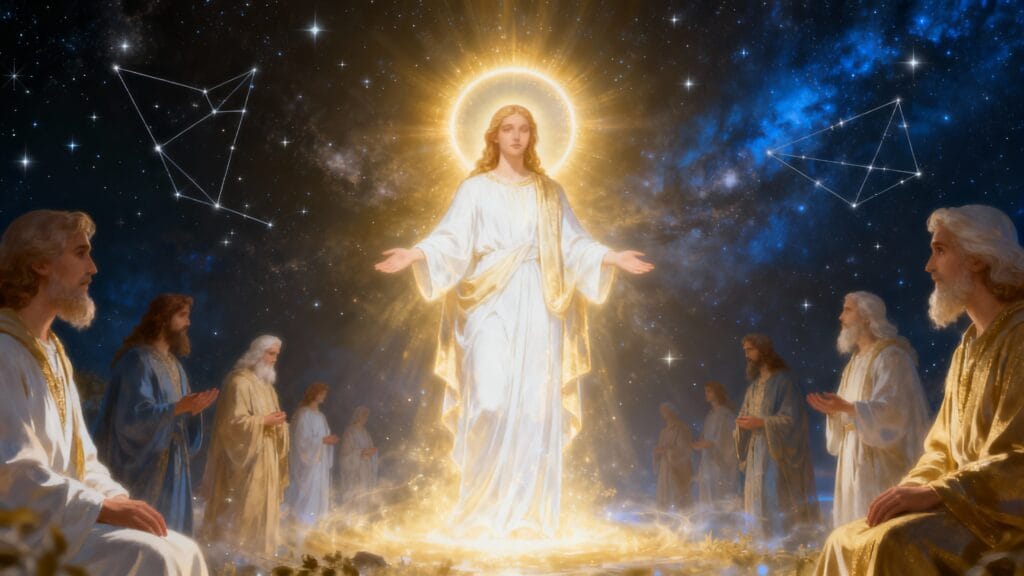
Wisdom, an inner presence
The first dimension of Wisdom is internal. It is the light of God that illuminates human consciousness. In the biblical tradition, it speaks in the secret of the heart, like a gentle voice that teaches discernment. Wisdom is not imposed; it is given to those who sincerely seek it.
When the text describes Wisdom as "pure," "steadfast," and "peaceful," it puts words to a universal experience: that of an inner order born of the divine presence. This peace does not come from the absence of conflict, but from communion with God. The wise person is not the one who knows everything, but the one who remains centered in this light, even amidst the complexities of life.
In prayer, this inner wisdom takes on an almost tangible form: it guides choices, illuminates words, and inspires righteous actions. It is listening before it is deciding. The believer gradually becomes a "reflection" of the eternal light; their soul becomes a mirror of the divine movement. Here we understand why the text speaks of a "spotless mirror of God's activity": Wisdom makes humanity transparent to the divine presence.
This intuition aligns with the great contemplative tradition, where purity of heart allows for clarity of vision. To the extent that the heart is purified of disorder and possession, it becomes capable of reflecting God.’humility becomes the fertile ground of light.
Wisdom, the order of the world
A second, cosmic dimension unfolds in the verses: Wisdom pervades and penetrates all things. Its purity does not distance it from the world; on the contrary, it sustains it in its very being. This vision aligns with the idea that the universe is structured by a divine rationality, discernible in the beauty of creation.
Wisdom rejects the separation between the spiritual and the material. Eternal light does not only illuminate souls; it permeates matter, illuminates nature, and governs the seasons. Wisdom acts as a universal harmony. Everything finds its rightful place because it participates, in a mysterious way, in this light that connects all things.
This perspective has an ecological dimension ahead of its time. To recognize Wisdom in the world is to recognize the implicit sacredness of creation. It invites a contemplative attitude: not domination, but cooperation with God's rhythm. Wisdom governs with kindness because it respects that which it governs. It is authority and gentleness, power and benevolence.
In an era marked by fragmentation, this perspective reintroduces unity. It reminds us that the world is not alien to us: it is the place where Wisdom manifests itself. To be wise, then, is to learn to see the world as an inhabited book, to read the light in things, and to participate in their order by contributing to it. kindness.
Wisdom, light incarnate
A third dimension emerges when Christian tradition rereads this text: Wisdom takes on a face in Christ. The radiance of eternal light becomes, in the New Testament, the Word made flesh. This passage from Book of Wisdom It then becomes prophetic: eternal light is coming to visit humanity.
In Christ, divine Wisdom draws near. It is no longer merely contemplation, but relationship. Eternal light becomes gaze, gesture, word of mercy. The mirror of divine activity is manifested in the face of the Son. This is why the Christian faith recognizes in Wisdom the unity of the Logos: in him perfect knowledge and love Perfect.
This incarnation gives Wisdom an ethical dimension: the light of God becomes a call to live according to that light. It leads to the transformation of our human relationships: "She governs the universe with kindness" becomes: let us govern our lives with kindness. Intelligence is fully divine only when it serves. charity.
In everyday life, this translates into a way of living illuminated from within. The wise person is one whose light does not dazzle but warms, whose knowledge does not judge but helps one understand. To follow Wisdom incarnate is to imitate Christ, gentle and humble of heart.
Echoes in tradition
The Church Fathers often commented on this page of the Book of Wisdom to see in it a hymn to the divine Word. Origen reads in it the pre-existing action of Christ in creation; Athanasius finds in it the proof of the union of the Son with the Father; Augustine compares Wisdom to the inner light that illuminates the human spirit.
In the medieval tradition, Wisdom and Love become almost synonymous. For Saint Bernard, divine Wisdom is "the measure of the heart": knowing according to charity. Thomas Aquinas, in his prayer for Wisdom, asks us to "inwardly savor" the truth: for wisdom is not only learned, it is tasted.
In the liturgy, the figure of Wisdom is often associated with the Virgin Mary. Married, seat of Wisdom. In it, the divine light has found its dwelling place. It becomes the model for every soul that welcomes this light without holding it back, letting it act and radiate.
Even today, contemporary Christian spirituality is rediscovering Wisdom as a path to unity: uniting thought and contemplation, science and faith, intelligence and goodness. It inspires theologians in the dialogue between faith and reason, but also those who seek God in inner silence.
Meditation trails for walking in the light
- Read the verses of the Book of Wisdom letting each word enlighten you.
- Observe how light acts in your life: where does it shine, where is it veiled?
- Ask God for purity of heart to become a mirror of his presence.
- Welcome creation as a place where Wisdom still acts today.
- Choose an act of kindness as a way to participate in the order of Wisdom.
- Recognize in Christ the incarnate Wisdom and let his light guide your choices.
- It ends in silence, letting the light become peace.
Conclusion
THE Book of Wisdom It opens a window onto the inner workings of God. The text does not offer a fixed thought, but a light in motion, a living mirror. By embracing this Wisdom, humanity enters into God's rhythm: discernment, peace, goodness.
The transformation is not external: it begins with the purification of the gaze., gentleness from the heart, loyalty in the little things. Wisdom is passed on "to holy souls." It becomes communion, friendship, service to good. The world needs this light to heal its fractures; the Gospel shows us that it already shines in the humanity of Christ.
In practice
- Begin your day by asking for the light of Wisdom.
- Read a passage from the Bible slowly and with inner listening.
- In every situation, seek the most beneficial attitude.
- Observe nature as a reflection of divine harmony.
- Make an important decision based on peace internal, not urgent.
- Cultivate gratitude: it makes visible kindness at work.
- Offer your knowledge in service to others, not in domination.
References
- Book of Wisdom 7.22 – 8.1
- Book of Proverbs 8,22-36
- Psalm 104
- Gospel according to John 1,1-9
- Colossians 1,15-20
- Athanase, Speech against the Arians
- Augustine, Confessions
- Thomas Aquinas, Prayer to obtain Wisdom