












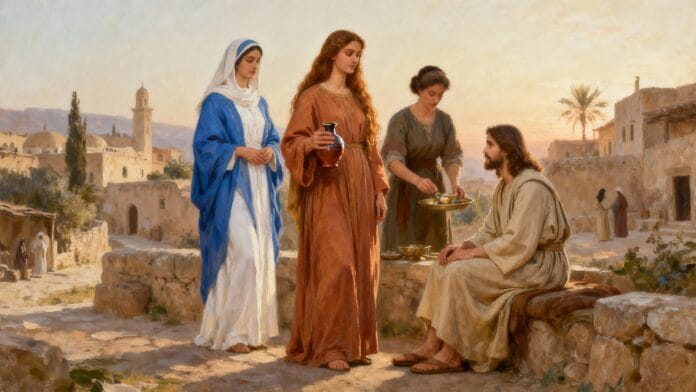
The role of women in the New Testament is generating increasing interest among both scholars and believers. These inspiring female figures play an often overlooked but fundamental part in conveying the Christian message. Studying women in the New Testament allows us to better understand the richness and diversity of biblical testimonies.
Here you will discover how these women, far from being mere secondary characters, actively participate in the history of salvation. Their presence reveals a profound spiritual dimension, often overshadowed by a reading focused on male figures. Exploring the role of women in the Bible enriches our understanding not only of the sacred texts, but also of the place of women in faith and society.
Some key points to remember:
- Women The New Testament plays an essential role in the major events of Jesus' life.
- They embody strong values such as faith, courage and loyalty.
- Their example continues to inspire contemporary generations in search of authentic role models.
This journey through inspiring female figures invites you to revisit the Scriptures from a new, more inclusive and fairer perspective.
The societal and religious context of the New Testament
The first century, the era in which the New Testament writings were written, was marked by a profoundly patriarchal society. This historical reality strongly influenced the role and place of women in daily, religious, and social life.
Historical and social context
- Patriarchal society : men hold family, political and religious authority. Women are generally confined to the domestic sphere, responsible for managing the household and educating the children.
- Limited legal status : women They have few legal rights. They depend on their father, then on their husband, in a logic of dominant male authority.
- Economic role Despite this legal subordination, some women participate in economic activities, particularly in trade or crafts. Their contribution is often invisible in official documents.
- Religious practices Attending places of worship is possible for women, but they do not have access to priestly functions or public responsibilities within religious assemblies.
Impact on the role of women in the New Testament
Patriarchal society clearly influences the way in which women are represented in Scripture. They often appear on the margins of narratives centered on dominant male figures. Yet, several passages demonstrate their active presence and spiritual importance:
- Presence alongside Jesus during key events (crucifixion, resurrection), testifying to remarkable fidelity.
- Participation as disciples or beneficiaries of the evangelical ministry.
- Stories that highlight qualities such as faith, courage, and wisdom.
These elements reveal a twofold movement: on the one hand, a society that restricts their public roles; on the other hand, a gradual recognition of their essential spiritual commitment. The historical context thus forges a framework that is difficult to overcome, but the New Testament offers examples where women transcend these social limits to become major players in the Christian narrative.
Mary Magdalene: an emblematic and apostolic figure
Married Mary Magdalene occupies a unique place in the New Testament. She is often described as a close disciple of Jesus, but her importance goes beyond this simple role. Married Madeleine is about understanding a woman whose faith and loyalty demonstrate a deep commitment, often summarized by the expression «"Apostle to the apostles"».
Introducing Mary Magdalene
Mentioned in all four Gospels, Married Mary Magdalene is first identified as the one from whom Jesus cast out seven demons (Luke 8:2This healing marked a turning point, closely linking her to Christ's mission. She became part of the group of women who followed Jesus and supported his ministry, a rare role at that time. Her constant presence underscored her remarkable faithfulness.
Presence at key moments
Married Madeleine is one of the few female figures present during crucial events:
- The crucifixion While the male apostles fled, she remained at the foot of the cross (John 19:25).
- The Entombment She observes where the body of Jesus is laid (Mark 15:47).
- The resurrection She is the first to discover the empty tomb and receives a direct message from the resurrected Christ (John 20:14-18).
This unique role makes her not only an eyewitness but also the messenger of the resurrection among the disciples. The title «"Apostle to the apostles"» He is assigned this role because of this crucial mission of announcement.
A modern reassessment of its role
Archaeological discoveries and apocryphal texts, particularly those found at Nag Hammadi, now allow for a more nuanced reinterpretation of her figure. These writings portray an educated woman, close to Christ in a more egalitarian relationship than patriarchal tradition suggests.
Married Madeleine also inspires contemporary women's movements that assert her central place in Christian history. She symbolizes:
- The strength of unwavering faith in the face of adversity.
- Loyalty active, which engages the whole being in service of the divine message.
- A figure of spiritual and social emancipation.
Her portrait challenges classical representations and invites us to recognize the richness of the feminine in the Gospel narrative.
«"« Married Madeleine embodies this alliance between personal courage and spiritual vocation — an essential example for anyone seeking to live their faith and fidelity to the fullest.»
Mary of Nazareth: a model of faith and obedience
Married Jesus' mother occupies a central place in the Gospel narrative. Her role transcends that of a simple maternal figure; she is the very embodiment of exemplary faith, accepting a divine mission of exceptional magnitude. From the Annunciation onward, her "yes"— fiat mihi secundum verbum tuum — demonstrates voluntary and conscious obedience, despite the many uncertainties linked to her status as a woman in a patriarchal environment.
- Unique spiritual role : Married She is chosen to bear the Son of God, which signifies an immense responsibility and a total commitment to the divine plan. This vocation places her at the heart of the Christian mystery, as a discreet but essential mediator.
- Social and cultural challenges As a Jewish woman of the 1st century, Married evolves in a context where women They generally occupy a subordinate position. Her courageous decision reveals a remarkable inner strength in the face of social norms that could have prevented her from asserting herself.
- A model of unwavering faith Throughout the Gospels, Married She appears as a constant presence at Jesus' side, particularly during crucial moments such as the wedding at Cana or the Crucifixion. She embodies loyalty absolute submission to the divine will, supporting her son to the very end.
«My soul magnifies the Lord…» (Song of Married, Luke 1:46-55) perfectly illustrates this profound faith which still inspires today.
The figure of Married This reminds us that the role of women in the New Testament is far more than anecdotal; they are major players in salvation. Her example of joyful obedience and complete trust continues to inspire those who seek to live their faith with authenticity and courage.
Martha and Mary two complementary forms of spiritual commitment
The figures of Martha and Married, The sisters of Lazarus offer valuable insight into the diversity of female roles in the New Testament. Their presence in the Gospel of Luke (10:38-42) and John (11:1-44; 12:1-8) reveals two modes of spiritual engagement which complement each other.
Marthe embodies active engagement. She busies herself welcoming Jesus into her home, diligently attending to his needs. Her role testifies to a faith put into action through caring for others and the practical management of daily needs. This practical activity should not be underestimated: it is essential for supporting the community and creating a space where an encounter with God becomes possible.
Married, Conversely, she is presented as the contemplative disciple. Seated At Jesus' feet, she listens to his teachings, embodying an attitude of deep listening and meditation. This moment underscores the importance of contemplation in the Christian life, an inner openness that allows one to fully receive the divine message.
The contrast between Martha and Married reveals that the’feminine spiritual commitment is not monolithic but plural:
- Marthe represents concrete action in service to others ;
- Married symbolizes attentive listening and inner communion with God.
Their interaction teaches that these two attitudes are necessary and complementary for a balanced Christian life. Jesus himself reminds Martha that while her service is important, it must not make her forget the essential: "You must listen to what the Lord says" (Luke 10,42).
These portraits thus highlight different expressions of female faith in a context often marked by strict social expectations. Martha and Married They are inspiring role models who show how every woman can find her place on the spiritual path according to her gifts and personal callings.
This dual perspective on action and contemplation enriches our understanding of...’feminine spiritual commitment in the New Testament, inviting us to recognize all forms of contribution to the kingdom of God.
Other inspiring female figures from the New Testament
The New Testament presents several women disciples and witnesses of Jesus, whose role is fundamental in transmitting his message. Among them, two figures stand out in particular:
- The Samaritan woman (John 4): Met at Jacob's well, she embodies openness to the divine word beyond cultural and religious barriers. Her dialogue with Jesus reveals a profound spiritual thirst and a powerful witness to her community, making her one of the first evangelists.
- The woman with hemorrhages (Mark 5; Luke 8): His courageous faith and personal commitment are exemplary. Touching Jesus' garment despite his social isolation demonstrates complete trust in his healing power. This encounter illustrates the intimate dynamic between individual faith and spiritual healing.
Other women also appear as committed disciples or key witnesses in the Gospel narratives:
- The women present at the Passion and Resurrection, often mentioned as faithful guardians of key moments.
- Some anonymous disciples who accompany Jesus and support his ministry through their service.
These female figures show that women's involvement in the New Testament is not limited to a passive role. They actively participate in spreading the Gospel and embody unwavering fidelity even in the face of peril. Their presence underscores an inclusive dimension of the Christian message, where women are major players in salvation.
Female figures from the Old Testament evoked for their faith and courage
In the Christian tradition, certain female figures from the Old Testament occupy a major symbolic place. These women embody fundamental spiritual values that illuminate the role of women in the New Testament: inspiring figures through their faith, courage, and faithfulness.
Deborah the Prophetess She is one of the few women to have combined the roles of judge and prophetess. She guides Israel through a turbulent period, calling for resistance against oppression. Her strength lies in her ability to combine spiritual authority with political leadership. Through her example, she demonstrates that faith can be expressed through both divine pronouncements and decisive action.
Esther brave She stands out as a model of audacity and wisdom. A Jewish woman who became Queen of Persia, she risked revealing her identity to save her people from an extermination plot. Her story underscores the crucial role of personal courage in the face of injustice and threat. Esther It also illustrates the power of a faith committed to serving others.
Ruth faithful It, on the other hand, represents loyalty and loyalty familial, but also spiritual. A foreigner who came to live with her mother-in-law Naomi, she voluntarily chose to adopt the God of Israel. This step reflects a profound conversion, founded on trust and love. Ruth It thus embodies an active loyalty that transcends cultural boundaries.
These ancient female figures bear witness to qualities valued throughout the writings:
- deep faith, the driving force behind their actions,
- courage in the face of adversity, often at the cost of sacrifice,
- loyalty, whether it is towards God or towards others.
They foreshadow the female role models of the New Testament, reminding us that the spiritual vocation transcends patriarchal social constraints. Their presence in the biblical narrative enriches our understanding of the role of women in salvation history, highlighting a continuity between the Old and New Testaments.
Values embodied by these biblical female figures
The female figures of the New and Old Testaments illustrate fundamental values that form the bedrock of the Christian faith. Their deep faith This is manifested in their unwavering trust in God, even in the face of extreme trials or uncertain situations. This faith is not passive: it engages a genuine spiritual courage, often in hostile contexts where their role could have been minimized.
Among the recurring features, we note:
- Loyalty These women remain committed to their dedication to God, their loved ones, and their mission, regardless of the difficulties they encounter. This faithfulness is a common thread running through their stories.
- Courage They dare to act where many would hesitate, whether it be to defend their people or Esther or to welcome the divine word as Married of Nazareth.
- Perseverance in the face of adversity They face social, religious or personal obstacles with remarkable inner strength.
«"Faith is the foundation of all that we hope for, the evidence of what we do not see" (Hebrews 11:1) aptly illustrates this dynamic experienced by these women.
These embodied values go beyond mere historical testimony; they continue to inspire Christian life today, showing how faith and courage intertwine to bring about authentic commitment.
A contemporary reinterpretation: moving beyond traditional, male-centric readings
L'’feminine hermeneutics This work offers a profound critique of the classical patriarchal interpretations that have long dominated the reading of sacred texts. These interpretations have often marginalized or minimized the crucial role of women in the biblical narrative, primarily emphasizing male figures as the sole agents of salvation. This restrictive approach tends to obscure the richness and diversity of women's contributions.
The limitations of traditional readings:
- They perpetuate a one-sided vision where women are often relegated to secondary or symbolic roles.
- The patriarchal socio-historical context of the 1st century is sometimes used to justify this marginalization, without questioning the mechanisms of exclusion.
- These interpretations overlook the fact that several women in the New Testament exercised an active and prophetic function, such as Married Madeleine or Deborah in the Old Testament.
The need for a a modern biblical reinterpretation An inclusive approach is essential to fully revealing the place of women in the history of salvation. This reinterpretation not only values their presence but also their actions and their fundamental witness.
Principles of inclusive reading:
- Recognize the plurality of female voices present in the Scriptures, beyond fixed stereotypes.
- To highlight their active role, whether it be apostolic, spiritual or social.
- Revaluing their faith experiences, often marked by courage and loyalty facing adversity.
- Reinterpreting certain passages taking into account the female perspective, in order to correct historical hermeneutic biases.
This approach paves the way for a richer understanding of the biblical text, where women and men participate together in the narrative of salvation. It invites us to recognize that the Christian message transcends gender barriers and that the feminine contribution is inseparable from spiritual history.
A careful and critical rereading thus allows us to broaden our theological and pastoral horizon, offering a more accurate and balanced reading of the Scriptures.
The spiritual legacy and contemporary inspiration of female figures in the New Testament for modern believers
The female figures of the New Testament continue to exert a lasting influence on the spirituality and lives of believers today. Their example nourishes a contemporary Christian inspiration which transcends the historical and cultural boundaries of the 1st century.
Religious female role models
Married Madeleine, Married Martha of Nazareth, Married and others embody traits such as deep faith, courage in adversity, and loyalty to God. These qualities resonate particularly with women engaged in modern church life. They offer concrete points of reference for living one's faith in a complex world.
Role in current Christian women's movements
These biblical figures are often highlighted at conferences, spiritual retreats, and in publications dedicated to the role of women in the Church. They encourage a redefinition of traditional roles and value the contribution of women as a driving force for ecclesial renewal. This approach is also found in ecumenical initiatives and in Christian feminist theology.
The role of women in the New Testament: inspiring figures remains a vibrant topic that continues to fuel debate, reflection, and commitment. These women are not merely figures of the past but rather sources of spiritual energy for contemporary believers seeking to reconcile faith, justice, and dignity.
Conclusion
The Place of Women in the New Testament: Inspiring Figures reveals a richness often overlooked in Scripture. These women are not simply secondary characters; they embody essential roles that challenge the patriarchal norms of their time.
You will discover that:
- Married Madeleine, apostle to the apostles, bears witness to an active and courageous faith.
- Married of Nazareth offers an example of exemplary faith and obedience.
- Martha and Married illustrate two complementary forms of spiritual commitment.
- Other figures such as the Samaritan woman or the woman with the hemorrhage reinforce the central role of women as disciples and witnesses.
Their journeys highlight universal values: deep faith, courage in the face of adversity And loyalty on the divine plane. These female figures invite an inclusive rereading of the Bible, going beyond traditional male-centered interpretations.
Exploring the role of women in the Bible helps you better understand the diversity of spiritual vocations and the richness of the Gospel message. Their legacy continues to inspire modern believers today, particularly in Christian women's movements that advocate for recognition and respect.
The place of women in the Bible is no longer a marginal subject; it deserves your full attention to enrich your faith and your view of salvation history.
Frequently Asked Questions
What is the place of women in the New Testament?
The New Testament highlights several inspiring female figures who play a vital role in the Gospel narrative, despite the patriarchal context of the time. These women, such as Married Madeleine and Married from Nazareth, are presented as models of faith, fidelity and spiritual commitment.
What role does Mary Magdalene play in the New Testament?
Married Mary Magdalene is an iconic figure in the New Testament, often called the "apostle to the apostles" because of her presence at key moments such as the crucifixion and the resurrection of Jesus. His faith and faithfulness are highlighted, and his role is positively re-evaluated through apocryphal texts and in contemporary women's movements.
How are Martha and Mary represented in the Gospels?
Martha and Married embody two complementary forms of spiritual commitment: Martha is active in service while Married is contemplative in the presence of Jesus. Their contrasting portraits, particularly in the Gospels according to Luke and John, offer a lesson on the diversity of female roles in Christian life.
What other important female figures are found in the New Testament?
Besides Married Madeleine and Married From Nazareth, other women such as the Samaritan woman or the woman with the hemorrhage play a crucial role as disciples or essential witnesses of the Gospel narratives, thus illustrating the female commitment to spreading the Christian message.
How are female figures from the Old Testament portrayed for their faith and courage?
Figures like Deborah the prophetess, Esther courageous and Ruth Faithful individuals are valued for their exemplary qualities such as deep faith, courage in the face of adversity, and loyalty. Their symbolic importance reinforces the Christian tradition by highlighting the key role of women throughout biblical history.
Why is a contemporary reinterpretation of the role of women in the Bible necessary?
A contemporary reinterpretation, particularly through a feminist hermeneutic, critiques classical patriarchal interpretations that have often minimized women's contributions. This inclusive approach fully values the role of women in the salvation narrative and inspires modern believers by highlighting their enduring spiritual legacy.