












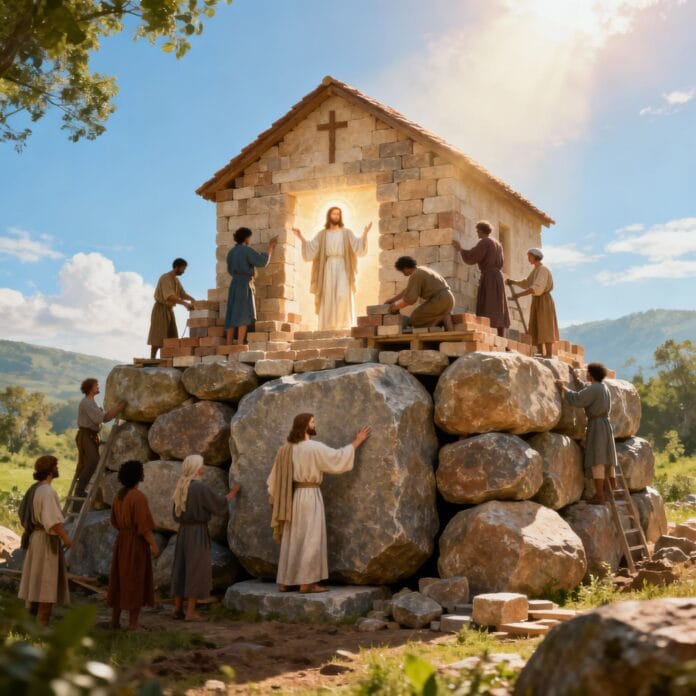
Reading from the first letter of Saint Paul the Apostle to the Corinthians
Brothers,
You are a building that God is constructing. According to the grace God gave me, I, like a skilled architect, laid the foundation. Another is building on top of it. But let each one be careful how he participates in this work.
As for foundations, no one can establish any other than those that already exist: Jesus Christ.
Do you not know that you are the temple of God, and that the Spirit of God dwells in you? If anyone destroys the temple of God, God will destroy him in turn, for the temple of God is sacred, and you are that temple.
You are God's sanctuary: built on the rock that is Christ
To inhabit the divine presence within oneself, to build together the’Living Church.
In this passage addressed by Saint Paul to the Church of Corinth, Christians are powerfully called to recognize that they are a sanctuary inhabited by the Spirit of God, a spiritual edifice founded on Jesus Christ. Intended for all those seeking to live their faith deeply, this text invites us to share personal and collective responsibility in building a spiritual life whose strength depends on the foundation laid by Christ himself. It opens the way to reflection on our identity, our vocation, and how we can contribute to the building of the Church.
This text will be explored in three parts: its historical and biblical context, an analysis of its unique foundation and the responsibility of believers, and then an examination of its ethical, spiritual, and communal implications. This will be followed by a powerful traditional perspective and concrete suggestions for embodying this message in daily life.
Context
There First Letter of Saint Paul to the CorinthiansWritten around 55-57 AD, this letter is addressed to a young and diverse church established in the cosmopolitan and polytheistic Greek city of Corinth. This community, emerging from a complex pagan context, was marked by internal tensions, divisions around leaders, and difficulties in achieving genuine unity in Christ. Paul intervenes to reaffirm the essential foundations of Christian life in the face of conflicts that threaten the cohesion of the church.
The selected passage (1 Co 3, (9c-11, 16-17) belongs to the heart of this apostolic discourse. Paul uses the image of a spiritual construction site. He declares himself a "wise architect" who laid the only true foundation: Jesus Christ, the unparalleled cornerstone. On this rock, others build, but each must be mindful of the quality of their contribution. This construction is not merely metaphorical: Paul forcefully affirms that believers themselves are "the sanctuary of God," a holy dwelling where the divine Spirit resides in person. This living temple must not be destroyed or corrupted, for its holiness is guaranteed by the very presence of God.
This injunction is obviously addressed to a Church in formation, but takes on a universal scope for all Christians It reveals the dignity and responsibility linked to our spiritual life. It calls for collective vigilance against anything that could harm the integrity of this sanctuary, and underlines the holiness inherent in each member, in each stone of this spiritual edifice.
In Christian liturgy, this passage is often meditated upon to emphasize God's presence within us and the sacred dimension of our daily lives, inviting a renewed personal commitment in loyalty to Christ. It is thus a call to grow in spiritual maturity, far from the quarrels and divisions that can degrade the "temple" that is the Church.
Here is the text in a formulation close to the traditional liturgical style:
«Brothers and sisters, you are a house that God is building. According to the grace God gave me, like a good master builder I laid a foundation. Someone else is building on it. But each one must be careful how he is building. No one can lay any other foundation stone than the one that has been laid, which is Jesus Christ. Do you not know that you are God’s temple and that God’s Spirit dwells in you? If anyone destroys God’s temple, God will destroy that person; for God’s temple is holy, and you are that temple.»
This powerful staging blends responsibility, identity and a call for absolute respect for the sacred dimension that dwells within each and every believer.
A living edifice founded on Christ
The central idea of this passage is clear and striking: the Christian is not simply a disciple, but is literally a temple, a spiritual house built by God himself with Jesus as its foundation. This image of the sanctuary captures both dignity and responsibility. Paul calls each believer to vigilance in their spiritual actions: building on Christ means working toward a lasting, sanctifying, and harmonious collective body.
The paradox at the heart of the text is that of the unique and irreplaceable foundation (Jesus Christ) upon which everyone can build, but with diverse materials that must be solid. Paul insists: «Let each one take care how he builds on it.» This reminder underscores that the freedom to act is not a license to improvise, but a serious exercise in discernment and fidelity. Any flawed spiritual construction, any division, any work contrary to divine unity, threatens the permanence of this edifice.
This call also reveals an existential dimension: each person carries within them a concrete divine presence, the Spirit of God dwelling within them. This gives a sacred dimension to daily life, a duty of respect toward oneself and toward one's brothers and sisters. The destruction of this sanctuary, which can occur through sin, division, or disunity, entails a grave consequence: "God will destroy it." The sanctity of the temple is therefore inviolable, imposing a strong ethical and spiritual commitment to live according to the Spirit.
Theologically, this text affirms the nature of the Church as the "body of Christ," but also as a "spiritual temple." The mystery of the Incarnation takes on a new meaning here: Christ, the foundation stone, connects each believer to the divine in a living way. This places the Christian within a logic of growth, of perpetual building, where the relationship with Christ is the essential axis.
Spiritually, this vision offers a powerful lever for understanding its vocation: to be a temple is to be inhabited and transformed from within. It is an invitation to cultivate unity, holiness, and vigilance, in a spirit of mutual collaboration under divine guidance.
Thus, from a simple, almost architectural text, springs a profound revelation about Christian identity, the personal and communal vocation to build a life absolutely centered on Christ, the only solid and eternal foundation.
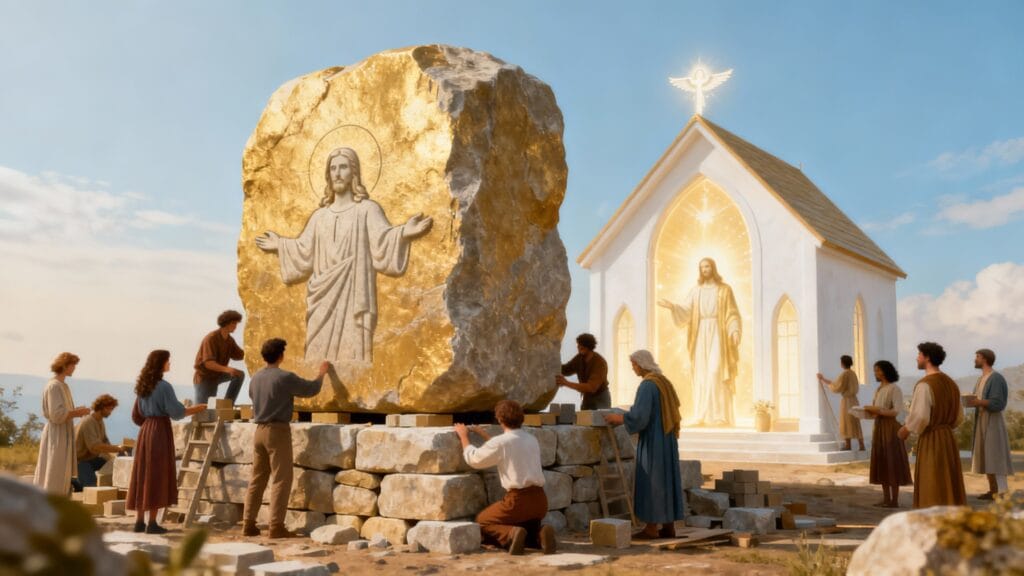
Spiritual building: an art of collaboration
In this passage, Paul presents himself as the architect who laid the foundation stone—Jesus Christ—but very clearly emphasizes that others are building upon it. This double metaphor stresses the community dimension of the Christian life. The spiritual work is not an individual project: it consists of living stones that each person brings, in unity, diversity and complementarity.
This leads to reflection on the role of each person within the Church: the vocation is not merely to be a static stone, but to actively contribute to collective spiritual growth. Building requires wisdom, discernment, patience, and respect. Every action, word, and spiritual work undertaken has an impact that can either edify or destroy.
This helps us understand the importance of being aware of our role as workers in God's service, where glory ultimately belongs to the one who makes things grow (God). This collaboration is founded on grace, but demands responsibility, because every poorly placed stone threatens the whole.
In practical terms, building together means avoiding the divisions, rivalries, and disagreements that undermine cohesion. It is an invitation to work in a spirit of love, forgiveness, and listening, so that the house becomes a solid, welcoming place where the Spirit can fully dwell.
The sanctity of the sanctuary: a call for ethical vigilance
The text does not merely speak of edification; it forcefully affirms the intrinsic holiness of the believer, the sanctuary of the believer. This sanctification is not based on human merit, but on the very presence of the Spirit of God.
This is an invitation to constant vigilance, for the sanctuary can be destroyed—that is, disfigured or desecrated—by sin, division, or apostasy. The gravity of this threat is underscored by the fact that «God will destroy it.» The stakes are therefore enormous: respecting and preserving the temple of God requires rejecting any form of behavior or thought that would render this divine dwelling place unfit for worship.
This vertical and sacred dimension defines a spiritual ethic founded on the awareness of the intimate divine presence. One no longer acts for oneself alone, but for the glory of God and the common good. This holiness commits the individual to a life of virtue, of fidelity to the Gospel and to its foundation, Jesus Christ.
This vigilance also applies to the community, which must ensure that destructive doctrines or behaviors are not introduced: preserving the temple means preserving the faith in its purity and vitality.
Thus, the sanctity of the sanctuary offers a fundamental ethical principle, which commits believers and the Church to a constant care to live in the Spirit, to recognize the responsibility before God for the purity of this spiritual house.
Vocation and application: living as a temple of the Spirit today
The passage calls each Christian to fully live out their vocation as a temple inhabited by the Spirit. This implies both an awareness of their dignity and a commitment to a consistent spiritual life.
In practical terms, being a sanctuary of God invites us to:
- nurture one's personal relationship with Christ, the unique foundation, through prayer, meditation and listening; ;
- cultivating spiritual maturity in love and the truth, avoiding childish and divisive attitudes; ;
- to actively participate in the life of the community, contributing one's gifts without pride, in a spirit of’humility and service; ;
- reject any form of behavior or teaching that could harm the unity or sanctity of the Church; ;
- to allow oneself to be transformed inwardly by the Spirit, the fruit of a constant commitment to growing in faith.
This makes each believer a responsible actor, aware that their life has a spiritual impact that goes beyond the individual sphere to touch the entire community.
This integrated approach also sheds light on the Church's place in the world: as a sanctified community, it is a visible sign of God's presence in the human environment, called to radiate through its witness of unity, peace, and holiness.
Thus, this vocation of a living temple radically transforms the way of conceiving Christian life: it is both a call to build oneself on Christ and to work so that the whole Church radiates the divine presence.
The Fathers and the Divine Abode
The Church Fathers, especially the Latin ones, such as Saint Augustine Saint Ambrose and Saint John meditated extensively on the image of the temple and the sanctuary, developing the profound meaning of the Church as the house of God built upon Christ. Augustine, taking up the metaphor of the rock, often speaks of the Church as this people of God founded on stability, which nothing can destroy when it rests on Christ.
Saint Gregory the Great emphasizes the Trinitarian unity that dwells in this house, where the Father, the Son, and the Holy Spirit reside. The Church is thus a living temple manifesting the Trinitarian presence in time and space.
In the liturgy, the celebration of the Holy Spirit It reminds us of this divine indwelling within the faithful. The Council Vatican He also renewed this vision by emphasizing that every baptized person is called to be a living sanctuary, a dwelling from which the light of Christ shines forth to the world.
This patristic and spiritual perspective illuminates our reading: it makes the Church not a simple material edifice, but a dynamic spiritual reality where human vocation and divine presence meet in a deep and sacred communion.
Thus, Paul's text is part of a rich current of thought that unites tradition, dogma, and spiritual practice since the origins of Christianity.
Steps to embody the sanctuary of God
To bring the message of 1 Corinthians 3 to life, here are some concrete steps suggested to nurture a living spirituality:
- Recognizing the presence of daily the Holy Spirit in itself, through an opening prayer.
- Meditate on the figure of Jesus Christ as the foundation stone, by regularly rereading the Gospels.
- To examine his life in the light of this holiness, to identify what could profane this sanctuary.
- To become involved in a community, to actively participate in works of edification.
- To favor peace and unity by rejecting unnecessary conflicts and criticism.
- Seeking continuous spiritual growth, rejecting stagnation or the «milk life».
- To give thanks and praise God for his living presence within us, the source of strength and hope.
These simple paths invite us on a journey of conversion deeply rooted in concrete life, nurturing a spiritual authenticity that makes us solid houses, bearers of divine grace.
Conclusion
This passage from 1 Corinthians offers a valuable insight into the Christian understanding of identity: to be a sanctuary of God inhabited by the Spirit, founded on Jesus Christ, is a lofty and demanding vocation. It is not merely an image, but a living reality that radically transforms the way we live our faith.
This vision commits the believer to an active responsibility in their spiritual development, but also in fraternal cohesion. It invites us to build together, in the’humility and vigilance, a structure that testifies to the divine holiness offered to everyone.
To live in a temple of the Holy Spirit is therefore to respond to a call that is both personal and communal, a call to holiness, to loyalty and to unity, making Christian life a continuous and dynamic construction site on the invincible rock that is Christ.
More than a teaching, it is a call to inner and social transformation, a call to allow ourselves to be shaped by the Spirit to build a world inhabited by the presence of God, right where we are.
Practical
- Take a moment of silence each morning to recognize the presence of the Spirit within.
- Meditate on a biblical passage centered on Jesus, the foundation of faith.
- To honestly assess one's spiritual life and identify the weak "materials" to strengthen.
- Commit to developing peace and unity within its environment.
- To participate regularly in the life of one's Christian community.
- Practicing at’humility by recognizing that God is the sole master builder.
- To offer concrete actions of service and fraternal building.