












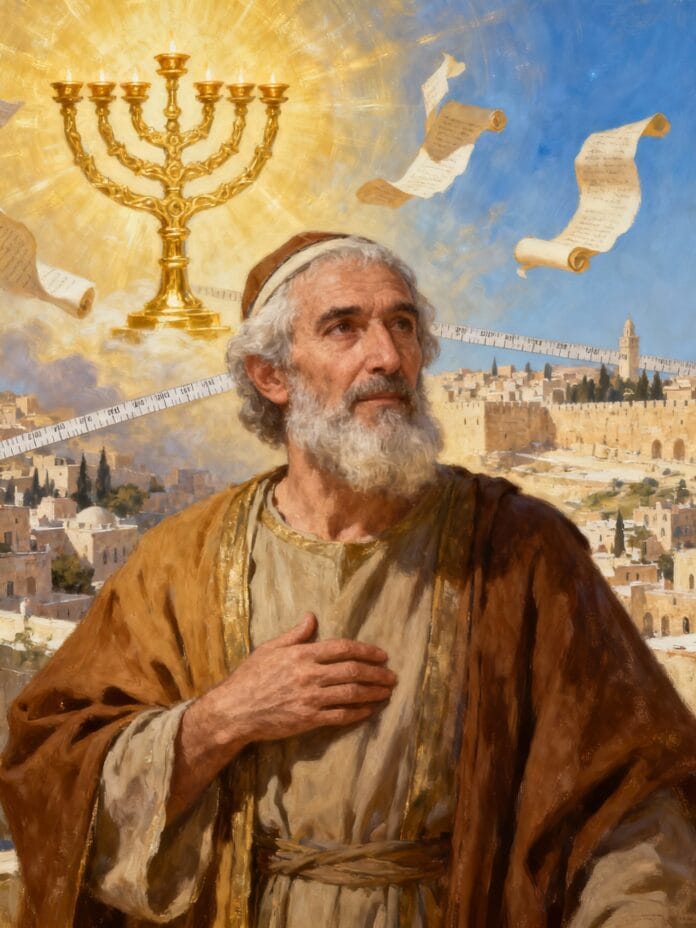
1° The person and era of the prophet. — His name, quite common in the Old Testament (there are more than twenty characters named Zechariah), has the form in Hebrew Zekaryah (the Latin form Zacharias was modeled on the Greek of the Septuagint, Zαχαρίας, which means, according to the most probable interpretation: (He of whom) God remembers (less well, according to Saint Jerome and other exegetes: Remembrance of God).
The prophet Zechariah himself provides us (1:1 and 7) with two interesting details about his family. He was the son of Bĕrékyah (Vulg., according to the Septuagint: Barachias) and grandson of ‘'Iddô (Vulg. and Septuagint: Addo). If Ezra, on two occasions (cf. Ezra 5:1 and 6:14), makes Zechariah the son of Addo, it is in the broad sense that this expression often receives among sacred writers to designate in general a descendant (cf. Ten. 29:5, where Laban is called son of Nahor, although he actually had Bethuel as his father. Cf. also 2 Chron. 22:1, 11, and 24:27, with Matt. 1:8: the evangelist seems to make Uzziah the son of Joram, although three generations separated them from each other. See also 2 Kings 9:14 and 20; Dan. 5:2 and the note, etc.). It has been quite plausible to conjecture that Ezra omitted Barachiah, either because this figure had died very early (probably before the end of the exile. Nehemiah does not mention him among the heads of the priestly families who returned from Babylon with Zerubbabel (cf. Neh. 12:1-7), nor among the heads of the same families during the following generation (ibid., verses 12-21). He only cites Addo and Zechariah), or because the sacred historian was keen to immediately link Zechariah to his grandfather Addo, who was the head of a priestly family when he returned from exile with Zerubbabel, a circumstance that had brought him to prominence.
Our Lord Jesus Christ mentions, in Matthew 23:35, a Zechariah, also son of Barachiah, whom the Jews had killed long ago between the temple and the altar; but there is no doubt that this martyr is not our little prophet, although they have sometimes been identified. According to the commonly held opinion, Jesus meant Zechariah, son of the high priest Jehoiada, massacred on the orders of King Joash (cf. 2 Chronicles 24:20 ff. See our commentary on Matthew 23:35).
According to what has been said above, the prophet Zechariah belonged to the tribe of Levi and was an influential member of the priestly line. It is generally assumed that he was born during the captivity, in a foreign land. He must have been quite young when he left Chaldea with his grandfather in 536 BC to come to Palestine. Indeed, in Zechariah 2:8, eighteen years after the end of the exile, at the beginning of his prophetic ministry, he receives the name of na'ar, young man (it is true that this expression was quite flexible among the Hebrews and could apply to a man of thirty years old. We can hardly rely on the information mixed with legends that Pseudo-Epiphanes, Pseudo-Dorotheus, etc. provide us. These writers make Zechariah an old man at the time he left Chaldea).
Like Haggai, Zechariah began to prophesy during the second year of the reign of Darius, son of Hystaspes, in 520 BC. The duration of his prophetic role is unknown. According to 7:1, he was still fulfilling it during the fourth year of Darius, in 518 BC; but it is likely that his mission continued beyond this time, since the prophecies contained in chapters 9-14 appear to be somewhat more recent.
Zechariah energetically devoted his influence as a priest and prophet to rebuilding the theocracy from its ruins. Ezra 6:14 praises the zeal he displayed, together with Haggai, for the reconstruction of the temple. Jewish tradition also shows these two prophets taking an interest in sacred liturgy and composing or arranging psalms (see the titles of Psalms 111 and 145 in the Vulgate; Psalms 137, 145-148 in the Septuagint; and Psalms 125-126 in the Syriac version); it also includes them among the members of the Great Synagogue who organized the canon of Holy Scripture (Tractate Megilla, (f. 17b-18a)
2° The authenticity of the book. The authenticity of chapters 9-14 is denied today by a number of exegetes (Joseph Mede was the first to contest it).Works, (London, 1664, pp. 786, 884). He bases his argument on the fact that passage 11-12 is attributed by Saint Matthew 27:9 to Jeremiah, not to Zechariah. Today, many rationalists go further and distinguish three authors of the prophecy instead of two, or even multiply them further: chapters 9-11 are the work of Zechariah I, a contemporary of Isaiah, during the reign of Ahaz, around 736 BC; chapters 12-14 are by an unknown author; chapters 1-8 were actually composed by Zechariah, a contemporary of Haggai. All of them, moreover, rely on the same reasons for admitting several prophets instead of just one, so that they can be refuted in the same way. Moreover, the "exegetes" often refute one another, admitting the most diverse periods for the composition of this or that part; thus, several of them attribute chapters 9-1 not to the 8th century BC, but only to the 5th or 4th. Their arguments boil down to three main points: 1) St. Matthew, in 27:9, attributes a passage from this section, 11:12, not to Zechariah, but to Jeremiah; consequently, in the time of Our Lord, chapters 9-14 were not read in the prophecy of Zechariah; 2) chapters 9-14, according to their content, were written before the captivity; 3) the style of chapters 1-8 and chapters 9-14 is completely different.
These objections can be answered as follows:
1. From the fact that St. Matthew attributes to Jeremiah a prophetic text that is not found verbatim in either Jeremiah or Zechariah, it cannot in any way be inferred that the last part of Zechariah is not authentic. «I fear that they (the exegetes who deny its authenticity) are going too far in trying to dispute three chapters in Zechariah in order to restore a single passage to Jeremiah,» rightly says Calmet (Comment. Litt. in Matth., 27, 9). The proof that their opinion is worthless is that no one dares to attribute the last part of Zechariah to Jeremiah, which should be done, however, if the argument that one claims to draw from St. Matthew were serious.
2. The objection to the authenticity of chapters 11-14 based on their content would be decisive if it were true, as claimed, that they contained evidence that they were written before the captivity; but no such evidence exists. In both parts of Zechariah, the return from captivity is presented as an image of happiness and described in the same way (cf. Zechariah 2:10 and 9:12; 2:10 and 9:9; 2:14 and 9:9, etc.). The author of chapters 9-14 lived so shortly before the capture of Jerusalem by Nebuchadnezzar that he made use of the writings of the prophets who lived during that later period ("this argument appeared so decisive to L. de Wette (a thoroughly rationalist critic) that, after admitting it in the first three editions of his Introduction (to the books of the Old Testament)) the duality of authors, in the fourth he recognized that the last chapters of Zechariah could be authentic. Here are the main parallel passages: Zechariah 9:2, and Ezekiel 28:4; 9:3, and 1 Kings 10:27; 9:5, and Zechariah 2:3; 10:3, and Ezekiel 34:17; 11:4, and Ezekiel 34:4; 11:3, and Jeremiah 12:5; 13:8-9, and Ezekiel 5:12; 14:8, and Ezekiel 47:1-12; 14:10-11, and Jeremiah 31:38-40; 14:20-21, and Ezekiel 43:12, and 44:9).
3. The last objection, based on the difference in style between the first eight chapters and the following six, has some truth to it, as there is not a complete resemblance between the language of the two parts; but the conclusion drawn from it is false, because the variety of tone, form, and expression is naturally explained by the change of subject. The visions cannot be described in the same terms and in the same way as the future glory of Jerusalem, which unfolds in the final scene; the narrator's manner of speaking is not that of an orator or a poet; Hosea expresses himself quite differently in chapters 1-3 and 4-14; Ezekiel in chapters 6-7 and 4. Moreover, the same characteristic expressions appear in both parts of Zechariah: 7:14 and 9:8; the eye of God for Providence (3-9; 4-10; 9:1, 8), etc. — The final chapters of Zechariah, therefore, belong to this prophet just as much as the preceding ones. Fulcran Vigouroux, Bible Manual Volume 1, number 1113. See also, by the same author, the Holy books and rationalist criticism, 4th ed., t. 5, p. 241-248.
3° The subject and division of the bookWe have seen that the prophets Haggai and Zechariah simultaneously displayed great zeal for the rebuilding of the temple. Nothing is more evident than this in the prophecy of Haggai, where everything revolves around the sanctuary and its restoration (see the Introduction to the Book of Haggai). It is not as evident in the pages Zechariah left us; at least it is certain that, while his prophecies only rarely refer directly to the rebuilding of the temple, they contribute everywhere in a general and indirect way to this then crucial undertaking. Delivered while the people were working zealously to build the temple, these prophecies are yet another stone laid by the prophet in the common edifice; he encourages, consoles, and exhorts, showing the bright future reserved for Israel and the abundant blessings that will accompany the restoration of God's sanctuary. Such is the theme of the book as a whole.
It has been divided in various ways; but, fundamentally, everyone agrees, so clearly are the divisions indicated by the author himself. Chapters 1-4 form an inseparable whole; chapters 7-8 also adhere to one another very closely; finally, there is a remarkable unity between chapters 9-14. It is also generally agreed that chapters 7 and 8 form a kind of link between those that precede them and those that follow them (in the manner of chapters 37-39 in the book of Isaiah).
From the point of view of both subject matter and external form, the division that seems to us the most natural and best consists in admitting only two parts: the book of visions (1:1–6:15), and the book of discourses (7:11–14:21) (compare the book of Amos, where we found two similar parts, but reversed with respect to the order in which the visions and discourses follow one another). The first part, which opens with a short exhortation to repentance (1:1–6), contains a series of eight visions, revealed to Zechariah during a single year, and relating to the future destinies of God's people (1:7–6:8); it concludes with a symbolic action (6:9–15). Taking as its starting point the state of distress in which Jerusalem then found itself, it clearly announces the transfiguration and the happy future of the theocratic nation. The second part consists of three discourses, All are preceded by a brief introduction (cf. 7:1-3; 9:1; and 12:1), and all deal with the same subject as the Book of Visions: 1) Israel in the past and in the future (7:1-8:23); 2) prophecies that concern in turn the Gentiles, who are under serious threat, and the holy nation, to whom God promises glory and prosperity (9:1-11:17); 3) the terrible judgments and the happiness of the Messianic era (12:1-14:21). The first part is addressed more directly to the Jewish community that had formed in Jerusalem since the end of the exile; the second, more specifically to those who would later form the people of God, regenerated and transfigured by the Messiah.
4° Zacharie's type as a writer. — His diction is quite pure, especially for this period of literary decline among the Hebrews. His style is youthful, figurative, and lively. It contains very expressive similes (see 2:8-9; 9:15-16; 10:3-5; 11:7, 10, 14; 12:3, 4, 6, 8; 14:4, 20, etc.). However, the large number of figures of speech, their novelty, and their rapid changes often make the diction obscure, as was already the case with Hosea. The rabbis complained about this with some bitterness, and Saint Jerome, following them, calls Zechariah "the most obscure of the twelve" minor prophets. Chapters 1-6 are written in ordinary prose; one already encounters more verve and beauty in chapters 7 and 8; chapters 1-6 are written in ordinary prose. 9-14 are admirably written and recall the prophecies of Isaiah in their depth, breadth, variety, and ornamentation of language.
5° The importance of this book This is considerable from a theocratic point of view, for all the visions and all the pronouncements successively announce that the holy nation will not perish, but that, reconstituted on new foundations, it will endure until the end of the world. Now, it is evident that a prediction of this kind is of no less interest to the Church than to the synagogue, since it is through the Church of Christ that the theocracy was to be, and in reality is, continued and completed.
It follows from this that the book of Zechariah is messianic throughout; but it is no less so in its details, which, in relatively large numbers, relate directly to the person and work of Christ. The principal passages of this kind are: 3:8, where we read the beautiful name "branch," already used in the same sense by Isaiah 4:2 and Jeremiah 23:5; 6:13, which predicts that the Messiah will be both priest and king; 9:9-10, which announces his modest triumph in Jerusalem (cf. Matthew 21:4); the three texts 11:12-13; 12:10 ff.; 13, 7, which prophesy that he will be betrayed by one of his own (cf. Matt. 27, 9), pierced by the lance (cf. John 19, 37), and abandoned by his apostles (cf. Matt. 26, 31).
The best Catholic commentaries are: in antiquity, Theodoret of Cyr, Enarrationes in duodecim Prophetas and Saint Jerome, Commentaria in Prophetas minores. In modern times: F. Ribera, In librum duodecim Prophetarum commentarii, Antwerp, 1571; Sanchez, Commentarius in Zachariam, Lyon, 1616.
Zechariah 1
1 In the eighth month of the second year of Darius, the word of the Lord came to Zechariah son of Barachiah, the son of Addo the prophet, saying: 2 The Lord was very angry with your ancestors. 3 And you shall say to them: Thus says the Lord of hosts: Return to me, oracle of the Lord of hosts, and I will return to you, says the Lord of hosts. 4 Do not be like your fathers, to whom the former prophets preached, saying, «Thus says the Lord of hosts: Turn therefore from your evil ways and your evil deeds,» and they did not listen or pay attention to me, oracle of the Lord. 5 Where are your ancestors? And the prophets, could they live forever? 6 But did not my words and decrees, which I entrusted to my servants the prophets, reach your ancestors, so that they repented and said, «As the Lord Almighty intended, according to our ways and our deeds, so he has done to us.» 7 On the twenty-fourth day of the eleventh month, which is the month of Sabbath, in the second year of Darius, the word of God came to Zechariah, son of Barachiah, grandson of Addo the prophet, saying: 8 I had a vision during the night: Behold, a man was riding on a red horse and he was standing among myrtles in a shady place and behind him were red, brown and white horses. 9 I said, "What are these, my lord?" And the angel who was speaking with me said, "I will show you what these are."« 10 And the man who was standing among the myrtles spoke up and said, «These are the ones whom the Lord has sent to roam the earth.» 11 And they answered the angel of the Lord who was standing among the myrtles, and said, «We have gone throughout the earth, and behold, the whole earth is inhabited and at rest.» 12 The angel of the Lord spoke and said, «Lord Almighty, how long will you not have mercy on Jerusalem and the cities of Judah, against which you have been angry these past seventy years?» 13 And the Lord spoke kind words to the angel who was speaking with me, words of comfort. 14 And the angel who was speaking with me said to me, «Proclaim this: Thus says the Lord of hosts: I was very zealous for Jerusalem and for Zion, 15 And I am filled with great anger against the nations that live in opulence, for I was a little angry, and they worked for ruin. 16 Therefore this is what the Lord says: I will return to Jerusalem with compassion, and my house will be rebuilt there, declares the Lord Almighty, and the measuring line will be stretched out over Jerusalem. 17 Proclaim this again: Thus says the Lord of hosts: My cities will again overflow with prosperity, and the Lord will again comfort Zion and again choose Jerusalem.»
Zachariah 2
1 I looked up and saw: And behold, four horns. 2 And I said to the angel who was speaking with me, «What are these?» He said to me, «These are the horns that scattered Judah, Israel, and Jerusalem.» 3 And the Lord showed me four blacksmiths. 4 And I said, «What are these coming to do?» He answered in these words: «These are the horns that scattered Judah, so that no one lifted up their head, and these have come to strike them with terror, to cut down the horns of the nations that raised their horns against the land of Judah to scatter it. 5 I looked up and saw: And behold, a man with a measuring line in his hand. 6 And I said, "Where are you going?" And he said to me, "I am going to measure Jerusalem to see what its width and length should be."« 7 And behold, the angel who spoke with me appeared, and another angel appeared, going to meet him, 8 and he said to him, «Run. Speak to this young man in these terms: Jerusalem will be like an open city, so many men and beasts will be inhabited within it. 9 And I, declares the Lord, will be a wall of fire around her, and I will be glorious in her midst. 10 Hey! Hey! Flee from the land of the north, declares the Lord, for I have scattered you to the four winds of heaven, declares the Lord. 11 Hey, Zion, escape, you who dwell in the daughter of Babylon. 12 For thus says the Lord of hosts: For his glory he has sent me to the nations that have plundered you, for whoever touches you touches the apple of his eye. 13 For behold, I shake my hand over them and they shall be plunder for those who are enslaved to them, and you shall know that the Lord of hosts has sent me. 14 Shout for joy and be glad, daughter of Zion, for behold, I come and I will dwell in your midst, declares the Lord. 15 Many nations will join themselves to the Lord on that day, and they will be my people, and I will dwell in your midst, and you will know that the Lord of hosts has sent me to you. 16 The Lord will possess Judah as his portion in the holy land, and he will again choose Jerusalem. 17 Let all flesh be silent before the Lord, for he has ascended from his holy dwelling.
Zechariah 3
1 He showed me Joshua, the high priest, standing before the angel of the Lord, and Satan standing at his right hand to oppose him. 2 And the Lord said to Satan, «The Lord rebuke you, Satan! The Lord who has chosen Jerusalem rebuke you! Is not this man a brand plucked from the fire?» 3 Gold Joshua was covered in dirty clothes and stood before the angel. 4 And the angel spoke and addressed those who stood before him, saying, «Take off his filthy garments.» And he said to him, «See, I have removed your iniquity from you and clothed you in rich garments.» 5 And I said, «Let them put a clean turban on his head.» And they put the clean turban on his head and clothed him with garments, and the angel of the Lord was standing there. 6 And the angel of the Lord did to Joshua this statement: 7 Thus says the Lord of hosts: If you walk in my ways and are faithful to my ministry, you also shall govern my house and guard my courts, and I will give you free access among those who stand here. 8 Listen, Joshua, High priest, you and your colleagues who sit before you: for they are men of omen. Behold, I am going to bring my servant the Branch. 9 For this is the stone that I have placed before Joshua, On this one stone there are seven eyes; behold, I will carve its image, declares the Lord of hosts, and I will remove the iniquity of this land in a single day. 10 On that day, declares the Lord of hosts, you will invite one another under the vine and under the fig tree.
Zechariah 4
1 The angel who was speaking with me returned and he woke me up like a man waking from his sleep. 2 And he said to me, «What do you see?» I answered, «I have seen, and behold, a lampstand all of gold, with its basin on its top, bearing its seven lamps with seven conduits for the lamps which are on the top of the lampstand. 3 And two olive trees stand beside it, one to the right of the basin and the other to its left.» 4 And I spoke again and said to the angel who was speaking with me, «What are these things, my lord?» 5 The angel who was speaking with me answered me and said, "Do you not know what these things are?" I replied, "No, my lord."« 6 And he continued and said to me: This is the word of the Lord to Zerubbabel, namely: «Not by an army, nor by power, but by my Spirit, says the Lord of hosts. 7 Who are you, great mountain, before Zerubbabel? You will become a plain. And he will lift up the stone from the top amid shouts of »Grace, grace to it!” 8 The word of the Lord came to me in these terms: 9 «"The hands of Zerubbabel have founded this house and his hands will finish it, and you will know that the Lord of hosts has sent me to you.". 10 For who would despise the time for little things? They will rejoice when they see the plumb line in Zerubbabel's hand. "These seven lamps are the eyes of the Lord, which range throughout the whole earth."» 11 I spoke again and said to him, "What are these two olive trees to the right of the lampstand and to its left?"« 12 I spoke again and said to him, "What are these two bunches of olives that are near the two golden funnels from which the gold flows?"« 13 He spoke to me in these terms: "Do you not know what it is?" I replied: "No, my lord."« 14 And he said to me, «These are the two anointed sons who stand by the Lord of all the earth.»
Zachariah 5
1 I looked up again and saw: And behold, a flying scroll. 2 He said to me, "What do you see?" I said, "I see a flying scroll, twenty cubits long and ten cubits wide."« 3 And he said to me, “This is the curse that goes out over the whole land, for according to what is written there, ‘Whoever steals shall be swept away from here, and according to what is written there, ‘Whoever swears shall be swept away from here.’”. 4 I have unleashed it, declares the Lord of hosts, and it will come to the house of the thief and to the house of him who swears falsely by my name; it will lodge itself in the midst of his house and consume it, both wood and stones. 5 The angel who was speaking with me appeared and said to me, "Lift up your eyes and see what appears." I said, "What is it?"« 6 He said, "It is the ephah that appears," and he added, "This is their sin throughout the land."« 7 And behold, a lead disc was lifted, and there was a woman seat in the middle of the amphora. 8 He said, "This woman is wickedness." And he drove her back into the middle of the ephah and threw the lead weight over its opening. 9 And I lifted up my eyes and I saw. And behold, two women appeared, with wind blowing in their wings, they had wings like the wings of a stork, and they lifted up the ephah between heaven and earth. 10 I said to the angel who was speaking with me, "Where are they taking the ephah?"« 11 He answered me, "They are taking him away to build him a house in the land of Sennaar, and when it has been founded, he will be placed there in his place.
Zechariah 6
1 I raised my eyes again and I saw: And behold, four chariots were coming out from between the two mountains, and the mountains were mountains of bronze. 2 The first chariot had red horses, the second chariot had black horses., 3 to the third chariot of white horses and to the fourth chariot of dappled, vigorous horses. 4 I spoke and said to the angel who was speaking with me, "What are these, my lord?"« 5 The angel answered and said to me, "These are the four winds of heaven that have just stood before the Lord of all the earth."« 6 The chariot with black horses went out towards the northern country, the white ones went out after them, and the speckled ones went out towards the southern country. 7 The mighty steeds went out and asked to go and roam the earth. The angel said to them, "Go, roam the earth," and they roamed the earth. 8 And he called to me and spoke to me, saying, «See, those who went to the northern country have calmed my spirit in the northern country.». 9 The word of the Lord came to me in these terms: 10 Take from the hand of the exiles, from Holdai, Tobiah, and Idaiah; you yourself shall go on that day, you shall go to the house of Josiah, to whom they went when they came from Babylon, 11 and you shall take silver and gold and make crowns and set them on the heads of Joshua, son of Joseph, the high priest. 12 You shall speak to him in these words: Thus says the Lord of hosts: Behold, the man whose name is Branch, he shall spring up in his place and build the temple of the Lord. 13 He will build the temple of the Lord and will be clothed with majesty, he will sit as sovereign on his throne and he will be priest on his throne and between the two there will be a council of peace. 14 And the crown will be for Helem, for Tobiah, for Idaiah, and for Hen, son of Zephaniah, as a memorial in the temple of the Lord. 15 Men from afar will come and work on building the temple of the Lord, and you will know that the Lord Almighty has sent me to you. This will happen if you faithfully obey the voice of the Lord.
Zechariah 7
1 In the fourth year of King Darius, the word of the Lord came to Zechariah on the fourth day of the ninth month in Casleu. 2 Bethel had sent Sarasar and Rogommelech, with his men, to implore the Lord, 3 to speak to the priests of the house of the Lord of hosts and to the prophets, saying: «Should I weep in the fifth month and abstain from sex, as I have done for so many years?» 4 The word of the Lord of hosts came to me in these terms: 5 Speak to all the people of the land and to the priests, saying: When you have fasted and observed mourning in the fifth and seventh months for the past seventy years, was it for me that you fasted? 6 And when you eat and drink, is it not you who eat and drink? 7 Are there not the words that the Lord proclaimed through the ancient prophets, when Jerusalem was inhabited and at peace, with its cities around it, and when the Negev and the Shephelah were inhabited? 8 The word of the Lord came to Zechariah in these words: 9 Thus spoke the Lord of hosts, saying: «Render justice according to truth, practice mercy And compassion each towards his brother, 10 Do not oppress the widow or the orphan, the foreigner or the poor, and do not plot evil against one another in your hearts.» 11 But they refused to listen, they offered a rebellious shoulder and hardened their ears so as not to hear. 12 They hardened their hearts like diamond, so that they would not hear the law and the words that the Lord Almighty spoke to them through his Spirit, through the ancient prophets. Therefore, the Lord Almighty was very angry. 13 And it came to pass: just as he had called, but they did not listen, "so they will call, but I will not listen to them," says the Lord of hosts. 14 I will scatter them among all the nations they do not know, and behind them the land will be desolate, with no one passing through or returning.» They have made a land of delights into a desert.
Zechariah 8
1 The word of the Lord of hosts was heard in these terms: 2 Thus says the Lord of hosts: I am very zealous for Zion, I am very angry with her. 3 Thus says the Lord: I have returned to Zion and I will dwell in the midst of Jerusalem; Jerusalem shall be called the city of truth and the mountain of the Lord of hosts, the holy mountain. 4 Thus says the Lord of hosts: There will again be old men and elderly women sitting in the squares of Jerusalem, each with his staff in his hand, because of the great number of their years. 5 The city squares will be filled with young boys and girls playing in its squares. 6 Thus says the Lord of hosts: If this seems marvelous in the eyes of the remnant of this people in those days, shall it also be marvelous in my eyes, declares the Lord of hosts? 7 Thus says the Lord of hosts: Behold, I am going to deliver my people from the land of the east and from the land of the setting sun. 8 I will bring them in and they will live in the midst of Jerusalem; they will be my people, and I will be their God, in truth and justice. 9 Thus says the Lord of hosts: Let your hands be strong, you who hear in these days these words from the mouth of the prophets who spoke on the day when the house of the Lord of hosts was founded, so that the temple might be rebuilt. 10 For before those days there was no wage for men, no wage for cattle, no security from the enemy for those who went out and came in, and I had set all men against one another. 11 But now I am no longer with the remnant of this people as in the days of old, declares the Lord of hosts. 12 For the seed will prosper, the vine will yield its fruit, the earth will give its produce, the heavens will give their dew, and I will give the remnant of this people as a possession of all these things. 13 And it will come to pass: as you have been a curse among the nations, O house of Judah and house of Israel, so I will deliver you, and you will be a blessing. Do not be afraid; let your hands be strong. 14 For thus says the Lord of hosts: As I intended to harm you when your fathers provoked my anger, says the Lord of hosts, and I did not relent, 15 So, on the contrary, I intend in these days to do good to Jerusalem and to the house of Judah; do not be afraid. 16 These are the words you shall observe: Speak the truth, each to your neighbor, administer justice in your gates according to truth and for peace, 17 Do not plot evil against one another in your hearts, and do not love false oaths, for these are all things I hate, declares the Lord. 18 The word of the Lord of hosts came to me in these terms: 19 Thus says the Lord of hosts: The fast of the fourth month, the fast of the fifth, the fast of the seventh, and the fast of the tenth month shall be changed for the house of Judah into gladness and joy and joyful solemnities. 20 Thus says the Lord of hosts: peoples and inhabitants of many cities will yet come. 21 The inhabitants of one will go to the other, saying, «Come, let us go and implore the Lord and seek the Lord of hosts.» «I too want to go.» 22 Many peoples and powerful nations will come to Jerusalem to seek the Lord of hosts and to implore the Lord. 23 This is what the Lord Almighty says: »In those days ten people from all languages and nations will take hold of a Jew by the hem of his robe and say, ‘Let us go with you, because we have heard that God is with you.’”
Zechariah 9
1 The Lord has spoken against the land of Hadrach, and his dwelling place will be in Damascus, for the Lord has his eye on mankind and on all the tribes of Israel., 2 and also to Hamath, near Damascus, to Tyre, and to Sidon, because their wisdom is great. 3 Tyre built herself a citadel, she amassed silver like dust and gold like the mud of the streets. 4 Behold, the Lord will seize it, he will strike his power upon the sea, and it will itself be consumed by fire. 5 Ashkelon will see it and be afraid, Gaza too, and writhe in grief, Accaron as well, for its hope is confounded. There will be no more king in Gaza, and Ashkelon will no longer be inhabited. 6 A bastard will settle in Azoth, and I will destroy the pride of the Philistines. 7 I will remove his blood from his mouth and his abominations from between his teeth, and he too will be a remnant for our God; he will be like a leader in Judah, and Accaron will be like the Jebusite. 8 I will camp around my house to defend it, against every army, against every coming and going, and no oppressor will pass through their midst anymore, for now I have seen with my own eyes. 9 Rejoice greatly, daughter of Zion. Shout aloud, daughter of Jerusalem. See, your King comes to you, righteous and protected by God, humble and riding on a donkey, on a colt, the foal of a donkey. 10 I will cut off the chariots from Ephraim and the horses from Jerusalem, and the battle bow will be destroyed. He will speak peace to the nations, and his dominion will extend from sea to sea, from the river to the ends of the earth. 11 For you too, because of the blood of your covenant, I will deliver your captives from the waterless pit. 12 Return to the stronghold, captives of hope. Even today I declare: I will repay you double. 13 For I will set Judah for myself and Ephraim on the bow; I will stir up your sons, O Zion, against your sons, O Javan, and I will make you like a mighty sword. 14 The Lord will appear above them, his arrow will flash like lightning, the Lord God will sound the trumpet and advance in the storms of the south. 15 The Lord of hosts will protect them; they will devour, they will trample the sling stones underfoot. They will drink, they will thrash about as if drunk with wine, and they will be filled like the cup of sacrifice, like the horns of the altar. 16 The Lord their God will be their salvation on that day, the salvation of the flock that is his people; they will be like jewels in a diadem, shining in his land. 17 What prosperity, what beauty is theirs! Wheat will make the young men grow, and new wine will make the virgins.
Zechariah 10
1 Ask the Lord for rain in the spring. It is the Lord who makes the lightning; he will give them abundant rain, and to each one grass in his field. 2 For the teraphim spoke of nonsense, and the diviners saw false visions; they uttered vain dreams and offered false comforts. Therefore they went astray like sheep; they were oppressed for lack of a shepherd. 3 My anger is kindled against the shepherds and I will punish the goats because the Lord of hosts visits his flock, the house of Judah, and makes them his steed of honor in battle. 4 From him will come the troops, from him the stake, from him the war bow, from him all the leaders will come together. 5 They will be like heroes, treading the mud of the roads in battle; they will fight, for the Lord will be with them, and they will put to shame those who ride on horses. 6 I will strengthen the house of Judah and save the house of Joseph; I will restore them, for I have compassion on them, and they will be as though I had not rejected them. For I am the Lord their God, and I will answer them. 7 Those of Ephraim will be like heroes and their hearts will be joyful as with wine; their children will see it and rejoice, and their hearts will exult in the Lord. 8 I will whistle after them and gather them together, for I have redeemed them, and they will multiply as they had multiplied. 9 When I have spread them among the peoples and they remember me in distant lands, they will live with their children and they will return. 10 I will bring them back from the land of Egypt and gather them from Assyria, and I will bring them to the land of Gilead and to Lebanon and there won't be enough space for them. 11 He will pass through the sea, the sea of distress; he will strike the waves in the sea, and all the depths of the river will be dried up. The pride of Assyria will be brought low, and the scepter of Egypt will be removed. 12 I will strengthen them in the Lord, and they will walk in his name, declares the Lord.
Zechariah 11
1 Open your doors, Lebanon and may fire consume your cedars. 2 Wail, cypress trees, for the cedar has fallen, the magnificent trees have been destroyed. Wail, oaks of Bashan, for the impenetrable forest is cut down. 3 We hear the lamentation of the shepherds, because their glory is ruined, we hear the roar of the lion cubs, because what was the pride of the Jordan has been ruined. 4 Thus says the Lord, my God: «Be the shepherd of the flock of slaughter 5 that their buyers kill with impunity and of which the sellers say: Blessed be the Lord, I am rich, and that their shepherds do not spare. 6 »For I will no longer spare the inhabitants of the land, declares the Lord; behold, I myself will deliver them into the hands of one another and into the hands of their king, and they will devastate the land, and I will not deliver them from their hand.” 7 So I became the shepherd of the slaughtered flock and also of the most wretched of the flock. I took two crooks, I named one Grace and I named the other Bond, and I shepherded the flock. 8 I dismissed the three shepherds in a single month. And I lost patience with the sheep, and they too were weary of me. 9 And I said, «I will no longer feed you; let the one that dies, die; let the one that disappears, disappear; and let those that remain devour one another.» 10 I took my staff, Grace, and I broke it, to break my covenant that I had made with all the peoples. 11 It was broken that day, and so the most wretched of the flock, who esteemed me, knew that this was the word of the Lord. 12 And I said to them, "If it seems good to you, give me my wages; if not, do not give them to me." And they weighed out my wages, thirty shekels of silver. 13 And the Lord said to me, «Throw it to the potter, this magnificent prize at which I was valued by them.» So I took the thirty shekels of silver and threw them into the house of the Lord, to the potter. 14 I then broke my second staff, Lien, to break brotherhood between Judah and Israel. 15 The Lord said to me, «Now take up the equipment of a new shepherd. 16 For behold, I myself will raise up over the land a shepherd who will not care for the lost sheep, nor seek the scattered, nor heal the injured, nor feed the healthy, but eat the flesh of the fat, and split their hooves. 17 Woe to the worthless shepherd who abandons his flock. May the sword be upon his arm and his right eye. May his arm wither and his right eye be extinguished.»
Zechariah 12
1 The sentence. The word of the Lord concerning Israel. The oracle of the Lord, who stretched out the heavens and laid the foundations of the earth, and formed the spirit of man within him: 2 Behold, I will make Jerusalem a shaking point for all the surrounding peoples, and this will also be the case for Judah when Jerusalem is besieged. 3 And it will happen on that day: I will make Jerusalem a stone for all peoples to lift; whoever lifts it will be severely injured, and all the nations of the earth will gather against it. 4 On that day, declares the Lord, I will strike all the horses with terror and their riders with madness; I will keep my eyes open on the house of Judah, but I will strike all the horses of the peoples with blindness. 5 And the leaders of Judah will say in their hearts, «The inhabitants of Jerusalem are a strength for me, by the Lord of hosts, their God.» 6 On that day I will make the leaders of Judah like a blazing fire in a woodpile, like a flaming torch in a sheaf of wheat, and they will devour all the surrounding peoples on the right and on the left, and Jerusalem will remain in its place, in Jerusalem. 7 The Lord will save the tents of Judah first, so that the pride of the house of David and the pride of the inhabitants of Jerusalem may not rise above Judah. 8 On that day the Lord will set up a wall around the inhabitants of Jerusalem, and whoever stumbles among them will be like David on that day, and the house of David will be like God, like the angel of the Lord before them. 9 And it will happen on that day: I will strive to destroy all the peoples who come against Jerusalem. 10 And I will pour out on the house of David and on the inhabitants of Jerusalem a spirit of grace and supplication, and they will turn their eyes to me whom they have pierced. And they will mourn for him as one mourns for an only son, and grieve bitterly for him as one grieves bitterly for a firstborn son. 11 On that day, there will be great mourning in Jerusalem, like the mourning of Adadremmon in the valley of Mageddo. 12 The country will mourn, each family separately, the family of the house of David separately and his wives separately, the family of the house of Nathan separately and his wives separately, 13 the family of the house of Levi set apart, and his wives set apart, the family of Shemei set apart, and his wives set apart, 14 all the families that remain, each family separately and its women separately.
Zechariah 13
1 On that day there will be a fountain opened to the house of David and to the inhabitants of Jerusalem to wash away sin and defilement. 2 And it will happen on that day, declares the Lord of hosts: I will abolish the names of the idols from the land, and they will no longer be mentioned, and I will also remove the prophets and the spirit of impurity from the land. 3 And if anyone prophesies again, his father and mother, who begot him, will say to him, «You shall not live, because you have spoken lies in the name of the Lord.» And his father and mother, who begot him, will pierce him while he is prophesying. 4 And it will happen on that day: The prophets will be ashamed, each of them at his vision when he prophesies, and they will no longer wear the hairy cloak to lie. 5 One will say, "I am not a prophet; I am a farmer, for a man bought me in my youth."« 6 And they will ask him, "What are these wounds on your hands?" and he will answer, "I received these blows in the house of my friends."« 7 Sword, rouse yourself against my shepherd, against the man who is my companion, declares the Lord of hosts. Strike the shepherd, and let the flock be scattered. And I will turn my hand against the little ones. 8 And throughout the land, declares the Lord, two-thirds will be exterminated and perish, and the other third will be left there. 9 I will bring this third into the fire and refine them like silver, and test them like gold. They will call on my name, and I will answer them. I will say, «They are my people,» and they will say, «The Lord is my God.»
Zechariah 14
1 The day is coming for the Lord, and your spoils will be divided in your midst. 2 I will gather all the nations before Jerusalem to the war and the city will be taken, the houses will be looted., women raped and half the city will go into captivity, but the rest of the people will not be cut off from the city. 3 And the Lord will go out and fight against those nations, as when he fights, on a day of battle. 4 His feet will stand on that day on the Mount of Olives, which is east of Jerusalem, and the Mount of Olives will split in two from east to west into a very large valley, with half of the mountain moving north and the other half moving south., 5 And you will flee through the valley of my mountains, for the valley of the mountains will extend to Azal. You will flee as you fled from the earthquake in the days of Uzziah, king of Judah. And the Lord my God will come, all the saints with you. 6 And it will happen on that day: There will be no light, but cold and ice. 7 It will be a unique day, known to the Lord, and it will be neither day nor night, and at evening time there will be light. 8 And it will happen on that day: Living water will flow out from Jerusalem, half of it toward the eastern sea and half toward the western sea, in summer as in winter. 9 And the Lord will become king over all the earth; on that day the Lord will be unique and his name unique. 10 The whole land will be turned into a plain, from Gibeah to Remmon, south of Jerusalem. And Jerusalem will be raised up and occupy its place, from the Benjamin Gate to the site of the First Gate, to the Corner Gate, and from the Tower of Hananel to the king's winepresses. 11 People will live there, and there will be no more curse, and Jerusalem will rest securely. 12 This is the plague with which the Lord will strike all the peoples who fought against Jerusalem: He will cause their flesh to rot while they are still standing, their eyes will rot in their sockets, and their tongues will rot in their mouths. 13 And it will happen on that day: There will be great confusion among them from the Lord, each one will seize the hand of his brother and they will raise their hands against one another. 14 Judah will also fight against Jerusalem. And the riches of all the surrounding nations will be gathered together, gold, silver, and clothing in very great quantities. 15 And the plague that will strike the horses, mules, camels, donkeys, and all the animals that are in those camps will be like that plague. 16 All those who remain, from all the nations that came against Jerusalem, will go up each year to worship the King, the Lord of hosts, and to celebrate the Feast of Tabernacles. 17 Those families of the earth who do not go up to Jerusalem to worship the King, Lord of the universe, will have no rain on them. 18 And if the family of Egypt does not go up and come, there will be no rain on them either; they will be struck with the plague with which the Lord will strike the nations that do not go up to celebrate the Feast of Tabernacles. 19 This will be the punishment of Egypt and the punishment of all the nations that do not go up to celebrate the Feast of Tabernacles. 20 On that day, the bells on the horses will bear the inscription: "Holiness to the Lord," and the cooking pots in the house of the Lord will be like the bowls before the altar. 21 Every cooking pot in Jerusalem and Judah will be consecrated to the Lord Almighty. All those who will sacrifice will come and take it and cook their meat in it, and there will no longer be a Canaanite in the house of the Lord Almighty on that day.
Notes on the Book of Zechariah
1.1 Darius, son of Hystaspes, king of Persia. ― In the eighth month of the sacred year, and second of the civil year, which began at the new moon of October, according to the rabbis; but it was more probably at that of November.
1.3 See Isaiah 21:12; 31:6; 45:22; Jeremiah 3:12; Ezekiel 18:30; 33:11; Hosea 14:2; Joel 2:12; Malachi 3:7.
1.7-17 ID Section: Vision on the future fate of the Jews, from chapter 1, verse 7 to chapter 6. — Three months after his calling to the prophetic ministry, in the year 521, Zechariah had several visions one night. — 1° In the first, chapter 1, verses 8 to 17, he saw a rider in the midst of the myrtles, a sign of mercy and heavenly blessings for Jerusalem.
1.7 From the eleventh month of the sacred year, and fifth of the civil year, which began at the new moon of January, according to the rabbis; but it was more probably at that of February.
1.12 The seventieth year. These seventy years of desolation in Jerusalem and throughout the country are different from the seventy years of captivity.
1.14 See Zechariah 8:2.
1.15 The meaning of this verse is that God is very angry with the nations that he had charged with carrying out his vengeance on Jerusalem, because in carrying out this vengeance, they went far beyond the punishment he wanted to inflict on his people, for whom, despite their infidelities, he had retained a great love (see v.13 and 14).
1.16 that is to say, the walls and houses of Jerusalem will be rebuilt, as well as the temple.
1.18-21 2° In the second vision, chapter 1, verses 18 to 21, Zechariah saw four horns and four blacksmiths, symbols of the ruin of the peoples who persecuted Judah; the four blacksmiths break the four horns, that is to say the Chaldeans, the Persians, the Greeks and the Romans.
2.1-2 The four horns They designate the four great empires which at various times scattered Israel and Judah, like a raging bull throwing to the wind all that it encounters, and which are, according to some, the Assyrians, the Chaldeans, the Persians and the Egyptians, and according to others, among whom is Saint Jerome, the Chaldeans, the Persians, the Greeks and the Romans, because the Assyrians had already been overthrown; but the partisans of the first opinion believe that this vision represents at the same time both what had been accomplished, and what was still to be accomplished.
2.3 Four blacksmiths, They are depicted as armed with hammers to cut down the four horns. Saint Jerome views these workers as figures of the angels who on various occasions weakened the four great empires.
2.5-8 3° In the third vision, chapter 2, a man appears to Zechariah armed with a measuring line to measure Jerusalem and signify that it will be abundantly repopulated, that is to say that the kingdom of God or the Church will extend over all the earth.
2.5 A man ; probably the angel from chapter 1, verses 8 and 11.
2.8 This young man ; That is to say, Zechariah. like an open city, That is to say, without walls. The new Jerusalem will have such a great multitude of inhabitants that it cannot be confined within the walls. — A few years before its destruction by Titus, it was indeed too small; a new city had to be added to the old one, and a great number of houses that had gradually sprung up outside its boundaries had to be enclosed. This infinite multitude of inhabitants in Jerusalem was a symbol and a kind of pledge of the influx of peoples who would one day enter the Church.
2.9 I will be in glory in her midst ; by my presence in her bosom I will fill her with glory and honor.
2.10 Run away, etc. Since the capture of Babylon by Cyrus, many Jews had remained there despite the freedom that this prince had granted them to return to their homeland. It is to them that these words are addressed.
2.11 Daughter of Babylon. The Orientals call girls, the capital cities, and other cities of a country.
2.12 Thus says the Lord of hosts, This seems to announce that it is God himself who is about to speak; but what follows proves that the one who speaks is God's messenger. Saint Jerome concludes that it is Jesus Christ who speaks through this angel, as being at the same time both God's messenger and God himself, equal to God his Father. For his glory. This expression, obviously elliptical, seems to allude to these words in verse 5.
2.14 Daughter of Zion. See v.7. ― The promises made in this verse and the following one were fulfilled only in the first coming of Jesus Christ, and in the calling of the Gentiles to the faith.
2.16 The Holy Land, that is to say, which was dedicated to him.
3.1-10 4. In the fourth vision, chapter 3, the high priest Jesus, son of Josedec, stands before an angel who clothes him in new vestments to signify the future glory of the holy city and the Messiah. This vision concludes, in fact, with a messianic prophecy.
3.2 Tison, etc. See on this expression, Amos, 4, 11.
3.8 The corresponding Hebrew word tsémah, which means germ, offshoot, is applied to the Messiah in Isaiah, 4, 2; Jeremiah, 23, 5; 33, 15; as well as the title of servant of God in Isaiah, 42, 1 ; 49, 3 ; 50, 10 ; 52, 13 ; 53, 11.
3.9 The stone, etc., is still a name that designates the Messiah in Psalms, 117, 22; Matthew, 21, vv. 42, 44; Acts of the Apostles, 4, 11; Romans, 9, 32-33. ― These seven eyes They can signify the fullness of the gifts of the Spirit of God, which Jesus Christ possessed without measure, or the perfect vigilance of the divine Savior in the formation, progress, and preservation of his Church. I'm going to sculpt, etc. Many exegetes understand this passage to refer to the holy stigmata that the crown of thorns, the nails of the cross, the soldier's lance, etc., left on his adorable body. ― In a single day ; the day of his passion.
3.10 A man, etc.; image of the spiritual goods brought to men by Jesus Christ, and which they were to communicate to one another within his Church.
4.1-14 5° In the fifth vision, chapter 4, God shows the prophet a golden candelabrum, placed between two olive trees; the candelabrum and the olive trees are the emblem of the temple which will be completed by Zerubbabel and enriched with all the gifts of the Holy Spirit.
4.1 That is to say, after approaching the high priest Jesus, to whom the previous chapter refers, and after speaking to him, the angel returns to Zechariah, seems to strike him and awaken him; for all this takes place in a vision.
4.2 The chandelier had the form of the one Moses describes (see Exodus, (25, v.31 and following; 37, v.17 and following); it had seven lamps mounted on seven branches; the oil was distributed equally to the seven lamps by seven channels that received it from a vessel placed on top of the lampstand, and the oil with which this vessel was filled flowed into it through pipes that extended to the two olive trees placed on either side of the lampstand. See v.3 and 12.
4.10 the time for little things. The meaning of this passage is therefore: Who among you could have looked with contempt upon the humble beginnings of the temple and regarded its reconstruction by Zerubbabel as a rash undertaking, when you will all see with joy this prince of Judah, plumb line and level in hand, hastening the work and happily bringing it to its completion? These seven lamps are. These words appear to be an interpretation of the symbol of the seven lamps (see v. 2), which in turn represent the seven angels who are like the eyes and inspectors God uses to oversee the accomplishment of his works. The kings of Persia had officers called the king's eyes, and who were like his spies.
4.14 These two anointed with holy oil are Jesus as high priest, and Zerubbabel as prince of the people and of the family of the kings of Judah; both are illuminated by the seven lamps and both pour out oil to keep these lamps burning, because, with the assistance of angels, they are ministers of the Lord's power for the execution of his purposes for his people. From another perspective, they represent the two apostles, Saint Peter and Saint Paul, who, in the establishment of the Church, were the principal ministers of the Lord's mercies for the conversion of Jews and Gentiles; just as, at the end of time, the two prophets Elijah and Enoch will be sent by God, one to bring the Jews back to Jesus Christ, and the other to preach repentance to the nations; it is of these that the Book of Revelation speaks (see Apocalypse, 11, 4): These are the two olive trees and the two lampstands set up before the Lord of the earth.
5.1-11 6th and 7th. In the sixth and seventh visions, which both have the same meaning, chapter 5, a flying volume and a woman placed in an ephah or amphora with a lead weight, lifted into the air by two other women, represent the exclusion of sinners from the kingdom of God.
5.2 Its length, etc. The old books were made up of sheets or pieces of vellum attached end to end lengthwise, which were rolled around a stick.
5.3 anyone who steals. Theft can be understood here as all injustices and violence perpetrated against men; and false oath, or perjury, as all faults committed against God.
5.6 the ephah, a type of basin or barrel with a capacity of 36.44 liters.
5.7 These two women According to the Jews, they mean the Medes and the Greeks, who afflicted the Babylonians and established their monarchy in their country; according to Saint Jerome, the Hebrews themselves, including those of the kingdom of Israel who were taken captive by the Assyrians, and those of Judah by the Chaldeans.
5.11 In the land of Sennaar, that is to say, Babylon, which was in that land. As in the figurative style of the prophets, and in the very book of Revelation, Babylon represents pagan Rome, the land of Sennacheri may very well represent here the Roman Empire, in the midst of which the Jews were transported and dispersed since Jesus Christ.
6.1-8 8. In the eighth vision, chapter 6, verses 1 to 8, four chariots correspond to the four winds or cardinal points, see Daniel, 7, 2, come out of two mountains of bronze (Zion and Moria): this is the sign of the judgment by which God renews the guilty world.
6.1 The quadrigas, according to v.5, represent the winds of the sky. See this verse.
6.5 These four winds of the sky, represented by the four quadrigas, are, according to common opinion, the four monarchies mentioned in Daniel, ch. 2 and 7, that is to say, those of the Chaldeans, the Persians, the Greeks and the Romans.
6.8 The meaning of the entire poetic vision is that God, the sovereign ruler of the whole earth, will inflict the punishment they deserve, not only on the Jews, but also on all the peoples of the world who oppose his ordinances, until his justice is satisfied.
6.9-15 9. Finally, a symbolic action, chapter 6, verses 9 to 15, the coronation of the high priest Jesus, indicates that’East, The head of the kingdom of God will unite in his person the dignity of king and pontiff.
6.14 Helem, Tobiah, Idaiah, Hen These were delegates from the Jews who had remained in Babylon, and who had come to bring gifts for the temple. The Prophet was to go to them on the day appointed by the Lord and receive their gold and silver, the destination of which is indicated in more detail in the following verses.
6.12 See Luke 1:78. Here is a man, etc. These words seem, at first glance, to refer to Zerubbabel, who was the offspring, the hope of the house of David, and whom God had chosen to rebuild his temple; but the words, he will raise up in his place, are only suitable for Jesus Christ, the true offspring of David, who in his temporal birth borrowed nothing from any man but came forth from an immaculate virgin, like a shoot from his stump (see Isaiah, 11, 1), and who built the most glorious temple that could be erected to God, his Church, a spiritual edifice of which we ourselves are the living stones. Zacharie, 3, 8.
7.1-14 IIe Section: The Lord's Response to the Messengers from Bethel on the Occasion of the Fast in Commemoration of the Capture of Jerusalem by the Chaldeans, Chapters 7 and 8. — In the year 518, messengers came from Bethel to Jerusalem to ask the priests and prophets whether the fast instituted as a sign of mourning for the destruction of the capital and the temple by Nebuchadnezzar should still be observed, now that the city and the house of God were restored, Chapter 7, verses 1-3. God has Zechariah answer them that what pleases Him is not abstinence, but obedience, verses 4-7; if He scattered His people among the Gentiles, it was because of their disobedience, verses 8-14; henceforth He will treat Zion with kindness, after having afflicted her, Chapter 8, verses 1-17; He will turn the days of fasting into days of joy and will glorify the holy city, so that powerful and numerous peoples will flock to worship him there when they convert at the coming of the Messiah, v.18 to 23.
7.1 From the ninth month. See Haggai, 2, 11.
7.2 Sarasar is an Assyro-Chaldean name, meaning: (May God) protect the king! The Israelite who bore it was probably born in Chaldea.
7.3; 7.5 The fifth month. See Ezekiel, 20, 1. ― The fasting and lamentations customary in the fifth month were established in memory of the burning of the temple, burned by the Chaldeans on the tenth day of that same month (Jeremiah 39, 8; 52, 13). The envoys speak on behalf of the body of Jews, for whom they have come to consult; hence they use the singular number.
7.5 See Isaiah 58:5. The seventh month. See Haggai, 2.2. — The fasting and lamentations customary in the seventh month were established and fixed on the third day of that month, in remembrance of the killing of Gedaliah and the scattering of the remnant of the people who were with him. See 2 Kings 25, 25; Jeremiah, 41, vv. 1, 3.
7.10 See Exodus 22:2; Isaiah 1:23; Jeremiah 5:28. Do not oppress. See Jeremiah, 50, 33.
8 This chapter contains the continuation of the previous discourse on the occasion of the envoys of Sarasar and Rogommelech.
8.2 I am animated, etc., because she despised and outraged my love for her.
8.3 These titles of city of truth and mountain of holiness, properly belong only to the Christian Church, whose holiness, unity and visibility they characterize.
8.8 I will bring them, etc. This promise will only be fully fulfilled for the Jews when they first return to their land and especially to Jerusalem [which has been in effect since 1948], they will convert to Catholicism after the fall of the Antichrist, and thus bring to the world "times of refreshing" (see 2 Pierre, 3, 9). Luke, 21, 24 and Romans, 11, 15.
8.10 In the first years following their return from captivity, there was neither profit nor commerce among the Jews; they were entirely given over to divisions, quarrels, and lawsuits; on the other hand, the jealousy and hatred of their external enemies gave them no rest (see Ezra Chapter 4; Nehemiah Chapter 4; Haggai, 2, vv. 16, 18).
8.12 The earthly blessings that God promises here to his people are a foreshadowing of the heavenly blessings he promises to the truly faithful. The dew of the sky is the symbol of grace, and the products of the earth represent the fruits of justice that our souls produce through the influence of this dew.
8.16 See Ephesians 4:25. In your doors, That is to say, at the gates of your cities; that is where the courts were located.
8.19 From the fourth month. See Ezekiel, 1, 1. ― From the fifth of the sacred year, and eleventh of the civil year. It began at the new moon of July, according to the rabbis, but it was more likely at that of August. From the seventh. See Haggai, 2, 2. ― From the tenth. See Ezekiel, 24, 1. ― These four fasts were celebrated since the captivity, and the Jews still observe them today.
8.23 the hem of a Jew's robe, that is, the tassels that Moses ordered the Hebrews to put on the corners of their cloaks, to distinguish them from other peoples (see Numbers, 15, 38; Deuteronomy, 22, 12). ― These promises will find their fulfillment at the restoration of converted Israel, at the second Coming and the glorious Reign of the Messiah. Isaiah, 11, 6-9; 65, 17-25 and Romans, 11, 15.
9.1-17 IIIe Section: Prophecies against Hadrach and Israel, from chapter 9 to chapter 14. — The last section contains two prophecies; the first is directed against Hadrach and the neighboring countries, from chapter 9 to chapter 11; the second against Israel, from chapter 12 to chapter 14. — 1. Oracle against Hadrach. The location of this city has remained unknown to this day; a number of exegetes, even contemporary ones, have maintained that this name was purely symbolic and corresponded to no reality; this is a mistake: the city of Hadrach existed; it is mentioned several times in the account of the wars of the kings of Assyria; it was located in Syria. It is mentioned here along with all the neighboring countries: Damascus, Hamath, Phoenicia, and the land of the Philistines. This entire region will be ruined (chapter 9), which occurred at the hands of Alexander the Great; the people of God, on the other hand, will be blessed and powerful (chapter 10); they will return from captivity under their new king.
9.1 Hadrach is the name of a small region near Damascus. The ancients took it for a symbolic word, which must be explained by its very meaning; but there is far from agreement on its true meaning. — It appears that the prophecies contained in this chapter against the Syrians, the Phoenicians, and the Philistines refer to the expeditions of Alexander the Great against these peoples.
9.4 At sea. Alexander sank the ships of Tyre right in front of his walls.
9.5-6 Ascalon, Gaza, Accaron, Azot, the four main cities of the Philistines, in southwestern Palestine.
9.6 A bastard, that is to say, Alexander, as some understand it, or the colonies of foreigners of a very different origin, which this prince had placed in the cities of the Philistines, and which were in relation to them, and to the cities which were given to them, true bastards; or finally the Jews who made themselves masters of the cities of the Philistines under the Maccabees, which the following verses suggest.
9.7 His blood, The Hebrews abhorred all those who ate meat with blood, whether it was the blood of the victims they had sacrificed or the blood found in the meat they ate. His abominations ; its meats consecrated to idols. ― Like a Jebusite, That is to say, as a natural inhabitant of Jerusalem. This city was formerly inhabited by Jebusites, and it was even called Jebus.
9.9 See Isaiah 62:11. Daughter of Zion, daughter of Jerusalem. See Zacharie, 2, 7. ― Only Jesus Christ has perfectly fulfilled the predictions contained in this verse and the following one. Matthew, 21, 5; Jeans, 12, 15.
9.10 From a sea, etc. His kingdom will encompass the whole earth.
9.11 The covenant made by the Lord with the Hebrews on Sinai was sealed with blood (see Exodus, 24, 8; Leviticus, 17, 11; Hebrews, (9:18). By this covenant they consecrated themselves to the Lord, and they acquired a right to his protection. the waterless pit, means a prison (see Jeremiah, 38, 6); and the prison She herself is the figure of great affliction (see Psalms, 39, 2; 87, 7; Isaiah, 42, 22).
9.13 This is commonly heard of the victories that the Jews won during the time of the Maccabees over the Greco-Syrian kings.
9.14 the hurricanes of the south. The midday storms in Palestine have always been very violent.
9.15 The trophies which are used for sacrifices. ― The horns of the altar where the victims are slaughtered.
9.17 This wheat and this wine Here we have the figure of the Eucharist, which is the food of the elect, the bread of the strong, and which makes the purity of holy souls grow.
10.3 I will punish the goats ; I will punish the leaders, the commanders of the people.
10.4 This prophecy was fulfilled in Jesus Christ, who came from the tribe of Judah, being a son of David according to the flesh. Isaiah, 22, v.23 et seq.
10.6 Joseph's house ; the ten tribes whose leader was that of Ephraim, son of Joseph.
10.7 The tribe of Ephraim was always famous for its valor (see Deuteronomy, 33, 17). The rest of the prophecy relates particularly to the ten tribes.
10.8 I will whistle ; see Isaiah, 5, 26.
10.10 Of Lebanon, in northern Palestine. The land of Gilead and Galilee were very populated in the time of the Maccabees and many Jews had settled there.
10.11 an allusion to the crossing of the Red Sea and the Jordan River. river probably from the Nile.
11.1-17 A scene of desolation follows, in chapter 11, the scene of bliss in chapter 10. The land of Israel is devastated by the enemies who have invaded it (chapter 11, verses 1-3). Zechariah receives the order to carefully tend and guard the flock destined for death (his people), whom he had abandoned to the Gentiles (verses 4-6). The Prophet, armed with two staffs, one of which is called Grace and the other Link, With the first, he protects the sheep entrusted to his care from the nations, and with the second, he keeps them together. However, God, in one month, that is to say 30 days or 30 x 7 = 210 years, see Daniel, 9, 2 and Jeremiah, 25, 11; 29, 10 and Daniel, 9:24, destroys three shepherds (of peoples), chapter 11, verses 1-8, the Chaldeans, the Persians, and the Greeks; he abandons the Jews and delivers them to their unfortunate fate, chapter 11, verses 7-11. God then says to them: Since I will no longer be your shepherd and you force me to leave you, at least give me my wages. God continues: They treat me like a lowly slave, they offer me a slave's wages, thirty shekels of silver. The Lord throws this sum into the temple, and his people cease to belong to him; his covenant with the Jews is broken, verses 12-14. The story of Our Lord clearly explains this passage. The Messiah, unrecognized by his own people, was bought for thirty shekels of silver; This sum was brought back to the temple by Judas, the traitor who had received it, and used by the priests to buy the potter's field. — The chosen people, now irrevocably abandoned by God, are delivered into the hands of a foolish shepherd, the Romans, who bring about their ruin, vv. 15-17.
11.1 Lebanon. The temple can be compared to Lebanon because of the number of cedar columns that adorned its porticoes. The Prophet here announces the final destruction of the temple by the Romans.
11.2 Basan. See Numbers, 21, 33.
11.5 This can be seen particularly in the violence perpetrated by the Romans against the Jews.
11.6 During the final siege of Jerusalem, the various factions that existed among the Jewish people destroyed one another. Those who survived fell under the domination of their king, that is, the Roman emperor, to whom they preferred to submit rather than to Jesus Christ (see Jeans, 19, 15).
11.7 I will graze, etc. Zechariah (compare to verse 4), in this capacity as shepherd, represented Jesus Christ himself. ― Grace. The Hebrew term also means gentleness, pleasantness, That is, the gentle and kind government that God exercised for a long time toward his people after the captivity. Link ; a symbol of the severity with which God began to punish the Jews for their abuse of his grace and blessings, and continued to chastise them until the end. According to others, Link, marks the union that was to be between the two houses of Israel and Judah, that is, the old people and the new people (see v.14).
11.8 THE three pastors, According to most exegetes, these are the priests, the princes, and the magistrates; according to some, three figures, but there is far from agreement on this; according to others, the number three represents an indeterminate number. Just one month, According to common opinion, it means a short period of time.
11.9 This verse seems to foretell the three most dreaded plagues, the war, the plague and famine.
11.12-13 Compare this prophecy with Matthew, 26, 15; 27, v.3 and following.
11.12 See Matthew 27:9.
11.14 Judah refers to the faithful Jews who believed in Jesus Christ, and Israel, the hardened Jews who rejected him.
11.17 The sword, etc. The historian Josephus asserts (Antq.(I, XIX, chap. 1) that when Caligula was killed by Chereas and his conspirators, the first blow struck him on the upper arm between the neck and shoulder; and that when he tried to escape, one of the conspirators knocked him to his knees, and he was finished off by the others. It was doubtless then that he received the blow to his right eye of which Zechariah speaks. Let us add that the right eye And the arm can be used here figuratively to refer to the strength and light of man, what man holds most dear and most necessary.
12.1-14 2° Prophecy about Israel, from chapter 12 to chapter 14. Zechariah announces, in conclusion, the final glory of Jerusalem in the conversion of the peoples to the Messiah. The war against Jerusalem, or the Church will turn to the detriment of its enemies, chap. 12, verses 1-4. God will cause his people to triumph, verses 5-9; he will pour out his spirit and his grace upon them, so that Judah will bitterly regret the death of the Messiah, verses 10-14, and will purify itself from all idolatry, chap. 13, verses 1-6. However, the Lord will root out the wicked from among the good, verses 7-9; the nations will march against Jerusalem, capture it, and take half of its inhabitants captive, chap. 14, verses 1-2; but when the wicked have been thus punished, God will save the rest of his people, he will come to establish his kingdom, verses 3-5; from Jerusalem a river of salvation will flow over all the earth, verses 6-11; the enemies of the holy city will be annihilated, verses 12-15; the other peoples will convert and worship the true God, vv. 16-21.
12.3 A stone to lift. According to Saint Jerome, there was in the towns and villages of Palestine an ancient custom which still existed in his time, and which consisted of young men, to test their strength, lifting large round stones as high as they could.
12.7 as if she had won these advantages through her own strength. It does not rise above Judah, as if it were to her (to the glory of the inhabitants of Jerusalem) that Judah owed its salvation.
12.8 Like David, That is to say, as strong as David. A house by David ; inaccessible to men.
12.10 They will watch, etc. Some interpret this passage as referring to Judas Maccabeus, who was killed by the enemy; but most agree that it literally refers to Jesus Christ crucified by the Jews and recognized by them (see Jeans, 19, 37; Luke, 23, 48; Acts of the Apostles, 2, 37).
12.11 Mageddo (see Joshua, 17, 11). It is believed that the Prophet is alluding to the mourning that took place at the death of Josiah, king of Judah, who was wounded at Mageddo while fighting against the army of Necho, king of Egypt (see 2 Kings 23, 29; 2 Chronicles 35, 22-25).
12.12 During public and solemn periods of mourning, people went in groups, the men separately and women Apart from crying in public squares, in the streets, and even outside the cities, uttering cries and lamentations; sometimes, to make the mourning sadder and more touching, instruments of a lugubrious sound were used.
12.13 Nathan's house was one of the main branches of David's family, but which had no share in the kingship (see 1 Chronicles 3, 5). ― The families of Semeï were one of the main branches of Levi's family, but who had not had a share in the priesthood (see 1 Chronicles 6, 17).
13.1 an open source ; probably the same one as the one mentioned in Ezekiel, 47, v.1 and following; Joel, 3, 18. In the literal sense, it was the water that was brought to the temple by aqueducts after the captivity, and which was used for ablutions and legal purifications; but, in the figurative sense, it marks the water of baptism and the pool of penance.
13.2 See Ezekiel 30:13.
13.3 they will pierce him. Compare to v.6. See Deuteronomy, 13, vv. 6, 10; 18, 20, where is set forth the punishment that the law inflicted on false prophets.
13.4-6 When a false prophet sees his deceit exposed, he will claim that he is not a prophet, but a simple farmer, and that the wounds on his hands were inflicted by his parents as punishment for his sins. Compare to verse 3. The Church, in its ministry, applies the words of verse 6.e verse to the adorable wounds of the Savior.
13.4 the fur coat ; garments of the prophets.
13.5 That is to say, far from being a prophet, I am obliged to cultivate the land and engage in the most arduous work like a slave.
13.7 Strike the pastor. Jesus Christ applied this prophecy to himself (see Matthew, 26, 31; Marc, 14, 27).
13.8 two-thirds The exegetes understand this to mean: Jews and Gentiles. Part Three : Christians ; but perhaps it is better to understand, for the third part, those Jews who will convert and who, terribly tested, will be recognized as the true people of God.
14.1 Then a day comes, etc.; a prophecy that some attribute to the persecution of Antiochus Epiphanes, and others to the time of the war Romans against the Jews.
14.3 The Lord fights for his people. Exodus, chap. 14.
14.4 His feet, etc. Those who apply the literal meaning of this passage to the persecution of Antiochus claim that the meaning is that God will defend his people and will give a great earthquake as a sign of his presence; but those who explain it from the war Some Romans, speaking against the Jews, say that Zechariah is referring here to the hollows and depths that the Roman troops made by digging into the mountains, in order to extract a large quantity of earth and stones to build their terraces, walls, and other works in the Kidron Valley and south of Jerusalem. Compare to the following verse. [But the obvious and primary meaning of this prophecy concerns the great battle that all nations will wage against Israel at the end of time, during the reign of the Antichrist; an eschatological battle accompanied by cosmic phenomena. The glorious reign of the Messiah will follow.]
14.5 in the days of Osias, etc. Amos, 1, 1. ― all the saints with you. See Deuteronomy, 33, 2. ― The valley of my mountains. The Kidron Valley.
14.6 There light means joy, happiness, and ice, cold, sadness, affliction.
14.7 Day also means joy, happiness, and night, affliction, misfortune.
14.8 White water, etc. This prediction cannot be taken literally, with regard to earthly Jerusalem, whether considered from the persecution of Antiochus or from its last capture by the Romans. These whitewater They are the embodiment of baptism and the other sacraments of the Church, the doctrine of the Gospel, and the grace of the Holy Spirit. The eastern sea, the Dead Sea, which represents the Jews. ― The western sea, the Mediterranean Sea, which represents the Pagans. ― Summer And winter, Among the Hebrews, this includes the entire year.
14.9 The Lord, etc. This passage obviously refers to Jesus Christ and the Christian religion. Matthew, 28, 18; Jeans, 13, 13-14; Philippines, 2, vv. 9, 11.
14.10 See Zacharie, 12, 6. ― Remmon, south of Jerusalem, To distinguish this Remmon from another that was in northern Palestine, see Joshua, 19, 13.
14.15 By horse, mule, etc., some exegetes understand this to mean simple soldiers, crude and stupid peoples; but among the ancients the anathema extended to animals as well as to people (Joshua, 6, 21).
14.16 The Feast of Tabernacles, one of the three solemn festivals that all Jews were obliged to go and celebrate in Jerusalem, in memory of the forty years they had spent in tents in the desert.
14.18 no rain on her either. One of the characteristic features of climate The thing about Egypt is that it almost never rains there; the Nile flood replaces the rain. See Deuteronomy, 11, 10-11.
14.20 That is to say, the ornaments in rich metals that decorated the horses' bridles. Formerly, the bridles themselves were made of gold. At least, that is what Quintus Curtius Rufus and Virgil tell us.