












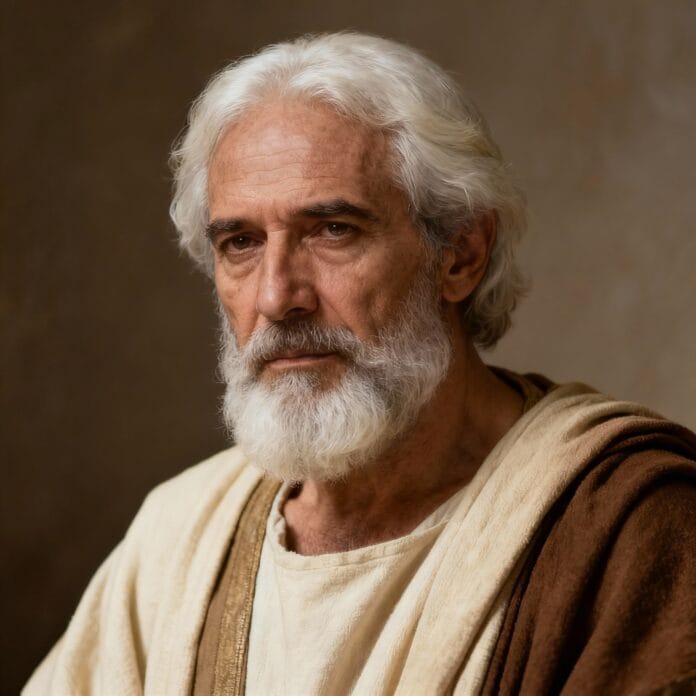
1° The Holy Apostle Peter. – The Gospels provide us with quite a lot of information about his life up to the ascension of the Savior. Named Simon when he was circumcised, in honor of one of the twelve patriarchs descended from Jacob, he received from Jesus the surname Cephas, which means: stone, rock (see Matthew 16:18 and the notes); ; John 1, 33). He was originally from Bethsaida, on the shores of the Sea of Galilee (John 1, 41). We know his father, who was called Jonas according to Saint Matthew (Matt. 16, 17), Joanès according to the Greek of the fourth gospel ( Ίωάνης. Cf. John 1, 42; 21,15-17): perhaps it was a double name, Jonas-John; or else, Jonas is a contraction of Joanès. We know his brother, Andrew (cf. Matt. 4, 18; ; John 1, 40-41, etc.). We know that he was married: the Synoptic Gospels recount the healing of his mother-in-law by the Savior (cf. Matthew 8:14-15; Mark 1:29-31, etc.). According to a tradition cited by Clement of Alexandria, Stromata, 7, 11, and Eusebius, Ecclesiastical History, (3:30) his wife was said to have suffered martyrdom, and he encouraged her as she was led to her execution. He was a fisherman by trade, like Andrew, James, and John (cf. Matthew 4:18; Luke 5:3, etc.). His education had been very modest; thus, the members of the Jewish Sanhedrin treated him disdainfully as an illiterate man.Acts of the Apostles 4, 13 ).
His first encounter with Jesus and his preliminary calling are admirably recounted by Saint John (John 1, 35-42). But his definitive vocation as a disciple of Christ took place only a little later, in the circumstances indicated by the first three Gospels (cf. Matt. 4:14-22; Mark 1:16-17; Luke 5:1-11). Finally, he was chosen, first of all (Matt. 11:1; cf. Mark 2:13ff.; Luke 6:12ff.), to be part of the apostolic college. He therefore remained for nearly three years with Our Lord Jesus Christ, receiving his divine teachings, enjoying exceptional favors (cf. Mark 5:37; 9:1ff.; 13:3, etc.), playing a preeminent role among the Twelve, confessing with faith the messianic character and divinity of his Master (cf. John 6, 68 ff.; Matt. 16:13-16), appointed as a reward Vicar of Christ (Matt. 16:17-19). During the Passion of Jesus, he was by turns valiant and weak (John 18:10, 15 ff.). After the resurrection He was among the first to be favored with the appearance of the Savior (Luke 24:34); then, on the shores of the Sea of Galilee, witness to his calling, he received the solemn confirmation of his title of prince of the apostles (John 21:15 ff.).
The first part of the Book of Acts details the main events in the life of Saint Peter during the first years after the Ascension. In Jerusalem, he truly speaks and acts as head of the Church, and no one disputes this role (Acts of the Apostles 1, 1-8). When the Christianity, Leaving the walls of the Jewish capital, which had been his first cradle, he made conquests first in Samaria, then among the pagans; Peter again played a characteristic and preponderant role (Acts of the Apostles 8, 14 ff.; 9, 32 ff.; 10, 1-11, 18). Imprisoned by Herod Agrippa I and about to be beheaded, he was miraculously delivered (Acts of the Apostles 12, 1 and following). It is then undoubtedly, as we said when explaining Acts of the Apostles 12, 17b, that he went to Rome for the first time, after having passed through Antioch of Syria. Later, the Council of Jerusalem was convened under his presidency (Acts of the Apostles 15, 1 et seq.).
A very affirmative tradition tells us that he spent the last years of his life in Rome, and that he suffered martyrdom there with Saint Paul, in the year 67. The reality of Saint Peter's stay in Rome, which was once strongly contested by Protestants, has been demonstrated by such solid arguments that quite a few rationalists now join Catholic historians in attesting to its "indisputable character".
2° The question of authenticity is easy to deal with, since the testimonies of ecclesiastical writers abound from the earliest times. If we place ourselves in the fourth century and go back further, we are first struck by the fact that, in all the lists that enumerate the canonical books of the New Testament (only the Muratorian canon is an exception; we do not know why. What it says about the writings of Saint Peter is, moreover, very obscure), our letter is cited and attributed to Saint Peter. Eusebius (Ecclesiastical History, 3, 25, 2) expressly mentions it among the books admitted in an indisputable manner, and he affirms (Ibid., 3, 3, 1) that "the ancient priests cited it in their writings as being most certainly authentic".
At the beginning of the third century and at the end of the second, we can observe this state of affairs: we have, for the Church of Alexandria, the testimony of the illustrious and learned Clement (Stromata, 3, 18; Paedag.. 1.1. Compare 1 Peter 1:6-9; 2:2-3. The Hypotyposeis contained brief explanations of this letter, as well as other Catholic letters); for the Churches of’ Africa, that of Tertullian (Comp. of Orat., 20 and 1 Peter 3, 3; ; Scorpio., 14 and 1 Peter 2:17, etc.); for the Churches of Syria, that of the Peschita; for the Churches of Gaul, that of Saint Irenaeus (Comp. adv. Haer., 4, 9, 2, and 1 Peter 1, 8, etc.); for the Church of Rome, those of Itala, of Saint Hippolytus (In Dan. 4, 69), etc. The First Letter of Saint Peter is also very frequently cited during the course of the second century and in the time of the Apostolic Fathers; it suffices to briefly refer the reader to the Acts of the Martyrs (see the letter from the churches of Lyon and Vienne, in Eusebius, Ecclesiastical History, 5, 1, and comp. 1 Peter 5, 6 and 8), to the great apologists (among others Theophilus, ad. Autolyc., 2, 34 (cf. 1 Peter 1, 18; 2, 11; 4, 3) and Saint Justin, Dialogue, 103, cf. 1 Peter 5, 8), to the heretical doctors themselves (our letter was very well known to the Gnostics of that time, in particular the Valentinians and Basilides), to Hermas (Vision 4, 3, 4; cf. 1 Peter 1, 7, etc.), to Papias (see Eusebius, Ecclesiastical History, 3, 39), at pope Saint Clement (1 Corinthians 36:2; cf. 1 Peter 2:9, etc.), etc. All this is so striking that a Protestant critic recently wrote: "The first letter of Saint Peter is perhaps, of all the writings of the New Testament, the one that brings together the best and most precise testimonies."
The intrinsic arguments further confirm the proof provided by tradition. The letter presents itself, 1.1, as the work of the prince of the apostles; now, many details it contains agree very well with this fact: in particular, the mention of Silvanus (5.12), an important figure who had had very close ties with the Church of Jerusalem (cf. 15.22 ff.), and that of Saint Mark (5.13), whose mother Saint Peter had long known (Acts of the Apostles 12, 12 and following) and that he then had with him in Rome (Eusebius, Ecclesiastical History, 3, 39, 14); fairly frequent allusions to the words of Jesus Christ (compare 3, 14 and 4, 14 with Matthew 5, 11-12; 2, 12 with Matthew 5, 16; 2, 6-8 with Matthew 21, 42 (cf. Acts of the Apostles 4, 11), etc.) and to various events in his life (cf. 1:19-20; 2:21-25; 3:18-19; 4:1, etc.), as well as to the personal relationship the author had with him (see especially 5:1: «a witness of the Passion of Christ»); finally, the very real resemblance that exists, both in content and form, between this writing and the discourses of Saint Peter preserved for us in the Book of Acts: In both cases, there are few abstract and speculative thoughts, but rather the facts of the Savior's life, especially those of his Passion, Resurrection, and Ascension, presented concretely as the basis of our salvation. In both cases, too, the author likes to connect his doctrine to the prophecies of the Old Testament. As for the style itself, the discourses and the letter contain a relatively considerable number of identical expressions.
3° The topic and the plan. No dogmatic or polemical thought dominates the letter or gives it a special form, as is the case with most of Saint Paul's letters. The tone is almost always that of a fatherly exhortation; thus, direct doctrinal teaching is relatively insignificant (it is far from being completely absent, however. The reader will find in the letter beautiful passages on the Holy Trinity, on each of the divine persons, on the mystery of redemption, on the Church, etc.), and this is understandable, since it did not fall within the author's scope.
«There is no precise plan, so spontaneous and, so to speak, unpremeditated is the thought.» Nevertheless, there is general agreement on adopting the following division. Between a short preamble, 1:1–2, and a very brief conclusion, 5:12–14, we find three series of exhortations, which form as many distinct sections. The first, 1:3–2:10, can be entitled: Privileges Belonging to the Family Redeemed by Jesus Christ, That I.e., to Christians, and the Holiness They Demand. It opens with thanksgiving to God for his manifold blessings, which are summed up in the salvation wrought by Christ (1:3–12); then it indicates to the readers what they are obligated to do as God’s chosen people, and what they themselves have the right to expect from this election (1:13–2:10). The second, 2.11-4.6, develops this idea: Christians in the midst of the world, and their particular and general obligations. It is a short treatise on practical morality, the main points of which are the following: the duties of the citizen, the slave, spouses, and Christians toward one another and in relation to the world; the example of the Savior; and flight from sin. The third part, 4:7–5:11, contains exhortations concerning the perfect life of Christian communities considered in themselves. It goes into considerable practical detail, which can be grouped under these various headings: being faithful in the use of spiritual gifts (4:7–11); being faithful in trials and having trust in God (4:12–19); the mutual obligations of pastors and their flock (5:1–5a); and some final recommendations (5:5b–11).
4° Language and style. – The letter was composed in Greek; there is not the slightest doubt about that. Saint Jerome alone supposed that the original language was Aramaic (Ep. ad Hedib.). Saint Peter, originally from the shores of the Sea of Galilee, had learned early on to speak Greek, which was in common use in those parts, and he developed his knowledge of this language during his apostolic missions (Saint Jacques And Saint Jude They were, like him, Jews by origin, and yet it is beyond dispute that they wrote in Greek, traveling through lands inhabited by Hellenic populations. His Hebraisms are neither frequent nor jarring. The principal ones are: sons of obedience, 1:14; the acceptance of persons, 1:17; the word of the Lord, 1:25; a people acquired, 2:9; the word "vessel" to designate the human body, 3:7, etc. The vocabulary of the letter contains a considerable number of words that are not used in any other book of the New Testament; as many as sixty-two have been counted, most of which are found in the Septuagint translation.
5° The recipients of the letter are designated in the clearest way from the first verse: "to the chosen ones, foreigners and scattered in Pontus, Galatia, Cappadocia, Asia and Bithynia." The five provinces mentioned were part of Asia Minor, of which they occupied the north (Pontus and Bithynia), the west (Asia, that is to say the so-called Proconsular Asia), the central and western part (Galatia and Cappadocia).
The gospel had been preached in these different regions by Saint Paul and his disciples, either directly, as in Galatia (see Acts of the Apostles 16, 6; Galatians 4, 13 and following, etc.) and in Asia (cf. Acts of the Apostles 19, 1 ff.), or indirectly: Christians from the province of Asia may have brought the good news to Bithynia and Cappadocia, as had happened in Phrygia (cf. Colossians 2:1). But it is quite possible that Saint Peter himself exercised his apostolic ministry in one or the other of these provinces between the years 51 and 54. This was the opinion of Origen (in Eusebius, Ecclesiastical History, 3, 12), of Saint Epiphanius (Haer., 27, 2), of Eusebius (L. c., 3, 4, 2), of Saint Jerome (De vir. ill., 1), etc. The apostle makes no allusion to it in this writing, nor in his second letter, and the hypothesis is not considered certain. Origen and Eusebius base their opinion precisely on the passage 1 Peter 1:1, which diminishes the value of their testimony.
The members of the Christian communities thus founded had, for the most part, belonged to paganism: See Saint Jerome, adv. Jovin., l, 39, and Saint Augustine, c. Faust., 29, 89, etc. This sentiment is now almost unanimously accepted. It is quite certain, according to 1.14; 2.9-10; 4.2-4. Origen (ap. Eusebius, Ecclesiastical History, 3, 1), Didymus (ibid., 3, 4, 2) and other ancient Greek authors believed, on the contrary, that the letter had been composed primarily for Christians of Jewish origin. Their main reason consisted of an inaccurate interpretation of the word διασπορᾶς, "dispersionis", which is found in the first line.
Nevertheless, we see from the book of Acts that there were considerable Jewish elements in several churches of the countries which have been listed above (cf. Acts of the Apostles (18:24 ff.; 19:8-10, etc.): it is therefore likely that a number of the recipients of this letter were Israelites by origin. As a whole, the readers had been converted for quite some time, since they had their priests and their regular ecclesiastical organization (see 5:1-5). They formed a perfectly constituted body among their neighbors who remained pagan.
6° The opportunity and the goal stand out quite clearly from the very core of the letter. Christians Those from Asia Minor, without being subjected to violent and, so to speak, official persecution (none of the passages in the letter where the readers' trials are mentioned—1:6-7; 2:12 ff.; 3:9, 13-14, 17, 19; 4:12 ff.—indicates such persecution, accompanied by martyrdom, confiscation of property, etc.), still had much to suffer. The pagans and Jews among whom they lived inflicted all sorts of painful vexations upon them. This is not surprising when one considers the situation of Christendom at that time: the new converts were abandoning not only their former religion but also, to a large extent, their way of life, and their former coreligionists did not forgive what they considered apostasy. They were even reproached for their holy lives. According to Gospel 4:12, a particular wave of hatred and hostility had just broken out against the churches in Asia. The faithful were not yet accustomed to such things; hence, for them, the turmoil and the danger of discouragement. The Prince of the Apostles therefore wrote to them to console and strengthen them in the midst of their trials. To this end, he showed them that suffering is the Christian's calling, and that it will later bring them great glory, just as it is already a great grace in this life. At the same time, he urged them to fulfill their duties to society and to themselves despite everything.
As we can see, the goal is entirely practical, entirely moral. The author himself explains it at the end of the letter, 5:12b, with the words exhorting and bearing witness. He exhorts his readers, mindful of their painful situation, and he attests, he testifies, that despite the adversities it causes, the Christianity is the grace of graces, and true religion (as examples of these "attestations" which give more weight to the exhortation, see 1, 3-12, 18-21, 23, 25; 2, 3-10, 19 ff.; 3, 14 ff.; 4, 12-14; 5, 7, 10, 12).
7° The place and time of composition. The author himself says (5:13) that he wrote this letter in Babylon, and a number of Protestant authors pretend to take this literally. But absolutely nothing is known of Saint Peter ever staying in the ancient capital of Chaldea. The name Babylon is therefore symbolic in this context, referring to Rome, which had succeeded the Chaldean city as the metropolis of the pagan world. Long before this time, the Jews used it in the same way in their apocalyptic literature (see also Revelation 14:8 and 18:2, 10). No one doubted this metaphorical meaning during the first sixteen centuries of Church history; we already find it in the writings of Papias and Clement of Alexandria (Ap. Eusebius, Ecclesiastical History, 2, 15. Compare Saint Jerome, of Vir. ill., 8, etc.). In addition, the tradition according to which Saint Peter ended his life in Rome is so strong that a fairly large number of heterodox or even rationalist critics accept it as we do.
According to the most likely opinion, this letter was composed around the year 63 or 64 AD. Saint Paul had just been delivered from his prison, and had left for Spain or the East (hence probably the letter's silence on the matter). Nero's persecution had not yet broken out (it only began towards the end of 64), although its warning signs were already visible. Saint Mark, mentioned at the end of the letter (5, 13b), was still in Rome, where the apostle to the Gentiles had summoned him some time ago (cf. Colossians 4:10).
8° Catholic comments. In antiquity, those of Bede the Venerable (Exposit. super cath. Epistolas), and of the two excellent Greek exegetes Œcumenius and Theophylact (in their explanations of the entire New Testament); in modern times, those of Catharinus (In omnes divi Pauli apost. et in septem. cath. lettre commentarius, Paris, 1566), of Estius (In omnes S. Pauli et septem cath. apostolorum epistolas commentarius, Douai, 1601), of Lorin (In cathol. Beat. Jacobi et Judæ apostolorum epistolas commentarii, Lyon 1619), by B. Justiniani (Explanationes in omnes epistolas cath., Lyon, 1621); in the 19th century, Paul Drach (the seven Catholic letters, Paris, 1873).
1 Peter 1
1 Peter, apostle of Jesus Christ, to the elect, foreigners and scattered throughout Pontus, Galatia, Cappadocia, Asia and Bithynia, 2 chosen according to the foreknowledge of God the Father, through the sanctifying work of the Spirit, to obey the faith and to share in the sprinkling of the blood of Jesus Christ, grace and peace to you more and more. 3 Blessed be God, the Father of our Lord Jesus Christ, who according to his great mercy has regenerated us by the resurrection of Jesus Christ from the dead for a living hope, 4 for an incorruptible, spotless, and unfading inheritance, kept in heaven for you, 5 to you whom the power of God protects through faith for salvation, which is ready to be revealed at the last moment. 6 With this thought, you rejoice greatly, although for a little while you must still be afflicted by various trials, 7 so that the proven genuineness of your faith—of greater worth than gold, which perishes even though refined by fire—may bring you praise, glory, and honor when Jesus Christ is revealed. 8 You love him without ever having seen him, you believe in him, though now you do not see him, and you rejoice with an inexpressible and glorious joy, 9 confident that you will win the prize of your faith, the salvation of your souls. 10 This salvation was the subject of the research and meditation of those among the prophets whose predictions foretold the grace that was destined for you, 11 They were trying to discover what time and circumstances the Spirit of Christ within them indicated, and which testified beforehand to the sufferings reserved for Christ and the glory which was to follow. 12 It was revealed to them that they were not serving themselves, but you, when they entrusted them to deliver the things which were proclaimed to you today by those who by the Holy Spirit sent from heaven, who preached the gospel to you—a mystery that is profound, where the angels desire to plunge their gazes. 13 Therefore, having girded up the loins of your spirit, be sober, and set all your hope on that grace which will be brought to you on the day when Jesus Christ is revealed. 14 Like obedient children, do not conform any longer to the evil desires you followed in your former ignorance, 15 But as he who called you was holy, so be holy in all you do., 16 For it is written: «Be holy, because I am holy.» 17 And if you call Father the one who impartially judges each person according to their works, 18 Live in fear during the time of your sojourn as strangers here below: knowing that you have been set free from the vain way of life inherited from your fathers, not by perishable things such as silver or gold, 19 but through precious blood, the blood of the spotless and blemishless lamb, the blood of Christ, 20 who was appointed before the creation of the world and was revealed in these last days for your sake. 21 It is through him that you have faith in God, who raised him from the dead and gave him glory, so that your faith is also your hope in God. 22 Since you have, by obeying the truth, purified your souls and thereby committed yourselves to sincere brotherly love, 23 Love one another fervently, from the heart, since you have been born again, not of corruptible seed, but of incorruptible, through the living and eternal word of God. 24 For all flesh is like grass, and all its glory like the flower of the grass. The grass withers and its flower falls, 25 But the word of the Lord endures forever. This is the word whose good news was brought to you.
2 Peter 2
1 Having therefore stripped away all malice and falsehood, dissimulation, envy, and all kinds of slander, 2 Like newborn infants, earnestly desire pure spiritual milk, so that it may nourish you for salvation., 3 if "you have tasted that the Lord is good."« 4 Come to him, the living stone, rejected by men, it is true, but chosen and precious in God’s sight, 5 and you yourselves, like living stones, are being built into a spiritual house to be a holy priesthood, offering spiritual sacrifices acceptable to God through Jesus Christ. 6 For it is written in Scripture: «See, I lay in Zion a chosen and precious cornerstone, and he who trusts in him will never be put to shame.» 7 To you then be honored, you who believe, but to the unbelievers, «the stone that the builders rejected has become the cornerstone, 8 a stumbling block and a rock of scandal,» they who will stumble against the word because they have not obeyed, indeed, that is what they are destined for. 9 But you are a chosen people, a royal priesthood, a holy nation, God’s special possession, that you may proclaim the excellencies of him who called you out of darkness into his marvelous light., 10 «"You who once were not his people, but are now the people of God; you who had not received mercy, but now have received mercy."» 11 Beloved, I urge you, as foreigners and exiles, to guard against the desires of the flesh, which lead to sin. the war to the soul. 12 Live honestly among the pagans, so that, though they accuse you of doing wrong, they may, when they see it clearly, glorify God for your good works on the day of his visit. 13 Therefore, submit to every human institution for the Lord’s sake, whether to the king as sovereign, 14 either to the governors, as delegates by him to bring justice to wrongdoers and to approve good people. 15 For it is God's will that by your good conduct you should silence the fools who do not know you. 16 Conduct yourselves as free men, not as men who use their freedom as a cloak to cover up their wickedness, but as servants of God. 17 Honor all, love all brothers, fear God, honor the king. 18 You servants, be subject to your masters with all respect, not only to those who are good and gentle, but also to those who are harsh. 19 For it is pleasing to God that one endures unjust punishment for his sake. 20 Indeed, what credit is it if, after doing wrong, you patiently endure the beating? But if, after doing good, you suffer pain and bear it patiently, this is pleasing to God. 21 For this is what you were called to, since Christ also suffered for you, leaving you an example, so that you might follow in his steps: 22 He who "committed no sin, and in whose mouth no falsehood was found"« 23 He who, when insulted, did not return the insult; who, when mistreated, did not threaten, but entrusted himself to him who judges justly, 24 who himself bore our sins in his body on the tree, so that we might die to sin and live for righteousness; by his wounds you have been healed.« 25 For "you were like sheep going astray," but now you have returned to him who is the shepherd and bishop of your souls.
2 Peter 3
1 Likewise, wives, submit yourselves to your own husbands, so that if any of them do not obey the preaching, they may be won over apart from the preaching by the behavior of their wives., 2 just by seeing your chaste and respectful life. 3 Let your adornment not be that of outward appearance: artfully braided hair, gold ornaments, or the tailoring of clothes, 4 But adorn the invisible man hidden in the heart with the incorruptible purity of a gentle and quiet spirit: this is true wealth in the sight of God. 5 This is how holy women who hoped in God used to adorn themselves in the past, being submissive to their husbands. 6 So Sarah obeyed Abraham, calling him Lord, and you have become his daughters, if you do good without fearing any threat. 7 Husbands, be wise as you live with your wives, and treat them with respect as weaker persons, since they are heirs with you of the grace that gives life, so that nothing will hinder your prayers. 8 Finally, may there be between you a union of feelings, compassionate kindness, fraternal charity, merciful affection, humility. 9 Do not repay evil for evil, nor insult for insult, but on the contrary, repay evil with blessing, for to this you were called, that you may become heirs of a blessing. 10 «Whoever wants to love life and see good days must keep their tongue from evil and their lips from speaking deceit.”, 11 that he turn away from evil and do good, that he seek peace and pursues her. 12 For the eyes of the Lord are on the righteous, and his ears are attentive to their prayers, but the face of the Lord is against those who do evil.» 13 And who can harm you if you are dedicated to doing good? 14 But if you suffer for righteousness' sake, blessed are you. Do not fear their threats, nor be disturbed., 15 But in your hearts revere Christ the Lord. Always be prepared to give an answer to everyone who asks you to give the reason for the hope that you have. But do this with gentleness and respect., 16 having a good conscience, so that, on the very point where you are slandered, you may put to shame those who defame your good conduct in Christ. 17 Indeed, it is better, God willing, to suffer for doing good than for doing evil. 18 For Christ also suffered death once for our sins, the righteous for the unrighteous, to bring us back to God, having been put to death according to the flesh, but made alive according to the spirit. 19 It was also in this spirit that He went to preach to the spirits in prison, rebels of yesteryear, 20 in the days of Noah patience God's work continued while the ark was being built, in which a small number, namely eight people, were saved through water. 21 It is she who saves you today, too, through her prefiguration: baptism, not the ablution that removes the defilements of the body, but the one that is the request made to God for a clear conscience, by the resurrection of Jesus Christ. 22 Having ascended into heaven, he is now at the right hand of God, and all are subject to him. the angels, the principalities and the powers.
2 Peter 4
1 Since Christ therefore suffered in the flesh, arm yourselves also with the same mindset, knowing that he who suffered in the flesh has broken with sin, 2 to live, during the time that remains for him to spend in the flesh, no longer according to the desires of men, but according to the will of God. 3 It is quite enough that we have done the will of the pagans in the past, living in disorder, lust, drunkenness, orgies, excessive drinking, and the criminal worship of idols. 4 They are now surprised that you are not running with them in the same excess of debauchery and they are hurling insults. 5 But they will give an account to him who is ready to judge the living and the dead. 6 That is why the gospel was preached also to the dead, so that, though condemned in the flesh according to men, they might live in the spirit according to God. 7 But the end of all things is near. Therefore be alert and sober-minded about prayer. 8 But above all, have a fervent love for one another, for love covers a multitude of sins. 9 Practice among yourselves’hospitality without a murmur. 10 Each one should use whatever gift they have received to serve others, as faithful stewards of God’s varied grace. If anyone speaks, they should do so according to the very words of God., 11 If anyone serves, they should do so with the strength God provides, so that in all things God may be praised through Jesus Christ, to whom be glory and power for ever and ever. Amen. 12 Beloved, do not be surprised at the fire that has broken out among you to test you, as though something extraordinary were happening to you. 13 But rejoice insofar as you share in the sufferings of Christ, so that when his glory is revealed you also may be filled with joy. joy and joy. 14 If you are insulted for the name of Christ, you are blessed, because the Spirit of glory, the Spirit of God, rests upon you. 15 Let none of you suffer as a murderer, as a thief or evildoer, or as one greedy for the property of others. 16 But if he suffers as a Christian, let him not be ashamed of it; rather, let him glorify God for that same name. 17 For behold, the time is coming when judgment will begin with the house of God; and if it begins with us, what will be the outcome for those who do not obey the gospel of God? 18 And "if the righteous are saved with difficulty, what will become of the wicked and the sinner?"« 19 Let those who suffer according to God's will entrust their souls to Him as to the faithful Creator, by practicing good.
2 Peter 5
1 I exhort the elders who are among you, I myself being an elder like them, a witness of the sufferings of Christ, and who will share with them in the glory that is to be revealed: 2 Shepherd the flock of God entrusted to you, watching over it, not under compulsion, but willingly, not for selfish gain, but with devotion, 3 not as rulers of the Churches, but by becoming models for the flock. 4 And when the Prince of Shepherds appears, you will receive the crown of glory that will never fade. 5 Likewise, you who are younger, be subject to the elders; all of you, clothe yourselves with honor toward one another.’humility, For "God resists the proud and gives grace to the humble."« 6 Humble yourselves, therefore, under God’s mighty hand, so that he may lift you up in due time., 7 Cast all your cares on him, because he himself takes care of you. 8 Be sober-minded, be watchful; your adversary the devil prowls around like a roaring lion, seeking someone to devour. 9 Resist him, firm in the faith, knowing that your brothers scattered throughout the world are suffering the same things as you. 10 The God of all grace, who called you to his eternal glory in Christ, after some suffering, will himself complete his work and will confirm you, strengthen you, and make you steadfast. 11 To Him be glory and power forever and ever, amen. 12 It was through Sylvain, a brother whose loyalty It is known to me that I am writing these few words to you, to exhort you and assure you that you are indeed established in the true grace of God. 13 The church in Babylon, chosen with you and Mark, my son, send you greetings. 14 Greet one another with a brotherly kiss. Peace Be with all of you who are in Christ. Amen.
Notes on the First Letter of Saint Peter
1.1 Scattered . See at Jacques, 1, 1, the note relating to this word. ― The Bridge. See Acts of the Apostles, 2, 9 ― The Galatia, a province of Asia Minor bordered to the north by Paphlagonia and Bithynia, to the west by Phrygia, to the south by Lycaonia and Cappadocia, and to the east by Pontus. ― Cappadocia. See Acts of the Apostles, 2, 9. ― Asia, the proconsular province of that name. See Acts of the Apostles, 2, 9. ― Bithynia. See Acts of the Apostles, 16, 7.
1.1-2 to the elect (…) chosen according to God's foreknowledge.Christians are elected and chosen by an eternal decree; they are like strangers on earth, regarding heaven as their true homeland. (…) The election that God makes of Saint John and not of Judas, for example, has its ultimate reason in God's eternal foreknowledge, that is to say, his determined will and his love; this divine election is executed in time by the action of the Holy Spirit, who justifies us inwardly and creates in us the new man; its immediate end is to lead us to faith and to bring us, through the merits of the blood of Jesus Christ, into the new covenant, which is the Catholic Church, just as the Israelites had been received into the old covenant by the sprinkling of the blood of the sacrifices (see Exodus, 24, 8).
1.3 See 2 Corinthians, 1, 3; Ephesians, 1, 3.
1.7 when Jesus Christ will appear ; that is to say, at the advent of the day of judgment.
1.13 Which will be brought to you, etc.; which will be given to you at the coming of Jesus Christ.
1.14 To the desires you once pursued ; to the passions to which you once gave yourself over, when you lived in ignorance.
1.16 See Leviticus 11:44; 19:2; 20:7.
1.17 See Deuteronomy 10:17; Romans 2:11; Galatians 2:6.
1.19 See 1 Corinthians 6:20; 7:23; Hebrews 9:14; 1 John 1:7; Revelation 1:5.
1.24 See Ecclesiasticus 14:18; Isaiah 40:6; James 1:10.
2.1 See Romans 6:4; Ephesians 4:22; Colossians 3:8; Hebrews 12:1.
2.2 Milk, «the word of God, so called to continue the metaphor.” Spiritual, nourishment for souls. ― Pure, without mixing in any errors.
2.6 See Isaiah 28:16; Romans 9:33.
2.7 See Psalm 117:22; Isaiah 8:14; Matthew 21:42; ; Acts of the Apostles, 4, 11.
2.10 See Hosea 2:24; Romans 9:25.
2.11 See Romans 13:14; Galatians 5:16.
2.12 On the day of his visit ; when God, in his mercy, will open their eyes and give them a luminous grace that will draw them to faith.
2.13 See Romans 13:1.
2.17 See Romans 12:10.
2.18 See Ephesians 6:5; Colossians 3:22; ; Tite, 2, 9.
2.22 See Isaiah 53:9.
2.24 See Isaiah 53:5; 1 John 3:5.
3.1 See Ephesians 5:22; Colossians 3:18.
3.3 See 1 Timothy 2:9.
3.4 The Hidden Man ; That is to say, the inner man. See Romans, 7, 22.
3.6 See Genesis 18:12.
3.7 See 1 Corinthians, 7, 3.
3.9 See Proverbs 17:13; Romans 12:17; 1 Thessalonians 5:15.
3.10 See Psalm 33:13.
3.11 See Isaiah 1:16.
3.12 The face of the Lord means here, as in several other places, its anger, her wrath.
3.14 See Matthew 5, 10.
3.16 See 1 Peter 2:12.
3.18 See Romans 5:6; Hebrews 9:28.
3.19 In prison ; that is to say, in limbo.
3.20 See Genesis, 7, 7; ; Matthew 24, 37; Luke 17:26. By water. The floodwaters did indeed save Noah's family by lifting the ark, thus preventing it from being submerged.
3.21 Baptism is similar to the flood in that water is used to represent the grace that purifies the soul, and which, in purifying it, brings about salvation. The request made to God, Saint Peter is referring either to the questions that are addressed to those who present themselves to receive baptism, if they are truly resolved to renounce the devil and embrace the Christian faith, or to the solemn promises that they make in response to these questions.
4.2 See Ephesians 4:23.
4.6 To the dead ; that is, to those who were held in limbo, and who had been unbelievers in the time of Noah (see 1 Peter, 3, 19-20); or to the pagans, who were regarded as dead buried in the darkness of error and ignorance.
4.8 A multitude of sins. In Proverbs (see Proverbs, (10:12), from which Saint Peter borrows this saying, it refers to the sins of one's neighbor: charity covers them with his cloak, and so peace and the union is preserved within the community.
4.9 See Romans 12:13; Hebrews 13:2; Philippians 2:14.
4.10 See Romans 12:6; 1 Corinthians 4:2.
4.18 See Proverbs, 11, 31.
5.5 See Colossians 3:12; James 4:6.
5.6 See James 4:10.
5.7 See Psalm 54:23; Matthew 6:25; Luke 12:22.
5.12 The true grace of God, etc. The true religion, the true way of salvation, the one we proclaimed to you, and in which you persevere despite the persecutions you have faced. The grace and truth that God has given to the world in Jesus Christ. The recipients of this letter had been evangelized by Saint Paul: this verse therefore contains an indirect confirmation of the latter's preaching. Perhaps the choice of Silvanus reflects the same idea: a companion of Paul carrying a letter from Peter addressed to Christians converted by Paul—what striking proof of the doctrinal conformity between the two apostles! By Silvain. This is probably Silvanus or Silas, a companion of Saint Paul. See Acts of the Apostles, 15, 22-27 ; 2 Corinthians, 1, 19.
5.13 Babylon, All the ancients, followed by most Catholic exegetes, and even some very famous Protestants, such as Grotius, Cave, Lardner, etc., have heard of the city of Rome, where the apostle wrote this letter. Marc Saint Mark, the Evangelist, whom Saint Peter calls his son, because he had begotten him to Jesus Christ, by converting him, instructing him and considering him as one of his principal disciples.