












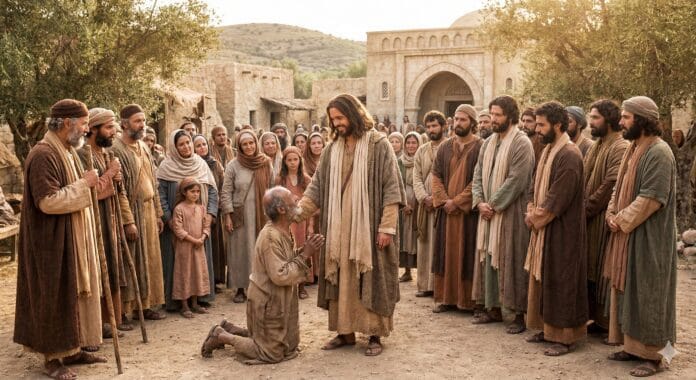
Gospel of Jesus Christ according to Saint Matthew
At that time, Jesus went through all the towns and villages, teaching in their synagogues, proclaiming the Good News of the Kingdom, and healing every disease and weakness. When he saw the crowds, Jesus felt compassion for them. compassion for them because they were lost and discouraged, like sheep without a shepherd. Then he said to his disciples, «The harvest is plentiful, but the laborers are few. Therefore, plead earnestly with the Lord of the harvest to send out laborers into his harvest.»
Then Jesus called together his twelve disciples and gave them the power to cast out unclean spirits and to heal every disease and every weakness. These twelve Jesus sent out with these instructions: «Go to the lost sheep of the house of Israel. As you go, proclaim that the kingdom of heaven is at hand. Heal them.” the sick, "Raise the dead, cleanse lepers, cast out demons. You have received without paying; give without demanding."»
Transform your view of crowds: when Christ's compassion becomes mission
Discover how Jesus' moved heart in the face of bewildered multitudes calls us today to become laborers in his harvest..
Faced with the lost crowds, Jesus felt a visceral emotion that compelled him to act. This compassion was not a vague feeling, but a force that transformed observers into missionaries. The Gospel of Matthew reveals to us the profound movement of God's heart: to see distress, to be moved by it, and then to send. This text is addressed to you who are seeking the meaning of your Christian commitment in a world adrift.
We will first explore the pastoral context of the sending of the Twelve, then we will analyze the three movements of the text: compassion who sees, the missionary urgency, and the free gift. Next, we will explore the concrete implications for your daily life, before examining the spiritual scope and contemporary challenges. A liturgical prayer and practical suggestions will conclude our journey.
The Matthean context: when the itinerant Rabbi trains his emissaries
The evangelist Matthew places this passage at a decisive turning point in Jesus' ministry. After demonstrating his authority through the teaching of the Sermon on the Mount (chapters 5-7) and a series of ten miracles (chapters 8-9), Christ does not keep this power for himself alone. He shares it.
The text falls between the end of the cycle of miracles and the beginning of the major missionary discourse (chapter 10). It is a pivotal moment where Jesus transitions from solitary action to the expansion of his ministry. The phrase "all the towns and villages" underscores the geographical scope of his mission. Jesus does not limit himself to prestigious places: he goes everywhere, without discrimination.
In first-century Jewish culture, the Rabbi taught in synagogues, the natural place for gathering and instruction. But Jesus added a new dimension: he proclaimed the Gospel of the Kingdom, that is, the Good News that the reign of God was approaching, and he healed. His teaching was not merely theoretical; it was embodied in acts of restoration.
The metaphor of "sheep without a shepherd" echoes several texts in the Old Testament, notably Numbers 27:17, where Moses asks God to provide a successor so that the people will not be "like sheep without a shepherd." Ezekiel 34 elaborates on this image, denouncing the bad shepherds of Israel who neglected the flock. Jesus thus positions himself within the prophetic tradition as the true and awaited Shepherd.
The calling of the Twelve is not arbitrary. The number twelve refers to the twelve tribes of Israel, signifying that Jesus is reconstituting the people of God. These men receive an "exousia," a power, a delegated authority. This Greek term indicates not mere permission, but a real capacity, an official mandate.
The instructions that follow reveal a precise missionary strategy: first Israel, then the nations. This priority is not exclusive but chronological. Jesus begins with the "lost sheep of the house of Israel," thus fulfilling the promises made to the patriarchs before expanding the universal mission after his resurrection.
The threefold movement of the missionary heart: to see, to be moved, to send
Compassion as a transformed vision
The Greek verb "esplanchnisthè," translated as "was moved with compassion," is remarkably intense. It derives from "splanchna," meaning entrails or viscera. It is an emotion that grips you, that overwhelms you physically. Jesus does not remain indifferent to collective suffering.
This compassion begins with a look. «Seeing the crowds»: Jesus observes, he takes the time to truly see. In our world saturated with images and information, we develop a kind of emotional numbness. We see without seeing. Jesus, however, looks with the eyes of the heart.
What he sees are not simply individuals, but "crowds," a mass of humanity. Yet his compassion is not abstract. He perceives their inner state: "distraught and dejected." The Greek words "eskylmenoi" (harassed, tormented) and "errimmenoi" (thrown to the ground, prostrate) describe an exhausted people, devoid of leadership and protection.
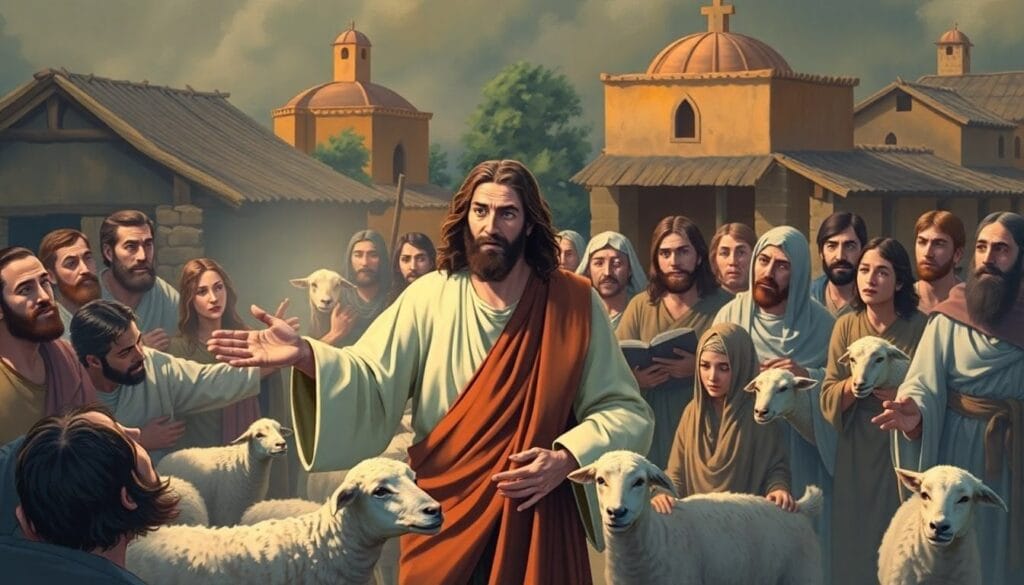
The following pastoral metaphor illuminates this vision: like sheep without a shepherd. Sheep are vulnerable animals, incapable of surviving on their own. Without a shepherd, they stray, fall into ravines, and become prey for wolves. This image reveals the fundamental fragility of the human condition when separated from God.
But compassion Jesus's action doesn't stop at observation. It provokes a reaction. That's where the difference lies between simple pity and compassion Christian compassion observes from afar, compassion It takes action. The heart of God cannot remain a spectator to human misery.
From the urgency of the harvest to the workers' call
Jesus then changes his metaphor: from sheep, we move to the harvest. This shift is not insignificant. While the image of the shepherd emphasizes the need for protection and guidance, that of the harvest evokes abundance, urgency, and the work to accomplish.
«The harvest is plentiful»: this is an optimistic vision amidst distress. Jesus doesn't just see misery; he sees potential, life ready to blossom. In the agrarian culture of the time, the harvest represented the crucial moment when everything the work The year is coming to an end. It's harvest time, the time when there's no waiting.
This urgency explains the disproportion: "there are few workers." There is a dramatic gap between the scale of the need and the availability of personnel. This imbalance is not new. God has always sought collaborators for his work.
The solution Jesus proposes is first and foremost prayer: «Pray therefore to the Lord of the harvest.» Before any action, it is necessary to acknowledge that the harvest belongs to God. The «Lord of the harvest» (kyrios tou therismou) is the one who owns the field, who decides the time of harvest, and who hires the workers. It is a prayer of dependence and trust.
Ironically, those who pray that God will send workers themselves become those workers. Matthew immediately continues: «Then Jesus called his twelve disciples.» Prayer does not exempt us from commitment; it prepares us for it. Those who intercede for the mission are the first candidates to be sent.
The free gift as a missionary principle
The sending of the Twelve came with equipment and precise instructions. The power given was concrete: "to cast out unclean spirits and to heal every disease and every infirmity." Jesus did not send them empty-handed. He transmitted to them his authority, his capacity to act.
The tasks entrusted to them mirror exactly what Jesus himself did: proclaiming, healing, raising the dead, purifying, and expelling. The disciples' mission extends that of the Master. They become his representatives, his ambassadors. Their message is identical: "The kingdom of heaven is at hand.".
This proximity of the Kingdom is crucial. It is not a matter of announcing something distant, hypothetical, or future. The Kingdom is "very near" (engiken), literally "has drawn near." It is already here, within reach, accessible now.
The final instruction sums up the entire missionary ethic: «You have received freely; give freely.» The Greek word «dôrean» means «without payment, as a pure gift.» This gratuitousness radically distinguishes Christian mission from any commercial enterprise or manipulation.
This principle reflects the very nature of divine grace. God does not sell his salvation; he offers it freely. Disciples should not try to profit from what they have received without charge. Their spiritual authority is not a commodity, but a gift to be shared without calculation or expectation of return.
This gratuitousness does not imply improvisation or amateurism. On the contrary, freely giving what one has freely received requires genuine receiving, being trained, equipped, and sent. The gratuitous nature of the gift does not diminish its value or seriousness; it guarantees its authenticity.
Compassion as a spiritual driving force
Compassion Christ-like devotion is not an optional or decorative sentiment. It is the fuel of every true mission. Without it, our church activities become empty programs, our charitable works disembodied operations.
Cultivating this compassion begins with slowing down. In our society of urgency and productivity, we skim over human realities. We pass faces without truly seeing them. Jesus, however, stops, observes, feels. He takes the time to let the distress of others penetrate his heart.
This compassion must also be cultivated. We cannot be overwhelmed by everything and everyone at once, at the risk of exhaustion or superficiality. It is about learning to discern where God is specifically calling us to engage. Jesus saw the crowds, but he chose the Twelve for a particular mission.
Compassion Authenticity rejects comfortable distance. It pushes us towards closeness, contact, and relationship. Sheep without a shepherd don't suddenly become autonomous because they receive a message of support from afar. They need a presence, a guiding hand, a reassuring voice.
Finally, this compassion is not limited to palliative care. Jesus does not simply distribute alms to the crowds. He heals. the sick, expels the demons, announces the Kingdom. Compassion Christian healing aims for the integral restoration of the person, body, soul and spirit. It addresses the root causes of evil, not just its symptoms.
In practical terms, developing this compassion means regularly exposing ourselves to the reality of those who suffer. Visiting a hospital, a homeless shelter, listening to the testimonies of broken people. Reading the Scriptures with the desire to encounter God's heart for the lost. Praying that our hearts may be touched as Jesus' heart was.
Missionary urgency without haste
The image of the harvest conveys a dual message: abundance and urgency. The ripe grain cannot wait. If we delay, the harvest rots in the field, birds devour it, storms destroy it. There is a "kairos," a propitious moment that must not be missed.
This urgency does not justify improvisation or frantic activity. Jesus takes the time to train his disciples. He does not send them out randomly. He gives them precise instructions, a defined territory, and words to speak. Urgency is combined with preparation.
In our contemporary context, this tension remains. On the one hand, billions of people have never heard the Gospel in an intelligible way. The need is immense. On the other hand, haste often produces damage: superficial conversions, moral scandals, and missionary burnout.
A properly understood missionary urgency recognizes that every day counts, that every person has infinite value, but refuses to sacrifice quality for quantity. It is better to train ten disciples who can then train others than to baptize a thousand people who will remain spiritually immature.
This urgency stems from a theological conviction: the time of grace is not unlimited. The opportunity to reconcile with God exists now. Tomorrow may be too late, not because God has become less merciful, but because our hearts can harden, because life is fragile, because eternity arrives sooner than we think.
So how can we live through this emergency in a healthy way? By strategically planning our missionary commitments. By identifying priorities according to needs and our resources. By rejecting the cult of activism that mistakes activity for fruitfulness. By resting regularly to sustain our efforts over time. By praying daily that God will guide our choices.
Freeness as the hallmark of the Gospel
In a consumer culture where everything has a price, where even relationships become transactional, the principle "you received for free, give for free" sounds like a revolution.
This gratuitousness does not imply amateurism. The harvest workers deserve their wages, as Jesus will say elsewhere. It is a matter of principle: what is given is given unconditionally, without expectation of return, without hidden manipulation. The gift does not create a debt for the recipient.
This stance faces many temptations. The first is that of exploitation: using material aid as bait to attract people to our message. Feeding the hungry to fill our churches. This approach betrays the Gospel because it makes love conditional.
The second temptation is the commodification of the spiritual: selling blessings, monetizing prayers, and trading in the sacraments. Church history is replete with these abuses, which the Reformers vehemently opposed. But the danger constantly reappears in new forms.
The third temptation is more subtle: it's the unconscious expectation of recognition. We give freely, certainly, but we secretly hope for gratitude, admiration, respect. When these don't come, we feel hurt, exploited. But a truly selfless gift seeks no return, not even emotional.
Practicing the Gospel's spirit of giving freely requires profound inner freedom. One must have received enough of God's love to no longer beg for human love. One must be so filled with divine grace that one can give it freely, without holding back, without anxiety.
In practical terms, this translates into choices: offering one's time without timing, sharing one's skills without charging a fee, welcoming without selecting based on merit or potential return. It means serving the ungrateful as well as the grateful, loving the indifferent as much as the enthusiastic, and blessing those who curse.
Practical applications in four spheres of life
In your personal and spiritual life
Begin each day by asking God to give you his eyes to see the people you meet. This simple prayer transforms your perspective. Instead of seeing others as obstacles, tools, or distractions, you see them as sheep whom Jesus loves.
Practice compassion review regularly. In the evening, review your day and ask yourself: "What distress did I feel touched by? What did I do with that emotion?" Don't feel guilty if you didn't resolve everything, but examine whether you were open or closed off.
Identify your "Israel," that is, the people or groups to whom God primarily sends you. You cannot bear the burden of the entire world. Jesus himself geographically limited the first mission of the Twelve. Where is your specific territory? Your family? Your colleagues? Your neighborhood?
Cultivate generosity in your relationships. Offer your listening ear without expecting anything in return. Do favors without hoping for repayment. Forgive without demanding prior repentance. This practice refines your heart and conforms you to Christ.
In your family and friendly relationships
Your loved ones are often the closest and most neglected "sheep." We show compassion to strangers and impatience with our spouse. Reverse this logic. Apply it at home first. compassion of Christ.
Really listen. When your child tells you about their day, put down your phone. When your friend expresses a difficulty, resist the urge to downplay it or immediately offer a solution. Let the other person's suffering affect you before reacting.
Proclaim the Kingdom in your home. Not by giving many moralizing speeches, but by living it. joy, peace and the hope that comes from God. Your peaceful presence, your encouraging words, your patience in conflicts testify that the Kingdom is near.
Give freely in your friendships. Don't keep track of who invited whom last. Don't calculate who gave more than the other. Christian friendship is not a financial exchange but a generous communion where each person contributes freely according to their means.
In your professional and social environment
Your workplace is a mission field. Stressed colleagues, exhausted employees, and anxious managers are all "sheep without a shepherd." Your compassion can be shown through small gestures: a genuine smile, a word of encouragement, selfless help.
Reject the purely transactional logic that often dominates the professional world. You can be excellent in your field while also cultivating generosity: sharing your knowledge without jealousy, helping a struggling competitor, defending a subordinate who has been unfairly treated.
Identify opportunities for professional "healing." Healing at work can mean resolving a conflict, restoring confidence to someone who is doubting themselves, or proposing a creative solution to an unsolvable problem. You have been given skills: use them to restore, not just to produce or accumulate.
Be a worker in the harvest, even in a secularized environment. This doesn't mean imposing your beliefs, but living so consistently, so radiantly, that others wonder about the source of your peace. Be prepared to explain the hope that dwells within you when the opportunity arises.
In your ecclesial and missionary commitment
If you are already involved in a local church, ask yourself: «Is our community driven by compassion or by habit, duty, tradition? A church that has lost the ability to be touched by distraught crowds becomes a religious club.
Encourage your church to go beyond its walls. Organize activities that reach out to the "sheep without a shepherd": open community meals, support groups for people in difficulty, support for single-parent families, homework help for disadvantaged children.
Pray regularly and specifically that God will send workers. Present to God the precise needs of your parish, your city, your country. And be ready for God to choose you as the answer to your prayer.
Train yourself and train others. Jesus equipped the Twelve before sending them out. Don't neglect biblical, theological, and practical training. Compassion without competence can cause harm. Expertise without compassion remains sterile. You need both.
Echoes in Christian tradition and theology
This passage profoundly influenced the Christian understanding of mission. The Church Fathers saw in it the foundation of the apostolate and the ordained ministry. Saint John Chrysostom, in his homilies on Matthew, emphasizes that compassion Jesus reveals his full humanity as much as his divinity. A God who is moved to his very core manifests a tenderness that tears the veil between heaven and earth.
Saint Augustine, In his commentary on the Sermon on the Mount, he establishes a link between the beatitude of the merciful and this missionary compassion. Those who have received mercy naturally become merciful. Mission is not an imposed burden but an overflowing abundance. The heart touched by God cannot close in on itself.
Monastic tradition has long meditated on the image of sheep without a shepherd. Desert Fathers They saw in the world lost souls that needed to be brought back through prayer and example. The monk is not a selfish fugitive but an intercessor who carries the world into his cell. His silent compassion mysteriously echoes that of Christ.
Thomas Aquinas, in his Summa Theologica, analyzes compassion as a virtue related to charity. She participates in divine love without fully identifying with it. Compassion They make us like Christ who "learned obedience through suffering" (Hebrews 5:8). To have compassion is to suffer with, to share in the Passion of Christ in the members of his body.
The Protestant Reformation emphasized the gratuitous nature of spiritual service. Luther saw in "giving freely" an illustration of "sola gratia" (free will). We are justified freely, saved freely, therefore we serve freely. Any attempt to monetize the spiritual betrays the very essence of the Gospel. Calvin developed the concept of vocation: God specifically calls certain people to certain missions; he equips those he sends.
Ignatian spirituality proposes "contemplation in order to serve". Ignatius of Loyola It encourages us to contemplate Jesus in his compassion for a long time before taking action. This contemplation is not an escape but a preparation. We can only truly give what we have first received. Mission is born from intimacy with Christ.
Latin American liberation theology has reinterpreted this text in light of the preferential option for the poor. Gustavo Gutiérrez points out that the "sheep without a shepherd" is not a pious metaphor but a description of the exploited masses. Compassion Christ's mission is political as much as spiritual: it demands just structures, not just alms.
John Paul II, In Redemptoris Missio, he reminds us that the mission remains urgent. The fact that other religions exist does not absolve us of this responsibility. Christians to announce Christ. Compassion requires sharing what we hold most dear: the knowledge of Jesus. Keeping the Gospel to oneself would be the opposite of compassion.
Benedict XVI developed the concept of "caritas in veritate": charity in truth. Compassion Authenticity cannot be separated from the proclamation of truth. To love someone is to desire their true good, not merely their immediate comfort. This vision balances feeling and doctrine.
THE pope In Evangelii Gaudium, Pope Francis calls for a "Church that goes forth," directly inspired by this text. A Church that does not go out to the peripheries to meet the lost sheep is a sick Church. Mission is not just another activity; it is the very identity of the Church. To exist in order to proclaim, to serve, to bear witness.
Meditation track
Choose a quiet moment, preferably in the morning before the day gets hectic. Make yourself comfortable, breathe deeply, and pray to the Holy Spirit to help you enter into the text.
First step: read the passage aloud slowly, articulating each word. Let the text resonate within you. Notice which verse particularly draws your attention. This is often the one you need today.
Step two: visualize the scene. Imagine Jesus standing, observing a huge, diverse, noisy crowd. See the tired faces, the lost looks, the slumped bodies. Take the time to truly see these sheep without a shepherd. What do you feel?
Third step: Approach Jesus in your imagination. Look at his face. See the emotion that passes through him, perhaps the tears in the corners of his eyes, the intensity of his gaze. Listen to him say, "The harvest is plentiful..." Let these words penetrate your heart.
Fourth step: Hear Jesus call you by name. You are one of the Twelve he sends. He places his hand on your head and gives you his authority. How do you feel? Fear? Joy? Unworthiness? Welcome these emotions without judgment.
Fifth step: Listen to Jesus' instructions: "Go to the lost sheep... Heal... Give freely." Ask him to show you concretely, today, to whom he is sending you. Wait in silence. A face, a name, a situation may appear.
Sixth step: Talk to Jesus. Express your doubts, your fears, your feelings of inadequacy. Listen to his answer in the silence of your heart. He doesn't send you alone. He equips you. He is with you.
Seventh step: Conclude by making a concrete, time-bound commitment. For example: "Today, I will call this person who is suffering" or "This week, I will dedicate two hours to serving…" Write it down so you don't forget.
Contemporary challenges to the compassionate mission
Our era poses unprecedented questions to the mission as Jesus entrusted it to the Twelve. Religious pluralism raises the question: how can we proclaim "the kingdom of heaven is near" in a society where everyone claims their own truth? The answer can be neither arrogance nor lukewarmness.
Compassion A Christian woman must remain convinced of the truth of the Gospel while respecting the freedom of conscience of others. Proclaiming the Gospel is not imposing it. Bearing witness is not manipulating it. There is a way to share one's faith that honors others, that listens before speaking, that seeks dialogue rather than monologue.
The second challenge is massive secularization. In many Western societies, Christian references have become incomprehensible. Speaking about the "kingdom of God" to someone with no biblical background requires relearning a language. The mission demands translating without betraying the faith.
This means meeting people where they are, with their real questions, not with our ready-made answers to questions they haven't even asked. Jesus spoke of this. parables drawn from everyday life. What is our everyday life like today? What contemporary metaphors convey eternal truth?
Third challenge: individualism. The very notion of "crowds" becomes problematic. Our contemporaries see themselves as autonomous individuals, not as sheep in a flock. How can we speak of a shepherd to someone who refuses to be guided? How can we express the need for community to someone who values independence?
The paradoxical answer is that, precisely, rampant individualism produces widespread loneliness. The "sheep without a shepherd" today are these millions of hyper-connected yet profoundly isolated individuals. The mission is to offer what the world cannot: true belonging, a spiritual family, a meaning that transcends the self.
Fourth challenge: information overload. We have never had so much access to information, including religious information. Yet, confusion reigns. How can we "proclaim" in an environment where everyone is proclaiming everything and its opposite? Missionary message risks being lost in the surrounding noise.
This is precisely where consistency in life becomes crucial. Our actions must authenticate our words. A Christian community that truly lives compassion, free of charge, brotherhood, It becomes a credible sign in a world of empty words. The embodied testimony cuts through the media noise.
Fifth challenge: worker exhaustion. Burnout also affects missionaries, pastors, and church volunteers. How can one sustain this effort over time when the harvest seems never to diminish and the workers are always too few?
Wisdom lies in accepting our limitations. Jesus didn't say, "Work yourself to exhaustion." He said, "Pray to the Lord of the harvest." We are not solely responsible for the world. God remains the architect. Our faithfulness is worth more than our efficiency. It is better to serve humbly for forty years than brilliantly for two years before collapsing.
Finally, there is the challenge of providing free services in a fully market-driven economy. Everything is monetized, valued, and made profitable. How can we maintain the principle of "giving freely" when church structures themselves often operate according to managerial logic?
It is a daily spiritual battle. We must constantly remind ourselves that the Gospel is not a product, that souls are not customers, and that missionary success is not measured by attendance figures. Giving freely requires a permanent conversion of our mindsets and our institutional practices.
Prayer
Lord Jesus, Good Shepherd of the lost sheep,
You have traveled through towns and villages,
Proclaiming the Good News of the Kingdom,
Curing all diseases and infirmities.
Seeing the crowds distraught and dejected,
Your heart was moved with deep compassion,
For they were like sheep without a shepherd,
Lost, vulnerable, without direction.
Grant us to see with your eyes, Lord,
The multitudes that surround us today,
These men and women in search of meaning,
These children who grow up without any guidance.
Touch our hearts with your divine compassion,
We must not remain indifferent,
Let us not turn a blind eye to the distress,
Let us not harden our souls in the face of suffering.
The harvest is plentiful, you told us so.,
But there are still too few workers.
We pray to you, Lord of the harvest,
Send workers to your field.
And if you call upon us to be those workers,
Give us the courage to answer: "Here I am."«
Equip us with your Spirit and your power,
So that we may bear fruit that will last.
You entrusted authority to your disciples
To expel unclean spirits and to heal,
To proclaim that your Kingdom has come near,
To give freely what they have received freely.
That this same authority rests upon us,
Not for our glory, but for yours.,
Not to dominate, but to serve.,
Not to accumulate, but to give.
Lead us to the lost sheep,
The ones you're looking for and that you love,
Those for whom you gave your life,
The ones you want to bring back home.
Teach us to proclaim with joy
That your Kingdom is not a distant theory
But a present reality, close, accessible,
A force that transforms and liberates.
Teach us to heal by your grace,
Not only sick bodies
But also broken hearts,
Wounded souls, tormented minds.
Keep us from the temptation to sell your gift,
To transform grace into commerce,
To turn the Gospel into a commodity,
To sell what should be freely offered.
May our whole life be a testimony
From the unconditional nature of your infinite love,
From the generosity of your mercy,
From the abundance of your grace, which is sufficient.
When we are tired and discouraged,
When the task seems too great,
When we doubt our ability,
Remind us that it is you who sends and supports.
May your Spirit fill us with strength,
May your presence accompany us every day.,
May your word guide our steps.,
May your love burn in our hearts.
Make our communities places of compassion.,
Havens for lost sheep,
Spaces where your tenderness manifests itself,
Living signs of your present Kingdom.
And at the end of our race,
When we appear before you,
May we hear these blessed words:
«"Good and faithful servant, enter into joy of your master.»
To you, Jesus, Good Shepherd and Sent One of the Father,
With the Father and the Holy Spirit,
Be all honor, all glory, all praise,
Now and forever. Amen.
To become what we have contemplated
This passage from Matthew leaves us profoundly changed. It confronts us with an essential truth: the Christian faith is not an intellectual pursuit but a mission in the field. To have encountered Christ is to be sent by Christ. To have contemplated him in his compassion is to be transformed into his image.
The bewildered crowds haven't disappeared. They've changed their appearance, but they're still there: your lonely neighbors, your exhausted colleagues, those young people desperately searching for meaning in their lives. They're waiting for shepherds, workers, witnesses who will offer something other than the world's superficial solutions.
You are called to be that witness. Not because you are perfect, competent, or extraordinary, but simply because you have received. You have tasted. compassion of Christ, you know joy From the Kingdom, you have experienced the power of grace. What you have received freely, you must give freely.
Start small, start local, start today. Don't let the magnitude of the task paralyze you. Jesus didn't ask the Twelve to save the world in a day. He gave them a specific mission: go to Israel first. Find your Israel, your specific territory, and be faithful to it.
Prayer remains the starting point. Before rushing into action, pray that God will send workers. And be ready to discover that you are the answer to your own prayer. This willingness to serve makes you a true disciple, a continuator of Christ's mission.
Practices to implement
- Daily Compassion Meditation Every morning, read slowly Matthew 9,36 and ask God to give you His gaze upon at least one person today, then act accordingly compassion Received.
- Identifying your territory : Take a sheet of paper and write down the three spheres where God regularly places you (family, work, neighborhood, association…), then choose a concrete and free commitment in one of them.
- Weekly practice of free giving Once a week, give something valuable (time, money, skill) to someone who can never repay you, and observe what it produces in you.
- Prayer for the workers : Incorporate into your daily prayer a specific intercession for God to raise up servants in your local church and in world missions, naming specific needs.
- Missionary Formation : Sign up for a biblical or theological course, even a short one, to better understand the Gospel that you are called to transmit, because you can only give well what you know deeply.
- Monthly outing to the outskirts Once a month, intentionally visit a place where there are "sheep without a shepherd" (hospital, prison, (home, street) to keep your heart open to real distress.
- Compassionate Life Review : Every Sunday evening, review your week and identify a time when you were touched by the suffering of others and a time when you remained indifferent, then entrust both to God in prayer.
References and resources for further exploration
- Commentary of Saint John Chrysostom on the Gospel of Matthew, Homilies 30-32, where he elaborates at length compassion of Christ and the missionary sending of the apostles.
- Benedict XVI, "Jesus of Nazareth"«, volume 1, chapter on the Sermon on the Mount and the mission, for a rigorous contemporary theological reading.
- Gustavo Gutiérrez, "Liberation Theology"«, chapter 13, to understand the social and political dimension of compassion evangelical towards the poor.
- Pope Francis, «Evangelii Gaudium» (Joy of the Gospel), especially chapters 1 and 3 on the missionary transformation of the Church and the proclamation of the Gospel.
- John Stott, "The Christian Mission Today"«, a Protestant classic on the theology and practice of integral mission, faithful to the model of Christ.
- Henri Nouwen, "Compassion: Reflections on the Christian Life"«, a deep meditation on compassion as the foundation of Christian spirituality and service.
- Dietrich Bonhoeffer, "The Price of Grace"«, to understand the tension between gratuitous grace and radical call to discipleship, between receiving and giving freely.
- Matthew 28,18-20 (the missionary mandate), Luke 10,1-12 (the sending of the seventy-two), John 20:21 ("As the Father has sent me, so I send you"): parallel texts to meditate on.