












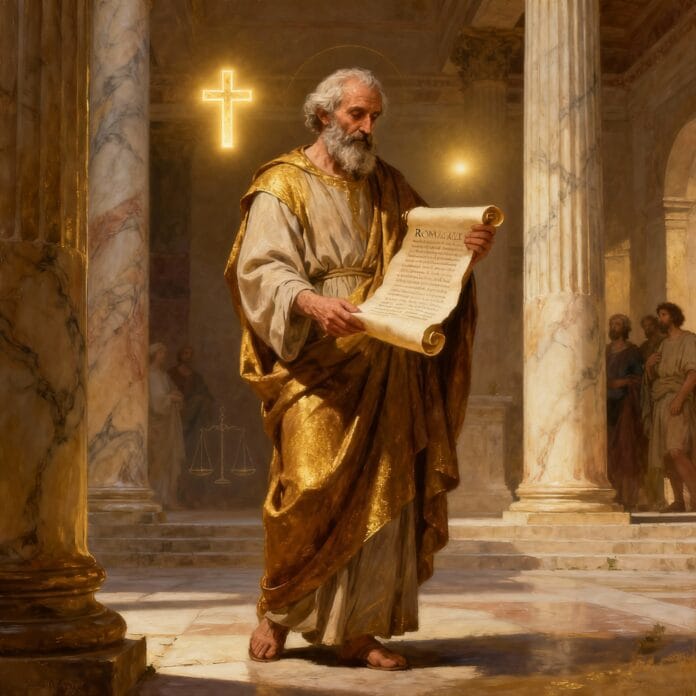
1° Foundation of the Christian Community of Rome— The Letter to the Romans very clearly assumes that a well-organized Christian community existed in the capital of the empire (see 12:4 ff.). No sacred writer tells us by whom and how this Christian community was founded; but we know, either from secular history or from the Book of the Act 2, 10-11, that there existed in Rome a fairly considerable Jewish community (it is believed to have numbered around twenty thousand members towards the end of Augustus's reign. Josephus, Ant., 17, 11, 1, speaks of eight thousand Jews from Rome who joined a delegation sent to the emperor by their coreligionists in Jerusalem after the death of Herod), composed mainly of former captives who had been brought from Palestine by Pompey and who had been gradually freed. Around this community radiated the circle of proselytes that was gradually forming wherever there were Jews. It had frequent contact with the metropolis of Jerusalem, especially during the major religious festivals (see Acts of the Apostles 2, 7-11. Cicero, pro Flacco, (p. 28, expressly mentions this fact). Therefore, it is possible, as the [authors] assert. Recognitiones clementinae, that the knowledge of Jesus reached Rome by this route, during his lifetime.
Among the Romans who witnessed the descent of the Holy Spirit upon the apostles and the first disciples (Acts of the Apostles 2, 10), it is permissible to suppose that there were some who carried away with them the fruitful impression of the first preaching of Saint Peter (Acts of the Apostles 2, 14-41). The persecution which, in the aftermath of the martyrdom of Saint Stephen, scattered a portion of the members of the nascent Church, may likewise have driven some fugitive Christians towards Rome… The whims of imperial policy, which at times expelled the Jews from the capital of the empire (Acts of the Apostles 18, 2), sometimes reminding them of this, only made them more susceptible to the widespread influence of the ChristianitySuch were undoubtedly the humble beginnings of Roman Christianity. It is perfectly possible to suppose, too, that Christians endowed with the spirit of evangelization had worked to spread the good news in the capital of the world, according to what had happened in Antioch and elsewhere. Cf. Acts of the Apostles 11, 19 and following.
But these reasons alone would be insufficient to explain the existence in Rome, around the year 59 AD, of such a flourishing Church (see Romans 1:8; 15:14; 16:19, etc.) as the one to which the letter we are beginning our study of was addressed. The full picture becomes clear if we accept, along with a very ancient tradition, the first traces of which appear in the writings of Saint Ignatius of Antioch (Ad Rom., 4), of Saint Irenaeus of Lyon (adv. Haer., 3, 1, 1 and 3, 3), of the priest Caius (see Eusebius, Ecclesiastical History, 2, 28), and which is most clearly attested by Eusebius (Ecclesiastical History, 2, 13-15), Saint Jerome (De Vir. illustr., 1) and Orose (Hist. adv. Pagan., 7, 6), that Saint Peter came to Rome during the second year of Claudius's reign (42 or 43); and that he personally founded there the Church to which he was later to permanently transfer his see as Vicar of Jesus Christ (see Acts of the Apostles 12, 17b).
From the preceding details, in its early days, Roman Christianity must have consisted almost entirely of converted Jews. The Israelite element was still very considerable when the letter to the Romans was written. This is evident from several passages in which the author is clearly addressing Christians of Jewish origin (see 2:17 ff.; 4:1 ff.; 7:1 ff. Compare also chapter 16, where several of the greetings are addressed to Christians of Jewish origin). However, in Rome as everywhere else, the Christian faith soon spread from the Israelites to the Gentiles, among whom it gained a great many followers. And it is especially these latter that Saint Paul has in mind in several passages of this letter: thus, he addresses the Romans as the apostle to the Gentiles (1:5); He hopes to bring about fruits of salvation among them as among the other pagan nations (1:13); he speaks to them openly as to converted infidels (11:13, 22 ff.; 15:14 ff., etc.). The Church of Rome therefore also included an element from the pagan world, which even seems to have been predominant at that time. This is the opinion of a great many exegetes. The opposing view also has its supporters; but it seems to us much less plausible. If, according to Acts of the Apostles 28, 16 and following, the Jews of Rome seem to be totally unaware of the nature of Christian doctrine at the time of the first captivity of Saint Paul, this is due to the fact that a split had long since occurred between the synagogues of the capital and the young Christendom.
2° The subject and division of the letter to the Romans. — The subject is clearly indicated in verses 16-17 of the first chapter: «The gospel is the power of God for salvation to everyone who believes, to the Jew first and also to the Greek. For in the gospel the righteousness of God is revealed—a righteousness that is by faith from first to last. As it is written: »The righteous live by faith.’” Saint Paul thus wished to develop for the Christians of Rome the beautiful and fundamental theme of justification by faith in Our Lord Jesus Christ. The salvation brought by Christ is intended for all people without exception, to Gentiles as well as to Jews, and it is obtained in the same way for all; it is attained not through observance of Jewish law, but by believing in Jesus Christ, the only Savior of humanity.
The letter opens with a relatively long preamble, 1:1-17, which consists of a solemn greeting (lines 1-7), a very delicate introduction in which the apostle presents himself to the faithful in Rome (lines 8-15), and finally a brief indication of the subject (lines 16-17). The body of the letter, 1:18–16:23, is divided into two parts, one dogmatic and the other moral. It is in the dogmatic part, 1:18–11:36, that the problem of Christian justification is masterfully addressed. It is divided into three sections: 1. Universal necessity and nature of this justification, 1:18–5:21; 2. Admirable moral effects it produces, 6:1–8:39; 3. The special situation of the Jews with regard to the salvation obtained through faith, 9:1–11:36. The moral section, 12:1–16:23, contains two parts: 1. Practical exhortations addressed to the Christians in Rome, to help them live in accordance with the faith (12:1–15:13); 2. Various points that concerned Saint Paul personally (15:14–16:23). The whole concludes with a majestic epilogue, 16:24–27.
3° His integrity. — The authenticity of the letter to the Romans is so clearly demonstrated by the testimonies of the most ancient and authoritative Fathers (see the General Introduction, pp. 8–9. Compare also Saint Irenaeus, Adv. Hær., 3, 16, 3 and 9; Tertullian, of Coron., 6. ; Clement d'Alex., Stromata 3, 11 and the Muratorian Canon, line 53; not to mention the quotations taken from our letter by Saint Clement pope, Saint Ignatius, Saint Polycarp, Saint Justin, the heretics Marcion and Basilides, the Valentinians, etc.) and by the perfect conformity of the epistolary genre with that of Saint Paul, which, when it was attacked some time ago by some followers of the most radical criticism, many more moderate rationalists protested vigorously.
As for its integrity, several facts have raised some doubts, though none serious. Marcion completely omitted chapters 15 and 16 (see Origen, in Rom., 16, 25). Moreover, as early as Origen's time, several manuscripts placed the final doxology, 16, 25-27, immediately after 14, 23, without, however, omitting the rest of the letter. From this, it has frequently been concluded, especially in the Tübingen school, that chapters 15 and 16, partially or totally (for opinions are very divided on this point, as always happens with subjective criticism), are a fragment of a letter originally intended for the Ephesians, a fragment later attached to the Letter to the Romans. But nothing is less well-founded than this hypothesis. Indeed, the deletion made by Marcion is entirely arbitrary. This heretic was accustomed to this practice, for he indiscriminately deleted passages from various parts of the New Testament that contradicted his theories (concerning the Letter to the Romans, see Tertullian, adv. Marc., 5, 13). As for the displacement of the doxology, besides the fact that it exists only in a small minority of ancient manuscripts, it is easy to explain without resorting to the arbitrary conjecture of critics. Chapter 16 contains almost exclusively individual messages, which were of interest only Christians of Rome. It is therefore likely that, in other churches, this chapter was omitted when the Letter to the Romans was read publicly. Here and there, it was also omitted from liturgical books. However, since they did not want to eliminate the magnificent final doxology (16:25-27), it was placed not after chapter 15, which itself ends with a doxology (cf. 15:33), but at the end of chapter 14. The style is, moreover, the same as in the rest of the letter, and chapters 15 and 16 demonstrate a subtlety of thought that one would search for in vain among all the interpolators. Let us add that the dominant notes of the letter still resonate within them.
4° The opportunity and the goal. — The occasion for most of Saint Paul's letters consisted of some particular circumstance directly related to the apostle's ministry or to his previous dealings with the recipients of his letters. Here, it appears to have been entirely general, as is evident from the very content of the letter. As many exegetes acknowledge, it must be sought in the close connection that existed between Paul's calling as apostle to the Gentiles and the metropolis of the Gentile world (cf. 15:15).
Saint Paul had long understood and been aware of this connection; therefore, there were "many years" (see 15, 23, and compare 1, 13; Acts of the Apostles (19, 21, etc.) that his aspirations drew him toward Rome, either to be edified among the Christians residing there, or to go from there to spread the gospel to the far reaches of the West. Now, his evangelizing work in the East was nearing its end: from Corinth, where he was then (see below, in paragraph 5), Paul only had to go to Jerusalem to deliver the alms collected for the Mother Church; having done so, he would set out for the city of the Caesars. But, let us note well, he had not yet had any personal contact with Roman Christianity; he had taken no part in its founding. Before visiting it, it therefore seemed useful and appropriate to him to establish direct contact with it, to announce himself, as it were, and thus prepare his apostolate there. Such was the primary occasion and principal purpose of the letter he wrote to him. Furthermore, he did not expect to be able to remain long in Rome; it was therefore advisable that he communicate in advance to the Romans, to compensate for the brevity of his visit, "a complete doctrinal exposition of the gospel," as he taught it everywhere. It is easy to understand that Saint Paul, who was fully aware of the important role that the Christian community in Rome was called to play in the development of the Church in the West, was eager to expound upon it the principles and doctrine that he strove to promote wherever his zeal led him. Paul's apostolate presupposed that the Christianity was intended for the pagan world as well as for the Jews; this is precisely why he expounds throughout the letter to the Romans the beautiful theory of salvation given to all people, Jews or pagans, through faith in Jesus Christ. The deaconess Phoebe, a devout Christian from the vicinity of Corinth, was about to leave for Rome; her journey was the external occasion that prompted the apostle to write at that very time (cf. 16:1-2).
Did he also propose, as a secondary goal, to bring about a reconciliation between the two Jewish and pagan elements that made up the Roman Catholic Church? A fair number of exegetes and critics have thought so, following the Saint Augustine (Inchoate. expos. in ep. ad RomHowever, there is no proof that divisions existed at that time within Roman Christianity or that it was threatened by them. Moreover, the tone of the letter, always calm, contains nothing that could suggest a polemical intention on the part of the author. What a difference, in this respect, between the First Letter to the Corinthians and the Letter to the Galatians, where this intention is truly present. If various passages (among others, 2:1 ff., 17 ff.; 9:6 ff.; 10:3, etc.) seem to have "an anti-Jewish character," it is precisely because Saint Paul wanted to demonstrate that justification was not the result of the more or less faithful observance of Mosaic Law, but solely of faith in Jesus Christ. Therefore, it is not Judaizing errors that he has in mind in these passages, but Judaism itself, insofar as it was opposed to Christianity.
5° The place and time of composition. — Some minor details, inserted in the last part of the letter, provide us with fairly precise information on these two points.
The letter to the Romans must have been written in Corinth. Indeed, Saint Paul greets the Church of Rome in the name of Gaius (Gaius (Γαΐος), according to the Greek), his host at the time, and of Erastus, the city's steward or treasurer (see Romans 16, 23). However, according to Acts of the Apostles 19:22 and 2 Timothy 4:20, the latter lived in Corinth; the same was true of Caius, according to 1 Corinthians 1:14. Moreover, as mentioned above, this letter was carried to Rome by the deaconess Phoebe, who was from Cenchreae, the eastern port of Corinth (cf. 16:1-2). Note also that, among those who greet the Roman Church with Saint Paul (Romans 16, 1), we find Sosipater, or Sopater, and Timothy, who, as we learn from Acts of the Apostles 20, 4, were then the companions of the apostle). It was therefore from the capital of Achaia that Paul wrote to the Romans. This opinion, which is almost unanimously accepted, is already mentioned in the words πρὸς Ρωμαίους ἔγραφη ἀπὸ Κορίνθου, which is read in many manuscripts.
That being said, the date becomes clear. Saint Paul announces to the Romans (15:25-28) that he is about to leave for Jerusalem, in order to bring there the proceeds of the collections he has made in Macedonia and Achaia. From there, he adds, he intends to go to Rome. Comparing these lines with the two passages Acts of the Apostles From 19, 21 and 20, 2-3, we see that the letter to the Romans must have been composed during the third apostolic journey of Saint Paul, towards the end of the three-month stay that the apostle made in Achaia and Corinth; consequently, towards the beginning of the year 59. The year was not yet very advanced, for Paul celebrated Passover shortly afterward in Philippi, and he desired to arrive in Jerusalem before Pentecost. Cf. Acts of the Apostles 20:3-6. According to some authors, the letter was written in 58. As we have seen, the chronology of Saint Paul's life can only be established approximately.
6° Its general character. — It is with good reason that the Letter to the Romans has been placed at the head of the collection of Saint Paul's writings; it is truly the most important of all his letters. Apart from the personal details found here and there in the second part, it is much more a treatise on theology than a letter properly speaking, and this treatise contains in summary the entire teaching of the Apostle to the Gentiles.
Elsewhere, Saint Paul assumes his readers have a general knowledge of Christian doctrine, addressing only isolated points as prompted by emerging abuses, errors, doubts, or questions raised by various churches. Here, however, he addresses the entirety of Christian dogma. The genesis and the consequences of paganism, the meaning and future of Judaism, the relationship of these two religions with the ChristianitySin and its disastrous consequences, the relationship between the first and second Adams, both with each other and with humanity: these are the principal questions of detail that he considers, and it is unnecessary to emphasize their exceptional gravity, the enduring interest they arouse. The Letter to the Romans moves within vast horizons. The explanations are given with warm eloquence, but above all with a most majestic doctrinal calm, with great vigor of argumentation, and with brilliant clarity.
Romans 1
1 Paul, a servant of Christ Jesus, an apostle by calling, set apart to proclaim the gospel of God, 2 The Gospel that God had previously promised through his prophets in the Holy Scriptures, 3 concerning his Son, born of the seed of David according to the flesh, 4 and miraculously declared Son of God, according to the Spirit of holiness, by a resurrection from the dead, Jesus Christ Our Lord, 5 Through whom we received grace and apostleship to bring all the Gentiles to the obedience of faith in his name, 6 of whom you too are included by the calling of Jesus Christ, 7 To all the beloved of God, the saints called by him, who are in Rome: Grace and peace to you from God our Father and the Lord Jesus Christ. 8 And first of all, I give thanks to my God, through Jesus Christ, for all of you, because your faith is being reported throughout the world. 9 God is my witness, this God whom I serve in my spirit by preaching the gospel of his Son, I constantly remember you, 10 continually asking in my prayers that I may finally, by His will, have some happy occasion to come to you. 11 For I have a great desire to see you, to impart to you some spiritual gift, capable of strengthening you, 12 I mean, to encourage one another in your midst by the faith that we have in common, you and me. 13 I do not want you to be unaware, brothers, that I have often intended to come to you, but have been prevented until now, in order that I might also have some fruit among you, as among the other nations. 14 I owe a debt to the Greeks and the Barbarians, to the learned and the ignorant. 15 Therefore, as far as it is in me, I am ready to preach the Gospel to you who are in Rome. 16 For I am not ashamed of the gospel, because it is the power of God for the salvation of everyone who believes, first of all of the Jew, then of the Greek. 17 For in it the righteousness of God is revealed, a righteousness that is by faith and intended for faith, as it is written: «The righteous will live by faith.» 18 Indeed, God’s wrath is poured out from heaven against all the ungodliness and wickedness of men, who by their wickedness suppress the truth, 19 For what can be known about God is manifest among them, because God has shown it to them. 20 Indeed, His invisible perfections, His eternal power, and His divinity have been made visible to the mind through His works since the creation of the world. They are therefore inexcusable., 21 For although they knew God, they did not glorify him as God or give thanks to him, but their thinking became futile and their foolish hearts were darkened. 22 Boasting of their wisdom, they have become mad. 23 and they exchanged the majesty of the incorruptible God for images representing corruptible man, birds, four-footed animals, and reptiles. 24 Therefore God gave them over in the lusts of their hearts to sexual sins, so that they dishonored their bodies among themselves, 25 They exchanged the true God for a lie and worshiped and served the creature in preference to the Creator, who is blessed forever. Amen. 26 That is why God gave them over to shameful passions: their women exchanged natural relations for those that are contrary to nature, 27 Likewise, men, instead of using women according to the order of nature, have, in their desires, burned for one another, making men with men commit infamous acts and receiving, in mutual degradation, the just reward for their error. 28 And because they did not care to know God well, God gave them over to their perverse minds to do what is wicked, 29 being filled with every kind of iniquity, malice, [fornication], greed, wickedness, full of envy, murderous thoughts, quarreling, deceit, malice, spreading false rumors, 30 slanderers, hated by God, arrogant, haughty, boastful, inventors of evil, disobedient to their parents, 31 without intelligence, without loyalty, [ruthless], without affection, without pity. 32 And although they know God's judgment declaring those who do such things worthy of death, not only do they continue to do them, but they also approve of those who do them.
Romans 2
1 Therefore, whoever you are, O man, you who judge, you are inexcusable because, in judging others, you condemn yourself, since you do the same things, you who judge. 2 For we know that God's judgment is according to truth against those who commit such things. 3 And you think, O man, you who judge those who commit them and who yourself do them, that you will escape the judgment of God? 4 Or do you despise the riches of his kindness, patience, and forbearance? And do you not know that kindness Is God calling you to repentance? 5 Because of your stubbornness and unrepentant heart, you are storing up wrath against yourself for the day of God’s wrath and righteous judgment., 6 who will repay each according to their deeds: 7 eternal life to those who, through perseverance in good works, seek glory, honor, and immortality 8 but anger and indignation to the rebels, unruly to the truth, docile to iniquity. 9 Yes, tribulation and anguish will come upon every man who does evil, upon the Jew first, then upon the Greek. 10 Glory, honor, and peace to everyone who does good, first to the Jew, then to the Greek 11 because God does not show favoritism between people. 12 All who have sinned without the law will also perish without the law, and all who have sinned under the law will be judged by that law. 13 For it is not those who hear the law who are righteous in God’s sight, but it is those who obey the law who will be justified. 14 When pagans, who do not have the law, naturally fulfill what the law commands, not having the law, they are a law to themselves., 15 They show that what the Law commands is written in their hearts, their conscience bearing witness at the same time through thoughts which, on both sides, accuse or defend them. 16 This will be revealed on the day when, according to my Gospel, God judges the secret actions of men through Jesus Christ. 17 You who bear the name of Jew, who rely on the Law, who glory in God, 18 who knows his will, who knows how to discern what is best, instructed as you are by the Law, 19 You who boast of being the guide of the blind, the light of those who are in darkness, 20 the doctor of the ignorant, the teacher of children, having in the Law the rule of knowledge and truth: 21 You who teach others, do you not teach yourself? You who preach against stealing, do you steal?. 22 You who forbid adultery, you commit adultery. You who abhor idols, you desecrate the temple. 23 You who pride yourself on having a law, you dishonor God by transgressing it. 24 for "the name of God is blasphemed among the nations because of you," as Scripture says. 25 Circumcision is useful, it is true, if you observe the Law, but if you transgress the Law, you are no longer, with your circumcision, but an uncircumcised person. 26 If, therefore, an uncircumcised man observes the precepts of the Law, will not his uncircumcision be considered as circumcision? 27 Moreover, the man who was uncircumcised from birth, if he observes the Law, will judge you, who, with the letter of the Law and circumcision, transgress the Law. 28 A true Jew is not one who is one outwardly, and true circumcision is not that which appears in the flesh. 29 But a Jew is one inwardly, and circumcision is that of the heart, in the spirit and not in the letter: this Jew will have his praise, not from men, but from God.
Romans 3
1 What advantage does a Jew have? Or what is the benefit of circumcision? 2 This advantage is great in every way. And first of all, it is that the oracles of God have been entrusted to them. 3 But what? If some did not believe, will their unbelief destroy loyalty of God? 4 Far from it. But rather that God be found true and every man a liar, as it is written: "So that, O God, you may be found just in your words and triumph when you are judged."« 5 But if our injustice demonstrates God's justice, what shall we say? Is not God unjust in giving vent to his anger? I am speaking in human terms. 6 Far from it. Otherwise, how will God judge the world? 7 For if, through my lie, God's truth shines forth more fully for his glory, why then am I myself condemned as a sinner? 8 And why should we not do evil so that good may come of it, as slander accuses us of doing and as some claim we teach? Their condemnation is just. 9 So then? Do we have any superiority? No, none, for we have just proven that all, Jews and Greeks, are under sin., 10 as it is written: "There is no righteous one, not even one. 11 There are none who have intelligence, there are none who seek God. 12 They have all strayed from the path, they have all become corrupt; there is no one who does good, not even one.» 13 «"Their throats are open sepulchers; they use their tongues to deceive." "The venom of an asp is beneath their lips."» 14 «"Their mouths are full of curses and bitterness."» 15 «"They have nimble feet for shedding blood.". 16 Desolation and misfortune are in their paths. 17 They don't know the way to peace18. “The fear of God is not before their eyes.” 19 Now we know that whatever the Law says, it says to those who are under the Law, so that every mouth may be silenced and the whole world may fall under the righteousness of God. 20 Indeed, no one will be justified in his sight by the works of the Law, for the law only gives knowledge of sin. 21 But now, apart from the Law, the righteousness of God has been revealed, to which the Law and the Prophets bear witness, 22 the righteousness of God through faith in Jesus Christ for all, and to all who believe, there is no distinction, 23 for all have sinned and fall short of the glory of God 24 and they are justified freely by his grace, through the redemption that is in Christ Jesus. 25 God gave him as a sacrifice of atonement, through faith, to demonstrate his righteousness, in his forbearance having left the previous sins unpunished, 26 in order, I say, to manifest his righteousness at the present time, so as to be recognized as righteous and justifying him who believes [in Jesus Christ]. 27 Where, then, is the reason for boasting? It is excluded. By what law? By the law of works? No, but by the law of faith. 28 For we hold it to be certain that a person is justified by faith apart from the works of the law. 29 Or is God only the God of the Jews? And is he not also the God of the Gentiles? Yes, he is also the God of those who are not Jews, 30 since there is only one God who will justify the circumcised by the principle of faith and the uncircumcised by faith. 31 Do we then abolish the Law by faith? Not at all. On the contrary, we uphold it.
Romans 4
1 What advantage, then, shall we say, was obtained by Abraham, our father, according to the flesh? 2 If Abraham was justified by works, he has something to boast about. But he has no reason to boast before God. 3 For what does Scripture say? «Abraham believed God, and it was credited to him as righteousness.» 4 Now to the one who does a work, the wage is not credited as a gift, but as something owed, 5 And to him who does no work, but believes in him who justifies the ungodly, his faith is credited as righteousness. 6 This is how David proclaims the blessedness of the man to whom God imputes righteousness independently of works: 7 «Blessed are those whose iniquities are forgiven, whose sins are covered.”. 8 Blessed is the man whose sin the Lord does not count against him.» 9 Is this happiness only for the circumcised, or is it also for the uncircumcised? For we say that faith was credited to Abraham as righteousness. 10 How then was it attributed to him? Was it in the state of circumcision, or in the state of uncircumcision? It was not in the state of circumcision, he was still uncircumcised. 11 He then received the sign of circumcision, a seal of the righteousness that he had by faith while he was still uncircumcised, so that he might be the father of all who have faith but are uncircumcised, in order that righteousness might be credited to them as well., 12 and the father of the circumcised, of those who are not only circumcised, but who at the same time walk in the footsteps of the faith that our father Abraham had when he was uncircumcised. 13 Indeed, it was not through the Law that the inheritance of the world was promised to Abraham and his descendants, but through the righteousness of faith. 14 For if those who have the Law are heirs, then faith is futile and the promise is void., 15 because the law produces anger, and where there is no law, there is no transgression either. 16 Therefore, it is by faith, so that it may be by grace, so that the promise may be assured to all Abraham’s offspring, not only to those who belong to the law but also to those who belong to the faith of Abraham, our father., 17 as it is written: «I have made you a father of many nations.» He is so before him in whom he believed, before God, who gives life to the dead and calls into being things that were not. 18 Against all hope, he believed, and so became the father of many nations, just as it had been said to him, «So shall your offspring be.» 19 And, unwavering in his faith, he did not consider that his body was already spent, since he was nearly a hundred years old, nor that Sarah's womb was exhausted. 20 Faced with God's promise, he had neither hesitation nor distrust, but drawing his strength from faith, he gave glory to God., 21 fully convinced that he will be able to fulfill the promise he made. 22 And that is why his faith was credited to him as righteousness. 23 But it is not for him alone that it is written that justice was credited to him, 24 but it is also for us, to whom it must be imputed, for us who believe in him who raised Jesus Christ, our Lord, from the dead, 25 who was delivered up for our sins and was raised for our justification.
Romans 5
1 Therefore, since we have been justified by faith, we have peace with God through our Lord Jesus Christ, 2 to whom we owe it that we have gained access by faith into this grace in which we now stand, and to boast in the hope of the glory of God. 3 Moreover, we even glory in tribulations, knowing that tribulation produces perseverance, 4 Consistency is a proven virtue, and proven virtue is hope. 5 But hope does not disappoint, because God’s love has been poured into our hearts through the Holy Spirit who has been given to us. 6 For when we were still powerless, at the appointed time Christ died for the ungodly. 7 People are hardly willing to die for a righteous person, and perhaps someone would even be willing to die for a good man. 8 But God shows his love for us in this: While we were still sinners, Jesus Christ died for us. 9 Therefore, since we are now justified in his blood, how much more shall we be saved from wrath by him. 10 For if, while we were enemies, we were reconciled to God through the death of his Son, much more, having been reconciled, shall we be saved by his life. 11 Moreover, we also glory in God through our Lord Jesus Christ, through whom we have now obtained reconciliation. 12 Therefore, just as sin entered the world through one man, and death through sin, and in this way death spread to all people, because all sinned. 13 For before the Law, sin was in the world, and sin is not imputed where there is no law. 14 However, death reigned from Adam to Moses, even over those who had not sinned, through a transgression like that of Adam, who is a type of the one who was to come. 15 But the free gift is not like the trespass; for if, by the trespass of one man, all men died, how much more did the grace of God and the gift of God, by the grace of one man, Jesus Christ, come abundantly upon all men. 16 And the gift is not like the consequences of one person's sin, for judgment was brought for one fault, but the gift brings justification for many faults. 17 For if, by the trespass of the one man, death reigned through that one man, how much more will those who receive God’s abundant provision of grace and of the gift of righteousness reign in life through the one man, Jesus Christ. 18 Therefore, as through the fault of one man condemnation came upon all men, so through the justice of one man justification which gives life comes to all men. 19 For just as through the disobedience of one man all were made sinners, so also through the obedience of one man all will be made righteous. 20 The law intervened to increase the guilt, but where sin abounded, grace abounded all the more., 21 so that, as sin reigned in death, so grace might reign through righteousness to eternal life, through Jesus Christ our Lord.
Romans 6
1 What shall we say then? Shall we remain in sin so that grace may abound? 2 Far from it. We who died to sin, how can we live in it any longer? 3 Do you not know that all of us who were baptized into Christ Jesus were baptized into his death? 4 Therefore we were buried with him through baptism into death, so that, just as Christ was raised from the dead through the glory of the Father, we too might walk in newness of life. 5 If, in fact, we have been grafted onto him through the likeness of his death, we shall also be grafted onto him through the likeness of his resurrection. 6 knowing that our old self was crucified with him, so that the body of sin might be destroyed, that we should no longer be slaves to sin 7 for he who has died is freed from sin. 8 But if we have died with Christ, we believe that we will live with him., 9 knowing that Christ, having risen from the dead, no longer dies, death no longer has power over him. 10 For his death was a death to sin once and for all, and his life is a life for God. 11 So you also must consider yourselves dead to sin and alive to God in Christ Jesus. 12 Therefore do not let sin reign in your mortal body, so that you obey its desires. 13 Do not offer your members to sin to be instruments of iniquity, but offer yourselves to God as those who are alive from being dead, and offer your members to him to be instruments of righteousness. 14 For sin will have no dominion over you, because you are not under the law, but under grace. 15 What then? Shall we sin because we are not under the Law but under grace? Far from it. 16 Do you not know that if you offer yourselves to someone as obedient slaves, you are slaves of the one you obey, whether you are slaves to sin leading to death, or to obedience to God leading to righteousness? 17 But thanks be to God that, though you used to be slaves to sin, you have come to obey from your heart the pattern of teaching that was taught to you. 18 So, having been set free from sin, you have become slaves to righteousness. 19 I speak in human terms because of your human limitations. Just as you presented your members as slaves to sexual sin and injustice, resulting in further injustice, so now present your members as slaves to righteousness, resulting in holiness. 20 For when you were slaves to sin, you were free in regard to righteousness. 21 What fruit did you have then in the things of which you are now ashamed? For the end of these things is death. 22 But now that you have been set free from sin and have become slaves of God, the benefit you reap leads to holiness, and the result is eternal life. 23 For the wages of sin is death, but the gift of God is eternal life in Jesus Christ our Lord.
Romans 7
1 Do you not know, my brothers, for I am speaking to men who know the Law, that a man is under the law as long as he lives? 2 Thus, a married woman is legally bound to her husband as long as he is alive, but if the husband dies, she is released from the law that bound her to her husband. 3 Therefore, if she marries another man while her husband is still alive, she will be called an adulteress; but if her husband dies, she is free from the law, so that she is no longer an adulteress when she becomes the wife of another husband. 4 So, my brothers, you also died to the law through the body of Jesus Christ, so that you might belong to another, to him who was raised from the dead, in order that we might bear fruit for God. 5 For when we were in the flesh, the sinful passions, aroused by the law, were at work in our members to produce fruits for death. 6 But now we have been released from the Law, having died to the Law under which we were bound, so that we serve God in the new way of the Spirit and not in the old way of the letter. 7 What then shall we say? Is the law sin? Certainly not! On the contrary, I would not have known sin except through the law. For example, if the law had not said, «You shall not covet,» I would not have known what coveting really was.» 8 Then sin, seizing the opportunity, stirred up in me, through the commandment, all kinds of desires, for apart from the Law, sin is dead. 9 For me, I once lived apart from the Law, but when the commandment came, sin came to life., 10 And I died. So the commandment that was supposed to lead to life turned out to lead to death for me. 11 For sin, seizing the opportunity offered by the commandment, deceived me, and through it gave me death. 12 Therefore, the Law is holy and the commandment is holy, just and good. 13 So, was a good thing a cause of death for me? Far from it. Rather, it was sin that brought about my death, in order that it might be shown to be sin by bringing about my death through a good thing, and in order that it might grow exceedingly sin through the commandment. 14 For we know that the Law is spiritual, but I am carnal, sold under sin. 15 Because I don't know what I'm doing: I'm not doing what I want and I'm doing what I hate. 16 But if I do what I do not want to do, I thereby acknowledge that the Law is good. 17 But then it is no longer I who do it, it is sin that dwells within me. 18 For I know that good does not dwell in me, that is, in my flesh; I have the will, but not the power to accomplish it. 19 For I do not do the good I want to do, and I do the evil I do not want to do. 20 But if I do what I do not want to do, it is no longer I who do it, but sin that dwells in me. 21 So I find this law within myself: when I want to do good, evil is near me. 22 For I delight in God's law, in my inner being. 23 But I see another law at work in my members, waging war against the law of my mind and making me a prisoner of the law of sin which is in my members. 24How wretched I am. Who will deliver me from this dead body? 25 Thanks be to God through Jesus Christ our Lord. So then, I myself, by spirit, am a slave to the law of God, and by flesh a slave to the law of sin.
Romans 8
1 Therefore, there is now no condemnation for those who are in Christ Jesus. 2 Indeed, the law of the Spirit of life has set me free in Christ Jesus from the law of sin and death. 3 For what the Law was powerless to do because it was weakened by the flesh, God did by sending his own Son in the likeness of sinful flesh to be a sin offering. And he condemned sin in the flesh, 4 so that the righteous requirement of the law might be fulfilled in us, who walk not according to the flesh, but according to the Spirit. 5 For those who live according to the flesh set their minds on the things of the flesh, but those who live according to the Spirit set their minds on the things of the Spirit. 6 For the affections of the flesh are death, but the affections of the Spirit are life and peace 7 because the affections of the flesh are enmity against God, for they do not submit to the divine law and cannot even do so. 8 But those who live in the flesh cannot please God. 9 You, however, do not live in the flesh but in the Spirit, if indeed the Spirit of God dwells in you. And if anyone does not have the Spirit of Christ, he does not belong to him. 10 But if Christ is in you, the body is indeed dead because of sin, but the spirit is life because of righteousness. 11 And if the Spirit of him who raised Jesus from the dead dwells in you, he who raised Christ from the dead will also give life to your mortal bodies, because of his Spirit who dwells in you. 12 Therefore, my brothers, we are not obligated to the flesh to live according to the flesh. 13 For if you live according to the flesh, you will die; but if by the Spirit you put to death the deeds of the body, you will live. 14 for all who are led by the Spirit of God are children of God. 15 For you did not receive a spirit of slavery to fall back into fear, but you received the Spirit of adoption, in whom we cry, “Abba, Father!”. 16 This Spirit himself testifies with our spirit that we are children of God. 17 Now if we are children, then we are heirs—heirs of God and co-heirs with Christ, if indeed we share in his sufferings in order that we may also share in his glory. 18 For I consider that the sufferings of this present time are not worth comparing with the glory that will be revealed in us. 19 Therefore, creation waits with eager longing for the manifestation of the children of God. 20 For creation was subjected to futility, not willingly, but by the will of him who subjected it, with hope 21 that she too will be set free from the bondage of corruption, to share in the glorious freedom of the children of God. 22 For we know that the whole creation has been groaning and suffering the pains of childbirth until now. 23 And not only she, but we also, who have the firstfruits of the Spirit, groan inwardly as we wait eagerly for adoption as sons, the redemption of our bodies. 24 For it is in hope that we are saved. But to see what one hopes for is no longer to hope: for what one sees, why hope for it still? 25 But if we hope for what we do not see, we wait for it patiently. 26 Likewise, the Spirit helps us in our weakness. For we do not know what to pray for as we ought, but the Spirit himself intercedes for us with groanings too deep for words. 27 And he who searches hearts knows what the desires of the Spirit are, and knows that he prays according to God for saints. 28 Moreover, we know that in all things God works for the good of those who love him, who are called according to his eternal purpose. 29 For those whom he foreknew he also predestined to be conformed to the image of his Son, in order that he might be the firstborn among many brothers. 30 And those whom he predestined, he also called; those whom he called, he also justified; and those whom he justified, he glorified. 31 What then shall we say after this? If God is for us, who can be against us? 32 He who did not spare his own Son, but gave him up to death for us all, how will he not also, along with him, graciously give us all things? 33 Who will accuse God's chosen ones? It is God who justifies them. 34 Who will condemn them? Christ died, moreover, he rose again, he is at the right hand of God, he intercedes for us. 35 Who shall separate us from the love of Christ? Shall tribulation, or distress, or persecution, or hungerOr nudity, or peril, or the sword? 36 As it is written: "For your sake we are given over to death all day long, and we are regarded as sheep to be slaughtered."« 37 But in all these trials we are more than conquerors, through him who loved us. 38 For I am certain that neither death, nor life, nor the angelsneither principalities, nor things present, nor things to come, nor powers, 39 Neither height nor depth, nor anything else in all creation, will be able to separate us from the love of God in Christ Jesus our Lord.
Romans 9
1 I speak the truth in Christ; I am not lying, my conscience bears me witness through the Holy Spirit: 2 I feel great sadness and I have an unceasing pain in my heart. 3 For I would wish that I myself were accursed, far from Christ, for the sake of my brothers, my kinsmen according to the flesh, 4 who are Israelites, to whom belong the adoption, the glory, the covenants, the Law, the worship, and the promises 5 and the patriarchs, and from whom came Christ according to the flesh, who is over all things God, blessed forever. Amen. 6 It is not that the word of God has failed. For not all who are descended from Israel are the true Israel., 7 And to be Abraham's descendants, not all are his children, but "It is the descendants of Isaac who will be called your descendants.", 8 that is to say that it is not the children of the flesh who are children of God, but it is the children of the promise who are regarded as the offspring of Abraham. 9 These are indeed the terms of a promise: "I will return at this time of year, and Sarah will have a son."« 10 And not only Sarah, but it was also the case with Rebecca, who conceived two children by one man, Isaac our father 11 For, before the children were born and had done anything, good or bad, so that God's elective purpose might be found firm, 12 not by virtue of works, but by the choice of the one who calls, it was said to Rebecca: "The elder will be subject to the younger,"« 13 as it is written: «I loved Jacob and I hated Esau.» 14 What shall we say then? Is there injustice in God? Far from it. 15 For he said to Moses, «I will have mercy on whom I will have mercy, and I will have compassion on whom I will have compassion.» 16 Thus, election depends neither on will nor on effort, but on God who shows mercy. 17 For the Scripture says to Pharaoh, «I have raised you up to show my power in you, and that my name may be praised in all the earth.» 18 Thus he shows mercy to whom he wills and he hardens whom he wills. 19 You will ask me: What then is God complaining about now? For who can oppose his will? 20 But rather, O man, who are you to argue with God? Does the clay pot say to the one who fashioned it, “Why have you made me like this?” 21 Is not the potter master of his clay, to make from the same mass a vessel of honor and a vessel of ignominy? 22 And if God, desiring to show his wrath and to make known his power, has endured with great patience vessels of wrath, formed for destruction, 23 and if he also wished to make known the riches of his glory in regard to the vessels of mercy which he prepared beforehand for glory, 24 towards us, whom he has called, not only from among the Jews but also from among the Gentiles, where is the injustice? 25 This is what he says in Hosea: «He who was not my people, I will call my people, and she who was not beloved, I will call beloved.» 26 «And in the place where it was said to them, »You are not my people,’ there they will also be called children of the living God.” 27 On the other hand, Isaiah cries out concerning Israel: "Though the number of the children of Israel be like the sand of the sea, only a small remnant will be saved."« 28 For fulfilling his word fully and promptly, he will execute it on earth. 29 And as Isaiah had foretold: «If the Lord Almighty had not left us a branch, we would have become like Sodom and been like Gomorrah.» 30 What then shall we say? That the Gentiles, who did not pursue righteousness, have attained it, but a righteousness that comes by faith, 31 whereas Israel, which sought a law of justice, did not arrive at a law of justice. 32 Why? Because he sought to attain it, not through faith, but as if he could have arrived through works. He stumbled against the stumbling stone., 33 as it is written: «See, I lay in Zion a stone that causes people to stumble and a rock that makes them fall, but whoever believes in him will never be put to shame.»
Romans 10
1 Brothers, my heart's desire and my prayer to God for them is that they may be saved. 2 For I can testify about them that they are zealous for God, but their zeal is misguided. 3 Not knowing God's justice and seeking to establish their own justice, they did not submit to God's justice. 4 For indeed, the end of the Law is Christ, for the justification of every man who believes. 5 Indeed, Moses says of the righteousness that comes from the Law: «The man who does these things will live by them.» 6 But this is how the righteousness that comes from faith speaks: «Do not say in your heart, »Who will ascend into heaven?’” (meaning to bring Christ down from heaven). 7 or "Who will descend into the abyss?" This means bringing Christ up from the dead 8 So what does it say? "The word is near you, in your mouth and in your heart." This is the word of faith that we preach. 9 If you confess with your mouth that Jesus is Lord and believe in your heart that God raised him from the dead, you will be saved. 10 For it is with the heart that one believes and is justified, and it is with the mouth that one confesses and is saved., 11 According to what Scripture says: "Whoever believes in him will never be put to shame."« 12 There is no difference between Jew and Gentile, because the same Christ is Lord of all, being rich toward all who call on him. 13 For "whoever calls on the name of the Lord will be saved."« 14 How then can one call upon the one in whom one has not yet believed? And how can one believe in the one of whom one has not heard? And how can one hear without a preacher? 15 And how can they preach unless they are sent? As it is written: «How beautiful are the feet of those who bring good tidings!» 16 But not all obeyed the Gospel, for Isaiah said, "Lord, who has believed our message?"« 17 Thus faith comes from hearing the preaching, and preaching is done through the word of God. 18 But I ask: did they not hear? On the contrary: «Their voice has gone out into all the earth, and their words to the ends of the world.» 19 I ask again: Did Israel not know? Moses first said, «I will make you jealous against a nation that is not a nation, I will make you angry against a nation without understanding.» 20 And Isaiah goes so far as to say: "I was found by those who did not seek me, I revealed myself to those who did not ask for me."« 21 But concerning Israel he said, "All day long I have stretched out my hands to an unbelieving and rebellious people."«
Romans 11
1 I ask then: Has God rejected his people? Far from it, for I too am an Israelite, a descendant of Abraham, a member of the tribe of Benjamin. 2 No, God has not rejected his people, whom he foreknew. Do you not know what the Scripture recounts in the chapter of Elijah, how he addresses this complaint against Israel to God? 3 «Lord, they have killed your prophets, they have torn down your altars, I am the only one left, and they seek my life.» 4 But what did the divine voice reply? »I have reserved for myself seven thousand men who have not bowed the knee to Baal.” 5 Likewise, in the present time, there is a reserve according to a choice of grace. 6 But if it is by grace, it is no longer by works, otherwise grace ceases to be grace. 7 What shall we say then? What Israel sought, it did not obtain, but those whom God chose obtained it, while the others were blinded, 8 as it is written, "God gave them a spirit of stupor, eyes that could not see and ears that could not hear, to this day."« 9 And David said, «May their table become a snare for them, a trap, a stumbling block, and a just punishment.”. 10 "Keep their eyes darkened so they cannot see, and keep their backs constantly bent."» 11 I ask then, Did they stumble so as to fall forever? Far from it, but through their fall salvation came to the Gentiles, so as to arouse the jealousy of Israel. 12 Now, if their fall was the wealth of the world and their diminishment the wealth of the pagans, what will their fullness be?. 13 Indeed, I say to you, Christians born in paganism: I myself, as the apostle to all Gentiles, strive to make my ministry glorious, 14 in order, if possible, to arouse the jealousy of those of my blood and to save some of them. 15 For if their rejection was the reconciliation of the world, what will their reintegration be, if not a resurrection from the dead? 16 If the first fruits are holy, the mass is also holy, and if the root is holy, the branches are also holy. 17 But if some of the branches were cut off, and you, who were only a wild olive tree, were grafted in their place and made a partaker of the root and sap of the olive tree, 18 Do not boast against the branches. If you boast, know that it is not you who support the root, but the root that supports you. 19 You will therefore say: These branches were cut off so that I might be grafted. 20 This is true; they were cut off because of their unbelief, and you stand by faith. Beware of proud thoughts, but fear. 21 For if God has not spared the natural branches, fear that he will not spare you either. 22 Therefore, consider kindness and the severity of God: his severity towards those who have fallen and his kindness towards you, if you maintain this kindness, otherwise you too will be cut off. 23 They too, if they do not persist in their unbelief, will be grafted in, for God is able to graft them in again. 24 If you were cut from a wild olive tree and grafted, contrary to your nature, onto a native olive tree, then all the more reason will the natural branches be grafted onto their own olive tree. 25 For I do not want you to be ignorant of this mystery, brothers, so that you may not be wise in your own eyes: that a part of Israel has gone into blindness until the whole lot of the Gentiles have come in. 26 And so all Israel will be saved, as it is written: «The deliverer will come from Zion, and he will remove all ungodliness from Jacob.” 27 and this will be my covenant with them, when I have taken away their sins. 28 It is true, as far as the Gospel is concerned, they are still enemies for your sake, but as far as God’s choice is concerned, they are loved for the sake of their fathers. 29 For the gifts and the calling of God are irrevocable. 30 And just as you yourselves once disobeyed God, and as a result of your disobedience you have now received mercy, 31 Likewise, they too have now disobeyed, because of mercy which was done for you, so that they too might receive mercy. 32 For God has imprisoned all men in disobedience, to show mercy to all. 33 O inexhaustible depth of God's wisdom and knowledge! How unsearchable are His judgments and His ways beyond understanding!. 34 For "who has known the mind of the Lord, or who has been his counselor?"« 35 Or, "who gave him first, so that he should receive in return?" 36 From him, through him, and for him are all things. To him be the glory forever. Amen.
Romans 12
1 Therefore, I urge you, my brothers, by mercy to God, to offer your bodies as a living sacrifice, holy and pleasing to God. This is your true and proper worship. 2 Do not conform to the pattern of this world, but be transformed by the renewing of your mind. Then you will be able to test and approve what God’s will is—his good, pleasing and perfect will. 3 By the grace given to me, I say to every one of you not to think of yourself more highly than you ought, but to think with sober judgment, each according to the measure of faith that God has distributed to him. 4 For, just as we have many members in one body and not all members have the same function, 5 So we, who are many, are one body in Christ, and each one of us is a member of another. 6 And we have different gifts, according to the grace given to us: either prophecy, according to the measure of our faith, 7 whether in ministry, to keep us in ministry, this one has received the gift of teaching: let him teach, 8 One has the gift of exhortation: let him exhort; another distributes: let him do so with simplicity; another presides: let him do so with zeal; another performs works of mercy: let him do them with joy. 9 Let your charity be without hypocrisy. Abhor evil, cling firmly to good. 10 As for brotherly love, be devoted to one another, honoring one another, 11 As for zeal, do not be lax. Be fervent in spirit, it is the Lord whom you serve. 12 Be full of joy that hope gives, patient in affliction, assiduous in prayer, 13 ready to provide for the needs of the saints, eager to givehospitality. 14 Bless those who persecute you: bless and do not curse. 15 Rejoice with those who are in joyWeep with those who weep. 16 Have the same feelings for one another; do not aspire to what is lofty, but be drawn to what is humble. Do not be wise in your own eyes, 17 Do not repay anyone evil for evil; be careful to do what is right in the eyes of everyone. 18 If it is possible, as much as it depends on you, be at peace with everyone. 19 Do not take revenge yourselves, beloved, but leave room for God's wrath, for it is written: "Vengeance is mine, I will repay, says the Lord."« 20 If your enemy is hungry, feed him; if he is thirsty, give him something to drink, for in doing this you will heap burning coals on his head. 21 Do not be overcome by evil, but triumph over evil with good.
Romans 13
1 Let every soul be subject to the higher authorities, for there is no authority except that which God has established, and those which exist have been instituted by Him. 2 Therefore, whoever resists the authority resists the order that God has established, and those who resist will bring judgment upon themselves. 3 For magistrates are not to be feared for good deeds, but for evil. Do you want to have no fear of the authority? Do good and you will have its approval., 4 For the prince is God's minister for your good. But if you do wrong, be afraid, for he does not bear the sword in vain, for he is God's minister, an agent of vengeance and punishment for the wrongdoer. 5 It is necessary to be submissive, not only out of fear of punishment, but also for reasons of conscience. 6 This is also why you pay taxes, because the magistrates are God's ministers, wholly dedicated to this function. Give to everyone what is due to them. 7 Whose tax, whose tax, whose tribute, whose tribute, whose fear, whose fear, whose honor, whose honor. 8 Do not owe anyone anything except mutual love, for he who loves his neighbor has fulfilled the law. 9 Indeed, these commandments: "You shall not commit adultery, you shall not murder, you shall not steal, you shall not covet," and those that could be cited elsewhere, are summarized in this saying:« You shall love your neighbor as yourself. » 10 Love does no harm to one's neighbor, therefore love is the fullness of the law. 11 This is all the more important because you know what time we are in; it is time to finally wake up from sleep, for now salvation is closer to us than when we embraced the faith. 12 The night is far advanced and the day is at hand. Let us therefore cast off the works of darkness and put on the armor of light. 13 Let us walk honestly, as in the daytime, not giving in to excesses of food and wine, to lust and impurity, to quarrels and jealousies. 14 But put on the Lord Jesus Christ and make no provision for the flesh, so as to gratify its desires.
Romans 14
1 As for those who are weak in faith, welcome them without arguing about their opinions. 2 One person believes they can eat anything, while another, who is weak, feeds on vegetables. 3 Let not the one who eats despise the one who does not, and let not the one who does not eat judge the one who does, for God has welcomed him into his own. 4 Who are you to judge another's servant? To his own master he stands or falls. And he will stand, for God is able to uphold him. 5 One person may make a distinction between days, another considers them all the same: let each one have full conviction in his mind. 6 He who observes such and such a day, observes it in view of the Lord, and he who eats, eats in view of the Lord, for he gives thanks to God, and he who does not eat, it is in view of the Lord that he does not eat and he also gives thanks to God. 7 Indeed, none of us lives for himself and none of us dies for himself. 8 For whether we live, we live for the Lord, or whether we die, we die for the Lord. So whether we live or die, we belong to the Lord. 9 For Christ died and lived in order to be Lord of both the dead and the living. 10 But why do you judge your brother? Why do you despise your brother? For we will all appear before the judgment seat of Christ. 11 For it is written: «As surely as I live, says the Lord, every knee will bow before me and every tongue will acknowledge God.» 12 Thus each of us will give an account to God for ourselves. 13 Therefore let us no longer judge one another, but rather judge that we should do nothing that would be a stumbling block or occasion to fall in the way of our brother. 14 I know and am convinced in the Lord Jesus that nothing is unclean in itself; nevertheless, if anyone considers something unclean, it is unclean for him. 15 But if you cause your brother grief over food, you are no longer walking according charityDo not lead a man to perdition by your food, for whom Christ died. 16 May your property not be a subject of blasphemy. 17 For the kingdom of God is not a matter of eating and drinking, but of righteousness and peace And joy in the Holy Spirit. 18 He who serves Christ in this way is pleasing to God and approved by men. 19 Let's therefore look for what contributes to peace and to mutual edification. 20 Beware of destroying God's work for the sake of food. It is true that all things are clean, but it is wrong for a person to become a stumbling block by eating. 21 What is good is not to eat meat, not to drink wine, not to do anything that would cause your brother to stumble. 22 Do you have a conviction? Keep it to yourself before God. Blessed is the one who does not condemn himself in the act he approves. 23 But whoever has doubts, if he eats, is condemned, because he does not act from conviction; everything that does not proceed from conviction is sin.
Romans 15
1 We who are strong must bear with the weaknesses of the weak and not please ourselves. 2 Let each of us seek to please our neighbor for the good, in order to edify him. 3 For Christ did not feel self-satisfaction, but, as it is written: «The insults of those who insult you have fallen on me.» 4 For everything that was written before us was written for our instruction, so that, by patience and the consolation that the Scriptures give, we possessed hope. 5 May the God of patience and the consolation that comes from having the same attitude toward one another in accord with Jesus Christ, 6 so that with one heart and one mouth you may glorify God, the Father of our Lord Jesus Christ. 7 Therefore welcome one another as Christ has welcomed you, for the glory of God. 8 I maintain that Christ became a minister to the circumcised to demonstrate God's faithfulness, fulfilling the promises made to their ancestors., 9 while the Gentiles glorify God for his mercy, as it is written: «Therefore I will praise you among the nations, and sing praises to your name.» 10 Scripture also says: «Gentlemen, rejoice with his people.» 11 And elsewhere: «All nations, praise the Lord; all peoples, extol him.» 12 Isaiah also says: «The root of Jesse will appear, he who arises to rule over the nations; in him the nations will put their hope.» 13 May the God of hope fill you with all joy and peace in believing, so that by the power of the Holy Spirit you may abound in hope. 14 I too, my brothers, am convinced of you that you yourselves are full of goodness, filled with all knowledge, and able to warn one another. 15 However, I wrote to you more freely, as if to partially revive your memories, because of the grace God has bestowed upon me. 16 to be a minister of Jesus Christ to the Gentiles, performing the divine service of the Gospel of God, so that the offering of the Gentiles may be accepted, being sanctified by the Holy Spirit. 17 Therefore, I have reason to boast in Christ Jesus regarding the service of God. 18 For I would not dare to speak of things that Christ has not accomplished through my ministry to bring the Gentiles to obedience to the Gospel, by word and deed, 19 by the power of miracles and wonders, by the power of the Holy Spirit: so that, from Jerusalem and the surrounding countries as far as Illyria, I have carried everywhere the Gospel of Christ, 20 However, I consider it my honor to preach the Gospel where Christ had not yet been named, so as not to build on the foundation that another had laid, 21 But as it is written: «Those who were not told about him will see him, and those who have not heard will know him.» 22 That's what has often prevented me from coming to your house. 23 But now, having nothing left to keep me in these parts and having for several years the desire to come to you, 24 I hope to see you in passing, when I go to Spain and be accompanied by you, after I have satisfied, at least in part, my desire to be among you. 25 I am currently going to Jerusalem to help the saints. 26 For Macedonia and Achaia were pleased to make a collection for the saints in Jerusalem who are in poverty. 27 They willingly accepted it, and indeed they owed it to them, for if the pagans have shared in their spiritual goods, they must in turn assist them with their temporal goods. 28 As soon as I have finished this matter and have deposited this gift in their hands, I will leave for Spain and visit you. 29 Now I know that when I come to you, I will come with an abundant blessing from Christ. 30 I urge you, my brothers, by Our Lord Jesus Christ and by charity of the Holy Spirit, to fight with me, by addressing prayers to God for me, 31 so that I may escape from the unbelievers in Judea and that the offering I bring to Jerusalem may be acceptable to the saints, 32so that I arrive at your place in joy, if it is God's will and I find some rest in your midst. 33 May the God of peace be with you all. Amen.
Romans 16
1 I recommend Phoebe, our sister, who is a deaconess of the Church of Cenchreae, 2 so that you may receive her in Our Lord in a manner worthy of the saints and assist her in all things where she may need you, for she too has given help to many and to me. 3 Greet Prisca and Aquila, my fellow workers in Jesus Christ. 4 To them who risked their lives to save me, not only I give thanks, but also all the churches of those who are not Jews. 5 Greet also the church that is in their house. Greet Epenetus, my beloved, who was the first convert to Christ in Asia. 6 Greet Marriedwho went to a lot of trouble for you. 7 Greet Andronicus and Junias, my relatives and fellow prisoners, who are highly regarded among the apostles and who were in Christ before me. 8 Greet Amplias, my beloved in the Lord. 9 Greet Urbanus, our fellow worker in Christ, and Stachys, my beloved. 10 Greet Apelles, who has proven himself in Christ. Greet those of the house of Aristobulus. 11 Greet Herodion, my relative. Greet those of the house of Narcissus who are in the Lord. 12 Greet Tryphena and Tryphosa, who work hard in the Lord. Greet Persis, the beloved, who has worked hard in the Lord. 13 Greet Rufus, distinguished in the Lord, and his mother, who is also mine. 14 Greet Asyncrite, Phlegon, Hermes, Patrobas, Hermas and the brothers who are with them. 15 Greet Philologus and Julia, Nereus and his sister, as well as Olympias and all the saints who are with them. 16Greet one another with a holy kiss. All the churches of Christ greet you. 17 I urge you, my brothers, to beware of those who cause divisions and offenses, who depart from the teaching you have received; keep away from them. 18 For such men do not serve Christ Our Lord, but their own stomachs, and with their sweet words and flattering language, they seduce the hearts of the simple. 19 For your obedience has reached everyone's ears, so I rejoice over you, but I desire that you be prudent in what is good and innocent in what is evil. 20 The God of peace will soon crush Satan under your feet. May the grace of Our Lord Jesus Christ be with you. 21 Timothy, my fellow worker, sends you greetings, as do Lucius, Jason and Sosipater, my relatives. 22 Greetings in the Lord, I, Tertius, who wrote this letter. 23 Caius, my host and the host of the Church, greets you. Erastus, the city treasurer, greets you, as does Quartus, our brother. 24 [May the grace of Our Lord Jesus Christ be with you all. Amen] 25 Now to him who is able to strengthen you according to my gospel and the preaching of Jesus Christ, in accordance with the revelation of the mystery that was kept secret for long ages, 26 But now revealed, and according to the command of the eternal God, carried by the writings of the prophets, to the knowledge of all nations, that they may obey by faith, to God alone, the wise one, be glory through Jesus Christ forever and ever. Amen.
Notes on the Letter to the Romans
1.1 See Acts of the Apostles, 13, 2.
1.4 As a man, Jesus Christ was predestined to be the Son of God. Now, three things prove that he truly is the Son of God: miracles that he performed, the communication he made of the Holy Spirit for the sanctification of men, and finally his resurrection.
1.7 the saints called by him. See Acts of the Apostles, 9, 13.
1.9 I remember you. This expression, which is found in the sacred text itself, does not express a simple, ordinary memory, as is commonly understood, but rather the idea of commemoration, as the Church has consecrated it in the liturgy.
1.14 To the barbarians: those among the pagans who do not speak Greek.
1.17 See Habakkuk2:4; Galatians 3:11; Hebrews 10:38. God's justice, etc. For it is the Gospel, in fact, which makes known to us that the righteousness which God has communicated to us, and which makes us righteous and holy, comes from faith, and is perfected by faith.
1.21 See Ephesians 4:17.
1.23 See Psalm 105:20; Jeremiah 11:10. images, etc. Pagan idols represented men and animals.
1.24 See Romans 1:27; 6:19; Ephesians 4:19.
1.26 God delivered them up, etc.; that is to say, having abandoned them to their own malice, he let them fall into these shameful sins as punishment for their pride.
2.1 See Matthew 7, 2.
2.4 Wisdom 11:24; 12:2; 2 Peter 3:9.
2.6 See Matthew 16:27.
2.11 See Deuteronomy 10:17; 2 Chronicles 19:7; Job 34:19; Wisdom 6:8; Ecclesiasticus 35:15; Acts of the Apostles10:34; Galatians 2:6; Colossians 3:25.
2.12 Without law, without the law of Moses.
2.13 See Matthew 7, 21; James, 1, 22.
2.14 naturally accomplish ; That is to say, without knowledge of Mosaic law, and solely by the guidance of natural law. — Pagan authors spoke explicitly of natural law. In the’Antigone In Sophocles' play, this heroine, who performed the burial rites for her brother despite the king's orders, replies to him when he asks her if she knew his prohibition: "I knew it. But such a law was promulgated neither by Jupiter nor by justice. The decrees of a man cannot prevail against unwritten laws, the immutable work of the gods. These are neither of today nor of yesterday; they exist for all time." The same poet also speaks in the«Oedipus Rex, "These laws emanating from the heavens, of which Olympus is the father, and which can never be abolished."«
2.16 My Gospel, that is, the Gospel that I preach. ― According to others, theGospel according to Saint Luke, the companion of Saint Paul, whom Saint Paul considered as his Gospel.
2.24 See Isaiah 52:5; Ezekiel 36:20.
2.27 With the letter of Mosaic law.
3.2 See Romans 9:4.
3.3 See 2 Timothy 2:13.
3.4 See John 3:33; Psalm 115:11.
3.9 See Galatians 3:22.
3.10 See Psalm 13:3; 52:4. — There is no one righteous by virtue of natural law or written law, but only by faith and grace.
3.11 Who understands holy things, having a taste and a feeling for goodness; a reproach that Jesus Christ addressed to Saint Peter himself. See Matthew 16, 23.
3.13 See Psalm 5:11; 139:4; James 3:8.
3.14 See Psalm 9:7.
3.15 See Isaiah 59:7; Proverbs 1:16.
3.18 See Psalm 35:2.
3.20 See Galatians 2:16. By the works of the law, purely external and devoid of what might make them pleasing to God, faith and charity.
3.24 Free of charge"Because your merits did not precede you, but God's blessings anticipated you," he said. Saint Augustine.
3.28 The faith that justifies man is not a presumptuous assurance of being justified, but a firm and living belief in all that God has revealed or promised; a faith that works through charity in Jesus Christ; finally, a faith accompanied by hope, love, repentance, and the use of the sacraments. excluding works. Compare to verse 2.
4.2 Abraham could not be justified by his own strength, without the grace of God and faith in the Messiah. Purely natural works might have earned him praise from men, but they lacked the necessary value to make him righteous in God's eyes.
4.3 See Genesis 15:6; Galatians 3:6; James 2:23.
4.7 See Psalm 31:1-2; 50:10. Cutlery ; that is to say, which no longer appeared, because they no longer exist, having been destroyed by justice and innocence obtained through faith.
4.8 to whom the Lord does not impute sin ; that is, to whom he has forgiven his sins.
4.11 See Genesis 17:10-11.
4.13 See Galatians 3:18; Hebrews 11:9.
4.14 Those who have the law ; that is to say, the Jews.
4.15 The law, if it is not accompanied by faith and grace, produces divine wrath by occasion, since it is an occasion for many transgressions which provoke the wrath of God.
4.16 Assured, certain, since it depends, not on the fulfillment of the Law (which no Jew has perfectly observed, see chapter 2), but on the grace and pure goodness of God, who can thus bring about the promised blessing both to the Jews who transgress the law and to the idolatrous pagans.
4.17 See Genesis 17:4.
4.17-18 Abraham hoped against hope itself, because he had faith in promises in which he should have had no hope, supposing he trusted only in natural lights.
4.18 See Genesis 15:5.
4.19 Sara She was 90 years old when she became Isaac's mother.
4.24 See 1 Peter 1:21.
5.2 See Ephesians 2:18.
5.3 See James 1:3.
5.6 See Hebrews 9:14; 1 Peter 3:18.
5.9 Anger ; That is to say, divine wrath.
5.13 Sin was not imputed as a transgression of a positive law that did not yet exist; conscience and natural law served to distinguish evil, but in a more confused way than since the promulgation of the law.
5.17 Before Jesus Christ, death, introduced by sin, reigned like a tyrant over humanity, its slave. By the grace of Jesus Christ, the slave has in turn become sovereign (see 1 Corinthians 4:8; 2 Timothy 2:12); with him and through him, the faithful have conquered death and received the seed of a new and eternal life.
5.20 The law was not given with the intention of increasing sin; but it produced this effect through the wickedness of men, who took advantage of the very prohibition of sin to sin more.
5.21 sin reigned through death to kill, grace reigned (…) for eternal life : to give eternal life.
6.4 See Galatians 3:27; Colossians 2:12; Ephesians 4:23; Hebrews 12:1; 1 Peter 2:1; 4:2. baptism in his death : to die to sin.
6.6 The body of sin. It is concupiscence that comes to us from Adam. Now it is principally through the senses and through the passions of which the body is the minister and the organ, that this concupiscence exerts its dominion.
6.14 See Romans 7:15 for the meaning of this verse.
6.16 See John 8:34; 2 Peter 2:19. For death, for justice ; that is to say, to find death and justice there.
7.2 See 1 Corinthians, 7, 39.
7.3 She will be called adulterous ; that's to say : She will commit adultery. We have already pointed out several times that the Hebrews said to be called For be.
7.5 When we were in the flesh ; that is to say, under the law of the flesh.
7.6 In a new spirit, in feelings and inclinations inspired by the Holy Spirit.
7.7 See Exodus 20:17; Deuteronomy 5:21. — Before the Mosaic Law, sin was not ignored, but it was not given the same importance; its gravity was only very imperfectly felt; because on the one hand the evil inclination of a corrupt nature blinded minds, and on the other hand there was a lack of this external rule, this visible censure, which reproached even the most foolhardy sinner, blinded by passion, for his excesses.
7.12 See 1 Timothy 1:8.
7.13 in order to show themselves as sinful ; That is to say, to show all its corruption.
7.15-17 Saint Paul seems to contradict here what he stated earlier (see Romans 6:14), that sin will no longer have dominion; but this contradiction is only apparent. Indeed, the great apostle recognizes two forms of captivity to which we can be subjected: that of the senses, which, accustomed to finding their satisfaction in the fulfillment of needs, develop the habit of preferring pleasure to duty; and that of the will, which considers good and preferable only what the senses present to it as more agreeable. The grace of Our Lord delivers us from this second form of captivity, which is the only real one; and this is what Saint Paul means by his words: Sin will no longer have dominion over you… you are under grace: This same grace of the Savior, on the contrary, leaves us subject to the first, which is not an evil, but a fragility; and that is what these words mean: It is no longer I who do it, it is sin that dwells within me (verse 17).
7.22 The inner man, signifies intelligence and reason enlightened by grace, and strengthened by the Holy Spirit.
7.24 this dead body ; of the body which is the cause of this death which I have just spoken of (verse 10 and following). Cf. Acts of the Apostles, 5, 20; 13, 26.
8.5; 8.8 Those who live according to the flesh… in the flesh ; carnal men who let themselves be carried away by the disordered movements of the flesh.
8.15 See 2 Timothy 1:7; Galatians 4:5. Abba, Father. See Mark 14:36.
8.16 Through the internal movement of love divine and peace From the conscience which the children of God experience, they have, in fact, a kind of testimony of divine favor, by which they are strengthened in the hope of their justification and their salvation, but which does not, however, give them absolute assurance; for this assurance is not ordinarily obtained in this life, where we are ordered to work for our salvation with fear and trembling, and to keep ourselves constantly on our guard, because he who believes himself to be firm is closer to falling.
8.18 glory to come ; now hidden in Heaven (see Colossians 3:3-4; 1 Peter 1:4). She will be revealed when the Messianic kingdom is inaugurated in all its splendor by the advent of Jesus Christ and the resurrection deaths.
8.19-23 The creature, Physical nature itself, wounded by sin, humiliated by the condemnation of Adam, is still subject to man, even vain and depraved man. Weary of being enslaved by sin, it longs to glorify God through glorified man. The creature awaits this glorification (the redemption of our body, (verse 23). Already in the Old Testament, the prophets foretell that when the full reign of the Messiah, victor over sin, comes, all of nature will be simultaneously ennobled and glorified (see Isaiah 11:6-9; 65:17-25; 66:22). This still somewhat obscure idea becomes, in later rabbis, a fully established dogma. Cf. Revelation 21 and 2 Peter 3:10 ff.
8.23 See Luke, 21:28.
8.26 The Holy Spirit does not pray or groan in his own person, but he produces prayer and groaning in us, he makes us speak in prayer. Now the groaning that he makes us produce is called ineffable, or because of their liveliness and ardor, or because of their object which is supernatural, or, finally, because they are internal to us.
8.27 For saints. See Acts of the Apostles, 9, 13.
8.36 See Psalm 43:22.
9.3 See Acts of the Apostles9:2; 1 Corinthians 15:9. — Bossuet rightly observes that the Apostle does not express his longing for the state of the damned, with regard to their suffering and the sin that causes it, but merely wishes to be deprived of the glory with which God crowns the elect. Moreover, this wish is not absolute, since, besides stemming from an impossible condition, Saint Paul desires to possess God everywhere. Thus, one might see in these words only a hyperbole dictated by an admirable zeal, but one that should not be taken literally and absolutely.
9.7 See Genesis 21:12, compare Romans 7:3.
9.8 See Galatians 4:28.
9.9 See Genesis 18:10.
9.10 See Genesis 25:24. Who had two sons Jacob and Esau.
9.13 See Genesis 25:23; Malachi 1:2. — In Scripture, the word hate often means to like less. Thus, the Apostle means that Jacob was preferred to Esau, but he also wants to show, against the Jews, that by this preference given to the younger over the elder, God is not bound to any particular nation in the distribution of his grace. For since, in fact, he sees no merit prior to his grace, but finds everything enveloped in sin, in the same mass of condemnation, there is no one whom he cannot justly leave in that mass; so that whoever is delivered from it, is delivered by his mercy, and whoever is left there, is delivered justly. It is as when, of two equally guilty men, a king is willing, by pure grace, to pardon one, while allowing justice to take its course with regard to the other.
9.15 See Exodus 33:19.
9.17 See Exodus 9:16.
9.18 God hardens the heart, not by inspiring evil in it, but by withholding grace, which is purely free from him.
9.20 See Wisdom 15:7; Isaiah 45:9; Jeremiah 18:6.
9.21 If the comparison of the potter and the clay is not right in all respects, since the clay does not contribute to the form given to it, while man contributes to the holiness that God communicates to him, it is at least right in those respects for which the Apostle makes use of it here.
9.22 And if God, etc. The reasoning which begins here, and which continues through various incidental phrases, is concluded by the Apostle in verse 30.
9.25 See Hosea 2:24; 1 Peter 2:10.
9.26 See Hosea 1:10. — Another quotation from Hosea, again speaking of the ten tribes. The calling of the Gentiles thus falls within the divine plan of redemption; the same is true of the unbelief of a portion of the Jews, and consequently of their exclusion from messianic salvation (verses 27-28).
9.27 See Isaiah 10:22.
9.28 His word ; this prophecy of Isaiah. ― promptly ; He will accomplish it quickly.
9.29 See Isaiah 1:9. Cf. Genesis 2:1.
9.30 Saint Paul here resumes the reasoning he began in verse 22.
9.33 See Isaiah 8:14; 28:16; 1 Peter 2:7. Writing The Apostle combines two verses from Isaiah (see line above) which, in their literal sense, refer to God and the theocracy of the Old Covenant, and, in their figurative sense, to the Messiah. Cf. 1 Corinthians 1:23; Matthew 11:6. In him ; that is to say, in the one who is represented by the stumbling block and the scandal.
10.5 See Leviticus 18:5; Ezekiel 20:11.
10.6 See Deuteronomy 30:12.
10.8 See Deuteronomy 30:14.
10.9 To confess that Jesus Christ is Lord and to invoke his name is not only to profess faith in the person of Jesus Christ, but it also implies a belief in the whole doctrine, and submission to his law, without which the invocation of his name would not save us.
10.10 to achieve justice ; That is to say, to obtain justice, to be justified.
10.11 See Isaiah 28:16.
10.13 See Joel, 2, 32; Acts of the Apostles, 2, 21.
10.15 See Isaiah 52:7; Nahum 1:15.
10.16 See Isaiah 53:1; John 12:38.
10.18 See Psalm 18:5.
10.19 See Deuteronomy 32:21.
10.20 See Isaiah 65:1.
10.21 See Isaiah 65:2.
11.3 See 1 Kings 19:10. They want to kill me to remove it from me.
11.4 See 1 Kings 19:18. In front of Baal. Baal was the supreme god of the Phoenicians.
11.8 See Isaiah 6:9; Matthew 13:14; John 12:40; Acts of the Apostles, 28, 26.
11.9 See Psalm 68:23. These words and those that follow do not express a desire for revenge, but a prediction of the punishment that was to befall those Jews who, instead of recognizing the Messiah, put him to death. [Extract from the Catechism of the Catholic Church: I. The Trial of Jesus.] Divisions of the Jewish authorities regarding Jesus: No. 595 Among the religious authorities of Jerusalem, not only were the Pharisee Nicodemus (cf. John 7:52) or the notable Joseph of Arimathea secretly disciples of Jesus (cf. John 19:38-39), but dissensions about Him occurred for a long time (cf. John 9:16-17; 10:19-21) to the point that on the very eve of His Passion, St. John could say of them that "a good number believed in Him," although in a very imperfect way (John 12:42). This is not surprising if we consider that in the days following Pentecost, “a multitude of priests obeyed the faith” (Acts 6:7) and that “some of the party of the Pharisees had become believers” (Acts 15:5), to the point that St. James could tell St. Paul that “several thousand Jews have embraced the faith, and they are all ardent followers of the Law” (Acts 21:20). No. 596 The religious authorities in Jerusalem were not unanimous in their dealings with Jesus (cf. John 9:16; 10:19). The Pharisees threatened excommunication for those who followed him (cf. John 9:22). To those who feared that “all would believe in Jesus and that the Romans would come and destroy our Holy Place and our nation” (John 11:48), the high priest Caiaphas prophesied: “It is better for you that one man die for the people than that the whole nation perish” (John 11:49-50). The Sanhedrin, having declared Jesus “liable to death” (Matthew 26:66) as a blasphemer, but having lost the right to put him to death (cf. John 18:31), handed Jesus over to the Romans, accusing him of political rebellion (cf. Luke 232) which will put him in parallel with Barabbas accused of "sedition" (Luke 23, 19). These are also political threats that the high priests exert on Pilate to force him to condemn Jesus to death (cf. John 19:12, 15, 21). The Jews are not collectively responsible for the death of Jesus. No. 597 Taking into account the historical complexity of Jesus' trial as manifested in the Gospel accounts, and whatever the personal sin of those involved in the trial (Judas, the Sanhedrin, Pilate) may be—a sin known only to God—one cannot attribute responsibility for it to all the Jews of Jerusalem, despite the cries of a manipulated crowd (cf. Mark 15:11) and the general reproaches contained in the calls to conversion after Pentecost (cf. Act 2, 23. 36; 3, 13-14; 4, 10; 5, 30; 7, 52; 10, 39; 13, 27-28; 1 Thessalonians 2, 14-15). Jesus himself, by forgiving on the cross (cf. Luke 23, 34) and Peter following him acknowledged the “ignorance” (Acts 3:17) of the Jews of Jerusalem and even of their leaders. Even less can one, based on the cry of the people, “His blood be on us and on our children” (Mt 27:25), which signifies a formula of ratification (cf. Acts 5:28; 18:6), extend responsibility to other Jews in space and time: Indeed, the Church declared at the Council Vatican II: “What was committed during the Passion cannot be imputed indiscriminately to all the Jews living then, nor to the Jews of our time. (…) The Jews must not be presented as rejected by God, nor cursed as if this followed from Holy Scripture” (Nostra Aetate 4). All the fishermen were the perpetrators of Christ's Passion. No. 598 The Church, in the Magisterium of her faith and in the testimony of her saints, has never forgotten that the fishermen they themselves were the authors and as it were the instruments of all the pains which the divine Redeemer endured" (Roman Catechism [= Catechism of the Council of Trent] 1, 5, 11; cf. Hebrews 123). Taking into account that our sins affect Christ Himself (cf. Mt 25:45; Acts 9:4-5), the Church does not hesitate to attribute to Christians the greatest responsibility in the suffering of Jesus, a responsibility with which they have too often burdened only the Jews: We must consider as guilty of this horrible fault those who continue to fall back into their sins. Since it was our sins that caused Our Lord Jesus Christ to suffer the torment of the cross, surely those who plunge into disorder and evil “crucify the Son of God again in their hearts, as far as he is in them, by their sins and cover him with shame” (Hebrews 6:6). And it must be acknowledged that our sin in this case is greater than that of the Jews. For they, according to the apostle's testimony, "if they had known the King of glory, they would never have crucified him" (1 Corinthians 2:8). We, on the contrary, profess to know Him. And when we deny Him by our actions, we, in a sense, lay our murderous hands upon Him (Roman Catechism 1:5, 11). And it was not the demons who crucified Him; it is you who, with them, crucified Him and continue to crucify Him, by delighting in vices and sins (Saint Francis of AssisiAdmonitions 5, 3).
11.10 hold their backs constantly bent That is to say, they remain attached to love earthly things, and in search of perishable goods.
11.15 The conversion of the Jews will bring profound transformations to the world and the Church; a regeneration, a joy and an immense happiness, like that of the passage from death to life.
11.22 In this kindness ; that is to say, in the state into which this divine goodness has placed you.
11.26 See Isaiah 59:20.
11.28 A character of holiness is inherent in the Jewish people.
11.32 God allowed all, Jews and Gentiles, to become unbelievers, so that, by becoming objects of his mercy, none could claim for themselves the merit of their justification and salvation. The text uses "all" because the neuter gender gives the idea a broader scope. Thus, it refers to all people without exception.
11.34 See Wisdom 9:13; Isaiah 40:13; 1 Corinthians 2:16.
12.1 See Philippians 4:18.
12.2 See Ephesians 5:17; 1 Thessalonians 4:3.
12.3 See 1 Corinthians 12:11; Ephesians 4:7.
12.9 See Amos 5:15.
12.10 See Ephesians 4:3; 1 Peter 2:17.
12.13 See Hebrews 13:2; 1 Peter 4:9. Saints. See Acts of the Apostles, 9, 13.
12.14 Bless The Christian sees persecution as a blessing from God intended to purify him and lead him to his end.
12.16 The same feelings : let unity and good understanding reign among you (see Romans 15:5). For this, be humble.
12.17 See 2 Corinthians, 8, 21.
12.18 See Hebrews 12:14. As much as it depends on you, without sacrificing the rights of your conscience.
12.19 See Ecclesiasticus, 28, 1-3; Matthew 5, 39; Deuteronomy, 32, 35; Hebrews, 10, 30.
12.20 See Proverbs 25:21-22. You will heap burning coals of fire on his head ; loan made from Book of Proverbs, an image of vivid and cruel pain. The Greek Fathers understood it as coals of anger ; so that if one does good to enemies, one is blameless, and they themselves are the sole cause of their punishment. But Saint Jerome, Saint Augustineetc., understand it as embers of love and charity, which make an enemy ashamed of his own malice and seek reconciliation. Meaning: Through your generosity and magnanimity, you will prepare him for shame and soon repentance; he will have no rest until he has repaired the wrongs he has done you.
13.1 See Wisdom 6:4; 1 Peter 2:13.
13.7 See Matthew 22, 21.
13.9 See Exodus 20:14; Deuteronomy 5:18; Leviticus 19:18; Matthew 22, 39; Mark, 12, 31; Galatians, 5, 14; James, 2, 8.
13.12 At night often marks times of ignorance in Scripture, and the day, the time of the Gospel.
13.13 See Luke 21:34. ― It was upon reading verses 13 and 14 that Augustine, prepared by the preachings of Saint Ambrose, and under the influence of a powerful grace, finally broke his chains and converted (Confessions, 8, 12).
13.14 See Galatians 5:16; 1 Peter 2:11.
14.2 Some weak Christians among the converted Jews did not dare to eat meats declared unclean by the law; ChristiansThose who were less weak ate it without scruple, which caused disputes among them. Saint Paul, to reconcile them, exhorts the former not to condemn the latter, who exercise their Christian freedom, and he urges the latter not to despise or scandalize their weaker brothers, either by leading them to eat what, in conscience, they do not believe they can eat, or by offending them to the point of exposing them to the danger of apostasy.
14.4 See James 4:13.
14.10 See 2 Corinthians, 5, 10.
14.11 See Isaiah 45:24; Philippians 2:10. I am alive ; oath formula which means: I swear by the life which is essentially in me, and necessarily, by my eternal life.
14.13 an opportunity to fall. See Romans 9:33.
14.15 See 1 Corinthians, 8, 11.
14.20 See Tite, 1, 15.
14.21 See 1 Corinthians, 8, 13.
14.23 He does not act out of conviction ; He acts against his own convictions, against his conscience. It is clear from the context that this is the true meaning of this passage, and that it has nothing to do with the faith that makes us Christians.
15.3 See Psalm 68:10.
15.5 See 1 Corinthians 1:10.
15.8 Christ Jesus was a minister, etc.; that is to say, he was the dispenser and minister of the Gospel to the circumcised Jews.
15.9 See 2 Samuel 22:50; Psalms 17:50.
15.11 See Psalm 116:1.
15.12 See Isaiah 11:10.
15.16 by the Holy Spirit : in sacrifices, before slaughtering and offering the victim, it was prepared by external purifications in order to make it pleasing to God: thus the pagans, born in the impurity of paganism, are purified by entering the Church by the Holy Spirit which they receive with baptism.
15.19 As far as Illyria. Illyria is the country located between Italy, Germany, Macedonia, and Thrace, between the Danube to the east and the Adriatic Sea to the west. It was a Roman province. Saint Paul named it as the furthest point to which he had, at that time, taken the Gospel.
15.21 See Isaiah 52:15.
15.24 For Spain. According to a large number of ancient testimonies, Saint Paul did indeed go to preach the faith in Spain, after his first captivity in Rome, something that many modern critics refuse to admit.
15.25 to come to the aid of the saints ; That is to say, to deliver to poor Christians the alms I have collected. — For the word saints, see Acts of the Apostles, 9, 13.
15.26 Macedonia and Achaea. See Acts of the Apostles, 16, 9 and 18, 12.
15.27 See 1 Corinthians, 9, 11.
16.1 Phoebe, whose name means the bright one, the moon, was a deaconess. Not to be confused with the sacrament of the diaconate, which has always been reserved for men within the Catholic Church. ― Cenchrées, one of the ports of Corinth, on the Asian side, on the Saronic Gulf. Several have thought that Phoebe, who was certainly going to Rome according to this passage, was charged by Saint Paul to deliver his letter to the Christians of that city.
16.3 See Acts of the Apostles, 18, vv. 2, 26. ― Prisca and Aquila. See Acts of the Apostles, 18, 2.
16.5 Sword, the first convert in the proconsular province of Asia. According to tradition, he became the first bishop of Carthage.
16.6 Married, Christian, probably of Jewish origin.
16.7 Andronicus and Junias, Junias, from the same tribe as Saint Paul, perhaps even his cousins. According to several critics, Junias is an abbreviation of Junilius or Juninianus and therefore a man's name. The circumstances under which Andronicus and Junia were imprisoned with Saint Paul are unknown.
16.8-9 Urban, Stachys are unknown. Tradition makes Stachys one of the seventy-two disciples.
16.10 Apelle, According to tradition, he became bishop of Smyrna or Heraclea.
16.11-12 Aristobulus, Herodion, Narcissus, Tryphene, Tryphosa, Persis, unknown.
16.13 Which is also mine ; that I regard as my own, because of the respect I have for it, and of love that she has for me. ― Rufus, probably one of the sons of Simon of Cyrene. See Mark 15:21.
16.14 Asyncritus, Phlegion, Patrobas, Hermes, unknown. Hermas, According to some, he is the author of the famous work entitled the Pastor, but it is generally believed Pastor less old.
16.15 Philologist and Julie. According to tradition, Julie was the wife of Philologue; according to others, it's a man's name (Julias). Nereus, Olympias, unknown.
16.21 See Acts of the Apostles, 16, 1. ― Timothy. See the introduction to the letters to Timothy. Lucius This may be Lucius of Cyrene, one of the doctors of the Church of Antioch. See Acts of the Apostles, 13, 1. ― Jason. See Acts of the Apostles, 17, 5. ― Sosipater. See Acts of the Apostles, 17, 10 and 20, 4.
16.22 Tertius was probably a Christian from Corinth who served as secretary to Saint Paul, writing at his dictation.
16.23 Caius was a Christian from Corinth, the only one, along with Crispus, whom Saint Paul had baptized in that city (see 1 Corinthians, 1, 14). ― Erastus. This name is also found in the Acts of the Apostles19:22 and 2 Timothy 4:20, but we do not know if it refers to the same person. Quartus, another Christian from Corinth, bearing a Roman name, like Tertius.
16.25 My Gospel, etc.; that is to say, the Gospel that I proclaim, and the doctrine of Jesus Christ.