












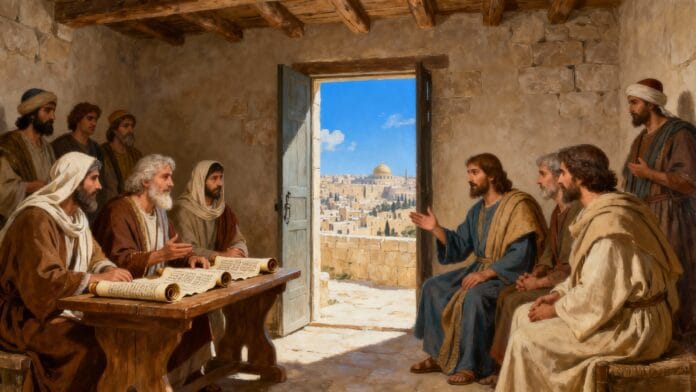
1° The title and subject of the book. — Very ancient testimonies attest to this (see Saint Irenaeus, Against Heresies, 5, 13; Clement of Alex., Stromata, 5.12; Tertullian, of Baptism, 10, etc.), the book of Acts of the Apostles, the writing whose study we are undertaking, has always been called Πράξεις ἀποστόλων (a reading much better guaranteed than Πράξεις τῶν ἀποστόλων, with the article); in Latin, Acta, or, more commonly, Actus apostolorum. Which is to say: History of the Apostles. But this name must be taken in a rather broad sense, because the Book of Acts is far from recounting in a complete and detailed way the missionary activity of each of the twelve apostles. While it begins by citing their list (cf. 1:13), and while it then mentions them collectively from time to time (see 2:14, 37, 42-43; 4:33-37; 5:2, 12, 18, 29; 6:6; 8:6, 14, 18, etc.), it only returns to six of them by name, including Saint Paul: Saint Peter and Saint Paul, Saint John, Saint James the Major, Saint James The Minor and Judas; indeed, it is Saint Peter and Saint Paul with whom he is primarily concerned. It is impossible to say whether the title originated with the author of the book himself, or whether it was added later. It is certain, at least, that it is as old as the collection of the New Testament canon [the canon is the official Catholic list of divinely inspired books].
The narrative in the Acts of the Apostles is very closely linked to that of the Gospels, especially the...’Gospel according to Saint Luke, of which it presents itself from its very first lines as a continuation (see 1:1, where the third Gospel is called πρῶτος λὁγος, the first treatise; it is therefore a δεύτερος λογός, or second treatise, that we have here. Compare also Acts of the Apostles 1:2–12, and Luke 24:50 ff. Both writings are also dedicated to the same person, Theophilus). It opens with the ascension of Our Lord Jesus Christ and the descent of the Holy Spirit upon the group of faithful souls who formed the nascent Church; then it sets forth the history of the early development of this society, this Church, which the Savior had come to found for the salvation of the world. However, the sacred writer, not wanting to recount everything, made a selection among the events, in the manner of the evangelists: he glosses over some points, he passes over others entirely in silence, and on the contrary, he dwells at length on several. In chapters 1-12, the episodes are grouped around Saint Peter (see 1:15 ff.; 2:14 ff., 38; 3:4 ff., 12 ff.; 4:8 ff.; 5:3, 29 ff.; 8:19 ff.; 9:32 ff.; 10:5, 6, 34 ff.; 11:4 ff.; 12:3 ff.); chapters Pages 13-28 are devoted almost exclusively to Saint Paul, whose apostolic journeys are described at considerable length. Nothing could be more natural, moreover, than this preponderant role given to the two apostles who played a part, one by virtue of his primacy (Saint Peter was the first). popeThe other, through his ardent activity among the Gentiles, played a pivotal role in the history of the establishment of the Church. The Book of Acts ends abruptly, after recounting the arrival of Saint Paul in Rome as a prisoner and the beginning of his captivity. It has sometimes been concluded from this that Saint Luke intended to write a third volume (τρίτος λογός), in which he would have continued the story of the apostles; but this is merely conjecture. It is better to say that the author stops there because he had achieved his goal. And it was certainly a great thing to have shown the Gospel, after its humble beginnings in Jerusalem and Palestine, arriving in the capital of the world, having conquered many provinces of the empire, and recruiting countless adherents among both Gentiles and Jews.
It has been quite rightly said that this entire book is summarized in the words addressed by Jesus Christ to his apostles at the time of his ascension: «You will be my witnesses in Jerusalem, and in all Judea and Samaria, and to the ends of the earth» (1:8b). We will observe this progress at every step (First stage: the Church in Jerusalem, 1:1–8:3. Second stage: the Church in Judea and Samaria, 8:4–11:18. Third stage: the Church in Antioch of Syria, 11, 19 – 13, 35. Fourth stage: the Church in the pagan world and in Rome, 13, 1 – 28, 31).
The events recounted span a little over thirty years (30 to 63 AD).
2° The plan and the division The Book of Acts has been implicitly indicated in the preceding lines. It comprises two parts: the Acts of Saint Peter, chapters 1-12, and the Acts of Saint Paul, chapters 13-28 (some exegetes adopt three or four parts; but this amounts to the same thing, as everyone agrees on the main subdivisions, so clearly are they marked). The first, which recounts the birth of the Church in Jerusalem and the beginnings of its spread, both among the Jews and in the pagan world, contains two sections: 1) the origins of the Christianity in Jerusalem, 1, 1 – 8, 3; 2° the preparation and the beginning of its dissemination among the Gentiles, 8, 4 – 12, 25. The second, which describes the missions and the captivity of Saint Paul, contains four: 1° the first apostolic journey of Paul and the Council of Jerusalem, 13, 1 – 15, 35; 2° the second journey of the apostle to the Gentiles, 15, 36 - 18, 22; 3° his third journey, 18, 23 – 21, 16; 4° his captivity in Caesarea and Rome, 21, 17 – 28, 31.
3° The author of the Acts of the Apostles. — With the exception of a few heretical sects, which rejected in whole or in part the teaching of Saint Paul, and which thereby more or less denied the authenticity of the Book of Acts, notably the Ebionites (see Saint Epiphanius, Haer., 30, 3, 6), the disciples of Marcion (Tertull., adv. Marc., 5, 2) and the Manicheans (Saint Aug., letter, (237, 2), early Christian thought always of this writing as canonical and unanimously attributed it to Saint Luke. The Apostolic Fathers quote quite a few passages from it or allude to it as part of Holy Scripture (among others, Saint Clement of Rome, Saint Polycarp, Saint Justin Martyr). From the end of the second century, the Muratorian Canon (the Acts are listed after the Gospels), Saint Irenaeus (Adv. Hær., 3, 14), Tertullian (From Jejun., 10; of Prescript., 22, etc.), Clement of Alexandria (Stromata, 5, 2) and Origen (Adv. Cels, 6, 12) formally mention Saint Luke as the author, and all subsequent testimonies of the Fathers and early ecclesiastical writers conform to this tradition, which the Church has only confirmed through its official decrees (for example, in the Council of Trent and in the 1er Vatican Council: «Vatican I»).
This same tradition finds further excellent support in what we now call internal or intrinsic evidence, that is, in the very content and form of the Book of Acts. Indeed, the following propositions can be demonstrated successively: 1. This work is remarkable for its unity of plan, thought, and style; it can therefore only have been composed by one and the same author (Baur and the famous "Tübingen school" have admirably contributed to highlighting this fact); 2. The author is so familiar with the ideas and literary style of Saint Paul that he can only be one of the disciples of the great Apostle; 3. The various passages in which he speaks in the first-person plural demonstrate beyond any doubt that he was on several occasions a traveling companion of Saint Paul. These passages number four: 16:10-17; 20:5-15; 21:1-18; 27:1–28:16. They are remarkable for their liveliness, the freshness of the narrative, and for numerous details that could only come from an eyewitness. Their style is entirely similar to that of the rest of the book, and there is no doubt that the whole was composed by a single author. 4. Saint Luke is the author of these passages and also of the entire book.
Finally, let us recall that the Acts of the Apostles, as mentioned above, openly present themselves as the work of the third of our evangelists; an assertion whose truth is so well demonstrated by the identity of the style of the two writings, that it is hardly the object of doubt even among the rationalists themselves.
4° The time and place of composition. — The Book of Acts was certainly written before the destruction of Jerusalem (70 AD). Indeed, not only does it make no mention whatsoever of this terrible event, but it speaks of the temple, worship, sacrifices, synagogues—in short, Jewish things—as still existing in their normal state in the capital of Israel. Many Catholic and Protestant commentators also admit that the composition predates the death of Saint Paul, and that it took place, as Saint Jerome already believed (De Vir. Illustr., 7), after the two years of captivity mentioned in the last lines of the narrative (28:30–31), therefore, around the year 63. In this case, Saint Luke would have written it in Rome itself (he had accompanied Saint Paul there, according to 28:16). Nothing more can be said about the place of composition.
5° The sources of the Book of Acts. — At the beginning of his Gospel, 1:1-4, Saint Luke himself provides us with some details on this point: he carefully sought out documents, he tells us. It will never be possible to demonstrate that the Book of Acts is merely a compilation, produced gradually by various revisers and editors with opposing views. Let us, however, make a distinction.
For chapters 1-12, which recount events that Saint Luke did not witness, he had at his disposal either the rich treasury of early Church traditions, or the accounts of eyewitnesses, or a number of written documents.
For chapters 13-28, he most often only had to refer to his personal recollections, to those of the other disciples of Saint Paul, to those of Saint Paul himself, which — several passages of his letters attest to this (cf. Romans 15, (16-32; 2 Corinthians 1:8-10; Galatians 1:11-2:14; Philippians 2:3-7, etc.), — in his private conversations, he readily recounted the various episodes of his life. This is all that can be said with certainty, and it is sufficient for us to trust the author of Acts entirely (see what will be said below, in point 7, regarding its perfect veracity).
6° The goal The aim of Saint Luke in writing this second book was the same as for his first book, the Gospel (cf. Luke 1:4): it was, therefore, once again, to confirm in the Christian faith, first and foremost Theophilus, the immediate recipient of the two volumes (cf. Luke 1:3 and Acts 1:1), and then all other readers. Now, after the account of the life, death, and the resurrection of Our Lord Jesus Christ, nothing could better demonstrate the divinity of Christianity that the wonderful story of its rapid development throughout the Jewish and pagan worlds despite obstacles of all kinds.
On this question, as on the previous one, rationalist criticism has gone strangely astray, attributing to the author of our book, who supposedly lived only in the first half of the second century, views and tendencies that exist only in certain modern or contemporary minds. Assuming, as the basis for these various theories, that the nascent Church was plagued by serious internal divisions caused by two rival factions, one based on Saint Peter and the other on Saint Paul, it has been claimed, sometimes, that the historian intended to present to the "Petrinians" an apology for Saint Paul, of whom he was an enthusiastic disciple; sometimes that he defended Saint Peter against the "Pauline" faction; and sometimes that he composed a kind of...«eirenikon intended to bring back peace between the two hostile parties. In any case, he would have arranged, transformed, or even positively invented the facts so that they would harmonize with his goal. But this, regardless of the existence of the Judaizing party, is nothing but pure and simple imagination: a study of the book suffices to demonstrate this. Moreover, even within the rationalist camp, these theories have found ardent opponents, so that, from this point of view as well, our book has emerged unscathed from the fire of criticism.
7° The historical value of the Book of Acts It is perfect, and has often been admired, even by exegetes who believe neither in its authenticity nor in its inspiration. "A work of inestimable value as a historical text"; "the ideal of ecclesiastical history," they say. Without it, apart from a few scattered details in the letters of Saint Paul, in Catholic letters, and in the rare fragments that remain from the earliest ecclesiastical writers, we would know nothing of the origin of the Church.
Moreover, the author of Acts was perfectly informed about everything he recounts. Of all the books of Scripture, none has such a vast and unfamiliar scope for the Jews. Saint Luke leads us into Syria, In Cyprus, Asia Minor, Greece, and Italy, his account is full of allusions to the history, customs, traditions, and religion of the peoples who inhabited these diverse regions, even to the navigational practices of his time. He moves with the greatest ease amidst such varied subjects and a wealth of detail, describing people, places, and events with an accuracy that only an intelligent, attentive, educated, and conscientious eyewitness can possess. Whenever it is possible to verify his narrative with secular sources—and this often occurs—the evidence is entirely in his favor. This is all the more remarkable because, in these diverse areas, there was ample room for error, while no ancient work provides such numerous proofs of veracity.
8° The principal Catholic commentaries are, in antiquity, those of Saint John Chrysostom, Oecumenius, Theophylact and Bede the Venerable and in modern times, those of Lorin (1605), Salmeron (1614) and Sanchez (1616).
Act 1
1 Théophile, in my first book, I recounted the entire series of actions and teachings of Jesus, 2 until the day when, after giving instructions through the Holy Spirit to the Apostles whom he had chosen, he was taken up into heaven. 3 To them also, after his suffering, he showed himself full of life, giving them many proofs, appearing to them for forty days and speaking to them about the kingdom of God. 4 One day, while he was at table with them, he advised them not to leave Jerusalem, but to wait for what the Father had promised, "which," he told them, "you have heard from my own mouth, 5 For John baptized with water, but in a few days you will be baptized with the Holy Spirit.» 6 So they gathered together and asked him, «Lord, has the time come when you will restore the kingdom of Israel?» 7 He answered them, «It is not for you to know the times or dates the Father has set by his own authority. 8 But when the Holy Spirit comes upon you, you will be clothed with power, and you will testify about me in Jerusalem, and in all Judea and Samaria, and to the ends of the earth.» 9 After he had spoken thus, he was lifted up in their presence and a cloud hid him from their sight. 10 And as they gazed intently up into the sky while he was moving away, suddenly two men dressed in white appeared beside them, 11 And they said, «Men of Galilee, why do you stand looking into the sky? This same Jesus, who was taken from you into heaven, will come back in the same way as you saw him go into heaven.» 12 They returned to Jerusalem from the mountain called Olivet, which is near Jerusalem, a Sabbath day's journey away. 13 When they arrived, they went up into the upper room, where they were usually sitting: they were Peter and John, James and Andrew, Philip and Thomas, Bartholomew and Matthew, James son of Alphaeus and Simon the Zealot and Judas, brother of James. 14 All of them, with one accord, persevered in prayer, along with some women and Married, mother of Jesus and his brothers.15 In those days, Peter stood up among the brothers, who were gathered together in numbers of about one hundred and twenty, and said to them: 16 «My brothers, the Scripture had to be fulfilled which the Holy Spirit spoke through David concerning Judas, the leader of those who arrested Jesus, 17 because he was one of us and he shared in our ministry. 18 This man acquired a field with the reward for his crime and, having rushed forward, broke in the middle and all his entrails spilled out. 19 This fact is so well known to all the inhabitants of Jerusalem, that this field has been named in their language Hakeldama, that is to say, field of blood. 20 It is written, in fact, in the Book of Psalms Let his dwelling become deserted and let no one inhabit it. And furthermore: Let another take his office. 21 Therefore, it is necessary that, among the men who have accompanied us throughout the time that the Lord Jesus lived with us, 22 From the baptism of John until the day he was taken up from us, one of them must become with us a witness to his resurrection.» 23 They presented two: Joseph, called Barsabbas and nicknamed the righteous, and Matthias. 24 And they began to pray, saying, «Lord, you who know the hearts of all, show me which of these two you have chosen.” 25 to occupy, in this ministry of the apostleship, the place that Judas vacated through his crime when he went to his own place.» 26 Their names were drawn by lot and the lot fell on Matthias, who was associated with the eleven Apostles.
Act 2
1 When the day of Pentecost arrived, they were all together in one place. 2 Suddenly a sound like the blowing of a strong wind came from heaven and filled the whole house where they were sitting. 3 And they saw what seemed to be tongues of fire that separated and came to rest on each of them. 4 They were all filled with the Holy Spirit and began to speak in other tongues as the Holy Spirit enabled them. 5 Now, among the Jews residing in Jerusalem, there were devout men from every nation under heaven. 6 At the sound that was heard, they came running in a crowd and were quite beside themselves, because each one heard them speaking their own language. 7 Surprised and astonished, they said, "Aren't all these people who are speaking Galileans?" 8 How is it that we hear them each speaking in their native language? 9 All of us, Parthians, Medes, Elamites, inhabitants of Mesopotamia, Judea and Cappadocia, Pontus and Asia, 10 from Phrygia and Pamphylia, from Egypt and the regions of Libya near Cyrene, Romans passing through here, 11 Whether Jews or proselytes, Cretans and Arabs, we hear them proclaiming the wonders of God in our own languages.» 12 They were all astonished and, not knowing what to think, they said to each other, "What could it possibly be?"« 13 Others mockingly said, "They are full of new wine."« 14 Then Peter, standing up with the Eleven, raised his voice and said to them, «Jews and all of you who live in Jerusalem, let me explain this to you and listen carefully to what I say: 15 These men are not drunk, as you suppose, because it is the third hour of the day. 16 What you see is what was foretold by the prophet Joel: 17 «In the last days,” says the Lord, “I will pour out my Spirit on all people. Your sons and daughters will prophesy, your young men will see visions, and your old men will dream dreams.”. 18 Yes, in those days I will pour out my Spirit on my servants, both men and women, and they will prophesy. 19 And I will show wonders in the heavens above and signs on the earth below: blood, fire, and swirling smoke, 20 The sun will turn into darkness and the moon into blood, before the coming of the great and glorious day of the Lord. 21 And whoever calls on the name of the Lord will be saved. 22 Children of Israel, listen to these words: Jesus of Nazareth, a man to whom God bore witness for you by miracles, miracles and the signs which he performed through him in your midst, as you yourselves know, 23 This man was handed over according to God’s unchanging plan and foreknowledge, and you crucified him and put him to death by the hands of lawless men. 24 God raised him from the dead, freeing him from the pains of death, because it was not possible for him to be held by it. 25 For David said of him, «I kept the Lord always before me, because he is at my right hand, so that I would not be shaken. 26 That's why my heart is in joy and my tongue will rejoice, and my body also will rest in hope, 27 for you will not leave my soul in the realm of the dead, nor will you allow your Holy One to see corruption. 28 You have shown me the paths of life, and you will fill me with joy by showing me your face.» 29 My brothers, let me tell you frankly about the patriarch David, that he died, that he was buried, and that his tomb is still among us today. 30 Because he was a prophet and knew that God had sworn to him to place a son of his own blood on his throne, 31 It is the resurrection of Christ, whom he foresaw, saying that his soul would not be left in the realm of the dead, nor would his flesh see corruption. 32 This is the Jesus whom God resurrected, we are all witnesses to it. 33 And now that he has been taken up to heaven at the right hand of God and has received from the Father the promise of the Holy Spirit, he has poured out this Spirit which you see and hear. 34 For David did not ascend into heaven, but he himself said, «The Lord said to my Lord, ‘Sit at my right hand,’”, 35 until I make your enemies a footstool for your feet.» 36 Therefore let all the house of Israel know assuredly that God has made this Jesus, whom you crucified, both Lord and Christ.» 37 Their hearts pierced by this speech, they said to Peter and the other apostles, «Brothers, what shall we do?» 38 Peter answered them, «Repent and be baptized, every one of you, in the name of Jesus Christ to obtain forgiveness for your sins and you will receive the gift of the Holy Spirit. 39 For the promise is for you, for your children, and for all who are far off—for all whom the Lord our God will call.» 40 And with many other words he urged and exhorted them, saying, «Save yourselves from the midst of this perverse generation.» 41 Those who received Peter's message were baptized, and that day about three thousand people were added to their number. 42 They devoted themselves to the preaching of the Apostles, to the common meetings, to the breaking of bread, and to prayer. 43 And fear was in every soul, and many wonders and miracles were performed by the Apostles. 44 All those who believed lived together and had everything in common. 45 They sold their lands and possessions and shared the proceeds among everyone, according to each person's needs. 46 Every day, all together, they attended the temple and, breaking their bread in their homes, they ate their food with joy and simplicity., 47 praising God and having the favor of all the people. And the Lord added daily to the number of those who were in the way of salvation.
Act 3
1 Peter and John went up together to the temple for the ninth hour prayer. 2 Now, there was a man, lame from birth, who was carried around. He was placed every day near the temple gate, called the Beautiful Gate, so that he could ask for alms from those who entered the temple. 3 This man, having seen Peter and John about to enter, asked them for alms. 4 Peter and John both stared at him and said, "Look at us."« 5 He looked at them attentively, expecting to receive something from them. 6 But Peter said to him, «I have neither gold nor silver, but what I do have I give you: In the name of Jesus Christ of Nazareth, rise up and walk.» 7 And taking him by the hand, he helped him to his feet. At that very moment, his legs and feet became firm, 8 He leaped to his feet and began to walk. Then he entered with them into the temple, walking, jumping, and praising God. 9 All the people saw him walking and praising God. 10 And recognizing that it was the very same man who used to sit at the Beautiful Gate of the temple asking for alms, they were astonished and beside themselves at what had happened to him. 11 As he did not leave Peter and John, all the astonished people ran towards them, to the portico called Solomon's. 12 Seeing this, Peter said to the people, «Children of Israel, why are you amazed at this? And why do you stare at us as though by our own power or piety we had made this man walk? 13 The God of Abraham, Isaac and Jacob, the God of your fathers, has glorified his servant Jesus, whom you handed over and denied before Pilate, even though he had decided to release him. 14 You have denied the Holy and the Just and have sought mercy for a murderer. 15 You killed the Author of life, whom God raised from the dead, and we are witnesses of this. 16 It is because of the faith received from him that his name has strengthened the man whom you see and know; it is the faith that comes from him that has worked this perfect healing before all of you. 17 I know, brothers, that you acted in ignorance, as did your leaders. 18 But in this way God fulfilled what he had foretold through all the prophets, that his Christ would suffer. 19 Repent, then, and turn to God, so that your sins may be wiped out., 20 so that times of refreshing may come from the Lord, and that he may send the one appointed for you, Jesus Christ, 21 that heaven must receive until the days of the restoration of all things, days which God spoke of long ago through the mouth of his holy prophets. 22 Moses said, "The Lord your God will raise up for you a prophet like me from among your brothers; you shall listen to him in everything he tells you. 23 And whoever does not listen to this prophet will be cut off from the people.» 24 All the prophets who have spoken since Samuel have also foretold these days. 25 You are the children of the prophets and of the covenant that God made with your fathers when he said to Abraham, «Through your offspring all nations on earth will be blessed.» 26 It is to you first that God, having raised up his Son, sent him to bless you, when each of you turns away from your iniquities.
Act 4
1 While Peter and John were speaking to the people, the priests, the captain of the temple guard, and the Sadducees arrived., 2 dissatisfied with what they were teaching the people and proclaiming in the person of Jesus the resurrection deaths. 3 They seized them and threw them into prison until the next day, because it was already evening. 4 However, many of those who had heard this speech believed, and the number of men rose to about five thousand. 5 The next day, their leaders, the Elders and the Scribes, assembled in Jerusalem, 6 with Annas, the high priest, Caiaphas, John, Alexander and all those who were of the papal family. 7 And having brought the Apostles before them, they asked them, «By what power or in whose name did you do this?» 8 Then Peter, filled with the Holy Spirit, said to them: 9 «Leaders of the people and elders of Israel: if we are asked today about a good deed done to a disabled person, how this man was healed, 10 Know this well, all of you and all the people of Israel: It is by the name of Jesus Christ of Nazareth, whom you crucified and whom God raised from the dead, it is by him that this man stands before you fully healed. 11 This Jesus is the stone that you rejected from the building and which has become the cornerstone. 12 And salvation is found in no one else, for there is no other name under heaven given to mankind by which we must be saved.» 13 When they saw the boldness of Peter and John, knowing that they were uneducated, ordinary men, they were astonished, and at the same time recognized them as having been with Jesus. 14 But, as they saw the man who had been healed standing near them, they had nothing to reply. 15 Having brought them out of the Sanhedrin, they began to deliberate among themselves, saying: 16 «What shall we do to these men? That they have performed a remarkable miracle is evident to all the inhabitants of Jerusalem, and we cannot deny it. 17 But to prevent this matter from spreading further among the people, let us forbid them, with threats, from speaking in that name to anyone whatsoever.» 18 And having summoned them, they absolutely forbade them to speak or teach in the name of Jesus. 19Peter and John answered them, «Judge for yourselves whether it is right in God’s sight to obey you rather than God. 20 For us, we cannot remain silent about what we have seen and heard.» 21 So they threatened them and released them, not knowing how to punish them because of the people, since everyone was glorifying God for all that had just happened. 22 For the man who had been healed in such a miraculous way was over forty years old. 23 Once freed, they went to their brothers and told them everything that the Princes of the priests and the Elders had told them. 24 When the brothers heard this, they all raised their voices to God, saying, «Sovereign Lord, you are the one who made the heavens and the earth and the sea and everything in them. 25 It is you who said [by the Holy Spirit], through the mouth of [our father] David, your servant: «Why did the nations tremble and the peoples form vain plots? 26 The kings of the earth have risen up, the princes have conspired against the Lord and against his Christ.» 27 Truly, in this city, Herod and Pontius Pilate, together with the Gentiles and the peoples of Israel, have conspired against your holy servant, Jesus, whom you have anointed., 28 to do what your hand and your advice had decided in advance. 29 And now, Lord, consider their threats and grant to your servants to proclaim your word with full boldness, 30 by stretching out your hand so that healings, miracles, and wonders may be performed, through the name of your holy servant Jesus.» 31 When they had prayed, the place where they were meeting was shaken. They were all filled with the Holy Spirit and spoke the word of God boldly. 32 The multitude of the faithful had but one heart and one soul; no one called what he possessed his own, but everything was held in common among them. 33With great strength the apostles bore witness to the resurrection of the Savior Jesus and great grace was upon them all 34 for there was no one needy among them: all those who owned land or houses sold them 35and brought the prize money to the feet of the Apostles, and it was then distributed to each person according to their needs. 36 A Levite from Cyprus, Joseph, nicknamed Barnabas by the apostles, which translates as Son of Consolation, 37 He owned a field, sold it, brought the money and laid it at the feet of the Apostles.
Act 5
1 But a man named Ananias, along with his wife Sapphire, sold a property, 2 and having, in concert with her, retained some of the prize money, he brought the rest and laid it at the feet of the Apostles. 3 Peter said to him, «Ananias, why has Satan filled your heart to lie to the Holy Spirit and to keep back some of the price of this field? 4 Couldn't you have kept it without selling it, and after selling it, weren't you still in control of the money? How could you have conceived such a plan? You haven't lied to men, but to God.» 5 Upon hearing these words, Ananias fell down and died, and all who heard of it were filled with great fear. 6 The young men got up, wrapped the body, and carried it away to be buried. 7 About three hours later, Ananie's wife came in, not knowing what had happened. 8 Pierre asked her, "Tell me, is this the price you sold your field for?" "Yes," she replied, "that's the price."« 9 Then Peter said to him, «How could you agree to test the Spirit of the Lord? Look, the feet of the young men who buried your husband are striking the threshold; they are going to bury you also.» 10 At that very moment, she fell at the Apostle's feet and died. The young men entered and found her dead; they carried her out and buried her beside her husband. 11 Great fear spread throughout the church and among all who learned of this event. 12 Many miracles and wonders were performed among the people by the hands of the apostles. And they were all together in Solomon's Portico, 13 No one else dared to join them, but the people praised them highly. 14 Each day saw an increase in the number of men and women who believed in the Lord, 15 so that we brought the sick in the streets and they were placed on beds or mats, so that when Peter passed by, at least his shadow would cover some of them. 16 People came in droves from the neighboring towns to Jerusalem, bringing sick people and those tormented by unclean spirits, and all were healed. 17 Then the high priest and all those who were with him, namely the party of the Sadducees, rose up, filled with jealousy. 18 and having arrested the Apostles, they threw them into a prison public. 19 But an angel of the Lord, having opened the gates of the night prison, made them leave, saying: 20 «Go, stand in the temple and proclaim to the people all these words of life.» 21 Having heard this, they went into the temple early in the morning and began to teach. Meanwhile, the high priest and all those with him gathered together, assembled the council and all the elders of the children of Israel, and they sent to the prison search for the Apostles. 22 The guards went and, not having found them in the prison, They returned and gave their report, saying: 23 «We found the prison The doors were carefully locked and the guards were standing guard, but after opening them, we found no one inside.» 24 When the high priest, the commander of the temple, and the chief priests heard these words, they were greatly perplexed about the prisoners, not knowing what they could be.25 At that moment someone came and said to them, «Those that you had put in prison, There they are in the temple, teaching the people.» 26 The commander immediately surrendered with his men and brought them in without using violence, because they feared being stoned by the people. 27 Having brought them in, they presented them before the Sanhedrin, and the high priest questioned them, saying: 28 «We expressly forbade you to teach that name, and yet you have filled Jerusalem with your doctrine and now you want to bring this man’s blood upon us.» 29 Peter and the Apostles replied: "We must obey God rather than men. 30 The God of our fathers raised Jesus from the dead, whom you had killed by hanging him on a tree. 31 God exalted him to his right hand as Prince and Savior, to give repentance to Israel and forgiveness sins. 32 And we are witnesses of these things, along with the Holy Spirit whom God has given to those who obey him.» 33 Exasperated by what they had just heard, the council members were of the opinion that they should be put to death. 34 But a Pharisee named Gamaliel, a teacher of the law, revered by all the people, stood up in the Sanhedrin and ordered that the Apostles be put outside for a moment, 35 He said, «Children of Israel, be careful what you do to these men. 36 For not long ago Theodas appeared, who presented himself as a personage, and about four hundred men attached themselves to him: he was killed and all those who had followed him were scattered and reduced to nothing. 37 After him arose Judas the Galilean, at the time of the census, and he attracted people to his party: he too perished, and all his followers were scattered. 38 Here is my advice to you: Pay no more attention to these people and let them go. If this idea or this work originates from men, it will destroy itself., 39 But if it comes from God, you cannot destroy it. Do not risk having fought against God himself.» 40 They gave in to his opinion and having called the Apostles back, they had them flogged, then they forbade them to speak in the name of Jesus and released them. 41 The Apostles left the Sanhedrin, rejoicing that they had been judged worthy to suffer disgrace for the name of Jesus. 42 And every day, in the temple and from house to house, they did not cease to proclaim Jesus as the Christ.
Acts 6
1 In those days, as the number of disciples increased, the Hellenists raised complaints against the Hebrews, because their widows were neglected in the daily care. 2 Then the Twelve, having gathered together the multitude of disciples, said to them, «It is not fitting that we should neglect the word of God in order to wait on tables. 3 Therefore, brothers, choose from among you seven men of good reputation, full of the Holy Spirit and wisdom, to whom we may entrust this office, 4 And we will devote ourselves entirely to prayer and to the ministry of the word.» 5 This speech pleased the whole assembly and they elected Stephen, a man full of faith and of the Holy Spirit, Philip, Prochorus, Nicanor, Timon, Parmenas and Nicolas, a proselyte from Antioch. 6 They were presented to the apostles, and after praying, the apostles laid their hands on them. 7 The word of God spread more and more, the number of disciples increased greatly in Jerusalem, and a multitude of priests became obedient to the faith. 8 Stephen, full of grace and power, performed wonders and great miracles among the people. 9 Some members of the synagogue known as the Synagogue of the Freedmen and of the Synagogue of the Cyrenians and Alexandrians, along with Jews from Cilicia and Asia, came to argue with him, 10 but they could not resist the wisdom and the Spirit with which he spoke. 11 So they bribed some people who said, "We heard him utter blasphemous words against Moses and against God."« 12 They thus roused the people, the Elders and the scribes and together they rushed upon him, seized him and dragged him to the Sanhedrin. 13 And they produced false witnesses, who said, «This man never stops speaking against the holy place and against the Law. 14 For we have heard him say that Jesus, this Nazarene, will destroy this place and change the institutions that Moses gave us.» 15 As all those who sat in the council had their eyes fixed on Stephen, his face appeared to them like that of an angel.
Acts 7
1 The high priest asked him, "Is that really the case?"« 2Stephen replied, «My brothers and fathers, listen. The God of glory appeared to our father Abraham while he was still in Mesopotamia, before he came to live in Haran, 3 and said to him, «Leave your country and your family and go to the land I will show you.» 4 So he left the land of the Chaldeans and settled in Haran. From there, after the death of his father, God caused him to emigrate to this land where you now live. 5 And he gave him no property in that country, not even a place to set foot, but he promised him, at a time when the patriarch had no children, to give possession of it to him and his posterity after him. 6 God spoke thus: «His descendants will dwell in foreign lands, and they will be enslaved and mistreated for four hundred years. 7 »But I will judge the nation that held them in slavery,” says the Lord. “After that, they will come out and serve me in this place.” 8 Then he gave Abraham the covenant of circumcision, and so Abraham, after fathering Isaac, circumcised him on the eighth day. Isaac fathered and circumcised Jacob and Jacob, the twelve patriarchs. 9 Driven by jealousy, the patriarchs sold Joseph to be taken to Egypt. But God was with him., 10 and he delivered him from all his trials and gave him grace and wisdom before Pharaoh, king of Egypt, who put him at the head of Egypt and of all his house. 11 Now a famine struck all the land of Egypt and Canaan. The distress was great, and our ancestors could find nothing to eat. 12 Jacob, having learned that there was food in Egypt, sent our fathers there for the first time. 13 And the second time, Joseph was recognized by his brothers and Pharaoh knew what his origin was. 14 Then Joseph sent for his father Jacob and all his family, consisting of seventy-five people. 15 And Jacob went down to Egypt, where he died, as did our fathers. 16 And they were carried to Shechem and placed in the tomb that Abraham had bought with money from the sons of Hamor in Shechem. 17 As the time drew near for the fulfillment of the promise God had sworn to Abraham, the people increased and multiplied in Egypt, 18 until another king appeared in that country who had not known Joseph. 19 This king, using trickery against our race, mistreated our fathers, to the point of making them expose their children so that they would not live. 20 At that time Moses was born, who was beautiful in the sight of God; he was nursed for three months in his father’s house. 21 And when he had been exposed, Pharaoh's daughter took him in and raised him as her son. 22 Moses was instructed in all the wisdom of the Egyptians, and he was powerful in word and deed. 23 When he reached the age of forty, it came to him to visit his brothers, the children of Israel. 24 He saw one being insulted, and taking up his defense, he avenged the oppressed by killing the Egyptian. 25 He thought that his brothers would understand that God was granting them deliverance through his hand, but they did not understand. 26 The following day, having encountered two who were fighting, he urged them to peace saying, "Men, you are brothers: why mistreat one another?"« 27 But the one who was mistreating his neighbor rejected him, saying, «Who made you a leader and judge over us?” 28 "Do you want to kill me, like you killed the Egyptian yesterday?"» 29 At this word, Moses fled and went to live in the land of Midian, where he fathered two sons. 30 Forty years later, in the desert of Mount Sinai, an angel appeared to him in the flame of a burning bush. 31 At this sight, Moses was filled with amazement, and as he approached to examine it, the voice of the Lord spoke to him: 32 «"I am the God of your fathers, the God of Abraham, Isaac, and Jacob." And Moses, trembling, did not dare to look. 33 Then the Lord said to him, «Take off your sandals, for the place where you are walking is holy ground. 34 »I have seen the affliction of my people in Egypt, I have heard their groaning, and I have come down to deliver them. Now come, and I will send you to Egypt.” 35 This is the Moses whom they had denied, saying, "Who appointed you ruler and judge?" This is the one whom God sent as ruler and deliverer, with the assistance of the angel who appeared to him in the bush. 36 It was he who brought them out, performing wonders and miracles in the land of Egypt, in the Red Sea, and in the desert for forty years. 37 This is the Moses who said to the children of Israel: "God will raise up for you a prophet like me from among your brothers [listen to him]."« 38 It was he who, in the midst of the assembly, in the desert, with the angel who spoke to him on Mount Sinai, and with our fathers, received living oracles to transmit to us. 39 Our fathers, far from wanting to obey him, rejected him and, returning in their hearts to Egypt, 40 They said to Aaron, "Make us gods who will go before us, for as for this Moses who brought us out of the land of Egypt, we do not know what has become of him."« 41 They then made a golden calf and offered a sacrifice to the idol and rejoiced in the work of their hands. 42 But God turned away and gave them over to the worship of the army of heaven, as it is written in the book of the Prophets: «Did you offer me sacrifices and offerings for forty years in the wilderness, O house of Israel? 43 You have carried the tent of Moloch and the star of your god Raiphan, these images that you made to worship. Therefore, I will carry you off beyond Babylon.» 44 Our fathers in the desert had the tabernacle of the testimony, as commanded by the one who told Moses to build it according to the pattern he had seen. 45 Having received it from Moses, our fathers brought it, under the leadership of Joshua, when they conquered the land from the nations that God drove out before them, and it remained there until the days of David. 46 This king found favor with God and asked to build a dwelling place for the God of Jacob. 47 Nevertheless, it was Solomon who built him a temple. 48 But the Most High does not dwell in temples made by human hands, according to the word of the prophet: 49 «Heaven is my throne and the earth is my footstool. What dwelling place will you build for me, says the Lord, or what will be the place of my rest?” 50 "Wasn't it my hand that did all these things?"» 51 You stubborn men, uncircumcised in heart and ears, you always resist the Holy Spirit, as were your fathers, so are you. 52What prophet did your ancestors not persecute? They even killed those who foretold the coming of the Righteous One, and today you have betrayed him and put him to death. 53 You who received the Law, in consideration of the angels who commanded you, and you did not keep it.» 54 Upon hearing these words, rage tore at their hearts and they gnashed their teeth at him. 55 But Stephen, who was filled with the Holy Spirit, looked up to heaven and saw the glory of God, and Jesus standing at the right hand of his Father. 56 And he said, «Look, I see the heavens opened and the Son of Man standing at the right hand of God.» 57 The Jews then shouted loudly, covering their ears, and all rushed at him together. 58 And having led him out of the city, they stoned him. The witnesses laid their garments at the feet of a young man named Saul. 59 While they were stoning him, Stephen prayed, saying, «Lord Jesus, receive my spirit.» 60 Then, kneeling down, he cried out in a loud voice, «Lord, do not hold this sin against them.» After saying this, he fell asleep [in the Lord]. Now Saul had approved of Stephen’s murder.
Acts 8
1 On the same day, a violent persecution broke out against the Church in Jerusalem and all except the apostles were scattered throughout the countryside of Judea and Samaria. 2 Pious men buried Stephen and mourned greatly over him. 3 And Saul ravaged the church, entering houses, dragging men out and women and made them throw in prison. 4Those who were scattered went throughout the land proclaiming the word. 5 Philip went down to a city in Samaria and preached Christ there. 6 And the crowds listened attentively to what Philip said, as they learned and saw miracles that he was doing. 7 For unclean spirits, crying out with loud voices, came out of many who were possessed; many who were paralyzed or lame were also healed., 8 And there was great joy in that city. 9 But there was already a man there named Simon, who practiced magic and amazed the people of Samaria, presenting himself as a great personage. 10 Everyone, young and old, had become attached to him. This man, they said, is the Virtue of God, the one that is called the Great. 11 They were therefore attached to him because, for a long time, he had seduced them with his enchantments. 12 But when they believed Philip, who proclaimed to them the kingdom of God and the name of Jesus Christ, they were baptized, both men and women. 13 Simon himself believed and, having been baptized, he attached himself to Philip and miracles and the great wonders he witnessed filled him with amazement. 14 The Apostles, who were in Jerusalem, having heard that Samaria had received the word of God, sent Peter and John there. 15 When they arrived at the Samaritans' house, they prayed for them, that they might receive the Holy Spirit. 16 For he had not yet come down on any of them; they had only been baptized in the name of the Lord Jesus. 17 Then Peter and John laid their hands on them, and they received the Holy Spirit. 18 When Simon saw that the Holy Spirit was given through the laying on of hands by the Apostles, he offered them money, 19 saying, «Give me this power also, so that everyone on whom I lay my hands may receive the Holy Spirit.» 20 But Peter said to him, «May your money perish with you, because you thought that the gift of God could be obtained with money. 21 You have absolutely no part in this favor, because your heart is not pure before God. 22 Therefore, repent of your iniquity and pray to the Lord to forgive you, if possible, the thought of your heart. 23 For I see that you are in bitter gall and in the bonds of sin.» 24 Simon replied, "Pray to the Lord yourselves for me, so that nothing that you have said may happen to me."« 25 As for them, after bearing witness and preaching the word of the Lord, they returned to Jerusalem, proclaiming the good news in many Samaritan villages. 26 An angel of the Lord spoke to Philip, saying, «Get up and go south to the road that leads down from Jerusalem to Gaza.» (This is a desert road.)» 27 He got up and left. And behold, an Ethiopian, a eunuch, minister of Candace, queen of Ethiopia and superintendent of all her treasures, had come to Jerusalem to worship. 28 He would return and, sitting on a chariot, he would read the prophet Isaiah. 29 The Spirit said to Philip, «Go up and stand beside that chariot.» 30 Philip ran up and, hearing the Ethiopian reading the prophet Isaiah, he said to him, "Do you understand what you are reading?"« 31 He replied, "How could I, unless someone guides me?" And he asked Philip to come up and sit with him. 32 But the passage of Scripture he was reading was this: «Like a sheep he was led to the slaughter, and like a lamb before its shearer is silent, so he did not open his mouth. 33 It was in his humiliation that his judgment was sealed. As for his generation, who will tell of it? For his life was cut off from the earth.» 34 The eunuch said to Philip, "Please, who is the prophet talking about? Himself or someone else?"« 35 Then Philip opened his mouth and, beginning with this passage, told him about Jesus. 36 On their way they came to some water, and the eunuch said, "Here is water: what can prevent me from being baptized?"« 37 [Philip replied, "If you believe with all your heart, it is possible." "I believe," the eunuch replied, "that Jesus Christ is the Son of God."] 38 So he had his chariot stopped and Philip, going down with him into the water, baptized him. 39 When they came out of the water, the Spirit of the Lord suddenly took Philip away, and the eunuch did not see him again, but went on his way rejoicing. 40 As for Philip, he found himself in Azotus, from where he went to Caesarea, evangelizing all the towns through which he passed.
Acts 9
1 However, Saul, still breathing the threat and fear of death against the Lord's disciples, went to the high priest 2 and asked him for letters to the synagogues of Damascus, so that if he found people of that faith, men or women, he would bring them in chains to Jerusalem. 3 As he was on his journey and approaching Damascus, suddenly a light from heaven shone around him. 4 He fell to the ground and heard a voice saying to him, "Saul, Saul, why are you persecuting me?"« 5 He answered, «Who are you, Lord?» And the Lord said, «I am Jesus, whom you are persecuting. [It is not good for you to kick against the goad.]» 6 Trembling and terrified, he said, «Lord, what do you want me to do?» The Lord answered him, «Get up and go into the city, and there you will be told what you must do.» 7 The men who were with him were filled with amazement, for they could hear the sound of the voice, but could see no one. 8 Saul got up from the ground, and although his eyes were open, he could see nothing; they took him by the hand and led him to Damascus., 9 And he was there for three days without seeing anything and without taking any food or drink. 10 Now there was a disciple in Damascus named Ananias. The Lord said to him in a vision, «Ananias.» He replied, «Here I am, Lord.» 11 And the Lord said to him, «Get up and go to the street called Straight, and inquire at the house of Judas for a man named Saul of Tarsus, for he is praying.» 12 And he saw in a vision a man named Ananias, who came in and laid his hands on him so that he might regain his sight. 13 Ananias replied, «Lord, I have heard from many about all the harm this man has done to your saints in Jerusalem. 14 And he has here, from the chief priests, full authority to bind with chains all those who invoke your name.» 15 But the Lord said to him, «Go, for this man is my chosen instrument to carry my name before the Gentiles and kings and the children of Israel, 16 And I will show him all that he must suffer for my name.» 17 Ananias went away and, having arrived at the house, laid his hands on Saul, saying, «Brother Saul, the Lord Jesus, who appeared to you on the road as you were coming here, has sent me so that you may regain your sight and be filled with the Holy Spirit.» 18 At that very moment, something like scales fell from Saul's eyes, and he regained his sight. He stood up and was baptized., 19 And after he had eaten, his strength returned. Saul spent a few days with the disciples who were in Damascus., 20 And immediately he began to preach in the synagogues that Jesus is the Son of God. 21 All who heard it were amazed and said, «Isn’t this the same man who persecuted those who call on this name in Jerusalem? And hasn’t he come here to lead them in chains to the chief priests?» 22 However, Saul felt his courage redouble and he confounded the Jews of Damascus, demonstrating to them that Jesus is the Christ. 23 After a considerable amount of time, the Jews formed a plan to kill him., 24 But their plot came to Saul's attention. The gates were guarded day and night, in order to put him to death. 25 But the disciples took him during the night and lowered him down through the wall in a basket. 26 He went to Jerusalem and sought to make contact with the disciples, but they all feared him, not being able to believe that he was a disciple of Jesus. 27 Then Barnabas took him with him and brought him to the Apostles and told them how on the road Saul had seen the Lord, who had spoken to him, and with what courage he had preached the name of Jesus in Damascus. 28 From then on, Saul went back and forth with them in Jerusalem and spoke boldly in the name of the Lord. 29 He also addressed the Hellenists and argued with them, but they sought to kill him. 30 The brothers, having learned of this, took him to Caesarea, from where they sent him to Tarsus. 31 The church was at peace throughout Judea, Galilee, and Samaria, growing and progressing in the fear of the Lord and multiplying through the help of the Holy Spirit. 32 Now it happened that Peter, visiting the saints from city to city, went down to those who lived in Lydda. 33 There he found a man named Aeneas, lying on a bed for eight years: he was a paralytic. 34 Peter said to him, "Aeneas, Jesus Christ heals you, get up and make your own bed." And immediately he got up. 35 All the inhabitants of Lydda and Sharon saw him and they turned to the Lord. 36 In Joppa, among the disciples, there was a woman named Tabitha, in Greek Dorcas: she was rich in good works and gave alms generously. 37 She fell ill at that time and died. After washing her, they placed her in an upper room. 38Since Lydda is near Joppa, the disciples, having learned that Peter was there, sent two men to him with this plea: «Do not delay in coming to us.» 39 Peter got up and went with them. As soon as he arrived, he was led into the upper room and all the widows surrounded him, weeping and showing him the tunics and garments that Dorcas had made while she was with them. 40 Peter sent everyone out, knelt down and prayed, then, turning towards the corpse, he said: "Tabitha, get up." She opened her eyes and, having seen Peter, she sat up. 41 Peter reached out his hand to her and helped her to her feet. Then he called together the saints and the widows and presented her to them alive. 42 This miracle became known throughout the city of Joppa, and a great number of people believed in the Lord. 43 Pierre stayed for some time in Joppa, at the home of a tanner named Simon.
Acts 10
1 In Caesarea there lived a man named Cornelius, a centurion in the Italian cohort, 2 Religious and God-fearing, as was his entire household, he gave much alms to the people and prayed to God constantly. 3 In a vision, around the ninth hour of the day, he clearly saw an angel of God who entered his house and said to him: 4 «"Cornelius." Fixing his eyes on the angel and seized with terror, he cried out: "What is it, Lord?" The angel answered him: "Your prayers and your alms have ascended before God as a memorial. 5 And now send men to Joppa and bring back a certain Simon, surnamed Peter, 6 He is staying with a tanner named Simon, whose house is located near the sea.» 7 When the angel who had been speaking to him had left, Cornelius called two of his servants and a pious soldier from among those who were attached to his person, 8 And after telling them everything, he sent them to Joppa. 9 The next day, as the messengers were on their way and approaching the city, Peter went up on the roof at about the sixth hour to pray. 10 Then, feeling hungry, he wanted to eat. While his meal was being prepared, he fell into a state of ecstasy: 11 He saw the sky opened and something descending from it, like a large sheet, tied at its four corners and coming down towards the earth, 12 Inside were all the four-legged animals and reptiles of the earth and the birds of the sky. 13 And a voice said to him, "Get up, Peter, kill and eat."« 14 Peter replied, "Oh no, Lord, for I have never eaten anything profane or unclean."« 15 And a voice spoke to him again: «What God has declared pure, do not call profane.» 16 This was done three times and immediately afterwards the sheet was lifted into the sky. 17 Now Peter was searching within himself for the meaning of the vision he had had, and behold, the men sent by Cornelius, having inquired about Simon's house, came to the gate, 18 and having called out, they asked if this was where Simon, surnamed Peter, was staying. 19 And as Peter was reflecting on the vision, the Spirit said to him, «Here are three men looking for you. 20 "Get up, go downstairs and go with them without fear, for it is I who have sent them."» 21 Immediately Peter went down to them: "I am," he said, "the one you are looking for. What is the reason that brings you here?"« 22 They replied, "Cornelius the centurion, a righteous and God-fearing man, commended by the whole Jewish nation, was instructed by a holy angel to send for you to come to his house and listen to your words."« 23 So Peter brought them in and lodged them. The next day, having gotten up, he left with them, and some of the brothers from Joppa accompanied him. 24 They entered Caesarea the following day. Cornelius was waiting for them and had invited his relatives and close friends. 25 When Peter entered, Cornelius went to meet him and fell at his feet and prostrated himself. 26 But Peter helped him up, saying, "Get up, I too am a man."« 27 And while he was talking with him, he went in and found a large crowd of people gathered. 28 He said to them, «You know that it is forbidden for a Jew to associate with a foreigner or to enter his house, but God has shown me not to call any man defiled or unclean. 29 So I came without hesitation, as soon as you sent for me. I would therefore ask you to tell me the reason why you summoned me.» 30 Cornelius replied: "For four days now I have been fasting and praying in my house at the ninth hour, when suddenly a man dressed in a dazzling robe appeared before me, who said to me: 31 «"Cornelius, your prayer has been answered and God has remembered your alms. 32 Send to Joppa and call for Simon, who is called Peter. He is staying at the house of Simon the tanner by the sea. [He will come and speak to you.]» 33 I immediately sent word to you, and you did well to come. Now we are all gathered before God to hear everything God has commanded you to tell us.» 34 Then Peter opened his mouth and spoke thus: «Truly I acknowledge that God is impartial, 35 But in every nation, he who fears him and does what is right is acceptable to him. 36 He sent the word to the children of Israel, announcing peace through Jesus Christ: he is Lord of all. 37 You know what happened throughout Judea, beginning with Galilee, after the baptism that John preached: 38 how God anointed Jesus of Nazareth with the Holy Spirit and with power, and he went around doing good and healing all who were oppressed by the devil, because God was with him. 39 For us, we are witnesses of everything he did in the countryside of Judea and in Jerusalem. Then they put him to death by hanging him on a tree. 40 But God raised him from the dead on the third day and enabled him to be seen, 41 not to all the people, but to the witnesses chosen beforehand by God, to us who ate and drank with him after his resurrection from the dead. 42 And he commanded us to preach to the people and to testify that this is the one whom God has appointed as judge of the living and the dead. 43 All the prophets testify about him that everyone who believes in him receives forgiveness of sins through his name.» 44 Peter was still speaking when the Holy Spirit came upon all who heard the word. 45 The faithful who had come from the circumcision group and who accompanied Peter were beside themselves when they saw that the gift of the Holy Spirit had been poured out even on the Gentiles. 46For they heard them speaking in tongues and praising God. Then Peter said: 47 «"Can we refuse baptismal water to these men who have received the Holy Spirit just as we have?"» 48 And he commanded that they be baptized in the name of the Lord Jesus Christ. After which they asked him to stay a few days.
Acts 11
1 The apostles and the brothers who were in Judea learned that the Gentiles also had received the word of God. 2 And when Peter returned to Jerusalem, the circumcised believers reproached him, 3 saying, "You went into the house of uncircumcised men and ate with them."« 4 Pierre, taking the floor, began to explain to them, in a coherent manner, what had happened. 5 «I was praying,” he said, “in the city of Joppa, and I had a vision in my ecstasy: something like a large sheet, held by its four corners, was coming down from heaven and coming toward me.”. 6 Fixing my eyes on this cloth, I considered it and saw the four-footed animals of the earth, the wild beasts, the reptiles, and the birds of the air. 7 I also heard a voice saying to me: "Get up, Peter, kill and eat. 8 I replied, "Oh no, Lord, for nothing profane or impure has ever entered my mouth. 9 For the second time a voice was heard from heaven: What God has declared pure, do not call profane. 10 This happened three times, then everything was lifted up into the sky. 11 At that very moment, three men appeared in front of the house where we were; they had been sent from Caesarea to me. 12 The Spirit told me to go with them without hesitation. These six brothers accompanied me, and we entered Cornelius's house. 13 This man told us how he had seen the angel appear to him in his house, saying: Send to Joppa and bring back Simon, called Peter, 14 He will speak words to you by which you and all your household will be saved. 15 When I began to speak to them, the Holy Spirit descended upon them, as upon us at the beginning. 16 And I remembered this saying of the Lord: John baptized with water, but you will be baptized with the Holy Spirit. 17 If then God gave them the same grace he gave us who believed in the Lord Jesus Christ, who was I to be able to stand in God's way?» 18 Having heard this, they calmed down and glorified God, saying, "So God has granted repentance to the Gentiles, so that they may have life."« 19 However, those who had been scattered by the persecution that arose on the occasion of Stephen went as far as Phoenicia, the island of Cyprus, and to Antioch, announcing the word to no one except the Jews alone. 20 However, there were some men among them from Cyprus and Cyrene who, having come to Antioch, They also addressed the Greeks and proclaimed the Lord Jesus to them. 21 And the hand of the Lord was with them, and a great number of people believed and turned to the Lord. 22 When the news reached the ears of the faithful of the church in Jerusalem, they sent Barnabas to Antioch. 23 When he arrived and saw the grace of God, he rejoiced and urged them all to remain steadfast in the Lord. 24 For he was a good man, full of the Holy Spirit and of faith. And a considerable crowd was joined to the Lord. 25 Barnabas then went to Tarsus to look for Saul, and having found him, he brought him to Antioch. 26 Now it happened that for a whole year they held meetings in that church and taught a great multitude. This was so at Antioch that, for the first time, the disciples received the name of Christians. 27 In those days, prophets came from Jerusalem to Antioch. 28 One of them, named Agabus, stood up and announced by the Spirit that there would be a great famine throughout the earth; indeed, it took place during the reign of Claudius. 29 The disciples decided to send aid, each according to their means, to the brothers who lived in Judea: 30 which they did. This aid was sent to the Elders by the hands of Barnabas and Saul.
Acts 12
1 Around that time, King Herod had some members of the Church arrested and mistreated., 2 He had James, John's brother, put to death by the sword. 3 Seeing that this pleased the Jews, he also ordered Peter's arrest: this was during the days of Unleavened Bread. 4 When he had it in his power, he threw it into prison and placed him under the guard of four squads of four soldiers each, with the intention of bringing him before the people after Passover. 5 While Pierre was thus kept in the prison, The Church continued to offer prayers to God for him. 6 But on the very night of the day Herod was to bring him to trial, Peter, bound with two chains, was sleeping between two soldiers, and sentries were guarding the gate. prison. 7 Suddenly an angel of the Lord appeared, and a light shone in the prison. The angel struck Peter on the side and woke him, saying, "Get up quickly," and the chains fell from his hands. 8 The angel said to him, "Put on your belt and sandals." He did so, and the angel added, "Wrap yourself in your cloak and follow me."« 9 Peter went out and followed him, not knowing that what was being done by the angel was real; he believed he was having a vision. 10 When they had passed the first guard, then the second, they arrived at the iron gate which leads into the city: it opened of its own accord before them, they went out and entered a street and immediately the angel left him. 11 Then Peter came to his senses and said, «Now I see that the Lord has really sent his angel and has rescued me from Herod’s hand and from everything the Jewish people were expecting.» 12 After a moment of reflection, he headed towards the house of Married, the mother of John, nicknamed Mark, where a large assembly was praying. 13 He knocked on the vestibule door and a servant named Rhode approached to listen. 14As soon as she recognized Peter's voice, in her joy, instead of opening the door, she ran inside to announce that Peter was at the door. 15 They told her, "You're crazy." But she insisted that it was so, and they said, "It's her angel."« 16 However, Peter kept knocking, and when they opened the door, seeing him, they were filled with amazement. 17 But Peter, having motioned them to be quiet, told them how the Lord had delivered him from the prison And he added, «Go and tell James and the brothers.» Then he went out and left for another place. 18 When day broke, there was great commotion among the soldiers, as they wondered what had become of Peter. 19 Herod had him searched for and, not finding him, proceeded to interrogate the guards and had them led to their execution. Then he left Judea to return to Caesarea, where he stayed. 20 Herod was at odds with the Tyrians and the Sidonians; they came together to him and, having won over Blastus, his chamberlain, they asked him peace, because their country derived its sustenance from the king's lands. 21 On the appointed day, Herod, dressed in royal robes and seated on his throne, addressed them, 22 And the people cried out, "This is the voice of a God, not of a man!"« 23 At that very moment, an angel of the Lord struck him down, because he had not given glory to God. And he died, eaten by worms. 24 However, the word of God spread more and more and gave birth to new disciples. 25Barnabas and Saul, having completed their ministry, returned from Jerusalem, taking with them John, surnamed Mark.
Acts 13
1 In the church at Antioch there were prophets and teachers, namely, Barnabas, Simeon called Niger, Lucius of Cyrene, Manaen, who had been brought up with Herod the tetrarch, and Saul. 2 While they were serving the Lord and fasting, the Holy Spirit said to them, «Separate Saul and Barnabas for me from the work to which I have called them.» 3 So, after fasting and praying, they laid their hands on them and let them go. 4 Sent by the Holy Spirit, Saul and Barnabas went to Seleucia, from where they sailed for Cyprus. 5 When they arrived at Salamis, they proclaimed the word of God in the Jewish synagogues. John was with them to assist them in their ministry. 6 Having traveled all over the island as far as Paphos, they found a certain magician, a false Jewish prophet, named Barjesus, 7 who lived with the proconsul Sergius Paulus, a wise man. The latter, having summoned Barnabas and Saul, expressed a desire to hear the word of God. 8 But Elymas, the magician, for that is the meaning of his name, opposed them, seeking to turn the proconsul away from the faith. 9 Then Saul, also called Paul, filled with the Holy Spirit, fixed his gaze on the magician, 10 He said to him, «You son of the devil, full of all kinds of deceit and trickery, enemy of all righteousness, will you not cease perverting the straight ways of the Lord?” 11 »Now behold, the hand of God is upon you, and you shall be blind, deprived for a time of the sight of the sun.” Immediately thick darkness fell upon him, and he looked about seeking someone to lay his hand upon him. 12 Upon seeing this marvel, the proconsul believed, deeply struck by the teachings of the Lord. 13 Paul and his companions embarked at Paphos, went to Perga in Pamphylia, but John left them and returned to Jerusalem. 14 They, pushing on beyond Perge, went to Antioch from Pisidia and having entered the synagogue on the Sabbath day, they sat down. 15 After the reading of the Law and the Prophets, the leaders of the synagogue sent word to them, saying, «Brothers, if you have any exhortation to address to the people, speak.» 16 Paul stood up and, motioning with his hand, said: «Children of Israel and you who fear God, listen. 17 The God of this people of Israel chose our fathers. He glorified this people during their stay in Egypt and brought them out of it with his mighty arm. 18 For nearly forty years, he took care of it in the desert. 19 Then, having destroyed seven nations in the land of Canaan, he put him in possession of their territory. 20 After that, for about four hundred and fifty years, he gave him judges until the prophet Samuel. 21 So they asked for a king, and God gave them Saul, son of Cish, of the tribe of Benjamin, for forty years. 22 Then, having rejected him, he raised up David to be their king, to whom he gave this testimony: I have found David, son of Jesse, a man after my own heart, who will carry out all my wishes. 23 It is from his descendants that God, according to his promise, brought forth for Israel a Savior, Jesus. 24 Before his arrival, John had preached a baptism of repentance to all the people of Israel., 25 And when he had finished his race, he said: I am not he whom you think I am, but behold, after me comes one whose sandal I am not worthy to untie. 26 My brothers, children of the race of Abraham and you who fear God, it is to you that this message of salvation has been sent. 27 For the inhabitants of Jerusalem and their officials, having rejected Jesus and the oracles of the prophets which are read every Sabbath, fulfilled them by their judgment., 28 And having found nothing in him that deserved death, they asked Pilate to put him to death. 29 And when they had fulfilled all that was written about him, they took him down from the cross and laid him in a tomb. 30 But God raised him from the dead, and for several days he appeared to those 31 who had gone up with him from Galilee to Jerusalem and who are now his witnesses to the people. 32 We also announce to you that the promise made to our fathers, 33 God has accomplished it for us, their children, by raising Jesus from the dead, according to what is written in the second Psalm: You are my Son, today I have begotten you. 34 That God raised him from the dead so that he will not return to corruption, is what he declared when he said: I will give you the divine favors promised to David, favors which are assured. 35 That is why he also says elsewhere: You will not allow your Holy One to see corruption. 36 Now David, after having fulfilled God's purposes while he lived, fell asleep and was gathered to his fathers and saw corruption. 37 But the one whom God resurrected did not see corruption. 38 Know this, my brothers: it is through him that forgiveness You are told about sins and all kinds of defilement, for which you were not justified by the law of Moses, 39 Whoever believes is justified by Him. 40 Therefore, beware lest what is said in the Prophets happen to you: 41 »Look, you disdainful men, be astonished and perish, for I am going to do a work in your days, a work you would not believe if someone told you about it.” 42 When they left, they were asked to speak on the same subject the following Sabbath. 43 And after the assembly, many Jews and devout proselytes followed Paul and Barnabas, and they spoke with them and urged them to persevere in the grace of God. 44 The following Sabbath, almost the entire city gathered to hear the word of God. 45 When the Jews saw this crowd, they were filled with jealousy and blasphemed, contradicting everything Paul said. 46 Then Paul and Barnabas spoke out boldly, «It was necessary that the word of God should be spoken to you first; but since you reject it and judge yourselves unworthy of eternal life, behold, we are turning to the Gentiles.” 47 For the Lord has commanded us: »I have appointed you to be a light for the nations, that you may bring salvation to the ends of the earth.” 48 When the Gentiles heard these words, they rejoiced and glorified the word of the Lord, and all who were destined for eternal life became believers. 49 And the word of the Lord spread throughout the whole land. 50 But the Jews, having stirred up women Proselytes from the upper class and the notables of the city, stirred up a persecution against Paul and Barnabas and drove them out of their territory. 51 Then Paul and Barnabas shook the dust off their feet against them and went to Iconium. 52 However, the disciples were filled with joy and the Holy Spirit.
Acts 14
1 In Iconium, Paul and Barnabas also went into the Jewish synagogue and spoke there, and a great multitude of Jews and Greeks embraced the faith. 2 But the Jews who remained unbelieving stirred up and embittered the spirit of the Gentiles against their brothers. 3 Nevertheless, they stayed for quite some time, speaking boldly, supported by the Lord, who bore witness to the word of his grace, by wonders and miracles that he gave them to do. 4 The whole city was divided; some were for the Jews, others for the Apostles. 5 But as the Gentiles and the Jews, with their leaders, moved to insult and stone them, 6 The Apostles, having learned of this, took refuge in the cities of Lycaonia, Lystra and Derbe, and the surrounding country., 7 and they announced the good news there. 8 In Lystra there was a man crippled in his legs, who sat up because he was lame from birth and had never walked. 9 He was listening to Paul speak, and Paul, having fixed his eyes on him and seeing that he had faith to be healed, said in a loud voice, "Stand up straight on your feet." Immediately he jumped up and walked. 10 When the crowd saw what Paul had just done, they raised their voices, saying in the Lycaonian language, "The gods have come down to us in human form!"« 11 And they called Barnabas Jupiter and Paul Mercury, because it was he who spoke. 12 Moreover, the priest of the temple of Jupiter, who was at the entrance to the city, brought bulls with bandages before the gates and wanted, along with the crowd, to offer a sacrifice. 13 When the apostles Paul and Barnabas heard of this, they tore their clothes and rushed out into the crowd. 14 And in a resounding voice they said, «O men, why are you doing this? We too are men subject to the same weaknesses as you, we announce to you that you must leave these vanities and turn to the living God, who made the heaven and the earth, the sea and all that is in them. 15 This God, in past ages, allowed all nations to follow their own ways, 16 Yet he did not cease to bear witness to himself, doing good, sending rain from heaven and favorable seasons, giving us abundant food and filling our hearts with joy.» 17 Despite these words, they only with difficulty succeeded in preventing the people from offering them a sacrifice. 18 Then Jews came from Antioch and Iconium, won over the people, stoned Paul, and dragged him out of the city, thinking he was dead. 19 But the disciples surrounded him, and he got up and went back into the city. The next day he left for Derbe with Barnabas. 20 When they had evangelized that city and made a considerable number of disciples, they returned to Lystra, Iconium, and Antioch, 21 strengthening the spirit of the disciples, exhorting them to persevere in the faith, and saying that it is through many tribulations that we must enter the kingdom of God. 22 They appointed elders in each church, after praying and fasting, and commended them to the Lord, in whom they had believed. 23 Afterwards, they crossed Pisidia and came to Pamphylia, 24 and after proclaiming the word of God in Perga, they went down to Attalia. 25 From there they embarked for Antioch, from where they had departed, having been commended to the grace of God for the work they had just accomplished. 26 As soon as they arrived, they gathered the church and recounted all that God had done for them and how he had opened the door of faith to the nations. 27 and they remained at Antioch long enough with the disciples.
Acts 15
1 Now some men came down from Judea and were teaching the brothers this doctrine: «Unless you are circumcised according to the law of Moses, you cannot be saved.» 2 Paul and Barnabas having therefore had a dispute and a heated discussion with them, it was decided that Paul and Barnabas, with some others of their number, should go up to Jerusalem to the Apostles and Elders to discuss this matter. 3 After being accompanied by the Church, they continued their journey through Phoenicia and Samaria, recounting the conversion of the Pagans, which caused great joy to all the brothers. 4 When they arrived in Jerusalem, they were received by the Church, the Apostles and the Elders, and they recounted all that God had done for them. 5 Then some of the party of the Pharisees, who had believed, stood up and said that the Gentiles should be circumcised and commanded to observe the law of Moses. 6 The Apostles and Elders assembled to examine this matter. 7 After a long discussion, Peter stood up and said to them, «Brothers, you know that God chose me from among you long ago so that through my mouth the Gentiles might hear the word of the gospel and believe 8 And God, who knows the hearts, testified in their favor, giving them the Holy Spirit just as he gave him to us, 9 He made no distinction between them and us, having purified their hearts by faith. 10 Why then are you testing God now, by placing on the disciples a yoke that neither our fathers nor we have been able to bear? 11 But it is through the grace of the Lord Jesus Christ that we believe we are saved, just as they are.» 12 The whole assembly remained silent as they listened to Barnabas and Paul, who recounted everything miracles and the wonders that God had done through them among the Gentiles. 13 When they had finished speaking, James spoke up and said, «Brothers, listen to me. 14 Simon recounted how God first took care to draw from among the Gentiles a people who would bear his name. 15 The words of the prophets agree with this purpose, as it is written: 16 After that I will return and rebuild the tent of David that lies fallen on the ground; I will repair its ruins and raise it up., 17 so that the rest of mankind may seek the Lord, and all the nations that are called by my name, says the Lord, who does these things. 18 The work of the Lord is known from all eternity. 19That is why I believe that we should not disturb those among the Gentiles who convert to God. 20 Let them simply be told that they must abstain from idol defilements, sexual sins, strangled meats, and blood. 21 For Moses has had preachers in every city for generations, since he is read in the synagogues every Sabbath day.» 22 Then it seemed good to the Apostles and Elders, and to the whole Church, to choose some of their number and send them to Antioch along with Paul and Barnabas, Jude, nicknamed Barsabbas, and Silas, prominent figures among the brothers, were chosen. 23 They entrusted them with a letter worded as follows: «The Apostles, the Elders, and the brothers, to the brothers among the Gentiles who are in Antioch, in Syria And in Cilicia: Hello. 24 Having learned that some of our people have come, without any mandate from us, to disturb you with speeches that have upset your souls, 25 We have gathered together and decided it appropriate to choose delegates and send them to you with our beloved Barnabas and Paul, 26 these men who risked their lives for the name of our Lord Jesus Christ. 27 We therefore have MP Jude and Silas, who will tell you the same things in person. 28 It seemed good to the Holy Spirit and to us not to impose any burden on you beyond what is necessary, namely: 29 "Abstain from food offered to idols, blood, strangled meat, and sexual sins. By keeping yourselves from these things, you will do well. Farewell."» 30 Having taken their leave, the delegates went to Antioch, They gathered all the faithful and handed them the letter. 31 It was read aloud and everyone was happy with the consolation it contained. 32 Judah and Silas, who were themselves prophets, addressed the brothers many times, encouraging and strengthening them. 33 After a stay of some time, they were dismissed by the brothers, with wishes of peace towards those who had sent them. 34 However, Silas decided it was best to stay, and Jude went to Jerusalem alone. 35 Paul and Barnabas remained at Antioch, teaching and proclaiming the word of the Lord with many others. 36 After a few days, Paul said to Barnabas, «Let us go back and visit the brothers in the various towns where we preached the word of the Lord, to see how they are doing.» 37Barnabas also wanted to take John, nicknamed Mark, 38 But Paul thought it best not to take as a companion a man who had left them from Pamphylia and who had not been working with them. 39This disagreement was such that they separated from each other, and Barnabas took Mark and sailed with him to Cyprus. 40 Paul chose Silas and left, commended by the brothers to the grace of God. 41 He traveled the Syria and Cilicia, strengthening the Churches.
Acts 16
1 Paul then went to Derbe, and then to Lystra. There was a disciple there named Timothy, the son of a Jewish Christian woman and a Greek father. 2 The brothers from Lystra and Iconium spoke highly of him. 3 Paul wanted to take him with him and, having taken him, he circumcised him, because of the Jews who were in those regions, for they all knew that his father was a Greek. 4 As they traveled through the cities, they taught the faithful to observe the decisions of the Apostles and Elders of Jerusalem. 5 And the churches were strengthened in the faith and grew daily. 6 When they had traveled through Phrygia and the region of Galatia, the Holy Spirit prevented them from preaching the word in Asia, 7 They arrived at the borders of Mysia and were preparing to enter Bithynia, but the Spirit of Jesus did not allow them to do so. 8 So, having quickly crossed Mysia, they went down to Troas. 9 During the night, Paul had a vision: a Macedonian man stood before him and begged him, «Come over to Macedonia and help us.» 10 After this vision of Paul, we immediately sought to go to Macedonia, certain that God was calling us to proclaim the good news there. 11 Having therefore set sail from Troas, we sailed straight towards Samothrace and the next day we landed at Neapolis. 12 From there we went to Philippi, which is the first city in this part of Macedonia and a colony. We stayed a few days in this city. 13 On the Sabbath day, we went outside the gate to the bank of a river, where we thought the place of prayer was. We sat down and spoke to the women who had gathered there. 14 Now in the audience was a woman named Lydia, a dealer in purple cloth from the city of Thyatira. She was a God-fearing woman, and the Lord opened her heart to pay attention to what Paul was saying. 15 When she and her family had been baptized, she addressed this prayer to us: "If you have judged that I have faith in the Lord, come into my house and stay there" and she compelled us by her entreaties. 16 One day as we were going to prayer, we met a young slave girl who had a Python spirit and brought great profit to her masters through her divinations. 17 She began to follow Paul and us, shouting, "These men are servants of the Most High God, who are telling you the way to salvation."« 18 She did this for several days. When Paul was distressed by it, he turned and said to the spirit, "I command you in the name of Jesus Christ to come out of her." And it came out at once. 19 The girl's owners, seeing their hopes of gain vanish, seized Paul and Silas and dragged them to the agora before the magistrates. 20 And having brought them before the magistrates, they said, «These men are disturbing our city. They are Jews, 21 They preach practices that we Romans are neither permitted to receive nor to follow.» 22 At the same time the crowd rose up against them and the magistrates, having torn off their clothes, ordered that they be whipped with sticks. 23 After they had been beaten, they had them put in prison, recommending to the jailer to keep them safe. 24 Having received this order, the jailer put them in one of the inner dungeons and placed their feet in stocks. 25 Around midnight, Paul and Silas were singing hymns to God, and the prisoners were listening to them. 26 Suddenly there was such a violent earthquake that the foundations of the prison They were shaken, at the same instant, all the doors opened and the bonds of all the prisoners fell away. 27 The jailer, having awakened and seeing the doors of the prison open, drew his sword and was about to kill himself, thinking that the prisoners had fled. 28 But Paul shouted in a loud voice, "Don't hurt yourself, we're all here."« 29 Then the jailer, having asked for light, rushed in and, trembling, fell down at the feet of Paul and Silas, 30 Then he brought them out and said, «Sirs, what must I do to be saved?» 31 They replied, "Believe in the Lord Jesus and you will be saved, you and your household."« 32 And they spoke the word of God to him and to all who were in the house. 33 Taking them with him at that hour of the night, he washed their wounds and immediately afterwards he and all his family were baptized. 34 Then he brought them up into his house and served them food, rejoicing with his whole family that they had believed in God. 35 When day broke, the magistrates sent the guards who said, "Release these men."« 36 The jailer informed Paul: "The magistrates have sent orders to release you; come out now and go in peace."« 37 But Paul said to the guards, «After publicly beating us Romans with rods without trial, they threw us into…” prison And now they're letting us out secretly. It won't be like that. Let them come themselves and set us free.» 38 The guards reported these words to the magistrates, who were frightened to learn that these men were Romans. 39 So they came and exhorted them and set them free, asking them to leave the city. 40 Upon leaving the prison, Paul and Silas went to Lydia's house and after seeing and encouraging the brothers, they left.
Acts 17
1 Having then passed through Amphipolis and Apollonia, Paul and Silas arrived at Thessalonica, where the synagogue of the Jews was. 2 As was his custom, Paul went in and for three Sabbaths he reasoned with them. Starting from the Scriptures, 3 He explained and established that the Messiah had to suffer and rise from the dead, and "this Messiah," he said, "is Christ Jesus, whom I proclaim to you."« 4 Some Jews were persuaded and joined Paul and Silas, as well as a large number of God-fearing Gentiles and quite a number of leading women. 5 But the Jews, consumed by jealousy, recruited some wicked individuals from the dregs of the population, incited a mob, and stirred up unrest in the city. Then, rushing to Jason's house, they sought Paul and Silas to bring them before the people. 6 Not having found them, they dragged Jason and some brothers before the magistrates, shouting: «These men who have turned the world upside down have also come here, 7 And Jason received them. They are all in violation of Caesar's edicts, saying that there is another king, Jesus.» 8 They thus stirred up the people and the magistrates who were listening to them. 9 And it was only after receiving a guarantee from Jason and the others that they let them go. 10 The brothers, without wasting any time, sent Paul and Silas away by night to Berea. When they arrived in that city, they went to the Jewish synagogue. 11 These latter had nobler sentiments than those of Thessalonica; they received the word with great eagerness, examining the Scriptures every day to see if what they were being taught was true. 12 Many of them, and among the Greeks, many high-ranking women and a large number of men, embraced the faith. 13 But when the Jews of Thessalonica learned that Paul was also proclaiming the word of God in Berea, they came there again to agitate the population. 14 So the brothers immediately sent Paul away to the sea, but Silas and Timothy remained in Berea. 15 Those who were driving Paul accompanied him as far as Athens, then, instructed to ask Silas and Timothy to come and join him as soon as possible, they returned. 16 While Paul was waiting for them in Athens, he felt in his soul a deep indignation at the sight of this city full of idols. 17 So he discussed in the synagogue with the Jews and the God-fearing men, and every day in the Agora with those he met. 18 Now, some Epicurean and Stoic philosophers having debated with him, some said, "What does this sower of words want from us?" Others, hearing him preach Jesus and the resurrection, They said, "It seems he has come to announce foreign deities to us."« 19 And having taken him with them, they brought him to the Areopagus, saying, "May we know what this new teaching is that you are teaching? 20 Because you're telling us strange things, we'd like to know what's going on.» 21 Now all the Athenians and foreigners living in the city spent their time doing nothing but telling or listening to news. 22 Paul, standing in the middle of the Areopagus, spoke thus: «Athenians, I perceive that in every respect you are exceedingly religious. 23 For when I passed by and looked at the objects of your worship, I even found an altar with this inscription: TO THE UNKNOWN GOD. The one you worship without knowing, I come to proclaim to you. 24 The God who made the world and everything in it, being Lord of heaven and earth, does not dwell in temples made by human hands, 25 He is not served by human hands, as if he needed anything, he who gives to all life, breath and all things. 26 From one man he brought forth all mankind to populate the face of the whole earth, having determined for each nation the duration of its existence and the boundaries of its territory, 27 so that men may seek him and find him as if groping, though he is not far from any one of us, 28 for it is in him that we have life, movement and being, and, as some of your own poets have also said: we are of his race. 29 Since we are of God's race, we must not believe that divinity is like gold, silver, or stone, sculpted by the art and genius of man. 30 God, having disregarded those times of ignorance, now commands all people, everywhere, to repent., 31 For he has set a day when he will judge the world with justice by the man he has appointed and accredited to all, by raising him from the dead.» 32 When they heard about the resurrection of the dead, some of them scoffed, while others said, "We'll hear you about that another time."« 33 So Paul withdrew from among them. 34 Some people, however, attached themselves to him and believed; among them were Dionysius the Areopagite, a woman named Damaris, and others with them.
Acts 18
1 After that, Paul left Athens and went to Corinth. 2 There he found a Jew named Aquila, a native of Pontus, who had recently arrived from Italy with his wife Priscilla, because Claudius had ordered all Jews to leave Rome. Paul went to see them, 3 And since he practiced the same trade, he stayed with them and worked there: they were tentmakers. 4 Every Sabbath, he would speak in the synagogue and persuade Jews and Greeks. 5 When Silas and Timothy arrived from Macedonia, he devoted himself entirely to preaching, testifying to the Jews that Jesus was the Christ. 6 But when they opposed him and reviled him, Paul shook out his clothes and said to them, «Your blood be on your own heads! I am innocent of it; from now on I will go to the Gentiles.» 7 And leaving there, he went to the house of a man named Justus, a God-fearing man, whose house was next to the synagogue. 8 Crispus, the synagogue leader, believed in the Lord with his whole household, and a great number of Corinthians, when they heard Paul, also believed and were baptized. 9 During the night, the Lord said to Paul in a vision: «Do not be afraid, but speak and do not be silent.” 10 for I am with you, and no one will lay a hand on you to harm you, for I have many people in this city.» 11 Paul stayed in Corinth for a year and six months, teaching the word of God. 12 Now, since Gallio was proconsul of Achaea, the Jews unanimously rose up against Paul and brought him before the tribunal., 13 saying, "This man persuades men to worship contrary to the Law."« 14 As Paul opened his mouth to reply, Gallio said to the Jews, "If it were a matter of some crime or serious wrongdoing, I would listen to you as is only reasonable, O Jews. 15 But since these are discussions about doctrine, names, and your law, that's your business; I don't want to be a judge of those things.» 16 And he sent them away from the court. 17 Then they all seized Sosthenes, the leader of the synagogue, and beat him in front of the tribunal, without Gallio paying any attention. 18 Paul stayed in Corinth for quite some time longer, and then, having said goodbye to the brothers, he embarked for the Syria, with Priscilla and Aquila, after having his head shaved at Cenchreae, in accordance with a vow. 19 He arrived in Ephesus and left his companions there. He himself entered the synagogue and conversed with the Jews, 20 who begged him to extend his stay. But he did not consent. 21 And he took leave of them, saying, "[I must by all means keep the coming feast in Jerusalem.] I will return to you, God willing." And he departed from Ephesus. 22 Having landed at Caesarea, he went up to Jerusalem, greeted the Church, and descended to Antioch. 23 After spending some time there, Paul set out and traveled successively through the country of the Galatians and Phrygia, strengthening all the disciples. 24 Now a Jew named Apollos, a native of Alexandria, an eloquent man well versed in the Scriptures, came to Ephesus. 25 He had been instructed in the way of the Lord and, with an ardent heart, he taught accurately about Jesus, although he knew only the baptism of John. 26 He began to speak boldly in the synagogue. Priscilla and Aquila, having heard him, took him aside and explained to him the way of the Lord more fully. 27 And since he wanted to go to Achaia, the brothers approved of him and wrote to the disciples to welcome him. When he arrived, he was of great help to those who had believed through grace., 28 for he vigorously refuted the Jews in public, demonstrating from the Scriptures that Jesus is the Christ.
Acts 19
1 Now, while Apollos was in Corinth, Paul, having traveled through the hill country, arrived in Ephesus. Having met some disciples, 2 He said to them, «Did you receive the Holy Spirit when you believed?» They answered him, «We have not even heard that there is a Holy Spirit.» 3«Then what baptism did you receive?» Paul asked. They said, «John’s baptism.» 4Paul then said, "John baptized with a baptism of repentance, telling the people to believe in the one who was coming after him, that is, in Jesus."« 5 Having heard these words, they were baptized in the name of the Lord Jesus. 6 When Paul laid his hands on them, the Holy Spirit came upon them and they began to speak in tongues and to prophesy. 7 There were about twelve of them in total. 8 Then Paul entered the synagogue and for three months spoke there with great boldness, persuasively discussing matters concerning the kingdom of God. 9 But, as some remained hardened and unbelieving, denouncing the way of the Lord before the people, he separated himself from them, took the disciples aside, and discoursed daily in the school of a man named Tyrannus. 10 He did this for two years, so that all who lived in Asia, both Jews and Greeks, heard the word of the Lord. 11 And God was performing extraordinary miracles through Paul, 12 to the point that it was applied to the sick handkerchiefs and belts that had touched his body would leave him, and illnesses would leave him and evil spirits would be driven away. 13 Some of the Jewish exorcists who roamed the country also tried to invoke the name of the Lord Jesus over those who had evil spirits, saying, "I adjure you by Jesus whom Paul preaches."« 14 Now there were seven sons of Sceva, the Jewish high priest, who engaged in this practice. 15 The evil spirit answered them, "I know Jesus and I know who Paul is, but who are you?"« 16 And the man who was possessed by the evil spirit threw himself upon them, overpowered them, and mistreated them so badly that they fled from that house naked and wounded. 17 When this happened, all the Jews and Greeks living in Ephesus were informed, and fear fell on them all, and the name of the Lord Jesus was glorified. 18 A large number of those who had believed came to confess and declare their actions. 19 And among those who had indulged in superstitious practices, many brought their books and burned them before all the people: when estimating the value of these books, they found fifty thousand pieces of silver: 20 so powerful was the word of the Lord, spreading rapidly and proving its strength. 21 After this, Paul resolved to go to Jerusalem, passing through Macedonia and Achaia. "After I have been there," he said to himself, "I must also see Rome."« 22He sent two of his assistants, Timothy and Erastus, to Macedonia, and he himself remained in Asia for some time. 23 At that time a great uproar arose concerning the Way of the Lord. 24 A goldsmith named Demetrius made small temples of Diana out of silver and provided his workers with a considerable profit. 25 Having gathered them together, along with others of the same trade, he said to them: «My friends, you know that our well-being depends on this industry, 26 And you see and hear that not only in Ephesus, but also in almost all Asia, this Paul has persuaded and turned away a great many people, saying that gods made with hands are not gods. 27 It is therefore to be feared not only that our industry will fall into disrepute, but also that the temple of the great goddess Diana will be held in contempt and even that the majesty of her, revered by Asia and the entire world, will be reduced to nothing.» 28 At these words, overcome with anger, they began to shout: "Great is Diana of the Ephesians!"« 29 Soon the city was filled with confusion. They all went together to the theatre, bringing with them Gaius and Aristarchus, Macedonians, who had accompanied Paul on his journey. 30 Paul wanted to enter the crowd, but the disciples prevented him. 31 Some of the Asiarchs, who were his friends, even sent messages to him, urging him not to appear at the theatre. 32 A thousand different cries could be heard, for disorder reigned in the assembly and most did not know why they had gathered. 33 Then Alexander, whom the Jews were pushing forward, was pulled from the crowd. He gestured with his hand that he wanted to speak to the people. 34 But when they realized that he was Jewish, they all shouted with one voice for nearly two hours: "Great is Artemis of the Ephesians!"« 35 The city secretary, having finally calmed the crowd, said: "Ephesians, what man does not know that the city of Ephesus is devoted to the worship of the great Diana and her statue that fell from the sky? 36 That being undeniable, you must remain calm and not act rashly., 37 because these men whom you have brought here are neither sacrilegious nor blasphemers of your goddess. 38 If Demetrius and those in his industry have a complaint against someone, there are days for hearings and proconsuls: let each one present his grievances. 39 If you have any other matters to settle, they will be decided in the legal assembly. 40 "We risk being accused of sedition for what happened today, because there is no reason that allows us to justify this gathering." Having spoken thus, he dismissed the assembly.
Acts 20
1 When the uproar had ceased, Paul gathered the disciples together, took leave of them, and departed for Macedonia. 2 He traveled through that region, giving his disciples many exhortations, and then went to Greece., 3 where he spent three months. He was preparing to embark for the Syria, when the Jews set traps for him. Then he decided to return to Macedonia. 4 He was accompanied to Asia by Sopater of Berea, son of Pyrrhus, Aristarchus and Secundus of Thessalonica, Gaius of Derbe, Timothy, Tychicus and Trophimus of Asia. 5 They took the lead and waited for us at Troas. 6 For us, after the days of Unleavened Bread, we embarked at Philippi and after five days we joined them at Troas, where we spent seven days. 7 On the first day of the week, as we were gathered together for the breaking of bread, Paul, who was to leave the next day, spoke with the disciples and prolonged his discourse until midnight. 8 There were many lamps in the upper room where we were assembled. 9 Now a young man named Eutycus was sitting on the windowsill. During Paul's long speech, he fell into a deep sleep and, overcome by sleep, fell from the third floor; he was found dead. 10 But Paul went down, knelt over him, and took him in his arms, saying, «Do not be troubled, for his life is in him.» 11 Then, having gone up again, he broke the bread and ate, and he talked for a long time, until daybreak, after which he left. 12 As for the young man, he was brought back alive, which was a great source of comfort. 13 For us, taking the lead by sea, we embarked for Assos, where we were to pick up Paul, as he had instructed, for he was to make the journey on foot. 14 When he joined us at Assos, we took him on board and sailed to Mytilene. 15 From there, continuing by sea, we arrived the next day off the coast of Chios. The following day, we arrived at Samos and, [after spending the night at Trogyllus], we arrived the next day at Miletus. 16 Paul had decided to pass by Ephesus without stopping, so as not to waste time in Asia. For he was hurrying to be in Jerusalem, if possible, on the day of Pentecost. 17 From Miletus, Paul sent to Ephesus to summon the elders of that church. 18 When they were gathered around him, he said to them: «You know how, from the first day I set foot in Asia, I have always behaved towards you, 19 serving the Lord in all humility, amidst the tears and trials brought on me by the snares of the Jews, 20 how I have not hidden from you anything that was advantageous to you, not failing to preach and instruct you publicly and in private homes, 21 announcing to Jews and Pagans the return to God through penance and faith in Our Lord Jesus Christ. 22 And now, bound by the Spirit, I am going to Jerusalem, not knowing what will happen to me there, except that from city to city the Holy Spirit assures me that chains and persecutions await me. 24 But I consider it nothing and I value life no more than this, if only I may finish the race and complete the ministry that I received from the Lord Jesus, to proclaim the good news of God’s grace. 25 Yes, I know that you will no longer see my face, O all of you among whom I have passed about preaching the kingdom of God. 26 That is why I attest to you today that I am pure of all blood., 27 for I have not hidden anything from you the whole plan of God. 28 Therefore, take heed to yourselves and to all the flock over which the Holy Spirit has made you overseers, to shepherd the church of the Lord, which he purchased with his own blood. 29 I know for certain that after my departure, cruel wolves will enter among you and will not spare the flock. 30 And indeed, from among your own number men will arise who will teach perverse doctrines in order to draw away disciples after them. 31 Therefore, be watchful, remembering that for three years I did not cease night or day to exhort each one of you with tears. 32 And now I commend you to God and to the word of his grace, to him who is able to complete the building and to give you the inheritance with all those who are sanctified. 33 I have not desired anyone's silver, gold, or clothing. 34 You yourselves know that these hands provided for my needs and those of the people who were with me. 35 In everything I did, I showed you that by this kind of hard work we must help the weak and remember the words of the Lord Jesus, who himself said, »It is more blessed to give than to receive.” 36 After speaking thus, he knelt down and prayed with them all. 37 They all burst into tears, throwing themselves into Paul's arms, kissing and embracing him., 38 They were especially distressed by what he had said: "You will never see my face again." And they accompanied him to the ship.
Acts 21
1 After tearing ourselves away from their embraces, they embarked and went straight to Kos. The next day we reached Rhodes, then Patara. 2 There, having found a boat making the crossing to Phoenicia, we boarded it and set off. 3 Having reached the horizon of Cyprus, we left the island to the left, heading towards the Syria and we landed at Tyre, where the ship was to unload its cargo. 4 We found the disciples and stayed there seven days, and they told Paul, by the Spirit of God, not to go up to Jerusalem. 5 But after seven days, we made our way to leave, and all of them, with their wives and children, accompanied us outside the city. We knelt on the shore to pray, 6 Then, after saying goodbye, we boarded the boat, while they returned home. 7 For us, having completed our voyage, we went from Tyre to Ptolemais and having greeted the brothers, we spent a day with them. 8 We left the next day and arrived in Caesarea. Having entered the house of Philip the evangelist, one of the seven, we stayed with him. 9 He had four virgin daughters, who prophesied. 10 As we had been in this city for a few days, a prophet named Agabus arrived from Judea. 11 When he came to us, he took Paul's belt, tied his own feet and hands with it, and said, "This is what the Holy Spirit says: The owner of this belt will be bound in Jerusalem by the Jews and handed over to the Gentiles."« 12 Having heard these words, we and the faithful of Caesarea urged Paul not to go up to Jerusalem. 13 Then he replied, «Why are you weeping like this and breaking my heart? I am ready not only to wear chains, but also to die in Jerusalem for the name of the Lord Jesus.» 14 Since he remained inflexible, we ceased our entreaties, saying, "The Lord's will be done."« 15 After those days, having completed our preparations, we went up to Jerusalem. 16 Disciples from Caesarea also came with us, bringing with them a man named Mnason, from the island of Cyprus, a long-time disciple, with whom we were to stay. 17 Upon our arrival in Jerusalem, the brothers received us with joy. 18 The next day, Paul went with us to Jacques' house and all the Elders gathered there. 19 After embracing them, he recounted in detail all that God had done among the Gentiles through his ministry. 20 Having heard this, they glorified God and said to Paul, «You see, brother, how many thousands of Jews have believed, and all are zealous for the Law. 21 But they have heard of you that you teach the Jews scattered among the Gentiles to separate themselves from Moses, telling them not to circumcise their children and not to conform to the customs. 22 So what to do? Without a doubt, we will gather in a crowd, because we will know of your arrival. 23 Do as we tell you. We have four men here who have made a vow, 24 Take them, purify yourself with them, and pay for their sacrifices so that they may shave their heads. Then everyone will know that the reports made about you are worthless and that you too are keeping the Law. 25 As for the pagans who believed, We wrote to them after We had decided [that they have nothing like it to observe, except] that they must abstain from food offered to idols, blood, strangled animals, and fornication.» 26 Then Paul took these men with him and after purifying himself, he entered the temple the next day with them to announce that the days of the Nazirite vow had expired, and he remained there until the sacrifice had been offered for each of them. 27 As the seven days were drawing to a close, the Jews of Asia, seeing Paul in the temple, stirred up the whole crowd and seized him, shouting: 28 «Children of Israel, help! This is the man who preaches everywhere and to everyone against the people, against the Law, and against this place; he has even brought pagans into the temple and desecrated this holy place.» 29 Because they had previously seen Trophimus of Ephesus with him in the city, and they believed that Paul had brought him into the temple. 30 Immediately the whole city was in turmoil and the people came running from all sides, they seized Paul and dragged him out of the temple, whose gates were immediately closed. 31 While they were trying to kill him, news reached the tribune of the cohort that all of Jerusalem was in confusion. 32 He immediately summoned soldiers and centurions and rushed to them. When they saw the tribune and the soldiers, they stopped beating Paul. 33 Then the tribune approached, seized him and had him bound with two chains, then he asked who he was and what he had done. 34 But in that crowd, some were shouting one thing, others another. Unable to learn anything for certain because of the tumult, he ordered him to be taken to the fortress. 35 When Paul reached the steps of the staircase, he had to be carried by the soldiers because of the violence of the crowd. 36 For the crowd followed, shouting, "Kill him!"« 37As he was being brought into the fortress, Paul said to the tribune, "May I say something to you?" "Do you know Greek?" replied the tribune. 38 "So you're not the Egyptian who recently revolted and led four thousand assassins into the desert?"» 39 Paul said to him, «I am a Jew, from Tarsus in Cilicia, a citizen of a city of considerable renown. Please allow me to speak to the people.» 40 Having received permission from the tribune, Paul, standing on the steps, gestured to the people. A profound silence fell, and Paul, speaking in Hebrew, addressed them thus:
Acts 22
1 «"My brothers and fathers, listen to what I now have to say in my defense."» 2 As soon as they heard him speaking to them in Hebrew, they became even more silent. 3 And Paul said, «I am a Jew, born in Tarsus of Cilicia, but brought up in this city and educated at the feet of Gamaliel in the strict knowledge of the Law of our fathers, being zealous for God, as you all are today. 4 It was I who persecuted this sect to the death, loading them with chains and throwing them into prison men and women: 5 The high priest and all the elders are witnesses to this. Having even received letters from them for the brothers, I left for Damascus in order to bring those who were there in chains to Jerusalem and to have them punished. 6 But as I was on my way and already near Damascus, suddenly, around noon, a bright light from the sky shone around me. 7 I fell to the ground and heard a voice saying to me: Saul, Saul, why are you persecuting me? 8 I replied: Who are you, Lord? And he said to me: I am Jesus of Nazareth, whom you are persecuting. 9 Those who were with me saw the light, but they did not hear the voice of the one who was speaking to me. 10 So I said, “What should I do, Lord?” And the Lord answered me, “Get up, go to Damascus and there you will be told everything you must do.”. 11 And as I could no longer see because of the brightness of that light, those who were with me took me by the hand and I arrived in Damascus. 12 Now there was a devout man according to the Law, named Ananias, of whom all the Jews in the city spoke well, 13 He came to me and, approaching me, said: Saul, my brother, receive your sight. And at that very moment I saw him. 14 Then he said: The God of our fathers predestined you to know his will, to see the Righteous One and to hear the words of his mouth. 15 For you will be a witness to him before all men of the things that you have seen and heard. 16 And now what are you waiting for? Get up, receive baptism and cleanse yourself of your sins, calling on his name. 17 Back in Jerusalem, as I was praying in the temple, I happened to be raptured in spirit, 18 And I saw the Lord saying to me, “Hurry and leave Jerusalem as quickly as possible, because the testimony that you will give of me will not be accepted there.”. 19 "Lord," I replied, "they themselves know that I was having them put in..." prison and to beat with sticks in the synagogues those who believed in you, 20 And when the blood of Stephen, your witness, was shed, I myself was present, joining my approval with that of the others, and guarding the garments of those who were stoning him. 21 Then he said to me, "Go, I want to send you to distant nations."» 22 The Jews had listened to him until these words, then they raised their voices, saying, "Remove such a man from the earth; he is not worthy to live."« 23 And as they shouted loudly, throwing off their coats and flinging dust into the air, 24 The tribune ordered that Paul be brought into the fortress and tortured with a whip, in order to find out why they were shouting against him. 25 The soldiers had already bound him with straps when Paul said to the centurion who was standing there, "Are you allowed to flog a Roman citizen who hasn't even been condemned?"« 26 At these words, the centurion went to the tribune to warn him and said, "What are you going to do? This man is a Roman citizen."« 27 The tribune came and said to Paul, «Tell me, are you a Roman citizen?» «Yes,» he replied, 28 And the tribune replied: "I paid a very high price for this right of citizenship." "And I," said Paul, "have it by birth."« 29 Those who were about to torture him immediately withdrew, and the tribune was also afraid when he learned that Paul was a Roman citizen and that he had him bound. 30 The next day, wanting to know exactly what the Jews were accusing him of, he had his bonds removed and ordered the chief priests and the whole Sanhedrin to assemble, then, having brought Paul down, he placed him in the midst of them.
Acts 23
1 Paul, looking intently at the Sanhedrin, said: «My brothers, I have conducted myself before God to this day in all integrity and a good conscience.» 2 The high priest Ananias ordered his assistants to strike him on the mouth. 3 Then Paul said to him, «Surely God will strike you, whitewashed wall! You sit here to judge me according to the Law, and yet you defy the Law by ordering me to be struck down.» 4 The assistants said, "You are insulting the high priest of God."« 5 Paul replied, «My brothers, I did not know that he was a high priest, for it is written: »You shall not revile a ruler of your people.’” 6 Paul, knowing that part of the assembly was composed of Sadducees and the other part of Pharisees, cried out in the Sanhedrin: «My brothers, I am a Pharisee, a son of Pharisees, because of the hope in the resurrection "I am being put on trial for the deaths."» 7 As soon as he had spoken these words, a dispute arose between the Pharisees and the Sadducees, and the assembly was divided. 8 For the Sadducees say that there is no resurrection, nor angel and spirit, while the Pharisees affirm both. 9 So there was a noisy commotion, and some scribes of the Pharisee party stood up and began a heated debate, saying, «We find no fault in this man if a spirit or an angel had spoken to him?» 10 As the discussion grew more heated, the tribune, fearing that Paul would be torn to pieces by them, ordered soldiers to go down and take him away from among them and bring him back to the fortress. 11 The following night, the Lord appeared to Paul and said, «Take courage! Just as you have testified about me in Jerusalem, you must also testify about me in Rome.» 12 As soon as day broke, the Jews plotted and swore an oath against themselves not to eat or drink until they had killed Paul. 13 There were more than forty who had joined this conspiracy. 14 They went to the chief priests and the elders and said, «We have solemnly sworn not to eat any food until we have killed Paul. 15 "So now you, along with the Sanhedrin, should address the tribune, so that he may bring him before you, as if you wish to examine his case more thoroughly, and we are ready to kill him on the way there."» 16 Paul's sister's son, having learned of the plot, rushed to the fortress and informed Paul. 17 He called one of the centurions and said to him, "Take this young man to the tribune, for he has something to reveal to him."« 18 The centurion, taking the young man with him, led him to the tribune and said, "The prisoner Paul asked me to bring you this young man who has something to tell you."« 19 The tribune took him by the hand and, having pulled him aside, asked him: "What do you have to tell me?"« 20 He replied: "The Jews have agreed to ask you to bring Paul before the Sanhedrin tomorrow, under the pretext of examining his case more thoroughly. 21 Don't listen to them, for more than forty of them are lying in wait for him and have sworn, under oaths against themselves, not to eat or drink until they have killed him. They are ready and waiting only for your order.» 22 The tribune sent the young man away, after advising him not to tell anyone that he had given him this report. 23 And having called two centurions, he said to them, «Have ready, from the third hour of the night, two hundred soldiers with seventy horsemen and two hundred spearmen, to go to Caesarea. 24 Also prepare horses for Paul to ride on, so that he can be safely transported to Governor Felix.» 25 He had written a letter worded as follows: 26 «"Claude Lysias, to the very excellent Governor Felix, greetings. 27 The Jews had seized this man and were about to kill him, when I arrived with soldiers and snatched him from their hands, having learned that he was a Roman. 28 Wanting to know what crime they were accusing him of, I brought him before their assembly, 29 and I found that he was accused concerning matters relating to their law, but had committed no crime that deserved death or the prison. 30 Having been informed that the Jews were plotting against him, I immediately sent him to you, letting his accusers know that they must explain themselves to you concerning him. [Farewell.]» 31 So the soldiers, having taken Paul, according to the order they had received, brought him during the night to Antipatris. 32 The next day, leaving the riders to continue on with the prisoner, they returned to the fortress. 33 Upon arriving in Caesarea, the horsemen handed the letter to the governor and presented Paul to him. 34 The governor, after reading the letter, asked which province Paul was from and, learning that he was from Cilicia: 35 «"I will hear you," he said, "when your accusers come," and he ordered him to be kept in Herod's praetorium.
Acts 24
1 Five days later, the high priest Ananias arrived, along with some elders and a certain rhetorician named Tertullus; they brought a complaint against Paul to the governor. 2 When he was summoned, Tertullus began to accuse him in these terms: «Enjoying profound peace, thanks to you, excellent Felix, and to the reforms that your foresight has brought about in favor of this nation, 3 We always and everywhere welcome them with complete gratitude. 4 But, so as not to delay you any longer, I ask you to listen to us for a moment with your usual kindness. 5 We have found this man: he is a pestilent person, a troublemaker among the Jews throughout the world, a leader of the sect of the Nazarenes, 6and who even tried to desecrate the temple, so we arrested him [and we wanted to judge him according to our law. 7 But the tribune Lysias arrived and violently snatched it from our hands. 8 and he ordered that his accusers come before you. You yourself will be able, by questioning him, to learn from his own lips all the things of which we accuse him.» 9 The Jews joined in this accusation, maintaining that things were this way. 10 After the governor had signaled him to speak, Paul replied: «I speak with confidence to defend myself, for I know that you have governed this nation for many years. 11 It has been no more than twelve days, you can be sure, since I went up to Jerusalem to worship. 12 And I was not seen in the temple speaking to anyone, nor stirring up a crowd, either in the synagogues or in the city, 13 and they would not be able to prove what they are now accusing me of. 14 I confess to you that I serve the God of our fathers according to the religion they call a sect, believing everything that is written in the Law and the Prophets, 15 and having this hope in God, as they themselves have, that there will be a resurrection of both the righteous and the sinners. 16 That is why I too strive to always have a clear conscience before God and men. 17 So I came, after several years, to give alms to my compatriots and to present offerings. 18 It was then that I was found in the temple, after my consecration, without any crowd or commotion., 19 by certain Jews from Asia, it was up to them to appear before you as accusers, if they had anything to reproach me for. 20 Or let them say what crime they found me guilty of when I appeared before the Sanhedrin, 21 unless I am accused of a crime for this single word that I spoke aloud in front of them: It is because of the resurrection "of the dead whom I am now brought to trial before you."» 22 Felix, who was well acquainted with this religion, adjourned them, saying: "When the tribune Lysias arrives, I will know your case in detail."« 23 And he gave orders to the centurion to keep Paul, but allowing him some freedom and not preventing any of his people from serving him. 24 A few days later, Felix came with Drusilla, his wife, who was Jewish. Having summoned Paul, he heard him speak about faith in Jesus Christ. 25 But when Paul began to speak of justice, chastity, and the coming judgment, Felix, frightened, said, "For now, leave; I will call you back at the first opportunity."« 26 At the same time, he hoped that Paul would give him money, so he had him come quite frequently to talk with him. 27 Two years passed in this way, and Felix was succeeded by Porcius Festus, and, in a desire to be agreeable to the Jews, he left Paul in prison.
Acts 25
1 Festus, having therefore arrived in his province, went up three days later from Caesarea to Jerusalem. 2 The chief priests and the leading Jews came to him to bring charges against Paul. With much earnestness, 3 They asked him as a favor, with hostile intent towards the Apostle, to have him transferred to Jerusalem; they planned to ambush him and kill him on the way. 4 Festus replied that Paul was being held in Caesarea and that he himself would return there shortly. 5 «"Those of you who are qualified to do so," he added, "should come down with me, and if there are charges against this man, let them accuse him."» 6 After spending only eight or ten days in Jerusalem, Festus went down to Caesarea. The next day, having taken his place on the judgment seat, he had Paul brought in. 7 When he was brought in, the Jews who had come from Jerusalem surrounded him, bringing many serious accusations against him, which they could not prove. 8 Paul said in his defense: "I have done nothing wrong, neither against the law of the Jews, nor against the temple, nor against Caesar."« 9 Festus, wanting to please the Jews, said to Paul, "Do you want to go up to Jerusalem and be tried there before me on these charges?"« 10 Paul replied, «I am standing before Caesar’s tribunal, where I must be judged. I have done no wrong to the Jews, as you yourself know very well.”. 11 If I have committed some injustice or some crime deserving of death, I do not refuse to die, but if there is no basis for their accusations, no one has the right to hand me over to them. I appeal to Caesar.» 12 Then Festus, after conferring with his council, replied: "You have appealed to Caesar, you shall go to Caesar."« 13 A few days later, King Agrippa and Berenice arrived in Caesarea to greet Festus. 14 As they spent several days there, Festus explained Paul's case to the king, saying, "There is a man here whom Felix has left as a prisoner. 15When I was in Jerusalem, the chief priests and the elders of the Jews brought charges against him, demanding his condemnation. 16 I replied that it is not the custom of the Romans to hand over a man before confronting the accused with his accusers and giving him the means to justify himself against what he is accused of. 17So they came here and, without delay, I took my place the next day on my tribunal and ordered that this man be brought to me. 18 When the accusers appeared, they did not accuse him of any of the crimes I suspected., 19 But they had disputes with him concerning their particular religion and a certain Jesus, who died but whom Paul claimed was alive. 20 As I was hesitant to investigate these matters, I asked him if he wanted to go to Jerusalem and be tried there on these accusations. 21 But when Paul appealed, so that his case might be brought before the emperor, I ordered him to be detained until I could send him to Caesar.» 22 Agrippa said to Festus, "I too would have liked to hear this man." "Tomorrow," replied Festus, "you will hear him."« 23 The next day, Agrippa and Berenice arrived in great pomp. When they were in the audience hall with the tribunes and the principal people of the city, Paul was brought in by order of Festus. 24 And Festus said: «King Agrippa and all of you who are present with us, you have before you the man about whom the Jews have come in large numbers to speak to me either in Jerusalem or here, shouting that he should no longer be allowed to live. 25 For my part, having recognized that he had done nothing that deserved death, and having himself appealed to the emperor, I resolved to send him to him. 26 Since I have nothing specific to write to the emperor about him, I have summoned him before you, and especially before you, King Agrippa, so that after this audience I may draw up my report 27 because it seems unreasonable to me to send a prisoner without also stating what he is accused of.»
Acts 26
1 Agrippa said to Paul, «You have the floor for your defense.» Then Paul stretched out his hand and gave his defense, saying: 2 «I consider myself fortunate, King Agrippa, to have the opportunity today to defend myself before you against all the accusations brought against me by the Jews.” 3 Because you know their customs and controversies better than anyone. I therefore ask you to listen to me patiently. 4 My life, from the early days of my youth, is known to all the Jews, since it took place in Jerusalem, in the midst of my nation. 5 Knowing me for so long, they know, if they wish to bear witness, that I have lived as a Pharisee according to the most austere sect of our religion. 6 And now I stand on trial because I have hope in the promise God made to our ancestors, 7 a promise whose fulfillment our twelve tribes await, serving God tirelessly, night and day. It is for this hope, O king, that the Jews accuse me. 8 Does it therefore seem incredible to you that God resurrects the dead? 9 I too had believed that I should oppose with all my might the name of Jesus of Nazareth. 10 This is what I did in Jerusalem, I had a great number of saints imprisoned, having received the power from the chief priests, and when they were put to death, I gave my vote. 11 Often, going through all the synagogues and waging war against them, I forced them to blaspheme, and my fury growing ever greater, I pursued them even into foreign cities. 12 As I was going to Damascus, with full powers and a mandate from the chief priests, 13 Around midday, I saw on the road, O king, a light from heaven, brighter than that of the sun, shining around me and my companions. 14 We fell to the ground and I heard a voice saying to me in Hebrew: Saul, Saul, why are you persecuting me? It would be hard for you to resist the goad. 15 "Who are you, Lord?" I cried. And the Lord said, "I am Jesus, whom you are persecuting.". 16 But get up and stand firm on your feet, for I have appeared to you in order to appoint you as a servant and witness of the things which you have seen and of those in which I will appear to you again. 17I have taken you from among this people and from the Gentiles to whom I am now sending you, 18 to open their eyes, so that they may pass from darkness to light and from the power of Satan to God, and thus, by faith in me, receive the remission of sins and the inheritance with those who are sanctified. 19 Therefore, King Agrippa, I did not resist the heavenly vision, 20 But first I preached to those in Damascus, then in Jerusalem and throughout Judea and among the Gentiles, repentance and conversion to God, through the practice of works worthy of penance. 21 That is why the Jews seized me in the temple and tried to kill me. 22 It is therefore thanks to God's help that I have remained standing to this day, bearing witness before small and great alike, saying nothing other than what Moses and the prophets foretold, 23 to know that Christ had to suffer and that, having risen first from the dead, he would proclaim the light to the people and to the Gentiles.» 24 As he spoke thus in his defense, Festus said aloud, "You are talking nonsense, Paul; your great learning is deluding your mind."» 25 «I am not being unreasonable, most excellent Festus,” replied Paul, “I am speaking the language of truth and wisdom. 26 The king is aware of these things and I speak freely to him about them, convinced that he is fully aware of them, because none of this has happened in secret. 27 Do you believe in prophets, King Agrippa? I know you do.» 28 Agrippa said to Paul, "You almost persuade me to become a Christian."« 29 "Whether by a little or a lot," replied Paul, "would to God that not only you, but also all those who are listening to me right now, were as I am, except for these chains."» 30 Then the king stood up, and with him the governor, Berenice, and all their retinue. 31 Having withdrawn, they said to one another, "This man has done nothing to deserve death or punishment." prison. » 32 And Agrippa said to Festus, "He could be released if he hadn't appealed to Caesar."«
Acts 27
1 When it was decided that we would go by sea to Italy, Paul and some other prisoners were handed over to a centurion named Julius, of the cohort Augusta. 2 We boarded a ship from Adramyttium which was to sail along the coasts of Asia and we set sail, with Aristarchus, a Macedonian from Thessalonica, with us. 3 The following day we landed at Sidon and Julius, who treated Paul kindly, allowed him to go to his friends and receive their care. 4 Having left from there, we sailed along the coast of Cyprus, because the winds were contrary. 5 After crossing the sea that washes the shores of Cilicia and Pamphylia, we arrived at Myra, in Lycia. 6 The centurion, having found a ship from Alexandria sailing for Italy, had us board it. 7 For several days we sailed slowly, and it was not without difficulty that we reached the latitude of Cnidus, where the wind prevented us from landing. We passed south of the island of Crete, on the side of Salmone, 8 and following the coast with difficulty, we arrived at a place called Bons-Ports, near which was the city of Lasaïa. 9 A considerable amount of time had passed, and the voyage was becoming dangerous, for the period of fasting was already over. Paul gave this warning to the crew: 10 «"My friends," he told them, "I see that the voyage cannot be undertaken without danger and serious damage, not only to the cargo and the ship, but also to our persons."» 11 But the centurion had more confidence in what the pilot and the ship's captain said than in Paul's words. 12 And as the port was not good for wintering, most were of the opinion to put to sea again and try to reach, to spend the winter, Phoenicia, a port of Crete which faces Africa and Corus. 13 A light south wind began to blow, and believing they could execute their plan, they weighed anchor and sailed closer to the coasts of Crete. 14 But soon a fierce wind, named Euraquilon, unleashed its fury upon the island. 15 The ship was swept away, unable to fight the hurricane, and we let ourselves drift. 16We quickly passed under a small island, named Cauda, and had great difficulty getting the longboat back up. 17 When it had been hoisted, the sailors, resorting to all means of salvation, surrounded the ship and, fearing to run aground on the Syrtis, they lowered the sails and let themselves go. 18 As we were being violently battered by the storm, the cargo was thrown overboard the next day., 19 and the following day we launched the ship's rigging with our own hands. 20 For several days, neither the sun nor the stars appeared and the storm continued to rage violently: all hope of salvation had vanished. 21 No one had eaten for a long time. Paul then stood up among them and said to them, «You should have listened to me, my friends, and not left Crete, thus sparing yourselves this peril and loss. 22 However, I urge you to take courage, for none of you will lose your life, only the ship will be lost. 23 This very night an angel of God, to whom I belong and whom I serve, appeared to me, 24 and said to me, Paul, do not be afraid; you must stand trial before Caesar, and behold, God has given you all those who sail with you. 25 So take courage, my friends, for I trust in God that it will be as I have been told. 26 We must be shipwrecked on an island.» 27 On the fourteenth night, as we were being tossed about in the Adriatic, the sailors suspected, around the middle of the night, that we were approaching some land. 28 Throwing the probe immediately, they found twenty fathoms, a little further on they threw it again and found fifteen. 29 Fearing they would strike reefs, they dropped four anchors from the stern and eagerly awaited daylight. 30 But as the sailors were trying to escape from the ship and had already, under the pretext of dropping anchors near the bow, launched the longboat, 31 Paul said to the centurion and the soldiers, "If these men do not remain on the ship, you are all lost."« 32 Then the soldiers cut the mooring lines of the longboat and let it fall. 33While waiting for the day, Paul urged everyone to eat: «Behold,” he told them, “this is the fourteenth day that you have been anxiously fasting and have not eaten anything. 34 I therefore urge you to eat, for this is essential to your salvation; not one of you will lose a hair of your head.» 35 Having said this, he took bread and after giving thanks to God in front of everyone, he broke it and began to eat. 36 And everyone, regaining their courage, ate too. 37 In total, there were two hundred and seventy-six people on the building. 38 When they had eaten enough, they lightened the ship by throwing the provisions into the sea. 39 When day came, they did not recognize the coast, but having spotted a bay with a sandy beach, they resolved to run the ship aground, if they could. 40 So we cut the anchor lines and abandoned them to the sea, at the same time we released the rudder attachments, set the mizzen sail to windward and headed towards the beach. 41 But having touched down on a spit of land, they ran aground there, the bow sank and remained motionless, while the stern broke apart under the force of the waves. 42 The soldiers were of the opinion that the prisoners should be killed, for fear that one of them might escape by swimming. 43 But the centurion, wanting to save Paul, prevented them from carrying out their plan. He ordered those who knew how to swim to jump into the water first and reach land. 44 and the others were instructed to stand on planks or on pieces of the ship. And so they all reached the shore safe and sound.
Acts 28
1 Once we were rescued, we recognized that the island was called Malta. 2 The barbarians treated us with unusual kindness; they gathered us all around a large fire they had lit because of the rain that had come and the cold. 3 Paul having gathered some brushwood and thrown it into the fire, a viper, which the heat brought out, attached itself to his hand. 4 Seeing the reptile hanging from his hand, the barbarians said to one another: "Without a doubt, this man is a murderer, for after he was saved from the sea, Divine Justice did not want to let him live."« 5 He, however, shook the viper into the fire and felt no harm. 6 The barbarians expected to see him swell up or suddenly fall dead. But after waiting a long time, seeing that no harm came to him, they changed their minds and said: He is a god. 7 In the vicinity, there were lands belonging to the island's most important person, named Publius, who received us and gave us lodging for three days.’hospitality the friendliest. 8 Publius' father was then in bed, sick with fever and dysentery. Paul went to visit him and, after praying, laid his hands on him and healed him. 9 Then the other sick people on the island came to him and they were healed. 10 We were given great honors upon our departure and were provided with what we needed. 11 After a three-month stay, we embarked on a ship from Alexandria which had spent the winter on the island; its ensign was the Dioscuri. 12 Having landed at Syracuse, we stayed there for three days. 13 From there, following the coast, we reached Reggio and the next day, with the wind blowing from the south, we arrived in two days at Pozzuoli. 14 We found some brothers there who asked us to spend seven days with them, then we left for Rome. 15 Having heard of our arrival, the brothers from that city came to meet us as far as the Forum of Appius and the Three Taverns. When Paul saw them, he gave thanks to God and was filled with confidence. 16 When we arrived in Rome, Paul was allowed to have his own lodgings with a soldier guarding him. 17Three days later, Paul summoned the leaders of the Jews, and when they came, he said to them, «My brothers, I have done nothing against the people or against the customs of our fathers, yet I am a prisoner and have been handed over to the Romans from Jerusalem. 18 After questioning me, they wanted to release me, because there was nothing in me that deserved death. 19 But the Jews opposed it, and I was forced to appeal to Caesar, not that I had any intention of accusing my nation. 20 That is why I asked to see you and speak with you, for it is because of the hope of Israel that I wear this chain.» 21 They replied, "We have received no letter from Judea concerning you, and none of the brothers who returned from there reported or said anything unfavorable about you. 22 But we would like to hear from you what you think, because we know that this sect faces opposition everywhere.» 23 Having arranged a day with him, they came in greater numbers to him where he was staying. Paul explained to them, in urgent language, the kingdom of God, seeking to persuade them, from the Law of Moses and the Prophets, concerning Jesus. The discussion lasted from morning until evening. 24 Some were convinced by what he said, but others did not believe. 25 As they withdrew in disagreement, Paul added only these words: «This is indeed the word that the Holy Spirit spoke to your fathers through the prophet Isaiah: 26 Go to this people and say to them: You will hear with your ears but you will not understand, you will see with your eyes but you will not perceive. 27 For the heart of this people has become callous, they have hardened their ears and closed their eyes, lest they see with their eyes, hear with their ears, understand with their heart, turn and receive salvation from me. 28 Therefore, know that this salvation from God has been sent to the Gentiles; they will receive it with meekness.» 29 [When he had spoken thus, the Jews went away, arguing sharply among themselves.] 30 Paul remained for two whole years in a house he had rented. He received all those who came to visit him, 31 preaching the kingdom of God and teaching about the Lord Jesus Christ, with all freedom and without hindrance.
Notes on the Acts of the Apostles
1.1 My first story ; That is to say, the Gospel that I composed. Théophile. Same dedication as for the’Gospel according to Saint Luke. See Luke 1:3.
1.2 Through the Holy Spirit, which prepared the Apostles to receive instructions from Jesus.
1.4 See Matthew 3:11; Mark 1:8; Luke 3:16; 24:49; John 1:26; 14:26.
1.6 See Matthew 10:23; 16:28; Mark 13:32. — Restoration of Israel foretold by the Prophets. See references in Luke, note 21:24. During forty days, Christ spoke to them of the kingdom of God (verse 3), and to the Apostles' question (verse 6), Jesus Christ does not tell them that they are mistaken in expecting this earthly restoration, but simply that it is not for them to know times and moments (verse 7).
1.8 See Acts of the Apostles, 2:2; Luke, 24:48. Judea properly speaking included southern Palestine; ; Samaria was located between Judea and Galilee.
1.9 He rose on the Mount of Olives.
1.10 Two men ; That is to say, two angels in human form.
1.12 A Sabbath day This here means a distance of two thousand paces, a distance that Jews could not exceed on the Sabbath. The mountain called the Mountain of Olives. See Matthew 21:1.
1.13 The inner circle It was an upper room where people withdrew to pray, received strangers, etc. It was the main room in Jewish homes; it was where people gathered for meals and conversations. The article presupposes a known cenacle, perhaps the one where Jesus celebrated the Last Supper with his Apostles. — The word inner circle is the translation from Greek hyperon, on which we can see Mark, note 2.4.
1.14 His brothers. See Matthew 12:46.
1.16 See Psalm 40:10; John 13:18.
1.18 See Matthew 27:7.
1.19 Haceldama. According to an ancient tradition, this field is located southeast of Jerusalem, in the Ben Hinnom Valley. It is situated amidst ancient tombs.
1.20 See Psalm 68:26; 108:8. — This application of the Psalms has all the more force because Saint Peter made it when speaking to Jews who admitted the allegorical meaning.
1.21 Lived among us ; literally Entered and exited with us. By the’enter and the to go out, The Hebrews understood all actions, the whole of life and conduct.
1.23 Joseph… Barsabbas or son of Sabas. Eusebius says that he was among the seventy-two disciples. Mathias, having become an apostle in place of Judas, went to preach the Gospel in Ethiopia and suffered martyrdom there.
2.1 Pentecost is a Greek word meaning fiftieth, because the festival we call by that name is celebrated on the fiftieth day after Passover. It was the second major Jewish festival and its purpose was to thank God at the end of the harvest for the bounty of the harvest.
2.2 The whole house. It is commonly believed that the Apostles were in the Upper Room.
2.4 See Matthew 3:11; Mark 1:8; Luke 3:16; John 7:39; Acts 1:8; 11:16; 19:6.
2.9 The fifteen peoples listed here and in verses 10-11 should be understood to mean the Jews living among them. The first group mentioned are east of Judea; from there, Saint Luke travels north, then south, and finally west. Parthians. Parthia was a province of Asia, bordered on the east by Ariana, on the north by Hyrcania, on the west by Media, and on the south by the deserts of Carmania. Medes. Media, also located in Asia and bordering Parthia to the east, was further bordered on that side by Hyrcania and Susiana; to the north it was limited by the Caspian Sea, to the west by the Syria and Greater Armenia, and to the south by Persia. Its capital was Ecbatana. There Mesopotamia This is the region of Asia situated between the two rivers Euphrates and Tigris, hence its name which means in Greek: in the middle of the rivers. The Jews were very numerous there. Cappadocia, In Asia Minor, it was bordered, within the Roman Empire, to the east by Lesser Armenia, to the north by Pontus, to the west by Galatia and Lycaonia, and to the south by Cilicia and Commagene. The Bridge, also in Asia Minor, its borders were, to the east, Lesser Armenia; to the north, the Black Sea; to the west, Paphlagonia and Galatia; to the south, Cappadocia and Lesser Armenia. Asia. This name, in the administrative division of the Roman Empire, designated Asia Proconsularis, that is, Mysia, Lydia, Caria, and Phrygia, and included most of eastern Asia Minor. Phrygia is named separately in verse 10 because of its importance.
2.10 Phrygia Its borders were Galatia to the east and north; Lycaonia to the southeast; Pisidia to the northwest; Lydia and Mysia to the west; and Bithynia to the northwest and north. The Phrygian cities mentioned in the Acts of the Apostles are Laodicea, Hierapolis, and Colossae. Pamphylia It was south of Pisidia, west of Cilicia, north of the Mediterranean Sea, and east of Lycia and Phrygia Minor. The regions of Libya neighboring Cyrene. Libya, a vast region of North Africa west of Egypt, included Cyrenaica, which took its name from the city of Cyrene and where Jews were very numerous. The Jews had been established there by Ptolemy I.er, king of Egypt.
2.11 Proselytes ; pagans converted to Judaism. ― Jews and proselytes. These words apply to the two classes of foreigners who came from Rome, some being Jewish by origin, others pagan by birth. Cretan, inhabitants of the island of Crete. Arabs, inhabitants of the Arabian Peninsula. Among the listeners of the Apostles, the Parthians, the Medes and the Elamites must have spoken dialects of the Persian language; Aramaic was the language of Mesopotamia, analogous to that of Judea; Arabic was the idiom of Arabia; the inhabitants of Cappadocia, Pontus, the province of Asia, Phrygia, Pamphylia, Egypt, Cyrenaica and Crete spoke Greek; those of Rome Latin and Greek.
2.14 Men of Judea :Jewish by birth.
2.15 The third hour of the day ; That is to say, nine o'clock in the morning. On holidays, Jews did not eat until after the morning prayers were finished, around noon.
2.17 See Isaiah 44:3; Joel 2:28. On all flesh. See Matthew 24, 22.
2.20 The sun will darken, the moon will become blood-colored: images of great calamities.
2.21 See Joel 2:32; Romans 10:13.
2.23 God gave up his Son, and his Son gave himself up because of his love for us. Thus, the sacrifice of Jesus Christ, given for us, was holy, and the decision of God himself. But those who betrayed him and crucified him committed a great crime, following in this their own malice and the instigation of the devil, and not the will and order of God, who was in no way the author of their wickedness, although he permitted it, because he could, as he truly did, bring about such great good from it, namely, our salvation. Book by Judas. ― Bad guys, the impious and the pagans (Pilate and the Romans): Peter is careful with the Jews, whom he wants to win over to Jesus Christ.
2.25 See Psalm 15:8.
2.27 the abode of the dead ; That is to say, in limbo, and certainly not in the tomb, as some claim. Way to corruption ; Hebraism, for experiences corruption.
2.29 See 1 Kings 2:10. In our midst, in Jerusalem.
2.30 See Psalm 131:91.
2.31 See Psalm 15:10; Acts of the Apostles 13:35.
2.34 See Psalm 109:1.
2.35 The step stool for your feet. See Matthew 22, 44.
2.38 Be baptized in the name of Jesus Christ ; That is to say, the baptism of Jesus Christ and not that of Saint John the Baptist; the baptism which, deriving its power from Jesus Christ, remits sins by itself. Thus, this text in no way proves that in the early Church baptism was performed solely by invoking the name of Jesus Christ, without mentioning the other persons of the Trinity.
2.44 Everything in common : this community of good existed only in the nascent Church of Jerusalem, and even then it was not as absolute as these words seem to indicate (see Acts of the Apostles, 4, 32).
3.1 The ninth hour It began at three o'clock in the afternoon and ended at sunset. The Jews prayed three times a day: in the morning, at noon, and in the evening.
3.2 The temple gate called the Beautiful, because it was more beautiful than the others. Josephus tells us that it was made of Corinthian bronze, covered with gold and silver. It was in the eastern precinct of the temple and led to the Court of the Gentiles in the Kidron Valley.
3.8 Darting forward, leaping…; cf. Isaiah 35:6: «The lame will leap like a deer, and the tongues of the mute will be loosed.»
3.11 At the portico called Solomon's. So called because it remained standing after the destruction of Solomon's temple under Nebuchadnezzar; it was located to the east of the temple. See John 10:23.
3.14 See Matthew 27:20; Mark 15:11; Luke 23:18; John 18:40. A murderer, Barabbas. See Matthew 27:16.
3.16 That his name ; biblical phrase: the name of Christ, for Christ himself; as in the Old Testament the name of God for God himself.
3.20-21 «"« Cooling times are identical with the days of the restoration of all things (verse 21), which will come after the second coming of the Messiah. At the judgment [of the Nations], the Messiah will expel from his kingdom all sin and all defilement; there will then be a new heaven and a new earth (see Revelation 21:1-5), and all things will be restored to their original state, before the Fall (cf. Romans 13:19 ff.); then the great Sabbath day will dawn for the righteous and faithful, a time of rest and refreshment, after the days of struggle and tribulation. But the coming of these happy times depends on the conversion of humankind: it is all the more imminent the sooner people are converted (cf. 2 Peter 3:9). From the Lord ; literally before the face of the Lord. » See Luke 17:21.
3.22 See Deuteronomy 18:15.
3.24 Samuel, the last judge of Israel, was the founder of the schools of prophets and a prophet himself.
3.25 See Genesis 12:3.
4.1 And the captain of the temple. See Luke 22:4.
4.5 The elders, the members of the Sanhedrin. ― The scribes. See Matthew 2:4.
4.6 Anne. See Luke 3:2. Caiaphas, see Matthew 26:3. ― Jean, Alexandre are two members, moreover unknown, of the Sanhedrin.
4.11 See Psalm 117:22; Isaiah 28:16; Matthew 21:42; Mark 12:10; Luke 20:17; Romans 9:33; 1 Peter 2:7.
4.12 In Scripture, the name is often used to refer to the person.
4.15 From the Council, of the Sanhedrin. See Matthew 26:59.
4.25 See Psalm 2:1.
4.27 Herod Antipas, tetrarch of Galilee. See Matthew 14:1. Pontius Pilate. See Matthew 27:2. Herod, who ridiculed Jesus, and Pilate, who condemned him, answer the kings of the earth in verse 26.
4.31 Trembla It was a local upheaval, similar to that of Pentecost, and like it accompanied by an outpouring of the Holy Spirit, which filled the disciples with a new ardor; it was a divine amen answered from above to their prayer.
4.36 Joseph, nicknamed Barnabas, John Mark, who was to play an important role in preaching the Gospel to the Gentiles, is known to us only through this episode in his life. It is unknown whether he was one of Our Lord's disciples during his mortal life. It has been suggested, but without proof, that he was a fellow student of Saint Paul during the time of Gamaliel. What is certain is that he was a companion of the great Apostle for a long time. The Acts of the Apostles tells us about the rest of his life until he went to Cyprus, his homeland, with John Mark, his nephew, who is believed to be the same as the Evangelist Saint Mark.
5.2 Ananias, as we see in verse 4, was absolutely in control of his money, and he would not have sinned by keeping it at home; but what made him guilty of a crime that God himself judged worthy of death was to have kept back part of this money out of avarice, while still wanting to give himself in public the merit of having offered it all, and not fearing to lie to God and to men.
5.4 Weren't you the master of money?, because of the price you had received from it, and it was up to you to keep it?
5.6 bury him. In Palestine, the dead were buried immediately after death.
5.11 The Church This is the first time this word appears in the Acts of the Apostles with the meaning of society of all the Faithful.
5.12 Through the hands of the Apostles. The Hebrews used the words hand, hands to express the ideas of AVERAGE, of’instrument, of’intermediary. ― In Solomon's Portico See John 10:23.
5.17 From the sect of the Sadducees. See Matthew note 3.7.
5.20 The expression this life can refer either to the eternal life that the Apostles usually preached in their speeches, or to the new life, that is, the new religion, the Christianity.
5.21 ; 5.27 ; 5.34 ; 5.41 The Council, the Sanhedrin. ― All the elders of the children of Israel, all the members of the Sanhedrin. See Matthew 26:59.
5.24 The temple commander. See Luke 22:4.
5.30 HASThe wood: according to the Law, this was the punishment for serious criminals, and whoever suffered it was "cursed by God" (see Deuteronomy 21:23). Peter deliberately chose an expression that evokes all these ideas.
5.34 Gamaliel, a Pharisee and doctor of the law, had been the teacher of Saint Paul. He is generally believed to be the same as the doctor of that name so famous in the Talmud. He was the son of Rabbi Simeon and the grandson of Hillel, one of the most renowned doctors of the law. He served as president of the Sanhedrin under Tiberius, Caligula, and Claudius. According to tradition, he converted to Christianity. Christianity and died eighteen years before the capture of Jerusalem by Titus.
5.36 who presented himself as a character, an important person, as stated in Acts of the Apostles, 8, 9. ― Theodas. Josephus speaks of a Theodas who also revolted against the Romans, but this cannot be the one mentioned by Saint Luke, because the one whose memory the Jewish historian has preserved for us did not rise up against foreign rule until at least ten to twelve years after Gamaliel's speech, that is, around the year 44 or 45, under the Emperor Claudius. Moreover, according to the Acts of the Apostles, Theodas was Judas the Galilean, whose insurrection broke out around the year 6 or 7 AD; his revolt must therefore be placed at the end of Herod the Great's reign. The very year of this king's death was marked by much unrest, and fanatical leaders arose from various quarters, most of whom are not named by Josephus. Among these insurgents, only vaguely mentioned, could have been the Theodas of the Acts of the Apostles. This name was quite common in Palestine.
5.37 Judas the Galilean or the Gaulonite, who revolted against the Romans "in the days of the census" of Quirinus, in the year 6 AD, was, according to the information provided by Josephus in his Hebrew Antiquities, Judas, a Gaulonite from Gamala, was nicknamed the Galilean, likely because his rebellion began in Galilee. His motto was: "We have no Lord or master but God." Judas perished, and his followers dispersed. Josephus, along with the Pharisee Zadok, considers him the founder of a new sect, the Gaulonites, which joined the Pharisees, Sadducees, and Essenes. The Gaulonites can be seen as the forerunners or ancestors of the Zealots who held sway in Jerusalem during Titus's siege of the city.
5.40 they had them whipped. See Matthew 21:35.
6.1 The word Hellenists This refers to Jews who, having been born among the Greeks, came from the provinces and settled in Jerusalem, and spoke only the Greek language. Hebrews were Jews born in Palestine and speaking the national language.― The widows were all the more in need of assistance because, according to the law, they could not inherit.
6.2 serve at the tables, to what is necessary for bodily life, acquisition, preparation and distribution of food.
6.5 Proselyte. See Acts of the Apostles, 2:11. Étienne. Its name, in Greek, Stéphanos, means crown. He is believed to have been one of the seventy-two disciples. His story is told in chapter 7 of the Acts of the Apostles. ― Philippe was married and had four daughters who were gifted with the gift of prophecy (see Acts of the Apostles, 21, 8-9). He was one of the most zealous disciples for the propagation of the Christianity (see Acts of the Apostles, 8, 5-17; 26-40). It is believed that he died in Caesarea. ― Prochorus, Nicanor, Timon, Parmenas and Nicholas, proselyte of Antioch, are only truly known to us by name through this passage. A tradition recounts that Prochore was consecrated by Saint Peter as Bishop of Nicomedia. — Pseudo-Hippolytus says that Nicanor He was one of the seventy-two disciples and died around the same time as Saint Stephen. Timon, According to a text attributed to Dorotheus of Tyre, he was also one of the seventy-two disciples; he became bishop of Bostra and completed his martyrdom by burning at the stake. Parmenas He is believed to have been martyred in Philippi during the reign of Trajan. ― Finally Nicolas was of pagan origin, since it is described as proselyte. According to several accounts, he was unfaithful to his calling and became the leader of the Nicolaitan sect, which Saint John mentions in the Apocalypse, 2, vv. 6, 15. The Nicolaitans did indeed regard him as their father; but it is not certain that their opinion was well-founded. — The names of the seven deacons are all Greek, which seems to indicate that the first six were Hellenistic Jews, the seventh being of Greek origin.
6.9 the synagogue, See Matthew 4:23. According to the Rabbis, there were four hundred and twenty synagogues in Jerusalem. — They were called Freedmen those who had gone from slaves to free. The Synagogue of the Freedmen was probably built by the Jews whom Pompey had once taken prisoner of war and who had later regained their freedom. Most of them had settled in Rome, but they had a synagogue built at their own expense in Jerusalem so that they could meet there when they went on pilgrimage to the holy city. That of the Cyrenaeans, Jews from Cyrene in Africa. See Acts of the Apostles, 2:10. Alexandrians, from Alexandria, a city in Egypt where the Jews were very numerous. ― From Cilicia, a province of Asia Minor, bordered to the north by Cappadocia, Lycaonia and Isauria, to the west by Pamphylia, to the south by the Mediterranean, to the east by the Syria. Saint Paul, being of Cilician origin, must have frequented the synagogue in Cilicia. From Asia, of the proconsular province of that name. See Acts of the Apostles, 2, 9.
6.12 and following. Unbelievers claim that the account of Saint Stephen's martyrdom contains circumstances that reveal a profound ignorance in the historian. The elders, the members of the Sanhedrin. ― At the Council, at the Sanhedrin. See Matthew 26:59.
6.15 In the Council, in the Sanhedrin.
7.2 Mesopotamia. See Acts of the Apostles, 2, 9. ― Haran, a city in Mesopotamia, whose site has been identified on the Balîkh, a tributary of the Euphrates, near the present Turkish village which perpetuates its name: Eski-Harrân, southeast of Urfa (the Edessa of the Seleucids and also of the crusaders).
7.3 See Genesis 12:1.
7.4 After the death of his father: here again Stephen follows an ancient tradition which, in order to highlight Abraham's filial piety, assumes that he did not leave his old father.
7.6 See Genesis 15:13. posterity represents the word descendants.
7.7 The Lord said. See Genesis 15:13-14. They will go out ; that is to say, the descendants of Abraham mentioned in the preceding verse.
7.8 See Genesis 17:10; 21:2, 4; 25:25; 29:32; 35:22. The Circumcision Alliance It consisted of this: God promised Abraham to bless his descendants and give him the land of Canaan; Abraham pledged himself and his descendants to serve God, the only true God, and to bear in his flesh, through circumcision, an outward sign of this commitment.
7.9 See Genesis 37:28.
7.10 See Genesis 41:37.
7.12 See Genesis 42:2.
7.13 See Genesis 45:3.
7.15 See Genesis 46:5; 49:32.
7.16 See Genesis 23:16; 50:5, 13; ; Joshua, 24, 32. ― At Shechem, today Nablus, in the mountains of Ephraim, in a well-watered valley, at the foot of Mount Gerizim.
7.17 See Exodus 1:7.
7.18 Another king who had not known Joseph. The pharaohs who ruled in the land of Gessen in the time of Moses were of Egyptian origin, while the kings who were masters of the Delta in the time of Joseph were conquerors of Semitic origin like the Hebrews.
7.20 See Exodus 2:2; Hebrews 11:23.
7.24 See Exodus 2:12.
7.25 By his hand. See, for this expression, Acts of the Apostles, 5, 12.
7.26 See Exodus 2:13.
7.29 In the land of Midian, in the Sinai peninsula where the Midianites led a nomadic life.
7.30 See Exodus 3:2.
7.35 See Acts of the Apostles, 5:12.
7.36 See Exodus 7:8-11, 14.
7.36 ; 7.38 ; 7.42 ; 7.44 In the desert from Sinai.
7.37 See Deuteronomy 18:15.
7.38 See Exodus 19:3.
7.40 See Exodus 32:1.
7.42 See Amos 5:25. The Sky Army, the stars worshipped as gods.
7.43 Moloch, idol of the Ammonites, to whom human victims, mainly children, were offered. ― Raiphan, probably the deified planet Saturn.
7.44 See Exodus 25:40.
7.45 See Joshua, 3:14; Hebrews 8:9. Jesus ; that's to say Joshua. These two names have the same meaning, that of Savior, They sometimes put themselves in each other's shoes. Until David's days, according to some, refers to the time during which the tabernacle remained in the land of the conquered nations; hence the meaning would be: And it remained there until the days of David ; and according to others, from the very expulsion of nations; so that one must translate: In the land of the nations that God gradually drove out before our ancestors until the days of David, who finished purging the land of all the Canaanites.
7.46 See 1 Samuel 16:13; Psalm 131:5.
7.47 See 1 Kings 6:1; 1 Chronicles 17:12.
7.48 See Acts of the Apostles, 17, 24.
7.49 See Isaiah 66:1.
7.51 Uncircumcised in heart and ears ; That is, you who have not cut out all evil desires from your heart, and who have not closed your ears to all kinds of evil talk.
7.53 in consideration of the angels. «These difficult words are translated in various ways. The idea is certainly this: the presence of the angels and the wonders they performed at Sinai led you to receive the Law as divine, and yet you have violated it. Cf. Galatians 3:19.”.
7.57 Saul of Tarsus, since the time of the Apostle Saint Paul. ― And leading him out of the city, to the north. This is where tradition places the site of the stoning of Saint Stephen, the first deacon who must have suffered his martyrdom north of Jerusalem.
8.5 In a town in Samaria, Sebaste, a city of the tribe of Ephraim, was founded by King Amri of Israel, who made it his capital. It later gave its name to the land of Samaria and the Samaritans. Destroyed by the Assyrians in 721 BC, rebuilt and again destroyed by John Hyrcanus, it was once more rebuilt from its ruins and Emperor Augustus gave it to Herod the Great, who named it Sebaste (or Augustus) in honor of his benefactor.
8.9 Simon the magician. Simon's first crime was to try to buy the episcopate, to attempt to traffic in God's gifts, and to use the supernatural powers that God confers upon his ministers for the salvation of souls for his own interests. Far from associating him with the Apostles, Saint Peter gave his successors an example of the severity they should exercise against the trafficking of holy things, by expelling this ambitious deceiver from the company of the faithful and threatening him with the most dire fate; but neither this threat nor this punishment could bring him back. — Opposed in every way to Simon Peter, Simon of Samaria soon began to dogmatize and became the foremost of the heretics. Saint Justin, who was from the same city as him and who must have known his story, tells us several details of his life and doctrine. This seducer presented himself as the antagonist of the Messiah and attributed divinity to himself. He performed miracles by means of magic. He published, under the title of’Exposure, a book that contained the seeds of Gnostic reveries, this genealogy of Aeons, descended from a single principle and subordinate to one another, down to the last, which is the world. As for morality, he recognized no distinction between vice and virtue, and saw truth and perfection only in the gnosis which he opposed to faith. Moreover, aligning his conduct with his principles, he lived immorally. His sect persisted until the fifth century. The discovery of Philosphumena confirmed what Saint Justin and Saint Irenaeus of Lyons tell us about his character and importance. Simon was, in the eyes of the first believers, like heresy personified, the type and father of all heretics.
8.18 He offered them money. That is why those who buy or sell spiritual things for money are called simoniacs.
8.26 The one that is deserted. There were two cities of Gaza; one old, which was abandoned, and the new, built closer to the sea. Gaza. To get from Jerusalem to Egypt and Ethiopia, one had to pass through Gaza, an ancient Philistine city, located on the southwestern border of Palestine.
8.27 Candace. This name or title was borne by all the queens who ruled the part of Ethiopia whose capital was Napata, just as Ptolemy's name was borne by all the Greek kings of Egypt. Eusebius recounts that the Ethiopian treasurer, converted by Saint Philip, preached upon his return the Christianity in Ethiopia. ― Queen Candace's eunuch. Ethiopia then extended southward into the Nile Valley. Candace was a dynastic title, like Aretas, Pharaoh, Ptolemy, etc. The eunuch The Queen of Ethiopia was not a stranger to the Jewish religion; otherwise, Cornelius would not have been the first pagan baptized; he was either an Israelite by birth, or a proselyte who came from the banks of the Nile to Jerusalem to worship the true God and take part in the solemnities of his cult. It is believed that he became the Apostle of Ethiopia and that he prepared his compatriots to embrace the Christianity. As for the voice heard by Philip, the supernatural lights that illuminated the proselyte, the promptness with which the evangelist conferred baptism upon him, the latter's sudden disappearance, and the consolations that filled the neophyte's soul, one can find in the history of the saints a multitude of similar events. The city of Gaza mentioned here is the one whose gates Samson captured and where he caused the death of so many Philistines.
8.32 See Isaiah 53:7.
8.40 Azot, one of the five principal Philistine cities, between Ascalon and Jamnia, not far from the Mediterranean. ― Caesarea. See further on, Acts of the Apostles, 9:30.
9.1 See Galatians 1:13.
9.2 Damascus, Jerusalem, 314 km northeast of Jerusalem, had been conquered by Pompey and was perhaps still under Roman rule at the time of Saint Paul's conversion; but soon after, it fell under the control of Aretas, King of Arabia, as evidenced by a coin from that city bearing his image. Like most of the major cities of Asia Minor and the empire, it contained a large Jewish community, which lived in a separate quarter and had not only religious assemblies but also its own laws, magistrates, and justice system. The High Priest of Jerusalem exercised his authority over them in both civil and religious matters. It was among their ranks that those new Christians were found, whose apostasy Saul sought to punish; and perhaps some faithful from Jerusalem had come there seeking refuge. The place where the persecutor was defeated and submitted to the divine master is located 500 paces from the city. Saint Augustine He says it is well known and is shown to travellers. Christians They go there in procession every year on January 25th. — All travelers eagerly praise the beauty of Damascus. «I understand,” said Lamartine, “that Arab traditions place the site of paradise lost in Damascus: no place on earth better recalls Eden. The vast and fertile plain, the seven branches of the blue river that water it, the majestic setting of the mountains, the dazzling lakes that reflect the sky onto the earth, the perfection of the climate, Everything indicates, at the very least, that Damascus was one of the first cities built by humankind… As long as the earth sustains empires, Damascus will be a great city.»
9.3 See Acts of the Apostles, 22, 6; 1 Corinthians, 15, 8; 2 Corinthians, 12, 2.
9.7 The men who were with him (…) could hear the sound of the voice, but could not see anyone seems contradictory to Acts 22:9: Those who were with me saw the light, but they did not hear the voice of the one who was speaking to me.. They heard noise but did not understand what was being said.
9.11 The street called the Right. The Straight Street still exists in its entirety; it is the largest in the city. It crosses it from one end to the other, from east to west. Its buildings on either side are almost as many shops or stores in which are displayed the richest merchandise, whether from Europe or from various parts of Asia, brought there by the caravans of pilgrims. Saul of Tarsus. On Tarsus, see verse 30.
9.12 Saul also saw a man. While the Lord was making his voice heard in Ananias, he was showing him to Saul in a vision.
9.13 The first Christians were commonly called saints, either because they had been sanctified by the grace of the sacraments, or because the purity of their morals and the holiness of their lives made them worthy of this glorious name.
9.24 See 2 Corinthians 11:32.
9.26 In Jerusalem, for the first time since his conversion. Although he had immediately received his apostolic mission from Jesus Christ, he felt he needed to be attached to the visible head of the Church. See Galatians 1:18.
9.27 To the Apostles, Peter and James, who were then in Jerusalem. Barnabas. See Acts of the Apostles, 4:36.
9.28 See Acts of the Apostles, 1:21.
9.29 THE Hellenists, the name refers to Jews who, born in a foreign country, spoke the Greek language.
9.30 Caesarea of Palestine, which must be distinguished from Caesarea Philippi's fortress was a stronghold, built by Herod on the seashore in honor of Caesar Augustus, and equipped with a major port. The Roman governor resided within its walls, with a corps of Italian troops stationed there. loyalty which he could rely on. The deacon Philip settled there. Two and a half centuries later (315-340), this city had as its bishop the first historian of the Church, Eusebius, and the house of the centurion Cornelius, transformed into a church, had become a place of pilgrimage. ― « Caesarea, The ancient and splendid capital of Herod, Lamartine recounts, no longer has a single inhabitant. Its walls, rebuilt by Saint Louis during his crusade, are nevertheless intact and would still serve today as excellent fortifications for a modern city. We crossed the deep moat that surrounds them, on a stone bridge roughly in the middle of the enclosure, and entered the maze of stones, half-open vaults, remains of buildings, fragments of marble and porphyry with which the ground of the ancient city is strewn. We flushed three jackals from the rubble that resounded beneath our horses' hooves; we searched for the fountain that had been indicated to us, and we found it with difficulty at the eastern end of these ruins; we camped there. Towards evening, a young Arab shepherd arrived with a countless flock of black cows, sheep, and goats; He spent about two hours constantly drawing water from the fountain to water his animals, who patiently waited their turn and withdrew in an orderly fashion after drinking, as if they were being led by shepherds. This child (…) had mounted a donkey; he was the last to emerge from the ruins of Caesarea, and told us that he came this way every day, traveling about two leagues, to lead the flocks of his tribe, settled in the mountains, to the watering place. That was the only encounter we had in Caesarea, in that city where Herod, according to Josephus, had amassed all the marvels of Greek and Roman art.» Tarsus, on the banks of the Cydnus, was the capital of Cilicia. It was a free city, Tarsus, which elected its magistrates, is not a Roman colony, nor does it possess the rights of a municipality. It is also believed that the title of Roman citizen, acquired by Saint Paul at birth, was a privilege of his family and not of his homeland. It is certain that there were Jews in Asia, particularly in Ephesus and Sardis, who had received this title, either for their military service or for some other reason. The proximity of the sea and the neighboring Cyprus allowed Tarsus to expand its trade and sell the products of its industry. Its schools, which Saint Paul may have attended in his youth, were famous in the East and, it is said, rivaled those of Athens and Alexandria.
9.32 The saints. See verse 13. Lydda, a town of the Benjamin tribe, also called Diospolis in Roman times, a short distance from the Mediterranean.
9.35 Saron. This refers to the Plain of Sharon. It stretched from Caesarea in Palestine to Joppa. It was very fertile and consequently densely populated.
9.36 Tabitha in Syriac, and in Greek Dorcas, means gazelle. ― Joppé, now Jaffa, whose name means beautiful, on the Mediterranean, on the borders of the tribes of Dan and Ephraim. The Hasmonean princes had restored its port. Incorporated by Pompey into the province of Syria, This city was returned to Hyrcanus II by Julius Caesar. Later it was under the rule of Herod the Great and Archelaus. Reunited with the Syria, It was later ruined by Cestius Gallus and Vespasian. Few cities have been sacked, burned, and rebuilt so often.
9.37 Upper chamber, hyperoon. See Mark 2:4.
9.39 See Acts of the Apostles, 1, 13. Dorcas had formed a group of pious widows, who spent their days with them weaving clothes for the poor.
10.1 At Caesarea. See Acts of the Apostles, 9:30. Crow. We know little of him beyond what the Acts of the Apostles tell us. Perhaps he belonged to the illustrious Roman family of Cornelius. Saint Jerome says that he built a Christian church in Caesarea, and tradition makes him bishop of Scamandios. Centurion. See Matthew 8, 5. ― From the cohort. See Matthew 27:27. Called Italic, Because it was composed of soldiers from Italy, not soldiers drawn from the provinces, so that the Roman procurator could rely on them more. At that time, the Apostles were debating whether pagans, who were considered impure by birth, could be admitted into the Church without having received circumcision. A divine revelation would enlighten Saint Peter on this important question.
10.3 The ninth hour. See Acts of the Apostles, 3:1.
10.9 At the top, etc.; that is to say, on the platform that served as a roof. Around the sixth hour ; That is to say, around noon.
10.14 I have not eaten anything impure. The law of Moses forbade the Israelites to eat the flesh of a number of animals called unclean for that reason.
10.17 At the door. The word used in the Greek text refers to the main entrance door of the house.
10.28 A stranger, a deliberately softened expression for a pagan. This prohibition is not explicitly found in the Law; it came from custom and the interpretation of the Doctors.
10.29 For what reason, etc. Peter already knew this (verse 22); but he wants to ascertain the Centurion's intentions and innermost feelings.
10.30 A man dressed in a dazzling robe. The important figures wore white robes. See Luke 23:11. An angel in the form of a man. See Acts 1:10.
10.34 Impartial, in the sense of not making a difference between people according to their social rank, their origin, their wealth, etc. See Deuteronomy 10:17; 2 Chronicles 19:7; Job 34:19; Wisdom 6:8; Ecclesiasticus 35:15; Romans 2:11; Galatians 2:6; Ephesians 6:9; Colossians 3:25; 1 Peter 1:17.
10.35 Peter proclaims here, no the indifference of religions, but indifference to national origin for salvation in Jesus Christ.
10.37 See Luke 4:14.
10.41 chosen beforehand by God predestined.
10.43 See Jeremiah 31:34; Micah 7:18.
10.44 «"This is the only example that the New Testament offers us of the outpouring of the Holy Spirit before baptism. God, in the distribution of his graces, considers first and foremost the dispositions of the soul: he is free for the rest.".
10.48 That they be baptized in the name, etc. See Acts of the Apostles, 2, 38.
11.5 Joppé. See Acts of the Apostles, 9:36.
11.16 See Matthew 3:11; Mark 1:8; Luke 3:16; John 1:26; Acts 1:5; 19:4. — The outpouring of the Holy Spirit in souls is called figuratively a baptism, obviously superior to the water baptism of Saint John the Baptist.
11.19 In Phoenicia. In the first century AD, Phoenicia formed a province of the Syria, running along the Mediterranean between the Eleuthera River and Mount Carmel. ― Cyprus, Mediterranean island between Cilicia and the Syria. Among the cities of this island, the Acts of the Apostles mentions Salamis and Paphos, 13:5-6. has Antioch, capital of the Syria, on the Orontes, built by Seleucus Nicanor and named by him Antioch in honor of his father Antiochus. There were many Hellenistic Jews there.
11.20 From Cyrene. See Acts of the Apostles, 2:10. To the Greeks, the Hellenistic Jews who spoke Greek.
11.25 For Tarsus. See Acts of the Apostles, 9:30.
11.27 Prophets, faithful people who had received the charism or gift of prophecy (see 1 Corinthians, 12, 10).
11.28 Agabus, moreover unknown, made another prediction later to announce the imprisonment of Saint Paul, see Acts of the Apostles, 21, 10. ― The famine he announced here took place around the year 44 and raged cruelly in Judea, as the historian Josephus recounted, below the reign of Claude, fourth Roman emperor, who ruled the empire from the assassination of Caligula in 41 until 54 when he was poisoned by his wife Agrippina.
11.30 By the hands ; That is, under the guidance. See Acts of the Apostles, 5:12. To the elders, to the heads of the church, who were the bishops and priests. The Greek text reads presbytery, a word that means both elders and old men, bishops and priests. The name of the priests even comes from there via Latin presbyteri.
12.1 This Herod was nicknamed Agrippa. — King Herod Agrippa Ier, son of Aristobulus and Berenice, grandson of Herod the Great and nephew of Herod Antipas, was born around 10 BC. Raised in Rome, he had been placed there in prison by Tiberius, but he was released upon the accession of Caligula and obtained the tetrarchies of Philip and Lysanias with the title of king. In 41 AD, Claudius added Judea and Samaria, so that Agrippa Ier He was thus as powerful as Herod the Great. He displayed great zeal for Judaism. His terrible death is recounted in verses 21-23. It took place in the year 44; he was 54 years old and had reigned 7 years.
12.2 Jacques the Greater, son of Zebedee, the first of the Apostles to suffer martyrdom. ― He had James put to death by the sword the Greater. On the traditional spot where the holy apostle was beheaded stands a church dedicated to him, belonging to the ununited Armenians, in the southwestern part of Jerusalem, on Mount Zion. Saint Jacques He was the first Apostle who shed his blood for Jesus Christ, in the year 44, eleven years after the Ascension, around the time of the Jewish Passover, according to the testimony of Clement of Alexandria, preserved by Eusebius.
12.3 Days of Unleavened Bread. See Matthew 26:17.
12.6 «We had applied to Pierre the custodia militaris of the Romans. Of the four soldiers in the squad, two were in the prisoner's cell: one was free, and Peter was chained to the other by two chains, one on each hand. The other two soldiers were stationed, one at the cell door, the other at the outer gate of the prison (the iron gate), but inside: these were the first and second guards (verse 10). These precautions clearly show Agrippa's intention to condemn the head of the Church to death.
12.12 John Mark, a relative of Barnabas, commonly regarded as the same as Saint Mark the Evangelist, accompanied Saint Paul and Saint Barnabas on some of their missions (see Acts of the Apostles, 13, vv. 5, 13; 15, vv. 37, 39). He later became secretary to Saint Peter.
12.13 Rhodes. This name means rose.
12.17 To Jacques the Lesser, son of Alphaeus, cousin of Our Lord and first bishop of Jerusalem.
12.19 At Caesarea. See Acts of the Apostles, 9:30.
12.21 The Jewish historian Josephus confirms in every respect the account of Saint Luke (Antiquity. XIX, VII, 1-2).
12.25 See Acts of the Apostles, 11:30.
13.1 Here begins the third and final part of the Acts. Barnabas who was probably at the head of the Church of Antioch. ― Simon called Niger, unknown character. ― Lucius of Cyrene is perhaps the same one who is named in Romans 16:21. Manahen is unknown. ― Herod the tetrarch. See Matthew 13.2 Saul, Saint Paul.
13.3 This is how the first mission of Saint Paul began, in the year 45 AD.
13.4 Seleucia, city of Syria on the Mediterranean. ― Cyprus. See Acts of the Apostles, 11:19.
13.5 At Salamis. It was one of the main cities of the island of Cyprus, on the eastern coast, with a good port. There were many Jews there. In the synagogues. When a foreign Jew attended synagogue services, the synagogue leader would invite him to speak, and Saint Paul never failed, throughout his apostolic career, to seize this opportunity to proclaim the Gospel. Cf. Luke 4:16 and Acts 13:15.
13.6 As far as Paphos. This seaport city was located opposite Salamis, on the western coast of the island of Cyprus. It served as the residence of the Roman proconsul. Ancient Paphos, famous among the ancients for the cult of Venus, lay to the north. Barjesu. This name means son of Jesus.
13.7 Sergius Paulus. The Acts of the Apostles give Sergius Paulus the title of proconsul. It is known, in fact, that Cyprus, by virtue of its importance and size, constituted a province in the empire, and several coins attest that it had an annual proconsul as its governor, like all provinces whose government depended on the Senate. The praise that Saint Luke bestows upon the wisdom and understanding of Sergius Paulus, and the impression that the Gospel made on his mind, give reason to believe that he became one of the pillars of the Christianity born. The Roman Martyrology names him on March 22nd, with the title of Bishop of Narbonne; and the church of that city has always regarded him as its apostle. According to tradition, Saint Paul established him in this see during his journey to Spain. Narbonne is indeed on the route leading from Italy to Baetica.’Antonin's itinerary, The account describing this route names Nice, Arles, Narbonne, the Pyrenees Mountains, and Barcelona. Many believe that it was in remembrance of Sergius Paulus's conversion, as a sign of the esteem and affection with which he honored his generous disciple, that the Apostle adopted the name Paul, instead of the name Saul he had previously borne. But while this conjecture has some plausibility, it is not necessary to explain the fact. The use of double names, or Greek and Latin surnames, was common among Jews at that time. A number of people who had significant names translated them into one of these languages, like Cephas, who became Peter, Silas, who was called Tertius or Silvanus, and so on. Others, renouncing their original name altogether, adopted one according to their taste, like John who took the name Mark, Jannes who called himself Alexander, Onias who became Menelaus, and Jesus who took the name Justus. Still others simply changed a few letters or modified the ending of their name to give it a Greek or Latin appearance. Thus, one would say Jason instead of Jesus, Alcimus for Eliacim, Hegesippus instead of Joseph, Dositheus instead of Dosithai, Trypho for Tarphon, Alpheus for Clope, and Diocletianus for Diocles. This is probably what Saint Paul did. Upon entering the empire and establishing contact with the Romans, he Latinized his name, altering it as little as possible.
13.13 Perge, capital of Pamphylia, on the Cestros River, 8 km from the Mediterranean. Nearby, on a rise, was a famous temple of Diana. ― Pamphylia, a province of Asia Minor, is already mentioned, see Acts of the Apostles, 2:10. ― Jeans Mark. See Acts of the Apostles, 12:12.
13.14 Antioch of Pisidia was a city of Phrygia, but it was called Pisidian, because of its proximity to that province and in order to distinguish it from Antioch. Syria. Like the latter, it had been built by Seleucus Nicanor, who named it in honor of his father Antiochus. It was an important city. Augustus made it a Roman colony.
13.15 The synagogue leaders. The first archsynagogus (see Marc, (5:22) was assisted by a council composed of a more or less considerable number of members, depending on the size of the synagogues. They were sometimes called Archisynagogi Or synagogue leaders. They had special seats in the assembly, near the chest intended to hold the Holy Scriptures.
13.17 See Exodus 1:1; 13:21-22.
13.18 See Exodus 16:3.
13.19 See Joshua, 14, 2.
13.20 See Judges, 3, 9.
13.21 See 1 Samuel 8:5; 9:16; 10:1.
13.22 See 1 Samuel 13:14; 16:13; Psalm 88:21.
13.23 See Isaiah 11:1.
13.24 See Matthew 3:1; Mark 1:4; Luke 3:3.
13.25 See Matthew 3:11; Mark 1:7; John 1:27. There sandal. See Mark 6:9.
13.26 This word of salvation ; That is, the salvation of which Jesus Christ is the author. Compare to verse 23. In Acts 5:20, a very similar sentence structure has been observed.
13.28 See Matthew 27, vv. 20, 23; Mark, 15, 13; Luke, 23, vv. 21, 23; John, 19, 15.
13.30 See Matthew 28 ; Mark, 16; Luke, 24; John, 20.
13.33 See Psalm 2:7.
13.34 See Isaiah 55:3.
13.35 See Psalm 15:10. Way to corruption. See Acts of the Apostles, 2:27.
13.36 See 1 Kings 2:10.
13.41 See Habakkuk, 1, 5.
13.43 Proselytes, pagans converted to Judaism.
13.45 Out of jealousy The Jews imagined that they alone had a right to the salvation brought by the Messiah.
13.47 See Isaiah 49:6.
13.48 those who were destined. See on this word, Acts of the Apostles, 10, 41.
13.51 See Matthew 10:14; Mark 6:11; Luke 9:5. Iconium, Konyeh, today an important city in Asia Minor, capital of the province of Lycaonia, in a fertile plain at the foot of Mount Taurus, on the main communication route between Ephesus and the cities of Tarsus and Antioch in Pisidia. It was advantageously situated to serve as a center for the missions of Saint Paul in this region; and we will see him there again.
14.2 Against their brothers ; that is to say, against the new converts, both from paganism and from Judaism.
14.3 See Acts of the Apostles, 5:12.
14.6 Lystre, south of Iconium, north of Mount Taurus. Timothy, a disciple of Saint Paul, was probably from Lystra. ― Derbé, southeast of Iconium, east of Lystra, probably located near the pass known as the Cilician Gates. These two cities, like Iconium, were part of the province of Lycaonia, in Asia Minor, bordered to the east by Cappadocia, to the north by Galatia, to the west by Phrygia, and separated to the south from Cilicia by the Taurus mountain range.
14.10 In Lycaonian, a dialect which has been assumed to be Cappadocian, but whose true character is unknown.
14.11 Jupiter, The king of the Olympian gods, the master of the gods, was often accompanied, according to Greek mythology, by Mercury, the god of eloquence, who spoke for the king of the gods. Saint Paul, being the orator, is taken to represent Mercury.
14.12 The priest, which served the temple of Jupiter located in the vicinity of the city. ― With bulls and crowns. Pagans used to adorn the victims they offered to the gods with crowns.
14.14 See Genesis 1:1; Psalm 145:6; Revelation 14:7.
14.18 From Antioch of Pisidia. See Acts of the Apostles, 13, 14.
14.23 Pisidia, a province of Asia Minor, bordered to the east by Lycaonia and Cilicia, to the south by Pamphylia, and to the west and north by Phrygia. The Apostles, heading south, arrived in Pamphylie, on which we can see Acts of the Apostles, 2, 10.
14.24 At Perge, capital of Pamphylia. See Acts of the Apostles, 13:13. ― Attalie, a city and seaport in southwestern Pamphylia, at the mouth of the Catarrachtes. It bore the name of Attalia, a parque that it had been founded by Attalus II Philadelphus, king of Pergamon (159-138 BC).
14.25 See Acts of the Apostles, 13:1. For Antioch of Syria. Here ends, with the return to the starting point, the first great apostolic journey of Saint Paul. It had lasted five years, from the year 45 to the year 50.
15.1 See Galatians 5:2. — The events recounted in this chapter took place in the year 51.
15.3 Accompanied by the Church ; That is to say, the Church had them accompanied by some of the faithful. Phoenicia. See Acts of the Apostles, 11:19.
15.4 The elders, title of dignity, the priests.
15.5 That they be circumcised ; That is to say, that the pagans were circumcised when they converted.
15.7 See Acts of the Apostles, 10:20.
15.8 See Acts of the Apostles, 10:45.
15.13 Jacques the Lesser, first bishop of Jerusalem, cousin of Our Lord.
15.14 A people who bore his name ; that's to say for him ; a people who belonged to him in a very special way. We have already noted that in Scripture the name is often used to refer to the person himself. This is especially true when it comes to God.
15.16 See Amos 9:11.
15.20 The defilements of idols here they mean meat sacrificed to idols, impure and abominable deities.
15.22 To the elders, to the priests. — Jude… Barsabbas is mentioned only in this chapter. — Silas, who appears here for the first time, became one of Saint Paul's companions, whom he followed on his mission to Macedonia (see Acts of the Apostles 15:40; 17:4). He remained in Berea when Saint Paul left that city, but he later joined the Apostle in Corinth, where he probably continued to preach the Gospel for some time. Silas is simply a contraction of Silvanus, and it is under this latter name that Saint Paul mentions him in his letters. The Silvanus by whom Saint Peter sent his first letter to the Churches of Asia Minor is probably the same.
15.23 ― In Syria. See Matthew 4:24. In Cilicia. See Acts of the Apostles, 5:9.
15.29 It was all the more necessary to expressly forbid fornication to the pagans, since it was generally considered permissible among them. As for the blood and flesh of strangled animals, this prohibition had been given to humans immediately after the flood. Saint Jacques is of the opinion that it should be maintained, either to inspire in converted pagans an ever-increasing horror of murder and bloodshed; or so that the Jews would have less aversion to the pagans who embraced the Christianity, seeing them agree with them on a point they considered one of the most important. However, this defense was only temporary.
15.32 All those who had the gift of interpreting the Scriptures and speaking about the things of God were called prophets, as well as those who were inspired to predict the future.
15.36 To visit. God then inspired Paul with another purpose (see Acts of the Apostles, 16, 6-9).
15.37 Jean… Marc. See Acts of the Apostles, 12:12.
15.38 In Pamphylia. See Acts of the Apostles, 13:13.
15.39 For Cyprus. See Acts of the Apostles, 11:19.
15.40 This is the beginning of Saint Paul's second apostolic journey, in the year 51.
15.41 There Syria. See Matthew 4:24. Cilicia. See Acts of the Apostles, 5:9.
16.1 Derbe, Lystra. See Acts of the Apostles, 14:6. — Timothy. See the introduction to the Pastoral Epistles.
16.2 Iconium. See Acts of the Apostles, 13:51.
16.3 Saint Paul was able to circumcise Timothy because the Apostles had not defined circumcision as illicit; they had limited themselves, as seen in the previous chapter, to declaring that it was no longer necessary.
16.4 The elders, the priests.
16.6 Phrygia. See Acts of the Apostles, 2:10. The Galatia. See Acts of the Apostles, 18:23. In Asia proconsular which included most of eastern Asia Minor, that is, besides Phrygia, Mysia, Lydia and Caria.
16.7 In Mysia, a province of Asia Minor, part of Asia Proconsularis, bordered to the east and partly to the north by the Aegean Sea, between the Propontis or Sea of Marmara and Lydia, had as its principal cities Pergamon, Troas and Assos. ― In Bithynia, another province of Asia Minor bounded to the north by the Black Sea, to the west by the Propontis and Mysia, to the south by Phrygia and Galatia, to the east by Paphlagonia.
16.8 Troas, A city and seaport near the Hellespont, between the promontories of Lectum and Sigeum, south of ancient Troy, considered by some to belong to Lower Mysia. Founded by King Antigonus, it was first called Antigonia Troas; later Lysimachus renamed it Alexandria Troas in honor of Alexander the Great. It flourished greatly during the Roman period, and Augustus established it as a colony with all the privileges attached to that title. The extent of its ruins testifies to its importance. This was due to its location on the route leading from various parts of Asia Minor to Macedonia. Saint Paul arrived in Troas in the year 52.
16.9 Macedonia, Macedonia, a country located north of mainland Greece, is bordered to the east by Thrace, to the north by Moesia, to the west by Illyria, and to the south by Epirus and Thessaly. Its borders have varied throughout history. Macedonia was conquered by the Romans during the reign of Perseus in 167 BC and soon after divided into four districts, each with its capital at Amphipolis, Thessalonica, Pella, and Pelagonia. In 142 BC, it became a proconsular province, a unique entity until the reign of Tiberius. Under Claudius, all of Greece was divided into two provinces under the names of Achaea and Ephesian Macedonia. The Macedonian cities mentioned in the Acts of the Apostles are Neapolis, Philippi, Apollonia, Berea, Thessalonica, Amphipolis, and Apollonia. Saint Paul's mission to Macedonia took place in the year 52.
16.11 Samothrace, an island in the Aegean Sea, north of Lemnos, south of the Thracian coast, first called Dardania and later Samothrace, because it was successively occupied by the Thracians and not the Samians. It was famous for the mysteries of Ceres and Proserpine that were celebrated there. ― Neapolis, a city and seaport on the Aegean Sea, had originally belonged to Thrace, but was incorporated into Macedonia by Vespasian.
16.12 Philippes, A city in Macedonia, in the first region of that province, according to the Roman division, on the Aegean Sea between the Strymon and Nestus rivers, on the Thracian border, thirty-three Roman miles north of Amphipolis, ten miles from Neapolis where Saint Paul had landed. Augustus had established it as a colony. It took its name from Philip I.er, king of Macedonia.
16.14 Lydia, He was probably a wealthy person and was only residing temporarily in Philippi. Thyatira, his homeland, famous for its purple fabrics, was a city in Lydia, in Asia Minor, colonized by the Macedonians, between Sardis and Pergamon, on the Lycus River.
16.16 A Python spirit ; a spirit of magic.
16.19 Silas. See Acts of the Apostles, 15:22.
16.21 We Romans, because Philippi was a Roman colony.
16.22 See 2 Corinthians 11:25; Philippians 1:13; 1 Thessalonians 2:2. whipped with sticks. See Matthew 21:35.
16.24 Vines are two wooden boards which come together, and which are pierced at various distances, in the holes of which the feet of the prisoners were placed at more or less distance; the prisoners thus remained lying on their backs, with their feet pressed together and their legs extended, in a very uncomfortable manner.
16.37 Without judgment, we who are Romans. Roman law carefully protected Roman citizens. "Many," said Cicero, "can be acquitted after their case has been heard; no one can be condemned without having been heard. It is a crime to chain and beat a Roman citizen."«
17.1 Amphipolis, a city in Macedonia on the Strymon River, which surrounded it, an Athenian colony, and under the Romans the metropolis of the first subdivision of Macedonia. ― Apollonia, another city of Macedonia, in the district of Mydonia, dedicated to Apollo, from whom it took its name. It was situated between Amphipolis and Thessalonica, thirty Roman miles from the former and thirty-six miles from the latter. ― Thessaloniki, metropolis of the second part of Macedonia, seaport on the Thermaic Gulf, a very populated and very flourishing city in the time of Saint Paul. It took its name from Thessalonica, sister of Alexander the Great and wife of Cassandra, who had built it.
17.4 Silas. See Acts of the Apostles, 15:22.
17.5 Jason was probably the relative of Saint Paul mentioned in Romans 16:21.
17.10 Berea, a city in the third subdivision of Macedonia, not far from Pella, at the foot of Mount Bermius. Sosipater, who was one of the companions of Saint Paul, was from Berea, if he is the same as Sopater of Acts of the Apostles, 20, 4, as is probable.
17.15 Athens, Athens, the famous city of Attica, was part of the Roman province of Achaea in the time of Saint Paul; but it was a free city, enjoying many privileges, particularly that of governing its own internal affairs. There were four hills in Athens, three of which, in the north, formed a kind of semicircle: the Acropolis, to the east, a rock about 45 meters high; to the west, the Areopagus, or Hill of Mars (Ares), lower than the Acropolis; and then the Pnyx, where the people's assemblies were held. The fourth hill, called the Museum, was to the south. The agora Or public square (verse 17) which served as a meeting place and marketplace was in the valley between the four hills. Saint Paul was taken from the agora to be led up the hill of the’Areopagus (verse 19) where the great tribunal, to which the hill gave its name, held its sessions. Saint Paul is led to the Areopagus hill (not before the tribunal to be judged) in order to expound his doctrine before the multitude. These events took place in the year 53.
17.17 Proselytes. See Acts of the Apostles, 2:11.
17.18 Foreign deities. The Greeks understood the gods in their own way. Some Epicurean and Stoic philosophers. The Epicureans (disciples of Epicurus, born in Samos (341-270 BC), but of Athenian origin and having spent most of his life in Athens) considered moral good to consist in pleasure and believed that the gods did not concern themselves with humankind. Their doctrine was therefore in complete opposition to the Gospel. The Stoics, thus called from the portico (stoa (in Greek) where their founder Zeno (IVe (century BC) taught in Athens, and their teachings defined wisdom as resignation and contempt for pain. Their teachings fostered pride and were thus in contradiction with the Christianity.
17.23 Pausanias, In his description of Athens, he says that the altar to the unknown God was near Phaleron where perhaps Saint Paul had landed.
17.24 See Genesis 1:1; Acts 7:48. — The divinity is not confined to temples, as if needing them for its dwelling place or for other purposes, as the pagans believed. But, as it is present everywhere, it is found there as elsewhere.
17.28 Some of your poets, Aratus, a Cilician poet and compatriot of Saint Paul, and Cleanthes, a disciple of Zeno. These two poets lived in the third century BC.
17.34 Dionysius the Areopagite, that is to say, a judge in the Areopagus court. ― Damaris. The mention of her here proves that she was of high rank. It has been assumed without proof that she was the wife of Dionysius the Areopagite.
18.1 In Corinth, the capital city of Achaia proper, on the Isthmus of the Peloponnese, between the Ionian and Aegean Seas. See the introduction to the Letters to the Corinthians. Saint Paul's journey to Corinth took place in the year 53 AD. He stayed there for part of the year 54, until around Easter. Ephesians
18.2 Aquila, of Jewish origin, born in Asia Minor, in Pontus (see Acts of the Apostles, 2:9), had lived in Rome with his wife Priscille until the year 50 or 51 when the emperor Claudius (see Acts of the Apostles, 11:28) banished all the Jews from his capital, because of the disturbances they had stirred up there, which seemed to have been caused by the division brought about by the preaching of Christianity She brought charges against the Jews who refused to convert and those who did. Priscilla appears to have been a remarkable woman and to have played a rather important role with Aquila in apostolic times. She had retired with her husband to Corinth, and it was there that they met Saint Paul. It is unknown whether they were already Christians or whether it was the Apostle who led them to embrace the new religion. They later accompanied Saint Paul to Ephesus, and when Claudius's decree of banishment fell into disuse, they returned to Rome. Tradition tells us that they both died martyrs. — Priscilla is the diminutive of Prisca or Prisque, and this woman is referred to interchangeably by either form, in accordance with common practice among the Latins. Ephesians
18.3 tentmakers. In the East, for any significant journey, it was necessary to carry tents for shelter. Saint Paul and Aquila made these small tents. This craft was very common in Cilicia, the homeland of Saint Paul; tents were made there in great numbers from goat hair, and this fabric had acquired the name of cilicium, from the country from which he came, Saint Paul had to learn this trade while he was studying, according to the Jewish custom of teaching everyone the means to earn a living in case of need.
18.5 Silas. See Acts of the Apostles, 15:22. Timothy. See Acts of the Apostles, 16:1. From Macedonia. See Acts of the Apostles, 16:9.
18.8 See 1 Corinthians 1:14. Crispus, the synagogue leader. On the synagogue leader, see Mark 5:22. Crispus was baptized by Saint Paul; see 1 Corinthians 1:14.
18.12 Gallion. «The proconsul before whose tribunal the Apostle was brought was Gallio († 65), brother of Seneca the philosopher and uncle of the poet Lucan. No less versed in literature than in administration, this magistrate of obscure origins had taken the name of a wealthy Roman, Junius Gallio, who had adopted him; and his brother's favor had earned him the proconsulship of Achaea. Seneca dedicated his treatise to him.” Anger, by bearing him this testimony, confirmed by Statius and not contradicted by Saint Luke, that he was the most patient and peaceful of men: Dulcis Gallio. He later needed his patience and philosophical wisdom to endure his brother's disgrace, and his own which soon followed. Saint Paul had been in Corinth for eighteen months when he appeared before this proconsul. Proconsul of Achaea. L'’Achaea, In its restricted sense, it referred to the northern maritime part of the Peloponnese. In its broader sense, the one it has here and throughout the New Testament, Achaea is the Roman province which, since 146 BC, comprised all of Greece, with the exception of Thessaly, which was part of the province of Macedonia.
18.17 Sosthenes He may have replaced Crispus as head of the Corinthian synagogue after the latter's conversion. Saint Paul, in his first letter to the Corinthians, 1:1, names a Sosthenes among his collaborators. It is unknown whether this is the same person referred to here. This name was quite common among the Greeks.
18.18 See Numbers 6:18; Acts 21:24. For the Syria. See Matthew 4:24. — to have had one's head shaved… by virtue of a vow, no doubt to thank the Lord for the success of his apostolic mission. Josephus says that it was a pious custom in his time among the Jews to seek divine protection by committing to offer a sacrifice in the Temple in Jerusalem and, thirty days beforehand, to cut their hair and abstain from wine. ― At Cenchrée, one of the ports of Corinth, on the Asian side, on the Thessalonian Gulf. Ephesians
18.19 Ephesus, a free city of the empire built on the banks of the Caistro River, between Miletus and Smyrna, famous for its commerce, its temple of Diana, and its zeal for the cult of her great goddess, was the metropolis of Asia Proconsularis. Below the proconsul, who governed the province, was a magistrate, appointed Scribe, or steward of the city. Dignitaries called Asiarchs oversaw religious festivals and theatrical performances. The Ephesians, passionate about honoring the goddess, were no less so about pleasure and magic, and it was difficult to find elsewhere more fanaticism and superstition. — Saint Paul's first stay in this city, upon returning from his second mission, was short; but the Apostle soon returned and stayed there for two years and a few months (55-58), that is, longer than anywhere else except Rome. Despite the opposition of the Jews, who had settled there in large numbers, his work produced abundant fruit that spread throughout the province of Asia. From there, he wrote his first letter to the Corinthians. Forced to leave the Church he had founded, he appointed Timothy, his disciple, as its bishop; This did not prevent Saint John from also settling in Ephesus after the death of the Virgin Mary and from exercising for a long time over the entire region the exceptional power conferred upon him by his status as an apostle. The vivid and striking picture that the author of Acts paints of the sedition to which Saint Paul felt compelled to yield, as well as of his stay in Athens, seems to have come only from an eyewitness. Nevertheless, it is remarkable that he always speaks in the third person. He only resumes his involvement in the narrative after the Apostle's journey through Greece, upon his return via Macedonia.
18.22 Caesarea. See Acts of the Apostles, 9:30. He went up to Jerusalem. This journey of Saint Paul to Jerusalem was the fourth he had made to that city since his conversion. He went down from Jerusalem has Antioch of Syria And there ended the second apostolic journey of Saint Paul, which had lasted three years, from 51 to 54.
18.23 This is the beginning of Saint Paul's third mission, undertaken with Timothy and Erastus in 54. Galatia, a province in central Asia Minor. It took its name from the Gauls who, after leaving their homeland, had gone to Thrace and from there to the 3rde century BC in Asia Minor. In 188 BC, they were subjugated by the Romans, but nevertheless had their own kings until 26 BC, when their country was reduced to a Roman province. Phrygia. See Acts of the Apostles, 2:10.
18.24 Apollo. See 1 Corinthians 1:12.
18.27 he was of great help, etc., by the light and grace with which he was filled.
19.4 See Matthew 3:11; Mark 1:8; Luke 3:16; John 1:26; Acts 1:5; 11:16.
19.6 Lay on hands : rite of confirmation. ― Speaking various languages, etc., see 1 Corinthians 14:2.
19.9 Tyrannus. This person is unknown. According to some, he was a Jew who taught in one of those schools that were sometimes attached to synagogues; according to others, he was a pagan philosopher who was at the head of a secular school.
19.10 In Asia, in the part of Asia Minor which the Romans had made a proconsular province under that name. For two years During his two-year stay in Ephesus, Paul wrote several letters: the one to the Galatians, the first to the Corinthians, etc. All those : hyperbole. ― Asia proconsular.
19.11 Through the hands of Paul. See Acts of the Apostles, 5:12.
19.12 Tissues. See Luke 19:20.
19.13. Jewish exorcists, Wandering Jews, who made a profession of exorcising demons.
19.14 Sceva He was a high priest, that is, probably the head of one of the twenty-four priestly families. It is not stated that he himself resided in Ephesus.
19.19 superstitious practices. Magic was held in such high esteem in Ephesus that the magical formulas carried in the East as amulets were called Ephesian letters. ― Their books, which dealt with magic and contained its formulas. ― Fifty thousand silver pieces, a silver coin would represent a worker's day's wages.
19.21 Macedonia and Achaea. See Acts of the Apostles, 16:9 and 18:12. Rome, the capital of the empire, already had a fairly large number of Christians within its borders.
19.22 Timothy. See Acts of the Apostles, 16:1. — Erastus is probably the same one named in the second letter to Timothy (4:20), but it is not possible to know if this is the one described as treasurer of Corinth in the letter to the Romans, 16, 23.
19.24 Demetrius commissioned the construction of small shrines representing the famous Temple of Diana at Ephesus, considered by the ancients to be one of the wonders of the world. Diana The goddess of Ephesus differed from the Greek Diana. She was closer to the Syrian Astarte and consequently to Venus.
19.26 Almost all of Asia proconsular. See Acts of the Apostles, 16, 6.
19.28 Large was the special title of Diana ÉPhoenicians.
19.29 Gaius, unknown, different from the Gaius of Acts 20:4. Aristarchus was from Thessalonica. He was with Saint Paul in Rome (see Acts of the Apostles, 27:2) and is mentioned as a collaborator of the Apostle and a prisoner with him, see Colossians, 4:10 and Philemon, 1, 24. According to tradition, he became bishop of Apamea.
19.31 The Asiarchs were the pagan pontiffs of Asia; they were chosen from among the richest and most important people in the province.
19.35 The city secretary was a public official responsible for drafting and safeguarding administrative documents.
19.37 Nor blasphemers of your goddess Paul and his followers had prudently avoided any direct attack against the worship of Diana; the simple exposition of the evangelical doctrine was sufficient for their cause.
20.1 By withdrawing, Paul did not give in to feelings of fear or personal cowardice, but acted very wisely; he thereby prevented Demetrius and the workers from attacking everyone Christians and do not sacrifice them to their fury. This is how Saint Athanasius later acted in his conflicts with the Arians. In Macedonia. See Acts of the Apostles, 16:8.
20.2 In Greece, as opposed to Macedonia. Greece here means the same thing as Achaia in the rest of Acts. See Acts 18:12.
20.3 In Syria. See Matthew 4:24.
20.4 Sopater, probably the same as Sosipater, a relative of Saint Paul, see Romans 16:21. ― Aristarchus. See Acts of the Apostles, 19:29. Second. This character, who bears a Latin name, is unknown, as is... Gaius of Derbe. ― Timothy. See the introduction to the Pastoral Letters. Tychicus, perhaps originally from Ephesus, was probably the same man who carried St. Paul's letters to the churches of Ephesus and Colossae (see Ephesians 6:21; Colossians 4:7). He is believed to have accompanied Titus and Trophimus on the Corinthian mission mentioned in 2 Corinthians 8:16-24. Trophime. «This Trophimus is the bishop whom the Church of Arles honors as its apostle. He was from Ephesus and a pagan by birth. After following Saint Paul to Jerusalem, he appears to have joined him in Rome, then accompanied him on his final missions. The Second Letter to Timothy shows him detained in Miletus by illness during the Apostle's last captivity; but, according to tradition, he soon returned, like Saint Crescent, from the East to Gaul. Having settled in Arles, he preached the Gospel with zeal and cultivated the field assigned to him with such care that from there, as from an abundant spring, the streams of faith flowed throughout all of France.» "These words from the Roman Martyrology [Liturgical book containing the official list of saints whose memory is celebrated every day in the Roman Church], December 29, taken from the first letter of Saint Zosimus (417), indicate the existence of a tradition, attested a few years later (450), more than a century before Saint Gregory of Tours, by all the bishops of the province of Vienne.
20.5 A Troas. See Acts of the Apostles, 16:8.
20.6 After the days of unleavened bread. See Matthew 26:17. In Philippi. See Acts of the Apostles, 16:12.
20.7 The first day of the week, on Sunday.
20.8 See Mark 2:4.
20.9 Eutychus. This name means fortunate.
20.13 Associations, seaport of Mysia, opposite and to the north of the island of Lesbos, nine Roman miles from the city of Troas.
20.14 Mitylene, capital of Lesbos, in the south of the island, in the Aegean Sea, today Metelin, once famous for its beauty, wealth and the literary culture of its inhabitants.
20.15 In front of Chio, an island in the Aegean Sea, between Lesbos and Samos, near Lydia. ― In Samos, an island in the Aegean Sea, not far from the mainland and Ephesus. ― At Miletus, South of Ephesus, the ancient capital of Ionia, near the mouth of the Meander, now completely ruined. It had four ports and founded a large number of colonies.
20.16 In Asia. In Asia Proconsularis. See Acts of the Apostles, 16:6.
20.17 The elders of the Church. This name is common to priests and bishops (verse 28). It generally designated the leaders of a community, responsible for instructing, directing, and administering it. the sacramentsetc., without designation of rank or hierarchical order. Saint Irenaeus believes that the Apostle brought not only the bishop of Ephesus and the priests of that Church, but also those of the neighboring Churches.
20.25 Saint Paul thought he would never return to Miletus; but we see in his letters that he formed the plan to return to Asia; and it appears that he did indeed return there.
20.30 Men Saint Paul has the Gnostics in mind.
20.34 See 1 Corinthians 4:12; 1 Thessalonians 2:9; 2 Thessalonians 3:8. These hands have provided by making tents. See Acts of the Apostles, 18, 2.
20.35 More happiness in giving than in receiving. These words are not found in the Gospel; Saint Paul had learned them from the tradition of the other Apostles.
21.1 Cos, a small island in the Aegean Sea, opposite Gnidus and Halicarnassus, very fertile and rich in wines and wheat. ― Rhodes. This island, one of the Cyclades, opposite Caria and Lycia, was very fertile and a major trading center. climate It is very soft. A Patare, a maritime city in Lycia, at the mouth of the Xanthus, famous for an oracle of Apollo.
21.2 In Phoenicia. See Acts of the Apostles, 11:19.
21.3 In sight of Cyprus. See Acts of the Apostles, 11:19. ― Towards the Syria. See Matthew 4:24. In Tyre. See Mark 3:8.
21.7 To Ptolemais, from Saint John of Acre, a Mediterranean port, south of Tyre, a city in Phoenicia.
21.8 See Acts of the Apostles, 6:5; 8:5. Of the seven deacons. This Philippe is named evangelist, because he was the first to preach the Gospel in Samaria. It is in this sense that Saint Paul recommends to his disciple Timothy (see 2 Timothy, 4, 5) to fulfill the office of evangelist. ― At Caesarea. See Acts of the Apostles, 9:30.
21.10 Agabus. See Acts of the Apostles, 11:28.
21.11 He tied his feet and hands : imitating the ancient prophets through this symbolic action.
21.16 Mnason He had a Greek name and was probably a Hellenistic Jew.
21.17 Upon our arrival in Jerusalem, in 58. Saint Paul's third apostolic journey lasted from 54 to 58.
21.18 All the elders, all the priests. ― At Jacques's the Less, brother of Saint John the Evangelist, Bishop of Jerusalem. Peter and the other Apostles were then far from that city.
21.20 How many thousands, etc. A large number of Jewish Christians had come to Jerusalem for the Feast of Pentecost. Zealous for the Law. There was a great danger in this community of religious practices that united the Judeo-Christians with the mass of Jews who remained unbelievers. The destruction of Jerusalem and the Temple brought this state of affairs to an end.
21.23 By a vow ; that of the Nazarenes.
21.24 See Numbers 6:18; Acts of the Apostles 18:18.
21.25 See Acts of the Apostles, 15, vv. 20, 29.
21.28 Against this place ; This holy place is the temple itself. It was forbidden, under penalty of death, for pagans to cross the barriers that separated the courtyard of the pagans from that of the Israelites within the temple. See Matthew 21:12.
21.29 Trophimus of Ephesus. See Acts of the Apostles, 20, 4.
21.30 The temple gates which provided access to the courtyards. ― Outside the temple, so that it would not be defiled by the shedding of blood.
21.31 To the tribune of the cohort. See Matthew 27:27.
21.32 Centurions. See Matthew 8, 5.
21.33 From two chains ; that is, one in each hand. Cf. Acts of the Apostles, 12, 6-7.
21.35 On the steps from the very high staircase which connected the temple with the Antonia tower.
21.38 Sicarii ; assassins then widespread in Judea, and so named because they carried a small dagger under their clothes, in Latin sica. Josephus attributes thirty thousand men to this Egyptian; but there is nothing to prevent the initial number from having been only four thousand. Furthermore, Josephus does not state that all thirty thousand brigands were Sicarii. Moreover, he is not entirely consistent with his own account of this event.
21.40 In Hebrew ; that is to say, in the Aramaic or Syro-Chaldean dialect that the Hebrews then spoke.
22.3 Gamaliel. See Acts of the Apostles, 5:34. In this city, Jerusalem, the metropolis of Judaism. At the feet The disciples sat on humble seats, or even on the ground, while the rabbi taught from the pulpit. From Gamaliel, the famous leader of the orthodox school of Pharisaism.
22.4 See Acts of the Apostles, 8, 3.
22.5 See Acts of the Apostles, 9, 2.
22.6 As I was on my way : this account agrees, in essential matters, with that of Saint Luke, (see Acts of the Apostles, 9, verse 3 and following); cf. Acts of the Apostles, 26, verse 12 and following.
22.9 But they did not hear, etc. In the sense of "they did not understand." See Acts of the Apostles, 9:7. They heard sounds but did not understand what was being said.
22.14 predestined. See on this word, Acts of the Apostles, 10, 41. ― The Righteous One par excellence, an expression consecrated in the Old Testament to designate the Messiah.
22.19 See Acts of the Apostles, 8, 3.
22.20 See Acts of the Apostles, 7, 57.
22.23 throwing dust into the air either as a sign of indignation and pain, or to express their desire to stone Paul.
22.25 ; 22.26 The centurion. See Matthew 8, 5.
22.28 Saint Paul did not derive his Roman citizenship from his birthplace, but from his parents. Even without being born in a city, Jews could enjoy the title of citizen and even Roman knight; as the historian Falvius Josephus attests.
22.30 All the Sanhedrin. See Matthew 26:59.
23.2 Ananie, Ananias, son of Nebedee, had received the high priesthood from Herod, king of Chalcis, in 48 AD, succeeding Joseph, son of Camithas. The Roman procurator Cumanus sent him to Rome in 52 to answer accusations brought against him by the Samaritans. Ananias was acquitted and retained his office until 59, when he was forced to relinquish it to Ishmael, son of Phabi. He perished at the hands of the Sicarii, who thus punished him for his dealings with the Romans, in 66 or 67.
23.5 See Exodus 22:28. — Saint Paul could easily have been unaware of the high priest, since at that time the office of high priest was a position that varied according to the whim or policy of the Romans. Josephus says that there were three high priests in the same year, and that one of them held the office for only a single day. Thus, Saint Paul could easily have been ignorant on this point. Furthermore, the high priest did not then wear his pontifical vestments; they were kept in the Antonia Tower, from which they were only brought out on solemn occasions. Finally, even supposing that there was a designated place for the high priest in the place where the Sanhedrin met, there certainly was no such place in the tribune's house where the council before which Saint Paul appeared was held.
23.6 See Philippians 3:5. Sadducees, Pharisees. See note on Matthew 3:7.
23.8 See Matthew 22, 23.
23.10 To go down of the Antonia fortress.
23.11 Rome being the capital of the pagan world, the Apostle to the Gentiles must preach there. Christianity.
23.14 The princes of the priests, See Matthew 2:4. The elders, the members of the Sanhedrin.
23.16 Paul's sister. Assuming she married early in Jerusalem, it explains why Paul was sent to that city at a very young age to pursue rabbinical studies. But perhaps this nephew of the Apostle had come there, as his uncle had before him, to study.
23.23 The third hour of the night ; That is to say, the midpoint of the interval between sunset and midnight. At Caesarea, the ordinary residence of the Roman governor. See Acts of the Apostles, 9, 30.
23.24 Felix. The secular historian mentions him as having governed Judea (52-59 AD) during the reign of Nero, during the pontificate of Ananias, immediately before Festus. Tacitus, Suetonius, and Josephus tell us some details of his life. He was the brother of Palladius and, like him, a freedman of Claudius's household. According to Tacitus, he retained, in his newfound wealth, the sentiments of his former status. Josephus adds that he lived an adulterous life and had become notorious for his extortion. Once, complaints about his rapacity had already led to his being summoned to Rome, and it was thanks to his brother's influence that he was acquitted. The Acts of the Apostles confirm what secular history tells us about his avarice and licentious lifestyle. This debauched slave successively married three daughters of kings. The last was Drusilla, daughter of Herod Agrippa I, sister of Berenice and Agrippa II. Felix had abducted her from Aziza, King of Emesa, through the trickery of a Jewish magician named Simon. She bore him a son, who perished with his mother in the eruption of Vesuvius during the reign of Titus in 79 AD. It took the Apostle's intrepidity to dare speak of chastity and justice (see Acts of the Apostles 24:25) before such a judge, who could have sent him to his death. Saint Paul went further. He proclaimed to him the Last Judgment, where virtues would be rewarded and vices punished. If Felix did not surrender, he could at least not help but feel a sense of terror.
23.26 Claude Lysias He was probably Greek by birth, as his name seems to indicate, and that is why he had been forced to buy Roman citizenship. See Acts of the Apostles, 22, 28.
23.27 Lysias distorts the truth here for his own benefit and cleverly conceals his wrongs against Saint Paul: see Acts of the Apostles, 22, 29.
23.31 Antipatris, Formerly Kapharsaba, now Kefr Saba, in a fertile and well-watered plain, between Jerusalem and Caesarea. Herod the Great, who restored Kapharsaba, gave it the name Antipatris in honor of his father Antipater.
23.34 From Cilicia. See Acts of the Apostles, 6:9.
23.35 Herod's Praetorium. Palace built by Herod the Great and inhabited by the Roman governor.
24.1 Some Elders, some members of the Sanhedrin. ― Tertullus, The name Tertius, a diminutive of Tertius, indicates a man of Latin origin. He was a lawyer hired by the Jews to accuse Saint Paul. The events recounted here took place in the year 58.
24.14 See Acts of the Apostles, 9:2.
24.18 See Acts of the Apostles, 21, 26.
24.21 See Acts of the Apostles, 23, 6.
24.24 With Drusille. See Acts of the Apostles, 23, 24.
24.26 He would give him money. Venality was one of the scourges of Roman administration, especially in provinces far from the center of the empire.
24.27 Festus, Festus, who succeeded Felix as procurator, was a freedman just like his predecessor. He came to Judea in 59, the fifth year of Nero's reign, the second of Saint Paul's captivity or of Felix's legation. As eager as he was to please the Jews, Festus reminded the Apostle's enemies of what Roman law and natural equity demanded: that no accused person should be condemned before being confronted with their accusers and given the opportunity to explain their accusations.
25.1 From Caesarea The ordinary residence of the Roman governor. See Acts of the Apostles, 9:30.
25.11 I appeal to Caesar. Saint Paul had the right to appeal to Caesar in his capacity as a Roman citizen. The Caesar to whom he appealed was then Nero (in the year 60).
25.13 This Agrippa was then king of Trachonitis. His father was Herod, nicknamed Agrippa, king of Judea, who had killed Saint James. See Acts of the Apostles, 12:1. Agrippa II, son of the murderer of Saint James, Herod Agrippa was Felix's brother-in-law through Drusilla. According to Josephus, he was a zealous Jew. He bore the title of king, although he did not succeed his father on the throne of Judea. He retired to Rome in 66 and died in 100. Bérénice, Agrippa's sister, older than Drusilla, already widowed from her uncle Herod of Chalcis, and separated from Polemon, King of Cilicia, was rumored to be her brother's concubine. These fallen children of the great Herod came to pay homage to the freedman Festus, who had temporarily become a favorite and high-ranking officer of the emperor. While they displayed their splendor in a city where their father had died, eaten by worms because of his pride, the Roman governor, wishing to distract them, invited them to preside over an interrogation that might be of interest to them, because it concerned their religion.
25.15 The princes of the priests, the heads of the twenty-four priestly families. ― The elders of the Jews, the members of the Sanhedrin.
26.10 See Acts of the Apostles, 8:3. Of saints. See Acts of the Apostles, 9:13.
26.11 Saint Paul goes into all these details to show King Agrippa that he had not embraced the Christianity slightly, since he had been such an ardent persecutor, and had only surrendered to the force of miracles and the evidence of truth.
26.12 See Acts of the Apostles, 9, 2.
26.20 See Acts of the Apostles, 13 and 14.
26.21 See Acts of the Apostles, 21, 31.
26.29 With the exception of these chains. «"And he showed these chains," said Count de Maistre. "After eighteen centuries have passed over these sacred pages, after a hundred readings of this beautiful reply, I feel as if I am reading it for the first time, so noble, gentle, ingenious, and penetrating does it seem to me! I cannot express to you how deeply moved I am by it."»
27.1 The Augusta cohort of which Julius was centurion, was probably composed of men called Augustani, which were assumed to be the same as the veterans forming the emperors' bodyguard. Saint Paul's departure took place in the year 60.
27.2 See Acts of the Apostles, 19:29; 20:4. D'Adramytte, a seaport in Mysia (Asia Minor), near the Caicus River. ― Aristarchus. See Acts of the Apostles, 19:29.
27.3 In Sidon, a city in Phoenicia, south of Tyre. ― To go to his friends' house, naturally under the guard of a soldier.
27.4 From Cyprus. See Acts of the Apostles, 11:19.
27.5 The sea of Cilicia and Pamphylia is located between the island of Cyprus and the coast of Asia Minor. — Myra, which would later be made famous by its bishop Saint Nicholas [the saint at the origin of the invention of "Santa Claus"], is indeed a city in Lycia, in Asia Minor, between Caria and Pamphylia. This city was a seaport, east of Patara.
27.6 A ship from Alexandria (Egypt's seaport) had been driven to Myra by contrary winds (verse 4). One could travel from Myra to Cnidus in one day.
27.7 In front of Cnidus, peninsula and city of the same name on the coast of Caria, between the island of Kos and Rhodes. ― Crete, an island southwest of Cnidus. The wind having prevented landing at Cnidus, the ship should have sailed north of Crete, but due to the weather, it sailed south of the island. ― Salmoned is a promontory at the eastern end of Crete.
27.8-9 Good Ports, south of Crete, west of Salmone, where there is a harbor sheltered from the northwest winds. ― Lasaïa. The ruins of this city were discovered in 1856, near Cape Leonda, not far from Bons-Ports, to the east.
27.9-10 Paul encouraged them while warning them of the danger they were in to their lives. — the time of fasting, ofu fasting of Forgiveness (Yom Kippur), or the Feast of Atonement, which took place at the beginning of October. After this date, sea voyages became dangerous; navigation was then closed, to be reopened in March.
27.12 Phoenicia, port of Crete, in the southwest of the island, probably the present-day Lutro, protected by rocks against the southwest winds, the’Africa, and from the northwest, the Corus.
27.13 Having weighed anchor, they sailed very close to the land, along the coast of Crete.
27.14-15 The ship was heading west. After rounding Cape Littino, it was sailing safely into Massara Bay when it rose a fierce wind, named Euraquilon, producing whirlpools, from between the east and the north; the violence of this wind carried the ship away without it being possible to resist it.
27.16 The ship was thus pushed underneath of an island which is called Cauda, today Gaudo, in southern Crete.
27.17 surrounded the ship ; That is to say, they made a kind of belt for the ship by binding it from bottom to top with cables, in order to reinforce its sides, using all sorts of meanss, like ropes, hooks.
27.27 In the Adriatic. The ancients usually applied this name to the Ionian Sea, between Greece and southern Italy.
27.28 Breaststrokes. The fathom is the length of two outstretched arms; it was worth five to six Greek feet, or 156 to 184 cm.
27.40 Mizzen ; others translate parrot's veil Or foremast : small mast hoisted on the tops of the other masts, and whose sail serves less to move than to steer the ship.
27.41 See 2 Corinthians, 11, 25.
28.1 The barbarians ; That is to say, the remains of the African peasants who had stayed on the island since the Romans had taken control; these peasants, speaking neither Greek nor Latin, were among those whom the Greeks then called barbarians. Malta, in the Mediterranean Sea, south of Sicily.
28.4 Revenge, in Greek Dikê, Divine vengeance personified according to pagan ideas.
28.7 To the first person on the island, named Publius. Two inscriptions, one Greek and the other Latin, tell us that the supreme magistrate of Malta bore the title of First on the island.
28.11 The Dioscuri, That is to say, Castor and Pollux, sons of Jupiter and Leda, after whom a constellation was named and whom sailors honored as a tutelary deity. Their image was painted on the prow of the Alexandrian ship, which, for this reason, bore their name.
28.12 Syracuse, the capital of Sicily, on the eastern coast of that island.
28.13 Reggio, in the Kingdom of Naples, to the southwest, opposite Sicily. ― Pozzolana, A city in Campania, on the Gulf of Naples. The port of Ostia could only accommodate small boats; that of Pozzuoli was the last port of call before the mouth of the Tiber. It was toward this perfectly safe port that the numerous ships sailing from Alexandria set sail; and it was there that the Jews and Syrians disembarked on their way to Rome. Saint Paul arrived there two days after his departure from Reggio. The friars who welcomed him with such eager charity, and who kept him for the entire week with Saint Luke and Aristarchus, were certainly Christians, as were those who came to meet him as far as the Market of Appius, nine leagues from Rome, and the Three Lodges, four leagues away. Pozzuoli is a short distance from Pompeii. A synagogue was recently found in the ruins of this latter city, buried eighteen years later in 79 under the lava of Vesuvius, and a definite trace of the existence of the city was found in an inscription engraved on the stucco of a wall. Christianity at that time: Audi christianos, sævos olores: listen Christians, sweet fragrances.
28.15 Forum or market d'Appius. It was located on the Appian Way, 66 km from Rome, northwest of Terracina; now San Donato. The Three Taverns were even further north, on the same Appian Way, 49 km from Rome.
28.16 with a soldier guarding him. He was a Praetorian Guard, to whom Saint Paul, according to Roman custom, was chained by the arm. Saint Paul arrived in Rome in March of the year 61, the 7the year of Nero's reign.
28.19 To Caesar, then Nero.
28.21-22 One senses, in the language of the Jews, a kind of diplomatic reserve; they maintain a purely official stance towards Paul. From this sect : the religion of Jesus, to which Paul alluded in verse 20.
28.23 The accommodation where he received the’hospitality, perhaps the house of Aquila and Priscilla.
28.25-26 See Isaiah 6:9 and following, quoted from the Septuagint: cf. Matthew 13:14 and John 12:40.
28.26 See Isaiah 6:9; Matthew 13:14; Mark 4:12; Luke 8:10; John 12:40; Romans 11:8.